

Category Archives: Saturday Cartoons
Popeye The Sailor ► Saturday Morning Cartoons
 |
| An early Thimble Theatre starring an early Popeye |
Popeye the Sailor Man is, according to the Wiki, a “cartoon fictional character,” in case any of you were confused.
He began his fictional life in the comic strips, which were a very big thing in the early years of the last century. Elzie Crisler Segar was the cartoonist who midwifed Popeye, adding him to his Thimble Theatre strip in 1929, 10 years after he began drawing it for King Features Syndicate.
Right from the start the strip featured the adventures of Olive Oyl, her older and shorter brother Castor Oyl, and her fiancé Harold Hamgravy. Ten years into the strip Ham Gravy (his name got shortened) hired a new character named Popeye to captain his treasure hunting ship. Little did he know that Popeye would become so popular that he’d become a regular and would eventually push him aside in Olive’s heart.
However, it was not love at first sight.
Olive and Popeye actually hated each other when they first met (her first words to him were “Take your hooks offa me or I’ll lay ya in a scupper”); they fought bitterly—and hilariously—for weeks until finally realizing that they had feelings for each other.
Popeye didn’t become animated until 1933, when Max Fleischer obtained the rights to make the original cartoons for Paramount Pictures. In his cinematic debut (above), Popeye appeared under the rubric of a Betty Boop cartoon, which the Fleischers were already producing, the only time that would happen.
The WikiWackyWoo picks up the story:
In every Popeye cartoon, the sailor is invariably put into what seems like a hopeless situation, upon which (usually after a beating), a can of spinach which he apparently regularly carries with him falls out from inside his shirt. Popeye immediately pops the can open and gulps the entire contents of it into his mouth, or sometimes sucks in the spinach through his corncob pipe. Upon swallowing the spinach, Popeye’s physical strength immediately becomes superhuman, and he is easily able to save the day (and very often rescue Olive Oyl from a dire situation). It did not stop there, as spinach could also give Popeye the skills and powers he needed, as in The Man on the Flying Trapeze, where it gave him acrobatic skills. (When the antagonist is the Sea Hag, it is Olive who eats the spinach; Popeye can’t hit a lady.)
In 1941 Paramount took over control of Fleischer Studios and they fired Dave and Max Fleischer, renaming the company Famous Studios. The quality of the Popeye cartoons began going downhill until the ’60s, when 220 cartoons were produced exclusively for television. These are the worst of the lot.
In 1980 Robert Altman directed a Popeye live-action musical comedy starring Robin Williams as Popeye and Shelly Duvall as Olive Oyl, with songs written by Harry Nilsson, except this one, of course:
The movie bombed at the box office, but has become a cult classic. Robin Williams was not a fan. He said that if you play it backwards, there’s a plot.
“Some people say” Nilsson’s songs were the best part of the movie. In fact, Harry recorded each of the songs as demos to be given to the actors, so they could earn the tunes. Luckily for Nilsson fans, some of these demos have escaped from the recording studio. What’s impressive about these songs is how they do not need the actor’s voice to stand up on their own. Each tune embodies the character within the music and lyrics. Listen:
However, the classic Popeyes are the original Fleischer cartoons. There are 109 of them. Here are just 10 for your viewing pleasure.
Beany and Cecil ► Saturday Morning Cartoons

When I was growing up in the ’50s and ’60s every tee vee station — all 3 of ’em — played cartoons on Saturday mornings. The Not Now Silly Newsroom launches a new regular feature: Saturday Morning Cartoons.
True story: I got my love of punning from Beany and Cecil. I can remember the exact moment that switch was turned on: When they traveled to the No Bikini Atoll. Prior to that revelation, I missed many puns on the show. But, from that moment on I watched for them. Whenever I saw one, I’d think I was especially clever because I was probably the only one who got it.
Beany and Cecil was the first cartoon I can remember — other than Disney — where you knew the name of the cartoonist. It was in the opening theme, fer crise sake, and every kid at home sang along. You can, too:
Who was Bob Clampett? Born in 1913 near Hollywood, he demonstrated an early talent for entertaining. As the story goes on the official website:
At aged 12 years Bob Clampett saw the 1925 silent film “The Lost World.” As a boy full of imagination, sitting in the audience for that film was a life altering experience for Clampett.. Special effects supervisor Willis O’Brien brought alive the creatures with his stop motion wizardry. Wallace Beery cut a larger than life figure as Professor Challenger.
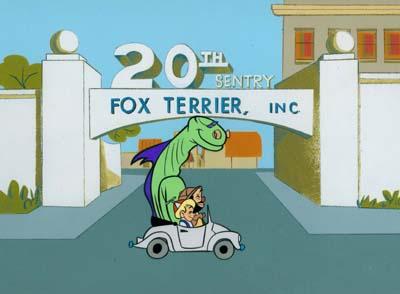 |
| Puns like these were hidden all over Beany and Cecil |
At the end of the film a brontosaurus jumps off of the London Bridge into the Thames River and as he swims away only his neck is visible from out of the water. Clampett immediately saw an interesting character in the action from that final scene.
Clampett came home and set about with his mother’s help to sew a sock puppet of this character. He then performed puppet shows in front of the neighborhood kids delighting them with the antics of his sea serpent character who bested the professor in the pith helmet.
For years after that Clampett frequently entertained with this sock puppet serpent character and in fact kept it nearby in a handy place.
Eventually, in an early example of merchandising and marketing, toy departments all across the country were selling green Cecil the Sea serpent hand puppets.But I’m getting ahead of myself.
However, speaking of merchandising: While still a teenager he came close to being sued by the Disney company when he tried to mass produce a Mickey Mouse doll. Luckily he got to show it to Walt himself, who not only liked it, but helped Bob and his father set up on the studio lot to mass produce the doll.
Having always demonstrated a facility for drawing, Clampett dropped out of high school to go to work as an “inbetweener” for Harmon-Ising, which eventually became Warner Bros. Cartoons. However, he never lost his interest in puppetry. As his website tells it:

In 1935 Clampett attended the California Pacific International Exposition in San Diego.
At this show he saw a demonstration of television for the very first time. He ran to his car and pulled his sea serpent hand puppet out of the glove compartment. Clampett was able to test for the first time what a puppet might look like on live television and recognized the power of this brand new medium.In 1937 while at Warner cartoon studio, Clampett built a puppet studio directly across the street. He worked there primarily on nights and weekends with his friend Al Kendig to develop 3D stop motion puppetry.
[…]
In the early 1940’s Clampett pitched his idea for filmed puppet shorts about a sea serpent and sea captain to Warner Cartoon studio head Leon Schlesinger. However, Schlesinger turned the project down by saying, “A shoemaker sticks to his last.” This was what Clampett later referred to as a critical moment in his career because Clampett was then able to retain the rights to his most important original 3D creation.
You can read more about how Bob Clampett continued to develop his television puppet show and how that eventually led him back to his original vocation of animation HERE. However, I’m as bored as a 5-year old waiting for the cartoons to start. Pass the popcorn.

If you’ve liked anything you’ve read at the Not Now Silly Newsroom, please consider donating to my Go Fund Me campaign to Support Investigative Journalism. My Freedom of Information requests from the City of Miami are beginning to add up, not to mention all the other costs of researching systemic racism and corruption in Coconut Grove.