Tag Archives: John Lennon

Nostalgia Ain’t What It Used To Be ► The Beatles’ Last Concert

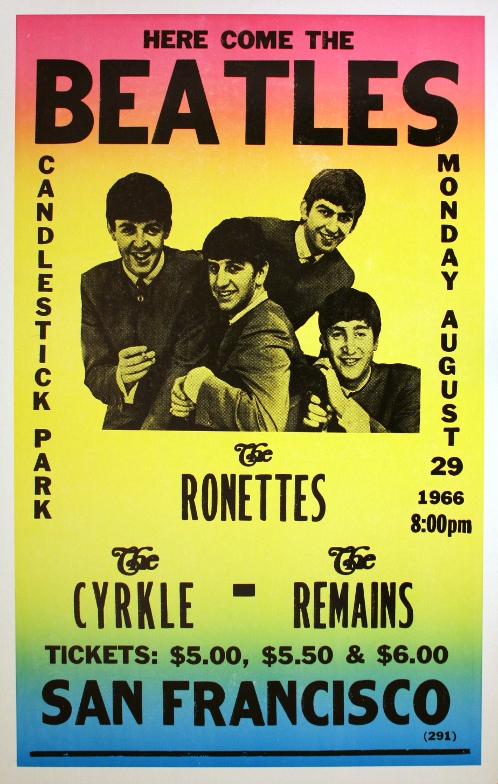
Dateline – August 29, 1966 – Candlestick Park, San Francisco – After an estimated 1,400 live shows and 9 years as a Band on the Run, John, Paul, George and Ringo, collectively known as The Beatles, perform their last concert for paying customers.
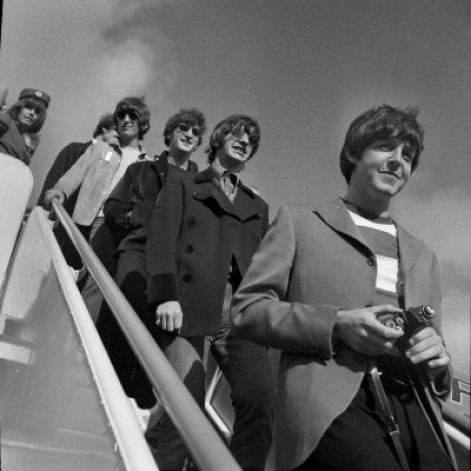
The Beatles arriving in San Francisco for the last concert

It had been a Long and Winding Road. From Hamburg to Liverpool. Then all around England, at first. Then the entire world. It seemed Beatlemania would never end. It got crazier and uglier and more dangerous as time went on. By the time The Beatles reached Candlestick Park in 1966, they knew it would be their last show. Even Paul was ready to throw in the towel and he was the Beatle who always wanted to tour and record.

“On our last tour people kept bringing blind, crippled and deformed children into our dressing room and this boy’s mother would say, ‘Go on, kiss him, maybe you’ll bring back his sight.’ We’re not cruel. We’ve seen enough tragedy in Merseyside, but when a mother shrieks, ‘Just touch him and maybe he’ll walk again,’ we want to run, cry, empty our pockets. We’re going to remain normal if it kills us.”

~~~~~John Lennon

“There was a big talk at Candlestick Park that this had got to end. At
that San Francisco gig it seemed that this could possibly be the last
time, but I never felt 100% certain till we got back to London.

John wanted to give up more than the others. He said that he’d had enough.”

~~~~~Ringo Starr

“Thank you very much everybody. Everybody, wonderful. Frisco, butchered.
We’d like to say that, erm, it’s been wonderful being here, in this
wonderful sea air. Sorry about the weather. And we’d like to ask you to
join in and, er, clap, sing, talk, do anything. Anyway, the song is…
good night.”

~~~~~Paul McCartney, introducing the last song at Candlestick Park

“That’s it, then. I’m not a Beatle anymore.”

~~~~~George Harrison, on the plane after the show
The Beatles taking the stage at Candlestick Park

According to Mitch McGeary’s Beatles website:

  • The Beatles took 65% of the gross, the city of San Francisco took 15% of paid admissions and 50 free tickets. This, along with lukewarm ticket sales and other unexpected expenses resulted in a financial loss for Tempo Productions;
  • The oversize tickets were to [sic] large to fit the counting machines at Candlestick and had to be counted by hand;
  • The performance was taped by Tony Barrow at Paul McCartney’s request and is available in bootleg format. The last song was truncated because the recorder ran out of tape;
  • Just before leaving the stage, John teasingly strummed the opening guitar notes of “In My Life”;
  • Wes Wilson designed the concert poster for the show. Wes later on to become one of the most influential artists of the psychedelic movement and designed many important posters for Bill Graham.

Although Candlestick Park had 42,500 seats, unbelievably the ticket sales were sluggish and just over half were sold. Only 25,000 people were on hand to witness the final official concert by the greatest Rock and Roll band to ever come down the pike.

Knowing it could be their last show The Beatles took some commemorative pictures:

“Before one of the last numbers, we actually set up this camera, I think it had a fisheye, a wide-angle lens. We set it up on the amplifier and Ringo came off the drums, and we stood with our backs to the audience and posed for a photograph, because we knew that was the last show.”

~~~~~George Harrison

The 33 minute show had a slightly altered setlist from the other shows on the tour:

  1. Rock and Roll Music (Chuck Berry cover)
  2. She’s a Woman
  3. If I Needed Someone
  4. Day Tripper
  5. Baby’s in Black
  6. I Feel Fine
  7. Yesterday
  8. I Wanna Be Your Man
  9. Nowhere Man
  10. Paperback Writer
  11. Long Tall Sally (Little Richard cover) (with ‘In My Life’ snippet at the end)

One other thing The Beatles did to commemorate the occasion was to ask press officer Tony Barrow to record the show: According to The Beatles Bible:

“At San Francisco airport, as our plane prepared to take off, Paul’s head came over the top of my seat from the row behind: ‘Did you get anything on tape?’ I passed the cassette recorder back to him: ‘I got the lot, except that the tape ran out in the middle of Long Tall Sally.’ He asked if I had left the machine running between numbers to get all the announcements and the boys’ ad lib remarks. I said: ‘It’s all there from the guitar feedback before the first number.’ Paul was clearly chuffed to have such a unique souvenir of what would prove to be an historic evening – the farewell stage show from the Fab Four.

Back in London I kept the concert cassette under lock and key in a drawer of my office desk, making a single copy for my personal collection and passing the original to Paul for him to keep. Years later my Candlestick Park recording re-appeared in public as a bootleg album. If you hear a bootleg version of the final concert that finishes during Long Tall Sally it must have come either from Paul’s copy or mine, but we never did identify the music thief!”

~~~~~Tony Barrow; “John, Paul, George, Ringo & Me”

Beatles fans (and completists like myself) are lucky there was a music thief. That’s why 46 years later we can still listen to the last concert The Beatles ever performed for a ticketed audience. Sadly the tape ran out part way through the last song. However, we still have this record of The Beatles at the height of their live performances.

From this moment through to Abbey Road, The Beatles were a recording band, save for their one brief appearance on the roof of Apple for the Let It Be film (which has still not been released on DVD. Get on that, Sir Paul.)

***

***

Musical Interlude ► Happy Birthday Harry Nilsson

Dateline June 15, 1941 – A happy father had a son*, Harry Edward Nilsson III.

There was a time I listed my Top Three artists as Frank Sinatra, Frank Zappa, and Harry Nilsson. Who knew that Sinatra would outlive the other two?

I first learned of Harry Nilsson the same way much of ‘Merka did, when The Beatles name-checked him twice during their ’68 press conference to announce the formation of Apple. Wait! What? Who? The Harry Nilsson Web Pages picks up the story: 

The album came to the attention of the Beatles (through Derek Taylor their press agent). At the press conference to announce the formation of Apple, the Beatles were asked “Who is your favorite American artist?” to which John Lennon replied, “Harry Nilsson.” When asked “What is your favorite American group?” Paul McCartney replied, “Harry Nilsson.”

Harry’s arrangement of “You Can’t Do That” weaves some 20-something other Beatles’ songs in and around the Lennon-McCartney melody.It needs to be heard to know why The Beatles were so knocked out by it.

The great irony of Harry Nilsson’s all-too-short artistic career is that while he is an amazing songwriter, the two songs he is best known for were not written by him: “Without You” was written by two of the members of Badfinger and was originally recorded by that group, while “Everybody’s Talkin'” was written by Fred Neil.

That’s why we’ll start with songs Harry wrote. Here’s a rare version of “Coconut” created for one of his his BBC shows. All vocals are Harry re-recorded specifically for this ‘video’ and the instrumentation is minimalist. to say the least:

Many people have covered Nilsson’s “One.” His version followed by the obscure Chris Clark on the even more obscure Motown subsidiary label Weed, because that’s what this LP was apparently fueled by.

Here is a rare tee vee appearance of Harry’s on The Smother’s Brothers Comedy Hour. Harry was a good friend of The Smothers Bothers, which is why he thought he and John Lennon could heckle them at The Troubadour, but we won’t rehash THAT story. “Think About Your Troubles,” the second song here, is personally one of my favourite Harry Nilsson songs. I like the circular story. I like how it sums up this larger dynamic than the listener and then says, “You  think you’re the center of the universe? Well, I got news for you.” The third song is from the upcoming “The Point” cartoon, which is remembered fondly by many big kids.

Another rarity from his BBC tee vee special is this medley of three covers intertwined, Walk Right Walk, Cathy’s Clown, Let The Good Times Roll all recorded with 3-part harmony done by Harry himself.

Here’s the very obscure Miss Butter’s Lament, written by fellow Canadian Bob Segarini.

When Harry Met John resulted in Pussy Cats, an album that marked the nadir of Harry’s career. Yet there are still some true gems on this LP. Harry makes his ravaged voice work for this incredibly emotional cover of Jimmy Cliff’s Many Rivers To Cross.

I could go on and on, but this makes a good starting point for Harry Nilsson if you are just getting to know him.

*1941, by Harry Nilsson

Day In History ► John and Yoko Bed-In in Montreal ► May 26

Dateline: 1969 – John Lennon and Yoko Ono begin their second Bed-In, this time in Montreal, Quebec. They had wanted to do it in New York City, but Lennon was still barred from entering ‘Merka. The Bahamas, which Lennon had visited during the making of “Help,” was considered too far away to bring the press. Finally they settled on Montreal. Here’s how the Canadian Broadcasting Company covered some of it:


However, not everyone was enthralled. Al Capp, the cartoonist best known for L’il Abner — Yeah, THAT AL Capp — was invited to the hotel suite for what turned out to be a very contentious debate:


On June 1st a gathering recorded Lennon’s “Give Peace A Chance” in the same hotel room. Included were with Dick Gregory, Tommy Smothers, Timothy Leary, Toronto Rabbi Abraham Feinberg, musician Petula Clark, and members of the Canadian Radha Krishna Temple. It’s a sing-a-long:

Here are John & Yoko talking to some of those people:

On the 30th Apple Records released “The Ballad of John and Yoko” in the U.K. and 5 days later in ‘Merka, on June 4th. The only Beatles on this recording are John Lennon, and Paul McCartney, who recorded in a hurry one evening while Ringo was filming “The Magic Christian” and George was on holiday. Christ, you know it ain’t easy:

This was The Beatles last #1 U.K. single.

My Days With John Sinclair ► Nostalgia Ain’t What It Used To Be

John Lennon wrote very few songs about REAL people, and when he did he disguised the name of the subject, like “Sexie Sadie,” who was “Maharishi” in the original version.

However, Lennon wrote and recorded a song called “John Sinclair,” about one of Detroit’s a cultural icons. Lennon’s “John Sinclair” was just one protest song on “Some Time in New York City.” a double-record set (filled with political polemic as 3 minute tunes on one LP, and live concert with Frank Zappa and the Mothers of Invention on the other). Lennon was protesting the sentencing of John Sinclair to 10 years of hard time for GIVING an undercover agent two joints. This made the already infamous Sinclair, who only had a regional reputation until then, an international cause célèbre, which is what prompted Lennon to write the song and later appear at a Free John Sinclair concert. However, I knew John Sinclair before he ever became a jailbird.

I first encountered John Sinclair way back in the ’60s. I grew up in Detroit on Gilchrist Street (we called it Gilchrist Avenue because that was classier), one block and three houses south of the infamous 8 Mile (aka M-102) and five houses south of David Palmer, the original drummer for the Amboy Dukes. We were all in our middle teens then, but Dave was a year or two older which made all the difference back then. He wasn’t part of our clique, just a few doors down. His clique was far more exciting to us. We thought he was really cool because he was in a real rock and roll band who played real concerts and made real records. However, for some of us there was a more important reason for admiring David Palmer: When the administration threw him out of Coffey Junior High School because his hair was well-below his collar, he responded with a lawyer who argued that this was how Palmer made his living and he would be affected adversely if he had to cut his hair. Those of us who were still fighting the Hair Wars — and still being kicked out for having long hair — knew that it was only a matter of time before the rule fell, because David Palmer had already blown right through it.  The school was forced to make an accommodation with Dave: He had to wear his hair tucked in his shirt collar the entire day so that it was no longer than his shirt collar.
From then on Dave wore wild paisley shirts, with even wilder ties to hold all the hair in. It was always a bit of a thrill to follow Dave out the door at the end of the school day, see him scoop his hair out of his collar, and watch it cascade down his back. When the Amboy Dukes rehearsed in Dave’s garage, all us neighbourhood kids would hang out at the end of the driveway to listen. They were my first garage band.
I was only 15 and most weekends  and would head to Plum Street—Detroit’s Haight-Ashbury—on weekends, where I’d occasionally get a glimpse of John Sinclair holding forth. He was Detroit’s Top Hippie and I was a weekend wannabe.  On more than one occasion I’d work up the nerve to talk to him. Despite the age difference, and his massive height, he never talked down to me and all these years later I never forgot that kindness. Sinclair seemed to be everywhere: He helped launch the The Fifth Estate (one of ‘Merka’s oldest alternative/underground newspapers) manager of the MC5, and head of the White Panther Party.
Skip ahead many years—through many twists and turns that no one could have predicted at the time. In the new century my nephew became John Sinclair’s merchandising manager. What a thrill it was to learn that.
That’s merely all background to the real story.

It’s Labor Day weekend, 2006 and I’m excited. I am going to the Detroit International Jazz Fest where I am going to see John Sinclair for the first time in about 40 years. More importantly, my nephew is going to officially introduce us, even though we met way back when. John is at the Jazz Fest performing with his band The Blues Messengers.
We get there early because my nephew has lots to do before the show and I’m directed to a little table in the VIP area to wait. I need to describe this VIP section so the story makes more sense. There are 8 stages around the downtown area and each has a VIP section. It’s not backstage; it’s off to one side or another in front of the stages. It’s for audience, but special audience. Like me. The regular audience sits on fold-up chairs or the ground. We get real chairs and small cabaret tables to sit at. How civilized.
I’m killing time and I see John Sinclair arrive and sit at a table a few away from me. When my nephew comes back he says, “So, didja say ‘Hi!’ yet?” I reply, ” No, he’s going to do a show soon and I don’t want to bother him now.” I said that because I saw someone approach him only to be told, “I’m going to do a show soon. Don’t bother me now. I need to concentrate. I’ll gladly talk to you after.”
My nephew doesn’t care about such niceties and drags me over and makes introductions.
John Sinclair says to me, “I’ve heard so much about you I feel like I know you. Your nephew talks about you all the time.”
After I come back to earth I say, “John, I just want to thank you for treating me with respect way back when, instead of the snot-nosed Hippie weekend-wannabe that I was.”
With that my nephew starts cackling, “I hear people come up to you all the time and say pretty much the same thing, John. But this time it’s my uncle.”
It turns out that for all our own reasons, the three of us are all thrilled at the meeting.
Introductions over, I go back to my table. Eventually Sinclair performs. We talk a bit after the set and then head off in separate directions, John to meet up with some musician friends and me to go see a 24-piece Big Band playing all Zappa music with Big Band arrangements. (!)
A few hours later I find myself at the same VIP table alone, rocking out to the Regal Brass Band of New Orleans, which I had seen earlier in the year during Mardi Gras, the first one after Katrina.  I didn’t see anyone sit down next to me, but suddenly I was nudged from someone on the left. It was John Sinclair passing me a joint. I have to say that again: JOHN SINCLAIR PASSING ME A JOINT!!!
And, I do inhale.
As I begin to pas sit back he nods, as if to say, “Now pass it to the guy on the other side of you,” so I nudge that guy and he turns towards me. That’s when Dr. John says to me, in his gravely voice, “No man, I gotta do a show soon,” so I pass it back to John Sinclair.
So now me, John Sinclair and Dr. John are all dancing in our seats to a New Orleans Jazz band. Amazingly, as we talk and smoke, I learn that Sinclair was also at that very same Mardi Gras I attended—on the other side of the street from where I was watching the parade. Exactly on the other side of the street. I’m amazed I didn’t see him.
Eventually Dr. John gets up and leaves because his set’s on soon and the joint goes out. Sinclair rips it open and puts the shreds on the table. Then he starts fishing in his pockets. He pulls out several roaches and starts ripping them apart. He’s determined to get one more joint out of this mess on the table and, believe me, I’m rooting for him.
While I’m watching John do his thing I vaguely become aware that the guy on stage has been talking longer than usual. I focus on what he’s saying:
“…a really dear friend of ours. We’d like to have him stand up and say “Hello.” He’s a Detroit native, but now he’s a citizen of the world, living part time in New Orleans and part time in Amsterdam. Please, a warm hand for Detroit’s own, John Sinclair!”
John is in his own world. He’s on a mission. He doesn’t realize the applause is for him.
I nudge him.
“What?”
“Stand up, John.”
He looks around a minute, sees that everyone is looking at him (at us!!!) and clapping, so he stands up and takes a small bow and then sits back down laughing. “Why did he have to introduce me then? Look at this table.”
“John, there was no other time to introduce you. What are you known for?”

<breathing air> And that, ladies and gentlemen, is my
John Sinclair Story. However, I invite you to tune in to listen to
John Sinclair
at Radio Free
Amsterdam
, one of the oldest regular online podcasts going and just another
one of the cultural touchstones John Sinclair helped create in his long and creative
career. And, if you are in Ireland
later this month, check out the BREATHIN’ AIR
– Irish Tour 2012
With Howard Marks.