All posts by Headly Westerfield

About Headly Westerfield

Calling himself “A liberally progressive, sarcastically cynical, iconoclastic polymath,” Headly Westerfield has been a professional writer all his adult life.

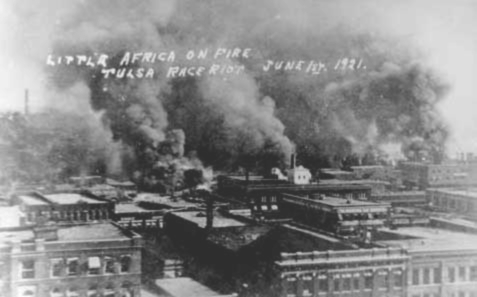
When Whites Went Crazy In Tulsa ► May 31, 1921 ► A Day In History

Otis G. Clark died last week at the ripe old age of 109. Mr. Clark was the last
survivor of the terrible Tulsa Race Riot on May 31, 1921, ninety one years ago
today.

The Tulsa Race Riot of 1921 is considered one of the worst race riots in U.S. history, and yet barely anyone knows about it. This history was whitewashed, pun intended, and for decades it wasn’t taught in any Oklahoma history classes. Many people are unaware that during the riot Whites took up in planes left over from World War One. They dropped bombs on and shot at Blacks on the ground.

Otis Clark was just a young man of 18 when the Whites in Tulsa went crazy 91 years ago. According to his obituary at WashPo:

For years, few people dared to speak about what happened on the night of May 31, 1921, during one of the most deadly and devastating race riots in the nation’s history. Otis G. Clark, who was 18 at the time, had grown up in Greenwood, a thriving African American section of Tulsa.

During a night that history almost forgot, Mr. Clark dodged bullets, raced through alleys to escape armed mobs and saw his family’s home burned to the ground. He fled Tulsa on a freight train headed north.

He would eventually move to Los Angeles, where he was the butler in the home of movie star Joan Crawford. He later turned to preaching and was known as the “world’s oldest evangelist.”

Here’s a news report on Mr. Clark when he was just a young pup of 106:

The Tulsa
riot of 1921 began as so many of these other disturbances did: A White person
took offense at something a Black person is alleged to have done and Whites went crazy.

The Oklahoma
Historical Society
has more:

Believed to be the single worst incident of racial violence
in American history, the bloody 1921 Tulsa
race riot has continued to haunt Oklahomans to the present day. During the
course of eighteen terrible hours on May 31 and June 1, 1921, more than one
thousand homes and businesses were destroyed, while credible estimates of riot
deaths range from fifty to three hundred. By the time the violence ended, the
city had been placed under martial law, thousands of Tulsans were being held
under armed guard, and the state’s second-largest African
American
community had been burned to the ground.

[…]

Tulsa
was also a deeply troubled town. Crime rates were sky high, while the city had
been plagued by vigilantism, including the August 1920 lynching,
by a white mob, of a white teenager accused of murder. Newspaper reports
confirmed that the Tulsa
police had done little to protect the lynching victim, who had been taken from
his jail cell at the county courthouse.

Eight months later an incident involving Dick Rowland, an
African American shoe shiner, and Sarah Page, a white elevator operator, would
set the stage for tragedy. While it is still uncertain as to precisely what
happened in the Drexel
Building on May 30, 1921,
the most common explanation is that Rowland stepped on Page’s foot as he
entered the elevator, causing her to scream.

The next day, however, the Tulsa
Tribune
, the city’s afternoon daily newspaper, reported that Rowland,
who had been picked up by police, had attempted to rape Page. Moreover,
according to eyewitnesses, the Tribune also published a now-lost editorial
about the incident, titled “To Lynch Negro Tonight.” By early evening
there was, once again, lynch talk on the streets of Tulsa.
The riot was on. Read more at:
Watch these spaces for an upcoming post about the several Detroit Riots in an upcoming episode of “Unpacking My Detroit.” Or read Part One and Part Two.

Musical Interlude ► Papa John Creach

Dateline May 28, 1917 – Papa John Creach, violinist, was born on this day and would have turned 95, had he not had the misfortune of dying in 1994. Creach was in Hot Tuna, Jefferson Airplane, and Jefferson Starship, but had been playing clubs since the mid-’30s, much older than the musicians he would eventually play with.
Here’s a Papa John jukebox:
Aunty Em!!! Aunty Em!!!

I’m going to sting you, Bumble Bee.

Some HOT HOT HOT Hot Tuna, from the movie “Fillmore: The Last Days:”

For those so inclined, here’s a Hot Tuna concert from 1968 that lasts an hour and 20 minutes:

Papa John was also in Dinosaurs with Merl Saunders, Peter Albin, and Vince Littleton:

Another tasty rendition of a classic:

And here he is adding to the psychedelia with Jefferson Airplane:

Today’s blog post is dedicated to Vermont Dave, who does odd jobs around here and is a big Hot Tuna fan. Thanks Dave.

Day In History ► John and Yoko Bed-In in Montreal ► May 26

Dateline: 1969 – John Lennon and Yoko Ono begin their second Bed-In, this time in Montreal, Quebec. They had wanted to do it in New York City, but Lennon was still barred from entering ‘Merka. The Bahamas, which Lennon had visited during the making of “Help,” was considered too far away to bring the press. Finally they settled on Montreal. Here’s how the Canadian Broadcasting Company covered some of it:


However, not everyone was enthralled. Al Capp, the cartoonist best known for L’il Abner — Yeah, THAT AL Capp — was invited to the hotel suite for what turned out to be a very contentious debate:


On June 1st a gathering recorded Lennon’s “Give Peace A Chance” in the same hotel room. Included were with Dick Gregory, Tommy Smothers, Timothy Leary, Toronto Rabbi Abraham Feinberg, musician Petula Clark, and members of the Canadian Radha Krishna Temple. It’s a sing-a-long:

Here are John & Yoko talking to some of those people:

On the 30th Apple Records released “The Ballad of John and Yoko” in the U.K. and 5 days later in ‘Merka, on June 4th. The only Beatles on this recording are John Lennon, and Paul McCartney, who recorded in a hurry one evening while Ringo was filming “The Magic Christian” and George was on holiday. Christ, you know it ain’t easy:

This was The Beatles last #1 U.K. single.

Nostalgia Ain’t What It Used To Be ► Mr. Bojangles ► May 25

Dateline May 25, 1878 – Bill “Mr. Bojangles” Robinson was born. It hardly matters that the Jerry Jeff Walker song was written about a White guy in jail in New Orleans. It will always be associated with the renowned star of stage and movies who managed to break thru’ the colour barriers of his time. In the day Black musical performances in movies were filmed in such a way so that they could be cut later when the movie played in the south. Bill Robinson’s dance with Shirley Temple in
The Little Colonel

was the first time audiences saw a Black man dancing with a White girl, with Robinson reprising his famous stair dance.

It hardly seems radical today, but it was groundbreaking in 1935. Yet, he will always be known more for his for his dancing than being the first this or that…which is the way it should be. Here’s his sand dance from “Stormy Weather.”

He just makes it look so easy:

Bill Robinson’s last public appearance was on the Ted Mack Amateur Hour in 1949, just weeks before he died:

As for the song itself? Here’s Jerry Jeff Walker performing it live:

The person who popularized the song, and made it synonymous with Bill Robinson — more than anyone else — was Sammy Davis, Jr., who made it a signature part of act for years.

However, in montage, here’s Sammy describing why emotionally it was such a difficult song for him to perform:

However, this post wouldn’t be complete without Harry Nilsson’s version of Mr. Bojangles. Enjoy:

Last Tonight Show with Johnny Carson ► A Day In History

Dateline May 22, 1992 – Johnny Carson made his final appearance as host of the Tonight Show after nearly 5,000 shows. Here’s how that show opened:


Johnny Carson gave so many comedians their start.  A case in point: Ellen Degeneres:


Carson started in magic and particularly loved magicians. Here is The Great Flydini:


Few people realize that Michael Caine got his start doing stand up for Johnny Carson:


In 1982 Eddie Murphy jokes about the first Black president:


You’d never know who or what you would see on the Carson show:


And that included Tiny Tim:


Johnny Carson’s last television’s appearance was a cameo:

It hardly seems like 20 years since he’s been gone from the air. There has never been another one like him and there never will be.

My Days With John Sinclair ► Nostalgia Ain’t What It Used To Be

John Lennon wrote very few songs about REAL people, and when he did he disguised the name of the subject, like “Sexie Sadie,” who was “Maharishi” in the original version.

However, Lennon wrote and recorded a song called “John Sinclair,” about one of Detroit’s a cultural icons. Lennon’s “John Sinclair” was just one protest song on “Some Time in New York City.” a double-record set (filled with political polemic as 3 minute tunes on one LP, and live concert with Frank Zappa and the Mothers of Invention on the other). Lennon was protesting the sentencing of John Sinclair to 10 years of hard time for GIVING an undercover agent two joints. This made the already infamous Sinclair, who only had a regional reputation until then, an international cause célèbre, which is what prompted Lennon to write the song and later appear at a Free John Sinclair concert. However, I knew John Sinclair before he ever became a jailbird.

I first encountered John Sinclair way back in the ’60s. I grew up in Detroit on Gilchrist Street (we called it Gilchrist Avenue because that was classier), one block and three houses south of the infamous 8 Mile (aka M-102) and five houses south of David Palmer, the original drummer for the Amboy Dukes. We were all in our middle teens then, but Dave was a year or two older which made all the difference back then. He wasn’t part of our clique, just a few doors down. His clique was far more exciting to us. We thought he was really cool because he was in a real rock and roll band who played real concerts and made real records. However, for some of us there was a more important reason for admiring David Palmer: When the administration threw him out of Coffey Junior High School because his hair was well-below his collar, he responded with a lawyer who argued that this was how Palmer made his living and he would be affected adversely if he had to cut his hair. Those of us who were still fighting the Hair Wars — and still being kicked out for having long hair — knew that it was only a matter of time before the rule fell, because David Palmer had already blown right through it.  The school was forced to make an accommodation with Dave: He had to wear his hair tucked in his shirt collar the entire day so that it was no longer than his shirt collar.
From then on Dave wore wild paisley shirts, with even wilder ties to hold all the hair in. It was always a bit of a thrill to follow Dave out the door at the end of the school day, see him scoop his hair out of his collar, and watch it cascade down his back. When the Amboy Dukes rehearsed in Dave’s garage, all us neighbourhood kids would hang out at the end of the driveway to listen. They were my first garage band.
I was only 15 and most weekends  and would head to Plum Street—Detroit’s Haight-Ashbury—on weekends, where I’d occasionally get a glimpse of John Sinclair holding forth. He was Detroit’s Top Hippie and I was a weekend wannabe.  On more than one occasion I’d work up the nerve to talk to him. Despite the age difference, and his massive height, he never talked down to me and all these years later I never forgot that kindness. Sinclair seemed to be everywhere: He helped launch the The Fifth Estate (one of ‘Merka’s oldest alternative/underground newspapers) manager of the MC5, and head of the White Panther Party.
Skip ahead many years—through many twists and turns that no one could have predicted at the time. In the new century my nephew became John Sinclair’s merchandising manager. What a thrill it was to learn that.
That’s merely all background to the real story.

It’s Labor Day weekend, 2006 and I’m excited. I am going to the Detroit International Jazz Fest where I am going to see John Sinclair for the first time in about 40 years. More importantly, my nephew is going to officially introduce us, even though we met way back when. John is at the Jazz Fest performing with his band The Blues Messengers.
We get there early because my nephew has lots to do before the show and I’m directed to a little table in the VIP area to wait. I need to describe this VIP section so the story makes more sense. There are 8 stages around the downtown area and each has a VIP section. It’s not backstage; it’s off to one side or another in front of the stages. It’s for audience, but special audience. Like me. The regular audience sits on fold-up chairs or the ground. We get real chairs and small cabaret tables to sit at. How civilized.
I’m killing time and I see John Sinclair arrive and sit at a table a few away from me. When my nephew comes back he says, “So, didja say ‘Hi!’ yet?” I reply, ” No, he’s going to do a show soon and I don’t want to bother him now.” I said that because I saw someone approach him only to be told, “I’m going to do a show soon. Don’t bother me now. I need to concentrate. I’ll gladly talk to you after.”
My nephew doesn’t care about such niceties and drags me over and makes introductions.
John Sinclair says to me, “I’ve heard so much about you I feel like I know you. Your nephew talks about you all the time.”
After I come back to earth I say, “John, I just want to thank you for treating me with respect way back when, instead of the snot-nosed Hippie weekend-wannabe that I was.”
With that my nephew starts cackling, “I hear people come up to you all the time and say pretty much the same thing, John. But this time it’s my uncle.”
It turns out that for all our own reasons, the three of us are all thrilled at the meeting.
Introductions over, I go back to my table. Eventually Sinclair performs. We talk a bit after the set and then head off in separate directions, John to meet up with some musician friends and me to go see a 24-piece Big Band playing all Zappa music with Big Band arrangements. (!)
A few hours later I find myself at the same VIP table alone, rocking out to the Regal Brass Band of New Orleans, which I had seen earlier in the year during Mardi Gras, the first one after Katrina.  I didn’t see anyone sit down next to me, but suddenly I was nudged from someone on the left. It was John Sinclair passing me a joint. I have to say that again: JOHN SINCLAIR PASSING ME A JOINT!!!
And, I do inhale.
As I begin to pas sit back he nods, as if to say, “Now pass it to the guy on the other side of you,” so I nudge that guy and he turns towards me. That’s when Dr. John says to me, in his gravely voice, “No man, I gotta do a show soon,” so I pass it back to John Sinclair.
So now me, John Sinclair and Dr. John are all dancing in our seats to a New Orleans Jazz band. Amazingly, as we talk and smoke, I learn that Sinclair was also at that very same Mardi Gras I attended—on the other side of the street from where I was watching the parade. Exactly on the other side of the street. I’m amazed I didn’t see him.
Eventually Dr. John gets up and leaves because his set’s on soon and the joint goes out. Sinclair rips it open and puts the shreds on the table. Then he starts fishing in his pockets. He pulls out several roaches and starts ripping them apart. He’s determined to get one more joint out of this mess on the table and, believe me, I’m rooting for him.
While I’m watching John do his thing I vaguely become aware that the guy on stage has been talking longer than usual. I focus on what he’s saying:
“…a really dear friend of ours. We’d like to have him stand up and say “Hello.” He’s a Detroit native, but now he’s a citizen of the world, living part time in New Orleans and part time in Amsterdam. Please, a warm hand for Detroit’s own, John Sinclair!”
John is in his own world. He’s on a mission. He doesn’t realize the applause is for him.
I nudge him.
“What?”
“Stand up, John.”
He looks around a minute, sees that everyone is looking at him (at us!!!) and clapping, so he stands up and takes a small bow and then sits back down laughing. “Why did he have to introduce me then? Look at this table.”
“John, there was no other time to introduce you. What are you known for?”

<breathing air> And that, ladies and gentlemen, is my
John Sinclair Story. However, I invite you to tune in to listen to
John Sinclair
at Radio Free
Amsterdam
, one of the oldest regular online podcasts going and just another
one of the cultural touchstones John Sinclair helped create in his long and creative
career. And, if you are in Ireland
later this month, check out the BREATHIN’ AIR
– Irish Tour 2012
With Howard Marks.

Another Magical Tee Vee Moment ► David Frost Interviews Paul McCartney

Dateline: May 18, 1964 – Paul McCartney is interviewed by David Frost in the full flush of Beatlemania.

It’s so funny they were talking about a possible retirement in 2010. who knew that 5 decades later Paul would still be making music and still making fans scream?

Thanks for all the music, Paul.

Harry Nilsson ► Thursday (Here’s Why I Did Not Go To Work Today) ► A Musical Interlude

“Thursday (Here’s Why I Did Not Go To Work Today)” has always been one of my favourite Harry Nilsson tunes. It comes from Sandman, a latter day effort. Harry’s voice had never been the same after the John Lennon produced Pussycats during Lennon’s “Lost Weekend.” This was no fault of Lennon’s. Nilsson had hurt his vocal cords and rather than tell Lennon he continued afraid to delay working with his hero. It only made it worse. While he never had that angelic voice again, he still wrote some lovely songs and this is one of them.It’s also a song on which his raspy voice gave the song the exact right amount of pathos. What do you think?

I’ve always especially loved the lyrics nearest the end. They’ve always had a Cole Porter feel to them for me, and that’s one of the highest forms of praise there is.

Monday is a blues day
That goes for Tuesday
Wednesday’s just the middle of the week, yeah mm
Friday is just another payday
The weekend’s just another heyday
But Thursday’s surreptitiously unique

That’s why I didn’t go to work today

Thursday’s got its own peculiar way

Of saying “hey”
Sometimes Thursday makes you want to run away

Thursday’s such a crazy, lazy day

Thursday’s such a crazy, lazy day

Thanks, Harry, for giving me a musical excuse to toss Thursday aside from time to time. However, today my clients were forced to cancel so I have the day off anyway.

So, while I have your attention: Here’s another wonderful Harry Nilsson performance, 100% live, from a BBC broadcast on which he did his entire “A Little Touch of Schmilsson In The Night” LP live. It’s sublime. And please note: Harry Nilsson was covering the American songbook long before Rod Stewart, Willie Nelson, or even Linda Ronstadt.

If you liked that, you will love parts two, three, four and five, which are all on the YouTubery.

You’re welcome.

Aunty Em Ericann’s Bun Fight With James Rosen of Fox “News”

Pic: Fair [and Balanced] use

I didn’t start it, but those who know me, or those who have grown to know and love Aunty Em Ericann, know that I won’t walk away from a fight. Johnny Dollar, aka Mark Koldys, is not the only person I’ve had a had a pissing match with on the interwoven nets lately. My Canadian friends won’t know James Rosen, Chief Washington correspondent for FOX “News” Channel. My ‘Merkin friends might know him only too well. Despite watching Fox “News” so you didn’t have to, Rosen hadn’t really registered on my radar until he reached out and introduced himself to me.  But I’m getting ahead of myself.  It all started with a Tweet to John W. Dean. [Those who have known me a long time, and my obsession with President Richard Nixon, know what a thrill it is just to be able to say that.]

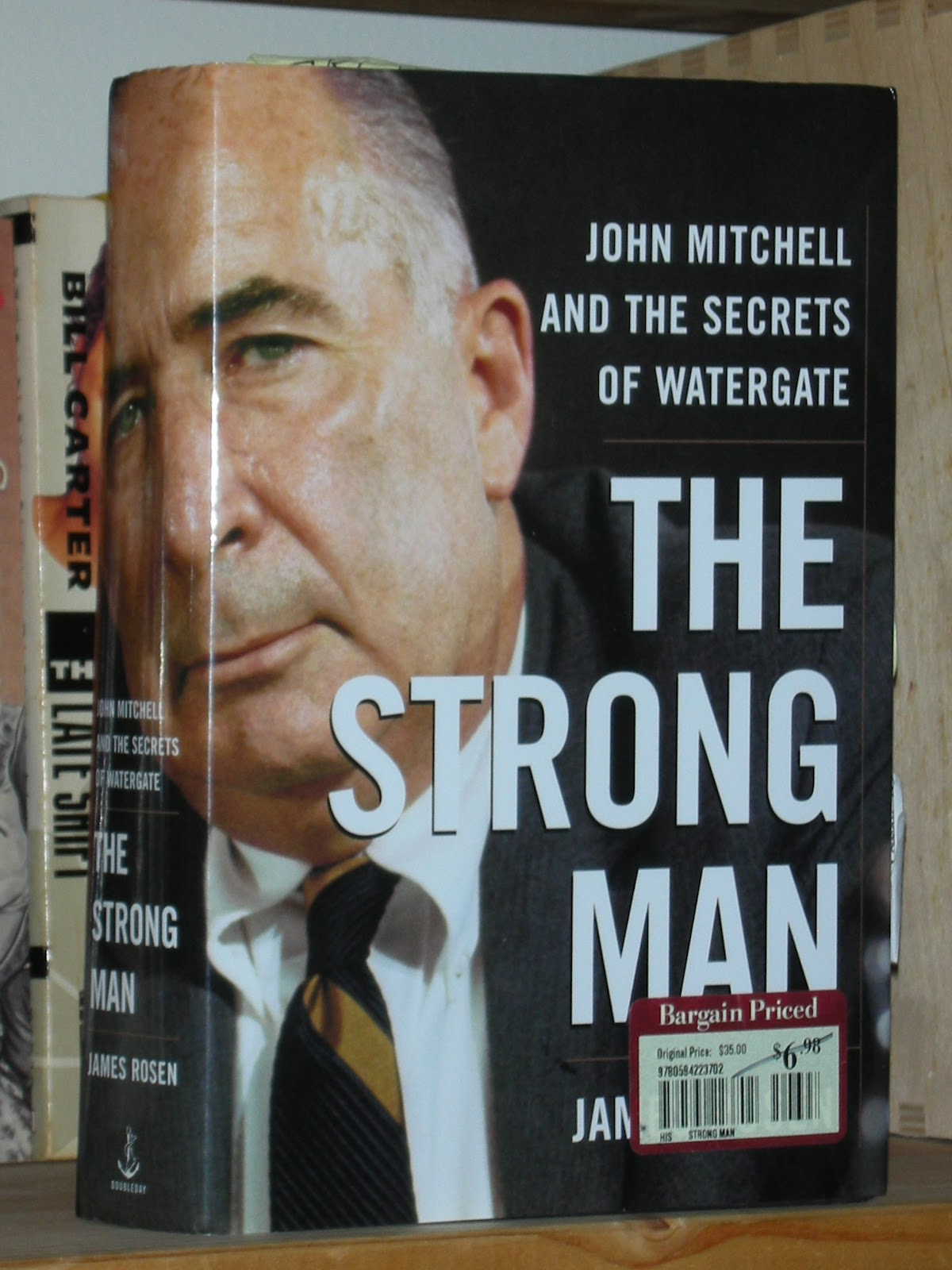
Wait!  What?  A Fox “News” person?  No kidding, Dean?  I happen to write about those.  I was in too much of a hurry to even glance at the name of the author when I bought the book.  I was merely using a bookstore to get from A to B more quickly when I spotted the book on a remainder table. Even with half his face cut off, I clearly recognized John Mitchell, President Richard Nixon’s Attorney General.  Here was a Watergate book I hadn’t seen before, even though I’ve always considered myself something of a Nixonphile.  I was born in Detroit in 1952, the year Nixon was first elected Vice President, and I have always felt a bizarre connection to the man.  By the time I was eight years old, with President Kennedy entering the White House and President Eisenhower leaving, Nixon was already a source of fascination to me.  [I had no hobbies, apparently.]  His winning the presidency in 1968 only added to my interest.  By the time he was reelected in ’72, I was already living in Canada and watched his presidency fall apart from afar.  Hours were spent watching the Watergate hearings instead of going to college classes.  By the time Nixon resigned it was clear to me that he made a Faustian bargain in order to become president.  That’s when I started reading books by and about Richard Nixon and Watergate. 

Some of my Nixon books. There are Nixon books behind the books.

On the day Richard Nixon died I happened to be in a K-Mart in Oak
Park, Michigan when a woman started berating me about Richard Nixon,
seemingly out of the blue.  It took almost 10 seconds to realize I was
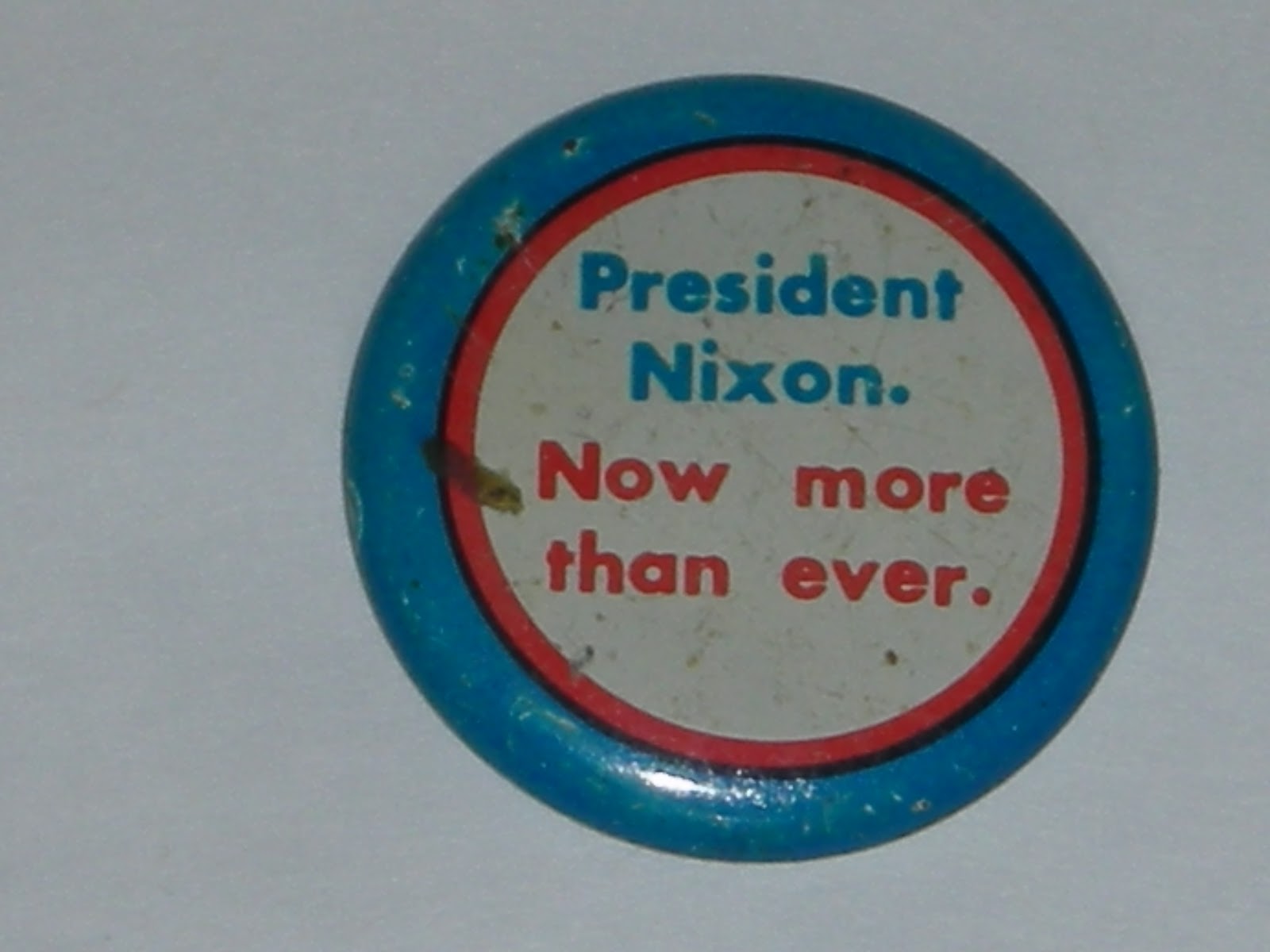
wearing my original 1972 “President Nixon Now More Than Ever” button on
my denim jacket, where it had been for many years.  I’ve never worn it
since.

Here’s the truth: When I saw the John Mitchell book I grabbed it to add to my Nixon collection (pictured above). I stood in line, even though I was already running late.  After I paid for it I stuffed it in my knapsack without a second glance and hot-footed it to my appointment.  Later it occurred to me to tell John W. Dean about my new purchase.

Pic by Westerfield

As soon as Dean warned me off reading it, I ran to my knapsack, pulled out the book, and saw that the remaindered sticker covered the name of James Rosen, “Chief Washington
correspondent for FOX ‘News’ Channel,” as the Fox web site puts it.  It seemed like ironic synchronicity that I
was holding a book written by someone at Fox “News” when my side-vocation was to write about Fox “News” for NewsHounds. I told my BFF John Dean that I would read it anyway,
since I read just about anything Watergate related, even the prison apologia/biography
of Nixon, written by my former-countryman (until he renounced his Canadian
citizenship) Conrad Black, or as I like to call him Lord Black of Black Bottom.

[BTW: “Tit in a ringer” is not sexist; it’s inside Watergate, inside
John Mitchell, inside baseball talk.  If
it needs explanation, it’s not worth it.]

And, that was that…or so I thought.

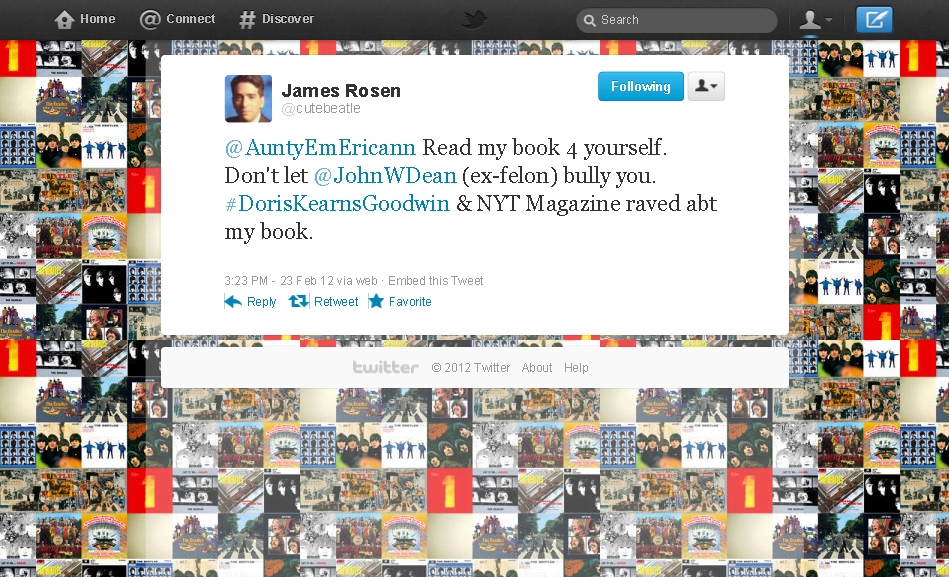
The next day I received the following tweet from the book’s author, who
thinks himself some kind of Beatles expert. 

Oh man, this is GREAT!!! I have John Dean and James Rosen arguing over my head on Twitter. The gang at the coffee shop certainly heard all about THAT the next day. All those days of skipping college classes to watch the Watergate hearings, and reading all those books, is finally paying off. Meanwhile, I’m not intimidated by a cutebeatle or anyone else at Fox “News.” If there’s one thing I know more about than Watergate, it’s The Beatles. So, I changed the subject and challenged Rosen with a Beatles trivia question.

Okay, maybe I made it worse with my next tweet.  And, maybe it was hubris on my part to also add Paul McCartney to my Beatles trivia challenge, but there it is:

And there it is, the gauntlet drawn. James Rosen will only play Beatles trvia with me if I promise to read his book and not be cowed by John Dean. Why do I suspect there is bad blood between Rosen and Dean and why do I feel that reading The Strong Man will provide the answer? But I don’t have time for that because there’s Beatles trivia with which to stump Rosen. Note my clue: You Can’t Do That.

And there we have it. I must have convinced Rosen that I would read his book because he finally deigns to play Beatles trivia with me.

Rosen’s second guess was Sophie Tucker, which if you know Beatles trivia isn’t that crazy an answer. But it was still wrong.  Rosen never attempted a 3rd guess, arguing instead that at the ’64 press conference The Beatles said Brian Wilson was their fave and at the ’66 press conference The Beatles said “Sophie Tucker” was their fave group. I had to remind cutebeatle about the ’68 press conference, when The Beatles were announcing the formation of Apple, they were asked their favourite ‘Merkin singer and they replied, “Harry Nilsson” and then were asked who is their favourite ‘Merkin group and they answered “Harry Nilsson,” which is how I discovered Harry Nilsson for myself.

So…I thought me and Rosen had a good thing going. Days later, a s I began reading his book we were still exchanging tweets back and forth, mostly Harry Nilsson-related at my instigation. Now I would see what the NYT and Doris Goodwin Kearns raved about.

Then several things occurred almost simultaneously:

  • I started asking James Rosen uncomfortable questions about The Strong Man;
  • I was besting him in Beatles trivia;
  • I told him an off-colour joke about President Nixon [It’s a pretty good joke. Rosen tweeted out that they had just released Nixon’s love letters. I told him that Nixon had watched Deep Throat 6 times because he wanted to get it down Pat. Buh Duh Boom!];
  • Wrote about him for NewsHounds, when he pulled the 21st Century Equivalent of the age old Fox “News” tactic of “Some people say” by reading anti-Obama tweets on the air. What was I to do? I couldn’t cut Rosen any slack just because he was now my Twitterific buddy.
Soon afterwards I learned that James Rosen, Chief Washington
correspondent for FOX “News” Channel, had a very thin skin because he blocked me on Twitter. However, for a while I didn’t know why. It could have been “All of the above” for all I knew. [He eventually cleared it up. It was “D.”]

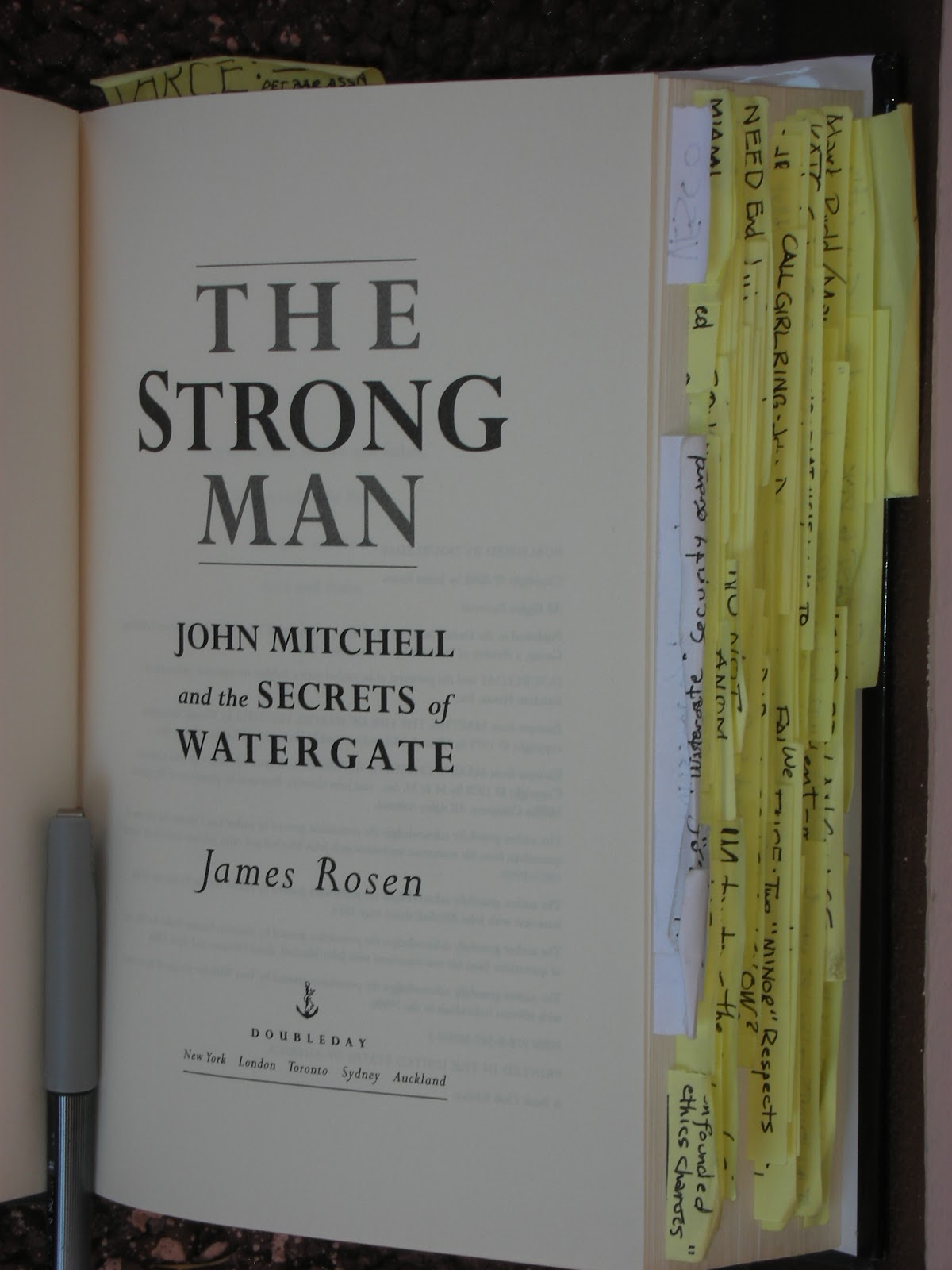
Meanwhile I was reading Rosen’s book on John Mitchell just like I promised. Because so many things jumped out at me while I was reading it, I marked each one with a yellow Post It note. This is what the book looks like now that I have finished. Every one of those yellow slips is a question I have for cutebeatle.

However, more to the point, I believe I have unmasked Rosen’s secret source. Bob Woodward and Carl Bernstein had their Deep Throat, the secret source that was later revealed to be Mark Felt, 2nd in command at the F.B.I., who kept them on the right track. Rosen appears to have his own Deep Throat, a secret source to whom he guaranteed anonymity. It comes early in The Strong Man, on page 61: “A source close to the [Anna Chennault] affair–who demanded anonymity–strongly challenged the veracity of the prime witness.” This is backed up by endnote 66, which reads: “E-mails from [a confidential source] to the author, January 21, 2003, 6:16 p.m.; and Wednesday January 22, 2003, 3:25 p.m.”

Here’s where we get into the weeds on Nixon. Rather than do that here, I am going to write a full review of The Strong Man by James Rosen, but I wanted to provide the background to why I would even bother to review a 4-year old book. Not only do I think Rosen made an overt challenge that requires a response in the form of a review, but now there are two other factors driving me: 

  1. It’s a book that deserved greater attention and condemnation when it was released. It’s full of contradictions, loaded language, softening of misdeads, and attempts to place the blame for Watergate on lower-downs; 
  2. I can break some news. I can not only expose Rosen’s confidential source, but can also explain who still has a reason to cover up Nixon’s misdeeds and why all these years later this confidential source still doesn’t want the public to know what happened way back then.

However, I miss playing Beatles trivia with cutebeatle.

Further reading on Not Now Silly:

Did Roger Ailes Dupe James Rosen, Or Did Rosen Dupe ‘Merka?

National Velvet ► Nostalgia Ain’t What It Used To Be

During my long career as a professional writer, there have been times that I was on staff and on a publication’s masthead and other times that I freelanced. As a freelancer, I would take just about any job that involved jamming words together. Once I wrote an entire work of fiction for a corporate brochure that made Scarborough, Ontario, Canada sound like a great place to live and work. It was fiction because I didn’t really feel that Scarborough was a great place to live and work. Despite my dislike for Scarberia, as it is derisively called, the brochure won an award by the City of Scarborough, which couldn’t read through to the sarcasm.  Another of my freelance jobs was writing for record companies. Occasionally these were the dry sales sheets, 200 words tops, which the salesmen would use to get the rack-jobbers to stock the LP. These were boring and tedious to write, but I could bang off up to 10 a day. However, my favourite writing for record companies was when I was hired to write artist biographies. These always involved meeting and interviewing the artists and I liked to spend as much time as possible with the artist/band before I ever sat down to write. And that’s how I came to meet National Velvet, when I was hired to write their biography.

 
Aside from the actual music, artist bios are one of the most important calling cards a band and/or record company has.
Before the first note of music is even heard, the artist biography is
often fully digested. Artist bios are a tricky business. Every word must
be right. The bio needs to capture the essence of the band or artists. It needs to make the reader WANT to play the record. It needs to tell you everything you need to know about the band, yet retain some mystery that can only be solved by listening to the music. There is no formula for writing an artists’ bio. Every one is different because every artist is different.

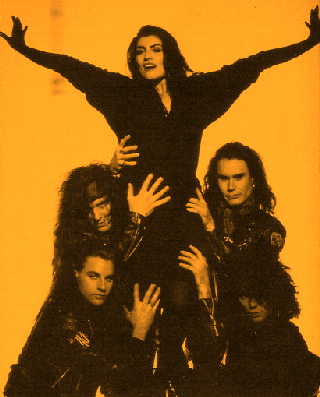
National Velvet were more different than most. NV was a Canadian Goth band before Goth was named Goth. Intrepid Records, distributed by Capital Records Canada, was preparing the release of their first National Velvet LP and hired me to write the bio. I spent about a week with the band, on and off. I went to a few rehearsals, met them in a coffee shop or two, and then someone’s living room. I took notes on how they interacted while recording all their words for posterity. When I felt I had enough, I went back to my belfry to write. One of the things I was struck with after re-reading all the notes I had taken (and which I still have and just used to refreshed my memory) is how thoughtful the band was about their place in the city, the music industry, the record business. I decided that the band’s thoughtful considerations deserved a thoughtful consideration in the biography, which I would blend with the dark, back alleys of the city. Sort of The Dark Knight meets The Hudsucker Proxy.

When I finally had a 1st draft I was happy with I showed it to the record company, the client.  That’s how it worked. Once I had something I liked, I would show it to the client who would tell me whether they liked the path I was on. If so, we’d kick the first draft around 5 or 10 or 15 times, until everyone was happy with the final product. If, in the alternative, the client hated it I would be back at square one, using their ideas to form an entirely new first draft.

In this case Intrepid Records didn’t much like the bio. While it managed to capture the band and the dark underbelly of the city, it came across as far too portentous, far too weighty.  They said, “We like everything about it, except it’s far too serious. What if we made it a cartoon instead?”

It must be noted that the band was not my client. I only had to make the
record company happy. If the band liked the biography the record company
chose to represent them with, that it was a happy bonus.

I wasn’t sure how this raw-edged Goth band would like being turned into a cartoon, but that was hardly my problem. The record company was paying the shots and I won’t get paid until they approve a final draft. So I go back to my belfry with a new task: Create a band biography that is dark without being serious because it needs to come off as a cartoon while, at the same time, capture the essence of these individuals.  Amazingly, that’s just what I did. I used contact sheets of the band’s photo session to create a comic book featuring the band collectively and individually. The words inside the word balloons were their own words. The words of the comic book narrator (me) conveyed the dark throb of the city surrounding the band, while the off-camera record company exec kept putting his 2 cents in for the commercial considerations. Yeah, I know; it was weird as hell. When I went back with that new 1st draft I was fully prepared for them to reject it and throw me out of the office forever.

However, that’s not what happened. It was one of the few times in my career that a first draft of something was also the last draft. Everyone loved it except me. It’s not that I didn’t like the words I wrote, or the concept. It had always been the execution that bothered me. It was supposed to mimic a comic book, but I felt there was only a passing resemblance to a comic book. A typed narration at the bottom, with intentional strike-outs over intentional typos was not part of my concept.

No matter. I got paid.

Skip ahead some 25 years. . . .

Skip ahead some 25 years and my son, who was so much of a National Velvet fan when he was a teen that he bought the LP, tells me he’s going to be seeing National Velvet in Ottawa and will be taking one of the biographies I gave him a million years ago with him.

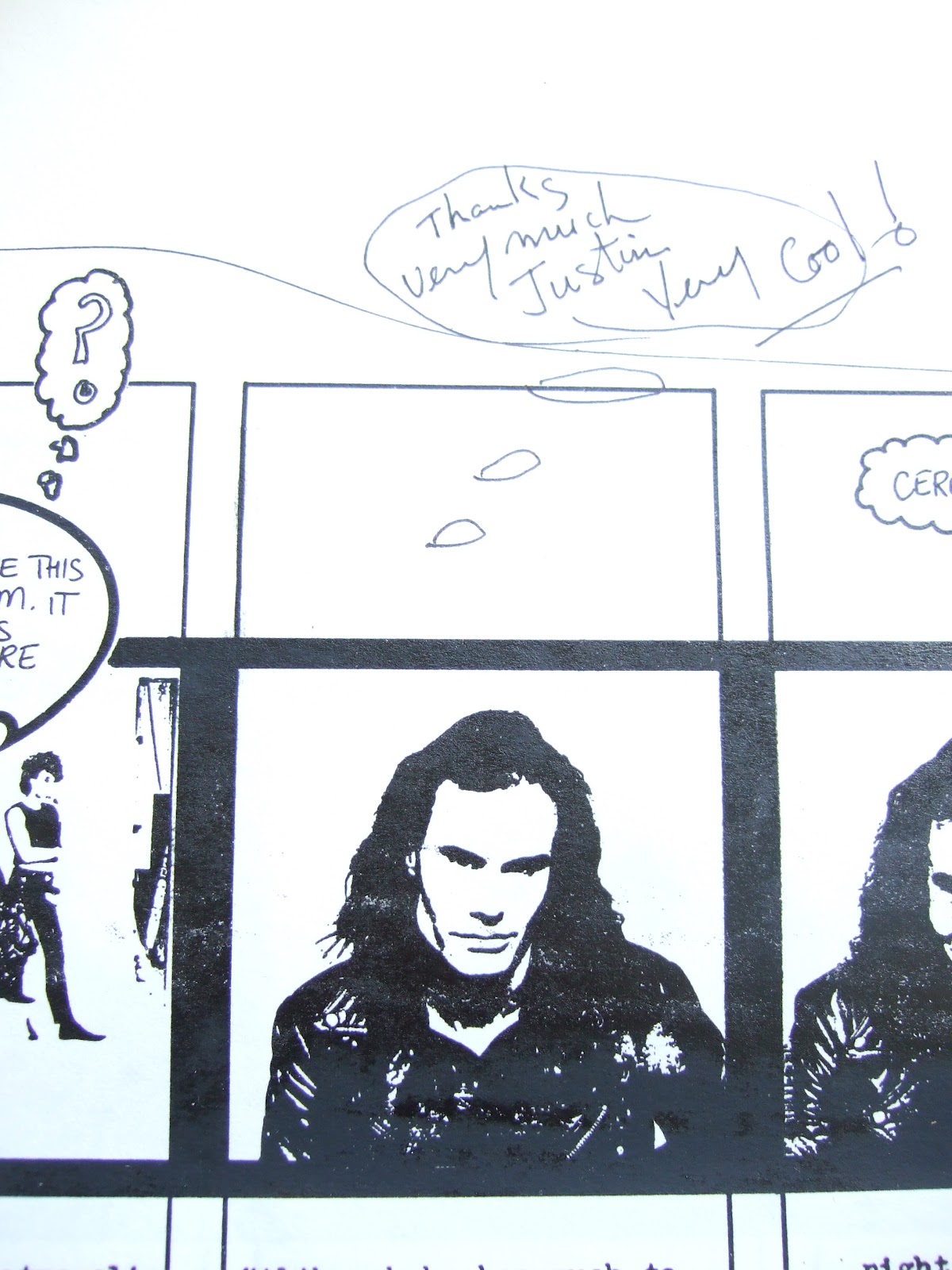
He returned with a happy surprise: The band not only autographed the bio, but part of the inscription was praise for the concept that I felt never worked properly.

THANKS MARIA!!!

Click to enlarge.

Click to enlarge.

Click to enlarge.

And thanks, Justin!!!

Here’s National Velvet’s big hit!!! Flesh Under Skin!!!