Category Archives: Musical Appreciation

Jazz At Carnegie Hall ► Monday Musical Appreciation

Benny Goodman Carnagie Hall Jazz ConcertOn this day in 1938: Jazz officially entered the mainstream. That’s when The Benny Goodman Orchestra played for the swells at Carnegie Hall, one of the most prestigious venues in the entire country.

Goodman was a relatively young man at 29 when the famed Carnegie Hall concert took place. However, he was already a music veteran. At 11 he was playing clarinet in Chacago pit bands and when he was 14 Goodman quit school and joined the American Federation of Musicians for a lifetime in music. Just a few years later he was hired to play his licorice stick for Ben Pollack, moving to Los Angeles for the next four years. He left Pollack’s band to move across the country to New York, then considered the hub of entertainment with radio shows and recording studios.

Benny GoodmanHis official biography picks up the story:

Then, in 1933, Benny began to work with John Hammond, a jazz promoter who would later help to launch the recording careers of Billie Holiday and Count Basie, among many others. Hammond wanted Benny to record with drummer Gene Krupa and trombonist Jack Teagarden, and the result of this recording session was the onset of Benny’s national popularity. Later, in 1942, Benny would marry Alice Hammond Duckworth, John Hammond’s sister, and have two daughters: Rachel, who became a concert pianist, and Benji, who became a cellist.

Benny led his first band in 1934 and began a few-month stint at Billy Rose’s Music Hall, playing Fletcher Henderson’s arrangements along with band members Bunny Berigan, Gene Krupa and Jess Stacy. The music they played had its roots in the Southern jazz forms of ragtime and Dixieland, while its structure adhered more to arranged music than its more improvisational jazz counterparts. This gave it an accessibility that appealed to American audiences on a wide scale. America began to hear Benny ‘s band when he secured a weekly engagement for his band on NBC’s radio show “Let’s Dance,” which was taped with a live studio audience.


One of the most famous Benny Goodman numbers,
with a great arrangement by Fletcher Henderson

The Jazz Age, the name given to the era in which Swing became popular, was another of the generation gaps that seems to always pit the young versus the old over the issue of music. Adults were still shaking off the Victorian Era, while Jazz was shaking society from the foundation to the rafters.

Benny Goodman - Palomar BallroomJazz was considered a just a teenage fad until one fateful day

The new swing music had the kids dancing when, on August 21, 1935, Benny’s band played the Palomar Ballroom in Los Angeles. The gig was sensational and marked the beginning of the years that Benny would reign as King: the Swing Era.

Teenagers and college students invented new dance steps to accompany the new music sensation. Benny’s band, along with many others, became hugely successful among listeners from many different backgrounds all over the country.

During this period Benny also became famous for being colorblind when it came to racial segregation and prejudice. Pianist Teddy Wilson, an African-American, first appeared in the Benny Goodman Trio at the Congress Hotel in 1935. Benny added Lionel Hampton, who would later form his own band, to his Benny Goodman Quartet the next year. While these groups were not the first bands to feature both white and black musicians, Benny’s national popularity helped to make racially mixed groups more accepted in the mainstream. Benny once said, “If a guy’s got it, let him give it. I’m selling music, not prejudice.”

By the time Benny Goodman played Carnegie Hall, he’d already been crowned The King of Swing by TIME Magazine.  There’s a lot more to Goodman’s story (and many good online sources). However, let’s just listen to the music from the day Jazz went mainstream at Carnegie Hall:


[APOLOGY: Sound quality varies]

Roy Head ► Monday Musical Appreciation

Monday Musical Appreciation - Roy HeadRoy Head — yes, that’s his real name — will always and forever be known as an entry on the list of One Hit Wonders, but what a musical hit!!!

“Treat Her Right” raced up the charts in the fall of 1965 due to its pulsating beat, driving horn riff, and a tune matched perfectly to a singing voice. However, Roy Head appears to be one of the worst lip-syncers in all of musical history and a terrible gymnast besides:

Despite the lack of subsequent hits, the Roy Head Wiki page is longer than some musicians’ pages that have far more chart toppers. It clocks on at 2195 words, not including Discography and reference links. However, it’s well worth reading to see how Head continued to reinvent himself and to adapt and change in order to continue his 60-year career in Show Biz. Here’s a highlight:

Monday Musical Appreciation - Roy Head

Head achieved fame as a member of a musical group out from San Marcos, Texas known as The Traits. The group’s sponsor landed their first recording contract in 1958 with TNT Music in San Antonio while they were still in high school. The Traits performed and recorded in the rockabilly, rock and roll and rhythm and blues musical styles from the late 1950s to the mid-1960s. Though landing several regional hits between 1959 and 1963 on both the TNT and Renner Record labels, Head is best known for the 1965 blue-eyed soul international hit, “Treat Her Right” released by Roy Head and the Traits. After going solo, Head landed several hits on the Country and Western charts between 1975 and 1985. During his career of some 50 years, he has performed in several different musical genres and used a somewhat confusing array of record labels, some too small to provide for national marketing and distribution. Roy Head and the Traits held reunions in 2001 and 2007 and were inducted into the Rockabilly Hall of Fame in 2007. One of the most gifted performers of his era, Head’s extraordinary dancing and acrobatic showmanship are legendary, often compared to the likes of Elvis Presley or James Brown.

CanCon Corner: Here’s Roy Head singing on the stage, and writhing on the floor, backed up by The Danny Marks Band at the Cadillac Lounge in Toronto 6 years ago.

 ROCK and ROLL is here to stay!!!

The Weavers ► Monday Musical Appreciation

Before and after

On this day in 1962 The WeaversRonnie Gilbert, Lee Hays, Fred Hellerman, and Pete Seeger — took a stand that almost ruined their careers.

You may not have heard of them, but there’s no denying their influence in ‘Merkin popular music. The Weavers were one of the most important groups of the ’50s and ’60s, despite being a mere Folk group that only lasted a few years. They subsequently influenced every folk who ever folked a Folk song.

According to This Day In History:

The importance of the Weavers to the folk revival of the late 1950s cannot be overstated. Without the group that Pete Seeger founded with Lee Hays in Greenwich Village in 1948, there would likely be no Bob Dylan, not to mention no Kingston Trio or Peter, Paul and Mary. The Weavers helped spark a tremendous resurgence in interest in American folk traditions and folk songs when they burst onto the popular scene with “Goodnight Irene,” a #1 record for 13 weeks in the summer and fall of 1950. The Weavers sold millions of copies of innocent, beautiful and utterly apolitical records like “Midnight Special” and “On Top of Old Smoky” that year.

The Weavers had grown out of an earlier Folk group, The Almanac Singers, which had been founded by Millard Lampell, Lee Hays, Pete Seeger, and Woody Guthrie in the early ’40s. The Almanac Singers were an overtly political group, as the WikiWackyWoo tells us:

As their name indicated, they specialized in topical songs, mostly songs advocating an anti-war, anti-racism and pro-union philosophy. They were part of the Popular Front, an alliance of liberals and leftists, including the Communist Party USA (whose slogan, under their leader Earl Browder, was “Communism is twentieth century Americanism”), who had vowed to put aside their differences in order to fight fascism and promote racial and religious inclusiveness and workers’ rights. The Almanac Singers felt strongly that songs could help achieve these goals.

However, the Red Scare and Entertainment Blacklists of the era put an end to their dream of influencing ‘Merka through song:

In 1942, Army intelligence and the FBI determined that the Almanacs and their former anti-draft message were still a seditious threat to recruitment and the morale of the war effort among blacks and youth.[17] and they were hounded by hostile reviews, exposure of their Communist ties and negative coverage in the New York press, like the headline “Commie Singers try to Infiltrate Radio”,[18] They disbanded in late 1942 or early 1943.

In 1945, after the end of the war, Millard Lampell went on to become a successful screenwriter, writing under a pseudonym while blacklisted. The other founding Almanac members Pete Seeger and Lee Hays became President and Executive Secretary, respectively, of People’s Songs, an organization with the goal of providing protest music to union activists, repeal of the Taft-Hartley Act, and electing Henry A. Wallace on the third, Progressive Party, ticket. People’s Songs disbanded in 1948, after the defeat of Wallace. Seeger and Hays, joined by two of Hays’ young friends, Ronnie Gilbert and Fred Hellerman, then began singing together again at fund-raising folk dances, with a repertoire geared to international folk music. The new singing group, appearing for a while in 1949 under the rubric, “The Nameless Quartet”, changed their name to The Weavers and went on to achieve great renown.[19]

However, the country would not let The Weavers free to be. Wiki has that, too.

During the Red Scare, however, Pete Seeger and Lee Hays were identified as Communist Party members by FBI informant Harvey Matusow (who later recanted) and ended up being called up to testify to the House Committee on Un-American Activities in 1955. Hays took the Fifth Amendment. Seeger refused to answer, however, claiming First Amendment grounds, the first to do so after the conviction of the Hollywood Ten in 1950. Seeger was found guilty of contempt and placed under restrictions by the court pending appeal, but in 1961 his conviction was overturned on technical grounds.[4] Because Seeger was among those listed in the entertainment industry blacklist publication, Red Channels, all of the Weavers were placed under FBI surveillance and not allowed to perform on television or radio during the McCarthy era. Decca Records terminated their recording contract and deleted their records from its catalog in 1953.[5] Their recordings were denied airplay, which curtailed their income from royalties. Right-wing and anti-Communist groups protested at their performances and harassed promoters. As a result, the group’s economic viability diminished rapidly and in 1952 it disbanded. After this, Pete Seeger continued his solo career, although as with all of them, he continued to suffer from the effects of blacklisting.

In December 1955, the group reunited to play a sold-out concert at Carnegie Hall. The concert was a huge success. A recording of the concert was issued by the independent Vanguard Records, and this led to their signing by that record label. By the late 1950s, folk music was surging in popularity and McCarthyism was fading. Yet the media industry of the time was so timid and conventional that it wasn’t until the height of the revolutionary ’60s that Seeger was able to end his blacklisting by appearing on a nationally distributed U.S. television show, The Smothers Brothers Comedy Hour, in 1968.[6]

By 1962, The Weavers had already broken up and reformed. On January 2nd, they were booked to play The Jack Parr Show, the precursor to the Tonight Show with Johnny Carson. However, their appearance was cancelled by after they refused to sign a loyalty oath.

Here is a wonderful documentary on the life and times of The Weavers followed by a personal favourite:

Before Emperor Trump reestablishes Loyalty Oaths, let’s take a moment to remember The Weavers, who refused to kowtow to government interference, just like the Constitution teaches.

Putting His Money Where His Mouth Is ► Monday Musical Appreciation

Let me be the last to wish you a Happy Holiday this year.

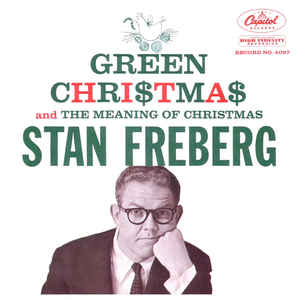
It’s only appropriate that on St. Stephen’s Day, honouring The First Martyr™, the Not Now Silly Newsoom finds a new way to commemorate Stan Freberg, this time for a selfless act of philanthropy performed on this day in musical history.

Funded by the royalties on his recording of “Green Chri$tma$”, a thumb-in-the-eye at the over-commercialization of Christmas, Freberg gave $1,000 to the Hemophilia Foundation on this day. However, there’s more to the story, of course.

More proof that the more things change, the more they stay the same: Christmas is still over-commercialized and saying anything negative against the holiday brings about a Phony War on Christmas.

According to Top 5 Christmas Novelty Recordings:

“Green Christmas” is a brilliant satire of the advertising profession and the commercialization of Christmas by the same. Borrowing from Dickens, Scooge is the COB of a large advertising firm, who is confronted by Bob Cratchit, the owner of a small spice company who is resisting the push to use Christmas as an advertising bonanza. Many of the most prominent products being hawked in a Holiday vein at that time (Coca-Cola, Chesterfield cigarettes, etc…) were slyly parodied, and subsequently many advertisers of the day refused to have their commercials air anytime the record was played and as a result the record received no commercial airplay. Nevertheless, the record sold, and there was a newspaper report on December 27, 1958, that the day after Christmas of 1958, Stan Freberg presented a check for $1,000 to the Hemophilia Foundation of Southern California as his royalties from the first year’s release of “Green Chri$tma$.” He gave all royalties from the song to charities to quell any criticism that he was profiting hypocritically from the subject of his satire.

Listen to this way-ahead-of-its-time tune:

In an unofficial vote of NNS staffers, Freberg wins as the greatest song parodist hands down. Not to take anything away from Weird Al, but Freberg took his droll humour from records to entire advertising campaigns. However, the negative publicity in the wake of Green Chri$tma$ almost sunk him. Here’s what the WikiWackyWoo has to say about that:

Release

At first, Capitol Records refused to release the record. Lloyd Dunn, the president of Capitol, told Freberg the record was offensive to everybody in advertising, and predicted that Freberg would never work in advertising again. Freberg responded with his intent to end his entire recording contract with Capitol. He spoke to a contact at Verve Records, and the company offered to release the record without even hearing it. Faced with this, Capitol finally decided to release it but provided no publicity at all.

Initial reception

The record was attacked in advertising trade magazines. It was played only twice in New York by one disc jockey, and the station’s sales department threatened to have him fired if he played it again. KMPC in Los Angeles played the record, but some advertisers required that their ads be scheduled more than fifteen minutes away from it. An editorial in the Los Angeles Times condemned it, but the author later admitted he had not listened to it. Similarly, Robert Wood, the station manager of KCBS-TV in Los Angeles (later president of CBS), cancelled a TV interview with Freberg because the record was “sacrilegious” and he did not need to hear it because he had read about it.[2] KRLA, Pasadena (Freberg’s hometown) showed it as reaching #3 in popularity in their printed survey. It is unclear whether this was based on sales or airplay.

Station KFWB, then known as “Color Radio Channel 98” also kept on playing the record. KFI, then the Earl C. Anthony station, played it a few times and then discontinued as did many other stations because of reaction from the advertising community.

However, the mail Freberg received from the public, including Christian clergy and rabbis, was overwhelmingly positive.

Aftermath

Within six months, Coca-Cola and Marlboro, both recognizably satirized in the record without being named, asked Freberg for advertising campaigns. He turned down Marlboro, but he created a campaign for Coca-Cola that was very effective. And contrary to the predictions of Lloyd Dunn (see above) and others, Freberg’s advertising campaigns continued to be in demand and successful for decades.

Some years later, Time magazine was going to publish an essay in their Christmas issue about the overcommercialization of Christmas, including considerable attention to Green Chri$tma$. The essay was killed at the last minute due to pressure from their sales department.

That wasn’t the only time Freberg took a crack at Christmas, nor at Jack Webb for that matter, who he also parodied in St. George and the Dragonet, and Little Blue Riding Hood, and Christmas Dragnet, all from 1953:

Sadly Stan Freberg died almost 3 years ago, in April of 2015. Read his NYT obit, Stan Freberg, Madcap Adman and Satirist, Dies at 88, for a deeper dive into this hilarious satirist’s life.

FURTHER READING at Not Now Silly:
Stan Freberg ► Nostalgia Ain’t What It Used To Be

Day In History ► Manhattan Island Sold

Frank Sinatra ► Monday Musical Appreciation

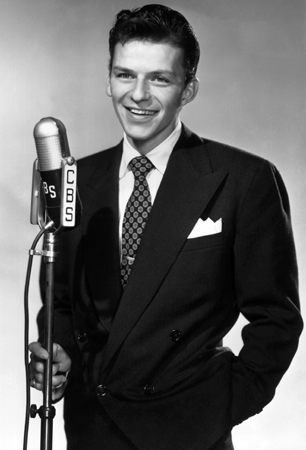
Had Frank Sinatra not died in 1998, he’d be celebrating his 101st birthday today.

When I was growing up in Detroit there weren’t a lot of LPs in the house. However, Pops had a friend who worked for Capitol Records, who gave him promo copies stamped with small holes that spelled out FREE in the upper left-hand corner. These included several classic Sinatra albums from what most people agree was his best period. The fact that he was also on The Beatles’ label didn’t hurt, either.

[By this point Sinatra was already on Reprise Records, a company he formed. This is when he got the nickname Chairman of the Board. But, I didn’t know any of that at the time. Nor would I have cared.]

I started listening to these records when I was about 11 or 12 and they spoke to me immediately. I didn’t have the contextual language to know why, but I was a fan at the first needle drop. I would listen to these albums for hours on end, marveling at every nuance. I didn’t know that in some places he was rushing the lyric and in others he allowed himself to fall behind. However, what I recognized — even at that young age — is that Sinatra had a way of imbuing a lyric with feeling in such a way that made it seem he was talking to me alone.

You may be cool but you will never be as cool as
Sinatra leaving a helicopter with a drink in his hand

I remember how, during the psychedelic era, I’d play some Sinatra to my band mates in Cobwebs and Strange, hoping to get them to agree to cover a Sinatra tune, or three. They couldn’t contain their laughter. It was an idea before its time. Soon it would become kitschy to break out a Sinatra tune in your set.

Of course over the years I learned more about Sinatra’s career and how he was the first teen idol. Girls — called bobbysoxers in the day — would scream and swoon over Frankie. That’s what eventually led Sinatra to go solo.

There’s some great family lore that Pops used to tell about when Sinatra broke away from the Tommy Dorsey band:

A distant cousin was part of Dorsey’s band and played with Sinatra when he was coming up.Then Sinatra went solo and was doing BOFFO business at the Paramount in NYC. The boys decided to head over from Jersey to see Frank. They showed up at the stage door and asked to see their old pal and were told that Mr. Sinatra couldn’t see him. From that day to the day he died my relative would spit when he heard Sinatra’s name or music.

Sinatra went on to win Oscars and take over Humphrey Bogart’s Rat Pack. However, it was the music that made Frank Sinatra special. That’s why some people called him simply, “The Voice.”

John Lennon’s Last Concert Appearance

Read the official report at
Elton John’s official website:


40 Years Ago Today…Elton
and John Lennon In Concert

Part 1
Part 2

On this day in 1974 John Ono Lennon made his very last concert appearance, on stage at Madison Square Garden.

This was not a Lennon concert. It was an Elton John show and Lennon was a surprise guest. He was there to fulfill a bet he and Elton made after recording “Whatever Gets You Through the Night.” According to Ultimate Classic Rock:

It began with the bet. Elton John sang and played piano on both “Surprise Surprise (Sweet Bird of Paradox)” and “Whatever Gets You Thru the Night” for Lennon’s 1974 album Walls and Bridges. To that point, Lennon had been the only former Beatle who’d never achieved a solo No. 1 single — a streak Elton suggested would be snapped by “Whatever.” So confident was Elton, in fact, that he suggested a little wager.

“He sang harmony on it and he really did a damn good job,” Lennon told David Sheff in 1980. “So, I sort of halfheartedly promised that if ‘Whatever Gets You Thru the Night’ became No. 1, which I had no reason to expect, I’d do Madison Square Garden with him. So one day Elton called and said, ‘Remember when you promised…’”

Despite Lennon’s pessimism, “Whatever Gets You Through the Night” blew past Bachman-Turner Overdrive’s “You Ain’t Seen Nothing Yet” to reach the toppermost of the poppermost, to steal a phrase. Lennon had little choice in the matter. unless he wanted to be known as a welsher

There is almost no footage of the event:

However, the concert was recorded, which is why a fan could assemble this recreated video of the performance.

Lennon would subsequently reconcile with Yoko Ono, following what’s been termed his Lost Weekend, although it lasted far longer than a weekend: 18 months, in fact. After he and Yoko reunited is when he began his househusband phase, a 5-year period in which he stayed away from the recording studio. Then he and Yoko recorded and released “Double Fantasy.” Just as it was rising in the charts — as no one needs reminding — he was murdered returning home from the studio on the evening of December 8, 1980.


This date is also known for several other Beatles-related stories. According to The Music History Calendar on this date in:

1966: The Beatles [recorded] Strawberry Fields Forever

1967: The Beatles [recorded] The Beatles’ Fifth Christmas Record

1968: John Lennon and Yoko Ono appear at the Marylebone Magistrates’ Court, London, to answer charges of cannabis resin posession. Lennon pleads guilty and is fined 150 pounds and 20 guineas.

1970: George Harrison [releases], My Sweet Lord1979: Ringo Starr‘s home in Los Angeles burns down, destroyed by fire.

Incidentally, earlier in the year John Lennon and former-band mate Paul McCartney reunited after the Beatles breakup to record together for the very last time. Bootleggers have long shared this mess and named it “A Toot and a Snore in ’74” for obvious reasons.

Dr. John ► Monday Musical Appreciation

Please read the story My Days With John Sinclair, in
which Dr. John makes a surprise guest appearance

Blowing out 76 candles on his cake today is Malcolm John “Mac” Rebennack, better know to the world as Dr. John.

Dr. John became known to music lovers with the release of his first LP Gris-Gris in the late 60s. However, he had already paid his musical dues by then. He quit high school to play professionally in clubs in New Orleans. He also produced mono singles for a few local artists. His guitar-playing career was almost over before it started when his left ring finger was shot off after he came to the defense of a band mate. He switched to bass guitar for a while, but finally settled on piano.

After a run in with the law, and a 2-year stretch in a federal prison on drug charges, headed to Los Angeles. There “he became a “first call” session musician in the booming Los Angeles studio scene in the 1960s and 1970s and was part of the so-called “Wrecking Crew” stable of studio musicians. He provided backing for Sonny & Cher (and some of the incidental music for Cher‘s first film, Chastity), for Canned Heat on their albums Living the Blues (1968) and Future Blues (1970), and for Frank Zappa and the Mothers of Invention on Freak Out! (1966), as well as for many other acts”, according to the know-it-all Wiki.

This hypnotic tune is from his first LP
When it became time to record his first LP, he adopted the name Dr. John Creaux after a Dr. John Montaine, a New Orleans historical character, rumoured to have been an African potentate and a practitioner of voodoo. According to the WikiWackyWoo:

He recalls reading about the original Doctor John in his youth, a purported Senegalese prince who came to New Orleans from Haiti, a medicinal and spiritual healer. The Doctor was a free man of color who lived on Bayou Road and claimed to have 15 wives and over 50 children. He maintained a fascination with reptiles and kept an assortment of snakes and lizards, along with embalmed scorpions and animal and human skulls. His specialization was healing, and as such, in selling gris-gris, voodoo amulets that protected the wearer from harm. Gris-Gris became the name of Dr. John the musician’s famed debut album, his own form of “voodoo medicine”.[8]

Rebennack was not supposed to be the Dr. John fronting this gumbo stew of a band. That was should have been Ronnie Barron, a singer friend from New Orleans. However, Barron’s manager talked him out of it and he went to work for Sonny and Cher instead. So Rebennack took the role of Dr. John and, ironically, the studio time for Sonny and Cher, when they were unable to make their sessions.

Gris-Gris was not a big hit, but has grown in popularity in retrospect. However, it wasn’t until his sixth LP, In the Right Place, that Dr. John was in the right place. The tune Right Place, Wrong Time was a Top 20 hit. And Dr. John has gone from strength to strength ever since.

Over the last number of years, Dr. John has been releasing tributes to various artists The first was Duke Elegant, dedicated to the tunes of Duke Ellington; then came Mercernary, highlighting the wonderful songs of Johnny Mercer; and Ske-Dat-De-Dat: The Spirit of Satch, a look at the first scat singer, Louis Armstrong.

Just this year, Dr. John also got the tribute treatment. The Musical Mojo of Dr. John: A Celebration of Mac & His Music is a CD and DVD concert, featuring Bruce Sprongsteen, Anders Osborne, Dirty Dozen Brass Band, Allen Toussaint, Chuck Leavell, Mavis Staples, John Fogerty, and, as they say, many more. The concert was produced and arranged by Don Was.

Watch the official trailer followed by some righteous Dr. John music.

Kevin Ayers ► Monday Musical Appreciation

I’m going to use today’s Super Moon to introduce you to one of my favourite artists: Kevin Ayers.

Ayers got his start at fame with Psychedelic Jazz Rock outfit Soft Machine, which also produced Robert Wyatt (another fave) Daevid Allen, and Mike Ratledge, among others. However, Ayers was the first one out of this band with the troubled history.

I played the grooves off that record when it was new.
I’ll let the WikiWackyWoo give you an overview:

Kevin Ayers (16 August 1944 – 18 February 2013) was an English singer-songwriter and a major influential force in the English psychedelic movement. Ayers was a founding member of the pioneering psychedelic band Soft Machine in the mid-1960s, and was closely associated with the Canterbury scene.[2] He recorded a series of albums as a solo artist and over the years worked with Brian Eno, Syd Barrett, Bridget St John, John Cale, Elton John, Robert Wyatt, Andy Summers, Mike Oldfield, Nico and Ollie Halsall, among others. After living for many years in Deià, Majorca, he returned to the United Kingdom in the mid-1990s before moving to the south of France. His last album was The Unfairground, recorded in New York City, Tucson, and London in 2006.[3] The British rock journalist Nick Kent wrote: “Kevin Ayers and Syd Barrett were the two most important people in British pop music. Everything that came after came from them.”[4]

Kevin Ayers was also part of one of the greatest Super Groups ever assembled:

But, what does have to do with the Super Moon? One of my favourite Ayers tunes and fave LP have the word “moon” in the title. Enjoy and, hopefully, this is enough to make you seek out some more Kevin Ayers music.

FULL DISCLOSURE: At one time I worked for Island Records Canada and promoted the music of Kevin Ayers, but I already arrived as a fan, having bought the Soft Machine’s LPs when they were newly released.

The Monster Mash ► Monday Musical Appreciation

On this day in 1962, Monster Mash was #1 on the Hit Parade, the first and last time a Halloween tune made the top of the charts.

The song was written by Lenny Capizzi and Robert George Pickett, who was known as Bobby “Boris” Pickett ever after. They were members of a Doo Wop band called the Cordials. One night lead singer, and aspiring actor, Bobby performed the tune “Little Darlin'” in the voice of Boris Karloff and the audience went wild.

Lightening struck, animating the song like Dr. Frankenstein’s laboratory animated the Monster. The Monster Mash was written in May and shopped around to, and rejected by, several record companies until Gary S. Paxton agreed to produce and release the single on his GarPax label. GarPax had success with the previous novelty tune “Alley Oop,” by the Hollywood Argyles, of which Paxton was a member.

The tune was credited to Bobby “Boris” Pickett & the Crypt-Kickers who get name-checked in the tune as the Crypt-Kickers Five. One of those 5 Crypt-Kickers was a young, 20-year old Leon Russell, already considered one of the hottest studio session piano players in L.A.

Over the years Pickett mined the Spooky theme for song after song, but none ever achieved the status of The Monster Mash, although when I had the LP in the ’60s I much preferred The Blood Bank Blues.