Category Archives: Unpacking Coconut Grove

The Coconut Grove Playhouse Trojan Horse; Part I

Some of the parking lots described in this post.
[See map legend below for matching location.]

Background: Looking south towards [C] the E.W.F. Stirrup
House, dwarfed by [A] The Monstrosity, aka Grove Gardens
Condominiums. Foreground: Looking across [F] The Blue
Star- Lite Drive-In and [E] the 45 parking spaces leased from
the MPA for Valet Parking. Behind the fence at right are [D]
the two vacant residential lots used illegally for parking rich
folk. Immediate left: The back wall of the Coconut Grove
Playhouse, the Blue Star-Lite Drive-In screen, and some junk.

Events have been moving quickly this week. Just as I was finishing a blog post writing up a full year’s worth of research on the parking lots
surrounding the Coconut Grove Playhouse, Miami-Dade County selected Arquitectonica to restore/ renovate/raze the structure (depending on who you ask). That forced a drastic rewrite to what follows.

Get comfortable, kiddies, because this is a long one. It needs to be long so I can develop the thesis in the headline: “Why is the reno of the Coconut Grove Playhouse really a Trojan horse for a gigantic glass and steel parking garage with a small theater attached?” It’s a sprawling Michener-like story — so long I’ve had to chop it up into 2 parts — covering almost a century and a cast of characters that number in the tens. Like Michener, lets take a quick look at who you will be meeting:  

  1. First and foremost, E.W.F. Stirrup, one of Florida’s
    first Black millionaires, who had more to do with the creation
    of Coconut Grove and the building of West Grove than anyone else you can
    name. Almost with his own hands he built an entire, cohesive Black neighbourhood in the Jim Crow south that lasts to this day. His house and his legacy have been allowed to undergo Demolition
    by Neglect; 
  2.  Commodore Ralph Monroe, a contemporary of Stirrup’s whose house The Barnacle, only a few thousand feet away from Stirrup’s, is now a State Park [K] and polished within an inch of its life, for whom Commodore Plaza [N] is named, and who gets most of the credit for creating the early Coconut Grove;
  3. Aries Development in the Snidely Whiplash persona of Gino Falsetto, who built The Monstrosity that changed the entire character of West Grove, has allowed the  E.W.F. Stirrup House to go to wreck and ruin through nearly a decade of Demolition by Neglect, and who, through several of his valet and parking companies, is destroying the quiet enjoyment of his neighbours; 
  4. The [allegedly] corrupt Miami District 2 Commissioner Marc D. Sarnoff, who refuses to answer any questions posed to him by this reporter and is now running his puppet wife for his seat, now that he’s been term-limited off the City of Miami Gravy Train; 
  5. Miami-Dade Cultural Czar Michael Spring, who recently defended the legitimate “cone of silence” during the Coconut Grove Playhouse selection process, but doesn’t mention any of the backroom deals and decisions that were made prior to starting the selection process and dropping the cone of silence; 
  6. Arquitectonica, chosen by Michael Spring’s selection committee to oversee the Coconut Grove Playhouse destruction, or renewal, depending on which side of the fence you sit;
  7. Luis Choter, of The Miami Parking Authority, who has likewise refused to answer the questions forwarded to him by [allegedly] corrupt Miami Commissioner Marc D. Sarnoff, despite his email to me of January 27th apologizing for his lack of attention and promising he will be “looking into all the concerns and responding accordingly within the next couple of days.”;
  8. Cameo appearances by Sharie Blanton, of [allegedly] corrupt Miami Commissioner Marc D. Sarnoff‘s office; Ron Nelson, of same; Arthur Noriega, CEO of the Miami Parking Authority; Alejandra Argudin, who does something or other with the MPA; and Rolando Tapanes, another MPA employee; all of whom are in the email’s CC: field dodging my questions;
  9. Entrepreneur Josh Frank and his Blue Star-Lite Drive-In; 
  10. Jeremy D. King, a media flack at Regions Bank’s HQ; 
  11. The Movers and Shakers of Coconut Grove, both now and then;
  12. 1920s architect John Irwin Bright who designed the Coconut Grove Playhouse; 
  13. Several valet companies with dozens of valets;
  14. A number of private parking companies;
  15. A number of different parking lots;
  16. And, neighbours both good and bad.

Let’s begin:

After a years research — and a lack of clear answers from the city of Miami — Not Now Silly concludes the small 300-seat theater being proposed as a replacement for the Coconut Grove Playhouse, is nothing more than a cultural Trojan Horse being used to sneak a huge parking structure onto the corner of Charles Avenue and Main Highway.

I started researching the parking problems around the Coconut Grove Playhouse a year ago as a natural outgrowth of my research on the E.W.F. Stirrup House and The Colour Line in West Grove. Six years ago, when I first started researching Ebenezer Woodbury Frankling Stirrup, I could have hardly imagined that his house, The Coconut Grove Playhouse and the Playhouse parking lot were interconnected in a very complicated ways, both now and historically.

The Bright Plan shows the proposed city hall and golf course,
with “Colored Town” moved to “the other side of the tracks.”

A QUICK HISTORY LESSON: Prior to the illegal annexation of Cocoanut [sic] Grove by Miami in 1925, the town’s monied interests — the Movers and Shakers — of The Grove envisioned turning the small, nascent tourist village into a big tourist destination. So they hired Philadelphia architect John Irwin Bright, who came up with The Bright Plan in 1921, the very first of an untold number of urban renewal plans for Coconut Grove over the years.

The Bright Plan called for a fancy hotel; a golf course across most of West Grove, from Main Highway to Douglas; and a city hall approximately where Cocowalk now is. A wide boulevard ran from city hall to Biscayne Bay with a reflecting pool down the middle. The entire Bright Plan was based on Mediterranean-style architecture and would have been beautiful. However, it never got built. The bottom fell out of the Florida real estate market almost before the ink on The Bright Plan had dried.

However, there was one item on the Bright Plan that eventually got built: The Coconut Grove Theater (now the Coconut Grove Playhouse) was erected in 1927 and was based on Bright Plan drawings, which is why the building has a faintly Mediterranean feel. It first showed movies, but was later converted to live theater before it closed in ignominious bankruptcy 2006.

This is just one rendering of a potential gigantic development on Main Highway.
Don’t be fooled. The facade will be a facsimile. There is no plan to save it.

Save The Coconut Playhouse is a Facebook group not affiliated with the Not Now Silly Newsroom. It has far more detail about the backroom machinations of the current plan to renovate and/or tear down the Coconut Grove Playhouse.

Please join if you care about historic preservation.

Another rendering of a potential glass and steel parking garage hiding a tiny theater..

Back in 1927 monied interests — the Movers and Shakers — got together to built the movie house to bring culture to Coconut Grove. However, before the theater could be built the land had to be acquired from E.W.F. Stirrup, by then one of the largest landholders in Coconut Grove. It’s still an open question whether Mr. Stirrup, who was Black, could even go into the movie theater just 200 feet from his front door. At the time movie theaters were heavily segregated. The Ace Theater, on Grand, was later built for the Black folk of West Grove.

Back in 1927 parking cars wasn’t a big issue, but there are times these days when it seems like the parking of cars is the only issue.

When Miami developers present plans for new buildings one of the first questions that needs answering is “Where’s the parking?” Providing adequate parking often seems more important than an eye-catching design or quality of life considerations. This is especially true of Coconut Grove, where residents are howling over the fact that Cars2Go and Citi Bike are taking up precious parking spaces in The Grove because parking for their precious cars is more important than taking a chance on new, alternative forms of transportation.

A year ago Miami-Dade Cultural Czar Michael Spring untangled the Gordian Knot of the Coconut Grove Playhouse in an attempt to revive and renovate it. In other words: Bring culture back to the corner of Main Highway and Charles Avenue.

And, that’s when today’s monied interests — our modern day Movers and Shakers — got involved to screw the taxpayers behind closed doors. 

The backroom Playhouse deal had many moving parts. One part of the deal was to give to Aries Development the former-Bicycle Shop [J on map below] and $15,000. This was done because Aries floated a loan [in an amount I’ve never been able to determine] to the former-Playhouse board before it went belly up. At the time Aries was given a lien on the Bicycle Shop as collateral. That’s not that unusual. What is unusual is that Paradise Parking (another tentacle of the rapacious developer Gino Falsetto, aka Aries Development) is said to have squatted on the Playhouse Parking lot in order to satisfy the loan.

In my exposé from last year, The Coconut Grove Playhouse Deal begins to Unfold, I speculated that a possible future use of the Bicycle Shop could be a restaurant:

[T]urning the Bicycle Shop into a restaurant makes sense because
that’s another cash business. Gino Falsetto [allegedly] learned how
lucrative restaurants can be when he (and his brothers) bankrupted four
of them in the Ottawa, Ontario, Canada, area. When the government
finally moved in to seize the assets (cash in the till and the cutlery,
essentially), Canadians lost an estimated $1,000,000.00 in unpaid taxes.
However, that’s chump change compared to what Falsetto’s investors
lost. That figure is estimated to be upwards of ten million dollars. And
then, next thing you know, Gino Falsetto has enough resources after his
business went bankrupt to buy his way into the hot Miami real estate
market.


Of course, it has to be said, that there are many honest and reputable
restaurant owners. In fact, the vast majority are. However, that doesn’t
mean that restaurant ownership has not been known as a source of illegal profit skimming. Just sayin’.


Speaking of cash businesses, that brings us to the Playhouse parking
lot. On March 1st the Miami Parking Authority (MPA) will take over
control of the Playhouse parking lot. On February 25th the new signage
was being erected. However, most of the old signs hadn’t been removed
yet.


Who had the parking concession until now?


Double Park, Paradise Parking, and Caribbean Parking. Bring Truth To Light
has written extensively about Gino Falsetto; his several various
partners in several various companies; Aries Development Group; shady
Coconut Grove real estate deals; and this particular parking lot. It’s worth quoting extensively: [Click the link to read more of this alleged nefariousness.]

How much money did these companies collect from parking fees in the
time it [allegedly] squatted on the Playhouse parking lot? Was it forced to
return any of that money to the MPA, or was it all just gravy on top of getting the Main Highway frontage, potentially worth millions? And, while I’m asking questions: How much money did these companies report on their income taxes for the years it allegedly squatted on the parking lot?

When I learned these parking companies may have been squatting on the
Playhouse Parking Lot for who-knows-how-long?, I began desultory research on the issue of parking in West Grove, but I had no real reason to write it all up into a post until December 12th.

The area surrounding the
Coconut Grove Playhouse
[Click map to enlarge]
LEGEND:


A). Grove Gardens Condominiums;
aka The Monstrosity;
B). Regions Bank;
C). The E.W.F. Stirrup House;
D). Zoned residential lots, used
for illegal parking;
E). Part of the 45 parking spaces
leased for Valet Parking;
F). Blue Star Drive In & remaining 45
spaces leased to Valet parking;
G). Playhouse Parking Lot
operated by the MPA;
H). Unlocked gate directing traffic
onto William and Thomas Streets
and location of arrow directing cars
to exit onto Charles Avenue;
I). Main entrance/exit for main
Playhouse parking lot;
J). The Bicycle Shop;
K). The Barnacle, now a State Park,
once belonged to Commodore Ralph
Monroe, a contemporary of E.W.F.
Stirrup;
L). Rich people in gated enclaves;
M). Far less well off people in West
Grove, which has remained
predominately Black and depressed
during the last 125 years;
N). Commodore Plaza, named after
Ralph Monroe, is lined with pricy
eateries and more expensive art
galleries, meant for people with
more disposable income than
those on the surrounding blocks.

Not Now Silly has often highlighted the Bad Neighbours on Charles Avenue. For a change of pace let me introduce you to a good neighbour.

Immediately west of the E.W.F. Stirrup House [C] lives Cynthia Hernandez, her husband, and their 2 children. I knew little about Cynthia’s credentials until a recent exchange of emails. That’s when I realized she is a Senior Research Associate, Instructor, & Director of Internship Programs, Research Institute on Social and Economic Policy, Center for Labor Research & Studies, at Florida International University. That’s a mouthful.

I first met Hernandez while photographing the Bicycle Shop for last year’s story. We started talking and, as always, I started pitching the history of the area, especially the E.W.F. Stirrup House. That’s when I learned she lived right next door to the Stirrup House, designated a historic site by the City of Miami, which hasn’t prevented it from undergoing nearly a decade of Demolition by Neglect.

Why is preserving the E.W.F. Stirrup House so important to the cultural history of Coconut Grove? Read: Happy Birthday Coconut Grove!!! Now Honour Your Past

Since then we’ve exchanged information on the house and Charles Avenue whenever I’m visiting. Hernandez couldn’t care any
more about what’s going on if she were an actual home owner. Unfortunately, she just
rents. One of the issues we’ve talked about extensively over the past year is the valet parking business that operates out of the Grove Gardens Residence Condominiums, aka The Monstrosity [A]. She feels her complaints about the additional valet car traffic on Charles Avenue have fallen onto deaf ears.

ANOTHER QUICK HISTORY LESSON: Across the street from the Stirrup House, are 2 residential lots [D] devoid of residences. They once had residences, of course: 2 cute little Conch-style houses. In the same complicated swap that gave Aries Development a 50-year lease on the Stirrup House, it acquired ownership of these 2 lots. The first thing Aries did was knock the houses down to use as a marshaling yard in order to build The Monstrosity in 2006.

The Monstrosity is the mixed-use, 5-storey condo complex, with 3
restaurants offering valet parking. While it fronts onto Main Highway,
it’s immediately behind the Stirrup House and dwarfs the modest 2-storey structure. While Zyscovich Architects did its best to design a building with a Key West/Bahamian feel, The Monstrosity looks totally out of place and out of scale when viewed from Charles Avenue, designated a Historic Roadway as the first street in Miami.

After these 2 lots were no longer needed to build The Monstrosity, they remained empty and poorly maintained. The property has been cited several times for a lack of upkeep, when the weeds were more than knee-high in some places. I have been told off the record, by someone in the know, that these two lots can NEVER be zoned for anything other than Single Family Residential use. However, the same thing was once said about the E.W.F. Stirrup House before the developer managed to get its zoning flipped to Commercial in anticipation of turning it into a Bed & Breakfast.

In mid-December I got an out-of-breath phone call from Hernandez about new parking shenanigans on Charles Avenue. While we had spoken many times over the last year, she had never phoned me before.

I took these pictures of residential lots [D] being used illegally for overflow
parking on November 8, 2014, long before the December kerfuffle. [There
are several cars parked to the right of this open gate which can’t be seen.]

Coconut Grove Village Council Chair Javier Gonzales may remember
me calling him that evening to suggest popping over to check it out for
himself; one of several times this reporter alerted him to this problem.

Hernandez’s concern was that the two residential lots across the street were ONCE AGAIN being illegally used as overflow
parking to the 45 spaces the valet parking companies rent from the Miami Parking Authority behind the Coconut
Grove Playhouse [E & F]. She described to me how there were some 40 cars parked on these residential lots, with the valets zipping cars in and out, and creating a traffic jam Charles Avenue, a residential street.

What made her even angrier was that when she called the police to complain she was told nothing could be done about it because — get this — the property owner had not complained. However, the property owner, through a complicated series of companies and familial relationships, also owns the valet parking outlets and the restaurants in The Monstrosity. He benefits financially by illegally parking cars on these residential lots. Why would he complain?

That’s when she called me. I told Hernandez to take pics and video. I also advised her to call the police back and ask, if they couldn’t do anything, would they at the very least make a written report so that there was proof a complaint had been made because previous complaints to the city fell upon deaf ears.

To their credit, after her second call Miami Police sent out a higher-up, who actually ordered the lots cleared. That took some 45 minutes and led to the 2nd traffic jam of the night on Charles Avenue.

I also advised Hernandez on a list of people she should send the pictures to come Monday morning, which she did. She then forwarded me the entire email chain generated by her complaint. That’s when I decided to collate my year’s worth of parking research for a Not Now Silly article. However, I needed some questions answered to adequately flesh out any such article. Consequently, I shot out an email to [allegedly] corrupt Miami Commissioner Marc D. Sarnoff asking 11 pointed questions in order to finish my article.

READ MORE . . . 

PART TWO of ‘The Coconut Grove Playhouse Trojan Horse quotes my email to [allegedly] corrupt Miami Commissioner Marc D. Sarnoff, his lack of adequate reply, and outlines why the Coconut Grove Playhouse is the Trojan horse for the gigantic Coconut Grove Parking Garage, coming soon to the corner of Main Highway and Charles Avenue.

Marc D. Sarnoff ► Everything Old Is New Again

I’ve managed (mainly) to avoid writing about [allegedly] corrupt Miami Commissioner Marc D. Sarnoff, except as it related to Trolleygate.

However, that doesn’t mean Sarnoff was totally off my radar. While I’ve been busy writing about things which interest me far more than a term-limited local politician, I still kept one eye on him, amazed at the crap he gets away with in plain sight. Therefore, I can’t help but wonder what he’s getting away with behind the scenes. Lately that has had a habit of sneaking out, mostly because he’s having trouble keeping his lies straight. You can’t tell one community group one thing and another community group the opposite and not expect them to compare notes. That’s why in so many recent off the record conversations the sentiment was expressed, “No one with the Sarnoff name will ever be elected to office again.”

Granted I was the one saying it, but only because I truly believe it.

I started researching this post, in a desultory manner, when the notice above came in through my electronic transom. “Oh!” I thought. “I really need to go to this to see if [allegedly] corrupt Miami Commissioner Marc D. Sarnoff says anything stupid or incriminating.”

I hadn’t forgotten how he used $200,000 of Astor Development’s money to bribe the folks at Ambrister Field to oppose the folks fighting to keep Sarnoff from shoving a polluting diesel trolley bus garage into their neighbourhood, contrary to zoning ordinances. I fantasized that Astor Development would be there to help Sarnoff cut the ribbon.  [At the time Armbrister Field was thought to be contaminated due to being right next door to Old Smokey, the incinerator.]

LONG STORY SHORT: In the end, after multiple lawsuits, the bus garage that got built BECAUSE of meddling by [allegedly] corrupt Miami Commissioner Marc D. Sarnoff will never be used as a bus garage. Now the dickering is over what adaptive use it can be converted to for the benefit of the neighbourhood and how much money Astor Development wants to get rid of this white elephant [pun intended]. The last figure I heard, that people are still laughing at, was $4,000,000.

ANOTHER LONG STORY SHORT: Sarnoff didn’t say anything stupid or incriminating at the Armbrister Field ribbon cutting and — amazingly — he didn’t even try to grab credit for all the renovations. While it amused me he pulled a muscle in the first inning of the Police vs Politicians softball game, it wasn’t enough to sustain a whole post. So I never wrote it up.

Even before the Armbrister Field ribbon cutting I had been thinking of Sarnoff because his name kept cropping up in the media on the issue of Soilgate. I joined a Facebook community group called Friends of Merrie Christmas Park, formed by Ken Russell who lives across the street from the park. Russell was blithely unaware he was living across the street from a toxic park until the park was suddenly closed. He was unaware a remediation plan had been put into effect until the bulldozers arrived. After he delved deeper into the city’s plan for
the toxic soil remediation, and found it wanting, Russell started to organize his neighbours.

Merrie Christmas Park is one of the Miami Parks — most of them in Coconut Grove — closed due to the discovery of toxic soil. The toxic soil comes from ash from Old Smokey, which was used as fill in the earliest days of Miami.

Are these parks merely the tip of the toxic iceberg?

Courtesy John Dolson

The dirty secret that almost nobody is talking about — concentrating on just the parks instead — is that toxic landfill from Old Smokey is scattered all over Miami.

Most of South Florida is built on fill of one sort or another. Keep in mind, just 100 years ago this entire region was little more than a swamp. Slowly, as infrastructure was added in the form of roads, railways, and bridges, vast swaths of land in between was still waterlogged. Digging the canals that crisscross South Florida helped drain the swamp and it also provided the earliest fill to build upon. However, it was never enough. Back in the day Old Smokey was simply giving it away. The du Ponts used approximately 100,000 tons of it to build their estate on St. Gaudens Road. 

What seems to have bothered Friends of Merrie Christmas Park most was the lack of public notification. Notification might have allowed them to have input into any eventual remediation plan. Or, at the very least, an understanding of the stakes before [allegedly] corrupt Miami Commissioner Marc D. Sarnoff cut all his backroom deals. Yet, as much as this fight is about toxic soil, it is also about property values. The decisions that Sarnoff shoved through city hall without public input forced Miami-Dade County to declare every home within a 1/4 mile radius a Brownfield site. No one knows for sure, but it’s estimated that having one’s home declared a Brownfield site devalues a property by 10% to 20%.

Once Sarnoff caught wind the Friends of Merrie Christmas Park was going to hold a neighbourhood meeting, he sprung into action!!! First he scheduled a Dog and Pony Show at Miami City Hall and then he crashed the neighbourhood meeting in Merrie Christmas Park to obfuscate. Watch:


Video courtesy Al Crespo of The Crespogram Report
IRONY ALERT: It was the earlier lawsuit against
Sarnoff’s previous fiasco, Trolleygate, that uncovered a 2-year old memo
indicating Miami was already aware of poisoned parks, but buried the
results. [Pun intended.] This led to the testing of all the parks, which led to the
closure of 6 of them for remediation. The biggest parallel between Soilgate and Trolleygate is how all of those decisions were made in backrooms, without proper neighbourhood notifications.

In Trolleygate that led to all those lawsuits, which cost the city of Miami a bundle to defend. That was taxpayer money wasted by Marc D. Sarnoff, who was protecting the interests of an out-of-town developer building an out-of-town diesel bus garage, over the interests of his own constituents.

No lawsuits have been filed in Soilgate . . . yet, but it seems inevitable. And, every dollar spent on lawsuits can be blamed on [allegedly] corrupt Miami Commissioner Marc D. Sarnoff making decisions in backrooms, as opposed to under the light of Florida Sunshine Laws.

IRONY ALERT II: A Marc D. Sarnoff Dog and Pony Show should be trade-marked and patented. They all follow the same pattern. First Sarnoff ignores his constituents, making backroom deals without benefit of Florida’s Sunshine Laws. Once the taxpayers and his constituents have learned they were sold down the river, they start to agitate. If they agitate loud enough, Sarnoff spends taxpayer money to create a Dog and Pony Show and then calls a public meeting to sell the neighbours on the plan that’s already a fait accompli.

In other words: The Dog and Pony Show is the public meeting that MORE PROPERLY should have taken place before any decisions were made so that the stakeholders — the neighbours — the community — the taxpayers — his own constituents — understand the issues. However, Marc D. Sarnoff prefers people are kept in the dark until it’s too late.

As Miami New Times writer David Villano tells us in his groundbreaking story City Quietly Labels Toxic Parks “Brownfield Sites,” Limiting Neighborhood Input In Cleanup:

Ken Russell of the Friends of Merrie Christmas Park, is outraged that he and other nearby residents were not notified of the proposal to re-label the park as a Brownfield — a move he believes could greatly impact property values.

“It’s hard to believe they didn’t make an effort to tell anybody,” he says.

[…]

City officials say an ad publicizing the hearing was placed in three local publications — the Miami Times, the Daily Business Review, and Diario Las Americas.

You might be forgiven if you don’t understand this notice. In
fact, it’s what [allegedly] corrupt Miami Commissioner Marc D.
Sarnoff was hoping. Image swiped from The Crespogram Report

How could the city say it notified the residents when no resident remembers being notified?  Al Crespo of The Crespogram Report, shows how this hocus pocus was performed. In a story called The Miami City Commission Will Always Try To Screw You In July, he reports the city did this by deliberately NOT naming the parks, just listing the various addresses:

Skimming through the agenda, or skimming through the notices published in the Public Notice section of Miami Times, The Daily Business Review and Diario Las Americas, one’s eyes could easily have slid over a bland notice listing a handful of addresses.

Further proof that this was intentionally done so as to minimize the ability of the residents living close to these parks to speak at the Public Hearing, was the failure of the City to post notices around these Park properties, thereby minimizing the possibility that the residents would find out and attend the Public Hearing.

A dollar to a donut says that all of this can be attributed to decisions and instructions issued by Commissioner Sarnoff to Assistant City Manager Alice Bravo.

Why Sarnoff?  First, because 4 of the 6 parks included in this agenda item are in his District, and secondly because he, along with Alice Bravo, his ever present sock puppet on all of these kinds of issues have been at the center of all issues and schemes dealing with how the city dealt with the discovery, testing and now with the clean up of the contamination in these parks.

Sarnoff again!!! He keeps turning up like a bad penny.

IRONY ALERT III:  The Marc D. Sarnoff Memorial Dog
Park, also known as Blanche Park, was also found to contain toxic soil.
This is ironic because Sarnoff not only lives across the street from the
park, but the park had been renovated SEVERAL times prior to the toxicity becoming known. One of those previous renovations was to take 2/3rd of the
park away from CHILDREN and letting it go to the dogs, literally, by turning it into a dog park.
Sarnoff has no children, but he does have dogs. And, he managed to ram a
dog park through across the street from his house, before anyone knew
what happened, children be damned.

IRONY ALERT IV: The Marc D. Sarnoff Memorial Dog Park is the only park closed because of toxic soil that has ALREADY been remediated and reopened. How about that? I’m sure it has nothing at all to do with the fact that [allegedly] corrupt Marc D. Sarnoff lives across the street.

However, and this is DAMNED important, it was closed, remediated, and reopened SEVERAL TIMES!!! What was wrong with the first remediation? What was wrong with the second remediation? What did all those children — and, okay, dogs, too — ingest in the various times the park was open before and between various remediations?

TRYING TO MAKE A VERY LONG STORY SHORT: What’s happened at Merrie Christmas Park since the latest Sarnoff Dog and Pony Show is almost a repeat of previous Sarnoff Comedy Capers. First he tries to set one neighbour off against another, by blaming the activists (who hired a lawyer to make sure their rights are not further abrogated by the meddling of Sarnoff) for the project being stalled. Once he saw which way the toxic wind was blowing, Sarnoff agreed to remove ALL the toxic soil, but only if the nearby residents would kick in a portion of the clean-up costs.

I need to repeat that because it’s so outrageous:

Marc D. Sarnoff thinks the residents should help pay the cost of removing the toxic soil that the City of Miami put in the park in the first place. 

Once the idea that residents pay for their own remediation was rightfully laughed at by all intelligent people, Sarnoff still got his way. In the end, an angel ponied up the private costs of removing the toxic soil. All that is know about this anonymous donor so far is that it is a male, he lives in Coral Gables, which is just on the other side of Le Jeune Road from Merrie Christmas Park, and has fond memories of playing in the park as a child.

However, the remediation appears to be stalled, despite several promises by Sarnoff that it would be cleaned up by now.

And, that’s just one park. 

There were 15 people at this meeting. Two were reporters. One
was a rep from the Coconut Grove Village Council. At least 2
live in other neighbourhoods.That leaves 11 concerned citizens.

SKIP AHEAD TO LAST SATURDAY: One of my sources sent me a notice of a Douglas Park Meeting on Clean-up and Re-Opening. Because the issues are virtually the same as those at Merrie Christmas Park, I thought I’d attend.

This meeting provided good news and bad news for [allegedly] corrupt Miami Commissioner Marc D. Sarnoff. First the good news: It was poorly attended. It was so poorly attended, Sarnoff didn’t even bother showing up, like he had the better-attended Merrie Christmas Park Meeting. The bad news? One of those that showed up was lawyer Michelle Niemeyer.

Niemeyer is the lawyer who has been advising and working with the Friends of Merrie Christmas Park. She’s managed to help them understand and negotiate the extremely complicated thicket of Miami, Miami-Date, Florida and U.S. environmental laws that go into effect once a neighbourhood has been designated a Brownfield site.

According to Niemeyer, the entire process for designating the 6 neighbourhoods around the toxic parks Brownfield sites was flawed from the get-go. The Brownfield designation was slapped on these neighbourhoods without the proper notification, no matter how many publications in which the city claims it was published. There are supposed to be public meetings before any decisions made and none were held.

Another concern expressed at the Douglas Park meeting was one I hadn’t heard before. Folks are not much happier with the artificial turf and rubber mulch the city proposes to use to cap, but not remove, the toxic soil. More and more communities are waking up to the dangers of artificial turf. The Poughkeepsie Journal is just one paper around the country reporting Fake Turf Poses Health Risk

Four of the constituent chemicals in these “tire crumbs” (or “tire mulch”) as they are called — arsenic, benzene, cadmium and nickel — are deemed carcinogens by the International Agency for Cancer Research. Others have been linked to skin, eye and respiratory irritation, kidney and liver problems, allergic reactions, nervous systems disorders and developmental delays.

While the risk came to light recently when a University of Washington women’s soccer coach began to think it might be more than a coincidence that two of her goalies were stricken with cancer, researchers have known about such potential links for years. A 2007 report by the Connecticut-based Environment & Human Health Inc. looked at several scientific studies and found definitive connections between various health problems and exposure to synthetic turf.

Environment & Human Health Inc. also reported that kids on playfields are likely to face similar risks as line workers in the rubber fabrication and reclamation industries, where they say health reports show the presence of multiple volatile organic hydrocarbons and other toxic elements in the air. “Studies at tire reclamation sites report leaching of similar sets of chemicals into the ground water,” says the group.

Yet, the city of Miami, is gung-ho on the use of artificial turf, such as they used for Armbrister Field.

When I went to the Armbrister Field Ribbon Cutting, I took note that the BRAND NEW artificial, rubberized cap over the children’s playground was already flaking. I was able to pick pieces of it up. Some of the small pieces are brightly coloured. I could easily see toddlers picking them up and putting them in their mouths, which is how toddlers sample their world.

HERE’S THE PUNCHLINE: Just as people were leaving the Douglas Park meeting someone passed out the flier at right, which looks almost exactly like the flier that called for a meeting on the toxic soil at Merrie Christmas Park.

Someone said, “Oh look. Sarnoff is holding another Dog and Pony Show.”

Someone else replied, “I hope he saved his script from the last one.”

And, this time, neither of those someones was me.

Another Charles Avenue Bad Neighbour Update

The empty residential lots are immediately
behind the Charles Avenue Historic Marker.

One of the things the folks who live along Charles Avenue were promised was the valet parking at The Monstrosity would not increase traffic on Charles, designated a Historic Roadway.

Another thing the residents along Charles Avenue were promised is that the two empty lots on the north side of Charles Avenue, across from the E.W.F. Stirrup House (and also controlled by Aries Development) would not be used for parking.

Both of these promises are being broken on a regular basis. Worse still: The residents on Charles Avenue tell this reporter that complaining to the City of Miami has been a waste of their time.

The valets (who — I wish to stress — are innocent freelancers caught in the middle) zip in and out Charles Avenue to get to the lot behind the Coconut Grove Playhouse. Making traffic matters worse, Miami Parking Authority painting an arrow on the ground, directing traffic to an exit on Charles Avenue.

Last night, as the photo on the right depicts, cars were being parked on the empty lot behind the Charles Avenue Historic Marker. This was overflow from the 45 spaces Aries already rents from the Miami Parking Authority behind the Coconut Grove Playhouse.

In addition, I watched a valet park a car in an empty space on the Regions Bank parking lot, where there were 9 other cars parked. It is unknown what arrangements Aries Development has made with Regions Bank, but after my recent dust up with Regions, I may just ask some pointed questions the next time I go in and ask for change for the parking meter.

That all these promises are being broken is important for reasons beyond the additional parking and the traffic problems. I have been assured that the zoning on the two vacant lots across the street from the E.W.F. Stirrup House, on which cars are now being parked, are zoned residential. I’ve been further told that this is the type of zoning that can never be changed. It will always be zoned “single family.”

However, 1). This same official (speaking off the record) who also told me there would never be parking on those residential lots and, if there was, the neighbours should complain [see above]; 2). That’s exactly what everybody said about the E.W.F. Stirrup House, before Aries managed to get the zoning flipped to commercial. Just another example of of how developers get whatever they want in Miami.

TO MAKE A SHORT STORY LONGER: Before Aries Development got its rapacious, grimy hands on these two lots there were cute, little shotgun houses on each. Aries knocked them down to use these lots as a marshaling yard to build The Monstrosity. Later it, apparently defaulted on a loan it had taken out using these lots as collateral. As a result they were sold at auction. However, in a supposedly arm’s-length sale, the property appears to be back under the control of Aries Development. How does that ever happen, except illegally?

Anywho . . . it’s just another example of Aries Development being The Worst Neighbour Ever!!!

Aries Development: Bad Neighbour Or Worst Neighbour Ever?

Gino Falsetto, the Anti-Midas

I’ve written so many times here about Gino Falsetto, that I should rename this joint The Falsetto Voice. Gino, who ran away from a string of bankrupted restaurants in Ottawa, Ontario, Canada, has the Midas touch in reverse. Everything he touches turns to crap.* And now he’s working his special brand of magic on Coconut Grove.

Bad enough that he is allowing the historically designated, 120-year old E.W.F. Stirrup House to undergo nearly a decade of Demolition by Neglect. Now Aries Development (Gino’s front company) is allowing a much more visible property on Main Highway to go to wreck and ruin.

Earlier this year Aries Development was gifted the structure known as the Bicycle Shop on Main Highway at the far side of the Coconut Grove Playhouse parking lot. It was a complicated property swap, told more fully in the posts The Bicycle Shop The Latest In The Cultural Plunder of Coconut Grove and The Coconut Grove Playhouse Deal Begins to Unfold.

TO MAKE A LONG STORY SHORT: The very first thing Aries Development did was remove the roof of the Bicycle Shop. The very last thing Aries did was remove the roof of the Bicycle Shop.

See the Bicycle Shop? See the roof?

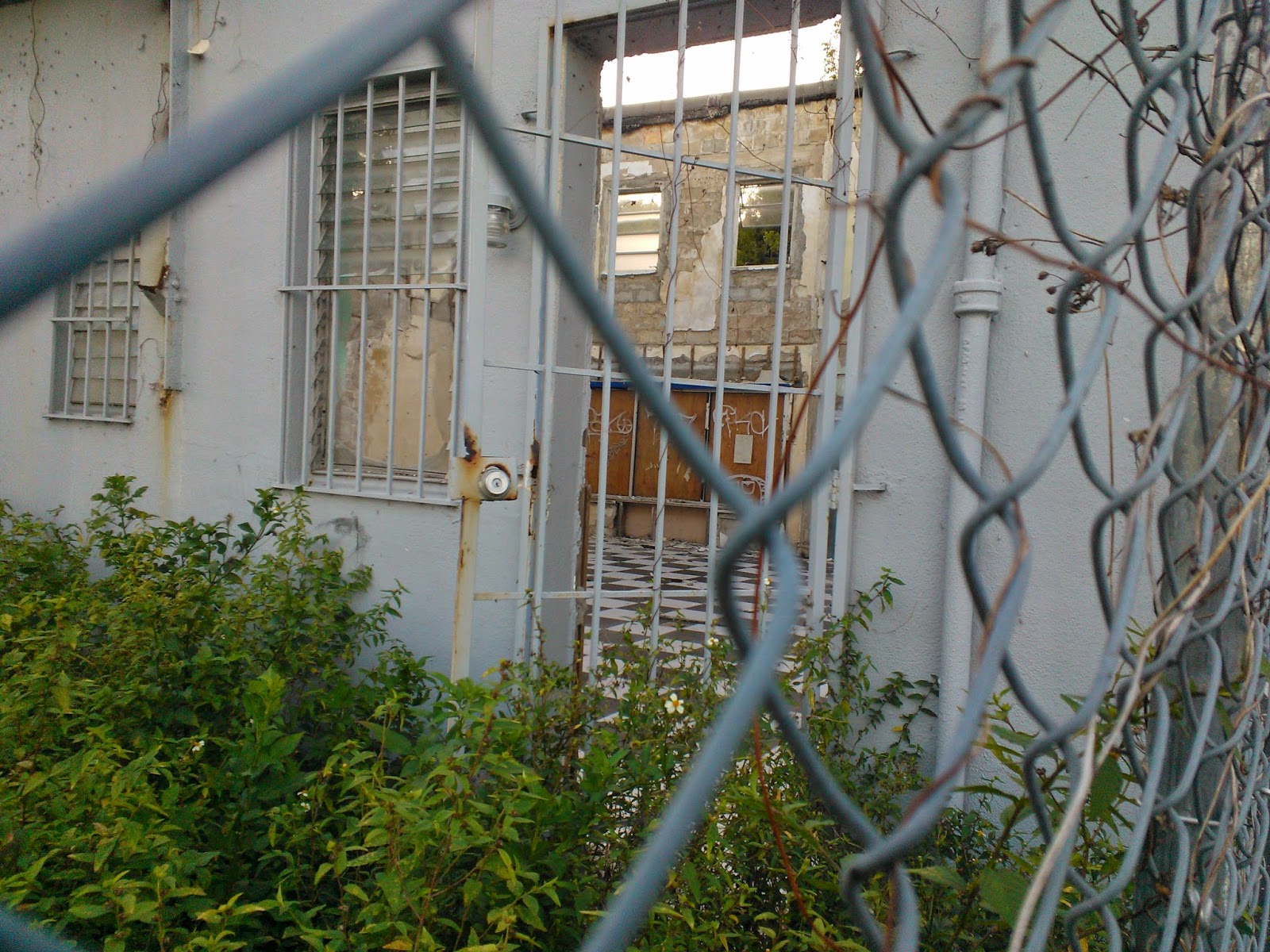
Well, not exactly. At first the Bicycle Shop was left as an open and unsecured construction site. After several complaints to the City of Miami By-Law Enforcement by this reporter, a gate was finally erected, making the construction site as secure as a 6 foot fence allows.

Incidentally, removal of the roof was allegedly done without benefit of a demolition permit, which is how Aries seems get away with a lot of skullduggery.

The Google satellite view at right shows several things. Firstly, it shows how the Bicycle Shop had a roof in the most recent snapshot. It also shows the Coconut Grove Playhouse, the large structure in the middle. Lastly, it shows how close the Bicycle Shop is to the E.W.F. Stirrup House (3242 Charles Avenue), which has been undergoing nearly a decade of Demolition by Neglect at the hands of Aries Development. So far the Bicycle Shop has ONLY undergone 10 months of Demolition by Neglect at the hands of Aries Development.

With the Farmers’ Market returning to the Coconut Grove Playhouse parking lot every Thursday, this is the structure that will greet buyers and vendors alike, and they have Gino Falsetto to thank.

Is this merely another case of Gino Falsetto hoping that Demolition by
Neglect will take care of another one of his properties so he doesn’t have to? Is this more of the same indifference to his neighbours that’s been eating
away at the E.W.F. Stirrup House for nearly a decade?

When will Aries’ neighbours finally get angry and make the City of Miami sit up and take notice? When will the City of Miami step in and FORCE Aries development to maintain and upkeep its holdings?

When will Aries Development and Gino Falsetto just do the right and proper thing, as all good neighbours should?

Here are pictures of the current state of the Bicycle Shop, taken November 1, 2014:

* Except for the Grove Gardens Residence Condominiums and the restaurants on the ground floor, Calamari, La Bottega, and The Taurus. Those were made a showplace. The E.W.F. Stirrup House and the Bicycle Shop? Not so much.

Shocker!!! E.W.F. Stirrup House Plans Are Finally On File

CLICK TO ENLARGE: This is the overall plan for the
E.W.F. Stirrup
House and Property. Charles Avenue runs
along the top and
Main Highway is the angled street at the
right. The irregular shape on the bottom half is the Grove
Gardens Residence Condominiums, known in these pages
as The
Monstrosity. To the left of that are two other buildings
belonging to The Monstrosity. What the rest of this post will
concern itself with is the 100′ x 100′ square at the top of the
plan. Of note is how this plan shows a continuous flow from
The Monstrosity through the Stirrup Property to Charles Avenue.

While there has actually
been no approval given to create one
large property from Franklin through to Charles Avenue, the
developer has already removed the 8 foot wall that once separated
the
two properties. It was done without a demolition permit, as
Aries seems to do
everything: without the proper permits.

It took a FOI request, but Not Now Silly has FINALLY acquired the plans for what Aries Development (read: Gino Falsetto) intends for the E.W.F. Stirrup House — and it’s not good!

These plans are a disaster for those who care about historical preservation. These plans do nothing to maintain the quiet, residential ambiance of Charles Avenue.

A short history lesson: Charles Avenue, originally called Evangelist Street for its many churches, was the first street in Miami. It was laid out by E.W.F. Stirrup himself, slightly off true east/west because he had no surveying tools. Charles has been designated an Historic Roadway and Stirrup’s house has been made an historic site.

Like a bookend, at the far end of Charles Avenue, is the Charlotte Jane Memorial Park Cemetery, named after E.W.F.’s childhood sweetheart. It was once the only place in Miami where Black folk could be buried. To put it simply: The history of Charles Avenue is the beginning of Miami’s history, but it also tells a story unique to this country. Because of the almost single-handed efforts of Mr. Stirrup, Coconut Grove once had the highest percentage of Black home ownership than anywhere else in this country.

These architectural plans take a figurative bulldozer to that rich legacy.

Let me state upfront, in case I’ve not made it abundantly clear in previous posts, that I am totally opposed to turning the E.W.F. Stirrup House into a Bed and Breakfast. A Bed and Breakfast does nothing to honour the legacy of Mr. Stirrup. Furthermore, these plans do nothing to honour the legacy of a Black neighbourhood that’s been
struggling since the very beginning. However, these plans do everything for Aries Development and the continued gentrification of West Grove. To truly honour Ebenezer Woodbury Franklin Stirrup, his house needs to relate to its neighbours on the west, not those in the other directions.

Plans for the E.W.F. Stirrup House have been hard to come by.

The last time this reporter spoke to anyone about plans for the E.W.F. Stirrup Property was around the time of The Great Miami Tree Massacre. Talking to the City of Miami, I learned there were no plans whatsoever on file for the E.W.F. Stirrup House. Of greater concern was that there were no plans on file to cut down the trees on the property. Miami takes its canopy seriously; more seriously than it takes its historic buildings, ironically enough. It’s illegal to cut down trees without the proper permits, which are only issued after a landscaping site plan has been submitted and approved. Because no landscaping plans had been filed, and no permits issued, the city cited and
fined the property owner* $1,000.00 per tree, or $4,000.00 total, and ordered a remediation plan.

CLICK TO ENLARGE: The landscaping plan that was approved after
the fact. This square is all we are going to concern ourselves with.

NB: A landscaping plan was eventually submitted — after the fact — which was eventually approved — after the fact — and all the fines were eventually expunged — after the fact. After all, this IS Miami, where developers get whatever they ask for.

As a result of a Freedom Of Information request, I finally have schematics of what Aries Development intends to do with the E.W.F. Stirrup Property. Gino Falsetto has been saying for years that he intends it to be a Bed and Breakfast. However, “some people say” the original promise was to turn it into a neighbourhood museum. TO BE FAIR: Another neighbourhood faction remembers it always being proposed to be a B&B. Interestingly, neither promise can be found in the City of Miami records. [However, Not Now Silly has recently been given another source of Miami documents to search. There may be more on this aspect of the development coming soon.]

As a novice in studying architectural plans, I took these to an architect who also renovates properties under historic protection. While I thought I had pure gold, I was cautioned not to put too much credence in these plans:

The plans are conceptual at this point and not yet fully compliant with the Secretary of the Interior’s Standards for Rehabilitation of Historic Properties. A process needs to be initiated to designate the property properly if that has not been done yet so that it will be eligible for Historic Rehabilitation Tax Credits. There is a note on the plans that the developer is seeking compliance with these Standards so that they can access federal historic tax credits and incentives as a part of the financing but there is no evidence that this process has been initiated. The process includes designation as a property individually listed on the National Register or a contributing building as part of a Historic District, then a 3-part application for the Historic Tax Credits through local, state and federal agencies.

This is the note referred to above. It’s the only thing on the entire plan that gives me any hope
that, after almost a decade of Demolition by Neglect, the developer MIGHT do the right thing.

What makes the E.W.F. Stirrup House significant? Read: Happy Birthday Coconut Grove!!! Now Honour Your Past

The E.W.F. Stirrup Property plan

A detailed explanation of the E.W.F. Stirrup property plans:

The E.W.F. Stirrup House is the irregular grey structure at the upper left. Currently, it’s the only structure on the property. It’s been undergoing nearly a decade of
Demolition by Neglect. It has still yet to be sealed from the elements and is never secured. [More about that later.]

On the plan the Stirrup House retains its current footprint. However, there is nothing in these 14 pages of plans that speak to what is intended for the renovations that need to take place inside of the house to turn it into a Bed and Breakfast and bring it up to code, while retaining its historical significance. That will remain a mystery until Aries eventually files those plans. I won’t hold my breath.

Bisecting this plan from top to bottom is a paved driveway. I have been
told this won’t be used as a driveway. I don’t believe it for one second. It’s as wide as the
front gate on Charles Avenue, a gate large enough to allow container trucks through. I do not for one minute accept the proposition that cars won’t
be parked along this driveway in the fullness of time. However, if it
pleases you to call it a footpath, who am I to disabuse you of that
silly notion?

The plan indicates a desire to build four additional ‘structures’ on the property. Five, if you include the new fountain. Let’s take them one by one:

CLICK TO ENLARGE: This drawing shows
the New Guest Suites Pavilion as it relates
to the E.W.F. Stirrup House. TO BE FAIR:
At least they are making it look as much like
a Bahamian Conch Style House as possible.

1). Immediately behind the E.W.F. Stirrup House is a brand new proposed structure. On the plans it’s labeled the “New Guest Suites Pavilion.” I’m sure when the preliminary approval was given for a Bed & Breakfast no mention was made of a separate structure on the property to hold bedrooms.That being said, the New Guest Suites Pavilion is composed of, essentially, two 22′ 2″ x 11′ hotel rooms, side by side, under the same roof, with two storage areas along the west wall.

TO BE FAIR: The New Guest Suites Pavilion have been designed to imitate the Bahamian-style Conch house architecture of some other homes in Coconut Grove.

However, these questions needs to be asked: A). Why does Aries Development need two additional guest suites to add to its Bed & Breakfast? B). Isn’t there enough room in the 2-story, historically designated, E.W.F. Stirrup House that Aries already promised to restore?

2). To the east of that structure, past the new fountain, is a small 12′ x 12′ storage shed.

While everyone always needs more storage, isn’t there any place in the 5-storey Monstrosity for storage? Why does Aries need to dump a storage shed on the Stirrup Property?

TO BE [SARCASTIC AND] FAIR: At least they are tucking it out of the way, next to the air conditioners that cool the restaurants in The Monstrosity, which were dumped on the Stirrup Property years ago. In point of fact: The Stirrup Property has always been where Aries dumped whatever it didn’t want to spoil the perfect ambiance of The Monstrosity.

3). Just north of the storage shed is an area called “Terrace” on the plans. It appears to be a large tree surrounded by 4 tables for restaurant seating. No doubt this is related to:

4). The Grill. On the drawing it is called a Parillada [sic] Grill. Not only is it misspelled, but it’s a redundancy since “parrillada” translates to “grill.”

It’s this last feature I find the most offensive, but it’s the clue that everything about this plan has been designed to line the developer’s pockets. Nothing about this plan speaks to the rich history of the original Bahamian community. To my thinking, this plan screams Rich White Hipster, while it doesn’t even whisper Black Historic Preservation.

The Parrillada Grill, as it relates to the E.W.F. Stirrup House (far
left). The floor plan is counterclockwise to actual orientation.

The drawing shows an open-air structure with a roof. Inside there appears to be everything needed for an indoor/outdoor kitchen, including what appears to be BBQ cookers, stovetops, ovens, and fridges.

Surrounding three sides of the Parrillada Grill is a waist-high counter, over which food can be served, with bar stools surrounding it.

How does a Parrillada Grill fit into the overall Charles Avenue Historic Roadway? How does adding all of these amenities to the Stirrup Property benefit the neighbours to the west? It’s clear how it benefits the bad neighbour to the south.

Not Now Silly is filled with five years worth of stories about Aries Development and Gino Falsetto. Each one demonstrates how Aries has been a bad neighbour, failing to maintain the grass on the property and demolishing the interior of the E.W.F. Stirrup House without benefit of a historic preservation plan or demolition permit. Then there’s the removal of the wall and the clear-cutting of the old trees, both also done without permits. Not just a bad neighbour, but a scofflaw besides.

If I were making the decisions, and clearly I’m not, I would refuse to allow Aries Development to expand its little empire before Gino Falsetto has made good on his original promise to RESTORE the E.W.F. Stirrup House.

Lookie: Newly sodded!!! The E.W.F. Stirrup House still ignored.

Why should Gino Falsetto be rewarded with approval for these grandiose plans to turn the E.W.F. Stirrup Property into his own personal fiefdom when he has yet to do the barest minimum to preserve the E.W.F. Stirrup House, the 2nd oldest house in Miami?

However, when Aries needs to pretend there has been some progress, it does something superficial. A few years back, in anticipation of a Charles Avenue Historic Preservation Committee meeting, it removed all of the vines growing up the back of the house and across the roof. However, in the process it destroyed parts of the house. Now that people have started sniffing around about its plans for the property, Aries laid down sod. Once again, Aries will be able to point at something and say, “See? It’s getting better.”

But, “better” would also mean that Aries is PROTECTING the house. All available evidence points to the opposite. The house has been empty and undergoing Demolition by Neglect for the entire time Aries has held the lease. Aries has yet to even seal the Stirrup House from the elements, which are extremely hard on wooden structures. Water, mold and mildew are its worst enemies and it rains here almost daily.

Front gate left open at 7:15 AM

Furthermore, Aries Development does not even secure the house or the property. This past Saturday morning, at 7:15 AM, this reporter was able to walk right in the unsecured front gate of La Bottega, one of the restaurants on the ground floor of The Monstrosity.

However, even if that front gate were left locked, the fence behind it
is only waist-high and provides no deterrent to those with nefarious
intent. [Original renderings show the waist-high fence was to be as tall as the 6′ gate.]

As I walked through the gate, I stopped several times to take pictures. I did not hide or act furtive. Nor did I rush. No one stopped me. No one challenged me. In fact, I did not see another person the entire half hour I wandered around.

Access to La Bottega’s patio seating.
The E.W.F. Stirrup House is to the right.

Once this gate is navigated, one has free access to The Stirrup Property, through the patio seating at La Bottega. It’s not just early in the morning when no one’s around. It’s all day long. When Calamari, La Bottega and The Taurus are open for business, any of their patrons can access the Stirrup Property.

And, not just patrons. Absolutely anyone. Later in the day, at around noon, I strolled in and walked past the hostess saying, “I need to use the washroom.” But I didn’t. While still within her sight lines I walked past the washrooms, through to La Bottega’s outdoor patio, to the very back of the Stirrup House. There I met a guy who worked for the Grove Gardens Residence Condominiums. We had a 15 minute conversation about the house and his boss, Gino Falsetto. I think I told him that his boss is the devil incarnate, but I may have just called him evil. At no time did he ever challenge me for being there and happily engaged in conversation until I excused myself.

7:15 AM: The back door is open. At noon it was open wider.

The back door of the E.W.F. Stirrup House is never locked!!! 

It’s almost as if Aries Development doesn’t REALLY care about the E.W.F. Stirrup House. For all it knows people have been sneaking inside to sleep or smoke crack.

A developer who cares about his investment will make sure it is kept safe. A developer who doesn’t care turns a blind eye to what’s going on, with the hopes that somehow the house, an impediment to his larger plans, might just disappear when no one is looking, either by Demolition by Neglect or fire. Aries Development seems to think that proposing a white picket fence at the front of the property will make people forget nearly a decade of Demolition by Neglect.

I’m here to see that doesn’t happen.

Join the Facebook group Save the
E.W.F. Stirrup House
. Let’s pressure the
city and developer to do the right thing.

[Pictured above are details of the architectural drawings. See the full documents below.]

* The property owner of record is not the rapacious developer who got his grubby mitts on a 50-year lease on the E.W.F. Stirrup House. However, whenever the lessee is delinquent in its commitment to provide upkeep on the property, it’s the owner of record which is cited and fined.

Full architectural drawings:

Where The Sidewalk Ends, Racism Begins ► Chapter Three

CLICK to enlarge: Red lines represent streets
never built, despite being on original planning maps.

I’ve written about Marler Avenue previously (Read Part Two of Where The Sidewalk Ends, Racism Begins). However, a (not so) quick history lesson here will better help you follow today’s bouncing ball:

Marler Avenue is a street in Coconut Grove just one block long, that connects to no streets, other than Hibiscus and Plaza, the two that feed it on either end. But, Marler was never supposed to just one block long. On the earliest planning maps of Coconut Grove, Marler is shown to have 3 other access points. Plaza Street, after a slight dogleg at Marler, was supposed to have extended south past Loquat Avenue. Likewise Hibiscus was supposed to continue past Marler and connect to Hibiscus in South Grove.

When and where the land grab was codified.
The Miami News – May 11, 1984

Most egregious, however, is Marler itself. It should have continued westward to connect to 37th, aka Douglas Road. However, the Loquatians (as those on Loquat call themselves), who lived along that stretch backing up onto Marler west of Plaza, just extended their backyards into the right of way, closing off direct access to Douglas. When, years later, the City of Miami figured out these White homeowners illegally squatted on city land, it chose to ‘grandfather’ the illegal land seizure, tax the larger parcels, and allow the building of a gated community — St. Hugh Oak — on the west end. However, no one seems to have considered what practical effect this might have.

The removal of these three lines on the street grid had an intended effect. It closed off Black Grove from White Grove. That this hemming in of Marler Avenue was Racism in Action is not even in dispute. It’s just a small part of the history of Race Relations (or lack thereof) in Coconut Grove that I’ve discovered since I began my research on E.W.F. Stirrup.

CLICK to enlarge: A 1947 planning map show
the three streets that were, eventually, never built.

I was alerted to Marler Avenue in an article in the Miami New Times called The Wall and have been fascinated by it ever since. I visit Marler as often as I do the E.W.F. Stirrup House, whenever I am in Coconut Grove. I have become such a fixture that neighbours invite me onto their porches for tea. I’ve been told of their struggles keeping children on the straight and narrow. Conversely, others have railed against cops at the new(ish) Miami police substation in Coconut Grove, because they treat all the kids alike, the good ones as well as the bad. Pastor Edmond Stringer, of Sweetfield Baptist Church on the corner of Marler and Plaza, proudly gave me a tour of his simple place of worship, telling me about the few pastors who preceded him and showing me their pictures.

The point I’m trying to make is I am no longer a stranger on Marler Avenue. The folks along the street approach me, freely sharing information, whereas they are, more often than not, wary of White folk who come ’round asking questions about race relations in Coconut Grove.

When Google Maps stands at the corner of Marler Avenue and Plaza Street
looking east, it can see THE WALL on the right, with the Sweetfield Baptist
Church on the far left. This is how THE WALL looked until this week.

One of the more interesting aspects of this short street, once you get over the whole racial angle that hemmed it in on all sides, is Marler Avenue only has one side to the street. Every house on Marler faces The Wall, which is set back about 4 feet from the curb. On the other side of this wall are the backyards of the houses on Loquat. In the most literal sense White Coconut Grove turned its back on Black Coconut Grove decades ago and never the twain shall meet.

And this is how it has been for the residents on Marler Avenue almost as long as anyone can remember. Until this week!!!

Not only did they bump out the wall, but stole one of
the trees. I wonder why they didn’t just take them all.

On Saturday I cruised along Marler Avenue and saw a work crew with a small CAT bulldozer with a pneumatic drill on the end. Wondering what was going on, I pulled over. When the work crew started up the drill, one of the White family came out to see what was going on as well. We talked for a minute or two. I told him it appeared as if they were moving the fence to abut the the curb, Mr. White assured me that would never happen, as that would be illegal.

Guess what I found when I went back yesterday, dear readers? I’ll give you three guesses and the first two don’t count.

For reasons that are, as yet, unexplained. A property owner decided to bump out a portion of their backyard 4 feet. Originally there was a never-used gate there. However, because there is a tree there, it would have been useless to pull a car in and out. The gate section was moved east a few fence posts, which would allow for a car to go in and out. That part of ‘fixing’ the fence makes perfect sense. What makes no sense whatsoever (as yet) is this bump out.

Here’s a Google Maps image from March 2014. Note the new
garage [above left] that is not in this picture. I wonder if they
got a building permit for that structure.

How is this any different to the land grab made decades ago along the western extension of Marler Avenue? That was eventually forgiven, codified and part of it turned into a gated community.

As soon as I saw this bump out I went to talk to Mr. White. No one was home, so left a note and scooted over to Loquat to see which house owner decided he was entitled to more land than they purchased.

However, I need to stress this: the word “scooted” is a misnomer. Even though I was only a few dozen or so feet away from this house, the only way I could get to it is drive west on Marler, north on Plaza, west on Franklin, out to Douglas Avenue, make a left, drive one block south to Loquat — past the gated community of St Hugh Oaks — make another left and drive along Loquat, a number of houses past what once might have been the southern leg of Plaza Street. When I got there I realized I could have walked it easier through the Plaza Path. [See Part Two of Where The Sidewalk Ends, Racism Begins for a full explanation of the Plaza Path.]

While taking a picture of the house (really a duplex, two low-slung units side by side) I got a call from a different Mr. White, who lives with his brother. Having got my note, he saw the bumped out portion of the wall I referenced and called right away. Even though he was only a few dozen or so feet away from me,  I had to totally reverse the trip described above. Because it was afternoon rush hour, and Douglas is such a thoroughfare and hard to turn onto, I told him I’d be by in 3 minutes. Had I not been illegally parked on Loquat I would have walked.

Mr. White had not noticed the change in the wall until he read my note and looked across the street. He assured me he would tell his brother about my latest visit. After that we talked generally about Coconut Grove history, the systemic racism, the E.W.F. Stirrup House and the Not Now Silly Newsroom. Or, rather, I did. However, for me the biggest thrill of meeting the White Brothers over the last few days is that, vicariously, I knew their father.

That article I mentioned way up there, The Wall, in Miami New Times; the article that led me to care about Marler Avenue, begins:

When David White was a boy back in the 1930s, he and his family used to walk the three blocks from their one-story house in the Bahamian section of Coconut Grove to Plymouth Congregational Church in the white neighborhood, just through the trees to the south. The Whites’ house was on the middle of the block on Marler Avenue, which shared a tree line with that wealthier white area. From their front yard the Whites would meander a half-block to the end of Marler Avenue, then turn right onto a footpath that led to Hibiscus Street, which was then a dirt road. Two blocks more would bring them to Plymouth. For decades the majestic coral stone church was the only racially integrated house of worship in Dade County; it still towers over Main Highway.

In those days residents of the Bahamian Grove, now known as the black Grove, routinely walked to and from the white neighborhood — the adults to work, the children to play. White’s parents, who moved to Coconut Grove from the Bahamian island of Eleuthera in 1901, were no exception. His father worked as a gardener and his mother as a maid. As a young man David also worked as a gardener and made the same brief commute, on foot, as his father.

White and his wife Tessie still live on Marler Avenue, in a house next to the one he was born in. But nowadays he would have to climb a ten-foot chainlink fenced topped with strands of barbed wire to take that first right onto Hibiscus Street into the predominantly white section. Not too easy for a 66-year-old retired public school administrator who is moving kind of slow these days.

At the very least, it seems I made some new friends on Marler Avenue and at least one enemy on Loquat.

Fighting Blight In Coconut Grove

The most recent notice on The Bicycle Shop, citing the owner,
Coconut Grove Playhouse LLC., with “First Year failure to
register a Blighted, unsecured, or abandoned structure.”

My recent trip to Gilchrist, my old stomping grounds in Detroit, has me thinking about urban blight in entirely different terms these days. Saturday’s visit to The Grove forced me to look at Coconut Grove blight in way I had never considered before.

Admittedly the word “blight” was already ringing in my head when I came across the NOTICE (left), which cites the owner of the Bicycle Shop with “First Year failure to register a Blighted, unsecured, or abandoned structure.” It’s worth noting that Aries Development, fronted by rapacious developer Gino Falsetto, took control of The Bicycle Shop in January. It promptly ripped off the roof and has since allowed it to become blighted, if the City of Miami can be believed. Imagine that. In one of the most exclusive Zip Codes in the entire country.

Which brings us to the blighted E.W.F. Stirrup House. Aries Development acquired control of the Stirrup House almost a decade ago. Since then the second oldest house in Coconut Grove has become blighted — there’s no other word for it — and it becomes more so every single day. Aries acquired a 50-year lease on the Stirrup House (the house must remain in the Stirrup family in perpetuity) in a complicated property swap when it built The Monstrosity, aka Grove Gardens Residence
Condominiums.

When Aries received the permits to build that 5-storey mixed-use condo complex, which dwarfs the modest Stirrup House, it committed to restoring this culturally important 120-year old house. A later plan claimed it would become a Bed and Breakfast. Meanwhile, it has become blighted, undergoing Demolition by
Neglect ever since Falsetto got his grimy hands on it. One could almost say Aries has once again failed “to register a Blighted, unsecured, or abandoned structure,” but I’ll let the City of Miami take care of any official notices. I can only tell you what I have observed the last 5 years I have been photographing and researching the E.W.F. Stirrup House.

The E.W.F. appears to have an open door policy again.

While it’s hard to tell from this pic, the front door of the Stirrup House was left open again on Saturday night. The last time I found the front door wide open I took it as an invitation to walk right in, since the front gate had also been left wide open. Neither the property or the structure were secured. Had the gate been closed and locked, at the very least, the property would have been secured. But, that’s no longer the case.

That’s because the back wall of the Stirrup property was demolished the same day Aries Development [allegedly] illegally cut down all the old trees on the Stirrup Property. That 7-foot wall was not just a target for neighbourhood taggers, it separated The Monstrosity’s fancy schmancy restaurants — with valet parking and underground wine cellar — from the blighted E.W.F. Stirrup House, right next door. Nowadays anyone who goes to The Taurus, La Bottega, and/or Calamari (the three restaurants that Aries Group runs) can wander right past where the wall used to be, up to the blighted, unsecured and abandoned Stirrup House and walk right in, as I would have on Saturday night had I not already been pressed for time.

Demolition by Neglect is a tried and true tactic to destroy a property that sits in a developer’s way. The E.W.F. Stirrup House has always stood in Aries Development’s way. Despite more recent claims to want to turn the house into a Bed & Breakfast, Aries has done ABSOLUTELY NOTHING, unless you call [allegedly] illegally cutting down all the old trees on the Stirrup property, and demolishing the interior without a permit, absolutely nothing.

Speaking of Aries: It had been my understanding that when the Coconut Grove Playhouse deal had gone through back in January, the Bicycle Shop was turned over to the Aries Group as a way to remove it from the Gordian Knot that had become the Coconut Grove Playhouse collapse. So, imagine my surprise when the NOTICE (above) was issued to COCONUT GRV PLAYHOUSE LLC, which SunBiz doesn’t list. All similar names are Inactive. Who actually owns this property? You’d think the city would know.

No matter. As has already been demonstrated, Gino Falsetto has the Midas touch in reverse. Everything he touches appears to become blighted. Or bankrupt. Before he washed up in the over-heated Miami real estate market, Falsetto and his brothers bankrupt several restaurants in the Ottawa, Ontario, Canada, area.

Sitting right between the Stirrup House and the Bicycle Shop is ANOTHER blighted and boarded-up building in Coconut Grove: The Coconut Grove Playhouse. Just when it appeared that everything concerning that issue had been solved came these screaming headlines earlier this week:

Coconut Grove Playhouse $45 million complex run by Arsht Center Bad Deal
Second Coconut Grove Playhouse proposed
Civic Leaders Evolving Alternate More Ambitious $45 Mil Plan For Coconut Grove Playhouse

It’s far too early to tell what this will mean for Charles Avenue, which has been designated a Historic Roadway as the first street in Miami. I’ll be writing more about the Playhouse in the days to come. However, it’s hard not to see the ultimate winner could be Aries Development, which not only owns the Bicycle Shop, but also the two vacant lots immediately west of the Playhouse. These lots, which once had small shotgun houses on them, were snatched up in the same deal that gave Aries control of the E.W.F. Stirrup House. Any large development at the corner of Main Highway and Charles Avenue will only enrich a rapacious developer, at the expense of Coconut Groves’s rich cultural heritage.

Packing for the Road Trip ► Unpacking The Writer

I’m writing and posting this month’s Unpacking The Writer a little early to get it posted before I leave on Monday for the 2nd Annual Sunrise to Canton Road Trip for Research. For the uninitiated, Unpacking The Writer is the monthly series in which I give my readers a look inside the mind of a writer, such as it is. And, in case you haven’t clued in yet, I am that writer. HI THERE!

NO CLICKING: I also used to use this monthly essay to beg my readers to click on the adverts here. However, I have been told I can’t do that anymore, even though it only returns a fraction of a penny per click. So I won’t. But, if you’re one of my smarter readers, you are already way ahead of me and clicking on the adverts anyway. You know there is absolutely nothing I can do to stop you.

SO SORRY: I owe my faithful readers an apology. More than one reader (two!) has noticed that I’ve not posted much new material at Not Now Silly lately, other than the regular Headlines Du Jour. I’m truly sorry, folks. While I have been researching a number of topics, nothing has gelled enough yet to be written up. I have also started a number of blog posts, some of which I still need to finish and others which (are crap and) will never see the light of day.

When I first began this blog I was given advice to post something every
day. Do you know how hard that is? Especially if you want a blog post to
have some weight? Especially if that added weight requires hours upon hours of research? Especially if it’s not your full-time job?

Despite that, I have published 583 posts in the last 27 months, not including this one. That averages 21.5 posts a month, a record I’m proud of. I’m also quite proud of many of the posts because I think I am mining important topics. As of this writing the Not Now Silly Top Ten is as follows:

  1. The Detroit Riots ► Unpacking My Detroit ► Part Five
  2. Brian Jones ► A Musical Appreciation
  3. Day In History ► Josephine Baker
  4. The Johnny Dollar Wars ► Chapter and Verse
  5. Aries Development Continues To Rape Charles Avenue
  6. Chow Mein and Bolling 5 ► Bully Boy Lies (Again)
  7. Did Roger Ailes Dupe James Rosen, Or Did Rosen Dupe ‘Merka?
  8. The First Three Stooges ► Nostalgia Ain’t What It Used To Be
  9. Is Marc D. Sarnoff Corrupt Or The Most Corrupt Miami Politician?
  10. Does Fox “News” Support Johnny Dollar? ► The Mark Koldys-Johnny Dollar Comment of the Day

[The Top Ten posts, always updated, always current, is in the column to the right of this one. It may have changed since this was published.]

In the early days of Not Now Silly I used to do a lot of one-off Day in History-type dealies. Maybe I should get back to doing some more of that after the 2nd Annual Sunrise to Canton Road Trip For Research. We’ll see.

Those one-offs were popular. They can also be pulled out of the archives on the appropriate dates in subsequent years. Conversely, Headlines Du Jour is pretty much stale the minute you read it. Yet Headlines Du Jour gets great numbers. Despite the simplicity, Headline Du Jour is time-consuming to post. It takes me 1.5 hours to 2.5 hours to format, even though the headlines themselves are compiled as they come in over the Not Now Silly Newsroom transom. Headlines Du Jour is the first thing I do when I wake up at 5:30 AM. As the first pot of coffee is brewing I sort the headlines collected since the last time. I decide which are keepers and which I should toss. Then they’re put into a running order that makes sense only to me. Some days, by the time it’s published, I feel totally wrung out and the pot of coffee is finished. However, I’ll try to add to the number of new posts (and pots of coffee?) on a regular basis while I also keep Headlines Du Jour going. My readers have that promise.

TO MY COCONUT GROVE READERS: While I never meant for Not Now Silly to be a blog solely about Coconut Grove, there have been times when it feels like that’s what it’s become. I’m thrilled that so many people in the West Grove have shared their personal stories with me. Oral histories are so important.

I’m still researching The Colour Line and will have new chapters in that series soon. While in Michigan, I will also be visiting the 8 Mile Wall for a blog post on The Colour Line in Detroit, ‘Merka’s first throwaway city. Meanwhile, there has been some news in the Grove, but nothing that seemed to deserve a blog post all on its own. In no particular order some of that is as follows:

Part of the Coconut Grove Playhouse parking lot will become a drive-in movie dealie on July 14th. The web site for the Blue Starlite Mini Urban Drive In promises “Car hop service by TAURUS,” so we now know how Aries Development and Gino Falsetto plan to profit off this new arrangement. To remind readers: Aries is the company that secured a 50-year lease on the historic 120-year old E.W.F. Stirrup House 9 years ago and has allowed it to undergo Demolition by Neglect ever since.

A reminder why the E.W.F. Stirrup House is culturally
important to Coconut Grove can be found in the Not Now Silly
post Happy Birthday Coconut Grove!!! Now Honour Your Past

I had hoped to go to opening night of the Blue Starlite Mini Urban Drive In, but the June opening was delayed a month. Now it won’t open until the day after I leave for the 2nd Annual Sunrise to Canton Road Trip For Research. This is actually one of those posts mentioned above, partially written in advance. I started it last month, just before the delay was announced. It would have become a full-blown blog post in the fullness of time. I had even considered delaying my Road Trip 2 days to go, take notes, take pictures, and finish writing that blog post, but, yannow what? I’ve seen The Cocoanuts, the first Marx Brothers movie, so many times I can recite entire scenes by heart. [Same with the 2nd movie in the opening night double feature, The Blob.] So, there’s another draft post consigned to the dustbin of history.

IRONY ALERT I: The Cocoanuts take place in Cocoanut Grove (the original spelling of Coconut Grove before it was illegally annexed by Miami in 1925).

IRONY ALERT II: The Cocoanuts satirizes the utter collapse of the Cocoanut Grove real estate market of the 1920s. Selling Florida swamp land had became such a a national joke that one of the top playwrights of the day, George S. Kaufman, and one of the country’s most famous composers, Irving Berlin, would write a musical about it. The Marx Brothers would first take it to Broadway, where it was a smash hit, and then make it their first movie extravaganza, launching a long career on film.

IRONY ALERT III: Miami has had several booms and busts since then. “Some people say” the current Miami building boom is just the beginning edge of the next bubble to bust.

IRONY ALERT IV: Bringing movies back to the Coconut Grove Playhouse, albeit outside, would be funny, if it weren’t so sad. When the currently-boarded up Coconut Grove Playhouse was originally built, it was to bring movies and culture to Coconut Grove. The land had been owned by E.W.F. Stirrup and sold to developers to build the Coconut Grove Theater, as it was called when it opened in 1927. It was renovated in the 1950s to become a legitimate theater, with the 1956 premier of “Waiting For Godot” as its first offering.

IRONY ALERT V: Even though the Coconut Grove Theater anchored the east end of Charles Avenue — the oldest neighbourhood in Miami, as well as the oldest Black neighbourhood — those folks had to go north to the smaller Ace Theater on Grand Avenue, which was not segregated. Earlier this month Miami’s Historic and Environmental Preservation Board designated the Ace a historic site.  According to the Miami Herald’s Jackie Salo:

For residents in the West Grove, the ACE Theater is a relic of the years of segregation. The movie theater, which was built circa 1930, was the only one to serve the black community in the Grove in the 1950s.

The building has since lost its luster, and stands as a shell of what it once was. The marquee has not lit up for years, and the pink facade that once distinguished the theater was painted white.

Plans to restore the theater never came to fruition and the rooms that housed sold-out audiences remain abandoned.

But the theater, albeit empty, has not been forgotten.

Having walked past the Ace many times, I’ve always thought it would make a great Indie/Revival movie house. Grand Avenue has been struggling for years. Opening a movie house on that stretch of Grand would go a long way towards revitalizing what was once the thriving Black business strip of Coconut Grove.

TROLLEYGATE: Still waiting for a settlement in the Trolleygate Scandal. The last word from my super-duper secret sources was that an offer was on the table and being considered. Consequently, all parties to the lawsuit asked the judge to give them 60 days to see if they could hammer out an agreement. That expired at the end of June, but I’ve heard nothing further. Basically the broad outline of the potential deal is this: A brand new Coral Gables diesel bus garage will be built right where the current Coral Gables diesel bus garage is. This despite the brand-spanking new [allegedly] illegal diesel bus garage built in West Grove. That’s the garage that’s the subject of multiple lawsuits, which even the Federal Department of Transportation ruled contravened the Civil Rights Act of 1964. The only decision left to be made is whether the brand-spanking new bus garage in West Grove can be used for the next 2-3 years while a newer diesel bus garage is built in Coral Gables.

Here’s how small West Grove really is: The [allegedly] illegal diesel bus garage is, more or less, just around the corner from the Ace Theater. Gibson Plaza, which I have also written about, is just across the street from the Ace Theater. Grand Avenue still has a long way to go before one could call this a revival, but it’s another baby step on the road to recovery for a business strip that’s seen better days.

Known all the world over, The Johnny Dollar Depreciation Society is
YOUR place for snark about Fox “News and crazy Fox “News” defenders

THE JOHNNY DOLLAR WARS: I couldn’t be more thrilled with the progress of The Johnny Dollar Wars up the Not Now Silly Top Ten Hit Parade. It justifies all the time I put into documenting those crazy cyber-stalking MoFos these last few years. Since being published on May 6th, The Johnny Dollar Wars has jumped to become the #4 most popular post at Not Now Silly, with 1,233 hits as we go to press. The only Not Now Silly post that ever rose faster and higher than that has now been relagated to the #5 position. Aries Development Continues To Rape Charles Avenue, about the E.W.F. Stirrup House had a good run, but it’s been leapfrogged in the ratings.

THE JOHNNY DOLLAR DEPRECIATION SOCIETY: I’ve migrated most of my Fox “News” snark from my timeline over to The Johnny Dollar Depreciation Society on the facebookery. I’m open to suggestions on how to make it more interactive. While membership has hit 120 people, only a few interact with the page at all, and only then by clicking LIKE. I’m thinking of holding a contest, but I’ll wait until I get back from Michigan to put that together.

LASTLY: Starting next Monday blog posts at Not Now Silly will be sporadically sporadic. My laptop has bought the farm and I’m not planning to get it fixed before I go away. I may look at a new device when I get back from the road trip, but it’s not in the budget at the moment.

The 2nd Annual Sunrise to Canton Road Trip for Research will be twice as long as last year’s. Last year’s research was productive, but, sadly, I had just a week to drive to Michigan, conduct my research, and drive back to FloriDuh. Despite mining some interesting veins of information, I had to cut the research short because I simply ran out of time. This year I will be meeting with some of the same people who fed me documents last time. I will also have more time to pour over some microfiche that one of my correspondents has uncovered. It may go a long way to provide greater context for the book I am writing.

Be good to your neighbours because you never know
when a journalist will come sniffing around for information.
~~~~~Headly Westerfield, The 1st Annual Sunrise
to Canton Road Trip For Research, June 2013

While I may be able to log into certain accounts while I am gone, last year I was unable to log in to facebook from strange computers because I was locked out of everything that wasn’t my home computer or my phone. Hopefully this year I have solved this problem. However, two things to keep in mind: 1). I don’t exactly know where and when I might encounter a computer, not to mention a computer owner who will allow me to take over their computer for a few hours to compose a blog post. Consequently, just like last year, it may just be updates from the Windows Phone. However, I won’t abandon you entirely. Also: Check my Twitter and Facebookery for updates from the road

And, speaking of computers along the way, I have twice as many visits with readers, fans, and friends scheduled for the 2nd Annual Sunrise to Canton Road Trip for Research. The intinerary is now locked. Stops are scheduled for (in order) Ave Maria University, in Ava Maria, Florida; Bonita Springs, Florida, which is just down the road from the University; Tallahassee, Florida‘s capital, after which I leave the state; Miamisburg, Ohio; Columbus, Ohio; Canton, Michigan, where I will stay for almost a week to conduct research and visit old haunts; Elyria, Ohio; Cleveland, Ohio, which looks to be the scene of the crime city chosen to host the 2016 GOP Convention; Dean Martin’s home town of Steubenville, Ohio; and Morgantown, West Virginia, where I will be given a privately-conducted Don Knotts Memorial Tour. Then it’s home by — no later than — the 28th of July.

A couple of people have asked me why I don’t just fly up to Canton, which would give me more time to research my book. There are 2 things that compel me to drive: 1). I love to drive. One of my favourite things to do is to be behind the wheel of a car, heading down the road, with the stereo cranked to 11; 2). It allows me to meet and greet some people that I’ve gotten to know thru’ the innertubes. Getting out, looking people in the eye, and debating the big stories of the day — or bullshitting over a coffee — is just a big bag of fun.

Where The Sidewalk Ends, Racism Begins ► Chapter Two

Our next destination in Where The Sidewalk Ends, Racism Begins.

This path runs along another section of The Colour Line in
Coconut Grove. Note the fence. We’ll get back to that later.

Before beginning our second West Grove stroll, it’s worth reading the last Where The Sidewalk Ends, Racism Begins. Since it was published in December, additional info about the Coconut Grove Colour Line has been found. In Dismantling Racism: The Continuing Challenge to White America [published by Augsburg Fortress, 1991], Joseph R. Barndt writes:

A southern version of these traceable corporate decisions to create a Black ghetto exists in Miami Florida. Running through the entire area called Coconut Grove on the South End of Miami are the remains of an eight-foot stone wall, built to separate Black and white residential neighborhoods. Resolution 745, adopted at Miami City Planning Board meeting of July 21, 1941, reads as follows: “A resolution recommending that the establishment of a permanent diving line between white and colored occupancy in the area north of Grand Avenue and east of Douglas Road.” There are also later resolutions that describe the placement, size, access, roads, and responsibility for maintenance of the wall. The wall’s remains still stand, but few citizens of Coconut Grove remember its original purpose, or the decisions that created it.

Fewer remember the next Colour Line we will visit on our Where The Sidewalk Ends, Racism Begins walking tour, although it’s far less hidden. Rather than running along the backyards of a neighbourhood, it’s in plain sight. An entire block of houses stare out at it. Furthermore, it’s not just in plain sight, but maintained and fortified to this very day. Let’s go for a walk.

From where one sidewalk ends to where the next sidewalk ends.

We begin right where we left off the last time. While standing on Douglas Road at The Colour Line facing The Wall of Shame, turn left, and cross Douglas. This will put you on Franklin Avenue. Walk east along the southern edge of the Charlotte Jane Memorial Park Cemetery, named after the wife and childhood sweetheart of E.W.F. Stirrup. This was once the only place in Miami where Black folk could be buried and, contrary to some references found on the internet, is not where Michael Jackson filmed Thriller. Past the cemetery is one modern 2-story home and then several single family homes in the Coconut Grove vernacular of being either modified Conch or Shotgun styles. Turn right at the little traffic circle at Plaza, the first street, and walk down to where the sidewalk ends. That’s where racism begins and Marler Avenue begins.

Marler Avenue is a funny little street in Coconut Grove, “little” being the operative word. It runs east-west for one short block, from Hibiscus Street to Plaza Street, with houses only along the north side. Every one of those houses looks out at a wall — overgrown with foliage and almost invisible in parts, unless you know where to look.

I first learned of Marler Avenue from an article called The Wall, which Kirk Nielsen wrote for Miami New Times way back in 1998:

One look at Marler Avenue clarifies [Marler resident David] White’s frustration: Not only are he and his neighbors fenced in at both ends of the block, but along the southern edge of the tiny street is a ten-foot fence. “This all used to be open,” White explains, standing in his driveway and pivoting 180 degrees as he points from one end of the street to the other. “We used to walk through there.” He gestures toward one section of fence with a coil of concertina barbed wire — the kind used in military operations: “Totally unnecessary,” White exclaims, shaking his head, his hands now tucked inside his back pockets.


Will Johnson, who returned home to the black Grove four years ago after eighteen years in the U.S. Army, is offended by the notion that white Grovites would put up barricades to protect themselves from their black neighbors. “The idea that a man would put that damn concertina wire on top of the fence there,” says Johnson, age 46, surveying the barrier with White. “The truth is it won’t make any difference at all. The guys know how to get over there and rob their ass anyway. It’s not a deterrent.”


White regards the barriers as vestiges of “segregation and white dominance. And I say, look, I pay taxes the same as anyone else. I don’t necessarily want to go into their community, but I do want to make sure that if I need to go over there for anything I have the accessibility. Now, if I’m going to go over to Plymouth Congregational, I gotta go all the way around” — he twirls slowly in a half-circle to indicate the circuitous route he would have to take — “instead of the way the streets were supposed to be.”

A map dated 1947-1949, before Marler Avenue was closed off on all sides.

That wall is the Marler Avenue Colour Line, but it also demarcates the end of the backyards of houses that front along Loquat, one block south. If you look closely at the map above, you will see a faint line running west from Marler, which would have extended the street all the way to Douglas Road, also known as 37th. In fact Marler was supposed to have gone through to Douglas, as this map from the late ’40s indicates. It also shows some other Marler mysteries. For instance both Plaza and Hibiscus were also supposed to link up to Loquat Avenue.

Back then Marler, Plaza, and Hibiscus were nothing more than a dirt roads that became mired in mud during the rainy season. However, a curious thing happened on what should have been the western end of Marler Avenue. The White homeowners on Loquat Avenue illegally extended their backyards into the right of way, closing off Marler. And, that’s how Marler Avenue lost access to Douglas Road. Quietly. Illegally. Racially.

Hibiscus Street never went through to Loquat as it should have either. Eventually that land was sold off and condos built. And, that’s how Hibiscus lost access to Loquat Avenue. Even more curious is the evolution of how Plaza Street lost access to Loquat.

Plaza Street begins its southward trek at the famed US-1. At Grand Avenue, once the thriving Black business district of Coconut Grove, it takes a slight jog. Today, it continues all the way down to Marler, where the sidewalk ends. According to that 1940s map, [above] Plaza Street was supposed to take another slight jog at Marler before continuing south past Loquat in South Grove, where at Poinciana Avenue, it would make a gentle left turn to connect to Main Highway. However, that was not to be.

When the lower section of Plaza, along with Marler and Hibiscus, were paved sometime in the ’70s, this dogleg, between Marler and Hibiscus remained dirt. It was little traveled by vehicles because it wasn’t well maintained and, quite frankly, South Grove had little reason to go north into West Grove, which was considered unsafe. West Grove, for the most part, traveled north to Grand Avenue to shop and be entertained. This little section of what should have been Plaza Street eventually became an overgrown footpath that crossed the Coconut Grove Colour Line from West Grove to South Grove, Black Grove to White Grove.

It remained a footpath until some time in the early ’90s when — without warning and city approval — a chain link fence was erected that closed off the bottom of Marler Avenue entirely. No one knows who paid to have it put up, but fingers were pointed at White residents in South Grove reacting to a perception of heightened crime, accusing the perps using this path.

The chain link fence didn’t stay up very long.

IRONY ALERT: Just like it was the complaints of White folk that got Old Smokey closed down, and
just like it was the White folk that finally got the western edge of the Wall of Shame taken down, it was the White folk of South Grove who were
responsible for getting the chain link fence taken down. A good many of the residents of West Grove worked for families in South Grove as gardeners, maids, handymen, and nannies. When the Plaza extension was closed off to foot traffic, these tradesfolk started complaining to their employers because, suddenly, they were forced to walk a lot farther to get to work. The fence came down.

There had been other leaks in The Wall of Shame. Along the south side of Marler that section of the wall had been porous. People remember using dirt paths to take shortcuts to Loquat and walk to Plymouth Congregational Church. But over the years one link after another was closed off until the Plaza foot path became the last surviving link between West Grove and South Grove along residential streets.

For the longest time it remained a dirt path. Eventually this rough footpath was improved by the City of Miami. Paving stones were added and the foliage would be cut back occasionally. However, it was poorly maintained over the years. That is, until quite recently.

In February this reporter first visited Marler Avenue to begin research on this post, and to scope out the lay of the land. Way back then the edges of the path were falling apart. Many pavers had been stolen. Sinkholes in several places made walking a baby stroller difficult. A second visit a few weeks later showed newer destruction. The post that would keep vehicles off the foot path had been flattened, probably by a vehicle. [A big rock at the south end of the path would have kept it from exiting on Loquat, however.] A third, more recent, visit held a much bigger surprise. A new, sturdier post had been installed to keep vehicles out and the path had been repaired. All the pavers were replaced and leveled, with the edges shored up. It wasn’t until I started taking videos to document the maintenance that I noticed something very disturbing.

BEFORE:

February 25, 2014: Crossing The Colour Line in Coconut Grove, from
Black Grove to White Grove, from Marler Avenue to Loquat Avenue

AFTER:

April 21, 2014: Note the brand new
addition to the fence along The Colour Line.

This is pretty much where maps say Marler Avenue should have met Douglas Road

As the path became more navigable, and the wild foliage cut back drastically, someone must have felt far more vulnerable. Why else would another 2 feet be added to the top of The Wall of Shame, The Colour Line of Coconut Grove? Furthermore, it was done in the cheesiest way possible, by just nailing new boards on top of the old ones.

No matter. It still makes a statement about keeping Black Grove separate from White Grove in 2014, 16 years after Black residents told Miami New Times how offended they are by a constant reminder of systemic racism. Despite the One Grove mural, the Black and White communities in The Grove are quite separate, and have been for decades.

As I said in the first entry in this series:

The Coconut Grove Wall of Shame™ is not unlike the wall in my home town of Detroit known alternatively as The 8 Mile Wall, The Wailing Wall, or the Birwood Wall. A search on the Googalizer for the 8 Mile Wall turns up references, history, as well as tons of images. However, one has to go digging to find any images or references to the Coconut Grove Wall, the history of which is being buried like much of the history of West Grove.

The Coconut Grove Wall of Shame is far longer that the 8 Mile Wall. The more I research Coconut Grove, the more I realize it is the story of Race Relations in this country writ large. However, West Grove is the exception that proves the rule. What has always put Coconut Grove into stark relief is the fact that, at one time, it had the highest percentage of Black home ownership than anywhere else in the country. Consequently it couldn’t be colonized; it had to be surrounded and walled in on all sides. Much of that wall still exists and the current invisible Colour Line can still be traced.

COMING SOON: Another walking tour along the Coconut Grove Colour Line.

A Grand Day For Grand Avenue ► Gibson Plaza Groundbreaking

Artist rendering: Grand Avenue and Gibson Plaza

A gala day on Grand in The Grove, for the Gibson groundbreaking. This mixed-use, residential-educational building is the first all-new affordable housing built in West Grove in almost 50 years.

Gibson Plaza has been in the planning stages for many years. However, it took a unique and unlikely group of partners to move this project forward, including the Theodore Roosevelt Gibson Memorial Fund, the Coconut Grove Collaborative Development Corporation, Miami-Dade College and the Mitchel Wolfson, Sr. Foundation. Miami-Dade County kicked in $9 million dollars, and Pinnacle Housing Group will construct the Bahamian-styled building that pays homage to West Grove’s original inhabitants.

Thelma Gibson’s 1st shovelful at the project she helped spearhead

Gibson Plaza, named for Reverend Theodore R. Gibson and Thelma Gibson, will be geared to the 55-and-up demographic, with 56 one and two bedroom units. Among the common amenities will be an exercise room, community center, library and computer lab. However, what has the neighbourhood excited is what’s slated for the ground floor. It is dedicated to providing continuing education, job training and after school programs for the neighbourhood at large.

“It has always been a dream of ours to have affordable housing, continuing education and after-school programs for children running side by side,” the 88-year old Ms Gibson said.

Every speaker who came up to the dais to say a few words (under the white tent in the 89 degree heat) spoke of how this project will lead to a neighbourhood revitalization of a sorely neglected area of Miami. That’s why residents were so upset about Trolleygate when they learned about it. This is a neighbourhood struggling to overcome a century of racism and neglect.

While east Grand Avenue got revitalized with CocoWalk, restaurants, and fancy hotels, the west end of Grand — Black Grove, or Kebo, as the original Bahamian residents called it — has struggled and become blighted over the decades. The non-conforming diesel bus garage is just a few very short blocks away from this development. The reason people were so upset with the trolley garage is because it does not comport with the vision of those who want better for the neighbourhood. Gibson Plaza is the beginning of that revitalization plan.

The two people who came in for the most praise and sustained ovations at yesterday’s ceremony were the two people who everyone acknowledged deserved the most credit for seeing this project through to fruition. First and foremost is Thelma Gibson, who, though the Foundation named after her late husband, helped aquire the 1 acre site, parcel by parcel, and who insisted that any project of this kind simply had to have an educational componant; and Jihad Rashid. President of the Coconut Grove Collaborative Development Corporation, who worked tirelessly to bring all the partners to the table and see that they all understood the vision.

One of the politicians mentioned over and over, by speaker after speaker, is Miami-Dade Commissioner Xavier Suarez, who fought to get County Commissioners to allocate the $9 million. “On behalf of the Miami-Dade County Board of County Commissioners, and as Commissioner of Miami-Dade District 7, it gives me a great deal of pleasure to be associated with a project that I believe will spur the re-birth of the long neglected segment of our community – The Coconut Grove Village West.” Yet, that wasn’t just promotional bumf.

Thirty years ago Suarez helped set up the Gibson Memorial Fund and he’s been behind this project from the get-go.

How close is Trolleygate to Gibson Plaza?

IRONY ALERT: Another politician got short shrift in all the speeches. That’s just as well because [allegedly] corrupt Miami Commissioner Marc D. Sarnoff arrived 10 minutes late and missed the shovel photo-op. His West Grove constituents accuse him abandoning them for monied interests and out of town developers.

Further reading: Is Marc D. Sarnoff Corrupt
Or The Most Corrupt Miami Politician?

Last year when Trolleygate erupted in controversy, Sarnoff staged The Trolleygate Dog and Pony Show to protect the profits of Astor Development and Coral Gables against the interests of his own constituents. After Sarnoff insisted he couldn’t talk about Trolleygate because it was before the courts, he presented a one-sided slide show to insist diesel fumes and bus traffic on residential streets is perfectly safe. However, it’s what he did in the middle of the meeting that Sarnoff demonstrated his despicable side. At one point in this contentious meeting this reporter heard Sarnoff covertly threaten to withdraw support for Gibson Plaza (and other projects) if the community continued its fight against Trolleygate.It was slyly done, but was not lost on anyone in the room.

So, colour me thrilled that Sarnoff missed his photo op — another way to grab credit. Judging from the sotto voce murmurings when he gave his short speech, he’s lucky he wasn’t booed.

Even as the Collaborative’s Jihad Rashid celebrated
this achievement, he warned against gentrification.

The slogan on the banner in front of which every speaker spoke read CATALYZE • REVITALIZE • TRANSFORM, which is everyone’s hope for this stretch of Grand Avenue. Immediately across the street from Gibson Plaza is the Collaborative offices. Just to the east of that is the brand new KROMA Gallery, which hosted a lunch for attendees after all the speakers were finished.

While everyone hopes Gibson Plaza leads to a revitalization of the west end Grand Avenue, the fear is that this is just another step along the process of slow gentrification that has been eating its way into West Grove. Even Rashid recognizes the danger. As Nick Madigan in the Miami Herald notes:

After waiting for a standing ovation to die down, Rashid reminded the crowd that there had been a “history of disinvestment and disenfranchisement” in the West Grove, and remarked on the irony of expensive hotels and condominiums perfectly visible only a few blocks to the east. Rashid also cautioned against the danger that the neighborhood’s longtime residents will be pushed out by construction projects and investors looking for profits.

“If they get gentrified out in the name of progress, I don’t think that’s progress,” Rashid said. Still, he concluded, Gibson Plaza is a huge step forward.

Those in the know tell this reporter that due to property speculation along Grand Avenue, nothing less than 5 stories will pay for itself. Nothing taller than 5 stories is allowed by the Miami 21 Plan. This means that only 5-storey high condo buildings will be built along Grand, making it a new canyon for colonization and gentrification. Otherwise, West Grand will continue to undergo Demolition by Neglect, which passes for progress in West Grove. There appears to be no room left for anything in between.

View pictures of the groundbreaking in this Facebook album.
View raw footage at this YouTube Playlist.