Tag Archives: Aries Development

Aftermath of the Great Miami Tree Massacre

Fined $1,000 per tree or $4,000 on the Stirrup property.

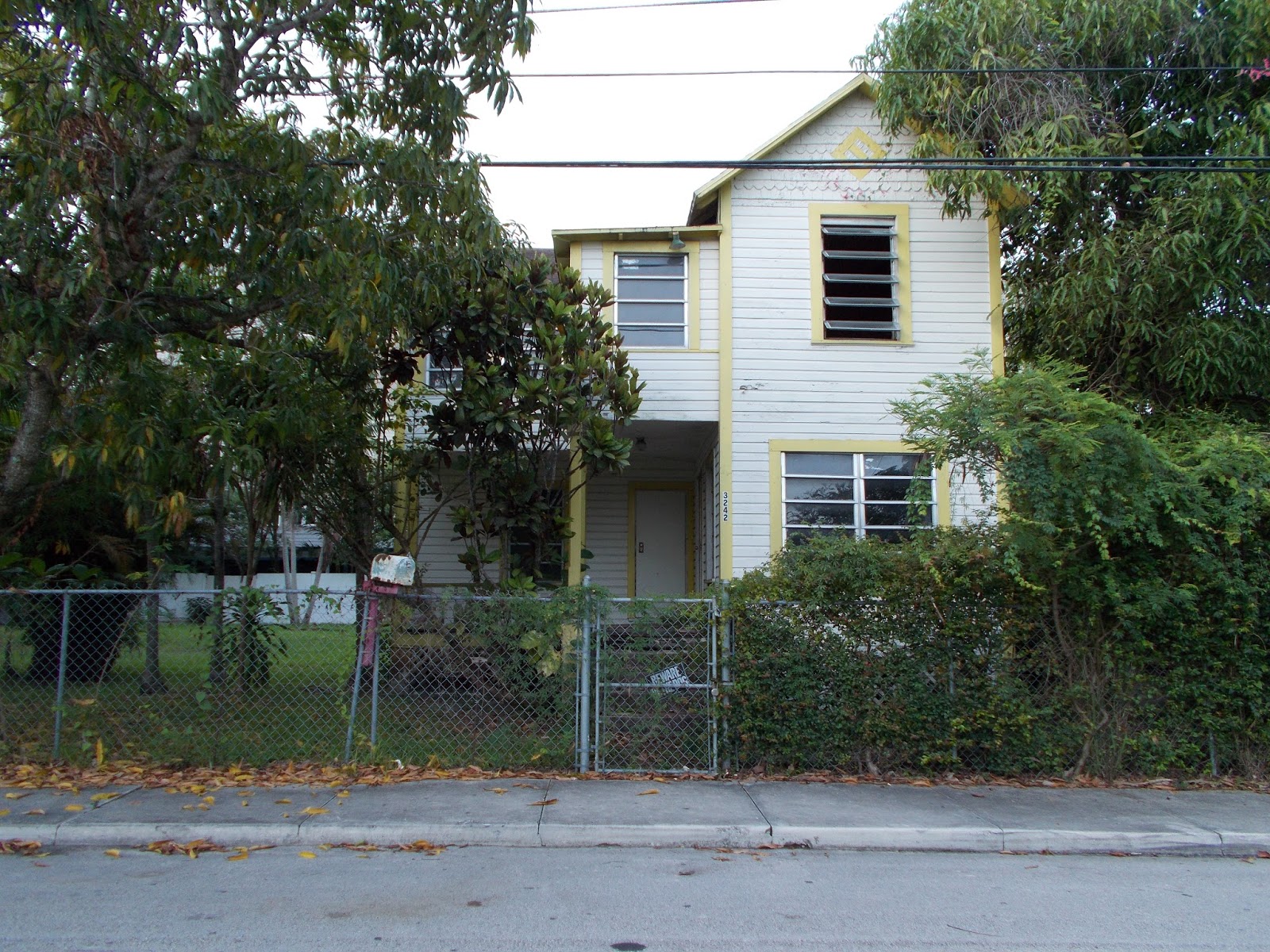
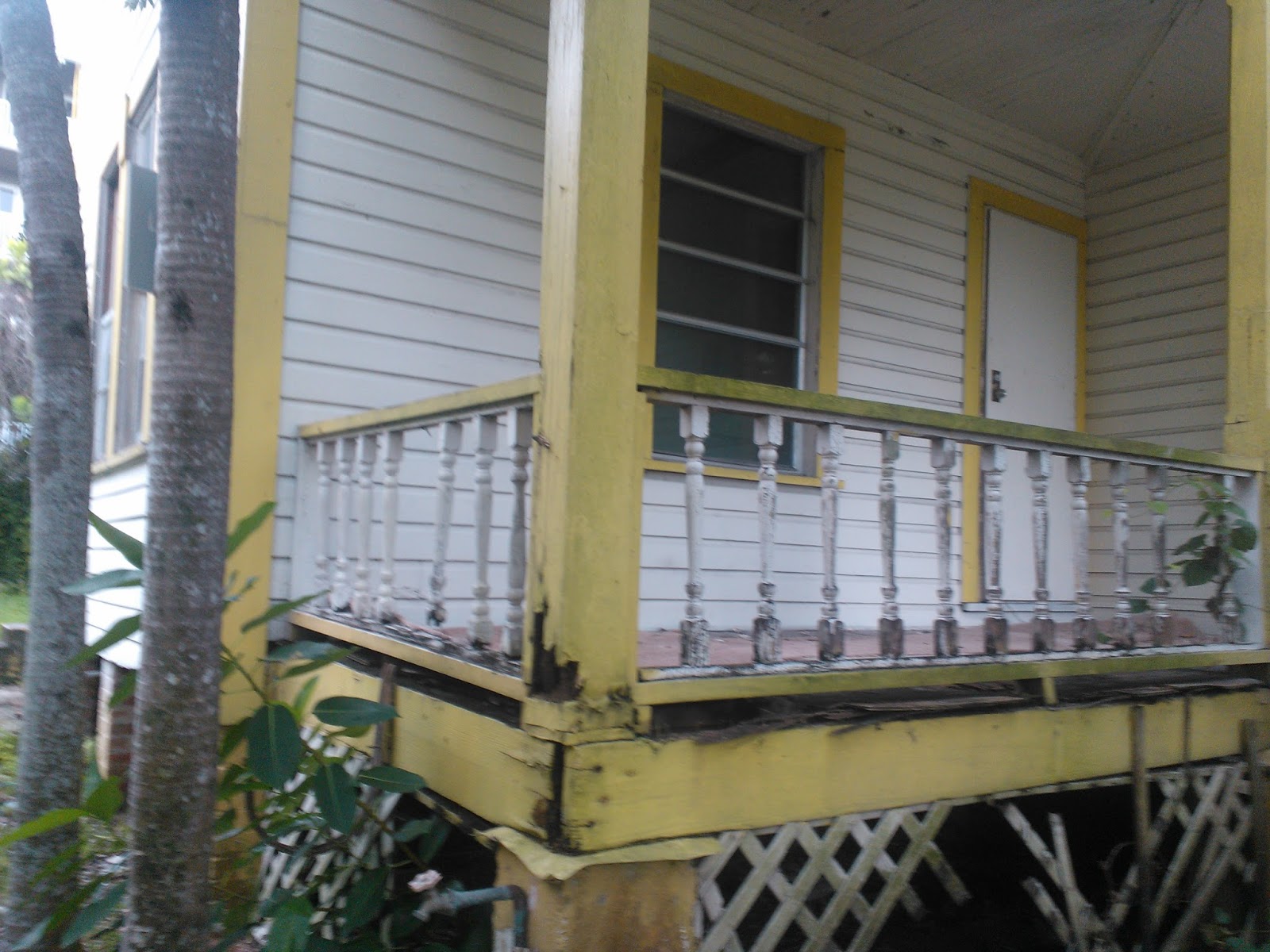
“Some people say” Gino Falsetto has finally gone too far. The recent destruction of the old growth trees on the E.W.F. Stirrup property is bringing awareness of the deplorable condition Aries Development has allowed the historic 120-year old house to devolve into.

Demolition by Neglect is a thing that can be looked up on the Googalizer. Demolition by Neglect is what Gino Falsetto has done with the E.W.F. Stirrup House for the past 8 years, ever since it entered into his possession.

IRONY ALERT: Sources tell Not Now Silly that had Aries Development applied for tree removal permits, in all likelihood they would have been granted. By ignoring the law, he just brought unwanted attention to his terrible stewardship of an important Coconut Grove cultural resource. E.W.F. Stirrup was among Florida’s first Black millionaires, a man who once owned most of 33133, a Zip Code now considered one of the most exclusive in the country.

However, those accomplishments pale to this one: With his own hands, on property he owned, Ebeneezer Woodbury Franklin Stirrup built more than 100 houses in the area. These were sold, rented, and bartered to the growing Black families that served as the service industry for the tourist trade. That action, during Jim Crow Days, created something unique in this country. At one time Coconut Grove had the highest percentage of Black home ownership than anywhere else.

The Great Coconut Grove Tree Massacre of ’14™ was supposed to have been worse than it was. There is a 5th tree on the lot that has the same florescent orange paint marker that spelled doomed the other four. It was to have come down with the rest of them but, according to my source on the scene last Thursday when it occurred, the neighbours were starting to complain loudly and the work crew stopped before the last immediately behind the Stirrup House was felled. One of those neighbours is said to have called By-Law Enforcement because they arrived early the next morning and left a citation.

It took a stump grinder all day to remove the remnants of the two trees flanking the E.W.F. Stirrup driveway.

The fine of $4,000 ($1,000 per tree) levied by the City of Miami (see citation above) will not be the only punishment. Coconut Grove Village Council Chair Javier Gonzalez tells Not Now Silly Miami has also ordered remediation on the Stirrup property. Aries Development will be forced to plant 2 trees for every tree removed. And, in 120 years, they will also be old trees just like the ones ripped down.

February 25, 2014

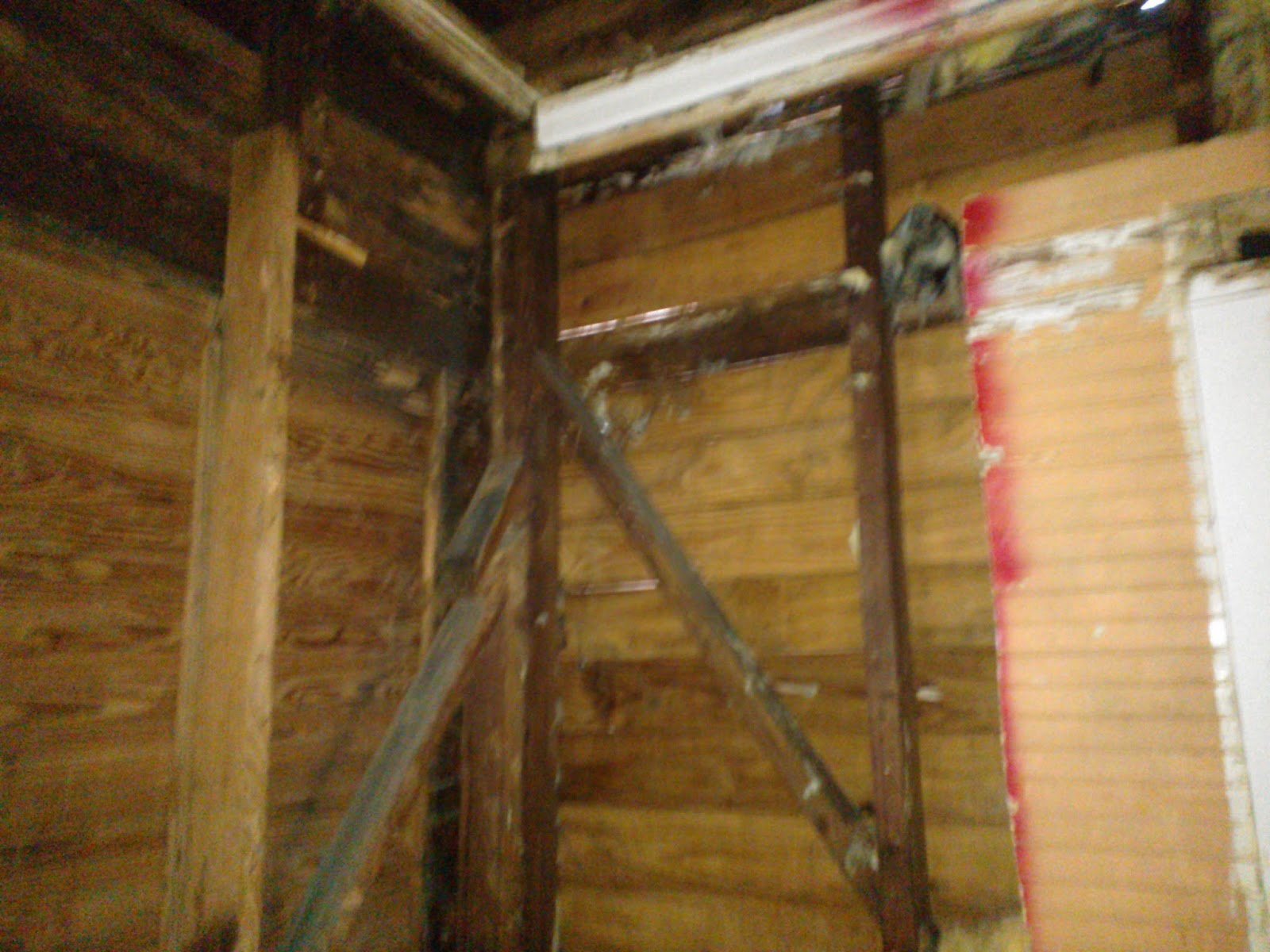
However, Gino Falsetto continues to prove that he’s an irresponsible corporate citizen. The picture to the right is the interior of the Bicycle Shop, that Aries Development took possession of on January 15th. More about that in The Coconut Grove Playhouse Deal Begins to Unfold, post and what that means for the community. However, this construction site has been left open and unprotected as of yesterday.

Beyond those doors is an alley that a lot of the students use as a short cut to Thomas Avenue or the A&M school. Kids being kids could start exploring the property and get hurt. This reporter had no trouble walking inside.

Gino Falsetto knows the laws about cutting down trees, just like he knows the laws about protecting the public from unsafe construction sites. He’s a long-time developer, for eff’s sake!!! All this proves is that no matter how often the City of Miami cites his company, Gino Falsetto will do exactly what he wants in Coconut Grove.

Imagine a child wandering in here:

Aries Development Continues To Rape Charles Avenue

Code enforcement beat me to it.
That $4,000 fine will restore the 100-year old trees, right?

It was supposed to be a quiet morning editing Farce Au Pain, until I received a text from one of my secret sources in Coconut Grove. The gist of the message being: “You won’t believe what’s going on at the E.W.F. Stirrup House.”

My source had heard that the 8-foot wall that separated the E.W.F. Stirrup property from the Grove Gardens Residence Condominiums [hereafter known as The Monstrosity] had been torn down. This was apparently done so that the restaurants and bars in The Monstrosity could start seating customers on the E.W.F. Stirrup Property.

Wait!!! What???

I jumped in the car and drove down to Coconut Grove as quick as the speed limit on I-95 would allow. While my source was correct, it was even worse than they had suspected. Yes, the wall — which had been the target of graffiti artists on more than one occasion — was removed as a first step to expanding the restaurant seating, but what was done at the front of the property is what reduced me to tears.

The E.W.F. Stirrup Property has been raped of all its old growth trees!!!

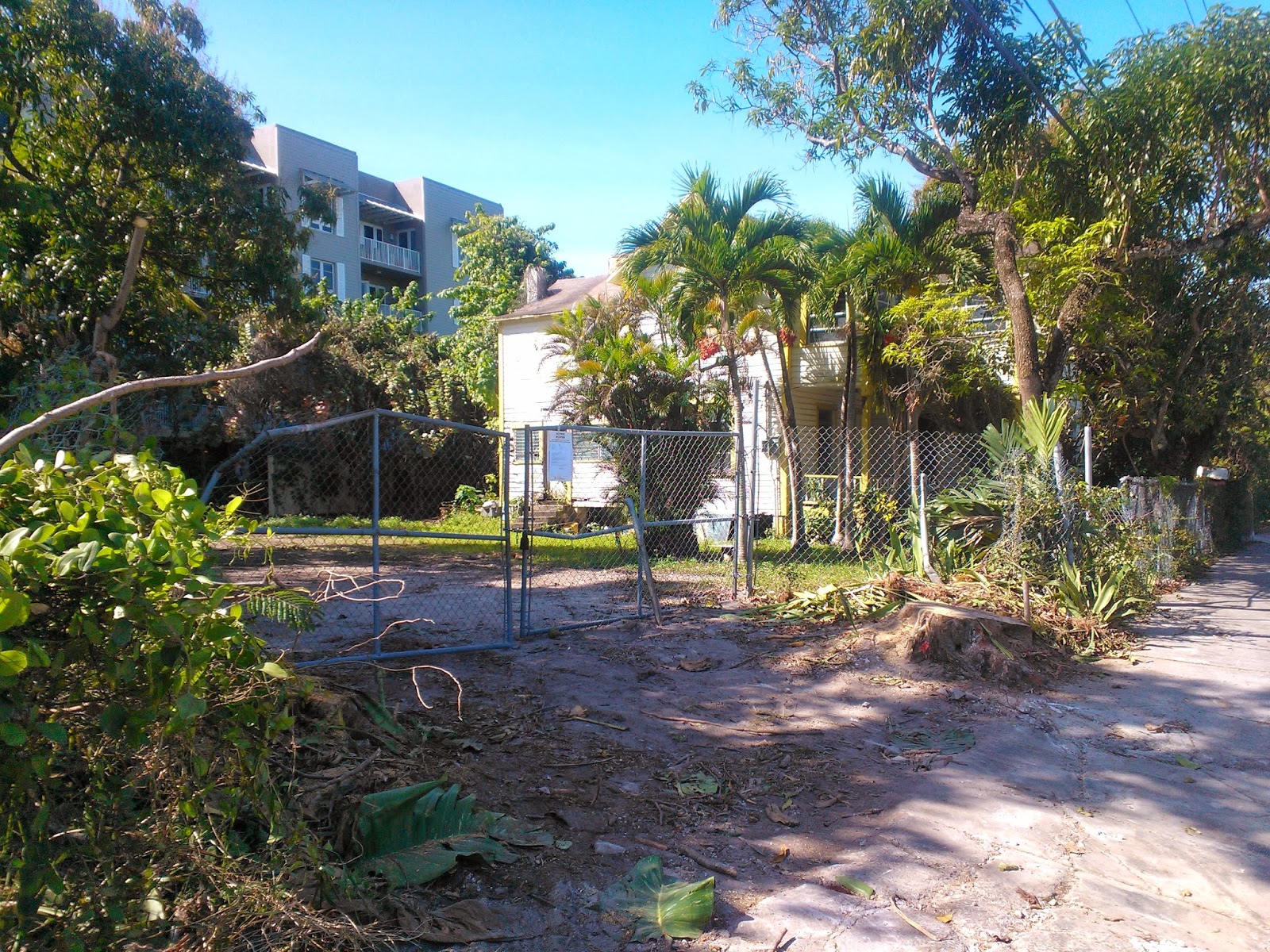
On the east side of the driveway now sits this beautiful stump.

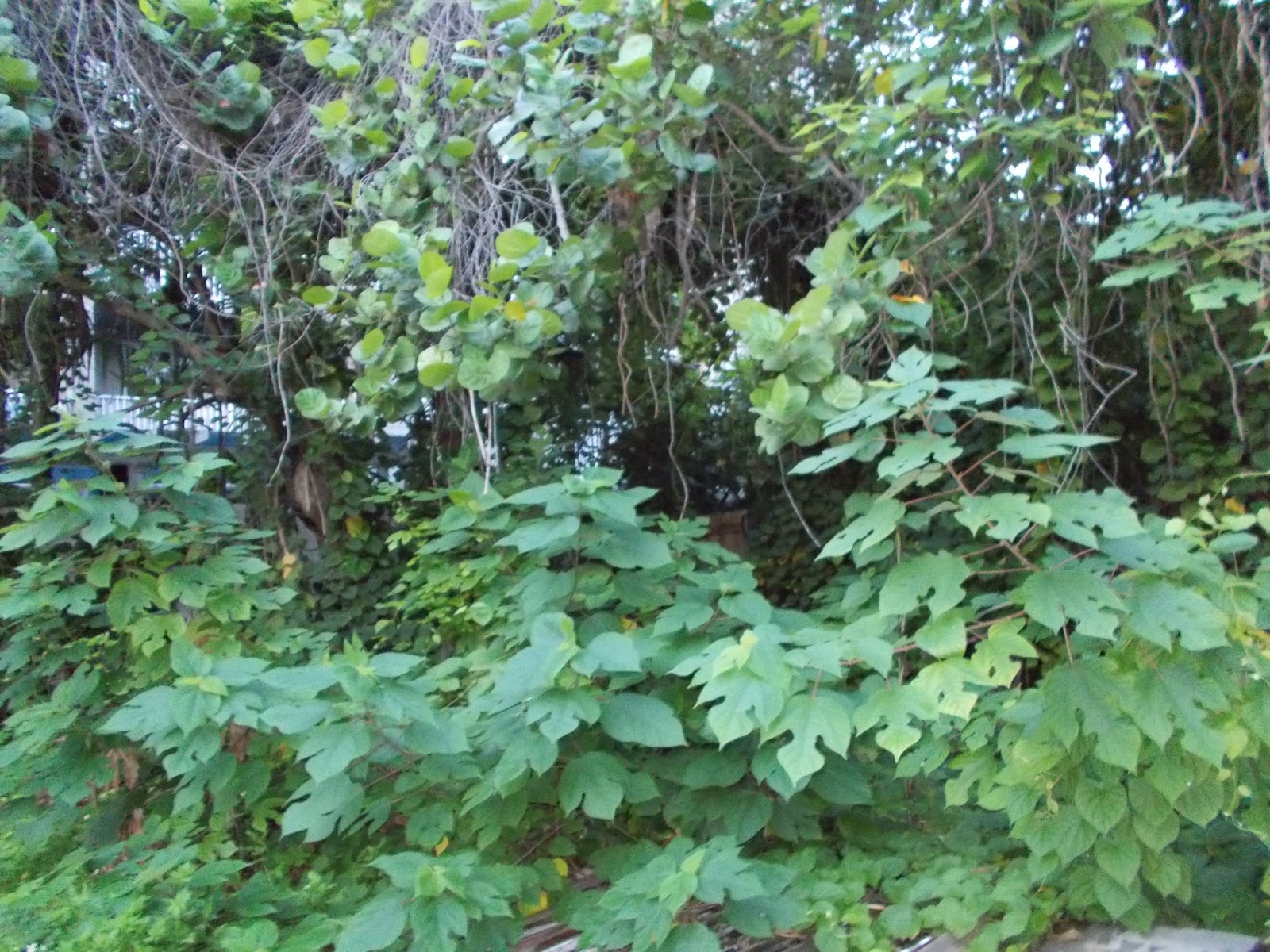
Four trees on Stirrup property (not to mention 3 trees on the vacant lot across the street) have been hacked down to the ground. Two of these trees flanked the Stirrup driveway entrance and they were nearly as old as the 120+-year old house. These trees were so old they had old growth vines climbing up them as far as the eye could see. This is the kind of lush foliage prized in Coconut Grove, with philodendron leaves LARGER than two dinner plates side by side. People pay extra in Coconut Grove for property with this kind of canopy. Now, it’s all gone. Compost.

Chopping down trees is one of those things that Miami takes very seriously. In fact, there are strict laws against it. When it was learned a year back that Coconut Grove would lose some of its canopy along Commodore Plaza — ironically just a block away from the Stirrup House — people went nuts and had the tree removal program scaled back considerably. Later, when people in Brickell learned that the green canopy there was slated for destruction, not only did public opposition stop that plan in its tracks, but recently the City of Miami decided to take responsibility of Brickell from Miami-Dade County to better manage its resources.

IRONY ALERT: I’ve been yelling about the Demolition by Neglect of the E.W.F. Stirrup House for years without getting any traction. However, after having made few phones yesterday afternoon about these old growth trees being chopped down, I had two reporters call me to see what I knew about it. I expect more media phone calls to come.

Two stumps, one on either side of the driveway.

Code enforcement beat me to the Stirrup House by minutes and cited the property owners for:

Violation Date: Feb 21, 2014 Violation Time: 10:00AM
Code Section(s) Violated: VIOL REF#2125 Tree removal/relocating/trimming/root pruning without a finalized permit. (Any required mitigation must be City Code Chapt 17

Correction: 4 trees removed on property and no permit on file, please contact planning Department for for an after the fact permit.


Fine amount: 1,000 * 4 = 4,000.

That 8-foot wall on the left used to run right across the back of the property.
Just beyond the yellow CAUTION tape is the restaurant seating. See video below.

As what always happens when Aries Development screws up at the Stirrup House, it’s the Stirrup Family that gets cited for the violation, a pattern documented in these pages on several occasions. That’s because Aries is merely the lessee of the Stirrup property.

When Mr. Stirrup died in 1957, his will stated that his beautiful house — which he built with his own hands and of which he was justifiably proud — must remain in the family in perpetuity. Consequently, the owner of record is a company called Stirrup Properties, Inc. The officers of that company are David Porter, Jr., Dazelle D. Simpson, and E.W.F. Stirrup, III., descendants of Ebeneezer Woodbury Franklin Stirrup. At one time Mr. Stirrup was the largest landholder in Coconut Grove and his lovely house looked out over his vast real estate holdings, leading to him becoming one of Florida’s first Black millionaires.

Developer and scumbag (but I repeat
myself) Gino Falsetto. Pic swiped from
Bring Truth To Light
, whose proprietor
has been fighting Falsetto for some 20+
years, documenting some shady real
estate deals
, in the public record.

If he could see to whom his grandchildren entrusted the second oldest house in Miami, he’d be spinning in his grave.

I’ve written many stories about Aries Development — and when I say Aries Development, I really mean my Canadian compatriot Gino Falsetto. Here’s a quick recap:

Falsetto skedaddled to Miami from Canada after bankrupting 4 restaurants that he (and his brothers) owned in the Ottawa, Ontario, area (some across the Ottawa River in Hull, Quebec). Ottawa is the nation’s capitol and at least one of these restaurants is where Canadian power-brokers and politicos wined and dined, while reaching in each others pockets. When the Canadian government finally lowered the boom on the Falsetto Boys, all it managed to do is seize the assets of those restaurants: cash in the till, liquor stock and plates and cutlery. It’s estimated that the Canadian taxpayers were left on the hook for $1,000,000 in unpaid taxes on the restaurants that had been making money hand-over-fist before Falsetto over-extended himself.  Also among the losers were the vendors and all the employees, who never received their final paycheques. However, private investors are said to have lost a pile of dough as well. One of my sources who once worked for Falsetto — and claims to like him — estimates these investors lost upwards of $10,000,000. Imagine what he might have told me if he hated Falsetto. My source wanted to clear things up because I had touted the million dollar figure. I don’t know whether he was bragging on Falsetto’s behalf, or not.

Falsetto seems to have left Canada just before the tarring and feathering. His golden parachute allowed him to land on his feet on the over-heated Miami real estate market. Where did he get the money if his restaurants just went into the dumper? Bars and restaurants are notorious for being cash operations. Just saying. And now Gino Falsetto is operating more bars and restaurants, this time building and owning The Monstrosity in Coconut Grove through his Aries Development; a multi-use complex for rich white folk (with certain exceptions, which I’ll get to in a minute) that has 4 restaurants and/or bars on the ground floor. Just saying.

This video
provides the brand new view from one of Falsetto’s restaurants in The
Monstrosity, La Bottega Enoteca Sociale, after the
8-foot wall was removed. Why Gino Falsetto would want the patrons of
his restaurants to look out onto the pile of crap he allowed the E.W.F.
Stirrup House to devolve into is one of those mysteries of the cosmos.
Missing from this view are the 4 old growth trees recently chopped down
to the ground.

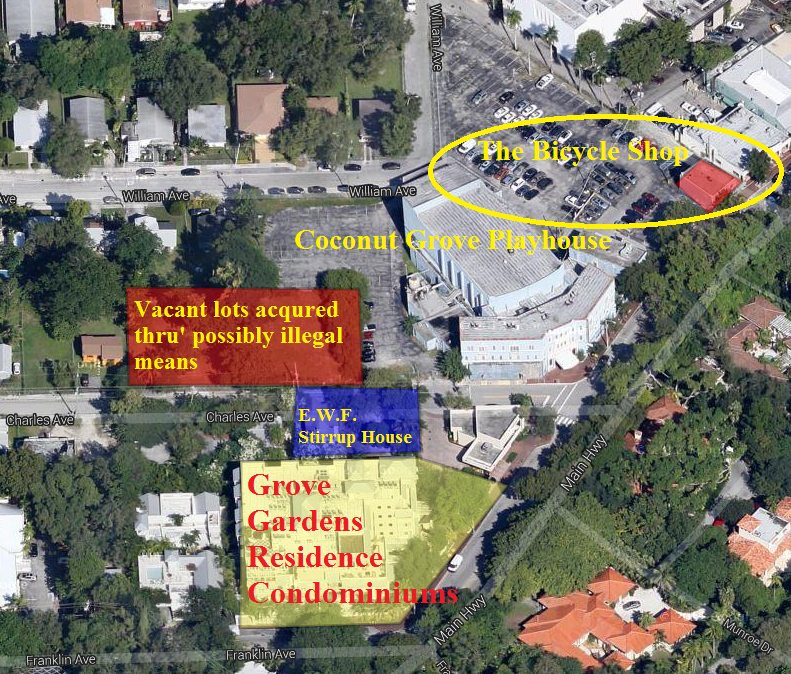
Among the other pies Falsetto stuck his fingers into once he landed on his feet in Miami is The Monstrosity on Main Highway, immediately behind the E.W.F. Stirrup House. From Day One Falsetto had his eyes set on bigger game. First he wrapped up control of the Stirrup House and ownership of two lots on the north side of Charles Avenue in the same deal, the broad contours of which appear to conceal a crime. We report; you decide. Follow the bouncing ball:

The Stirrup Family owned the 2 lots on the north side of Charles Avenue and Aries Development (Gino Falsetto) made them an offer. “We’ll trade you two units in The Monstrosity for a 50-year lease on the Stirrup House, ownership of the two double lots across the street from the Stirrup House, and $10 to make it all legal.” All of that was quite legal.However, here’s where it gets tricky.

Gino Falsetto seems to have learned how to make bankruptcy work for him. That’s what may have been illegal on this deal, in which the Stirrups appear to have been mere pawns — and Falsetto made out like a bandit. First he valued the 2 condos that he traded away in The Monstrosity at $500,000 each. Then he went to the bank and, based on his own valuation, got a loan of a figure adjacent to $750,000, using the property as collateral. Then he promptly defaulted on the loan.

Two giant old growth trees once flanked this driveway. Had they still
been there it would have completely blocked the view of The Monstrosity.

When the bank put the property up for a foreclosure auction, it was purchased for some $250,000 by a company in which Pierre Heafey figures prominently. Heafey is also a Canadian compatriot, who is partners with Gino Falsetto in other companies. Then the properties appear to have been shuffled through several numbered companies, until they now seem to be owned by a numbered company in which Falsetto is an officer. To recap: These two properties that Falsetto defaulted on have wound up being owned by companies in which Gino Falsetto figures prominently. Of course the banks were insured for the loss by the FDIC, which means that this was YOUR tax dollars at work.

Regardless of this skullduggery, which was still in the future, the Stirrup family accepted the trade. There were no microphones present to see whether they sang the theme song to The Jeffersons, but the fact of the matter is that the Stirrups were literally moving on up to the East Side, to a deluxe apartment in the sky. And then, for the next 8 years, the Stirrups have been witness to (if their balconies have a northern view) the garbage dump and disrepair that Gino Falsetto has allowed on their grandfather’s property, a precious cultural resource. The ongoing program of Demolition by Neglect is heartbreaking for anyone who cares about Black history.

The most recent Google Maps Street View with the foliage flanking the driveway. While the
8-foot wall (since removed) can be seen in the background, The Monstrosity is barely visible.

It gets worse, of course, because when one starts to peel back the onion that is Coconut Grove corruption, you will find layers upon layers.

The view from the restaurant towards the pile of crap
the rear of the E.W.F. Stirrup House has become.

While Falsetto’s tentacles had been thrust into the other fiasco on Charles Avenue, the Coconut Grove Playhouse, his claims on that building ended recently when he was gifted the Bicycle Shop, a small building with extremely valuable Main Highway frontage. While the Playhouse is an entirely separate issue that also happened to involve Falsetto, the only reason to mention it here is to note how the aftermath of that Playhouse deal has made it worse for The Charles Avenue Historic Roadway.

Until that deal had been worked out Falsetto-connected companies (Double Park LLC and Paradise Parking Systems LLC) were able to pocket the parking fees on the lot between the Playhouse and the Bicycle Shop. However, once the Playhouse deal is certified (which is supposed to happen any day now) that parking revenue will revert to the Miami Parking Authority and Falsetto will be frozen out.

One blogger is calling for an investigation
into how those companies got the Playhouse parking concessions in
the first place. However, just like restaurants, parking lots are another business that deals in cash, in which skimming is notoriously rampant. Just saying.

So . . . remember those vacant lots on the north side of Charles Avenue that Falsetto may have acquired illegally? At least one of them is slated to be “flat parking,” presumably for the valet parking for the restaurants in The Monstrosity. This will replace some of the revenue lost to the Miami Parking Authority, which brings us to the latest Falsetto Bait & Switch. A while back he got the City of Miami to agree to a zoning variance on these vacant lots to allow him to shunt the valet car parking in and out of the lot behind the Playhouse. Now that variance will be used to create a surface parking lot on on what was always meant to be a residential street, before Gino Falsetto got his grimy hands on those properties.

In fact, before Gino Falsetto got his grimy hands on those properties there had been houses on those two double-wide lots on the north side of Charles Avenue. However, they were knocked down when The Monstrosity was being built so that Aries Development could use these lots as a marshaling yard for the construction of The Monstrosity. Rather than go out to Main Highway the construction materials were shunted in and out of the Stirrup property to the construction site.

Behind this sign honouring the original Bahamian residents of Coconut Grove
are the two vacant lots, seen here before 3 trees were removed from the that lot.
This vacant lot will apparently become “flat parking” on a street that had been
zoned residential before Falsetto started messing around. Now these lots will
be used for the fancy cars of the rich White folk who frequent Gino Falsetto’s
restaurants in The Monstrosity. Thus Falsetto profits his destruction?

I have been writing about the E.W.F. Stirrup House for 5 years. My stories on the house led to my stories on Trolleygate, which I have been writing about for the past year. However, it’s only been recently that I realized that what I was REALLY writing about was The Colour Line in Coconut Grove. My continued research has shown that The Colour Line has been shifting and moving in Coconut Grove for the last century. It’s only recently that the center has been shrinking at a rapid rate.

By that yardstick the E.W.F. Stirrup House crossed The Colour Line when Falsetto acquired control of it. The two houses, on the double-wide lots on the north side of Charles Avenue, crossed The Colour Line when ownership was slipped to Falsetto thru the back door, as it were, and they were destroyed to make way, eventually, for a parking lot. The property on which the Coconut Grove Playhouse sits crossed The Colour Line in 1926 when E.W.F. Stirrup sold it so that it could become a movie theater, bring culture to Coconut Grove. Prior to that the eastern edge of The Colour Line was Main Highway, the opposite side of which contains homes in the several millions of dollars today. That’s always been the White side of The Colour Line.

[Trolleygate is another issue in which several Black properties crossed The Colour Line. Those neighbours have banded together to wrest the 4 properties back to the other side of The Colour Line.]

It’s the rich cultural legacy of E.W.F. Stirrup that is being destroyed, along with his property. I won’t go into why Mr. Stirrup is important to the history of Coconut Grove here, as this post is long enough already. However, if you want to know how a Black man became a millionaire in the Jim Crow South and created a unique community in this country along the way, please read:


If you care about this issue, please join the facebook group Save the E.W.F. Stirrup House.

Oh, and in case I forgot, I’d like to wish you all a very happy and joyous Black History Month.

Here are two more video views documenting the most recent destruction of the E.W.F. Stirrup property at the hands of a rapacious developer, aided and abetted by the descendants of one of the most important men in Coconut Grove history.


What’s Going On At The Taurus Bar?

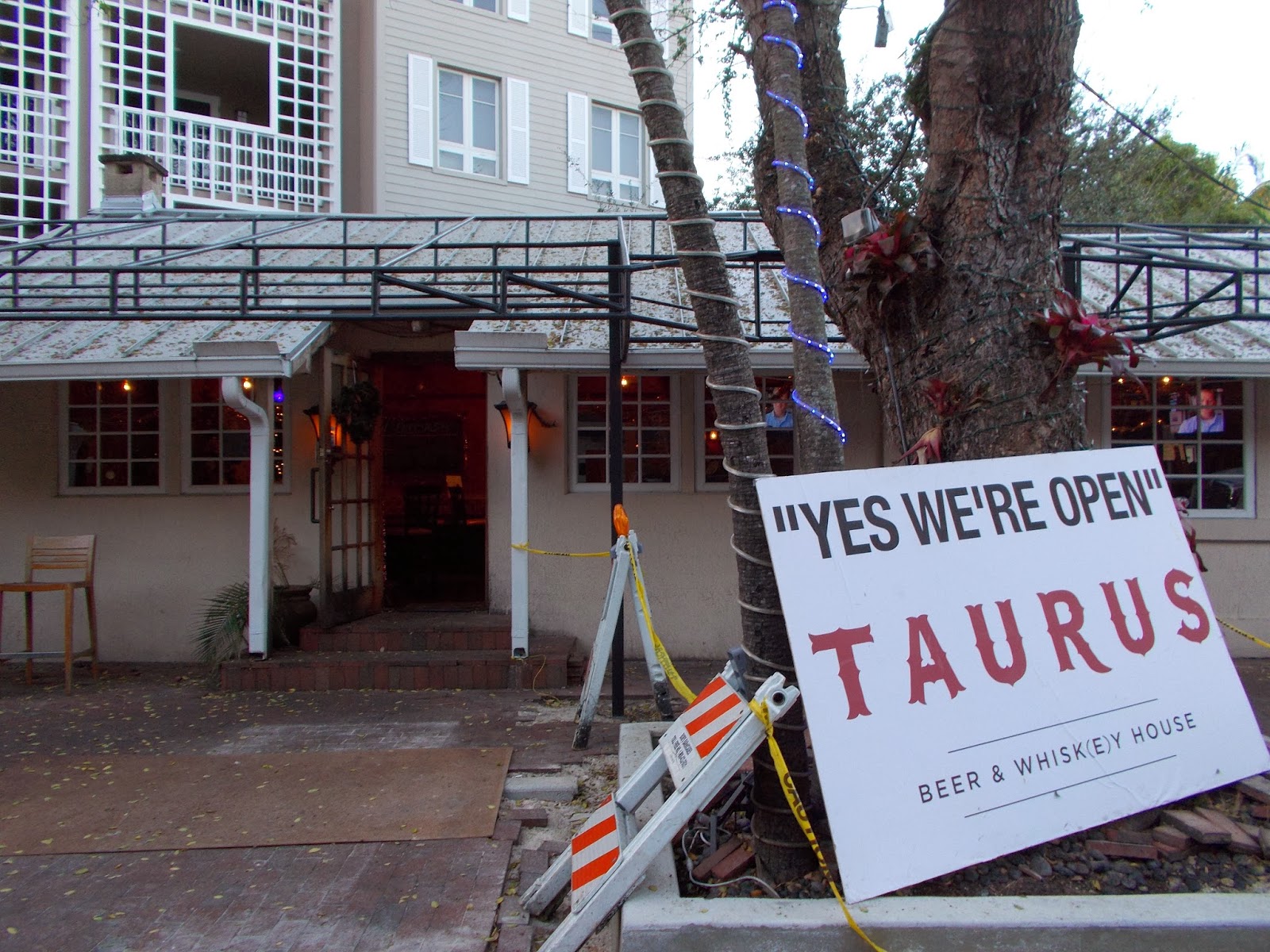
Framework for an awning is being installed on The Taurus Bar, December 19, 2013.
This work may or may not be non-conforming, may or may be contrary to previous
promises, and may or may not have been built without benefit of a building
permit. With the Grove Gardens Residence Condominiums in the background.

A recent visit to Coconut Grove to document The Bicycle Shop revealed work going on at The Taurus Bar, the venerable watering hole in front of the Grove Gardens Residence Condominiums. 

Based on my previous investigations of [allegedly] illegal work going on inside the E.W.F. Stirrup House, it’s fair to ask the following questions: *


1) Does this work conform to all Miami and Miami-Dade bylaws?
2). Does this work conform with whatever promises were made to preserve The Taurus when the GGRC was built?
3). Does the owner have a building permit for the work?

I’ve written about The Taurus briefly, and only tangentially, during my research of Coconut Grove. It’s owned by an arm of Aries Development, builder of the GGRC, the monstrosity that dwarfs the little one-room building and the 2-story E.W.F. Stirrup House. Aries also owns the two other restaurants on the ground floor of the mixed use condo complex. Aries, in case you haven’t been following along chapter by chapter, also owns the two lots on the north side of Charles Avenue immediately behind the Coconut Grove Playhouse. Furthermore, Aries is about to get title to The Bicycle Shop — extremely valuable Main Highway frontage — in exchange for reliquishing all claims against the Playhouse for a previous loan.

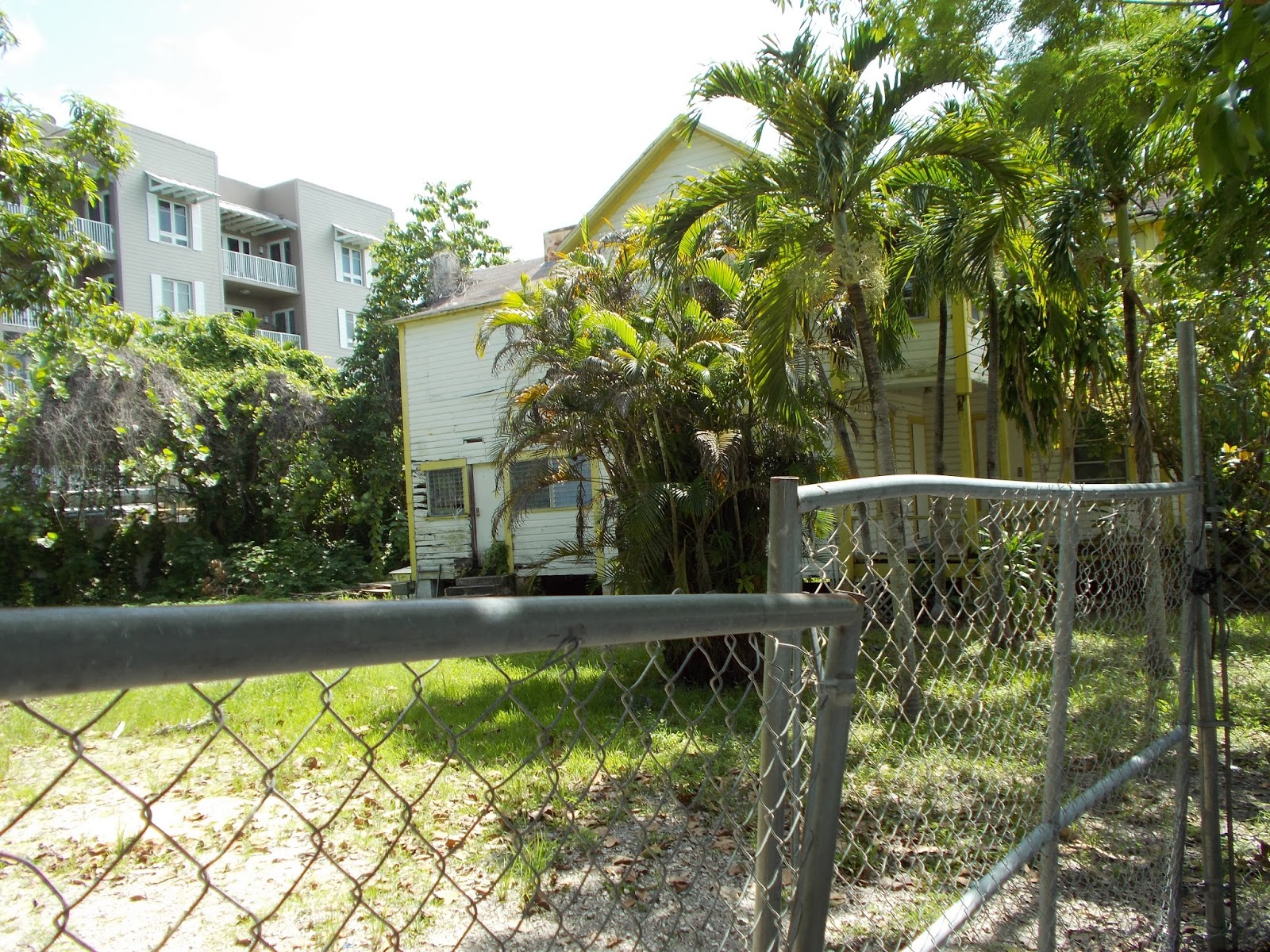
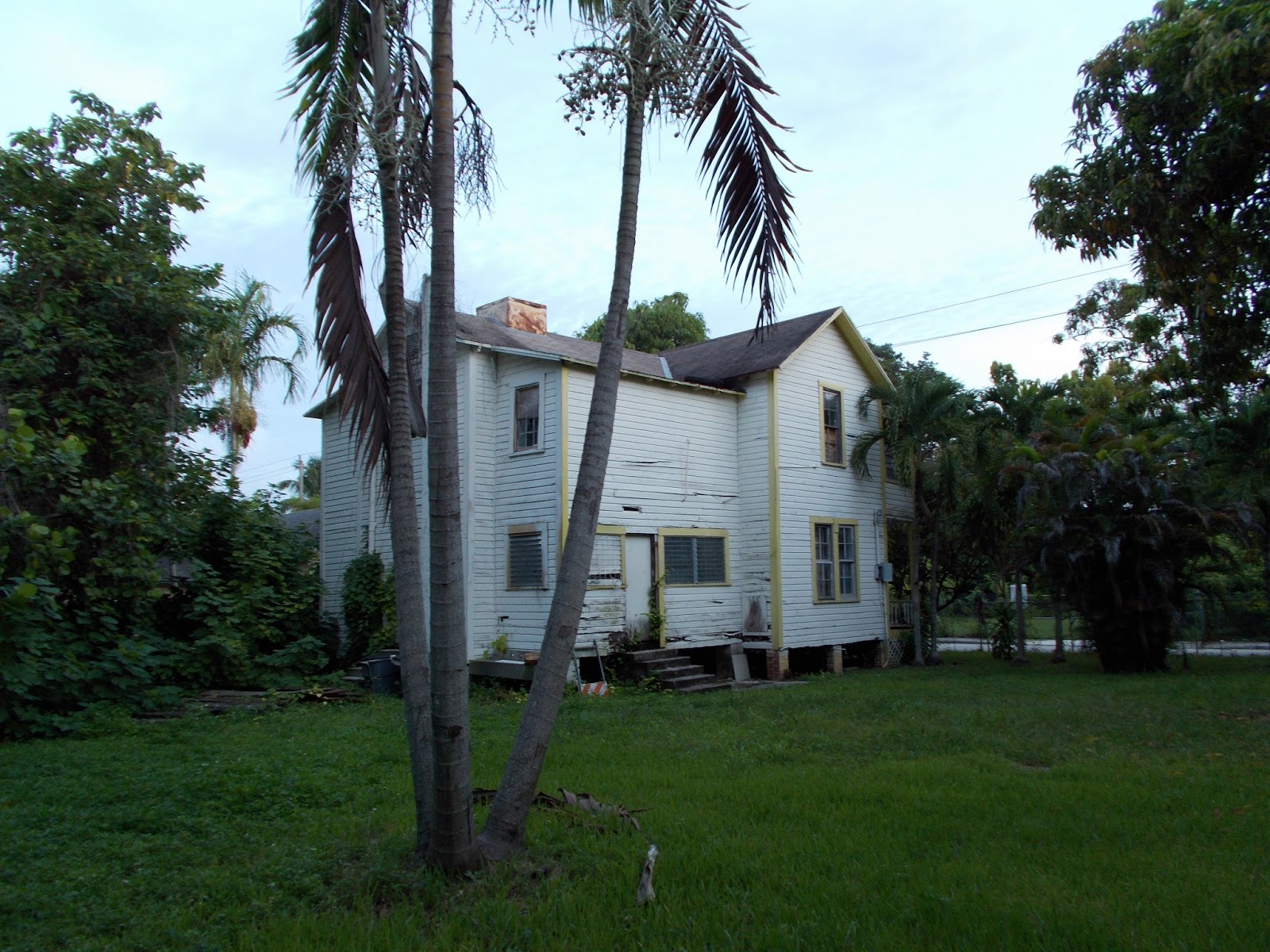
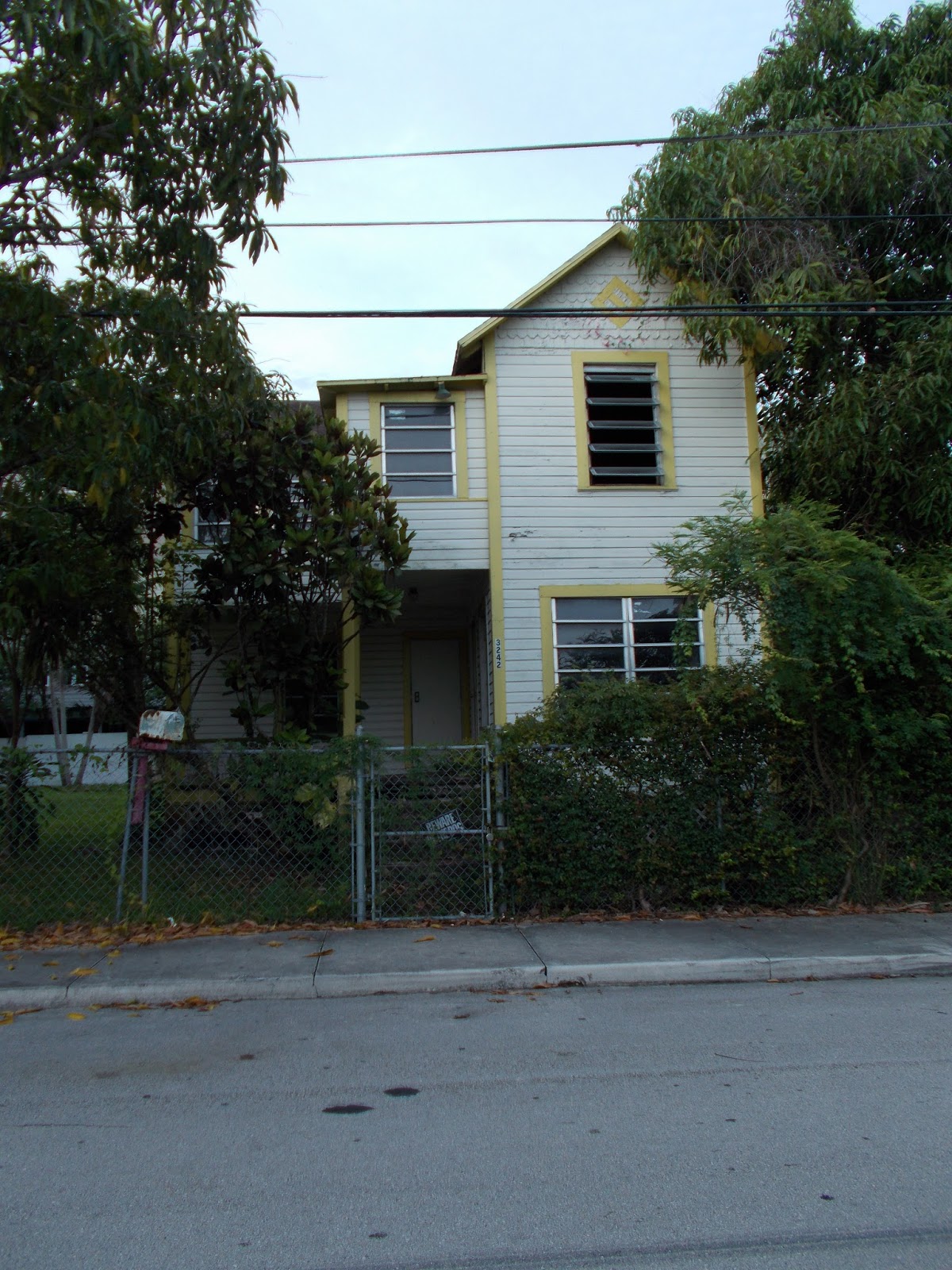
The historic 120-year old E.W.F. Stirrup House — a 2-story modified Conch-
style house — dwarfed by the 5-story Grove Gardens Residence Condominiums

Far more important, at least as far as I am concerned, is that Aries also finagled a 50-year lease on the E.W.F. Stirrup House and has been allowing it to undergo Demolition by Neglect during the 8 years it has had control of the 120-year old cultural treasure. The Stirrup House is now believed to be the 2nd oldest house in Miami, after the Barnacle, Commodore Monroe’s house, which is now a Historical State Park and less than a tenth of a mile away. 

Charles Avenue has been designated an Historical Roadway and the E.W.F. Stirrup House has also been designated historical by the City of Miami. However, the practical effect seems to be no practical effect.on Gino Falsetto, the primary owner of Aries Development. His stewardship of this historical landmark has been nothing less than shameful.

Related: Why saving the Stirrup House saves important Black History?
Please read:Unpacking Coconut Grove ► Part Two ► E.W.F. Stirrup House

Preserving the Taurus Bar was among the promises Aries Development made in order to get its permits to build the Grove Gardens Residence Condominiums. So was preserving and renovating the E.W.F. Stirrup House. It’s interesting to compare and contrast the treatment of the Taurus vs. the fate of the E.W.F. Stirrup House. 

The Taurus goes back, at the very least, to 1906, when it was a tea room for the High Society of Coconut Grove. Over the years it went from being a tea house to a neighbourhood bar. It attracted those within walking distance, but another one of the attractions, especially for the old-timers, was — as downtown Coconut Grove became overly developed — there was a free parking at the Taurus Bar in the years just before the GGRC was built. [Drinking and driving? Never mind.]

The E.W.F. Stirrup House goes back to the 1890s. I’ve written so much about the Stirrup House, I won’t go into its history here, other than its recent history. Ownership of the house remains in the hands of the Stirrup Family, as dictated by the will left behind when E.W.F. died in 1957. Aries obtained a 50-year lease on the house through a complicated property swap that’s detailed elsewhere at Not Now Silly.

While Gino Falsetto (through Aries, of course) promised to preserve and renovate both the Taurus and the Stirrup House, only the Taurus was fixed up. It’s been open almost the entire time. During a period that coincides almost perfectly with the Taurus being open, the E.W.F. Stirrup House has been empty, undergoing Demolition by Neglect, as mold, mildew and termites work away at the house.

I was told the reason no work ever progressed on the Stirrup House was because Aries ran out of money. However, The Taurus has been generating money for Aries and Aries had enough money to loan the defunct Playhouse board some of it. But, isn’t it strange Gino Falsetto never found the money to fulfill its OBLIGATION to restore the E.W.F. Stirrup House. And now it’s spending MORE money to put an awning on the Taurus before it fulfills its promises on the Stirrup House.

The Taurus Bar on December 19, 2013
TO BE FAIR: The Taurus could use an awning. Any place that hopes to have a viable outdoor patio, which The Taurus hopes to, in South Florida needs an awning. Fans and mist-ers are also a good idea. However, can you just throw an awning on any old building? What about a building more than 100 years old? What about a building more than 100 years old that you’ve promised to preserve?

And, while I’m asking questions, where’s the building permit? I looked inside and out, but saw no building permit. Does this awning affect pedestrian traffic? Was a study done of pedestrian traffic? Does the awning encroach on the public easeway for the sidewalk? How is Main Highway impacted by this awning. Is this an [alleged] infraction against Miami by-laws, Miami-Dade by-laws, or both?

Based on the past performance of Gino Falsetto these are all fair questions to ask. By sheer coincidence these happen to be the same questions I’ll be asking city and county officials in the next few days.

* The work is probably finished by now in advance of The King Mango Strut with Grand Marshall Rob Ford.

The Bicycle Shop The Latest In The Cultural Plunder of Coconut Grove

The Coconut Grove Playhouse before the hoarding was fixed

Recent news trickling out of Miami-Dade County has exposed more backroom machinations concerning the Coconut Grove Playhouse and — appearing for the very first time in any of the negotiations — The Bicycle Shop. 

Before getting too deeply into the weeds, this news proves that once again the ultimate stakeholders — the citizens of Coconut Grove and taxpayers of Miami — were played for dupes. All decisions concerning the Playhouse’s future have already been set in stone, without any public input whatsoever. Furthermore, not all those decisions have been made public yet, such as the ultimate design. 

There was a time I was ambivalent about the Coconut Grove Playhouse. I vaguely understood it to be mired in scandal and controversy. However, my cursory research showed that it was one of those things that served White Coconut Grove and I was researching the unique history of Black Coconut Grove. I was already committed to saving the historic, 120-year old E.W.F. Stirrup House; I didn’t have time for another Coconut Grove boondoggle.

My Trolleygate series proved why I need to follow all anonymous tips to see where they ultimately lead. It’s all interconnected in ways I could never have imagined when I started this research 5 years ago. The Stirrup House is catercorner to the rear of the Playhouse, just across the
street from the Charles Avenue historical marker. Oddly enough it’s been empty and undergoing Demolition by Neglect just about as long as the Playhouse has been shuttered. However, proximity and similar fates were not all that connected the two properties. I have since found two important links between Ebeneezer Woodbury Franklin Stirrup and the Coconut Grove Playhouse that finally placed it on my radar screen.

The Charles Avenue historical marker with the E.W.F. Stirrup House

The first goes all the way back to the 1920s and, to understand it, a small history lesson is in order. At that time E.W.F. Stirrup was one of the unlikeliest Movers and Shakers of a nascent Coconut Grove tourist industry. Ebeneezer Woodbury Franklin Stirrup was a Black man who, through hard work and a good business sense, became one of the Grove’s largest landowners and one of Florida’s first Black millionaires. His own house on Charles Avenue, which looked out over his holdings, was a 2-story showpiece, in a 1 story Conch house neighbourhood.

Together, with the other Movers & Shakers of the Grove, Stirrup must have anticipated reaping a financial windfall when, in the early 1920s, they commissioned The Bright Plan, the first urban renewal plan ever devised for Coconut Grove. Had the Bright Plan been implemented, Coconut Grove would have become the jewel of South Florida. A long boulevard with fountains down the middle would have led to an ornately appointed Coconut Grove City Hall, located approximately where Cocowalk is nowadays. All the designs of the buildings and fountains were based on a Mediterranean style. The Charles, Franklin, and Williams Avenue corridor would have become a golf course and the neighbourhood now known as West Grove would have been lost.

On the planning maps “Coloredtown,” would have been pushed to “the other side of the tracks,” just like in every other city in ‘Merka. That it didn’t happen is one of the things that makes Coconut Grove unique in this country. While Coconut Grove had its own Colour Line circling the traditional Black neighbourhood, it did not include railroad tracks.

However, it was not to be. Before the Bright Plan could be implemented, the Florida land boom went bust. By 1925 the words “Florida real estate” had became a national joke, so much so that George S. Kaufman’s Broadway musical-comedy The Cocoanuts revolved around swampland, tourism, and Irving Berlin tunes. Starring the Marx Brothers, it was set in Cocoanut Grove [note the “a,” the original spelling before amalgamation] and was a huge hit. The 1929 movie of the same name, with the same Marx Brothers, further cemented the town’s reputation.

A page from The Bright Plan shows the grand boulevard from Biscayne
Bay to a Coconut Grove City Hall. The odd shape in the upper-left is
where Coloredtown would have moved had this plan been implemented.

After the Bright Plan fell apart (younger) Miami annexed (older) Coconut Grove, including all of West Grove, or Coloredtown, or Black Grove, or Kebo, the African name given by the original Bahamian residents.

And, that almost didn’t happen either. Some White folk — among them some of those same Movers and Shakers that didn’t get rewarded financially when the Bright Plan died — lobbied against including West Grove in the boundaries of the new Miami.

It was fairly common in this country, as towns expanded and new areas
annexed, to exclude any of the small Black enclaves that had developed here and
there. The mere presence of Black folk could depress property values (and still does, for that matter). Whenever possible annexation occurred around these small Black enclaves until they were eventually swallowed up by the city.

That’s because — no matter where you go and no matter the era — the Movers and Shakers are, essentially, the monied and propertied of a given area. What Movers and Shakers generally want is to acquire more money and property, in order to become bigger Movers and Shakers. The Coconut Grove Movers and Shakers were no different. It was thought not having a Black area would make the new Miami more attractive for development, rewarding those who held property in Coconut Grove.

When Miami decided to annex West Grove along with the rest of Coconut Grove, a smaller group of those Movers and Shakers were already building their own lily White city of Coral Gables, just next door to Coconut Grove. The ugly historical fact is that the creation of Coral Gables was White Flight; a reaction to the Kebo neighbourhood of Bahamians, who could not be dislodged because the land was Black-owned, all due to the hard work of E.W.F.
Stirrup.

A White city could more easily control the movements of Black folk and their presence in Coral Gables was severely restricted. Right into the ’70s (according to anecdotal reports from a 73-year old who has lived in the same house on Charles Avenue his entire life), one needed ‘papers’ to be Black in Coral Gables. This usually amounted to a letter from your employer. However, if you couldn’t produce one, you’d be arrested for vagrancy and everyone in West Grove knew it.

To this day Coral Gables is 98% White. That doesn’t happen by accident.

Statue of George Merrick,
founder of Coral Gables,
outside Coral Gables
City Hall

Related reading:

No Skin In The Game is a
series looking into some of
the disparities between
Coconut Grove and Coral
Gables, Florida

Part One looks at a protest
against Trolleygate aimed
by the citizens of Coconut
Grove to land at a debate
for mayor of Coral Gables
in order to bring awareness
to the controversy.

Part Two is a continuation
of the evening in which our
intrepid reporter daydreams
about the founding of
Coral Gables.

Part Three is all about the
exception that proves the
rule; how Coral Gables
allowed a Black conclave
within its boundaries to
house its service workers.

Which brings us to the Coconut Grove Playhouse. 

In the mid-’20s, while George Merrick was building his lily White Coral Gables and Miami was annexing Black and White Coconut Grove, one item from the Bright Plan finally got built. E.W.F. Stirrup sold a large parcel of land on the northeast corner of Main Highway and Charles Avenue on which a developer could build the Coconut Grove Theater, now the Coconut Grove Playhouse, in the same Mediterranean style dictated in the Bright Plan.

There’s one other thing that links the E.W.F. Stirrup House to the Playhouse and that’s Gino Falsetto. Falsetto is the rapacious developer who arrived in the hot Florida real estate market after walking away from a string of bankrupt restaurants in the Ottawa, Ontario, Canada, area.

It’s an open question whether Falsetto became a Miami Real Estate Mover and Shaker on the backs of the Canadian taxpayers, his vendors, and the employees from his restaurants. All lost money — estimated to be more than $1,000,000 all told — when the Canadian government seized the physical assets of the eateries. Falsetto walked away, allowing the companies to go bankrupt. How much money did Falsetto pocket? The answer to that may never be known. What is known is that bankruptcy appears to be a tactic of Falsetto’s, which has served him well so far, as you will see.

Seemingly from Falsetto’s first arrival in the over-heated Miami real estate market, his various companies have been tangled up in one lawsuit after another. However, for unexplained reasons, he seems to keep falling up. Eventually he (Aries Development) acquired property at Main Highway and Franklin Avenue, large enough to propose building the Grove Gardens Residence Condominiums. During the permitting process there were three major objections from neighbourhood groups, all of which Aries promised to satisfy:

► The rich White folk on the east side of Main Highway — in Camp Biscayne, one of the oldest gated communities in south Florida — didn’t want to lose their spectacular sunsets for which they paid several million dollars for. They wanted the height of the condo building scalled back. Done. The multi-use condo complex was limited to 5 stories and stepped back as it rose, so it didn’t present a huge facade to Main Highway;

► The White drinkers at the venerable Taurus Bar were upset that they might lose their drinking hole, one of the only bars in Coconut Grove with free parking. TO BE FAIR: The Taurus dates back to AT LEAST 1906, when it was a tea room. Regardless, the developer heard the protests. Done! The Taurus is still there (although a possibly non-conforming awning was being built when this reporter visited on December 17th);

The lay of the land:

Gino Falsetto has sewn up a number of properties along Main Highway and Charles
Avenue. Now, to release his claim to the Coconut Grove Playhouse, he is being
given ownership of the Bicycle Shop, with valuable frontage on Main Highway

► The Black residents of West Grove were concerned that the development would threaten the 120-year old E.W.F. Stirrup House.

In order to obtain its building permit Aries made certain promises and representations to preserve and restore the E.W.F. Stirrup House, either as a community museum and resource center, or a Bed and Breakfast. Anecdotal memories differ and, sadly, no one seems to be able to produce the actual meeting minutes in which the condo project was approved.

No matter what the promise MAY have been, it has been broken. Since getting his grubby little hands on it almost 9 years ago, Gino Falsetto has neglected the Stirrup House, except for some [allegedly] illegal interior demolition and destruction. This precious community resource, believed to be the 2nd oldest house in Miami, has been allowed to undergo Demolition by Neglect. Aries Development has proven to be a terrible steward of this historic 120-year old house, like no other in the neighbourhood.

IT GETS WORSE: In the same deal in which Falsetto acquired the lease on the Stirrup House, he also scooped up two double-size lots on the north side of Charles, across from the Stirrup House. However, there appears to be some subsequent irregularity — some say illegality — with those two properties.

Falsetto traded two units within the Grove Gardens Residence Condominiums — the monstrosity he built behind the Stirrup House — for outright ownership of the two lots assessed at $87,615 and the 50-year lease on the Stirrup House. Heinz Dinter tells the next part of the story:

Gino Falsetto finds himself a real estate appraiser who dares to value the two lots heavy with weed and grass at $1,000,000. With the appraisal in hand Falsetto finds a daring banker who loans Gino Falsetto $700,000 — all so legal in accordance to the 70% loan to equity ratio. What a coup!

That’s not the end of the dramatic plot. Gino Falsetto defaults on the loan, the bank forecloses with a $720,546.28 judgment in hand and none other than Pierre Heafey’s Heagrand Inc buys the land in the foreclosure sale for $200,100. [Editors note: Pierre Heafey and Gino Falsetto are partners in other companies.]

The curtain rises on the last act. Falsetto forms a new company, 3227 Charles LLC, and that new company buys the two lots from Heafey for $215,800.

The bottom line must be called a stunning performance: Gino Falsetto gives up two condominiums worth $419,050 and in return is the sole owner of two vacant lots assessed at $87,615, but possibly worth many times more depending on the neighborhood’s future, and some half a million dollars in cold cash in his pockets compliments of the American taxpayer (the bank loan was insured by FANNIE MAE).

The Bicycle Shop is the latest, and possibly last, piece in the Coconut Grove
Playhouse puzzle. In the latest deal — struck in the backrooms between the big
boys — Gino Falsetto’s Aries Development gets ownership of this property (and
a nominal $15,000) to relinquish all claims to the Coconut Grove Playhouse.

Got that? Foreclosure auctions are supposed to be at arm’s length. How is it that a company owned by Gino Falsetto managed to get its hands back on the same property after a company owned by Gino Falsetto defaulted on the original loan?

I’m not a lawyer, but that can’t be legal.

During the same period that Falsetto was scooping up valuable and culturally important Coconut Grove real estate through dubious means, he (through Aries) also loaned the defunct board of the defunct Coconut Grove Playhouse some defunct money. Holding a financial lien on the Playhouse, Aries has scuttled deal after deal for those who were trying to renovate and reopen the Playhouse. That is, until recently.

Which brings us full circle: When the news leaked that there may FINALLY be a deal to renovate the Playhouse, people were stunnded to discover it involved giving the Bicycle Shop to Aries Development. This small building at the northeast end of the Playhouse parking lot — which really was a bicycle shop a long time ago — and the nominal amount of $15,000 will be given to Aries Development to satisfy all claim on the Playhouse.

Currently the alley immediately to the north of of the Bicycle Shop [at right above] is the end of the demilitarized zone in Coconut Grove. Casual pedestrians tend not to walk any further south, unless they are walking on the OTHER side of Main Highway. The newly opened restaurant Acropolis, on the other side of that alley, is as far south as people tend to walk. Those who arrive at the restaurants on the ground floor of the Grove Gardens Residence Condominiums — just a block south — tend to arrive by car.

The Bicycle Shop is piece of Main Highway frontage that will be a goldmine once the Playhouse reopens. It will have a Playhouse on one side, restaurants on the other, with The Barnacle Historic State Park and some of the most expensive houses in all of Florida in heavily gated communities right across the street.

It’s an insult to the memory of E.W.F. Stirrup that Gino Falsetto and Aries Development will be rewarded for their avariciousness and Demolition by Neglect of the E.W.F Stirrup House. 

Before Miami-Dade gives away a piece of property worth potentially millions of dollars over the long run, why doesn’t the county see to it that Aries fulfill the promises it has already made to the people of Coconut Grove and taxpayers of Miami?

Is Gino Falsetto Breaking The Law Again? ► A Charles Avenue Update

The Charles Avenue historical marker with the
E.W.F. Stirrup House across the street.

It’s always been about the E.W.F. Stirrup House. My research into Ebeneezer Woodbury Franklin Stirrup has led to many interesting tangents, none of which would I have ever heard about had it not been for Mr. Stirrup.

Among those tangents include my series No Skin In The Game, documenting 90 years of Coral Gables racism; my investigations into [allegedly corrupt] Miami Commissioner Marc D. Sarnoff, who managed to build himself a dog park and a traffic circle, not to mention the undying enmity of his West Grove constituents; and my ongoing reporting on Trolleygate, which culminated in a hearing at the Dade-County Courthouse on Friday. However, I would never have come across those stories had I not accidentally encountered the Charles Avenue historical marker in February of 2009. That was the day I first set eyes upon the E.W.F. Stirrup House and fell in love.

That’s the very same day I started researching the history of the house, which quickly led to the discovery that E.W.F. Stirrup was a remarkable man — decades ahead of his time. Mr. Stirrup created an area unique to this entire country. Because of his efforts Coconut Grove at one time had the highest percentage of Black home ownership in the entire country, which might be the only reason West Grove has remained intact all these years.

Elsewhere in ‘Merka, Black neighbourhoods were comprised of a majority of renters, with absentee landlords. This is why I-95 could be punched through the middle of Overtown, or why I-75 totally obliterated Paradise Valley, in my home town of Detroit.

Yet, sadly, Mr. Stirrup’s legacy is barely known to the people of Coconut Grove. If they know the name at all it’s only because of the E.W.F. Stirrup Elementary School. However, that’s not Mr. Stirrup being honoured by having a school named after him. That’s his son. Not that he doesn’t deserve to be commemorated, because he was a man with a legacy in his own right. However, his father was far more significant to the history of Coconut Grove, Miami, Florida and the United States. This is not hyperbole. Read my previous chapters on the E.W.F. Stirrup House to understand why Mr. Stirrup was important and why it’s imperative to save his house.

Even though the E.W.F. Stirrup House has been designated historic by the City of Miami, a rapacious developer got his hands on the Stirrup House 8 years ago and has been allowing it to undergo Demolition by Neglect ever since. Aries Development is the name of the company and and Gino Falsetto is the name of the man who runs it. Falsetto is Canadian, not that I hold that against him because so am I. However, Falsetto left a string of bankrupt restaurants behind in Ottawa, Ontario, Canada on which the Canadian taxpayers lost an estimated $1,000,000. And, of course, all the employees and vendors lost money. However, shortly afterwards Falsetto landed on his feet as one of Miami Real Estate’s big wheelers and dealers. Then he set his eyes on Coconut Grove and built the Grove Gardens Residence Condominiums on Main Highway, immediately behind the E.W.F. Stirrup House. And that’s when the E.W.F. Stirrup House began to fall apart.

One wonders if the Canadian taxpayers provided Gino Falsetto with the grub stake to buy into the always over-heated Miami real estate market.

During Falsetto’s property-trading he managed to acquire a 50-year lease on the E.W.F. Stirrup House, the ownership of which still remains in the Stirrup Family. At the time he acquired the lease, Falsetto promised to restore the house. In the 4 years I have been visiting the house, and the 4 years prior to that, he’s done virtually nothing, except to make things worse by allowing it to undergo Demolition by Neglect.

It was just a year ago, August 18th, that I got into the house for the first time. I documented that in a Not Now Silly post called Unpacking Coconut Grove ► Part Four ► Open Houses and Broken Laws. Compare the pics in that post to the current look of the interior in this video taken on August 16, 2013:

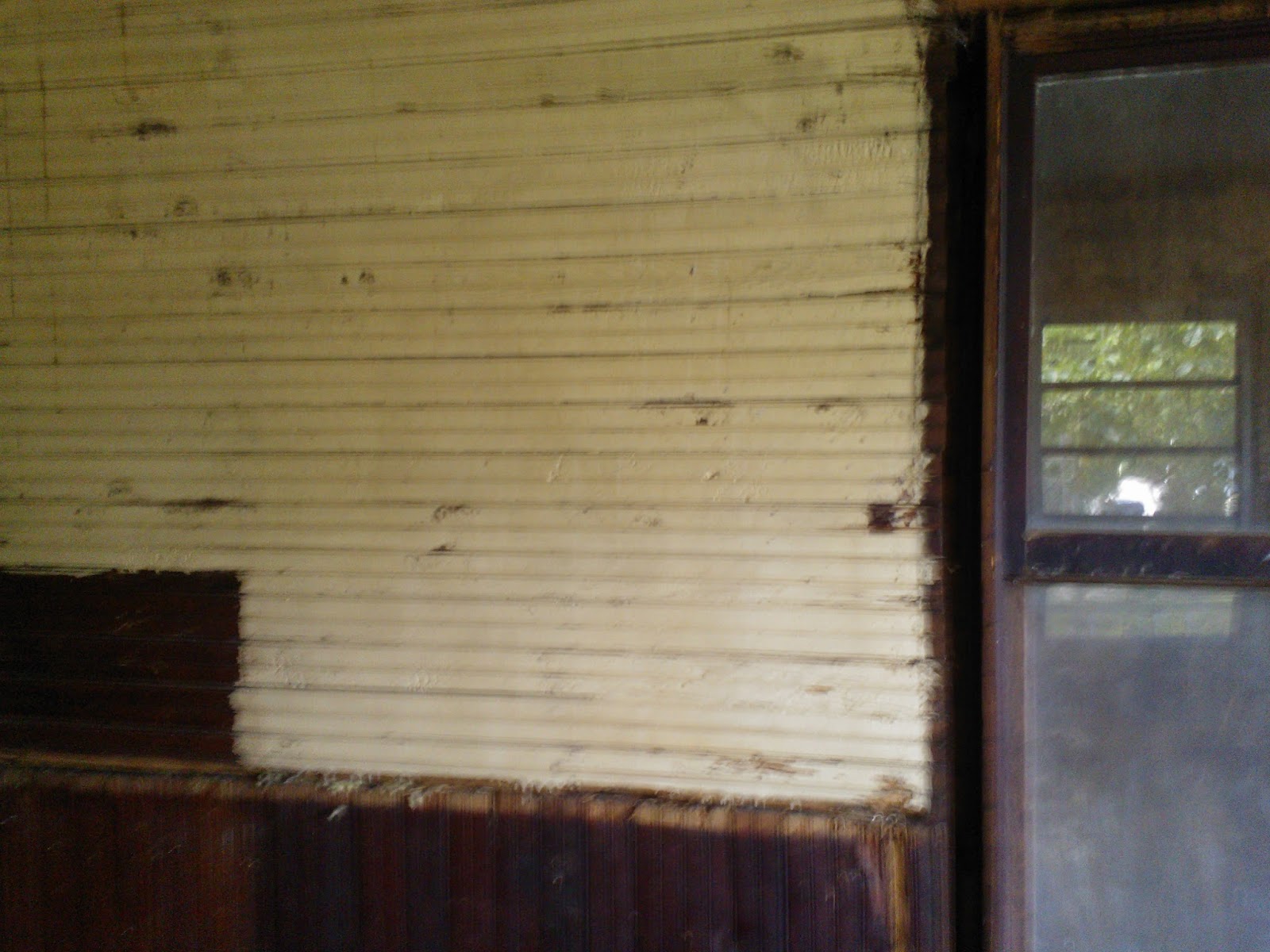
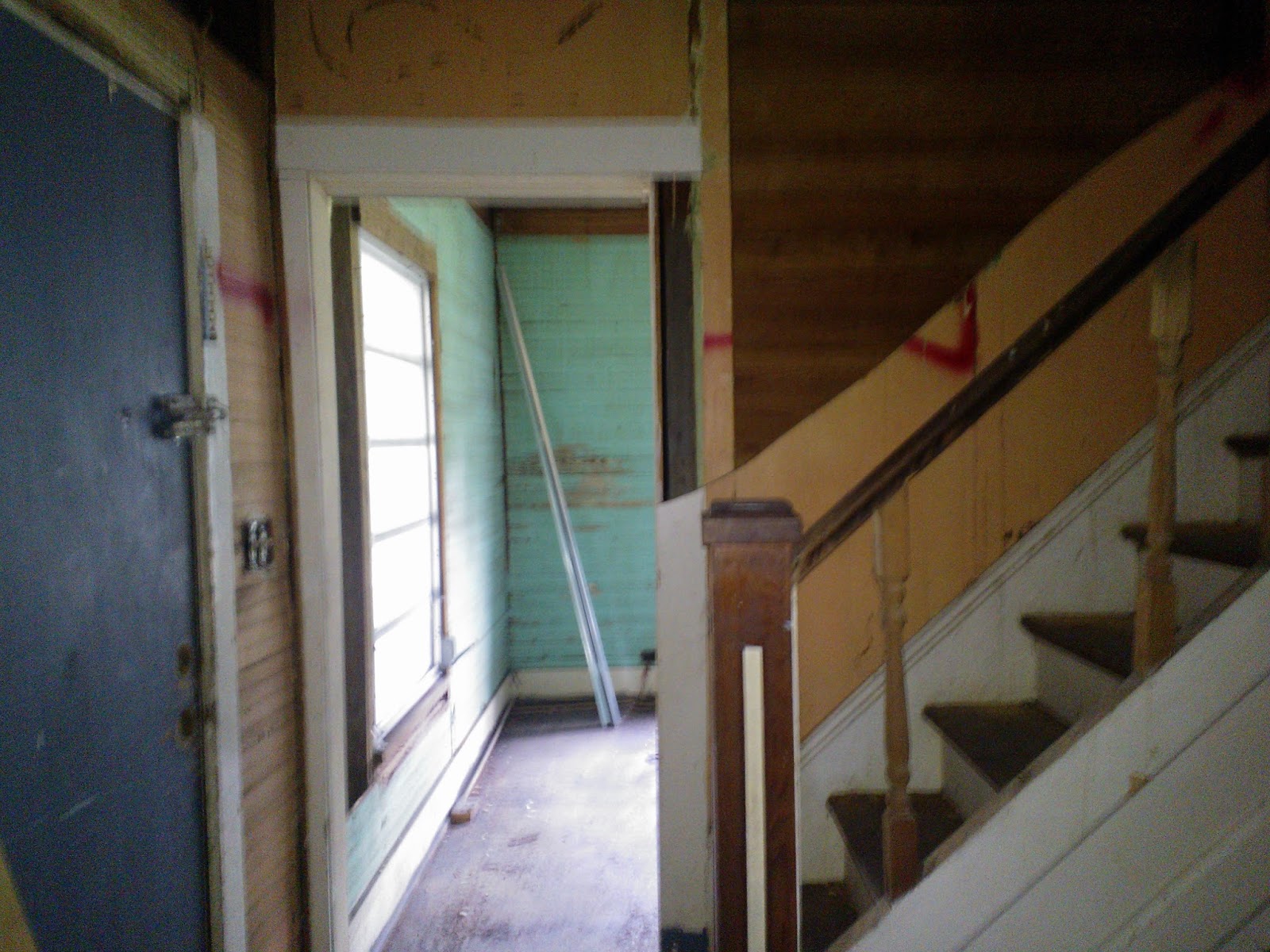
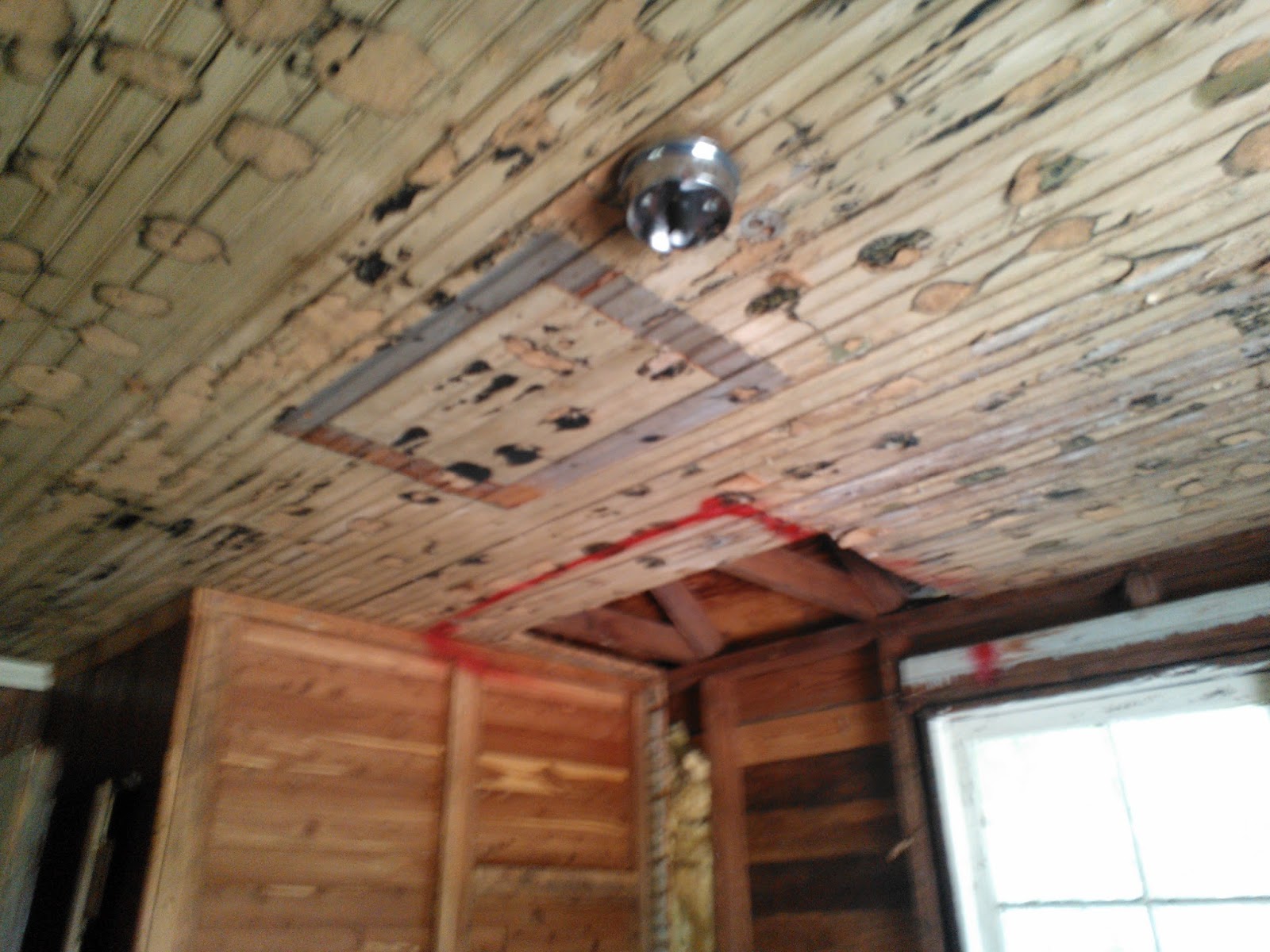
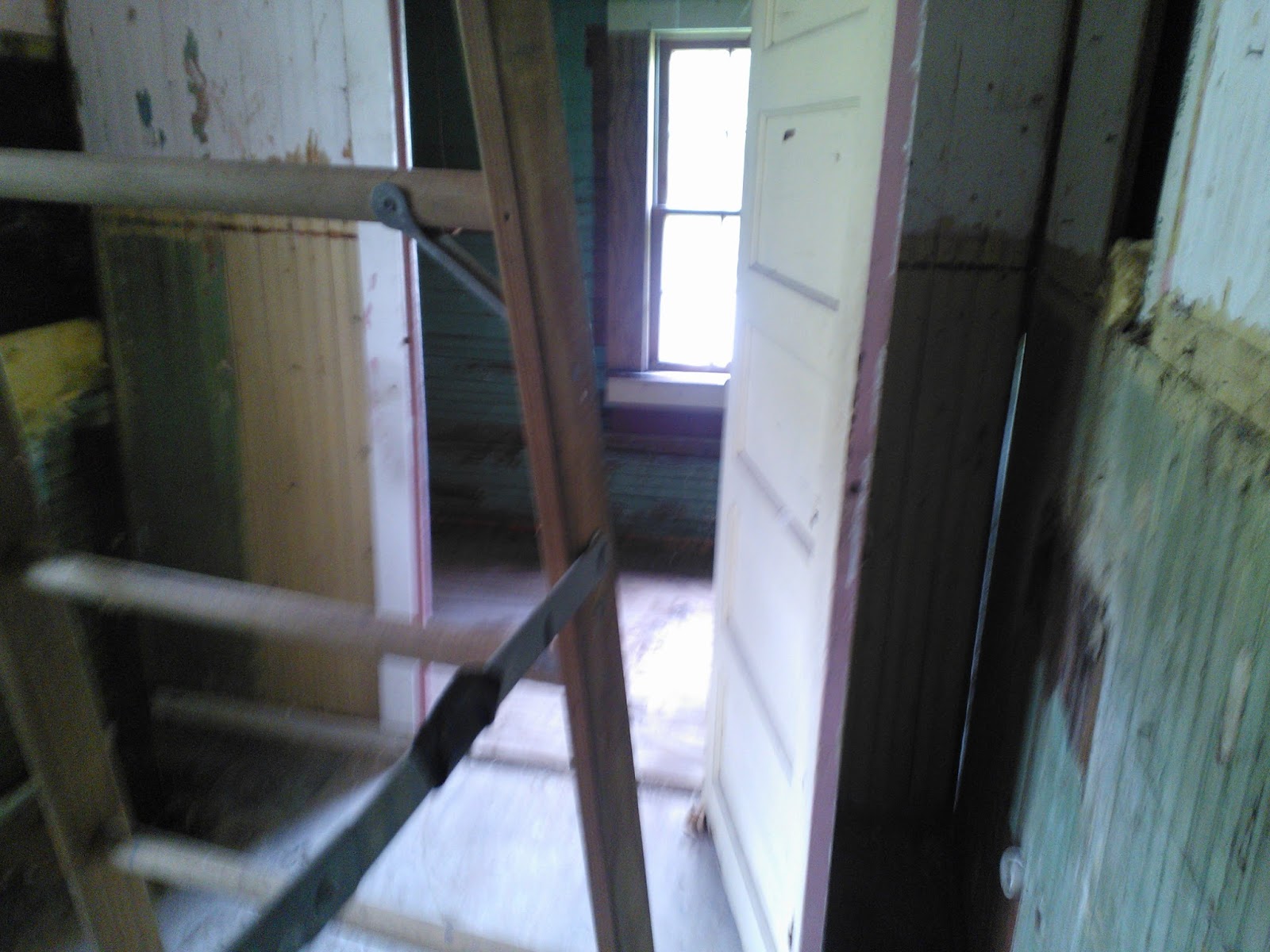
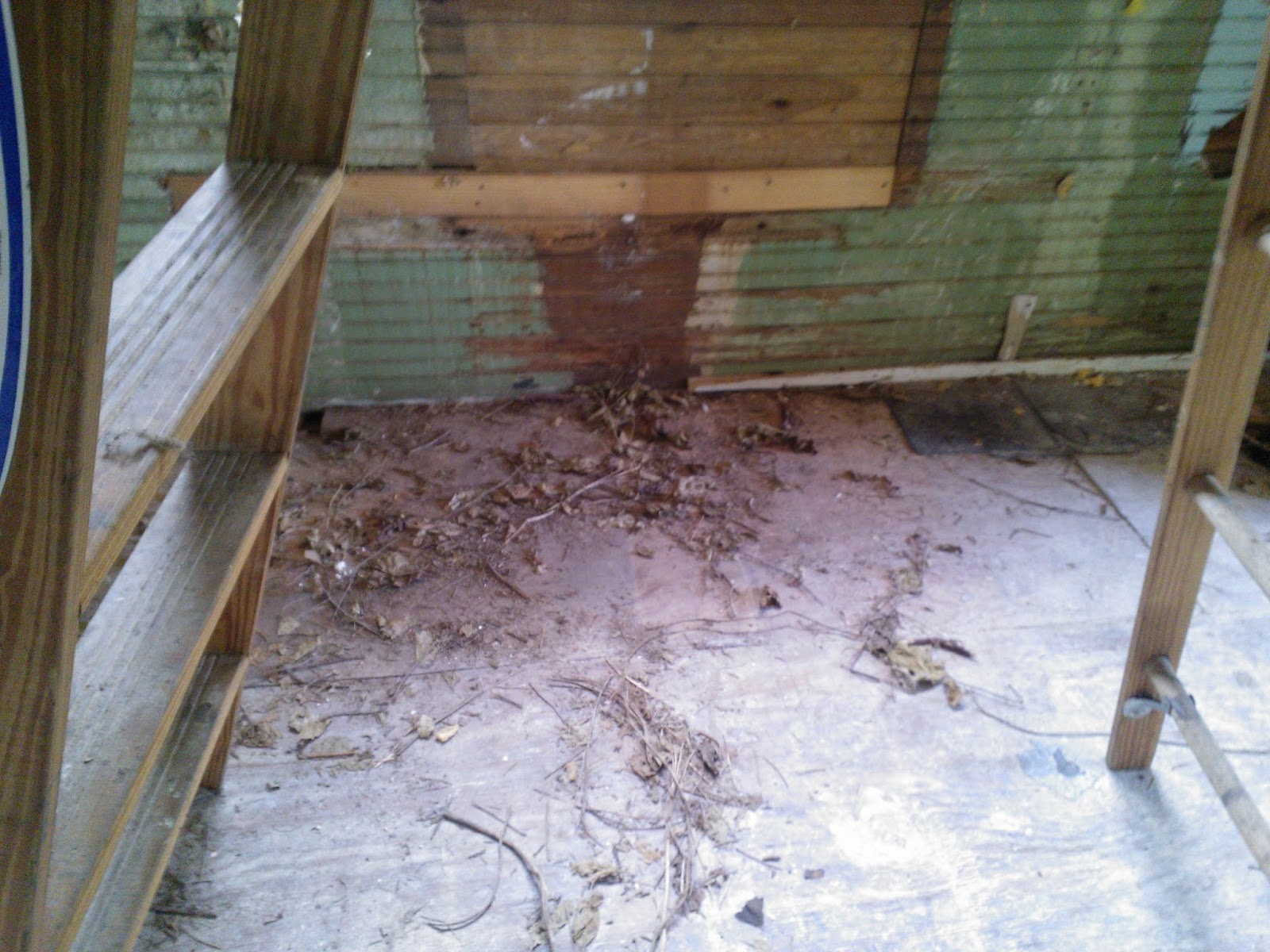
All of that interior destruction is apparently taking place without the benefit of a plan for historic restoration, which I am told must be approved by the Miami Historical Board before any work is to take place. The work is also being done without benefit of a building permit, which must be posted prominently on the property while work is going on and until the completion of the renovation.

A wide-open gate on the Stirrup property says, “C’mon in.”

Let me tell you a little something about getting inside the E.W.F. Stirrup House. Last Friday was the first time I ever surreptitiously entered the house, but the two previous times I was invited in by workmen.

There was a time I used to wander onto the Stirrup property at will. There was a very large hole in the chain link fence at the extreme south-east corner of the property. After I started posting pictures of the property (that had obviously been taken from on the property), I discovered the hole had been patched. Once that hole was fixed I stopped slipping through that gap. Nor did I ever slip through the gap between the two front gates, which are chained together so loosely that Rush Limbaugh could squeeze through. However, I have encountered those gates wide open on many subsequent visits. When the gate is left wide open I take that as a personal invitation to document Gino Falsetto’s shoddy stewardship of a precious Miami historic site.

On August 16th, when I arrived at 7 a.m., the gate was wide open and had clearly been left that way overnight. I wandered onto the property and took several pictures before I headed off to my next appointment. However, I noted something on that visit that required an additional visit later to see whether my eyes were deceiving me.

When I got back to the E.W.F. Stirrup House I discovered my eyes hadn’t deceived me at all. The front door had been left open a crack all night and, at 2 in the afternoon, it was still open the same crack, which meant that there had been no workmen there in the interim. So, if an open gate says, “C’mon in,” so does an unlocked front door. My desire to save the house and protect it from idiots who have no conception of the history the house represents overrules any proprieties about property rights.

An example of some of the destruction that’s taken place inside the E.W.F. Stirrup House.

So, yesterday I a very busy boy. I spoke to a very nice woman at the City of Miami Historical Preservation office. She told me that as far as she could tell, there were no plans on file for historic preservation of 3242 Charles Avenue, aka The E.W.F. Stirrup House. However, she would have to do some more research before she could state that categorically.

Then I left a message for Peter Iglesias, who is head of the Building Department, where any building permits would have been issued for work on the E.W.F. Stirrup House. However, I suspect there is no building permit. Just like there was no building permit last year when I reported [allegedly] illegal demolition work inside the house. That file was closed without a determination. What’s crazier is that no matter how many times I called back, no one was ever able to tell me what happened to my complaint, only that it had been closed. I had a confirmation number and everything. I believe it fell into a Black hole, pun intended.

In fact, I have documented here, in an open letter to Miami, how all my previous phone messages left for City of Miami employees have all gone into the same Black hole. Miami employees never answer their phones and have never returned the phone messages I’ve left. I was shocked when Marina Novaes in the Historic Preservation office answered her phone. That was a first! She took my number and said she’d get back to me. That would also be a first.

And, just like last year, and the [allegedly] illegal demolition work inside the house, it’s invisible if and when the building inspector comes around because IT’S ALL HAPPENING INSIDE THE WALLS OF THE HOUSE, not outside. I can’t stress this enough. That’s why Gino Falsetto has been getting away with this [allegedly] illegal work. And, that’s why I took the risk and decided to enter the house. I’ve got it all documented if the City of Miami Building Department Chief Peter Iglesias wants to see what’s happening inside this historic house.

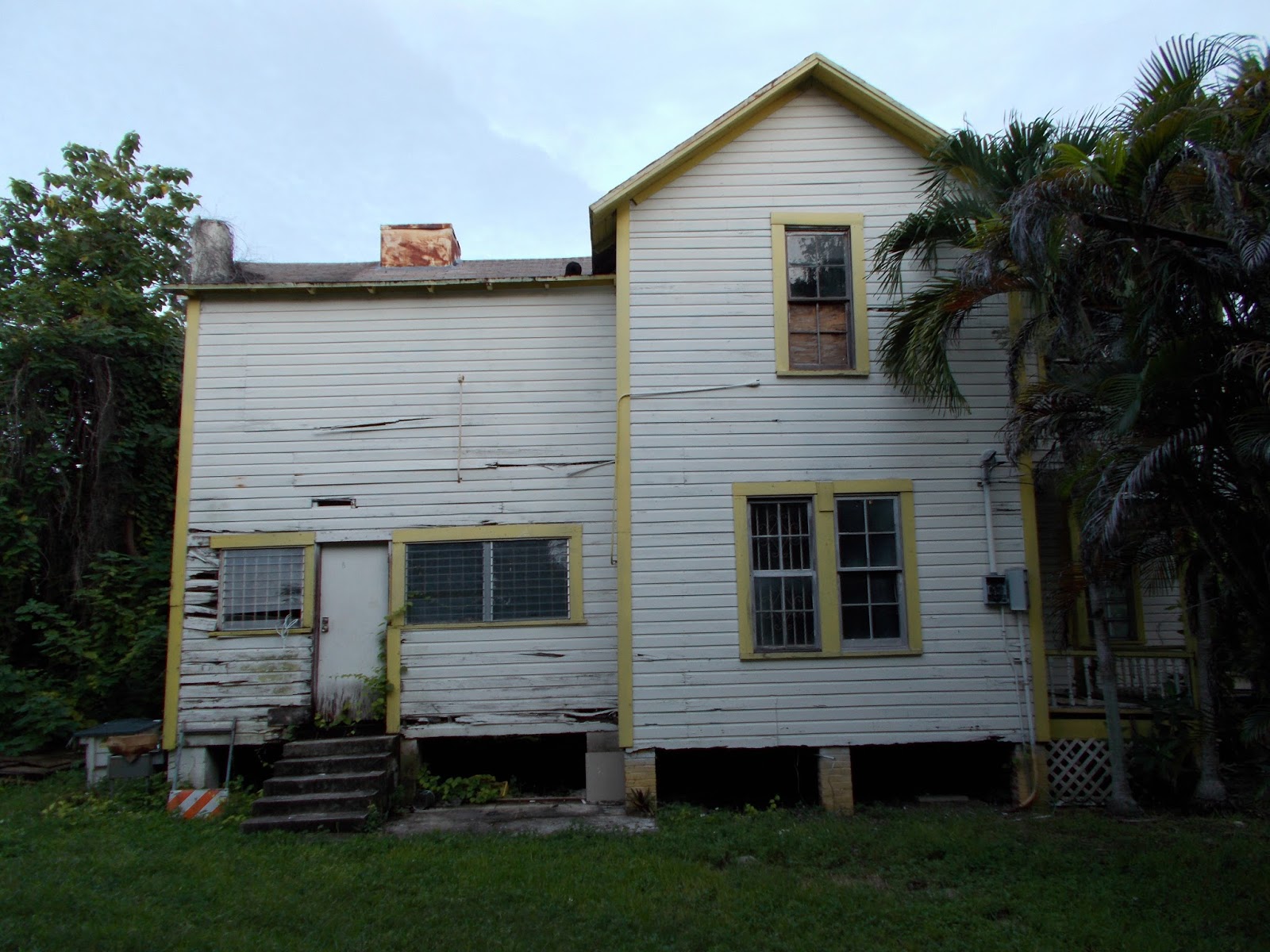
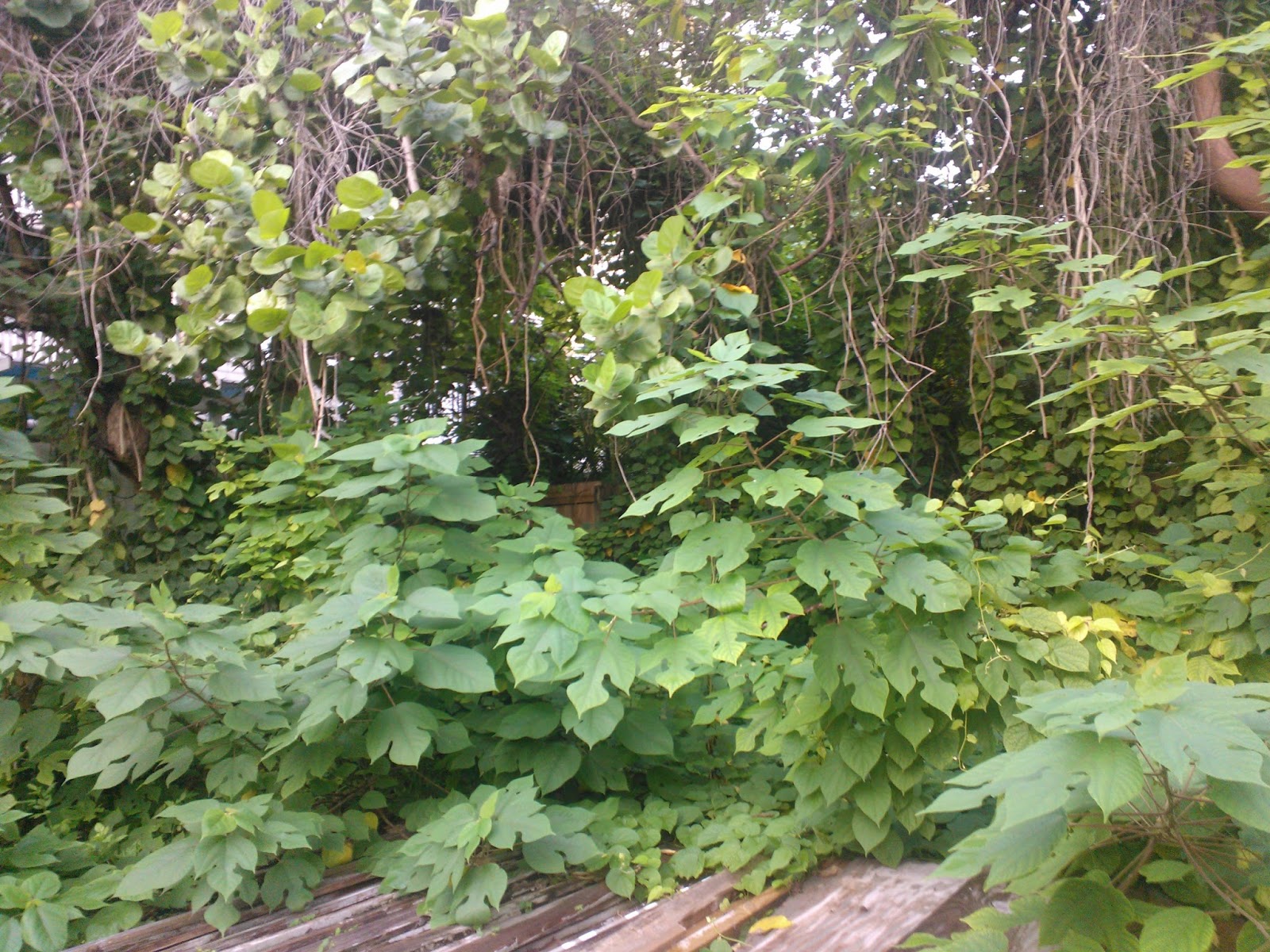
After cutting back the vines in February, they’ve not been cut since. Before
they were cut the last time, they grew 30 feet high and over the top of the house.

And, while I’m on that topic: The City of Miami by-law compliance officers need to see what’s happening behind the house, too. I’ve documented previous occasions when the property has been cited for a lack of landscaping upkeep and graffiti on the back wall. Remember that Gino Falsetto (Aries Development) is the lease-holder. However, it’s the owner, Stirrup Properties, that gets cited for all the deficiencies caused by Falsetto. Do I have to point out the obvious? The Black corporation is being blamed for the White corporation’s misdeeds.

However, Gino Falsetto seems to have learned something else: the by-law compliance officers cannot see what’s behind the house, so that area is almost never landscaped. It became a jungle, which I also documented in previous posts. It grew over 30 feet tall and part way across the roof of the house in the back, all unseen by the by-law compliance officers.

That jungle was cut back drastically in February for the first time in the 4 years I have been visiting the property. However, that had nothing to do with being cited by the city. It was in advance of a meeting of the Charles Avenue Historic Committee, on which Gino Falsetto sits. He wanted to be able to point to SOME WORK having taken place, in case people asked. However, what was done actually destroyed part of the house, as documented here.

Since then the vines have been allowed to grow unmolested again.

Say, I got an idea! Let’s start a pool and bet on how tall the vines are allowed to grow before Gino Falsetto feels he needs to impress someone else with the work he hasn’t been doing on restoring the E.W.F. Stirrup House and it gets cut back again merely for appearance sake, and not because the vines are harming a precious historic house.

Of course, if the City of Miami ever manages to inspect the inside of the E.W.F. Stirrup House and determines that Gino Falsetto has ordered illegal work, it will be Stirrup Properties, LLC, that is cited and/or fined.

Let’s face it, Gino Falsetto doesn’t care about Stirrup Properties, LLC; Coconut Grove history; or the Stirrup legacy; nor has he shown any care of the historic 120-year old E.W.F. Stirrup House. Falsetto is a rapacious developer who cares only about making money by developing property. In fact, having to save the Stirrup House foils Falsetto’s ultimate plan. He has managed to scoop up every bit of property surrounding the Stirrup House, including a financial stake in the Coconut Grove Playhouse. An empty lot where the Stirrup House currently sits would be far more valuable to Falsetto than this house that he’s committed to restoring. Is that why he’s allowed 8 years of Demolition by Neglect to eat away at the house? Is that why the property is left unsecured, hoping for an accident to happen?

Here are several more pictures of the state of the E.W.F. Stirrup House on August 16, 2013:

An E.W.F. Stirrup House Shocker! ► Is Gino Falsetto Following The Rules?

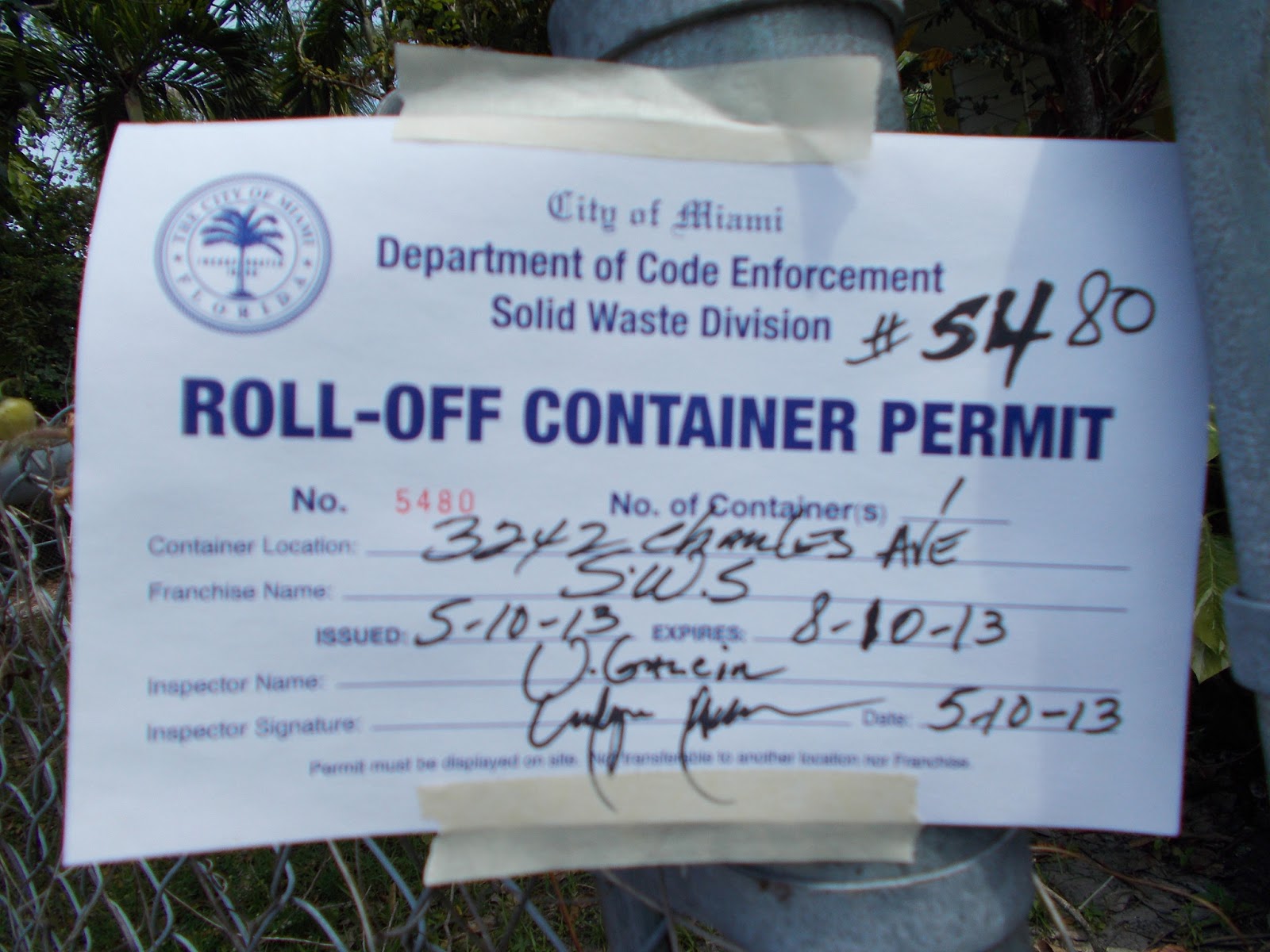
The dumpster on the property is finally legit, until August at least

Dateline May 17, 2013 – A quick visit to the E.W.F. Stirrup House produced something totally surprising.

For the last several years I have been documenting the dumpsters that come and go from the Stirrup property. Earlier this week I made special mention of the most recent dumpster, filled with what appeared to be refuse carted out from some restaurant renovation within the Grove Gardens Residence Condominiums.

However, what do I discover when I arrive at the E.W.F. Stirrup House for my latest visit? Lo and behold: a permit for the dumpster. FINALLY!!! I have seen dozens of interchangeable dumpsters disappear, only to be replaced by an empty dumpster. However, this is the first time it has ever been permitted, literally, by the city.

Dumpster Still Life, May 17, 2013

It begs the question: Why? Did the city finally clue in to the fact that the Stirrup Family had been flagrantly breaking the law for the last several years?

TO BE FAIR: While Stirrup Properties, Inc. is the owner of the property on paper, it ceded effective control of the property to Aries Development, owned in part by Gino Falsetto. The Stirrup Family gave Aries a 50-year lease on the property. It’s Aries who has allowed the property to turn into a garbage dump time and time again. However, whenever the property is cited for violations, it’s the Stirrup family’s company that gets its metaphorical hands slapped, not Falsetto’s company. Cute, that.

I wonder if this means Aries Development will finally go to the city and get a building permit for the illegal, covert work that’s been going on inside the E.W.F. Stirrup House since last August, at the very least.

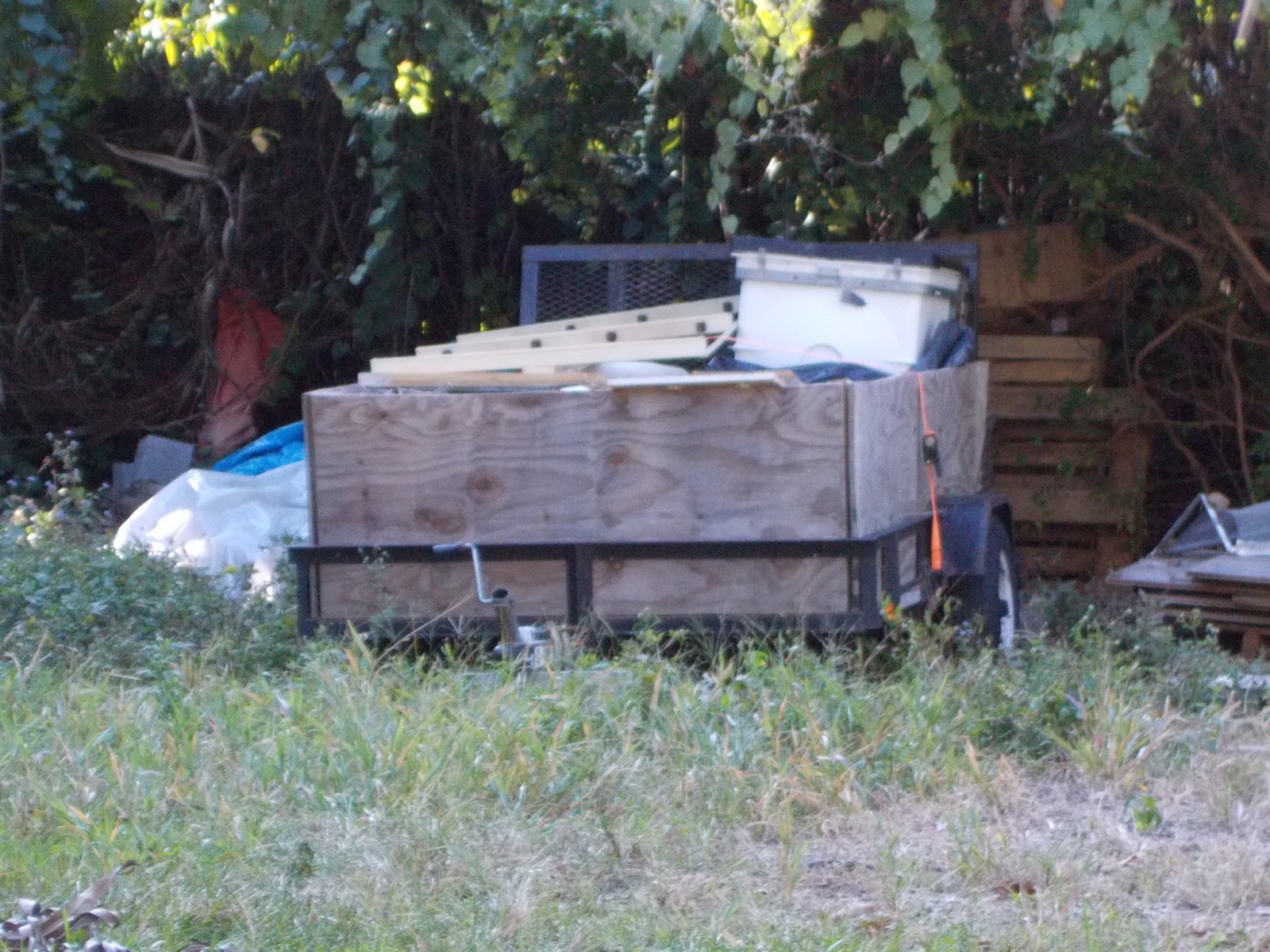
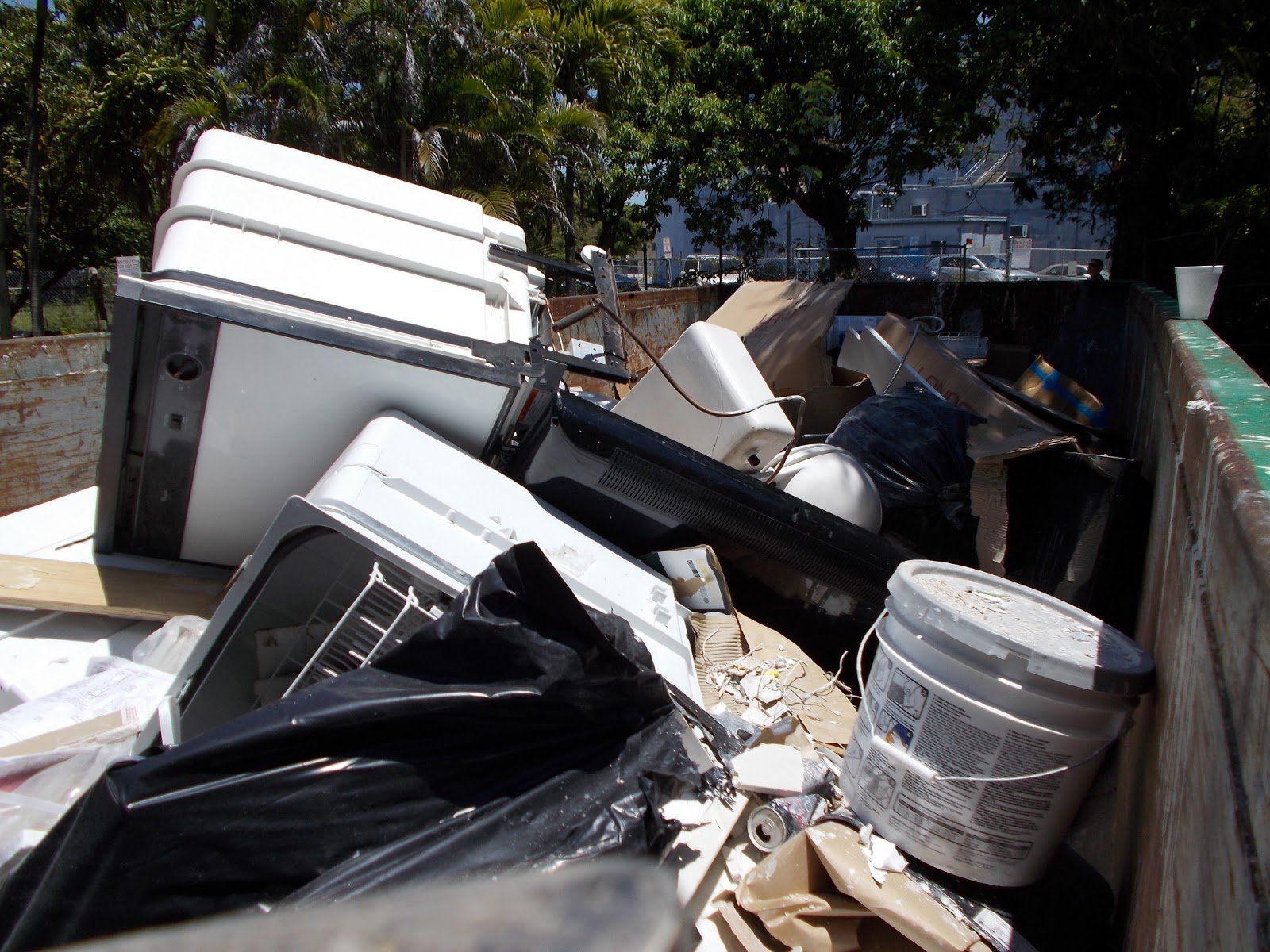
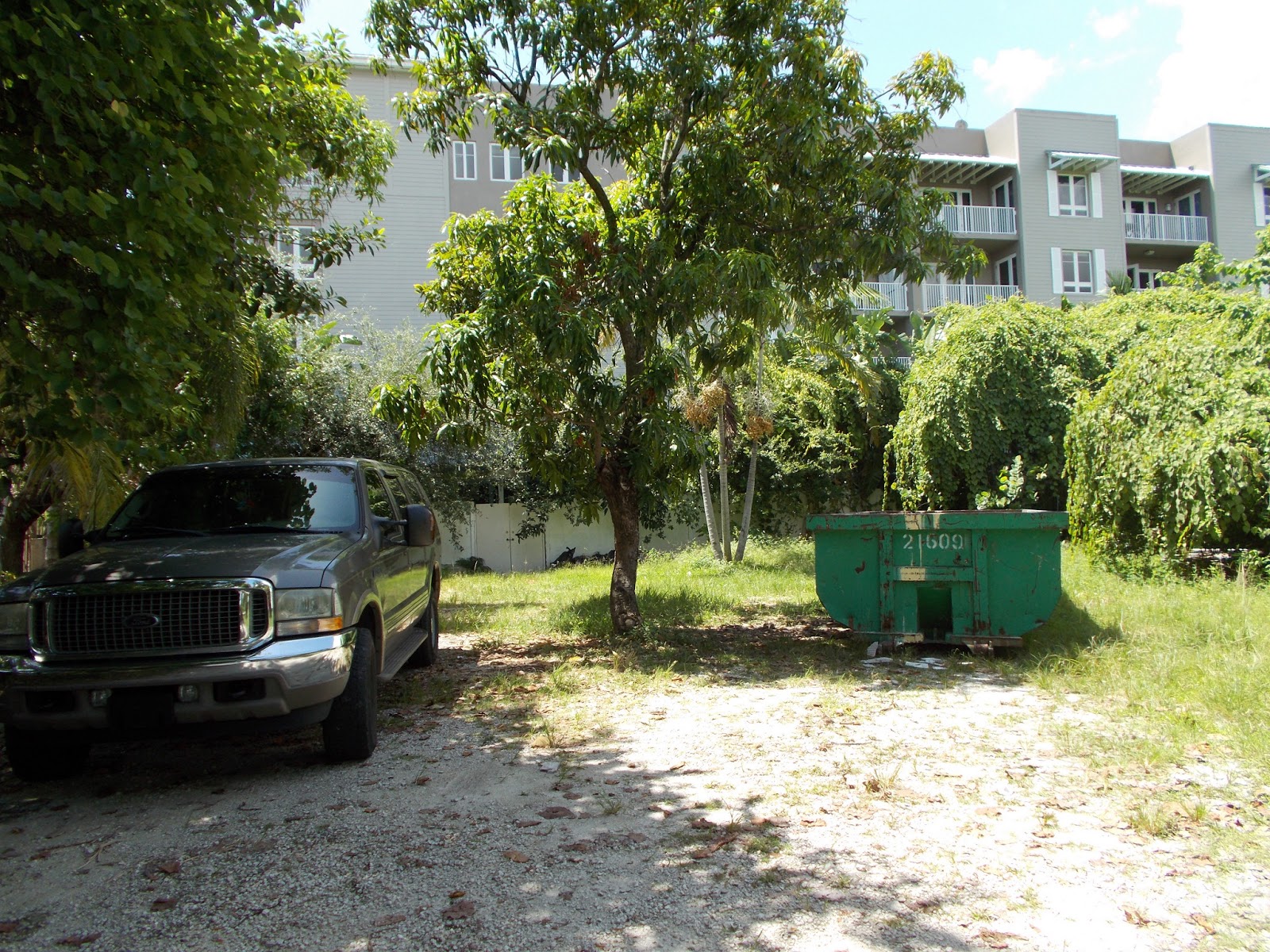
Here is a series of pictures we’ll call Dumpsters I Have Known: They were taken on various visits to Charles Avenue.

These are all separate and different dumpsters. There are still some 20 file directories filled with pictures of the E.W.F. Stirrup House, but I got bored looking for dumpsters.

***

***

Bulldozing Cultural History

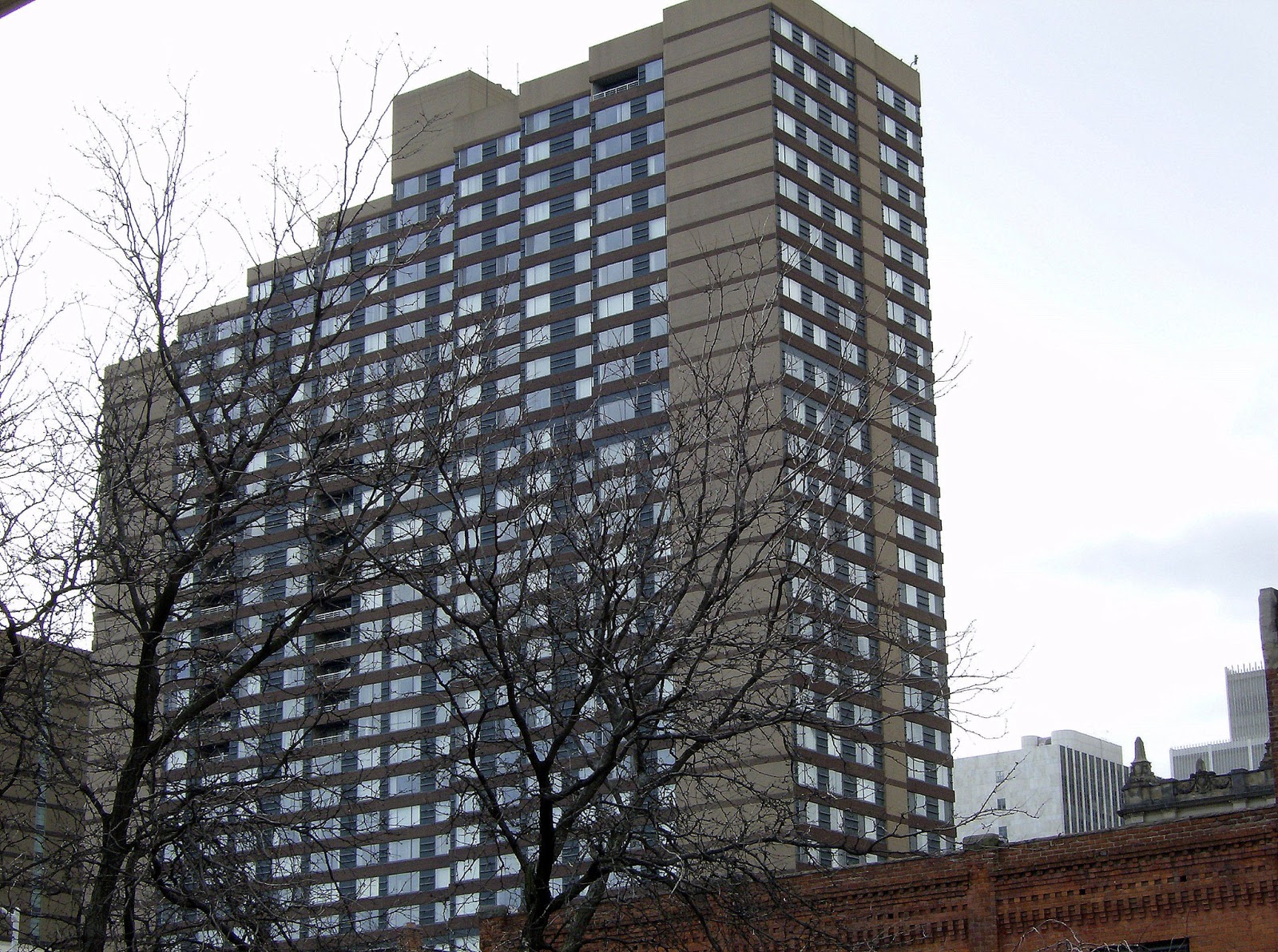
The soon-to-be-former Millender Apartments in Detroit

A recent article at Deadline Detroit got me thinking about how cultural history can be bulldozed without any structures being lost. Bill McGraw was writing about the rename of the Millender Apartment building, but, in a way, he could be writing about the E.W.F. Stirrup House and Coconut Grove.

McGraw’s article is on the topic of the renaming of the Millender Apartments. I was unfamiliar with the 33-storey highrise building in downtown Detroit, for good reason: It was built 15 years after I had already left Detroit. However, I’m sorry I was unaware of Robert Millender, a man whose accomplishments are enough to have garnered him a page on the Detroit African-American History Project:

Millender [after getting his law degree following the war] became interested in politics as a way for African Americans to exert power, given that they were often denied economic power. In the mid-1950s he began to develop political strategies and to recruit young African-American leaders to run for political office. Millender and George Crockett, Jr. were instrumental in finding the logical boundaries and legal grounds for creating a new congressional district in Detroit that would elect an African American to the United States House of Representatives. These efforts paid off in 1964 with the election of John Conyers, for whom Millender acted as campaign manager. Millender was known for his tireless efforts on behalf of African-American candidates, spending countless hours canvassing neighborhoods and meeting with voters and city leaders. His dedication paid off in a number of significant political victories in which he managed campaigns. He served as campaign manager for George Crockett’s 1966 election as the first African-American Recorder’s Court Judge and for Detroit City Council members Robert Tindal and Erma Henderson. Millender managed Richard Austin’s 1969 campaign as the first African-American mayoral candidate and his 1970 successful candidacy for secretary of state, making Austin the first African American to hold that post. Millender’s political activism reached an apex with Coleman Young’s 1973 election as mayor of Detroit.

One of the saddest historical markers I know.

Bill McGraw’s article “Renaming The Millender Apartments Is Not a Neighborly Thing To Do” expresses his frustration that while the building will remain, Robert Millender’s name will be bulldozed into the dustbin of history by a new owner:

[…] Detroiters who were paying attention recalled Millender as a giant of black Detroit.

Bob Berg, a public relations executive who served as a spokesman for both Gov. William Milliken and Mayor Coleman Young, said Millender continues to enjoy “legendary status” in Detroit’s  African American community.

“Coming in and changing the name is extremely insensitive and confirms the worst fears many have about the impact of growing suburban influence in the city,” said Berg, who happens to be white.

[…]

Memory is important to every ethnic and racial group. That’s why many buildings, parks and streets around the world are named after people.  Detroit, despite being the biggest black-majority city in the nation, has relatively few African Americans memorialized within its city limits.

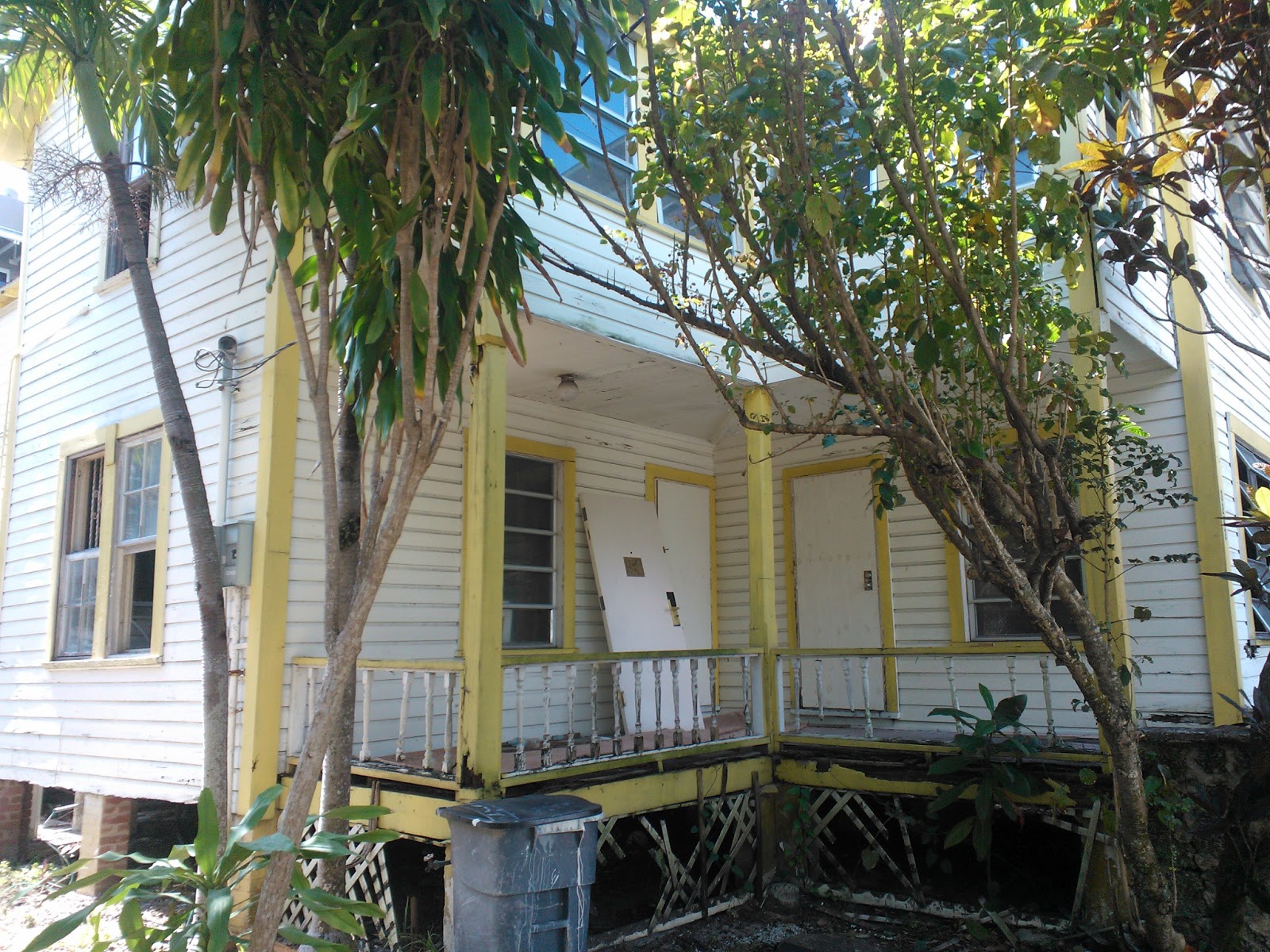
The E.W.F. Stirrup House currently undergoing demolition by neglect.

I cannot help but think of the parallels to the E.W.F. Stirrup House, the rich cultural legacy of which is slowly being allowed to undergo Demolition by Neglect by a rapacious developer who cares more about making money than Coconut Grove history.

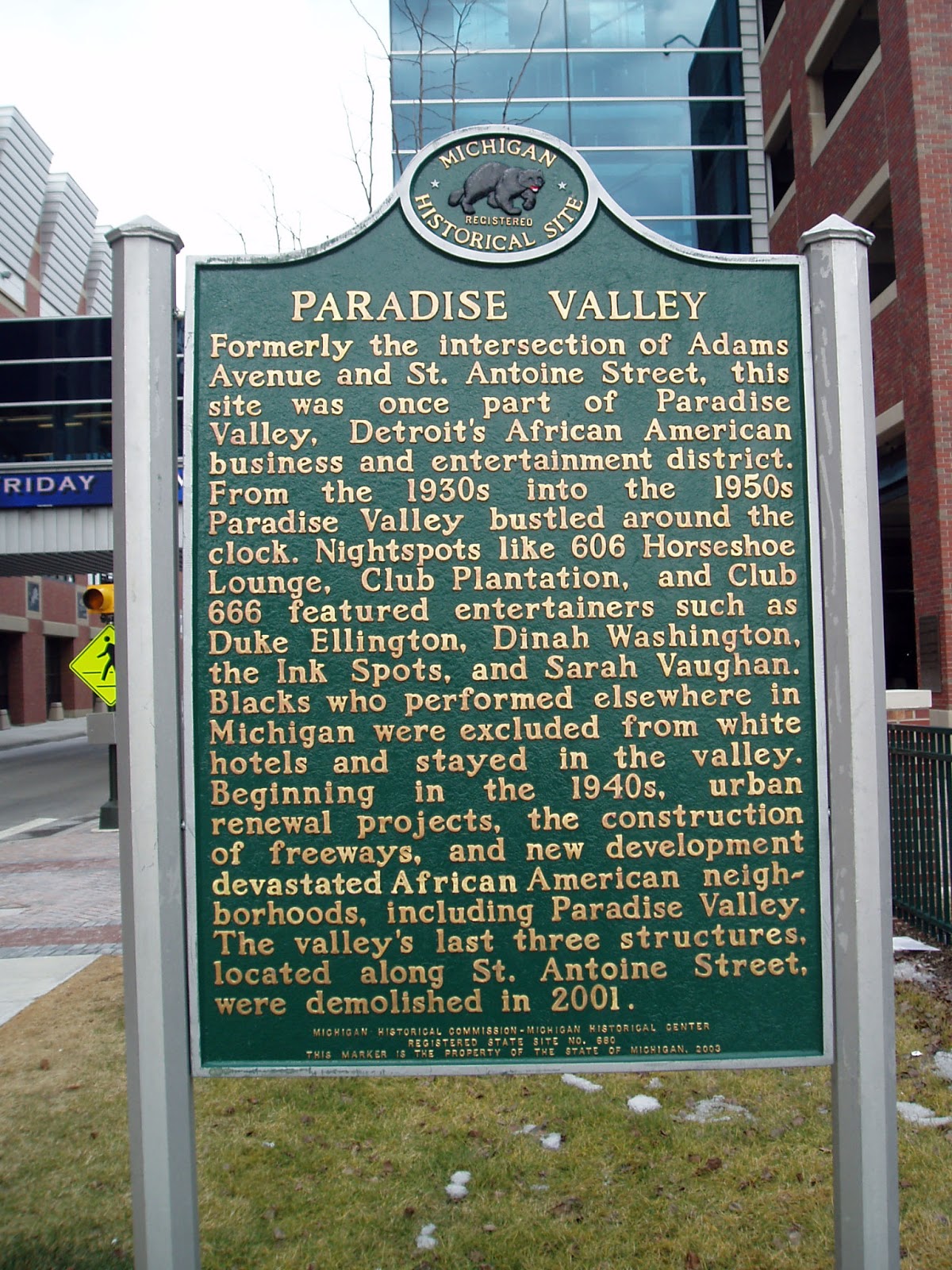
When cultural history is lost, it cannot be replaced. The historical marker in Detroit (above), which marks where Paradise Valley was once a vibrant community is one of the saddest I know. There had been plenty of time to save some of the structures in Paradise Valley, but clearly there was no will to do so.

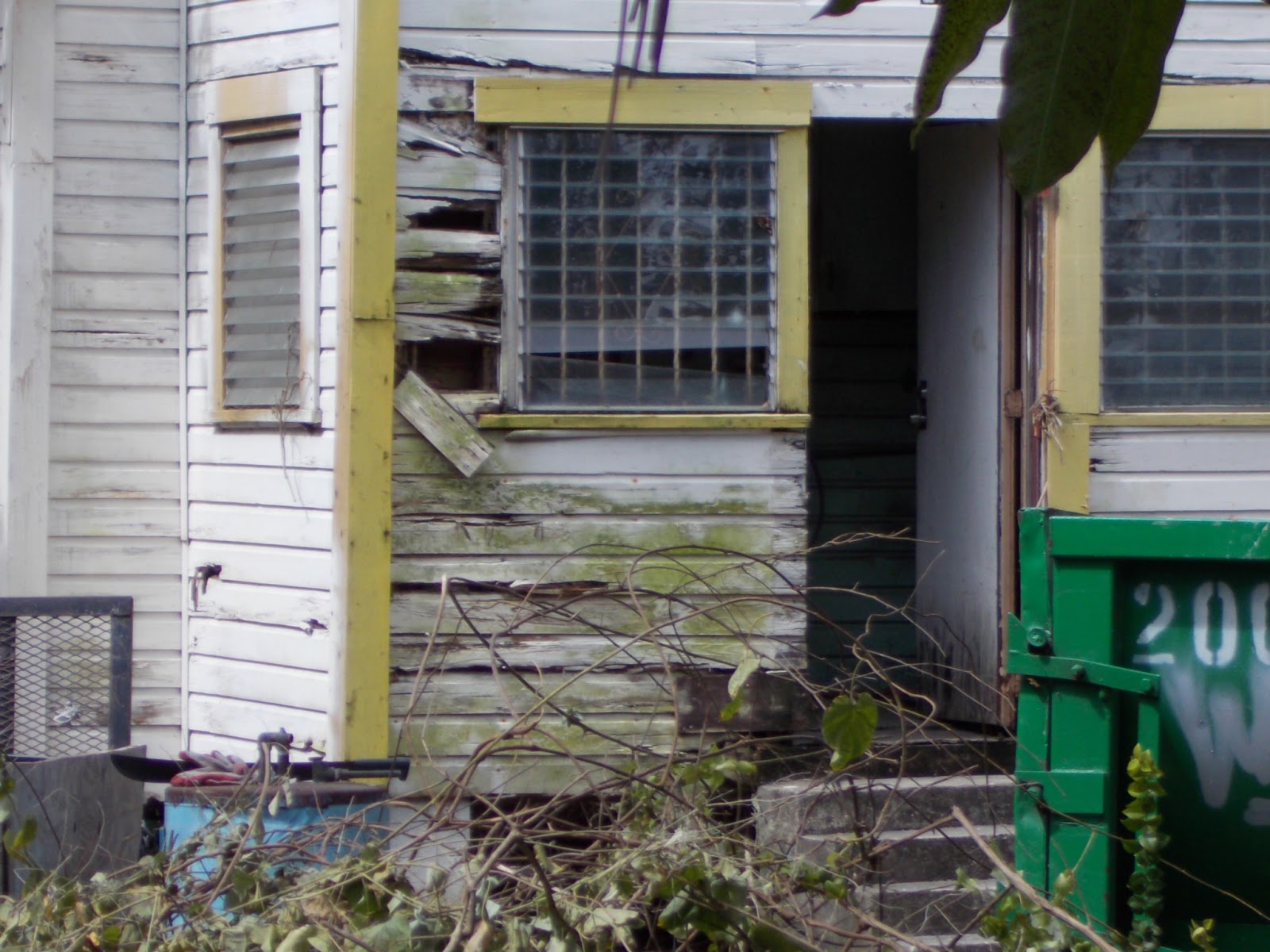
Rapacious developer Gino Falsetto, one of the owners of Aries Development, claims he will turn the E.W.F. Stirrup House into a Bed and Breakfast. However, in the 8 years he’s had effective control of the property, he’s done NOTHING to protect his investment, not even sealing the house from the elements during all that time. Wind, rain, and animals have all been allowed to attack the house unmolested.

This is all the proof needed to know the E.W.F. Stirrup House is of no concern to Falsetto. In fact, the house stands in his way. Falsetto is after a much bigger prize. He has acquired all the land that surrounds the Stirrup House and wants to bring to West Grove the biggest mixed-use condo development since the Grove Gardens Residence Condominiums, which was Aries’ last mixed-use monstrosity.

Save the E.W.F. Stirrup House!!!

No Skin In The Game ► Part Three

History is complicated.

Little did I realize how accurate I was in intimating Coral Gables has a long history of Racism, going back to its founding. As reported in Part Two of No Skin In The Game, to this day Coral Gables has a population that is 98% White. This demographic never happens by accident. 

However, there is one Coral Gables neighbourhood that turns out to be the exception . . . the exception that proves the rule.

In my research I recently, accidentally, stumbled across something called the MacFarlane Homestead Subdivision Historic District. It was an odd little reference in the Sun Sentinel that caught my attention. In the article Reference Guide Lists Historic Black Sites, were mentioned Black sites across Florida, including one in 98% White Coral Gables, of all places:

CORAL GABLES

MacFarlane Homestead Subdivision Historic District:

Bounded by Oak Avenue, Grand Avenue and Jefferson Street. The residences were built primarily in the late 1920s and 1930s in a vernacular type of architecture not seen elsewhere in Coral Gables. The styles in the district include bungalows and one-story frame “shotgun“ houses. St. Mary`s Baptist Church at 136 Frow Ave. was built in 1927.

Detail of map showing the MacFarlane Homestead Subdivision Historic District,
the oddly shaped triangle in blue. Everything to the south and east is Coconut
Grove. Everything north of the tracks and U.S.1 is Coral Gables.

That address puts it in the odd triangle section of Coral Gables immediately adjacent to West Coconut Grove. It’s just a little more than a block away from the Coral Gables diesel bus garage that the residents of West Grove have been saddled with.

Reading between the lines:

  • “…built primarily in the late 1920s and 1930s…” can be translated to say “this neighbourhood was created contemporaneously with the founding of Coral Gables;”
  • “…in a vernacular type of architecture not seen elsewhere in Coral Gables. The styles in the district include bungalows and one-story frame “shotgun“ houses…” translates to “built in the inexpensive and expedient Bahamian style, styles of house that would never be allowed elsewhere in hoity-toity Coral Gables, but seen in abundance in neighbouring Black Coconut Grove.”

In other words: this neighbourhood was created so the Black folk who were doing the back-breaking labour of building Coral Gables — and, later, serving Coral Gables — would have a place to live. My understanding of the racial implications was instinctive and immediate. Proving that point would be more difficult.

1913 Poster

One thing that made Coconut Grove unique in this country — aside from having the highest percentage of Black home ownership in the nation — is that the Black community in Coconut Grove was NOT on the “other side of the tracks.” Think about that expression for a moment. The “other side of the tracks” was the poor part of town, where Black enclaves originally started near the railroad tracks. That was generally an area where no decent, self-respecting White person would find themselves living, or even traveling. Black folk had far fewer choices for neighbourhoods. And, as has always been true in this country, once there were a few Blacks in an area, it became all Black over time.

While Coconut Grove didn’t have an “other side of the tracks,” it’s clear that Coral Gables did. The blue triangle on the map above (or on this interactive map) is the only area in Coral Gables that Blacks could live. South of U.S. Highway #1, which runs parallel to the railroad tracks, is the other side of the tracks if you live in Coral Gables. It may be technically a part of Coral Gables, but it’s not OF Coral Gables, if you get my meaning.

It turns out the proof I was looking for was tucked away in a book called “African American Sites in Florida” by Kevin M. McCarthy. Within I found the following:

Coral Gables

When I took pictures of George Merrick and Coral Gables City
Hall in August of 2009, who knew they would come in handy?

Coral Gables may have been the second planned community in the United States, after Washington, D.C. George E. Merrick spent much time and money designing the city, including what became the University of Miami, which opened in 1926. To promote the planned community, he used the oratorical skills of William Jennings Bryan in the mid-1920s; Bryan, who had been President Woodrow Wilson’s Secretary of State and a three-time Democratic Party nominee for President, gave impassioned speeches around Merrick’s fabulous Venetian Pool, encouraging visitors to buy and settle in the planned community.

The city never had a large number of blacks, and in 2000 only 3% (1,348) of the total population of 40,091 were black.

MACFARLANE HOMESTEAD SUBDIVISION HISTORIC DISTRICT is a black enclave within the city of Coral Gables. It is bordered by Oak Avenue, S. Dixie Highway (U.S.1), Brooker Street, and Grand Avenue east-northeast of the University of Miami. The district takes its name from Flora MacFarlane, who homesteaded 160 acres of land there and in Coconut Grove in 1892. Some of the houses in the district predate the expansion of the Gables in 1925 and 1926, while others were built in the 1930s at a time when blacks were not allowed to build in the wealthier parts of Coral Gables. One of the earliest structures, St. Mary’s Baptist Church, was built in 1927. Most of the homes in what is called the black Gables are small, single-story homes built from Dade County pine. Many of the blacks worked in the homes of the wealthy white residents or in the construction of such buildings as the City Hall and the Biltmore Hotel. The area is changing rapidly today, with many large homes being built.

The historic 120-year old E.W.F. Stirrup House,
still undergoing Demolition by Neglect

Here’s the supreme irony: Coral Gables is so proud of its little Apartheid Triangle that in 1994 it had it listed on the National Register of Historic Places. That’s like hiding its racism in plain sight. Now, if anyone exposes Coral Gables’ long and complicated history of racism, it can point to the MacFarlane Homestead Subdivision Historic District and claim, au contraire mon frere, it has honoured the original Black builders of Coral Gables.

Which is more than neighbouring Coconut Grove has done. Coconut Grove has continued to ignore its history. Rapacious carpetbagging developers have now taken control of some of the historic elements of Black Coconut Grove and no one seems to care.

People tell me that the E.W.F. Stirrup House is on a registry of historic city homes. I’m calling bullshit on that claim. I can find no historical designation for the E.W.F. Stirrup House by Coconut Grove, the City of Miami, Miami-Dade County, the State of Florida, or the country. Yet E.W.F. Stirrup created a unique place in this country, which is slowly disappearing.

SAVE THE E.W.F. STIRRUP HOUSE!!!

No Skin in the Game – Part One
No Skin in the Game – Part Two

The E.W.F. Stirrup House ► Before and After

Meeting announcement
Click to enlarge

It probably has absolutely nothing to do with the fact that the next Charles Avenue Historic Preservation meeting is this Wednesday, but there were big doings afoot at the E.W.F. Stirrup House yesterday.

The meeting announcement (left) lists rapacious developer Gino Falsetto under the rubric “Historic Assets.” Presumably that means the 120-year old E.W.F. Stirrup House, which his Aries Development controls through a 50-year lease. Falsetto claims he wants to preserve and renovate the house, turning it into a Bed and Breakfast. If that were truly the case, why has he been allowing it to undergo Demolition by Neglect for the better part of a decade? Why wouldn’t Falsetto do the bare minimum to protect his asset by — at the very least — sealing the windows to keep out the weather? Wood, water, and Florida humidity don’t mix very well and Gino’s given them 8 years to work their moldy magic on this architectural gem.

However, lo and behold: Yesterday a crew was cleaning up the Stirrup property by removing the vines and bushes that had grown all over the back of the house. This blog has documented how the property becomes an unruly garbage dump between citations from the City of Miami. The property is always cleaned up before fines are levied. Then it’s allowed to slowly fall into disarray until the next city inspector posts a citation on the property about all the garbage, weeds, and graffiti. Despite occasional landscaping, the vast Westerfield Archives has several year’s worth of pictures that prove these bushes and vines have never been cleared away. This was not just another minor clean-up.

Could it be that Gino Falsetto realized that eyes would be on the E.W.F. Stirrup House again this week because of the Charles Avenue Historic Preservation meeting? After 8 years of inactivity, is it possible that Falsetto wants to be able to say at Wednesday’s meeting “Things are happening,” only to let it slid into disarray until the next time it gets cleaned up?

[Continued after the jump.]

BEFORE – September 14, 2012
AFTER – February 22, 2013

You can clearly see the damage of vines having 8 years to work their way into the structure and what happens when they are finally ripped out indiscriminately. [Above]

Before – July 17, 2012
After – February 22, 2013

However, that’s just the property. This clean-up is primarily superficial, except for the new scars left on the structure from the brutal landscaping job. Sadly, the E.W.F. Stirrup House, the object of my affection, continues to rot away. To be fair: There has been some very minor work inside the house, which will be the subject of an upcoming post.

Continue to Part Two: Inside The E.W.F. Stirrup House ► Before and After 

For more on the E.W.F. Stirrup House, please read my continuing series:

EmTV Presents: The E.W.F. Stirrup House

The E.W.F. Stirrup House in the background, as
seen from the Charles Avenue Historical Marker.
Photograph by author.

This blog is moving into the digital age today with the official launch of EmTV. See? Now I’m just like Glenn Beck.

I thought I’d test the video recorder in my new camera on the historical 120-year old E.W.F. Stirrup House. Surprised at how good it turned out, I decided to post it to my blog.

Aries Development, owned in part by Gino Falsetto, has a 50-year lease on the E.W.F. Stirrup property. Rather than take the most minimal actions to preserve the house, Falsetto is allowing the E.W.F. Stirrup House to fall into Demolition By Neglect. Since 2009, when I began writing about, researching, and documenting the E.W.F. Stirrup House, it has only gotten worse.

Miami has had a law against Demolition By Neglect. City inspectors are falling down on their jobs.

Please watch:

You can see my entire series in my Unpacking Coconut Grove Compendium.