Tag Archives: Vaudeville

Little Nemo In Slumberland ► Saturday Morning Cartoons

Click HERE for larger size

Little Nemo In Slumberland is not really a Saturday morning cartoon, but a weekly comic strip created by famed artist Winsor McCay, sometimes called The Father of American Animation.

If Nemo were his only creation, McCay would still go down in history. However, Zenas Winsor McCay was also the artist behind 1914’s Gertie the Dinosaur, considered the first example of true character animation. The WikiWackyWoo also tells us:

Although Gertie is popularly thought to be the earliest animated film, McCay had earlier made Little Nemo (1911) and How a Mosquito Operates (1912). The American J. Stuart Blackton and the French Émile Cohl had experimented with animation even earlier; Gertie being a character with an appealing personality distinguished McCay’s film from these earlier “trick films”. Gertie was the first film to use animation techniques such as keyframes, registration marks, tracing paper, the Mutoscope action viewer, and animation loops. It influenced the next generation of animators such as the Fleischer brothers, Otto Messmer, Paul Terry, and Walt Disney. John Randolph Bray unsuccessfully tried to patent many of McCay’s animation techniques and is said to have been behind a plagiarized version of Gertie that appeared a year or two after the original. Gertie is the best preserved of McCay’s films—some of which have been lost or survive only in fragments—and has been preserved in the US National Film Registry.

Little Nemo began his life as a comic strip, running in the New York Herald from 1905 to 1911. Hired away by William Randolph Hearst — in an early dispute about Intellectual Property — the Herald won the rights to the Little Nemo name, but McCay was able to move the characters he created to the New York American, where they reappeared under the name “In the Land of Wonderful Dreams.”

McCay led a fascinating life. During his time with the Hearst papers, he also debuted a vaudeville act, where he would produce drawings at a rapid pace. He would also appear with his animated creation Gertie in an interactive show. A live McCay would command the animated figure, who would comply.

It was a box office hit in much simpler times.

Eventually, Gertie toured the country in the form seen above, without the live segments, using intertitles instead.

Hearst, who seemed to think he owned McCay, objected to his vaudeville career because he thought the strip suffered. When he couldn’t reach McCay because he was on stage, Hearst ordered his papers not to run advertising for the stage show. Eventually the artist was forced to limit his stage appearances and, in the end, Hearst got McCay off the stage almost completely. However, he also agreed to pay McCay more to make up for the loss of the box office income.

In the ’70s I became interested in comic strips that came before my time. Starting with what’s considered the Golden Age of Superheroes, I worked backwards.

I fell in love with Little Nemo the second I found him. He’s been my favourite comic strip character ever since. I’ve bought large coffee table books filled with Slumberland comics and return to them often.

Little Nemo is simply gorgeous to look at. Each viewing brings out details not noticed before. While McCay created much of the later vocabulary of the graphic artist, no other comic strip before, or since, looks this way. Cartoonists ever since have tried to imitate him, but nobody has ever come close.

However, it’s appeal to me is based on more than that. Little Nemo has always appealed to both the child and the cynic in me: Dreaming big but waking up in the same mundane world day after day no matter how exciting a night I may have had.

Apparently there was a crappy animated movie made in 1989 called Little Nemo: Adventures in Slumberland. From all reports I’m glad I missed it.

The images for this post came from (were swiped at) The Comic Strip Library, a wonderful source. Here are a couple more full size:


The First Three Stooges ► Nostalgia Ain’t What It Used To Be

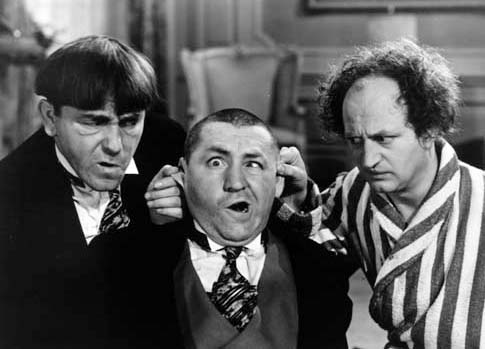
Above: Larry, Moe and Curly, not necessarily in that order.

Dateline May 5, 1934 – The Three Stooges release their first short “Woman Haters” and nothing was ever the same again.

The Three Stooges made more than 190 two-reelers over a 26 year period, but they started in the knockabout world of Vaudeville. Ted Healy was already a hit in Vaudeville when, in 1922, he took on new actors for his stageshow. Among them was Moe Howard, a childhood friend that had appeared, briefly, in the earlier act Ted Healy and his Southern Gentlemen.

Moe’s job was to act as an average audience member who is called onstage. Hilarity ensues. The showbiz term for this stock character was “stooge.” Soon Shemp, who was Moe’s real life brother, and Larry Fine joined the act. They appeared with Healy in one short, “Soup To Nuts.” but after a dispute over the movie contract, Larry, Moe and Shemp went solo, or as solo as a trio can go. They also took with them some of the material they had performed with Healy.

Intellectual property rights being intellectual property rights, Healey sued. However, he lost. As it turned out the material was owned by the show’s producer, the Shubert Theatre Corporation, which gave the Stooges the right to perform it.

The Three Stooges then had a brief rapprochement with Healy and were to appear together in a new Shubert production. However, when Healy got a better offer, he quit the show, taking Two Stooges with him; Shemp, who had threatened to quit previously, finally decided to pack it in. In need of a third Stooge, Moe suggested his younger brother. Jerry Howard joined the act as Curly.

Healy and the Stooges signed a contract with MGM in 1933 and made a number of shorts. When that contract expired a year later The Three Stooges split from Healy for good. Soon afterwards they signed with Columbia and released “Woman Haters,” the first official Three Stooges short

Growing up I watched a lot of Three Stooges in my time, but I don’t recall ever seeing this one. It’s all done in rhyme and song, all 20 minutes of it. There’s no way they could carry that over 2 2-reelers, let alone 190. Enjoy:

***

Groucho Marx ► Nostalgia Ain’t What It Used To Be

Dateline October 2, 1890 – Julius Henry Marx is born in NYC. Later he is nicknamed Groucho and, along with his brothers Chico, and Harpo, became one-third of the greatest comedy team of all time: The Marx Brothers.

The Marx boys started in Vaudeville as singers. The Four Nightingales were Julius, Milton (also called Gummo), Arthur, and another boy named Lou Levy. They were always near the bottom of bill. After one performance in which the audience was more interested in a mule kicking up a fuss in Nacodoches, Texas, they started cracking wise onstage. Among the ad libbed gems: “Nacogdoches is full of roaches” and “The jackass is the flower of Tex-ass.” As it turned out, they were better comedians than singers. Instead of getting angry, the audience loved them. The Marx Brothers completely rewrote the act (read: borrowed a skit about a schoolroom and had it rewritten to suit themselves) and toured in variations of it for the next seven years or so, adding Chico along the way.

There were actually 5 Marx Brothers. 1938: Front L-R:
Harpo, Chico, Groucho; Back L-R: Zeppo, Gummo

Each of the brothers played upon a comedy trope popular at the time. Harpo played a “Patsy Brannigan:” An Irish ruffian. He was uncomfortable speaking onstage, so he took the advice of his show-biz uncle Al Shean to remain silent and mime. Chico used an Italian accent that had, in real life, helped him avoid some bullies who were looking for a Jewish kid. Groucho played the teacher in this “Fun In Hi Skule” skit with a German accent. However, after the Lusitania was sunk a German accent was no longer funny to ‘Merkins. Groucho dropped the accent and became the character we know today: a rapid-fire, joke-cracking Lothario.

After seven years The Marx Brothers found themselves at the top of the bill and starring in their own Broadway shows, two of which became their first two movies: “The Cocoanuts” and “Animal Crackers.”

FUN TRIVIA: The action in “The Cocoanuts” takes place in Coconut Grove, Florida, during the land boom of the 1920s. Coconut Grove is also the location of the E.W.F. Stirrup House, which I am trying to save from a rapacious developer. Take a few minute to read about my ongoing series dedicated to the campaign to save this 120-year old house, which is currently undergoing Demolition by Neglect.

In all, The Marx Brothers made 13 movies together and Groucho made another 13 movies without his brothers. By the time Groucho became a radio show host for “You Bet Your Life,” which he later took to tee vee, he had already been in show biz for nearly half a century.

Here are some highlights of Groucho’s long career.

This was Phyllis Diller’s first appearance on national tee vee:

Just think: Had it not been for that mule in Texas all those years ago, we might have never heard of The Marx Brothers. We are lucky to have had them.

***
***