Category Archives: Race Relations

A Tribute to Don Knotts ► Morgantown’s Favourite Son

DATELINE: Morgantown, West Virginia – As part of the 2nd Annual Sunrise to Canton Road Trip for Research, the Not Now Silly Newsroom sent ace investigative reporter Headly Westerfield to Morgantown, West Virginia, for a privately conducted Don Knotts Memorial Nostalgia Tour. Here is his uncensored report: *

I drove into Morgantown after midnight, although I had been expected hours earlier. Because I was running so late, my correspondent had already gone to bed. To make matters worse, due to a faulty GPS and an incredibly dark section of road on the outskirts of town, I passed the driveway of the condo complex several times before I finally gave up and phoned. A teenager I had never spoken to before answered. Even with his help I managed to pass the entrance another two times. Finally he came out to the main road, while still on the phone, and waved a flashlight. To my chagrin, I was in the parking lot right next door. I hoped this would not be an omen for the Don Knotts Memorial Nostalgia Tour.

Morgantown is city tucked into a valley, in the crook between Cheat Lake and the Monongahela River. Downtown Morgantown has the appearance of a small town. What is known as Greater Morgantown, these days, is really comprised of several distinct neighbourhoods. Some of these had been separate towns that were annexed into the city proper. The surrounding area is so hilly, and with suburban sprawl occurring wherever they could make the land flat, each neighbourhood is almost a town onto itself, connected by highways and roads which wind up one side of a mountain and down the other.

A quick dip into the WickyWhackyWoo also tells me that Morgantown was named after one of the first homesteaders, Zackquill Morgan. Morgans Town was incorporated as Morgantown by the Virginia General Assembly in 1838. It is best known — for better or worse — as being the birthplace of Don Knotts.

Before my editor arranged for the privately conducted Don Knotts Memorial Nostalgia Tour, I didn’t know a whole lot about Don Knotts, other than many of his roles. I remember as a kid seeing him on the Steve Allen Show, often playing a nervous man-in-the street. Then, of course, there was Deputy Barney Fife, the role that made him famous. Another of his tee vee roles was that of swinging-single-man-about-town, Ralph Furley. Knotts jumped into the already successful Three’s Company after ABC ill-advisedly spun off The Ropers, which barely lasted a season and a half before it was cancelled. And, of course, I knew all those whacky movies from the ’60s: The Incredible Mr. Limpet, The Ghost and Mr. Chicken, The Reluctant Astronaut, and The Shakiest Gun in the West, among others. I grew up on Don Knotts comedy. He made me laugh.

Don Knotts with Danny “Hootch” Matador (right)

But, I have to admit I didn’t know anything about Don Knotts, the person. Imagine my surprise to learn he led an early life of heartbreak and confusion. Again, the WikiWhackyWoo saved me from abject ignorance:

Knotts’ paternal ancestors had emigrated from England to America in the 17th century, originally settling in Queen Anne’s County, Maryland. Knotts’ father was a farmer. William Knotts had a nervous breakdown due to the stress of the fourth child, Don, being born so late (Don’s mother was 40). Afflicted with schizophrenia and alcoholism, he sometimes terrorized his young son with a knife, causing the boy to turn inward at an early age. Knotts’ father died of pneumonia when Don, the youngest son, was 13 years old. Don and his three brothers were then raised by their mother, who ran a boarding house in Morgantown.

Like so many that have experienced early tragedy, Don Knotts became a comedian. During his teen years Knotts had a successful ventriloquist act, entertaining his Morgantown High School classmates at parties and other paid performances, including appearing occasionally at The Metropolitan Theatre, the big deal theater in town that opened the same year Knotts was born.

The Metropolitan Theatre in beautiful downtown Morgantown

After a failed trip to New York City to see if he could make it in the Big Time, Knotts returned home, enrolling in West Virgina University. However, WWII intervened and, like most of his peers, Knotts signed up for duty. Knotts didn’t see much combat. He was assigned to the Special Services Branch, where he and his dummy Danny “Hootch” Matador entertained the troops for the duration.

When the war was over, Knotts decided to try New York City all over again.This time he used the connections he made during his tour of duty to get a toe-hold in the business called Show. Aside from appearing at some comedy clubs, Knotts started to get a bit of radio work. Tee vee was still in its infancy when, in 1953, Knotts took on the regular role of Wilbur Peterson on Search For Tomorrow, his only dramatic part in a long comedic career. However, it was on Steve Allen’s show where he gained his first brush with real fame. While he was appearing on that show, Knotts his Broadway debut in No Time For Sergeants

No Time For Sergeants has an interesting history, especially since it’s the vehicle that brought Don Knotts and Andy Griffith together as an enduring comedy team. It started as a 1954 novel by Mac Hyman, about the antics of an unsophisticated country boy drafted into the Army Air Force during WW2. It was adapted a year later by Ira Levin as a 1-hour segment of The United States Steel Hour, which starred Andy Griffith (and some folks that few people remember). Andy Griffith had become an over-night sensation when his rural comedy monologue, What It Was, Was Football, was released as a single in ’53. It was a no-brainer to look at Andy Griffth when a country bumpkin was needed for the No Time role.

The Don Knotts Childhood Home

After Levin adapted No Time For Sergeants for Broadway, Griffith reprised his tee vee role with an up-and-coming Don Knotts playing several parts, the first pairing of this comedy team.

Then Levin adapted the teleplay and Broadway hit into a full-length motion picture, called, not surprsingly, No Time For Sergeants. Both Knotts and Griffith reprised their roles in that 1958 hit movie directed by Mervyn Leroy. This flick is considered the springboard that launched the national careers of Don Knotts and Andy Griffith.

Two years later when Andy was looking for a second banana for The Andy Griffth Show he didn’t have to look much farther than Don Knotts. The rest is tee vee history.

The Morgantown High School auditorium

The Don Knotts Memorial Nostalgia Tour began soon after the crack of noon, because that’s when teenagers wake up.

The first stop was, fittingly, the Don Knotts Childhood Home, which sadly is unmarked or commemorated in any way. The house presents a very small façade from the street, but because it was built on one of Morgantown’s many hills, the land drops away sharply in the back revealing a deep 3-storey structure that could have easily been used as a boarding house. It’s a humble beginning for the 5-time Emmy Award winner.

Not very far away, after navigating a few more of Morgantown’s hills and one way streets, we come to Morgantown High School, where Don Knotts began his long career as an entertainer. Outside the school’s auditorium there is an appropriately moving tribute to those alumni who gave their lives fighting in various wars. However, there was nothing that this reporter could see that commemorated Morgantown High’s most famous graduate, Don Knotts, ranked by TV Guide as #27 on its list of 50 Greatest TV Stars of All Time.

Bigger disappointment was still to come.

This reporter heard through the grapevine that there was one place in Morgantown where Don Knotts was commemorated as he so rightly deserved. According to the requisite several confidential sources, I should head over to the Metropolitan Theatre immediately. There, according to urban legend, I would find a large brass plaque embedded in the sidewalk which honours the location where Don Knotts got his start in Legit Show Biz.

Jumping back into the car, we raced the several blocks to the location, fighting the heavy downtown Morgantown traffic all the way. We were forced to pay for parking at an available meter more than a block away. Walking up to the building, this is what greeted us:
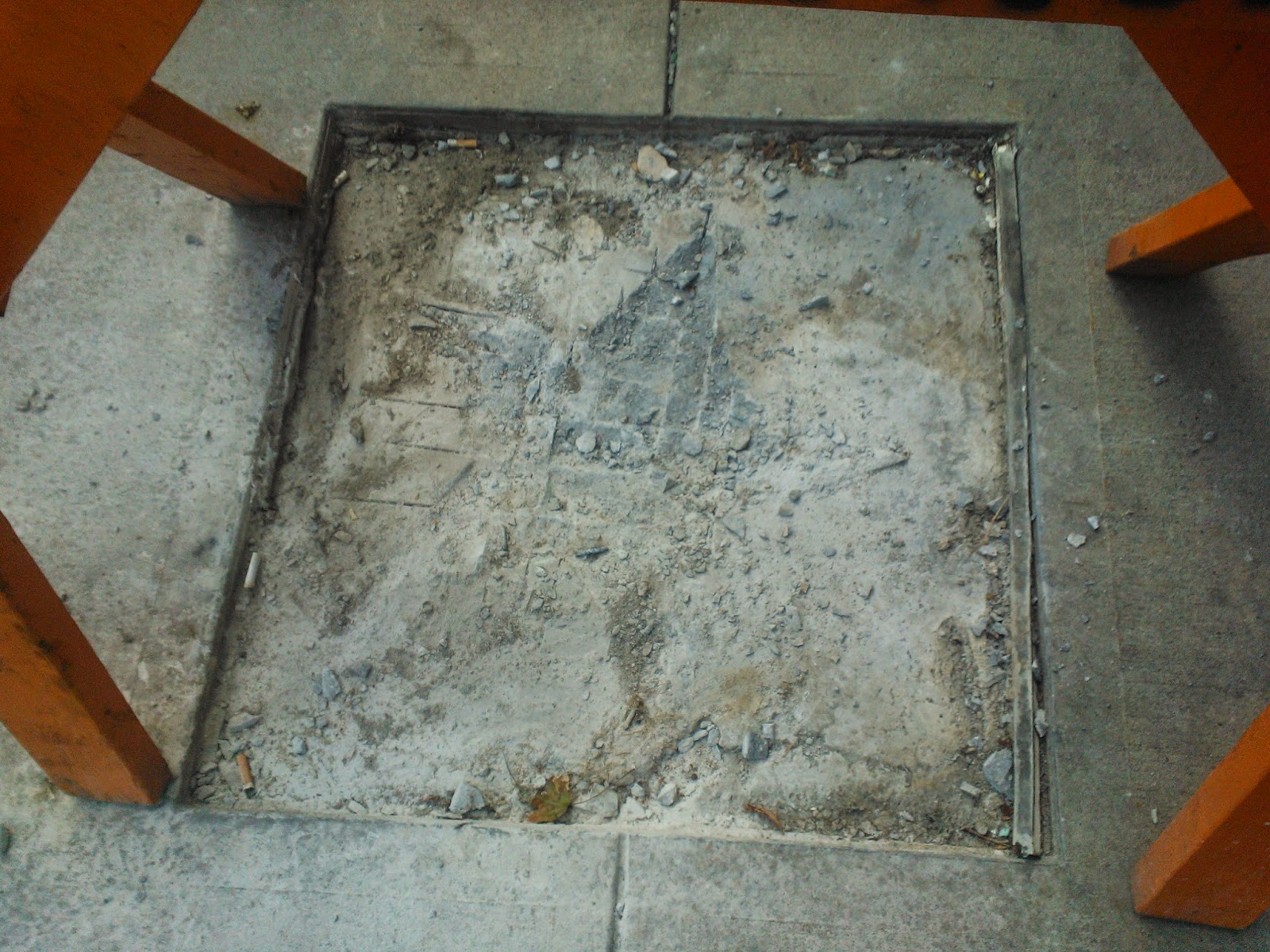
The scene of the crime against humanity! Where is the brass plaque honoring Don Knotts that was embedded in the sidewalk?
And, I made sure I wiped my dirty shoes on their nice rug, too!

I was heartbroken!!!

Now, keep in mind that I had already
traveled some 2,000 miles on the Sunrise to Canton Road Trip for Research to get this far (not counting several touristy
side trips). Why wasn’t Don Knotts getting the kudos he deserved, other than a small section of University Avenue renamed Don Knotts Boulevard during a Don Knotts Day held while the comedian was still alive?

There was no way I was going to put up with this bullshit.

I stormed inside and marched right up to the ticket windows. The two women inside the booth cowered as I demanded to know where the Don Knotts Memorial sidewalk plaque was. I made sure they learned some new expletives. I impressed upon them how many thousands of miles I had already traveled. Raising my voice to the highest dudgeon, I informed him that, as an employee of the Not Now Silly Newsroom, I refused to leave unless they gave me satisfactory answers to my questions. As they shuddered under the power of the press and the weight of The First Amendment, I threatened to expose them, the Metropolitan Theatre, and their entire bullshit town, which merely pretends to honour its greatest citizen of all time, but in actuality thumbs its nose at all the rubes who come to Morgantown for the full Don Knotts Experience.

In reality: I walked up to the ticket booth in the lobby and politely asked the two very sweet women if they knew what had happened to the plaque. All they knew for sure is that it had just recently been removed for repairs and they didn’t know when would be returned. Just then the manager of the theater came along and suggested I inquire up the street at the Morgantown Visitors Center, where they might know when the plaque would be returning.
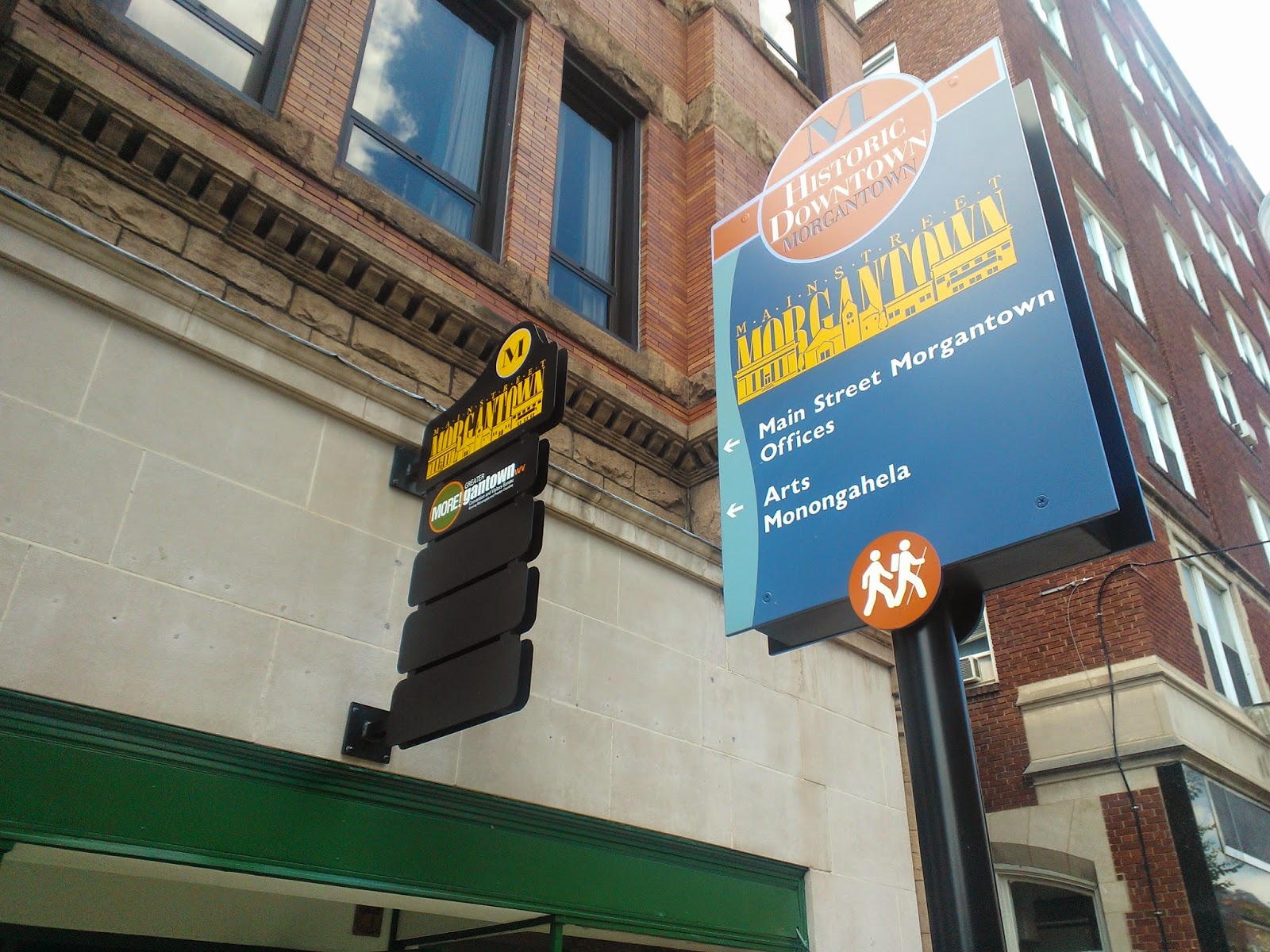
Morgantown Visitors Center

Back into the car, fighting the awful downtown traffic all over again, we finally pitched up at the Morgantown Visitors Center, a mere two blocks away. And, it’s there that the entire Don Knotts Memorial Nostalgia Tour was redeemed because, there, just inside the front window, was an entire display all about Morgantown’s favourite son, Don Knotts.

Taking a picture through the window wouldn’t work because of the glare. I was so excited to finally hit pay dirt that I rushed inside and started taking pictures. It’s my normal practice to ask permission before taking pictures because it’s the polite thing to do. However, I simply forgot my manners and knew I had screwed up mightily when a woman started screaming at me, “STOP! Don’t touch it! What are you doing? STOP!” Only my mother has ever yelled at me like that.
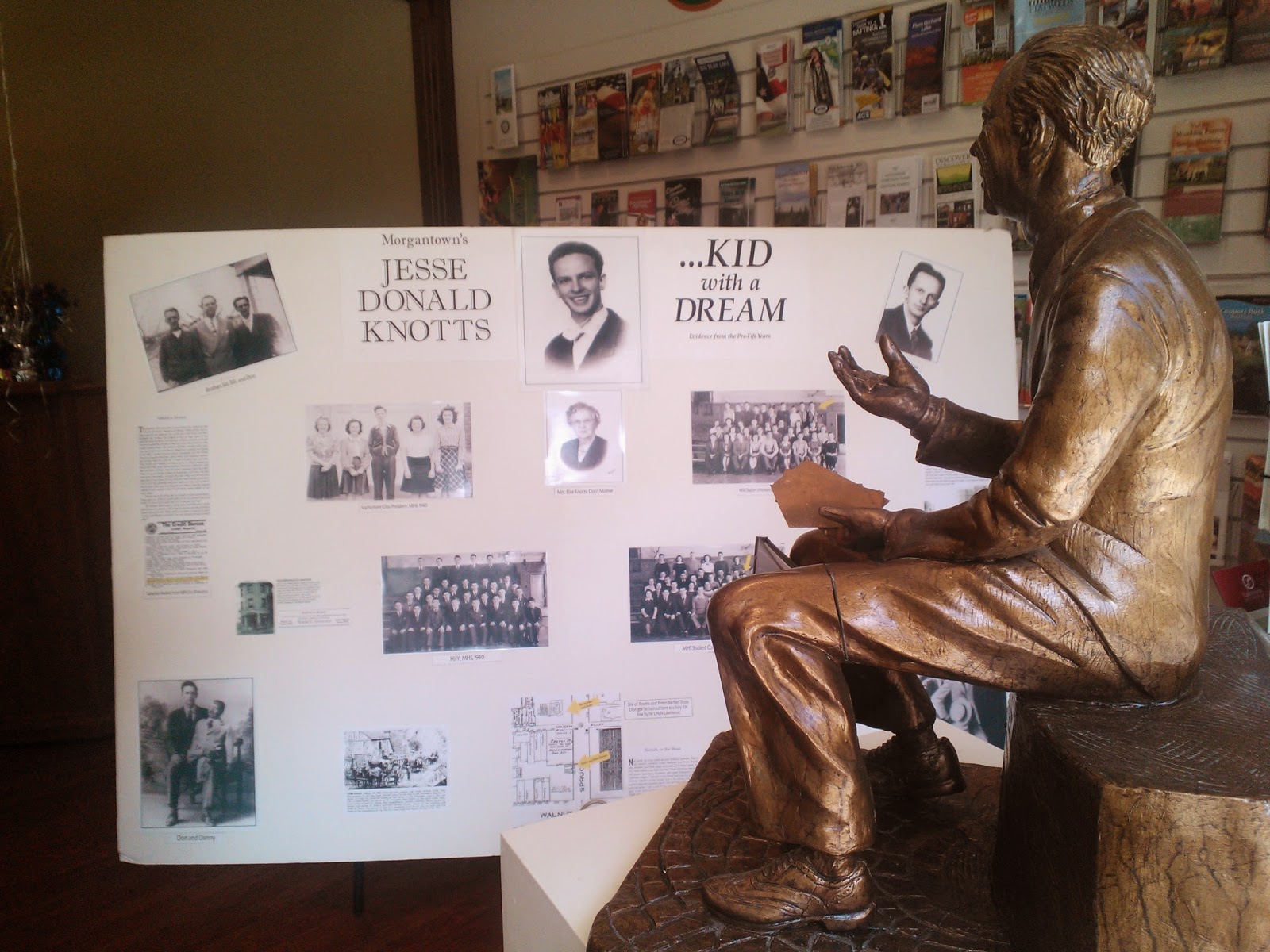
As if I was answering my mother, it all came out in a torrent: “I’m so sorry, I would never touch a display, but had traveled thousands of miles for the Don Knotts Memorial Nostalgia Tour, and this was the first acknowledgement of Don Knotts I’ve found, and just down the street was supposed to be a huge brass plaque embedded in the sidewalk, but it’s missing, and they sent me down here because you might know about it, and, I’m so sorry, I should have asked, but all I want is get some close up pictures. Honest, lady. Don’t hurt me.”

That’s when she relaxed. To help me get better pictures, she even turned the entire display around, so I could get a better angle. If you look closely at the pic above, you can see why the woman was so protective of the maquette. Just above the knee is a crack that runs right through the leg. It seems that just the week before my arrival someone grabbed the leg and broke it. Now the woman makes sure that Don Knotts doesn’t get damaged any further.
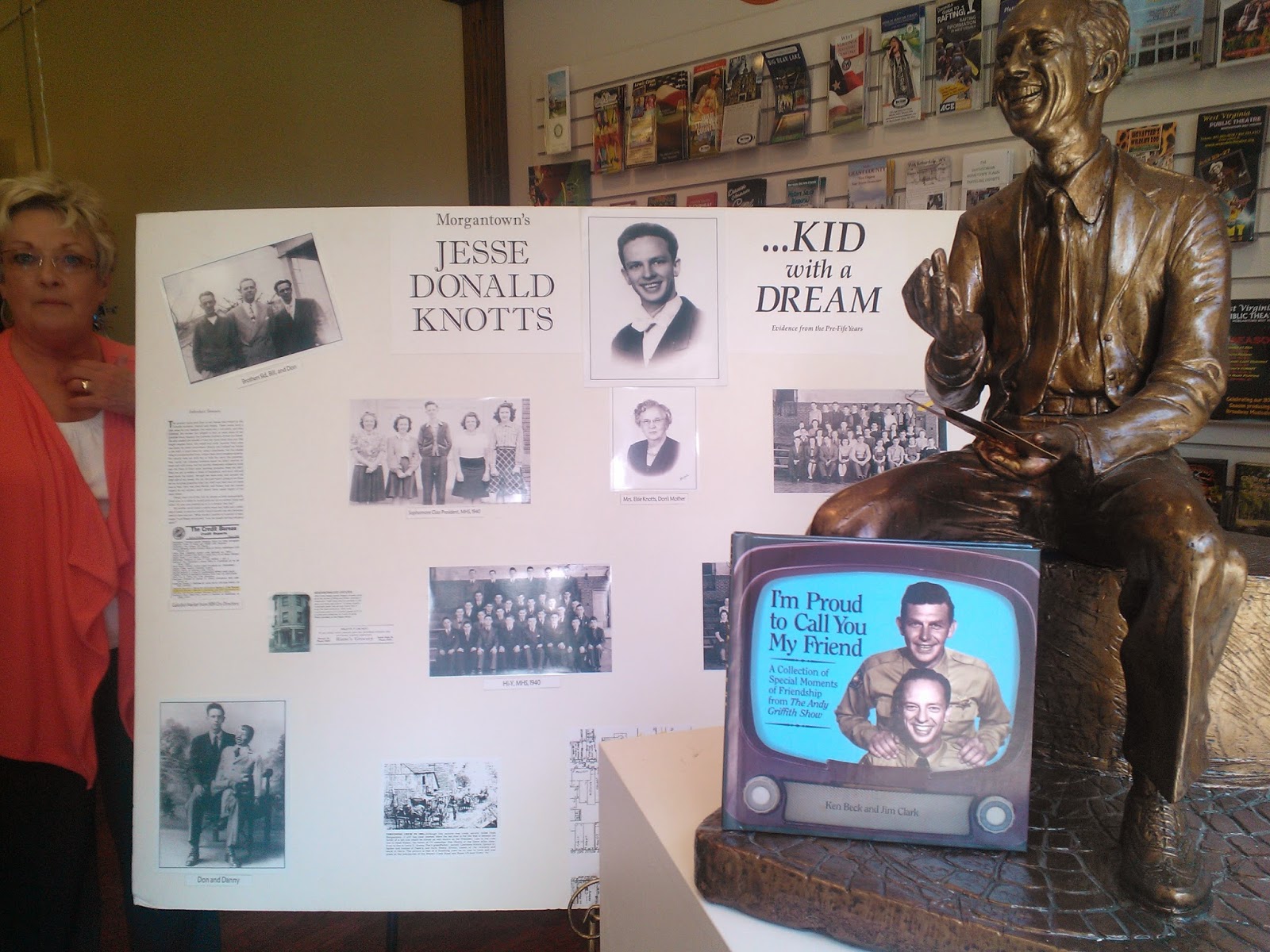
Guarding Don Knotts

This maquette is to become a larger-than-life statue of Don Knotts to be erected on the waterfront. Morgantown is hoping to create a whole day of it, whenever it is, with a dedication and unveiling. An entire weekend of Don Knotts Days might include parades, picnics, band concerts, beauty pageants, culminating in a massive fireworks display. I sure hope I’m invited to the event I just created in my head.

I am always looking for the hidden Easter eggs real life has to offer. Finally, there are two weird pieces of synchronicity on which we’ll end the Don Knotts Memorial Nostalgia Tour.

SYNCHRONICITY #1: Almost 300 miles south of Morgantown I was reminded of the enuring legacy of Don Knotts on ‘Merkin culture.
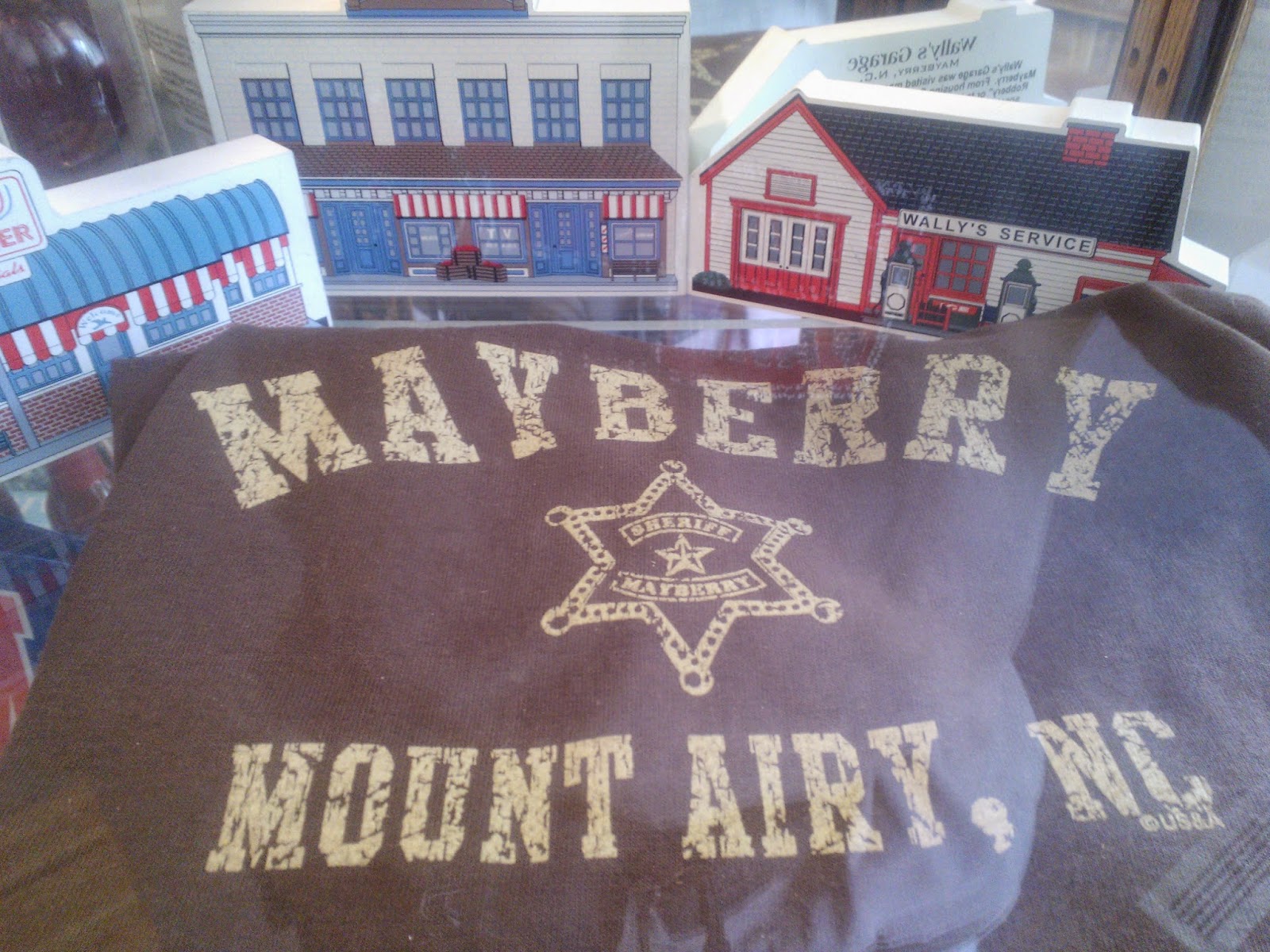
After leaving Morgantown, with more than a thousand miles still to go before I get home, the Sunrise to Canton Road Trip for Research was just marking off the miles with no more side trips. The farther south I traveled, the less hilly the terrain. The road began to level out in southern Virginia. Crossing the state line into North Carolina, I was in great need of rest stop. The first one I happened across was not far into the state, just outside of Mount Airy, North Carolina.

I didn’t realize it until I walked inside, but Mount Airy was the birthplace of Andy Griffith. Inside the rest stop, in a display cabinet given pride of prominence is a tribute to Mount Airy’s favourite son. Of course no tribute to Mayberry is complete without a nod to Dan Knotts, second banana extraordinaire.

SYNCHRONICITY #2: As I was editing this into a coherent arrangement of words, sentences, and paragraphs, the tee vee was playing in the background. A noisy commercial distracted me and I looked up to see what it was about. There, on my tee vee tube, was Don Knotts!!! As it turns out, MeTV is bringing The Andy Griffith Show to its comedy calvacade, replacing the ever-dreadful Gilligan’s Island, starting September 1st, and every weeknight at 8PM Eastern, 7 Central.

* As the Not Now Silly Newsroom Fact-Checkers were preparing this article for print it was discovered that not all events took place as described. We were going to just scrap this travelogue as not worthy of publication, but Headly has already cashed the cheque.
A Note From The Road

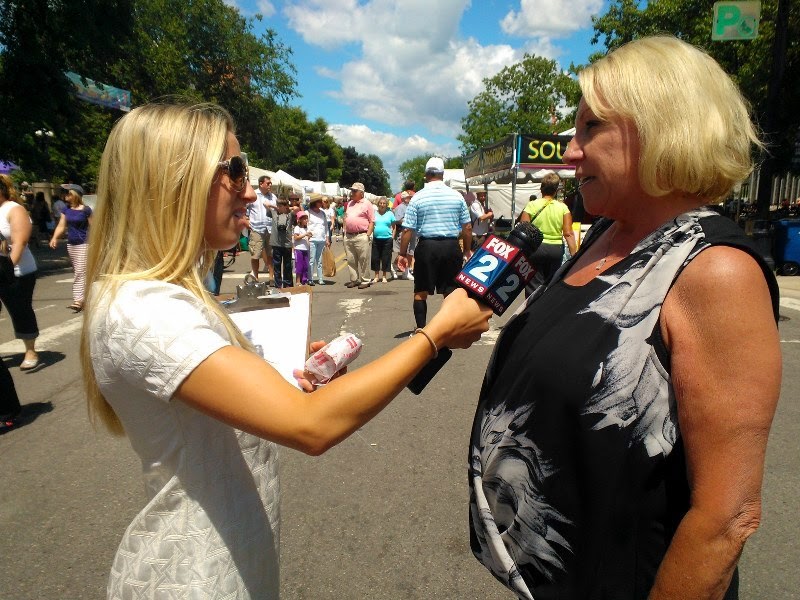
Spent yesterday at the Ann Arbor Art Fair. That’s where I encountered this Foxite. It was tempting to jump into the shot, but then I remembered guarding David Onley on the sidewalk in front of Citytv while he was doing weather reports. I resisted, but it took every ounce of willpower.

Where The Sidewalk Ends, Racism Begins ► Chapter Two

Our next destination in Where The Sidewalk Ends, Racism Begins.

This path runs along another section of The Colour Line in
Coconut Grove. Note the fence. We’ll get back to that later.

Before beginning our second West Grove stroll, it’s worth reading the last Where The Sidewalk Ends, Racism Begins. Since it was published in December, additional info about the Coconut Grove Colour Line has been found. In Dismantling Racism: The Continuing Challenge to White America [published by Augsburg Fortress, 1991], Joseph R. Barndt writes:

A southern version of these traceable corporate decisions to create a Black ghetto exists in Miami Florida. Running through the entire area called Coconut Grove on the South End of Miami are the remains of an eight-foot stone wall, built to separate Black and white residential neighborhoods. Resolution 745, adopted at Miami City Planning Board meeting of July 21, 1941, reads as follows: “A resolution recommending that the establishment of a permanent diving line between white and colored occupancy in the area north of Grand Avenue and east of Douglas Road.” There are also later resolutions that describe the placement, size, access, roads, and responsibility for maintenance of the wall. The wall’s remains still stand, but few citizens of Coconut Grove remember its original purpose, or the decisions that created it.

Fewer remember the next Colour Line we will visit on our Where The Sidewalk Ends, Racism Begins walking tour, although it’s far less hidden. Rather than running along the backyards of a neighbourhood, it’s in plain sight. An entire block of houses stare out at it. Furthermore, it’s not just in plain sight, but maintained and fortified to this very day. Let’s go for a walk.

From where one sidewalk ends to where the next sidewalk ends.

We begin right where we left off the last time. While standing on Douglas Road at The Colour Line facing The Wall of Shame, turn left, and cross Douglas. This will put you on Franklin Avenue. Walk east along the southern edge of the Charlotte Jane Memorial Park Cemetery, named after the wife and childhood sweetheart of E.W.F. Stirrup. This was once the only place in Miami where Black folk could be buried and, contrary to some references found on the internet, is not where Michael Jackson filmed Thriller. Past the cemetery is one modern 2-story home and then several single family homes in the Coconut Grove vernacular of being either modified Conch or Shotgun styles. Turn right at the little traffic circle at Plaza, the first street, and walk down to where the sidewalk ends. That’s where racism begins and Marler Avenue begins.

Marler Avenue is a funny little street in Coconut Grove, “little” being the operative word. It runs east-west for one short block, from Hibiscus Street to Plaza Street, with houses only along the north side. Every one of those houses looks out at a wall — overgrown with foliage and almost invisible in parts, unless you know where to look.

I first learned of Marler Avenue from an article called The Wall, which Kirk Nielsen wrote for Miami New Times way back in 1998:

One look at Marler Avenue clarifies [Marler resident David] White’s frustration: Not only are he and his neighbors fenced in at both ends of the block, but along the southern edge of the tiny street is a ten-foot fence. “This all used to be open,” White explains, standing in his driveway and pivoting 180 degrees as he points from one end of the street to the other. “We used to walk through there.” He gestures toward one section of fence with a coil of concertina barbed wire — the kind used in military operations: “Totally unnecessary,” White exclaims, shaking his head, his hands now tucked inside his back pockets.


Will Johnson, who returned home to the black Grove four years ago after eighteen years in the U.S. Army, is offended by the notion that white Grovites would put up barricades to protect themselves from their black neighbors. “The idea that a man would put that damn concertina wire on top of the fence there,” says Johnson, age 46, surveying the barrier with White. “The truth is it won’t make any difference at all. The guys know how to get over there and rob their ass anyway. It’s not a deterrent.”


White regards the barriers as vestiges of “segregation and white dominance. And I say, look, I pay taxes the same as anyone else. I don’t necessarily want to go into their community, but I do want to make sure that if I need to go over there for anything I have the accessibility. Now, if I’m going to go over to Plymouth Congregational, I gotta go all the way around” — he twirls slowly in a half-circle to indicate the circuitous route he would have to take — “instead of the way the streets were supposed to be.”

A map dated 1947-1949, before Marler Avenue was closed off on all sides.

That wall is the Marler Avenue Colour Line, but it also demarcates the end of the backyards of houses that front along Loquat, one block south. If you look closely at the map above, you will see a faint line running west from Marler, which would have extended the street all the way to Douglas Road, also known as 37th. In fact Marler was supposed to have gone through to Douglas, as this map from the late ’40s indicates. It also shows some other Marler mysteries. For instance both Plaza and Hibiscus were also supposed to link up to Loquat Avenue.

Back then Marler, Plaza, and Hibiscus were nothing more than a dirt roads that became mired in mud during the rainy season. However, a curious thing happened on what should have been the western end of Marler Avenue. The White homeowners on Loquat Avenue illegally extended their backyards into the right of way, closing off Marler. And, that’s how Marler Avenue lost access to Douglas Road. Quietly. Illegally. Racially.

Hibiscus Street never went through to Loquat as it should have either. Eventually that land was sold off and condos built. And, that’s how Hibiscus lost access to Loquat Avenue. Even more curious is the evolution of how Plaza Street lost access to Loquat.

Plaza Street begins its southward trek at the famed US-1. At Grand Avenue, once the thriving Black business district of Coconut Grove, it takes a slight jog. Today, it continues all the way down to Marler, where the sidewalk ends. According to that 1940s map, [above] Plaza Street was supposed to take another slight jog at Marler before continuing south past Loquat in South Grove, where at Poinciana Avenue, it would make a gentle left turn to connect to Main Highway. However, that was not to be.

When the lower section of Plaza, along with Marler and Hibiscus, were paved sometime in the ’70s, this dogleg, between Marler and Hibiscus remained dirt. It was little traveled by vehicles because it wasn’t well maintained and, quite frankly, South Grove had little reason to go north into West Grove, which was considered unsafe. West Grove, for the most part, traveled north to Grand Avenue to shop and be entertained. This little section of what should have been Plaza Street eventually became an overgrown footpath that crossed the Coconut Grove Colour Line from West Grove to South Grove, Black Grove to White Grove.

It remained a footpath until some time in the early ’90s when — without warning and city approval — a chain link fence was erected that closed off the bottom of Marler Avenue entirely. No one knows who paid to have it put up, but fingers were pointed at White residents in South Grove reacting to a perception of heightened crime, accusing the perps using this path.

The chain link fence didn’t stay up very long.

IRONY ALERT: Just like it was the complaints of White folk that got Old Smokey closed down, and
just like it was the White folk that finally got the western edge of the Wall of Shame taken down, it was the White folk of South Grove who were
responsible for getting the chain link fence taken down. A good many of the residents of West Grove worked for families in South Grove as gardeners, maids, handymen, and nannies. When the Plaza extension was closed off to foot traffic, these tradesfolk started complaining to their employers because, suddenly, they were forced to walk a lot farther to get to work. The fence came down.

There had been other leaks in The Wall of Shame. Along the south side of Marler that section of the wall had been porous. People remember using dirt paths to take shortcuts to Loquat and walk to Plymouth Congregational Church. But over the years one link after another was closed off until the Plaza foot path became the last surviving link between West Grove and South Grove along residential streets.

For the longest time it remained a dirt path. Eventually this rough footpath was improved by the City of Miami. Paving stones were added and the foliage would be cut back occasionally. However, it was poorly maintained over the years. That is, until quite recently.

In February this reporter first visited Marler Avenue to begin research on this post, and to scope out the lay of the land. Way back then the edges of the path were falling apart. Many pavers had been stolen. Sinkholes in several places made walking a baby stroller difficult. A second visit a few weeks later showed newer destruction. The post that would keep vehicles off the foot path had been flattened, probably by a vehicle. [A big rock at the south end of the path would have kept it from exiting on Loquat, however.] A third, more recent, visit held a much bigger surprise. A new, sturdier post had been installed to keep vehicles out and the path had been repaired. All the pavers were replaced and leveled, with the edges shored up. It wasn’t until I started taking videos to document the maintenance that I noticed something very disturbing.

BEFORE:

February 25, 2014: Crossing The Colour Line in Coconut Grove, from
Black Grove to White Grove, from Marler Avenue to Loquat Avenue

AFTER:

April 21, 2014: Note the brand new
addition to the fence along The Colour Line.

This is pretty much where maps say Marler Avenue should have met Douglas Road

As the path became more navigable, and the wild foliage cut back drastically, someone must have felt far more vulnerable. Why else would another 2 feet be added to the top of The Wall of Shame, The Colour Line of Coconut Grove? Furthermore, it was done in the cheesiest way possible, by just nailing new boards on top of the old ones.

No matter. It still makes a statement about keeping Black Grove separate from White Grove in 2014, 16 years after Black residents told Miami New Times how offended they are by a constant reminder of systemic racism. Despite the One Grove mural, the Black and White communities in The Grove are quite separate, and have been for decades.

As I said in the first entry in this series:

The Coconut Grove Wall of Shame™ is not unlike the wall in my home town of Detroit known alternatively as The 8 Mile Wall, The Wailing Wall, or the Birwood Wall. A search on the Googalizer for the 8 Mile Wall turns up references, history, as well as tons of images. However, one has to go digging to find any images or references to the Coconut Grove Wall, the history of which is being buried like much of the history of West Grove.

The Coconut Grove Wall of Shame is far longer that the 8 Mile Wall. The more I research Coconut Grove, the more I realize it is the story of Race Relations in this country writ large. However, West Grove is the exception that proves the rule. What has always put Coconut Grove into stark relief is the fact that, at one time, it had the highest percentage of Black home ownership than anywhere else in the country. Consequently it couldn’t be colonized; it had to be surrounded and walled in on all sides. Much of that wall still exists and the current invisible Colour Line can still be traced.

COMING SOON: Another walking tour along the Coconut Grove Colour Line.

A Different Drummer ► Unpacking the Writer

A funny thing happened at the 32nd Annual King Mango Strut

Back in December, when I covered the 32nd Annual King Mango Strut,
I could have hardly imagined it would be a life changing event. Yet,
almost immediately I realized it was a transformational day.

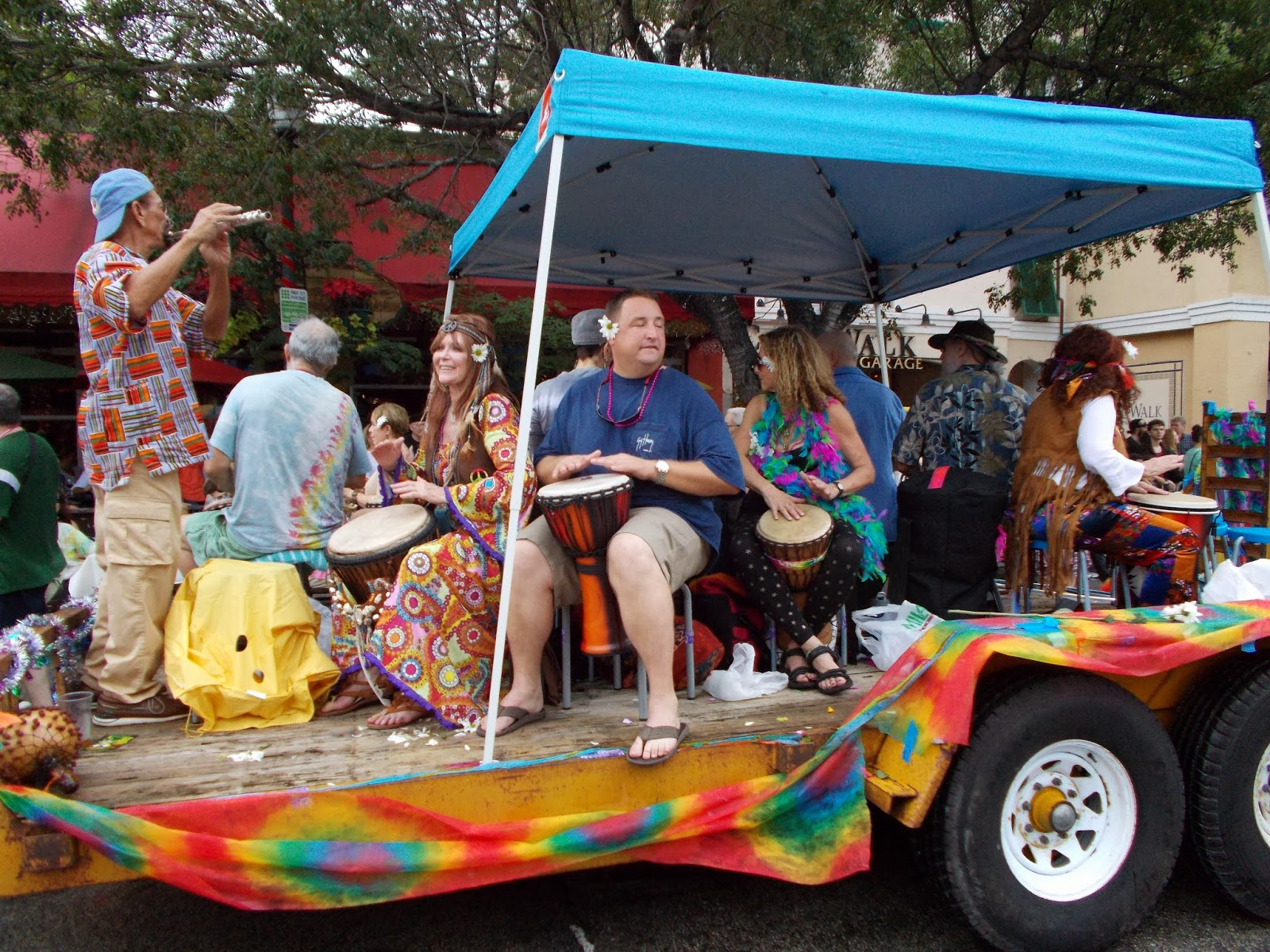
TO RECAP: I attached myself to the Coconut Grove Drum Circle to cover the King Mango Strut from the inside. The parade, which went
around a small 2-block circuit exactly one time, spent the entire morning
marshaling on Commodore Plaza. I had a lot of time to think. It took 5 times longer to get ready for
the Strut than it did to Strut. That was over almost before it began.

A journalist
straddles a tiny grey area between participant and observer. One tries
to stay out of everybody’s way, without blending too far into the background. Taking notes, taking pictures, taking impressions at once removes the
journalist from the action, while it immerses the writer in the experience at the very same time. It’s an anomaly.

One thing became clear to me during all those hours: I DID NOT want
to be covering the King Mango Strut. I just wanted to be hitting those
drums instead.

I’m no drummer. I barely have any rhythm. I’m not even a musician. The blog post My First Band ► Cobwebs And Strange
recalls my HIGH-LARRY-US teenage attempts at being a lead singer in a Rock and
Roll band. To sublimate my lack of musicianship, I love listening to
all genres of music passionately. It’s not a fair tradeoff, but it’s all I’ve got. [That and 42 linear feet of CDs, more that 25,000 tunes on my hard drive, and enough Spotify playlists to last several lifetimes. Whoever has the most music when they die, wins!]

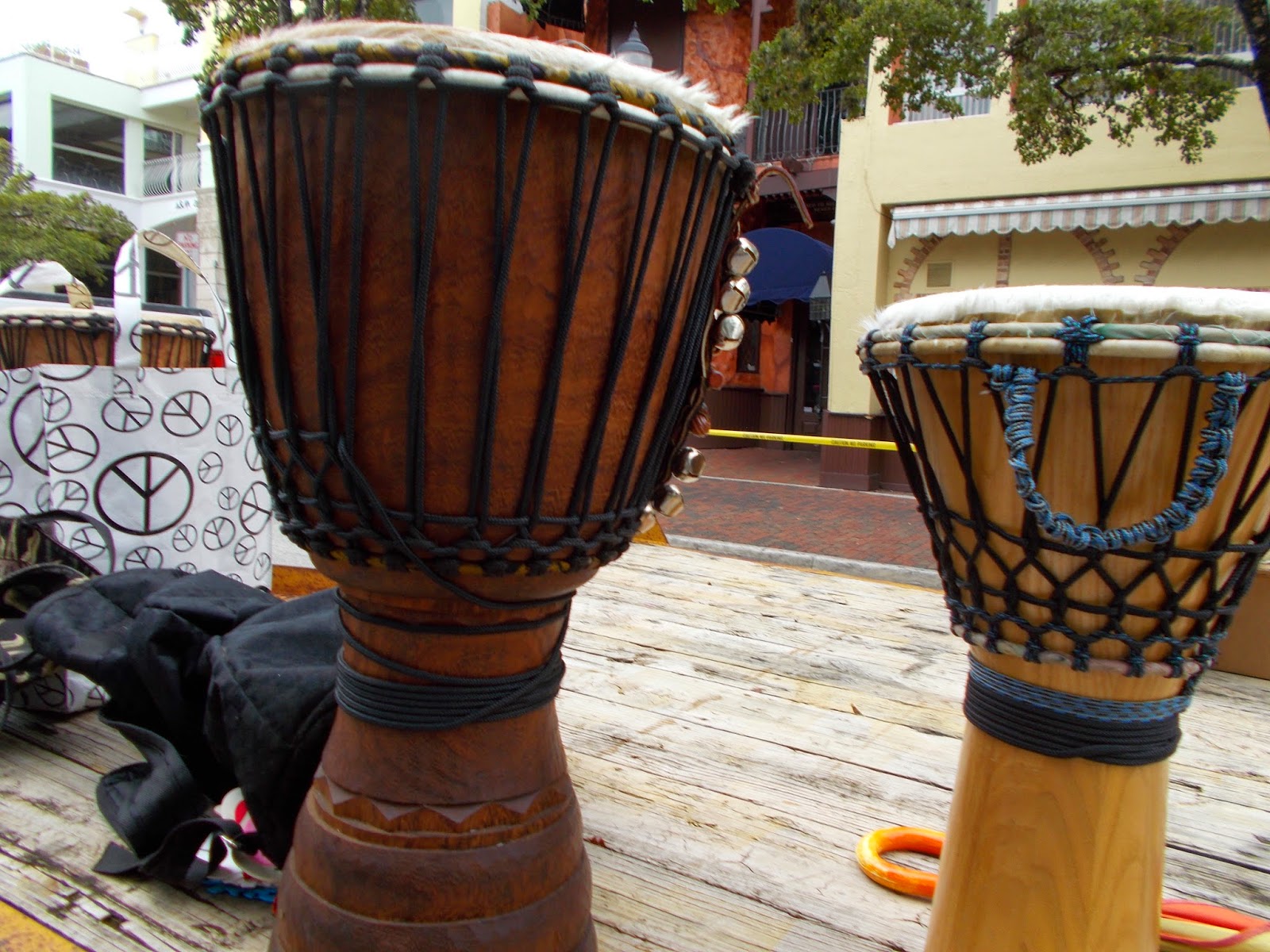
Djembe drums awaiting use

But…but…but…on
the day of the King Mango Strut, all I wanted to do was to slap those drum skins. Every once in a while one of the drummers would let me have a few
whacks on their oddly shaped drum, which I now know is called a
djembe. But, walking past a drum and giving it a few taps is different
from putting it between your legs and banging away. And, I was desperate to put one of those things between my legs and bang away. The only other time music had such an immediate, visceral effect on me is told in The Day I Met Bob Marley, another popular post at Not Now Silly.

By
the time the Strut was over, I knew I would be joining the
Coconut Drum Circle again, but this time as a participant. I would get my chance soon enough. There’s one held on the
first Saturday of every month, just a few hundred feet from where we
marshaled for the Strut.

So, skip ahead. It’s the first Saturday of the month. At the corner of Commodore Plaza and Grand Avenue I was handed a djembe. I spent the evening pounding away like a mad man, until my hands hurt. Sadly, it was nothing like what I had anticipated and it turned out to
be a very unsatisfying and deflating experience.

To begin with, I should have brought my own camping chair. I don’t mean to be churlish because I was graciously supplied with a drum and a tiny stool. But that little thing hurt my delicate ass after several hours. To make matters worse, I couldn’t hear myself. That’s why I hurt my hands. I was trying to make my drum loud enough so I could hear it over all the other drums. Not
being able to hear meant that I couldn’t tell how hitting the head in different places affected the sound. Only later did I realize I sat next to all the BIG DRUMS that people were hitting with big sticks. No wonder I couldn’t hear myself.

Worse still was the fact that, once again, I had to face up to the limitations of my left hand. Back when I was a teenager my guitar teacher told me I had no absolutely coordination in my left hand. To quote myself:

It turns out that time proved him right. Over the years I have learned
that my left hand is pretty useless for most tasks. When I smoked I
couldn’t even use my left hand to hold the cigarette because I managed
to drop it so many times. Trying to use a remote with my left hand?
Forget it! I’m the EXTREME opposite of ambidextrous. Hell! I’d give my
right arm to be ambidextrous.

It’s probably just as well I couldn’t be heard in the mix at the drum circle. Whenever I tried to find my own beats within the group’s rhythm, my left hand would lurch out spasmodically, finding crazy syncopation never intended for music of any kind, even Jazz. I drove back to Sunrise from my first drum circle dejected. It was not at all what I had hoped. Nor did it feel as if I could ever fit myself within the group’s rhythms.

Yet, there were moments that first night that transcended thoughts, transcended time, transcended my crappy rhythm. I would find myself transported, soaring through millennia of music making. I imagined myself back in Kebo, the name the original Bahamians
gave to this area of Coconut Grove a century ago when they settled here and built Miami. At night there would have been music-making. I could feel the
energy we created merging with rhythms from the past, present and future. Outside was one thing. In my head I could fuse what the circle created with Gospel melodies, horn sections, Rock and Roll, Jazz, New Orleans, and Reggae rhythms. Again, it penetrated me deeply in a way that words just seem so inadequate to describe. This paragraph will have to do instead.

I was pissed. As much as I was drawn to the drumming — as much as I wanted to be a part of it — my lack of left-hand rhythm kept me at a distance, kept returning me to reality. I was running these thoughts through my mind the next day as I listened to music. I soon became aware that, as always, I was tapping my feet and ‘drumming’ the fingers of my right hand on my desk to the tunes. What was going on?

TANGENT: My odd relationship with music didn’t quite make sense to me until I read Musicophilia by Dr. Oliver Sacks. That’s also when I started to over-think my lifetime contract [sic] with music and how I process it. I’ve been reading Sacks, who writes fascinating books about people who have anomalies, diseases, or damage in their brain, for many years. However, this book was the first time I ever thought he was talking directly about me, in part.

I happened across the Sacks book right after reading This is Your Brain on Music: The Science of a Human Obsession by Daniel J. Levitin. Musicophilia is about the [almost mystical] effect of music in (on?) the brains of case studies, both normal and abnormal. This is Your Brain describes the science of measuring the changes in the brain caused by listening to and/or playing music. These two books summed up for me my relationship to music, whether it’s shaking my eardrums or being created inside my head.
Growing up, adults always
told me I was fidgety. It took many years to realize that I wasn’t
nervous. I was keeping a rhythm to music by tapping my feet and/or drumming my
fingers. Even if there’s no music playing. Especially if
there’s no music playing. My mind is
always creating music when there is none: the ticking of a fan, the hum of florescent lighting, or the sound of footsteps can all lead to my brain over-laying a tune on top of it. My toes and fingers are reacting to that. As a child I never had the language to describe it. As a young adult I figured if I told that to people, they might lock me up. Now that I am — ahem — mature, I’m quite comfortable with the music in my brain. TANGENT OVER. MOVE ALONG.

I spent almost a week of analyzing my disappointment to my first drum circle. Friends told me I was over-thinking the whole dealie, but that’s how I process events that rub me wrong. One friend tried to make me understand that all that was needed was for me to feel the music. It wasn’t necessary to think the music. I especially didn’t need to over-think the music. But I did. I knew I did. How did I know? Because I couldn’t get the problem out of my head.

Then the light bulb went on. I realized that what I really wanted to play was what I heard in my head and what I was hearing in my head was not a drum. A drum circle plays
budda-duh-budda-duh-budda-duh-budda-duh-dum-dum-daddah. [repeat] What I was
hearing in my head was tink, tink, tink, tinka-tinkahh, tink, tink,
tink, tinka-tinkahh on top of the rhythm.

It came to while I was ‘drumming’ my fingers on the desk again. Paying better attention to what my fingers were doing — over-thinking it, you naysayers — I realized they weren’t beating out a steady rhythm at all. My fingers were popping off accents within the rhythm. I was hearing the syncopation inside the rhythm.

Mine looked exactly like this
until I knocked the logo off

Over the next week I visited a couple of music stores and tested out a number of percussion instruments. I really liked the sound of the wood blocks, but they were all far too expensive for this weird, new obsession I was chasing. What if I didn’t like it?

I finally settled on a set of claves and a cowbell. I spent the next little while practicing the claves as various genres of music played on my computer jukebox. I knew almost immediately I had found my instrument! My left hand needs to do nothing but hold a stick. How hard is that? My right hand only needs to bang another stick against it. How hard is that?

Since finding my instrument I’ve also learned about several different drum circles in my area. Until recently I had no idea drum circles were even a thing, but they’re all over the place. There are a few nearby on each full moon and several within an hour’s drive at other times during the month. There are drum circle classes and larger, yearly, conglomerations of drummers. These bring together many drum circles and people make a weekend of it and howl in the woods (in my imagination). I’m learning there’s a very primal need being fulfilled with drum circles. The journalist in me says they require further investigation. The neanderthal in me just wants to bang sticks together.

I have now guest starred with a few separate drum circles, insinuating my tink, tink, tink, tinka-tinkahh, tink, tink,
tink, tinka-tinkahh within the budda-duh-budda-duh-budda-duh-budda-duh-dum-dum-daddah. I’ve now sat in enough drum circles to note each have a different personality. I’m not quite sure how anyone else takes what I do, but I’m having a great time finally playing what I hear in my head and meeting new friends along the way.

And that’s the story of how covering something as a writer changed my life.

NOT NOW SILLY NEWS FROM THE NOT NOW SILLY NEWSROOM: There are several new posts already in the works, with the research pretty much finished. Just within the last few days so many things have occurred on Charles Avenue, that I’ve barely had time to keep up. I have a few outstanding phone calls, but that will get its own post coming up in the next few days. I’m also part-way through documenting a second chapter of Where the Sidewalk Ends, Racism Begins. And, as I keep promising, there’s a new chapter of Farce Au Pain coming up. While on the subject of books, don’t miss The Johnny Dollar Wars ► Chapter and Verse, in which I expose my crazy cyber-bullies for the malevolent creeps they are, last thing Mark Koldys wants anyone to know.

Unpacking The Writer ► April 2014

Welcome readers both new and old. Once a month, on an irregular schedule, I drop a blog post under the rubric Unpacking the Writer, where I pull back the curtain and expose some of what’s happening on this side of the keyboard, much like Toto did to The Wizard of Oz.

Which is only appropriate because I wrote under the nom de plume of Aunty Em for NewsHounds, the motto of which is “We watch Fox so you don’t have to.” Clearly, I did a very good job of exposing Fox “News” mendacity. You know how I can tell? Although I left NewsHounds more than 2 years ago, the same crazy, obsessive Fox “News” defending, cyber-stalking bullies I picked up back then continue to hound me to this very day. [See what I did there?]

BOOK CORNER: I’ve been writing about the exciting adventures battling my cyber-stalking bullies — chapter by chapter — since the day I launched this blog. They’ve been published at Not Now Silly as needed and now comprise quite a thick dossier on what crazy obsessives do in the Age of the Internet. In previous times they’d be standing on street corners babbling incoherently. This medium keeps them off the street, unless they have a phone smarter than they are.

As of late [and mentioned only to satisfy Grayhammy’s vast curiosity, because he keeps asking] I have been working with an editor to give the project more ‘”shape,” as they keep putting it. They believe The Johnny Dollar Wars could be turned into a Laff Riot Situation Comedy or a blockbuster Gothic Horror movie. [It works both ways.] Until I post a compendium, the best place to start is Anatomy of a Cyber-Feud, which is currently the #3 most popular post at Not Now Silly for the past 30 days, despite it being published way back in December. If you want to keep up with the daily shoot & miss tactics of The Flying Monkey Squad, you’re personally invited to join The Johnny Dollar Depreciation Society, on the facebookery.

Follow the day-to-day craziness of my cyber-stalking bullies at The Johnny Dollar Depreciation Society page.
HARD WORK: Forging Farce Au Pain from the raw alphabet.

CHAPTER TWO: My other book, Farce Au Pain, proceeds a lot slower than I ever expected when I promised serialization way back when. I anticipated having more time to work on it, but life and new Coconut Grove stories keep getting in the way. It doesn’t help that I chose to make my task more difficult. Because it’s being published on the Internet, I decided to link all the facts and references to the existing internet proofs as I edit the manuscript. There are a lot of those, which you’ll notice when it’s eventually published. I’m closing in on it, but I’ve learned better to make any hard promises, otherwise Grayhammy will squawk again. Hopefully I’ll have some news on that front very soon. Stay tuned. Check your local listings. Coming to a browser near you, and all that Jazz.

COCONUT GROVE CORNER: Still awaiting news of a Trolleygate settlement in West Grove. Almost 2 months ago I wrote Is Trolleygate Headed For An Out Of Court Settlement? To quote myself:

So confident are all the parties that an agreement is possible, that they’ve requested a 60-day freeze in all legal proceedings to see if they can all get on the bus. Based on the anger expressed at the Village Council Meeting, it may be an uphill climb on a rough road to a negotiated settlement.


The broad outline of the proposed settlement looks like this: Coral Gables agrees to drop its lawsuit against Astor Development that asks a judge to abrogate its contract with the developer. Meanwhile Astor Trolley/Astor Development agrees to stick the new fake trolley garage RIGHT WHERE IT IS NOW, more or less, as opposed to the non-conforming White Elephant on Douglas Road.

Those 60 days are just about up, if they haven’t expired already. I should put in a few calls. I’ll add that to my ever-increasing To Do List.

This is where the next sidewalk ends.
This historic walkway has been fixed.

MY LATEST WRITING PROJECT: I’ve slowing been crafting another chapter in my ongoing series Where The Sidewalk Ends, Racism Begins (of which there has been only one so far). The next one will delineate another segment of The Colour Line in Coconut Grove, pictured at left.

The Coconut Grove Colour Line has existed for decades. The line was
always meant to keep Black Grove separated from White Grove. But, it’s not just ancient history.

Current segments of The Colour Line are as concrete as the cinder block wall described in Where The Sidewalk Ends, Racism Begins.
Other parts of The Colour Line in Coconut Grove are subtle and almost
imperceptible to the naked eye, unless you know what to look for. Still
other parts of The Colour Line are as clear as black and white when
looking at maps of property values and demographics in Coconut Grove. 

A close up of the fence seen in the background [above left]. Two
feet have been added to the top of it within the last few weeks.

Although the building of The Colour Line in Coconut Grove is ancient history, some of the walls along it were not only maintained, but made taller and more formidable as time went on, a process that continues to this very day. Shockingly so.

Within the last few weeks the latest spot I have been struggling to write about has had its fence — this small segment of The Colour Line — grow 2 feet taller by just nailing new boards over the old. Look for the next blog post on The Colour Line, coming soon to a browser near you.

THE CORNER OF MAIN HIGHWAY AND CHARLES AVENUE: This is where it all began for me 5 years ago when I discovered the Historical Marker and started researching and writing about this small corner of the world. Here are some quick updates:

The deal concerning the Coconut Grove Playhouse continues to unfold exactly as the residents had hoped it never would. The Miami Parking Authority has now painted HUGE arrows in the parking lot on Main Highway, directing traffic to an exit on Charles Avenue. This has increased the traffic in both directions along the Historic Roadway, along which you will find the Coconut Grove Playhouse; the Charles Avenue Historical Marker; the E.W.F. Stirrup House; the former Odd Fellows Hall; the Mariah Brown House, the first house built on Charles; ending at the Charlotte Jane Memorial Park Cemetery, named after the wife and childhood sweetheart of Mr. Stirrup and at the time of its founding the only place in Miami Black folk could be buried.

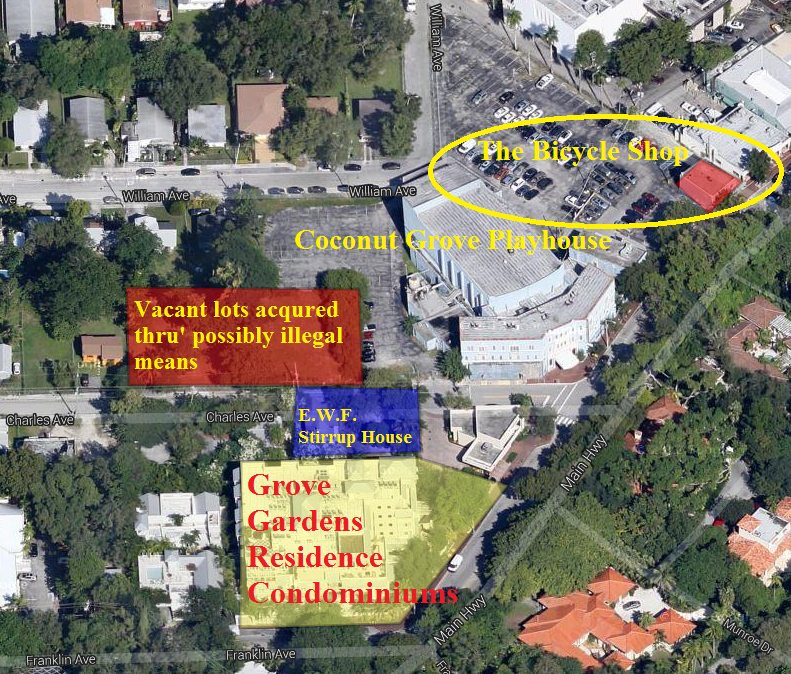
Meanwhile rapacious developer Gino Falsetto continues to chip away at The Colour Line in Coconut Grove. His Aries Development has checkmated the Coconut Grove Playhouse with the acquisition of the Bicycle Shop on Main Highway at one end. This adds to the property he’s controlled for a while: the two empty lots immediately west of the Playhouse and the E.W.F. Stirrup House immediately across the street. Now whatever people want to build in between all those properties will have to go begging to Aries Development, hat in hand.

Pops on his 88th birthday, February 14, 2014

PERSONAL CORNER: My family and closest friends know, but I’ve not shared this with Not Now Silly readers yet: I came to Florida after the death of my mother to look after Pops. It’s starting to weigh on me and maybe writing about it will help me work some things out.

I’ve been in Sunrise for 9 years, arriving just in time for Hurricane Wilma. When I arrived, Pops was fine, despite his having a stroke about 20 years ago. He battled back and you would never know he had had one.

Pops didn’t really need me to care for him. He was capable of accomplishing more in a day than I did. However, he is of a generation of men who knows where the kitchen is, but just doesn’t know what kind of magic gets food on the table. If I weren’t here, he’d be getting all his meals out of the microwave. A fried egg is beyond his expertise.

However, in every other way he was competent. Three or 4 days a week Pops played 9 holes of golf on the course that wends its way around the condo complex. He’d hang with his buddies at Subway or the condo clubhouse. The last few years he’s been slowing down. At first he’d only play 8 holes of golf, knocking off at the one closest to our building. Then it was 5 holes, meeting up with his crew on the 4th and playing with them through 8.

He may have battled back against the stroke, but he’s getting pummeled by the years. Within the last year he’s been admitted to the hospital twice, both times for having a bit of trouble catching his breath. The last visit was 3 weeks ago. He’s just not bounced back the way we all thought he would afterwards. And, he hasn’t played any golf since. He’s just had a round of tests to see whether we can get to the bottom of this latest problem and we’ll get the results in a few days when we visit the pulmonologist again. Meanwhile he’s on a Nebulizer twice a day and an inhaler 4 times a day and his movements are resricted by his lack of energy.

We’ve recently convinced Pops to start using a cane. After the stroke he always had a very slight imbalance. However, lately it’s been more pronounced. He seems unaware of how he tacks to the right as he walks without assistance. My biggest fear, of course, is that he’s going to fall when I’m not here or when I’m asleep. That’s why I now always make sure a walker and cane are within reach.

This all means I am getting to Coconut Grove less often than I would like, but I wouldn’t suggest Gino Falsetto relax. I still pop into Coconut Grove when I’m least expected. Recently I was fortunate enough to meet his wife Magda. Maybe one day soon I can meet the brains behind Aries Development and can ask him questions directly. Meanwhile, you can help Save the E.W.F. Stirrup House by joining the Facebook group.

Aries Development Continues To Rape Charles Avenue

Code enforcement beat me to it.
That $4,000 fine will restore the 100-year old trees, right?

It was supposed to be a quiet morning editing Farce Au Pain, until I received a text from one of my secret sources in Coconut Grove. The gist of the message being: “You won’t believe what’s going on at the E.W.F. Stirrup House.”

My source had heard that the 8-foot wall that separated the E.W.F. Stirrup property from the Grove Gardens Residence Condominiums [hereafter known as The Monstrosity] had been torn down. This was apparently done so that the restaurants and bars in The Monstrosity could start seating customers on the E.W.F. Stirrup Property.

Wait!!! What???

I jumped in the car and drove down to Coconut Grove as quick as the speed limit on I-95 would allow. While my source was correct, it was even worse than they had suspected. Yes, the wall — which had been the target of graffiti artists on more than one occasion — was removed as a first step to expanding the restaurant seating, but what was done at the front of the property is what reduced me to tears.

The E.W.F. Stirrup Property has been raped of all its old growth trees!!!

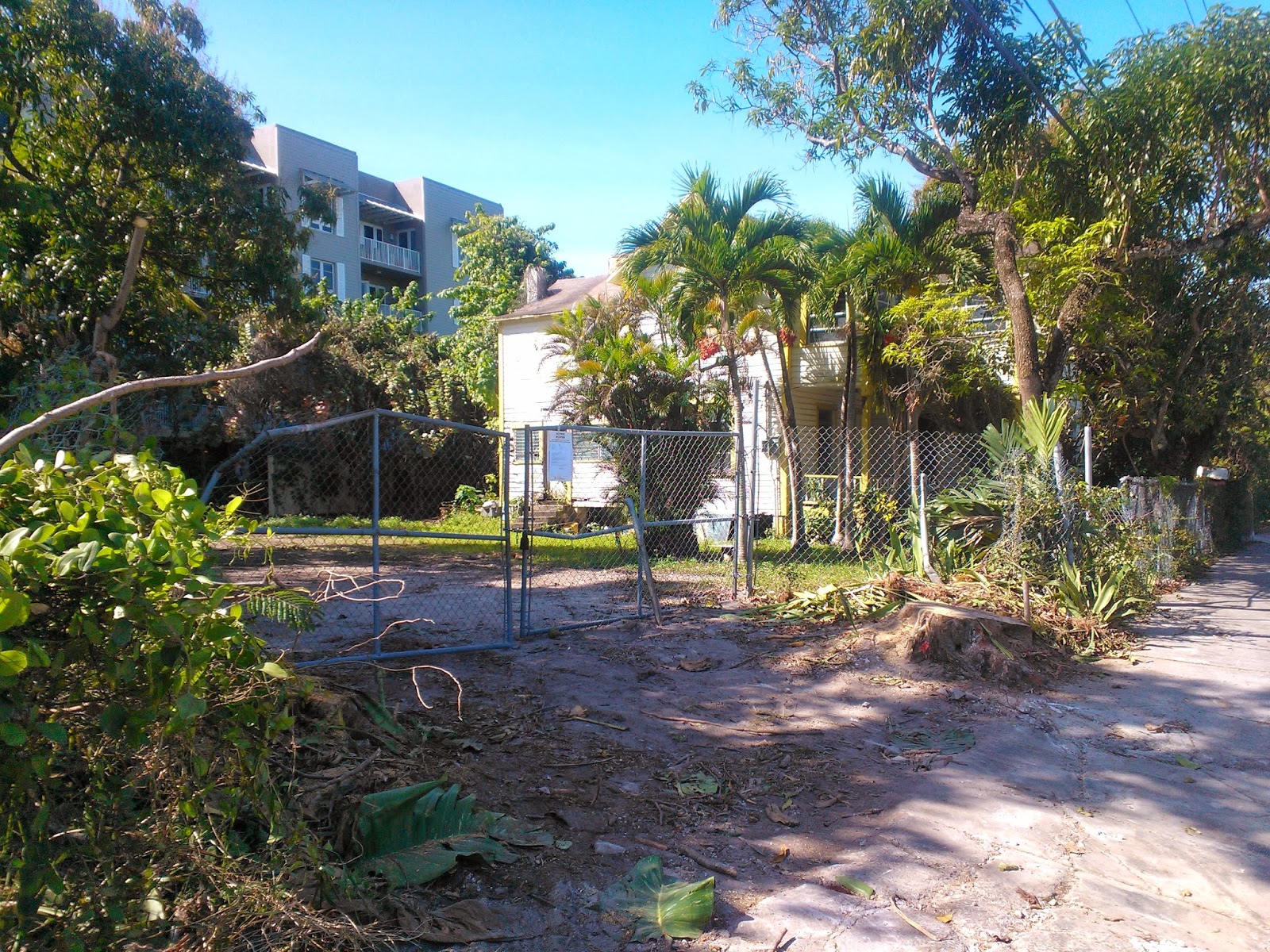
On the east side of the driveway now sits this beautiful stump.

Four trees on Stirrup property (not to mention 3 trees on the vacant lot across the street) have been hacked down to the ground. Two of these trees flanked the Stirrup driveway entrance and they were nearly as old as the 120+-year old house. These trees were so old they had old growth vines climbing up them as far as the eye could see. This is the kind of lush foliage prized in Coconut Grove, with philodendron leaves LARGER than two dinner plates side by side. People pay extra in Coconut Grove for property with this kind of canopy. Now, it’s all gone. Compost.

Chopping down trees is one of those things that Miami takes very seriously. In fact, there are strict laws against it. When it was learned a year back that Coconut Grove would lose some of its canopy along Commodore Plaza — ironically just a block away from the Stirrup House — people went nuts and had the tree removal program scaled back considerably. Later, when people in Brickell learned that the green canopy there was slated for destruction, not only did public opposition stop that plan in its tracks, but recently the City of Miami decided to take responsibility of Brickell from Miami-Dade County to better manage its resources.

IRONY ALERT: I’ve been yelling about the Demolition by Neglect of the E.W.F. Stirrup House for years without getting any traction. However, after having made few phones yesterday afternoon about these old growth trees being chopped down, I had two reporters call me to see what I knew about it. I expect more media phone calls to come.

Two stumps, one on either side of the driveway.

Code enforcement beat me to the Stirrup House by minutes and cited the property owners for:

Violation Date: Feb 21, 2014 Violation Time: 10:00AM
Code Section(s) Violated: VIOL REF#2125 Tree removal/relocating/trimming/root pruning without a finalized permit. (Any required mitigation must be City Code Chapt 17

Correction: 4 trees removed on property and no permit on file, please contact planning Department for for an after the fact permit.


Fine amount: 1,000 * 4 = 4,000.

That 8-foot wall on the left used to run right across the back of the property.
Just beyond the yellow CAUTION tape is the restaurant seating. See video below.

As what always happens when Aries Development screws up at the Stirrup House, it’s the Stirrup Family that gets cited for the violation, a pattern documented in these pages on several occasions. That’s because Aries is merely the lessee of the Stirrup property.

When Mr. Stirrup died in 1957, his will stated that his beautiful house — which he built with his own hands and of which he was justifiably proud — must remain in the family in perpetuity. Consequently, the owner of record is a company called Stirrup Properties, Inc. The officers of that company are David Porter, Jr., Dazelle D. Simpson, and E.W.F. Stirrup, III., descendants of Ebeneezer Woodbury Franklin Stirrup. At one time Mr. Stirrup was the largest landholder in Coconut Grove and his lovely house looked out over his vast real estate holdings, leading to him becoming one of Florida’s first Black millionaires.

Developer and scumbag (but I repeat
myself) Gino Falsetto. Pic swiped from
Bring Truth To Light
, whose proprietor
has been fighting Falsetto for some 20+
years, documenting some shady real
estate deals
, in the public record.

If he could see to whom his grandchildren entrusted the second oldest house in Miami, he’d be spinning in his grave.

I’ve written many stories about Aries Development — and when I say Aries Development, I really mean my Canadian compatriot Gino Falsetto. Here’s a quick recap:

Falsetto skedaddled to Miami from Canada after bankrupting 4 restaurants that he (and his brothers) owned in the Ottawa, Ontario, area (some across the Ottawa River in Hull, Quebec). Ottawa is the nation’s capitol and at least one of these restaurants is where Canadian power-brokers and politicos wined and dined, while reaching in each others pockets. When the Canadian government finally lowered the boom on the Falsetto Boys, all it managed to do is seize the assets of those restaurants: cash in the till, liquor stock and plates and cutlery. It’s estimated that the Canadian taxpayers were left on the hook for $1,000,000 in unpaid taxes on the restaurants that had been making money hand-over-fist before Falsetto over-extended himself.  Also among the losers were the vendors and all the employees, who never received their final paycheques. However, private investors are said to have lost a pile of dough as well. One of my sources who once worked for Falsetto — and claims to like him — estimates these investors lost upwards of $10,000,000. Imagine what he might have told me if he hated Falsetto. My source wanted to clear things up because I had touted the million dollar figure. I don’t know whether he was bragging on Falsetto’s behalf, or not.

Falsetto seems to have left Canada just before the tarring and feathering. His golden parachute allowed him to land on his feet on the over-heated Miami real estate market. Where did he get the money if his restaurants just went into the dumper? Bars and restaurants are notorious for being cash operations. Just saying. And now Gino Falsetto is operating more bars and restaurants, this time building and owning The Monstrosity in Coconut Grove through his Aries Development; a multi-use complex for rich white folk (with certain exceptions, which I’ll get to in a minute) that has 4 restaurants and/or bars on the ground floor. Just saying.

This video
provides the brand new view from one of Falsetto’s restaurants in The
Monstrosity, La Bottega Enoteca Sociale, after the
8-foot wall was removed. Why Gino Falsetto would want the patrons of
his restaurants to look out onto the pile of crap he allowed the E.W.F.
Stirrup House to devolve into is one of those mysteries of the cosmos.
Missing from this view are the 4 old growth trees recently chopped down
to the ground.

Among the other pies Falsetto stuck his fingers into once he landed on his feet in Miami is The Monstrosity on Main Highway, immediately behind the E.W.F. Stirrup House. From Day One Falsetto had his eyes set on bigger game. First he wrapped up control of the Stirrup House and ownership of two lots on the north side of Charles Avenue in the same deal, the broad contours of which appear to conceal a crime. We report; you decide. Follow the bouncing ball:

The Stirrup Family owned the 2 lots on the north side of Charles Avenue and Aries Development (Gino Falsetto) made them an offer. “We’ll trade you two units in The Monstrosity for a 50-year lease on the Stirrup House, ownership of the two double lots across the street from the Stirrup House, and $10 to make it all legal.” All of that was quite legal.However, here’s where it gets tricky.

Gino Falsetto seems to have learned how to make bankruptcy work for him. That’s what may have been illegal on this deal, in which the Stirrups appear to have been mere pawns — and Falsetto made out like a bandit. First he valued the 2 condos that he traded away in The Monstrosity at $500,000 each. Then he went to the bank and, based on his own valuation, got a loan of a figure adjacent to $750,000, using the property as collateral. Then he promptly defaulted on the loan.

Two giant old growth trees once flanked this driveway. Had they still
been there it would have completely blocked the view of The Monstrosity.

When the bank put the property up for a foreclosure auction, it was purchased for some $250,000 by a company in which Pierre Heafey figures prominently. Heafey is also a Canadian compatriot, who is partners with Gino Falsetto in other companies. Then the properties appear to have been shuffled through several numbered companies, until they now seem to be owned by a numbered company in which Falsetto is an officer. To recap: These two properties that Falsetto defaulted on have wound up being owned by companies in which Gino Falsetto figures prominently. Of course the banks were insured for the loss by the FDIC, which means that this was YOUR tax dollars at work.

Regardless of this skullduggery, which was still in the future, the Stirrup family accepted the trade. There were no microphones present to see whether they sang the theme song to The Jeffersons, but the fact of the matter is that the Stirrups were literally moving on up to the East Side, to a deluxe apartment in the sky. And then, for the next 8 years, the Stirrups have been witness to (if their balconies have a northern view) the garbage dump and disrepair that Gino Falsetto has allowed on their grandfather’s property, a precious cultural resource. The ongoing program of Demolition by Neglect is heartbreaking for anyone who cares about Black history.

The most recent Google Maps Street View with the foliage flanking the driveway. While the
8-foot wall (since removed) can be seen in the background, The Monstrosity is barely visible.

It gets worse, of course, because when one starts to peel back the onion that is Coconut Grove corruption, you will find layers upon layers.

The view from the restaurant towards the pile of crap
the rear of the E.W.F. Stirrup House has become.

While Falsetto’s tentacles had been thrust into the other fiasco on Charles Avenue, the Coconut Grove Playhouse, his claims on that building ended recently when he was gifted the Bicycle Shop, a small building with extremely valuable Main Highway frontage. While the Playhouse is an entirely separate issue that also happened to involve Falsetto, the only reason to mention it here is to note how the aftermath of that Playhouse deal has made it worse for The Charles Avenue Historic Roadway.

Until that deal had been worked out Falsetto-connected companies (Double Park LLC and Paradise Parking Systems LLC) were able to pocket the parking fees on the lot between the Playhouse and the Bicycle Shop. However, once the Playhouse deal is certified (which is supposed to happen any day now) that parking revenue will revert to the Miami Parking Authority and Falsetto will be frozen out.

One blogger is calling for an investigation
into how those companies got the Playhouse parking concessions in
the first place. However, just like restaurants, parking lots are another business that deals in cash, in which skimming is notoriously rampant. Just saying.

So . . . remember those vacant lots on the north side of Charles Avenue that Falsetto may have acquired illegally? At least one of them is slated to be “flat parking,” presumably for the valet parking for the restaurants in The Monstrosity. This will replace some of the revenue lost to the Miami Parking Authority, which brings us to the latest Falsetto Bait & Switch. A while back he got the City of Miami to agree to a zoning variance on these vacant lots to allow him to shunt the valet car parking in and out of the lot behind the Playhouse. Now that variance will be used to create a surface parking lot on on what was always meant to be a residential street, before Gino Falsetto got his grimy hands on those properties.

In fact, before Gino Falsetto got his grimy hands on those properties there had been houses on those two double-wide lots on the north side of Charles Avenue. However, they were knocked down when The Monstrosity was being built so that Aries Development could use these lots as a marshaling yard for the construction of The Monstrosity. Rather than go out to Main Highway the construction materials were shunted in and out of the Stirrup property to the construction site.

Behind this sign honouring the original Bahamian residents of Coconut Grove
are the two vacant lots, seen here before 3 trees were removed from the that lot.
This vacant lot will apparently become “flat parking” on a street that had been
zoned residential before Falsetto started messing around. Now these lots will
be used for the fancy cars of the rich White folk who frequent Gino Falsetto’s
restaurants in The Monstrosity. Thus Falsetto profits his destruction?

I have been writing about the E.W.F. Stirrup House for 5 years. My stories on the house led to my stories on Trolleygate, which I have been writing about for the past year. However, it’s only been recently that I realized that what I was REALLY writing about was The Colour Line in Coconut Grove. My continued research has shown that The Colour Line has been shifting and moving in Coconut Grove for the last century. It’s only recently that the center has been shrinking at a rapid rate.

By that yardstick the E.W.F. Stirrup House crossed The Colour Line when Falsetto acquired control of it. The two houses, on the double-wide lots on the north side of Charles Avenue, crossed The Colour Line when ownership was slipped to Falsetto thru the back door, as it were, and they were destroyed to make way, eventually, for a parking lot. The property on which the Coconut Grove Playhouse sits crossed The Colour Line in 1926 when E.W.F. Stirrup sold it so that it could become a movie theater, bring culture to Coconut Grove. Prior to that the eastern edge of The Colour Line was Main Highway, the opposite side of which contains homes in the several millions of dollars today. That’s always been the White side of The Colour Line.

[Trolleygate is another issue in which several Black properties crossed The Colour Line. Those neighbours have banded together to wrest the 4 properties back to the other side of The Colour Line.]

It’s the rich cultural legacy of E.W.F. Stirrup that is being destroyed, along with his property. I won’t go into why Mr. Stirrup is important to the history of Coconut Grove here, as this post is long enough already. However, if you want to know how a Black man became a millionaire in the Jim Crow South and created a unique community in this country along the way, please read:


If you care about this issue, please join the facebook group Save the E.W.F. Stirrup House.

Oh, and in case I forgot, I’d like to wish you all a very happy and joyous Black History Month.

Here are two more video views documenting the most recent destruction of the E.W.F. Stirrup property at the hands of a rapacious developer, aided and abetted by the descendants of one of the most important men in Coconut Grove history.


Headlines Du Jour ► Friday, January 10, 2014

As Fox “News” lionizes New Jersey Governor Chris Christie as a shining example of leadership, the robot drones have returned with today’s Headlines Du Jour. Let’s get right to it . . . before they close the bridge again.

BEST HEADLINE DU JOUR:

Police Find Entire Jewelry Store Inside Teen’s Rectum

TODAY IN HEALTH CARE:

New Data Show How Hospitals Rip You Off

EXAMPLES OF THE COLOUR LINE:

#BlackTwitter Gives Politico’s Dylan Byers Hell For Melissa Harris-Perry ‘Intellectual’ Comments

Where The Sidewalk Ends, Racism Begins

WAR IS HELL:

Gatesgate: Why Obama was right to Distrust his Generals on Afghanistan

Top Ten Things Bob Gates was Wrong about, Some Criminal

FOX NEWS IN THE NEWS:

Megyn Kelly Renews Her Racial Attacks On Eric Holder

Megyn Kelly Race Baits? Teaching Black Toddler To Swear Is Child Abuse!

Fox host on Christie: ‘Bridge thing’ ruining
coverage of Bob Gates’ Obama-bashing

Fox News Downplayed Chris Christie Scandal All Day

FREE THE WEED!!!

The One Crucial Detail That
Could Sink Legal Pot in Colorado

THE “O” IN GOP STANDS FOR OLD:

HISTORY IS COMPLICATED:

Skeleton of 2,000-year-old woman unearthed in Davie

VIDEO DU JOUR:


Headlines Du Jour is a leisure-time activity of Not Now Silly, home of the
Steam-Powered Word-0-Matic, and your rest stop on the Information
Highway. Use our valuable bandwidth to post your news comments in
today’s open thread.

The 32nd Annual King Mango Strut

Fake Ford, Fake Francis

The IM came from a functionary of the King Mango Strut: “Can we go off the record?” 

This can be a trap for a journalist. Answer “Yes” and anything you’re told cannot be reported. Answer “No” and you may lose a good tip. What to do? What to do?

After thinking it over for 10 seconds — and remembering how an anonymous tip led to all my reporting on Trolleygate — I agreed to go “off the record.”

“The Rob Ford that will be Grand Marshall at tomorrow’s King Mango Strut is not the real Rob Ford. He’s a lookalike.”

Oh, great!!! I now have the Scoop of the Century and I can only report it if I can get 2 independent sources to go on the record. But why would I even want to?

The King Mango Strut is one of those Coconut Grove events I’ve made fun of in the past. I’ve compared the yearly Strut whoop dee doo negatively with the total lack of concern and awareness for the E.W.F. Stirrup House. However, the truth of the matter is, I have never attended one myself. I just made fun of it from a distance. This would be the year I would change all of that. I was determined to make fun of it close up.

However, before I ever made fun of the King Mango Strut in the past, I did look at hundreds of online pictures from various previous King Mango Struts. One of the things that struck me looking at all those pics is how many of the participants and observers are White. Like 98.4%.

Okay, I plead guilty to looking at everything in Coconut Grove as two societies divided by The Colour Line. The truth is that whenever I look at pictures of any Coconut Grove event, I tend to see a sea of White faces. Believe me, I obsessively look for the people who stand out, because so few do.

The E.W.F. Stirrup House is marked, with
Commodore Plaza where the blue dots stop

I hope you don’t get the impression that West Grove — Black Grove — is on the other side of town, or anything. The King Mango Strut marshals on Commodore Plaza, the next street over from Charles Avenue, just on the other side of The Colour Line. Commodore Plaza is White Coconut Grove. Just behind it is Black Coconut Grove. It’s a slow 3-minute saunter from the historic 120-year old E.W.F. Stirrup House, currently undergoing Demolition by Neglect, to the middle of Commodore Plaza.

The King Mango Strut also [in all those pics] had the faint whiff of alcohol on the breath. From the pics it just seemed like an excuse for a drunken party. Not that there’s anything wrong with that. The whole thing, in all the pics I viewed over the years, just seemed like one big goof. People didn’t take themselves, or the parade, very seriously.

In fact the whole thing started as a big Eff You to the Orange Bowl Parade years ago when King Orange put so many conditions on entering a float (No kazoos? That’s crazy!!!) that some intrepid Grovites pulled a Mickey Rooney-Judy Garland and started their own damned parade. Hence King Mango. King Orange got kicked to the curb in 2002, but King Mango lives on. The WikiWhackyWoo gets it:

The spirit of the King Mango Strut is significantly tongue-in-cheek. Participants are willing to poke fun at anything and everything. Most of the parade consists of satire of events that have happened in the last year, from world events to state to local. Nothing is off-limits, and the boundaries of good taste are often pushed or broken in the name of irreverent comedy. For example, co-founder Bill Dobson died from cancer in October 2004, but made an appearance in the 2004 Mango Strut, in the form of an urn, with ashes being strewn along the parade route. A group followed with brooms and vacuums followed, trying to “get Bill out of the road.” Organizers do have some humility, however; the ashes were not actually Bill’s remains but regular fireplace ash mixed with kitty litter. However, a sign rode along with Bill’s urn, proclaiming “Hey, I may be dead, but I can still vote in Miami.” Governor Rick Scott, Giant Snails, Global Warming and whatever is current are also “fodder for fun” skits.

When I heard early in the week that Rob Ford, the Crack Smoking Mayor of the town I call home, was going to be Grand Marshall of the 32nd Annual King Mango Strut, I had to see if I could score an interview and put Not Now Silly on the map.

I decided my best bet for doing that would be to latch onto the Coconut Grove Drum Circle. A few weeks ago I mentioned to one of the CGDC organizers that a visit to the Grove coincided with one of their evening get-togethers and I would drop by when I was finished. However, best laid plans, and all that, and I had to skip it. Having now told the drum circle that I would be coming, I decided that it would be impolite to not show up again — just because the real Rob Ford decided not to go. Which is why bright and early Sunday I was driving the 35 miles to Coconut Grove.

MEA CULPA: I misjudged the King Mango Strut entirely. While it’s still 98.4% White, or thereabouts, it’s not the crazy drunken bacchanal as the pictures made it appear. Oh, sure there was a lot of public drinking by both participants and observers, but I didn’t see anyone who was drunk. Except maybe for the fake Rob Ford. It’s hard to tell with that guy.

Something else that I didn’t quite get from all the pics I’ve viewed over the years is the overall vibe of the King Mango Strut, man.

While I’ve written considerably about the Bahamian history of Coconut Grove, I’ve barely touched upon the Bohemian history of Coconut Grove. As long as people have been coming to the Grove, it’s been known as an artists’ colony. From Bohemians to Hippies, The Grove has always had an alternative bent and The King Mango Strut is one of the last vestiges of that Hippie ethos that, I am told, once thrived in the small shops where Cocowalk now is and in Peacock Park. That part of the King Mango Strut actually spoke to me, since I am an unreconstructed Hippie at heart.

And, the drums!!! The incessant drums!!! The beating of the drums!!! 

The CGDC gave off more energy than any of the other floats, and it also
fed off the energy of the participants who got up to dance as they
passed. Experiencing the parade vicariously through the Coconut Grove Drum Circle took me back through the years to Kebo, the African name the original Bahamians gave to the neighbourhood — just the other side of The Colour Line, just the other side of the last century. It made me wonder how long the sound of drums have echoed through this area. The Coconut Grove Drum Circle is keeping a tradition alive that is as old as sticks and logs. All music starts with the rhythm.

A big THANK YOU to the Coconut Grove Drum Circle for allowing me to document up close their participation — from start to finish — in the 32nd King Mango Strut. There’s a much larger facebook gallery of pics here and a playlist of videos at my YouTubery channel.

And, clearly I didn’t insult anyone because the Coconut Grove Drum Circle has invited me back.

What’s Going On At The Taurus Bar?

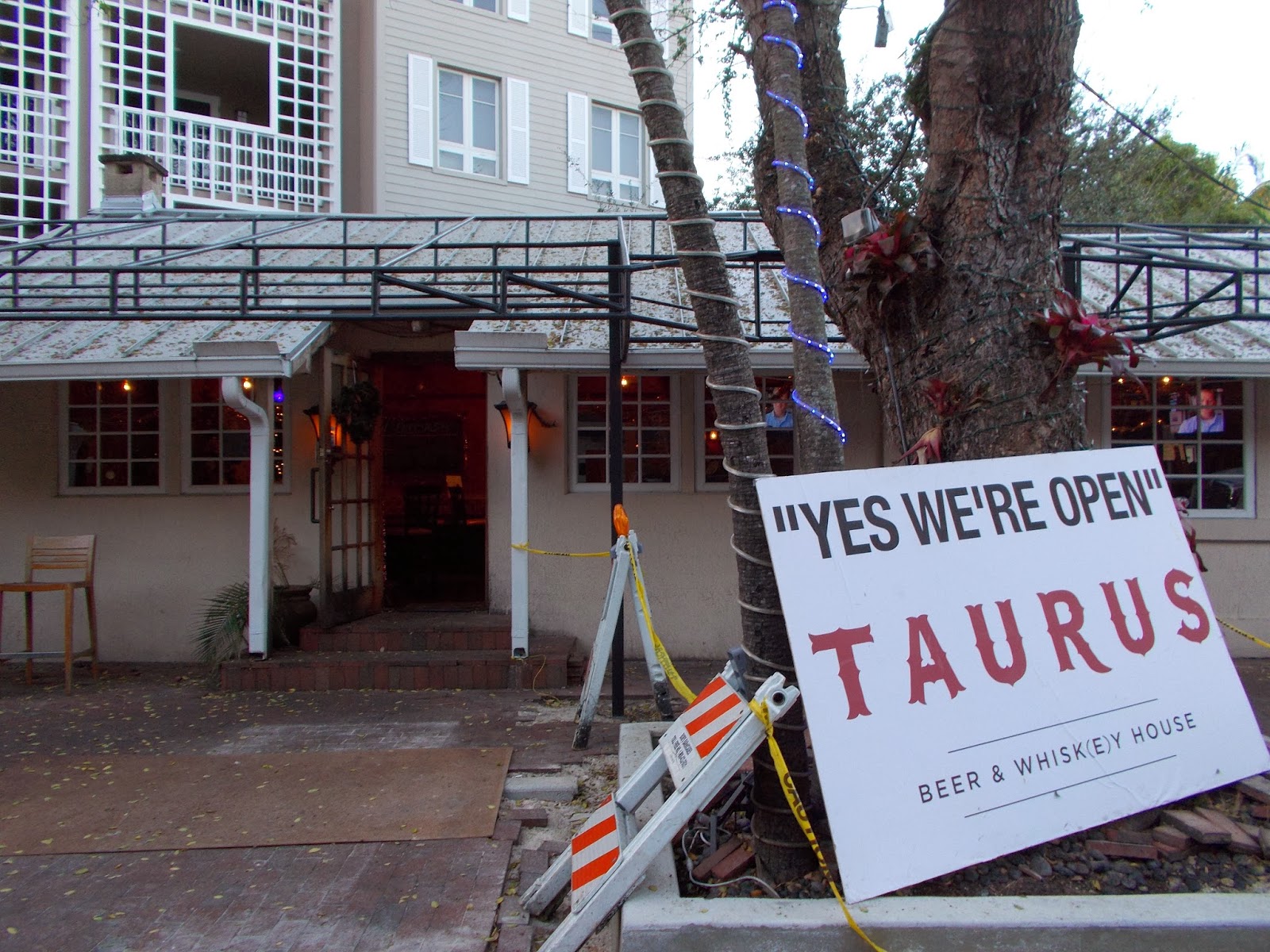
Framework for an awning is being installed on The Taurus Bar, December 19, 2013.
This work may or may not be non-conforming, may or may be contrary to previous
promises, and may or may not have been built without benefit of a building
permit. With the Grove Gardens Residence Condominiums in the background.

A recent visit to Coconut Grove to document The Bicycle Shop revealed work going on at The Taurus Bar, the venerable watering hole in front of the Grove Gardens Residence Condominiums. 

Based on my previous investigations of [allegedly] illegal work going on inside the E.W.F. Stirrup House, it’s fair to ask the following questions: *


1) Does this work conform to all Miami and Miami-Dade bylaws?
2). Does this work conform with whatever promises were made to preserve The Taurus when the GGRC was built?
3). Does the owner have a building permit for the work?

I’ve written about The Taurus briefly, and only tangentially, during my research of Coconut Grove. It’s owned by an arm of Aries Development, builder of the GGRC, the monstrosity that dwarfs the little one-room building and the 2-story E.W.F. Stirrup House. Aries also owns the two other restaurants on the ground floor of the mixed use condo complex. Aries, in case you haven’t been following along chapter by chapter, also owns the two lots on the north side of Charles Avenue immediately behind the Coconut Grove Playhouse. Furthermore, Aries is about to get title to The Bicycle Shop — extremely valuable Main Highway frontage — in exchange for reliquishing all claims against the Playhouse for a previous loan.

The historic 120-year old E.W.F. Stirrup House — a 2-story modified Conch-
style house — dwarfed by the 5-story Grove Gardens Residence Condominiums

Far more important, at least as far as I am concerned, is that Aries also finagled a 50-year lease on the E.W.F. Stirrup House and has been allowing it to undergo Demolition by Neglect during the 8 years it has had control of the 120-year old cultural treasure. The Stirrup House is now believed to be the 2nd oldest house in Miami, after the Barnacle, Commodore Monroe’s house, which is now a Historical State Park and less than a tenth of a mile away. 

Charles Avenue has been designated an Historical Roadway and the E.W.F. Stirrup House has also been designated historical by the City of Miami. However, the practical effect seems to be no practical effect.on Gino Falsetto, the primary owner of Aries Development. His stewardship of this historical landmark has been nothing less than shameful.

Related: Why saving the Stirrup House saves important Black History?
Please read:Unpacking Coconut Grove ► Part Two ► E.W.F. Stirrup House

Preserving the Taurus Bar was among the promises Aries Development made in order to get its permits to build the Grove Gardens Residence Condominiums. So was preserving and renovating the E.W.F. Stirrup House. It’s interesting to compare and contrast the treatment of the Taurus vs. the fate of the E.W.F. Stirrup House. 

The Taurus goes back, at the very least, to 1906, when it was a tea room for the High Society of Coconut Grove. Over the years it went from being a tea house to a neighbourhood bar. It attracted those within walking distance, but another one of the attractions, especially for the old-timers, was — as downtown Coconut Grove became overly developed — there was a free parking at the Taurus Bar in the years just before the GGRC was built. [Drinking and driving? Never mind.]

The E.W.F. Stirrup House goes back to the 1890s. I’ve written so much about the Stirrup House, I won’t go into its history here, other than its recent history. Ownership of the house remains in the hands of the Stirrup Family, as dictated by the will left behind when E.W.F. died in 1957. Aries obtained a 50-year lease on the house through a complicated property swap that’s detailed elsewhere at Not Now Silly.

While Gino Falsetto (through Aries, of course) promised to preserve and renovate both the Taurus and the Stirrup House, only the Taurus was fixed up. It’s been open almost the entire time. During a period that coincides almost perfectly with the Taurus being open, the E.W.F. Stirrup House has been empty, undergoing Demolition by Neglect, as mold, mildew and termites work away at the house.

I was told the reason no work ever progressed on the Stirrup House was because Aries ran out of money. However, The Taurus has been generating money for Aries and Aries had enough money to loan the defunct Playhouse board some of it. But, isn’t it strange Gino Falsetto never found the money to fulfill its OBLIGATION to restore the E.W.F. Stirrup House. And now it’s spending MORE money to put an awning on the Taurus before it fulfills its promises on the Stirrup House.

The Taurus Bar on December 19, 2013
TO BE FAIR: The Taurus could use an awning. Any place that hopes to have a viable outdoor patio, which The Taurus hopes to, in South Florida needs an awning. Fans and mist-ers are also a good idea. However, can you just throw an awning on any old building? What about a building more than 100 years old? What about a building more than 100 years old that you’ve promised to preserve?

And, while I’m asking questions, where’s the building permit? I looked inside and out, but saw no building permit. Does this awning affect pedestrian traffic? Was a study done of pedestrian traffic? Does the awning encroach on the public easeway for the sidewalk? How is Main Highway impacted by this awning. Is this an [alleged] infraction against Miami by-laws, Miami-Dade by-laws, or both?

Based on the past performance of Gino Falsetto these are all fair questions to ask. By sheer coincidence these happen to be the same questions I’ll be asking city and county officials in the next few days.

* The work is probably finished by now in advance of The King Mango Strut with Grand Marshall Rob Ford.

The Bicycle Shop The Latest In The Cultural Plunder of Coconut Grove

The Coconut Grove Playhouse before the hoarding was fixed

Recent news trickling out of Miami-Dade County has exposed more backroom machinations concerning the Coconut Grove Playhouse and — appearing for the very first time in any of the negotiations — The Bicycle Shop. 

Before getting too deeply into the weeds, this news proves that once again the ultimate stakeholders — the citizens of Coconut Grove and taxpayers of Miami — were played for dupes. All decisions concerning the Playhouse’s future have already been set in stone, without any public input whatsoever. Furthermore, not all those decisions have been made public yet, such as the ultimate design. 

There was a time I was ambivalent about the Coconut Grove Playhouse. I vaguely understood it to be mired in scandal and controversy. However, my cursory research showed that it was one of those things that served White Coconut Grove and I was researching the unique history of Black Coconut Grove. I was already committed to saving the historic, 120-year old E.W.F. Stirrup House; I didn’t have time for another Coconut Grove boondoggle.

My Trolleygate series proved why I need to follow all anonymous tips to see where they ultimately lead. It’s all interconnected in ways I could never have imagined when I started this research 5 years ago. The Stirrup House is catercorner to the rear of the Playhouse, just across the
street from the Charles Avenue historical marker. Oddly enough it’s been empty and undergoing Demolition by Neglect just about as long as the Playhouse has been shuttered. However, proximity and similar fates were not all that connected the two properties. I have since found two important links between Ebeneezer Woodbury Franklin Stirrup and the Coconut Grove Playhouse that finally placed it on my radar screen.

The Charles Avenue historical marker with the E.W.F. Stirrup House

The first goes all the way back to the 1920s and, to understand it, a small history lesson is in order. At that time E.W.F. Stirrup was one of the unlikeliest Movers and Shakers of a nascent Coconut Grove tourist industry. Ebeneezer Woodbury Franklin Stirrup was a Black man who, through hard work and a good business sense, became one of the Grove’s largest landowners and one of Florida’s first Black millionaires. His own house on Charles Avenue, which looked out over his holdings, was a 2-story showpiece, in a 1 story Conch house neighbourhood.

Together, with the other Movers & Shakers of the Grove, Stirrup must have anticipated reaping a financial windfall when, in the early 1920s, they commissioned The Bright Plan, the first urban renewal plan ever devised for Coconut Grove. Had the Bright Plan been implemented, Coconut Grove would have become the jewel of South Florida. A long boulevard with fountains down the middle would have led to an ornately appointed Coconut Grove City Hall, located approximately where Cocowalk is nowadays. All the designs of the buildings and fountains were based on a Mediterranean style. The Charles, Franklin, and Williams Avenue corridor would have become a golf course and the neighbourhood now known as West Grove would have been lost.

On the planning maps “Coloredtown,” would have been pushed to “the other side of the tracks,” just like in every other city in ‘Merka. That it didn’t happen is one of the things that makes Coconut Grove unique in this country. While Coconut Grove had its own Colour Line circling the traditional Black neighbourhood, it did not include railroad tracks.

However, it was not to be. Before the Bright Plan could be implemented, the Florida land boom went bust. By 1925 the words “Florida real estate” had became a national joke, so much so that George S. Kaufman’s Broadway musical-comedy The Cocoanuts revolved around swampland, tourism, and Irving Berlin tunes. Starring the Marx Brothers, it was set in Cocoanut Grove [note the “a,” the original spelling before amalgamation] and was a huge hit. The 1929 movie of the same name, with the same Marx Brothers, further cemented the town’s reputation.

A page from The Bright Plan shows the grand boulevard from Biscayne
Bay to a Coconut Grove City Hall. The odd shape in the upper-left is
where Coloredtown would have moved had this plan been implemented.

After the Bright Plan fell apart (younger) Miami annexed (older) Coconut Grove, including all of West Grove, or Coloredtown, or Black Grove, or Kebo, the African name given by the original Bahamian residents.

And, that almost didn’t happen either. Some White folk — among them some of those same Movers and Shakers that didn’t get rewarded financially when the Bright Plan died — lobbied against including West Grove in the boundaries of the new Miami.

It was fairly common in this country, as towns expanded and new areas
annexed, to exclude any of the small Black enclaves that had developed here and
there. The mere presence of Black folk could depress property values (and still does, for that matter). Whenever possible annexation occurred around these small Black enclaves until they were eventually swallowed up by the city.

That’s because — no matter where you go and no matter the era — the Movers and Shakers are, essentially, the monied and propertied of a given area. What Movers and Shakers generally want is to acquire more money and property, in order to become bigger Movers and Shakers. The Coconut Grove Movers and Shakers were no different. It was thought not having a Black area would make the new Miami more attractive for development, rewarding those who held property in Coconut Grove.

When Miami decided to annex West Grove along with the rest of Coconut Grove, a smaller group of those Movers and Shakers were already building their own lily White city of Coral Gables, just next door to Coconut Grove. The ugly historical fact is that the creation of Coral Gables was White Flight; a reaction to the Kebo neighbourhood of Bahamians, who could not be dislodged because the land was Black-owned, all due to the hard work of E.W.F.
Stirrup.

A White city could more easily control the movements of Black folk and their presence in Coral Gables was severely restricted. Right into the ’70s (according to anecdotal reports from a 73-year old who has lived in the same house on Charles Avenue his entire life), one needed ‘papers’ to be Black in Coral Gables. This usually amounted to a letter from your employer. However, if you couldn’t produce one, you’d be arrested for vagrancy and everyone in West Grove knew it.

To this day Coral Gables is 98% White. That doesn’t happen by accident.

Statue of George Merrick,
founder of Coral Gables,
outside Coral Gables
City Hall

Related reading:

No Skin In The Game is a
series looking into some of
the disparities between
Coconut Grove and Coral
Gables, Florida

Part One looks at a protest
against Trolleygate aimed
by the citizens of Coconut
Grove to land at a debate
for mayor of Coral Gables
in order to bring awareness
to the controversy.

Part Two is a continuation
of the evening in which our
intrepid reporter daydreams
about the founding of
Coral Gables.

Part Three is all about the
exception that proves the
rule; how Coral Gables
allowed a Black conclave
within its boundaries to
house its service workers.

Which brings us to the Coconut Grove Playhouse. 

In the mid-’20s, while George Merrick was building his lily White Coral Gables and Miami was annexing Black and White Coconut Grove, one item from the Bright Plan finally got built. E.W.F. Stirrup sold a large parcel of land on the northeast corner of Main Highway and Charles Avenue on which a developer could build the Coconut Grove Theater, now the Coconut Grove Playhouse, in the same Mediterranean style dictated in the Bright Plan.

There’s one other thing that links the E.W.F. Stirrup House to the Playhouse and that’s Gino Falsetto. Falsetto is the rapacious developer who arrived in the hot Florida real estate market after walking away from a string of bankrupt restaurants in the Ottawa, Ontario, Canada, area.

It’s an open question whether Falsetto became a Miami Real Estate Mover and Shaker on the backs of the Canadian taxpayers, his vendors, and the employees from his restaurants. All lost money — estimated to be more than $1,000,000 all told — when the Canadian government seized the physical assets of the eateries. Falsetto walked away, allowing the companies to go bankrupt. How much money did Falsetto pocket? The answer to that may never be known. What is known is that bankruptcy appears to be a tactic of Falsetto’s, which has served him well so far, as you will see.

Seemingly from Falsetto’s first arrival in the over-heated Miami real estate market, his various companies have been tangled up in one lawsuit after another. However, for unexplained reasons, he seems to keep falling up. Eventually he (Aries Development) acquired property at Main Highway and Franklin Avenue, large enough to propose building the Grove Gardens Residence Condominiums. During the permitting process there were three major objections from neighbourhood groups, all of which Aries promised to satisfy:

► The rich White folk on the east side of Main Highway — in Camp Biscayne, one of the oldest gated communities in south Florida — didn’t want to lose their spectacular sunsets for which they paid several million dollars for. They wanted the height of the condo building scalled back. Done. The multi-use condo complex was limited to 5 stories and stepped back as it rose, so it didn’t present a huge facade to Main Highway;

► The White drinkers at the venerable Taurus Bar were upset that they might lose their drinking hole, one of the only bars in Coconut Grove with free parking. TO BE FAIR: The Taurus dates back to AT LEAST 1906, when it was a tea room. Regardless, the developer heard the protests. Done! The Taurus is still there (although a possibly non-conforming awning was being built when this reporter visited on December 17th);

The lay of the land:

Gino Falsetto has sewn up a number of properties along Main Highway and Charles
Avenue. Now, to release his claim to the Coconut Grove Playhouse, he is being
given ownership of the Bicycle Shop, with valuable frontage on Main Highway

► The Black residents of West Grove were concerned that the development would threaten the 120-year old E.W.F. Stirrup House.

In order to obtain its building permit Aries made certain promises and representations to preserve and restore the E.W.F. Stirrup House, either as a community museum and resource center, or a Bed and Breakfast. Anecdotal memories differ and, sadly, no one seems to be able to produce the actual meeting minutes in which the condo project was approved.

No matter what the promise MAY have been, it has been broken. Since getting his grubby little hands on it almost 9 years ago, Gino Falsetto has neglected the Stirrup House, except for some [allegedly] illegal interior demolition and destruction. This precious community resource, believed to be the 2nd oldest house in Miami, has been allowed to undergo Demolition by Neglect. Aries Development has proven to be a terrible steward of this historic 120-year old house, like no other in the neighbourhood.

IT GETS WORSE: In the same deal in which Falsetto acquired the lease on the Stirrup House, he also scooped up two double-size lots on the north side of Charles, across from the Stirrup House. However, there appears to be some subsequent irregularity — some say illegality — with those two properties.

Falsetto traded two units within the Grove Gardens Residence Condominiums — the monstrosity he built behind the Stirrup House — for outright ownership of the two lots assessed at $87,615 and the 50-year lease on the Stirrup House. Heinz Dinter tells the next part of the story:

Gino Falsetto finds himself a real estate appraiser who dares to value the two lots heavy with weed and grass at $1,000,000. With the appraisal in hand Falsetto finds a daring banker who loans Gino Falsetto $700,000 — all so legal in accordance to the 70% loan to equity ratio. What a coup!

That’s not the end of the dramatic plot. Gino Falsetto defaults on the loan, the bank forecloses with a $720,546.28 judgment in hand and none other than Pierre Heafey’s Heagrand Inc buys the land in the foreclosure sale for $200,100. [Editors note: Pierre Heafey and Gino Falsetto are partners in other companies.]

The curtain rises on the last act. Falsetto forms a new company, 3227 Charles LLC, and that new company buys the two lots from Heafey for $215,800.

The bottom line must be called a stunning performance: Gino Falsetto gives up two condominiums worth $419,050 and in return is the sole owner of two vacant lots assessed at $87,615, but possibly worth many times more depending on the neighborhood’s future, and some half a million dollars in cold cash in his pockets compliments of the American taxpayer (the bank loan was insured by FANNIE MAE).

The Bicycle Shop is the latest, and possibly last, piece in the Coconut Grove
Playhouse puzzle. In the latest deal — struck in the backrooms between the big
boys — Gino Falsetto’s Aries Development gets ownership of this property (and
a nominal $15,000) to relinquish all claims to the Coconut Grove Playhouse.

Got that? Foreclosure auctions are supposed to be at arm’s length. How is it that a company owned by Gino Falsetto managed to get its hands back on the same property after a company owned by Gino Falsetto defaulted on the original loan?

I’m not a lawyer, but that can’t be legal.

During the same period that Falsetto was scooping up valuable and culturally important Coconut Grove real estate through dubious means, he (through Aries) also loaned the defunct board of the defunct Coconut Grove Playhouse some defunct money. Holding a financial lien on the Playhouse, Aries has scuttled deal after deal for those who were trying to renovate and reopen the Playhouse. That is, until recently.

Which brings us full circle: When the news leaked that there may FINALLY be a deal to renovate the Playhouse, people were stunnded to discover it involved giving the Bicycle Shop to Aries Development. This small building at the northeast end of the Playhouse parking lot — which really was a bicycle shop a long time ago — and the nominal amount of $15,000 will be given to Aries Development to satisfy all claim on the Playhouse.

Currently the alley immediately to the north of of the Bicycle Shop [at right above] is the end of the demilitarized zone in Coconut Grove. Casual pedestrians tend not to walk any further south, unless they are walking on the OTHER side of Main Highway. The newly opened restaurant Acropolis, on the other side of that alley, is as far south as people tend to walk. Those who arrive at the restaurants on the ground floor of the Grove Gardens Residence Condominiums — just a block south — tend to arrive by car.

The Bicycle Shop is piece of Main Highway frontage that will be a goldmine once the Playhouse reopens. It will have a Playhouse on one side, restaurants on the other, with The Barnacle Historic State Park and some of the most expensive houses in all of Florida in heavily gated communities right across the street.

It’s an insult to the memory of E.W.F. Stirrup that Gino Falsetto and Aries Development will be rewarded for their avariciousness and Demolition by Neglect of the E.W.F Stirrup House. 

Before Miami-Dade gives away a piece of property worth potentially millions of dollars over the long run, why doesn’t the county see to it that Aries fulfill the promises it has already made to the people of Coconut Grove and taxpayers of Miami?