Category Archives: Race Relations

Coconut Grove Is Not Out Of The Woods Yet

Lorry Woods had a great smile & a great idea to meet the voters in Coconut
Grove. The Not Now Silly Newsroom’s Head Writer will get to it eventually

Headly Westerfield, Not Now Silly‘s Head Writer, was out on the campaign trail for the second time this week. This time he wasn’t chasing Marco Rubio. Here’s his report from the Lorry Woods BBQ Judging Meet & Greet.

It was a beautiful day in Miami that started with some cloak and dagger skullduggery. There’s a person I have been pumping for information about one of the ongoing stories I’m writing about. At the same time they have a story about [allegedly] corrupt Miami Commissioner Marc D. Sarnoff that can barely be believed, but no one puts it past him. We’d been exchanging phone calls and text messages for a while and it was finally time to meet.

There’s nothing I love better than meeting up with whistle-blowers and this one was providing a rare two-fer. [For now, that’s all I”ll reveal.] This person wanted to meet out of their own neighbourhood, so that no one who knew either of us, would see us. I let them choose and it was Panther Coffee, in Wynwood.

I’ll never go back there again, if I can help it.

To start with, one needs a credit card to park in that neighbourhood. It’s all Pay by Phone, or Pay by Phone App. Either way, you’ll need a credit card to complete the transaction. I was told there are some machines in the area, but I drove around several blocks and never saw them. However, I saw blocks and blocks of Pay by Phone only parking.

This is just another area of life where the Have Nots are screwed. If they don’t have a smart phone and/or credit card, they’re not parking their cars in Wynwood.

Panther Coffee is a tiny little place that’s so crowded, that if one of the 4-seat tables is occupied, there’s no room to pull out a chair at the adjoining table. Additionally, there’s nothing in that room to baffle the sound. It bounces off every wall. The din was so loud I could barely hear the person talking right next to me.

Lastly, the Have Nots probably can’t afford Panther Coffee, either.

People make fun of my Starbucks addiction, but I go there because I like the taste of their coffee. I pay $2.50 for “Biggest/Boldest,” or a straight Venti brew. A smaller cup of coffee at Panther was $3.75. You read that right: $3.75 for a plain cup of coffee. Furthermore, I stood in line for 18 minutes, because I timed it, while the 6 hipsters in line ahead of me ordered complicated drinks and food from a more complicated menu. They need a COFFEE ONLY line, or find a way to speed up that whole process.

I repeat: I’ll never go back to Panther Coffee again, if I can help it.

My whistle-blower had a lot to say about [allegedly] corrupt Miami Commissioner Marc D. Sarnoff. Of course, it all needs to be confirmed before I can print it. However, if only 10% of it is true, it becomes a game-changer.

From Wynwood I was going to a Lorry Woods Meet & Greet in Coconut Grove, dipsy-doodling the 7 miles along surface streets until I got to the E.W.F. Stirrup House. A citation on the gate alerted me to the fact that the house is now owned by a different company than had owned it previously. Previously the house was listed as owned by Stirrup Properties, Inc. Now it’s owned by EWFs No 1 LLC. It will also take a bit of investigation to learn why there has been a change. The house is still in the Stirrup family, but one of the officers appears to have been removed. It’s ironic that E.W.F. Stirrup, III, is no longer listed as one of the owners of the E.W.F. Stirrup House.

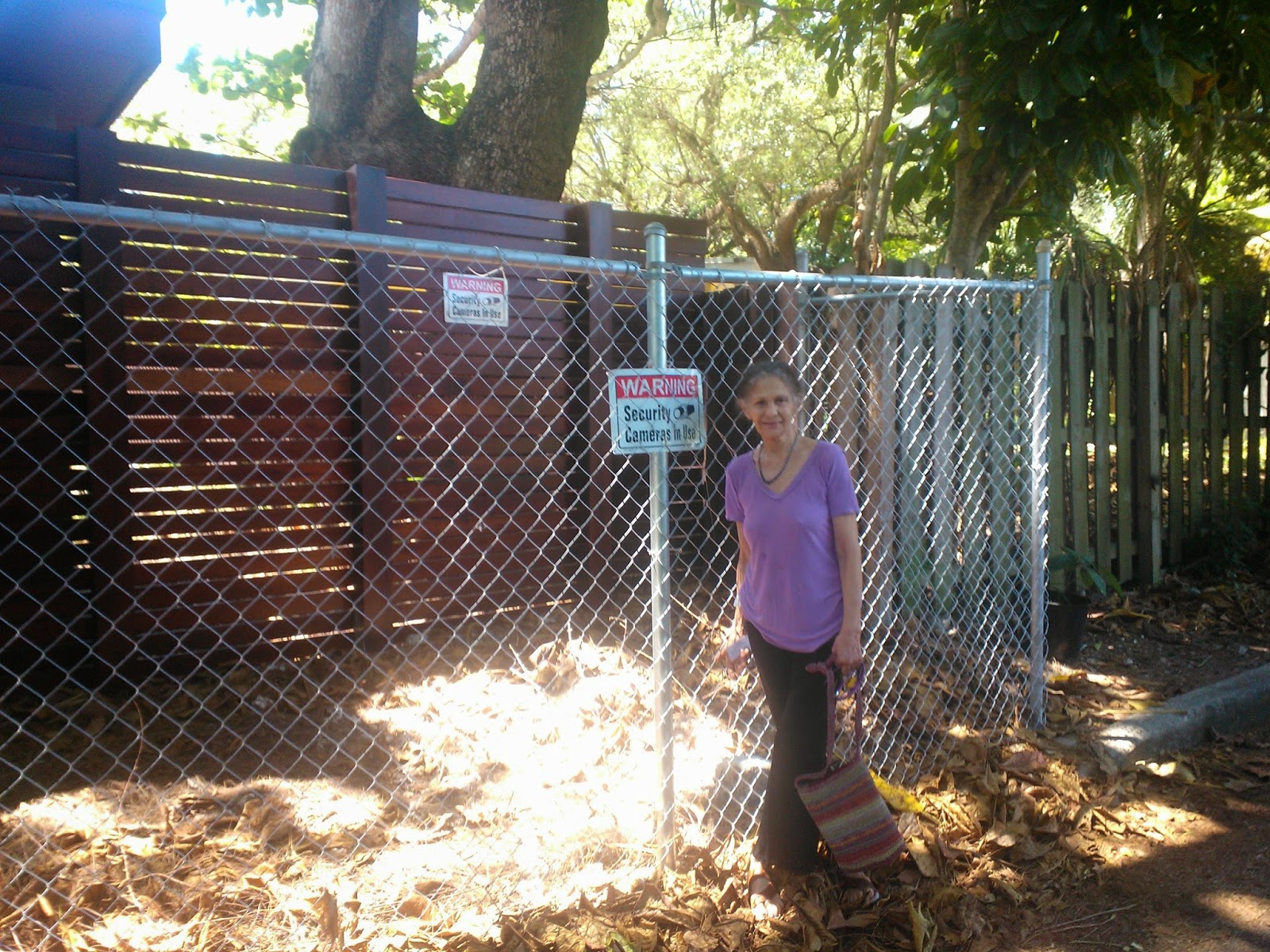
Donna Barnett, who lives across the street, poses at the fence
telling her she is on camera. This reporter has seen no cameras.

Next I visited Marler Avenue.

I’ve written about Marler before, in Where The Sidewalk Ends, Racism Begins; Chapter Three. In the 6 months since, the offending neighbours on Loquat have built a HUGE wooden fence just behind the property line, which is indicated by the picket fence on the extreme right in the picture left. (TO BE FAIR: It’s a beautiful HUGE wooden fence.)

To remind readers, the picket fence is the remnants of the wall the City of Miami ORDERED to be erected to keep West Grove out of South Grove. Or, to put it into stark relief: to keep Black folk out of Whitey Town. Each chapter of Where the Sidewalk Ends documents another section of that wall built to circumscribe the lives of the Black folk living in West Grove.

Not a lot has changed in the many years since the residents of Loquat moved their backyards into the public Right Of Way that would have connected Marler Avenue to Douglas Avenue. Six months ago a neighbour on Loquat bumped out a portion of his fence 5 feet into the Marler Right Of Way. At the time I interviewed a number of residents about the new fence and they were all outraged that a homeowner would steal public land, just like in the old days. However, they were also resigned to the fact that no one would care.

I did what I could to disabuse them of that idea: “City Hall will definately care. Call them
up and complain. Call up the NET office. Call the city inspectors.”

Since then I visit Marler Avenue whenever I am in West Grove to see if anything has changed. This time some of the neighbours were outside and recognized me. “Hey! I thought you said we could get this fixed!”

But, it gets worse.

Donna Barnett, who I spoke to 6 months ago, told me a horror story about a recent incident. Apparently she mouthed off to the neighbour who built the [allegedly] illegal fence. Whether she was loud, or rude, is hardly the question, so I didn’t ask. Next thing you know a cop is knocking on her door. The Loquat neighbour called the police on her, who were not so busy with actual crime they didn’t have time to visit Barnett’s house. Barnett tells me the neighbour is Latino and so was the cop who responded.

The cop threatened to arrest her if she exercised her First Amendment Rights again, by yelling at the neighbour, who is the one breaking the law. Then he commented on the condition of her property in a threatening manner, as if he could see to it that the property is cited for infractions. And then he got extra offensive, saying, “If I lived here, I’d build a fence, too.”

TRANSLATION: This is a bad neighbourhood filled with Black folk and people were right to wall it off from polite society.

Lorry Woods meets with a voter

It was after this interview on Marler that I drove the few blocks north to the Lorry Woods Meet & Greet on Grand Avenue. It was held in the parking lot behind the Coconut Grove Collaborative Office.

I was impressed with Lorry Woods as an authentic person. She wasn’t putting on airs. She wasn’t telling people about herself, as much as she was asking questions and listening to the concerns of the residents. I overheard her in deep conversation with many potential constituents on a variety of topics.

I was more impressed by the idea behind the Meet & Greet. To draw West Grove residents, the Lorry Woods Campaign sponsored a BBQ Contest between Mango Man and Warren, a gent with a smoker on Hibiscus Street at Franklin Avenue who serves up delicious BBQ. The locals who wandered back to the campaign event would get a free plate of chicken. Then they’d vote on which BBQ joint they liked best. [FULL DISCLOSER: I didn’t taste the ribs because I don’t partake in campaign food & drink. I even bring my own water. I’ve eaten at Warren’s, and have interviewed him as well. It all smelled delicious.]

To be perfectly honest, I didn’t find out a lot when talking to Lorry Woods, but that’s entirely my fault. During introductions I mentioned that I was researching the history of West Grove and the E.W.F. Stirrup House. She showed interest and asked a few questions, so I gave her a 5 minute capsule history lesson. Then, remembering I had just come from Marler Avenue, I gave her another 5 minute capsule history of that street, The Colour Line in Coconut Grove, and then brought her up to date on what I had just learned on Marler Avenue. By that time the voters started arriving, so we had to wrap it up.

I shouldn’t really give a candidate advice, but what’s the harm? Unless she’s stupid, and I don’t think there’s a chance of that, she’s already figured this out: Miami events need shade.

People were tucked up tight against the back wall of the parking lot, where there was only a small sliver of shade. The event could have used better signage, as well:

Couldn’t you have, at least, put FREE FOOD on the sign? When people who walked by asked me what was going on, that’s what I told them: “It’s a BBQ judging contest with free BBQ.” Everyone who heard that came to take a look. However, many people just walked past, unaware of the event at all, despite the signboard.

Those are nits to pick at this Lorry Woods picnic. It was a wonderful community event that brought many old friends together, some who hadn’t seen each other for a while. Also in attendance was Thelma Gibson, the matriarch of the family for which Gibson Plaza is named.

Gibson Plaza, across the street from the Collaborative Office, appears to be nearing completion. A Grand Day For Grand Avenue ► Gibson Plaza Groundbreaking was published here just a year ago. I won’t repeat how important a project this is for Coconut Grove, other than to say this is the first development in decades that was not designed to generate as much money as possible for developers.

Which brings us back to this election. Right now the developers and Big Money Boys have helped the wife of [allegedly] corrupt Miami Commissioner Marc. D. Sarnoff, Teresa, amass a war chest in the neighbourhood of $333,000, which is a damned expensive neighbourhood. It’s magnitudes more than the other 7 candidates put together.

Candidate Lorry Woods owns Elwoods Gastro Pub on NE 2nd Street in downtown Miami. I have to admit, the lack of an apostrophe crawls up my back. The only thing that would make up for that is learning it is named after Elwood Blues, but that’s not likely, considering all the British motifs in the pictures on line.

However, I’d like to know her opinion on Miami’s runaway development, which is my opinion on it. A restaurant owner on 2nd Street would logically be pro-development. More people could only help their bottom line.

I’ll also gauge Lorry Wood’s interest in West Grove issues going forward. The people of Brickell and downtown Miami don’t need a champion at City Hall. The Developers, who have held sway over City Hall for far too long, don’t need a champion at City Hall. Even restaurateurs don’t need a champion at City Hall. These are groups or individuals with resources, who can afford $3.75 cups of cofffe at Panther without flinching.

However, yesterday Lorry Woods saw with her own eyes some of the people in a neighbourhood disadvantaged by 120 years of systemic racism. Can she be their champion? As Trolleygate, Soilgate, and, now, Marlergate demonstrate: this racism is not confined to the past. This neighbourhood, and Overtown, needs someone at City Hall who will speak for them.

Here are several more of the pictures. I took yesterday:


Then I wandered down the street to the Kroma Gallery. The artwork is always changing and always wonderful and thought provoking.


I also walked past the Ace Theater, designated historical like the E.W.F. Stirrup House, but being better cared for even though it’s boarded up. At one time the Ace Theater was the only movie house where Coconut Grove’s Black folks could go. The Coconut Grove Theater, later the Coconut Grove Playhouse, apparently allowed the daughters of E.W.F. Stirrup to go inside, but they were the exception that proved the rule. And, the only reason they were the exceptions was because their father sold the land on which the Playhouse was built.


Raking Muck in the Big Miami ► Unpacking The Writer

An app that allows me to pretend
I’m being sketched on the beach.

Hold on, dear readers! It’s that time of the month when I pull back the curtain like Toto did to the Wizard of Oz and reveal a bit more of myself. AUNTY EM!!! AUNTY EM!!!

But first, A NOT NOW SILLY NEWSROOM ALERT: Further to The Coconut Grove Playhouse Trojan Horse, my 2-part investigative report from last week: While [allegedly] corrupt Miami Commissioner Marc D. Sarnoff has yet to answer any of my 11 questions, I did get an apology from the Miami Parking Authority and a confirmed time and date for a meeting with CEO Art Noriega. Hopefully I can answer some of the Charles Street neighbours’ questions afterwards.

Right after The Coconut Grove Playhouse Trojan Horse was published Friends of Merrie Christmas Park reminded me of When Miami Commissioner Marc D. Sarnoff Lied To My Face. So I wrote up that exciting episode as well and posted it here a few days later. It’s all part of my relentless campaign to elect ABT – Anybody But Teresa in Miami’s upcoming District 2 election. Maybe I should start a PAC and then buy some radio adverts. But, since I can’t afford that, why not join my facebookery of the same name? Trust me, you’ve done worse things in your life.

https://www.facebook.com/pages/ABT-Anybody-But-Teresa/378120335693205
Nine years ago, when I moved from Hamilton, Ontario, Canada, back to ‘Merka, the land of my birth, the last thing I figured I’d be doing is getting involved in ‘Merkin politics. I lived in Canada for 35 years — more than twice as long as I lived in the States — taking out Canadian citizenship in the process. To become a citizen of Canada I had to swear an oath to Queen Elizabeth II, her heirs and assigns. In that oath I swore that I would not serve in the armed forces of another country, nor would I vote in their elections. While it’s an oath I take seriously, once I got down here in Florida I was inexorably drawn into ‘Merkin politics. 
My political foray began as Aunty Em Ericann, my alter ego when I was writing for NewsHounds, the motto of which is “We watch Fox so you don’t have to.” I looked at Aunty Em as performance art, which I carried on for years. Being Aunty Em freed up my writing style considerably. She threw out a lot of the rules of writing and started inventing her own words and lexicon, a tradition I continue here and on the facebookery.

I wrote so many columns for NewsHounds that sometimes, when I’m researching the Friday Fox Follies for PoliticusUSA, I trip over an article of mine that I don’t even remember writing. However, they always make me laugh, which is my primary purpose in life: making myself laugh. If I can make myself laugh with my own writing, then maybe you will too. The supreme compliment, as far as I’m concerned, is “That was funny.”

I still think one of my funniest columns for NewsHounds is retold in The Day I Shook Hands With Glenn Beck ► Nostalgia Ain’t What It Used To Be. Your mileage may vary.

The E.W.F. Stirrup House continues to rot away in
the hands of a rapacious developer. This is what
nearly a decade of Demolition by Neglect looks like.
As my longtime readers know — but I pick up Newbies alla time — my ongoing project has been my 5-years-and-counting source of fascination, the 120-year old E.W.F. Stirrup House in Coconut Grove, Miami, Florida. Every story I’ve written about Coconut Grove has been a direct outgrowth of my continued research of Ebeneezer Woodbury Franklin Stirrup, his place in the late 1880s, and how he created a place that was, at one time, unique in this country.

I’ve written so much about him that I won’t repeat any of it today, but take a gander at Happy Birthday Coconut Grove!!! Now Honour Your Past to see why it’s important to save his legacy, Then read Shocker!!! E.W.F. Stirrup House Plans Are Finally On File to see how badly this house, so important to the history of Coconut Grove, has been mismanaged.

Not Now Silly explores the historic Coconut Grove Colour Line:
Where The Sidewalk Ends, Racism Begins; Part I; Part II; Part III

As usual, I digress. I was talking about Miami politics. There was a time — and not all that long ago — I couldn’t have told you where District 2 was. Now I have people calling me up to test the waters for a run as Commissioner in District 2. Whether I really want to be involved in the District 2 race, I’m still being inexorably drawn in. So far I have only thrown my weight behind Anybody But Teresa. If, at any time, I come out in favour of a candidate, you’ll be the first to know.

Lately, I’ve also been getting more tips from sources who wish to remain anonymous. It takes a long time to nurture a secret source. So many people have been burned by journalists before. Occasionally, before my sources share their tip, they tell me how they’ve been burned. However, my sources trust that OFF THE RECORD truly means OFF THE RECORD. That’s how I get people to talk.

It takes time to chase down these tips and not all of them pan out. F’rinstance, The Coconut Grove Playhouse Trojan Horse, took a year’s worth of research, some of which included just sitting in parking lots observing for hours on end. At the time I didn’t even know I’d be writing an article about parking. Someone who read that story alerted me to an even bigger story of potential skulduggery and malfeasance. If true, this is EXPLOSIVE!!! This source has been solid on every tip so far, but getting to the truth of this one could be difficult. First I need to know which sewer to start dredging. As they say on the Tee Vee Tubery, STAY TUNED.
Not Now Silly set a new, all time record for readers in January, 2015.
NOT NOW SILLY HOUSEKEEPING: I know, I know, I know . . . I keep promising a new, improved Not Now Silly Newsroom, but what can I tell you at this point? I’m keeping up my end of the bargain by posting stories that my readers want to CLICK on. I no longer know what’s holding things up on the end of my Web Master.

To think this started as a casual conversation in July that began, “How can I monetize my web site?” That’s when the suggestion was made that I’d have to jump onto a WordPress template for that to happen and, while you’re at it, you may as well buy your own domain name. I replied, as I have to others who said the same thing, “But, I don’t want to lose everything that’s been posted up to now at the Not Now Silly Newsroom.” He’s the first guy to say, “You don’t have to,” so he began the process of moving everything to the new platform and template, which I love and approved months ago. Now I’m just waiting for the other shoe to drop. And waiting patiently, I might add.

If you have any suggestions for me in that area, I’d love to hear it. 

Lastly, Pops celebrated his 89th birthday on Valentine’s Day. He’s the reason I came to Florida. After the death of my mother almost 10 years ago he asked me if I would come down and help him. He didn’t really need taking care of. He still golfed almost every day and was totally capable of taking care of himself. However, he had no idea of the magic created in the kitchen. He couldn’t even fry an egg, let along make himself dinners.

However, every year there is less and less he can do for himself. He’s no longer driving long distances, sticking to just local runs. He stopped golfing, but still meets the boys out on the course every morning. He walks with a cane, but most of the time he’s only using it for balance, swinging it parallel to the ground. That’s why it’s dangerous to walk in front of him or behind him. I can’t even tell you how many times I’ve been poked already.

So there it is, the life of a writer for another month. Tune in sometime during March for another exciting episode of Unpacking the Writer, from the real files of the Not Now Silly Newsroom. In the meantime, we rejoin the regular Not Now Silly Newsfeed, already in progress.

The Coconut Grove Playhouse Trojan Horse; Part I

Some of the parking lots described in this post.
[See map legend below for matching location.]

Background: Looking south towards [C] the E.W.F. Stirrup
House, dwarfed by [A] The Monstrosity, aka Grove Gardens
Condominiums. Foreground: Looking across [F] The Blue
Star- Lite Drive-In and [E] the 45 parking spaces leased from
the MPA for Valet Parking. Behind the fence at right are [D]
the two vacant residential lots used illegally for parking rich
folk. Immediate left: The back wall of the Coconut Grove
Playhouse, the Blue Star-Lite Drive-In screen, and some junk.

Events have been moving quickly this week. Just as I was finishing a blog post writing up a full year’s worth of research on the parking lots
surrounding the Coconut Grove Playhouse, Miami-Dade County selected Arquitectonica to restore/ renovate/raze the structure (depending on who you ask). That forced a drastic rewrite to what follows.

Get comfortable, kiddies, because this is a long one. It needs to be long so I can develop the thesis in the headline: “Why is the reno of the Coconut Grove Playhouse really a Trojan horse for a gigantic glass and steel parking garage with a small theater attached?” It’s a sprawling Michener-like story — so long I’ve had to chop it up into 2 parts — covering almost a century and a cast of characters that number in the tens. Like Michener, lets take a quick look at who you will be meeting:  

  1. First and foremost, E.W.F. Stirrup, one of Florida’s
    first Black millionaires, who had more to do with the creation
    of Coconut Grove and the building of West Grove than anyone else you can
    name. Almost with his own hands he built an entire, cohesive Black neighbourhood in the Jim Crow south that lasts to this day. His house and his legacy have been allowed to undergo Demolition
    by Neglect; 
  2.  Commodore Ralph Monroe, a contemporary of Stirrup’s whose house The Barnacle, only a few thousand feet away from Stirrup’s, is now a State Park [K] and polished within an inch of its life, for whom Commodore Plaza [N] is named, and who gets most of the credit for creating the early Coconut Grove;
  3. Aries Development in the Snidely Whiplash persona of Gino Falsetto, who built The Monstrosity that changed the entire character of West Grove, has allowed the  E.W.F. Stirrup House to go to wreck and ruin through nearly a decade of Demolition by Neglect, and who, through several of his valet and parking companies, is destroying the quiet enjoyment of his neighbours; 
  4. The [allegedly] corrupt Miami District 2 Commissioner Marc D. Sarnoff, who refuses to answer any questions posed to him by this reporter and is now running his puppet wife for his seat, now that he’s been term-limited off the City of Miami Gravy Train; 
  5. Miami-Dade Cultural Czar Michael Spring, who recently defended the legitimate “cone of silence” during the Coconut Grove Playhouse selection process, but doesn’t mention any of the backroom deals and decisions that were made prior to starting the selection process and dropping the cone of silence; 
  6. Arquitectonica, chosen by Michael Spring’s selection committee to oversee the Coconut Grove Playhouse destruction, or renewal, depending on which side of the fence you sit;
  7. Luis Choter, of The Miami Parking Authority, who has likewise refused to answer the questions forwarded to him by [allegedly] corrupt Miami Commissioner Marc D. Sarnoff, despite his email to me of January 27th apologizing for his lack of attention and promising he will be “looking into all the concerns and responding accordingly within the next couple of days.”;
  8. Cameo appearances by Sharie Blanton, of [allegedly] corrupt Miami Commissioner Marc D. Sarnoff‘s office; Ron Nelson, of same; Arthur Noriega, CEO of the Miami Parking Authority; Alejandra Argudin, who does something or other with the MPA; and Rolando Tapanes, another MPA employee; all of whom are in the email’s CC: field dodging my questions;
  9. Entrepreneur Josh Frank and his Blue Star-Lite Drive-In; 
  10. Jeremy D. King, a media flack at Regions Bank’s HQ; 
  11. The Movers and Shakers of Coconut Grove, both now and then;
  12. 1920s architect John Irwin Bright who designed the Coconut Grove Playhouse; 
  13. Several valet companies with dozens of valets;
  14. A number of private parking companies;
  15. A number of different parking lots;
  16. And, neighbours both good and bad.

Let’s begin:

After a years research — and a lack of clear answers from the city of Miami — Not Now Silly concludes the small 300-seat theater being proposed as a replacement for the Coconut Grove Playhouse, is nothing more than a cultural Trojan Horse being used to sneak a huge parking structure onto the corner of Charles Avenue and Main Highway.

I started researching the parking problems around the Coconut Grove Playhouse a year ago as a natural outgrowth of my research on the E.W.F. Stirrup House and The Colour Line in West Grove. Six years ago, when I first started researching Ebenezer Woodbury Frankling Stirrup, I could have hardly imagined that his house, The Coconut Grove Playhouse and the Playhouse parking lot were interconnected in a very complicated ways, both now and historically.

The Bright Plan shows the proposed city hall and golf course,
with “Colored Town” moved to “the other side of the tracks.”

A QUICK HISTORY LESSON: Prior to the illegal annexation of Cocoanut [sic] Grove by Miami in 1925, the town’s monied interests — the Movers and Shakers — of The Grove envisioned turning the small, nascent tourist village into a big tourist destination. So they hired Philadelphia architect John Irwin Bright, who came up with The Bright Plan in 1921, the very first of an untold number of urban renewal plans for Coconut Grove over the years.

The Bright Plan called for a fancy hotel; a golf course across most of West Grove, from Main Highway to Douglas; and a city hall approximately where Cocowalk now is. A wide boulevard ran from city hall to Biscayne Bay with a reflecting pool down the middle. The entire Bright Plan was based on Mediterranean-style architecture and would have been beautiful. However, it never got built. The bottom fell out of the Florida real estate market almost before the ink on The Bright Plan had dried.

However, there was one item on the Bright Plan that eventually got built: The Coconut Grove Theater (now the Coconut Grove Playhouse) was erected in 1927 and was based on Bright Plan drawings, which is why the building has a faintly Mediterranean feel. It first showed movies, but was later converted to live theater before it closed in ignominious bankruptcy 2006.

This is just one rendering of a potential gigantic development on Main Highway.
Don’t be fooled. The facade will be a facsimile. There is no plan to save it.

Save The Coconut Playhouse is a Facebook group not affiliated with the Not Now Silly Newsroom. It has far more detail about the backroom machinations of the current plan to renovate and/or tear down the Coconut Grove Playhouse.

Please join if you care about historic preservation.

Another rendering of a potential glass and steel parking garage hiding a tiny theater..

Back in 1927 monied interests — the Movers and Shakers — got together to built the movie house to bring culture to Coconut Grove. However, before the theater could be built the land had to be acquired from E.W.F. Stirrup, by then one of the largest landholders in Coconut Grove. It’s still an open question whether Mr. Stirrup, who was Black, could even go into the movie theater just 200 feet from his front door. At the time movie theaters were heavily segregated. The Ace Theater, on Grand, was later built for the Black folk of West Grove.

Back in 1927 parking cars wasn’t a big issue, but there are times these days when it seems like the parking of cars is the only issue.

When Miami developers present plans for new buildings one of the first questions that needs answering is “Where’s the parking?” Providing adequate parking often seems more important than an eye-catching design or quality of life considerations. This is especially true of Coconut Grove, where residents are howling over the fact that Cars2Go and Citi Bike are taking up precious parking spaces in The Grove because parking for their precious cars is more important than taking a chance on new, alternative forms of transportation.

A year ago Miami-Dade Cultural Czar Michael Spring untangled the Gordian Knot of the Coconut Grove Playhouse in an attempt to revive and renovate it. In other words: Bring culture back to the corner of Main Highway and Charles Avenue.

And, that’s when today’s monied interests — our modern day Movers and Shakers — got involved to screw the taxpayers behind closed doors. 

The backroom Playhouse deal had many moving parts. One part of the deal was to give to Aries Development the former-Bicycle Shop [J on map below] and $15,000. This was done because Aries floated a loan [in an amount I’ve never been able to determine] to the former-Playhouse board before it went belly up. At the time Aries was given a lien on the Bicycle Shop as collateral. That’s not that unusual. What is unusual is that Paradise Parking (another tentacle of the rapacious developer Gino Falsetto, aka Aries Development) is said to have squatted on the Playhouse Parking lot in order to satisfy the loan.

In my exposé from last year, The Coconut Grove Playhouse Deal begins to Unfold, I speculated that a possible future use of the Bicycle Shop could be a restaurant:

[T]urning the Bicycle Shop into a restaurant makes sense because
that’s another cash business. Gino Falsetto [allegedly] learned how
lucrative restaurants can be when he (and his brothers) bankrupted four
of them in the Ottawa, Ontario, Canada, area. When the government
finally moved in to seize the assets (cash in the till and the cutlery,
essentially), Canadians lost an estimated $1,000,000.00 in unpaid taxes.
However, that’s chump change compared to what Falsetto’s investors
lost. That figure is estimated to be upwards of ten million dollars. And
then, next thing you know, Gino Falsetto has enough resources after his
business went bankrupt to buy his way into the hot Miami real estate
market.


Of course, it has to be said, that there are many honest and reputable
restaurant owners. In fact, the vast majority are. However, that doesn’t
mean that restaurant ownership has not been known as a source of illegal profit skimming. Just sayin’.


Speaking of cash businesses, that brings us to the Playhouse parking
lot. On March 1st the Miami Parking Authority (MPA) will take over
control of the Playhouse parking lot. On February 25th the new signage
was being erected. However, most of the old signs hadn’t been removed
yet.


Who had the parking concession until now?


Double Park, Paradise Parking, and Caribbean Parking. Bring Truth To Light
has written extensively about Gino Falsetto; his several various
partners in several various companies; Aries Development Group; shady
Coconut Grove real estate deals; and this particular parking lot. It’s worth quoting extensively: [Click the link to read more of this alleged nefariousness.]

How much money did these companies collect from parking fees in the
time it [allegedly] squatted on the Playhouse parking lot? Was it forced to
return any of that money to the MPA, or was it all just gravy on top of getting the Main Highway frontage, potentially worth millions? And, while I’m asking questions: How much money did these companies report on their income taxes for the years it allegedly squatted on the parking lot?

When I learned these parking companies may have been squatting on the
Playhouse Parking Lot for who-knows-how-long?, I began desultory research on the issue of parking in West Grove, but I had no real reason to write it all up into a post until December 12th.

The area surrounding the
Coconut Grove Playhouse
[Click map to enlarge]
LEGEND:


A). Grove Gardens Condominiums;
aka The Monstrosity;
B). Regions Bank;
C). The E.W.F. Stirrup House;
D). Zoned residential lots, used
for illegal parking;
E). Part of the 45 parking spaces
leased for Valet Parking;
F). Blue Star Drive In & remaining 45
spaces leased to Valet parking;
G). Playhouse Parking Lot
operated by the MPA;
H). Unlocked gate directing traffic
onto William and Thomas Streets
and location of arrow directing cars
to exit onto Charles Avenue;
I). Main entrance/exit for main
Playhouse parking lot;
J). The Bicycle Shop;
K). The Barnacle, now a State Park,
once belonged to Commodore Ralph
Monroe, a contemporary of E.W.F.
Stirrup;
L). Rich people in gated enclaves;
M). Far less well off people in West
Grove, which has remained
predominately Black and depressed
during the last 125 years;
N). Commodore Plaza, named after
Ralph Monroe, is lined with pricy
eateries and more expensive art
galleries, meant for people with
more disposable income than
those on the surrounding blocks.

Not Now Silly has often highlighted the Bad Neighbours on Charles Avenue. For a change of pace let me introduce you to a good neighbour.

Immediately west of the E.W.F. Stirrup House [C] lives Cynthia Hernandez, her husband, and their 2 children. I knew little about Cynthia’s credentials until a recent exchange of emails. That’s when I realized she is a Senior Research Associate, Instructor, & Director of Internship Programs, Research Institute on Social and Economic Policy, Center for Labor Research & Studies, at Florida International University. That’s a mouthful.

I first met Hernandez while photographing the Bicycle Shop for last year’s story. We started talking and, as always, I started pitching the history of the area, especially the E.W.F. Stirrup House. That’s when I learned she lived right next door to the Stirrup House, designated a historic site by the City of Miami, which hasn’t prevented it from undergoing nearly a decade of Demolition by Neglect.

Why is preserving the E.W.F. Stirrup House so important to the cultural history of Coconut Grove? Read: Happy Birthday Coconut Grove!!! Now Honour Your Past

Since then we’ve exchanged information on the house and Charles Avenue whenever I’m visiting. Hernandez couldn’t care any
more about what’s going on if she were an actual home owner. Unfortunately, she just
rents. One of the issues we’ve talked about extensively over the past year is the valet parking business that operates out of the Grove Gardens Residence Condominiums, aka The Monstrosity [A]. She feels her complaints about the additional valet car traffic on Charles Avenue have fallen onto deaf ears.

ANOTHER QUICK HISTORY LESSON: Across the street from the Stirrup House, are 2 residential lots [D] devoid of residences. They once had residences, of course: 2 cute little Conch-style houses. In the same complicated swap that gave Aries Development a 50-year lease on the Stirrup House, it acquired ownership of these 2 lots. The first thing Aries did was knock the houses down to use as a marshaling yard in order to build The Monstrosity in 2006.

The Monstrosity is the mixed-use, 5-storey condo complex, with 3
restaurants offering valet parking. While it fronts onto Main Highway,
it’s immediately behind the Stirrup House and dwarfs the modest 2-storey structure. While Zyscovich Architects did its best to design a building with a Key West/Bahamian feel, The Monstrosity looks totally out of place and out of scale when viewed from Charles Avenue, designated a Historic Roadway as the first street in Miami.

After these 2 lots were no longer needed to build The Monstrosity, they remained empty and poorly maintained. The property has been cited several times for a lack of upkeep, when the weeds were more than knee-high in some places. I have been told off the record, by someone in the know, that these two lots can NEVER be zoned for anything other than Single Family Residential use. However, the same thing was once said about the E.W.F. Stirrup House before the developer managed to get its zoning flipped to Commercial in anticipation of turning it into a Bed & Breakfast.

In mid-December I got an out-of-breath phone call from Hernandez about new parking shenanigans on Charles Avenue. While we had spoken many times over the last year, she had never phoned me before.

I took these pictures of residential lots [D] being used illegally for overflow
parking on November 8, 2014, long before the December kerfuffle. [There
are several cars parked to the right of this open gate which can’t be seen.]

Coconut Grove Village Council Chair Javier Gonzales may remember
me calling him that evening to suggest popping over to check it out for
himself; one of several times this reporter alerted him to this problem.

Hernandez’s concern was that the two residential lots across the street were ONCE AGAIN being illegally used as overflow
parking to the 45 spaces the valet parking companies rent from the Miami Parking Authority behind the Coconut
Grove Playhouse [E & F]. She described to me how there were some 40 cars parked on these residential lots, with the valets zipping cars in and out, and creating a traffic jam Charles Avenue, a residential street.

What made her even angrier was that when she called the police to complain she was told nothing could be done about it because — get this — the property owner had not complained. However, the property owner, through a complicated series of companies and familial relationships, also owns the valet parking outlets and the restaurants in The Monstrosity. He benefits financially by illegally parking cars on these residential lots. Why would he complain?

That’s when she called me. I told Hernandez to take pics and video. I also advised her to call the police back and ask, if they couldn’t do anything, would they at the very least make a written report so that there was proof a complaint had been made because previous complaints to the city fell upon deaf ears.

To their credit, after her second call Miami Police sent out a higher-up, who actually ordered the lots cleared. That took some 45 minutes and led to the 2nd traffic jam of the night on Charles Avenue.

I also advised Hernandez on a list of people she should send the pictures to come Monday morning, which she did. She then forwarded me the entire email chain generated by her complaint. That’s when I decided to collate my year’s worth of parking research for a Not Now Silly article. However, I needed some questions answered to adequately flesh out any such article. Consequently, I shot out an email to [allegedly] corrupt Miami Commissioner Marc D. Sarnoff asking 11 pointed questions in order to finish my article.

READ MORE . . . 

PART TWO of ‘The Coconut Grove Playhouse Trojan Horse quotes my email to [allegedly] corrupt Miami Commissioner Marc D. Sarnoff, his lack of adequate reply, and outlines why the Coconut Grove Playhouse is the Trojan horse for the gigantic Coconut Grove Parking Garage, coming soon to the corner of Main Highway and Charles Avenue.

Packing Up 2014 ► Unpacking The Writer

A billboard erected in my honour will look nothing like this.

Howdy to new readers. Old readers know Unpacking The Writer as the monthly post where I pull back the curtain Wizard of Oz-like to reveal the interior life of a writer. AUNTY EM!!! AUNTY EM!!!

First an apology to my most rabid readers. I’ve not published as many original stories this month as usual. While Headlines Du Jour is fun to put together, and a very popular series, I don’t consider any of that original writing and don’t take all that much pride in it, other than a job well done when it’s done. It’s aggregation. I’m fine with calling it that, but wish I had published more new stuff this past month. Maybe I can make that my very first New Year’s Resolution to break.

Meanwhile, I’ve been going though the Not Now Silly Newsroom archives and sharing important, funny, or just plain weird stories on social media. I know it doesn’t fully make up for a lack of NEW, but as I like to tell people, “It’s not a repeat if you never saw it before.”

Part of what’s been keeping me busy is the Friday Fox Follies, which I’ve been crafting the last few months for PoliticusUSA. Because I always saw it as an outgrowth of Headlines Du Jour, from the start the idea was to use actual headlines found on the innertubes to craft a story arc that covers Fox “News” shenanigans and tomfoolery from Friday to Friday. Trying to shoehorn in the actual headlines creates some grammatical irregularities and awkward constructs, but overall I think it’s working. Your mileage may vary.

In the beginning it took me almost 2 days to compile and write, but I’ve managed to get it down to a solid 6 hours of writing for approximately 1200 words. Here’s my methodology: During the week I compile intriguing Fox “News” headlines as they present themselves. Midweek I look to see what themes might be developing and I start thinking about the shape the column might take if these trends continue. By the time I wake up Friday morning at 5AM to start writing it, I have the basic outline and an opening paragraph in my head. After taking a quick look to see which Fox “News” personality said something stupid while I was sleeping, I hit the ground running. Provided there are no power outages (never a guarantee around here), I send it off to the editors some time between 1 and 3PM.

But still, those 6 hours are 6 hours I can’t devote to writing about Coconut Grove, the E.W.F Stirrup House, and what I still hope will be a new ongoing series, Pastoral Letter.

Speaking of my Friday Fox Follies, this happened:

The Charles Avenue Historic Marker with
the E.W.F. Stirrup House in the background.

Also keeping me busy this month has been some pretty extensive research concerning Coconut Grove and Charles Avenue. I’m pulling at several different subject threads simultaneously. This has required spending many hours in the City Clerk’s office doing some deep research on Charles Avenue, the E.W.F. Stirrup House, and Miami Commission meetings, with still many more hours to come.

I have been researching two of these topics for an entire year. While I had hoped to hold them until I had all my ducks in a row, a recent flashpoint has made it important to finish one in a timely manner. To that end I now have outstanding emails with both a Media Relations Associate at a bank’s HQ and a City of Miami Commissioner. Each email requested ON THE RECORD written answers to a series of questions. We’ll see whether I even get the courtesy of replies. If I’m not satisfied I may have to resort to another FOIA request.

Meanwhile, the residents of West Grove continue to get the short end of the stick, while Aries Development and Gino Falsetto seem to get away with everything short of murder. My interest in Coconut Grove started with falling in love with a house, researching its history, falling in love with the legacy of the man who built it, and then falling in love with the people and the neighbourhood, that is sadly being gentrified out of existence around the edges.

I can remember — vividly — how years ago, after my first visit to Coconut Grove, I came back and told a group of friends that I thought I had found an interesting story at the corner of Charles Avenue and Main Hightway, I just wasn’t sure what it was yet. How could I have possibly known back then it would lead to even bigger stories on Trolleygate, Soilgate, Demolition by Neglect of the E.W.F. Stirrup House, rapacious developers, much potentially illegal shenanigans, a [allegedly] corrupt Miami Commissioner, and mapping The Colour Line that still surrounds the historically Black neighbourhood of the West Grove? No wonder there are times I feel so busy.

Join the campaign to Save the E.W.F. Stirrup House on Facebook.

Digging really deep into my id without revealing too much: It was just a month ago when I embarked on what I thought would be a great series — my own Tuesday’s With Morrie — when I published Finding An Old Friend ► Unpacking My Detroit. It still might. However, I must admit to initially being totally flummoxed about where to take it. Let me explain:
I was overjoyed to locate my childhood friend Kenneth Wilson and surprised to learn he was one of the first (maybe only) evangelical pastors in the entire country to OPENLY argue for the church to be inclusive (not just tolerant) of the LGBT communities. I wrote him that open letter, which I posted, and then waited for a reply. It didn’t occur to me until a few weeks later that maybe Pastor Kenny posted his reply somewhere on the innertubes. Turns out I was right. What surprised me more was the realization that he delivered his reply as a sermon from the pulpit. A printed version is at The Gospel of John, Chapter One: They Came in Twos and a live (slightly different) recording can be found HERE.
I arrived back in Kenny’s life at an interesting time for him. In his sermon he says goodbye to his church. He’s not explicit about who fired whom, but it’s clear this is his last sermon from the pulpit of The Vineyard Church of Ann Arbor. Obviously the same notoriety that allowed me to find my childhood friend so easily caused a rend in the tapestry of his church.  He said, in part:
Ann Arbor Vineyard, carry the seed of the kingdom with you into your next chapter. If there are tears, and I hope there will be a few, use those tears to sow the seed for a new harvest.

I could imagine you becoming an even more multi-ethnic congregation than you are now. I could imagine your ministries flourishing in new, unforeseen ways.

To those who will join Emily and me in new Blue Ocean Church Plant, lets use our tears to sow the seeds we bring with us, from this awesome place, this house of the Lord…

Together, Ann Arbor Vineyard and your newest Blue Ocean church plant lets make this our song:

Those who sow with tears
will reap with songs of joy.
Those who go out weeping,
carrying seed to sow,
will return with songs of joy,
carrying sheaves with them.
My final practical tip [as the recorded sermon deviates slightly from the printed version], is at a moment like this, when you don’t know what you’re supposed to say, don’t say nothing. 
And then he called for 2 minutes of silence which ends his reply to me. 
I’ve now read, and listened, to Pastor Kenny’s Pastoral Letter to me several times. I kept more than 2 minutes of silence because I wanted to respect any mourning period he may have had for losing his gig, but more importantly, because I simply didn’t know what to say. So, I said nothing.

His sermon — his reply to me — was religious allegory and I’m not steeped in religious allegory. It took me quite a while to interpret it. And, I recognize, I may still have it all wrong. However, it has meaning for me now when it was just words when I first read it. That’s why I’m working on the next Pastoral Letter, which (like everything else) is taking longer than I thought. However, it’s been started and is the next post I intend to finish. Meanwhile, Ken did send me his phone number and I really have to clear some time to phone him.

Incidentally, for those who keep track of this kind of Westerfield Minutia, Zachary Harvard Weed, who inhabits the pages of Farce Au Pain, lives in the house that Kenny’s family once lived in. Adrian Roland Thompson lives in the house I grew up in.

A snapshot in time: The All Time Top Ten at the time of this writing.

At year’s end it’s always nice to take a look at some stats, facts, and figures, especially as we get closer to launching a brand new, improved Not Now Silly Newsroom under our own domain name.

I’m quite proud of my All Time Top Ten, at left. Except for #6, Chow Mein and Bolling 5, which is silly fluff, but the readers just love it. I like to think the rest are all important stories on important topics and thank my readers for having the intelligence to boost them to the Top Ten list. The Blogger platform doesn’t give me very many stats, but one that’s always intrigued me is the search engine results that people received just before they washed up at Not Now Silly. Because this is getting long enough, and because I’ve got other shit to write, I’ll end this with 3 pics: The All Time search results, the top monthly search results, and the weekly flotsam and jetsam. 

See ya next year!

All Time:
Monthly:
Weekly:


Farce Au Pain ► Chapter Two


The foundations of our new government are laid, its
cornerstone rests, upon the great truth that the negro is not equal to
the white man; that slavery, subordination to the superior race, is his
natural and moral condition.
~~~Alexander Stephens, Vice president of the Confederacy (1812-1883)

 Things are more like they are now than they ever were before.
~~~Dwight D. Eisenhower (1890-1969)

 It may be true that the law cannot make a man love me,
but it can stop him from lynching me, and I think that’s pretty
important.
~~~Martin Luther King, Jr. (1929-1968)

There have been throughout history, mythology, fiction and show biz many Dynamic Duos.  I’ve always believed my childhood friends, Zachary Harvard Weed and Adrian Roland Thompson, belong on any such list.  You don’t have such a list?  It just so happens I’ve compulsively kept just such a list over the years, which my editor keeps insisting I shorten:
Masters and Johnson, Amos and Andy, Henry the VIII and Catherine of Aragon, Richard Burton and Elizabeth Taylor, Mutt and Jeff, Hepburn and Tracy, Heckle and Jeckle, Hansel and Gretel, Gallagher and Sheen, Superboy and Krypto, Henry the VIII and Anne Boelyn, Richard Burton and Elizabeth Taylor, Batman and Robin, Captain Kirk and Mr. Spock, King Arthur and Sir Lancelot, Dun and Bradstreet, Wheeler and Woolsey, Starsky and Hutch, Laurel and Hardy, The Lone Ranger and Tonto, Rosencrantz and Guildenstern, James and Dolley Madison, Tarzan and Jane, Nelson Mandela and Winnie Mandela, Peter Cook and Dudley Moore, Derek and Clive, Mary and Joseph, Mickey Mouse and Donald Duck, Cheech and Chong, Donnie and Marie, Mork and Mindy, Currier & Ives, Sigmund Freud and Carl Jung, Sears and Roebuck, Nixon and Agnew, Edger Bergan and Charlie McCarthy, Charlie McCarthy and Mortimer Snerd, Antony and Cleopatra, Marie and Pierre Curie, Alexander Graham Bell and Mr. Watson, Dr. Watson and Sherlock Holmes, Barnum and Bailey, Pierrot and Pierrette, Bogie and Bacall, Tom and Jerry, Astaire and Rogers, McMillan and Wife, Henry the VIII and Jane Seymour, Richard Burton and Elizabeth Taylor, Burns and Allen, Allen and Rossi, Martini and Rossi, Sacco and Vanzetti, Tippecanoe and Tyler too, Rowan and Martin, Martin and Lewis, Lewis and Clarke, Simon and Garfunkle, Abbott and Costello, Judy Garland and Mickey Rooney, Gable and Lombard, Leopold and Loeb, Johnny Carson and Ed McMahon, McMann and Tate, Gannon and Friday, Friday and Robinson Crusoe, Henry the VIII and Anne of Cleeves, Richard Burton and Elizabeth Taylor, Clark Kent and Lois Lane, John and Martha Mitchell, Hope and Crosby, Arno Penzias and Robert. W. Wilson, Crick and Watson, Lucy and Desi, just to name a few.
This book isn’t about any of them. To tell this story of Zachary Harvard Weed and Adrian Roland Thompson properly, let’s jump into the Wayback Machine:

“Hon. Thurlow Weed”
Mathew Brady (1823-1896)
Library of Congress

Thurlow Weed lived between 1797 and 1882. Zachary’s ancestor’s loved to tell the story of Thurlow, who grew up to be a famed journalist and politician, who led the Whig and, later, the Republican Party. One of the original backroom deal-makers, he was (as the WikiWackyWoo tells us) “instrumental in the nominations of William Henry Harrison (1840), Henry Clay (1844), Zachary Taylor (1848) Winfield Scott (1852), and John Charles Frémont (1856).”  Although he supported the nomination of his good friend William H. Seward for the Republican ticket in 1860, he backed Abraham Lincoln wholeheartedly. Weed was so vigourous in his support of Lincoln’s war policies, he was sent abroad by the 16th President of the United States in the first two years of the oxymoronically named Civil War.  Thurlow was a man with a life worth remembering.  Almost nothing is known about his wife.

One son was born to the Weeds, Zachary Lyons Weed (1829–1902).  This tumble Weed pushed west in the early 1850s, where he married and settled near Mt. Shasta.  His dry goods business prospered and today, a century and a half later, just off Route 5 in Siskiyou County, California is the town called Weed.  Current population: just under 3,000.
Zachary Lyons Weed outlived his only son Harvard (1859–1891) by some 11 years.  As much as the tragedy of his son’s murder almost destroyed him (the culprit was never found), the birth of his only grandchild, Daniel Harvard Weed (1892–1950), gave him the joy missing from his early life.  Until his death at the ripe old age of 73, he regaled the boy with tales of his famed father, the boy’s great grandfather Thurlow.
Long after the death of his grandparents, Daniel Harvard Weed moved southeast some 250 miles to Nevada, settling in Yerington on the shore of the Walker River.  Maybe he was drawn by the name of the county, Lyon.  Maybe not.  Maybe he worked in the Anaconda Mine. Maybe not. We will never know and family lore seems to skip over this Weed. 

Today, a suburb of that vast metropolis of Yerington is named Weed Heights. Although we know Daniel Harvard Weed moved there, this company town wasn’t built until after he died. It’s unknown why it appears to be named for him, if indeed it was. One historian suggests it’s nothing but an odd coincidence, a synchronicity with no deeper meaning. Another historian theorizes the name “Weed” was meant to be ironic, noting the lack of any vegetation in what is essentially a desert. No matter. 

Daniel Harvard Weed had one child, named after an amalgamation of previous Weeds: Daniel Lyon Weed.  Although descended from hearty pioneer stock, this Weed had no taste for the rough and tumble west and, soon as he was able, moved to Detroit where Weeds were scarce but jobs plentiful.

“Dandy Lyon” was very much like the nickname given him during the war.  He was a fop, a fine gentleman, a dude, beau, man about town, prig, and jackanapes.  He was a man more concerned with sartorial splendour than with his only child Zachary Harvard Weed.  Dandy Lyon wore, as Zac would say later, “the worst toupee inna entire world.”
His natural hair, what was left of it, was bright red.  As hairstyles changed over the years, so did his rug.  Brushcut for the lean, mean ‘50s?  No problem.  Slick Dan was here.  Something for the Surfin’ Sixties?  Why not the Surfer Dan look?  A longer, modish style for the British Invasion?  Meet Ringo Weed.  A hippy style for the later sixties?  Here comes ol’ Long Locks Lyon.  In the back of his closet, he kept a briefcase containing all his discarded hairpieces.  It looked like the ancient burial ground for laboratory animals. 
I should know.  I saw it once. 
Dandy served his country during the Second World War keeping the western shores of Lake Erie safe from the Nazis, Japs, and the Huns. That’s where he eventually met the woman who would become his wife. Like him, she had flaming red hair.  Unlike him, she had a quality that radiated life. Why she would eventually marry Dullard Dandy is another of life’s mysteries I pondered as a teenager.
Dicentra Spectabilis aka Bleeding Heart

According to the story she told (and she told it often), it was a cruel trick of fate: When she was born to Jonathon and Erma Poppy of Toledo, Ohio, their first inclination was to name her Dicentra. It was unusual, it had that certain feminine ring to it, and it was short for the Latin Dicentra Spectabilis, the beautiful red-flowered member of the poppy family.  At the last moment they chickened out and went for something a little more conventional, but not totally conventional. They named her Rose-Violet Poppy, with an eye still on the cute-factor. However, they could justify it because of her Grammy Rose and her Aunt Violet; flower names proliferated on that branch of the family bush. 

The cruel twist of fate, as Rose-Violet came to see it, is that this beautiful flower would fall in love with, and marry, a Weed, forever losing her fragrance.

Her parents should have stuck to their first thought, however, and named her Dicentra because she was the original bleeding heart and that, after all, is the more common name for Dicentra Spectabilis.  During her loveless marriage any man with a half-decent line could get her heart to bleed.  Her red-hair and well-proportioned body made any man with glands still intact offer her a half-decent line (and some were downright indecent). 
As a teenager, I was madly in lust with her and she provided me with many masturbatory fantasies. 
Maybe Rose-Violet just never got over the initial shock of seeing Dandy without his rug.  It must have happened on their wedding night in 1951 and would have been quite the shocker.  Rose claimed to have never had “relations” with him ever again.  Zachary, the issue of that encounter, was the only thing in that marriage she loved. 
When Dandy died some years later Rose raged, romped, rampaged, ravished, rebounded, raped, ravaged, revelled, and reproduced (or at least went through the motions).
Incidentally, Zachary was named by Rose-Violet.  She named him after his great great Grandfather as well as the Weed who died so early in life before he had achieved much more than continuing the family lineage.  She had heard the history of the family line not from her husband Daniel, but from his father.  For reasons unknown to her, her husband despised his Weed roots.  However, Rose-Violet found it important enough to use the family history as bedtime story fodder for Zachary from birth, which is how I came to know much of it. However, I had assumed it was all bullshit until research confirmed it as reality; a reoccurring theme during the writing of this book.

Zachary, like all 5-year old kids, cared far more for the reality of Saturday morning cartoons. He was bored by the family lore, which he had heard so many times. The descriptions of pioneering Weeds sounded made up compared to the excitement of television.

Captain Gallant was played by Buster Crabbe.

In an odd bit of synchronicity, the author has
only collected 2 autographs in his entire life.
One was from Weird Al, personally made out
to his youngest son, and the other was inscribed
personally to his father from Buster Crabbe.

Which is why early on June 1, 1957, Zachary was in the basement, warming himself in the bluish glow of Captain Kangaroo.  The good captain hopped into Howdy Doody on Channel 4.  After the goings-on in Doodyville—Zac knew the schedule by heart—he would turn to watch Mighty Mouse, which lasted until the Channel 7 cartoons at 10:00.  At 10:30 came Captain Gallant; at 11:00, Sky King.  11:30 was the time for Sagebrush Shorty and after that would come—

“Za-ach?”  Rose-Violet always managed to make it a two-syllable word.
Nothing came back.  Again, this time louder, “Zac?”
Still no response.
“ZACH-A-RY!!” Three syllables loud and clear, which could not be ignored.
“Yeah, Ma?”
“Why don’t you shut that thing off and go outside t’play?  It’s a nice day out.  The radio says it’s going up to 80 today.”  She walked down the stairs as she spoke.
“I don’t wanna, Ma.  The Lone Ranger’s just startin’.  C’mon, Ma.”
“No, outside with you.”  She stood at the bottom of the stairs now, drying her hands on a tea towel.  Her smile said it all.  Zachary was the light of her life and now, at five years old, he was growing up to be quite a little man.  He was almost 3 inches taller then the other boys his age, but he also acted older than any of them.  However, she felt his best asset were his eyes.
They could be described as blue, but that would do them a disservice. That would be like calling Mickey Mantle a baseball player. It said the barest minimum. In fact, Zac’s eyes were the colour of Star of Sapphire gemstones; deep pools of reflection that seemed far wiser than his 5 years. Old and knowing eyes.
His hair, not surprising given his parentage, was a shock of red curls, which women pay good money to obtain.
   
“B’sides. Your father will be getting up soon and you know what he’s like in the morning. Anyways, I thought you’d be excited to see what’s going on across the street.”
“Whuzgoin’ on?”
“There’s a moving van across the street.  Someone’s finally moving into the Ball house.”
Before she had finished the entire sentence, Zachary had rushed past her and run up the stairs, hitting the side door running, the words “Hi Yo Silver” echoing to an empty basement. Rose smiled again and turned off the TV.
The moving truck was parked in the drive of the vacant house across the street. Zachary knew the house’s history well.  His father repeated it often enough. It had now been empty for 3 months. Its previous owner was one Doyle F. Ball. The Ball’s moved into the house when the neighbourhood was new, a few years before the Weeds. Doyle was known around the Weed house as “That Asshole.” Zac had always found Mr. Ball to be nice; Mrs. Ball always had a kind word and a cookie. However, his father referred to anyone he could not relate to as an “asshole.” With that one word, Daniel L. Weed could dismiss 92.48% of the human race.
Three months ago, without telling a soul, the Balls moved out of their house.
Since that day, the house had been vacant.  No “For Sale” sign ever went up. No listing was ever made with a realtor. Dandy had checked. That was the most “assholish” thing they could have done. There was only one reason houses changed hands quietly in 1957. Dandy was convinced that lily-white Gilchrist Street was about to get some chocolate drops. 

In 1942, during war time, Detroit was already experiencing racism.

This was how block-busting was usually done in Detroit. One of the neighbours would quietly move out having sold to a real estate agent, or they would sell it privately. Either way there was a very large profit to be made by the first person on a block to sell their house to a Negro, as they were called by polite society back then. The practice that kept Blacks out of certain neighbourhoods in Motown was called redlining. However, once a block was broken, it was amazing how quickly White Flight could change a neighbourhood.

Dandy Lyon, like most men who went through the service during wartime and had developed their first working relationship with Black folk, didn’t want to live across the street from one. Hell, that’s why he fought the war in the first place! For his Constitutional Right to discriminate!

Such was life in Detroit. Such was life on the west side of Detroit. Such was life on the northwest side of Detroit.

Zachary lived on the northwest side of Detroit, on the west side of Gilchrist, in a house two doors south of the cross street, Hessel.  His house was one block and two houses south of Eight Mile Road, the northernmost boundary of the city of Detroit and the county of Wayne.  Everything beyond 8 Mile was suburbs.

When the Balls moved into their house, the smell of fresh paint would have still permeated the new structure. It, and all the houses around it, was built in 1947. They were post-war houses at their most lackluster built in a tract called Madison Park, but apparently no one who ever lived knew that. The name Madison Park seems to have existed only on the original planning maps. The entire housing tract went up at the same time, virtually overnight. 
A current bird’s eye view of Gilchrist

Each block contains 15 houses whose backyards meet the backyards of 15 houses from the next block. Those 15 houses face 15 houses on the other side of the street. Those 15 houses have backyards that meet the backyards of 15 houses, which look out at 15 houses on the other side of the street. 

In Motown, there are blocks and blocks—stretching into miles and miles—of this type of development. Each house sits on a lot 40 feet wide by 100 feet deep. On a city block: 30 houses; 15 back-to-back with 15 others.  There are eight such blocks to the linear mile. 
In Motown, there are blocks and blocks—stretching into miles and miles—of this house, as there seems to have been only one basic design. Some were finished in asbestos tiles; most were brick. Some had the floor plan reversed; some had unfinished basements.  Some had a finished second floor; others may have had a garage at the end of the driveway. Some had aluminium siding and the occasional house had painted brick. All, however, were the same house and from the outside looked like one of those little green houses you line up on Baltic Avenue before trading them in for a hotel.
At one time, when it was still all forest and farm, people would travel from The City to this very area. Where the West Side Drive-In once stood used to be a farm, complete with riding stables. One could rent a horse and saddle for the afternoon. Just over a mile to the west, as the crow flies or the horse walks, was Madison Park, where Zac’s house came to be built after the war.  It seems a shame that so many trees, each one different and distinct, were destroyed to make way for one house—one house multiplied thousands of times.
If you say Zachary’s house was one block and two houses south of Eight Mile, you could also say it was six blocks and thirteen houses north of Seven Mile. 
Such was life on the northwest edge of Detroit City.

Now on June 1, 1957, the mystery of the Ol’ Ball Plce was about to be solved for young Zachary.  He wriggled into the bushes that flanked his front porch.  This was his customary hiding place.  He often sat, alone, beneath the bushes in the cool shade and spied on the world at large. 

The world at large always seemed to behave differently if it didn’t know a 5-year old child was watching it.
This day there was far more action than usual.  In fact, it was a veritable flurry of activity.  Movers busied themselves carrying boxes and furniture into the Ball house.

It was the goofy family he had spied on months earlier, from this very spot, having a picnic on that very lawn. 

Girls, seemingly of every size and age, helped carry the smaller and lighter objects.  And, on the curb side, in front of the Ol’ Ball Place, was a boy a few inches shorter than Zac, but seemingly of the same age.  He was crying.  He was lying on his back on the grass, legs in the street, screaming himself hoarse. The tears were running down his upper cheeks into his ears. Zach found his empathy and carried it across the street.
When he was close enough to be heard, he spoke.
“Hi!”
The boy froze. His crying stopped. He tilted his head and looked up.
“I’m Zachary.  Can I be your friend?”
The little stranger wiped his eyes. Then he wiped his ears. Then he replied, “Are you a nigger?”

Adrian Roland Thompson’s family wasn’t big on family lore, but there was one thing he knew about his lineage: He was no nigger, whatever that was. The word had been used, often in contemptuous tones, in Adrian’s house. It had usually been whispered about some mysterious “they” and only when Adrian was thought to be out of earshot. One thing was clear: The Thompson’s were better than any niggers.

In direct contrast to Zachary, Adrian knew very little of how he came to be. He had no grandparents that he knew of. He had never heard the story of how his parents met, let alone where they were born. Adrian didn’t know how many generations his family lived in America, nor could he say if any of his kinfolk were famous. In fact, up until the age of three and a half, he didn’t say much of anything.
He never uttered a word.
Roland and Dorothy, his parents, took him to a steady stream of pediatricians, psychologists, and psychiatrists. Dorothy thought he was just “slow developing, thass all” and would catch up to his peers. She’d read Ugly Duckling to him one too many times, and believed it herself.
Randolph had his own theory. He knew Roland was “a mental retard. Other kids his age? You can’t shut ‘em up, they talking a mile a minute.  Bad genes.  Luck o’ the draw, is all.”
Adrian survived the battery of tests.
The experts were in agreement for the big picture, differing only in some details. Adrian’s intelligence scores were higher than average; comprehensive excellent; memory skills outstanding.
One of the more brave (or foolhardy) of the professionals suggested “a trauma—a psychological trauma—which may have caused him to withdraw. It may have been something small and seemingly insignificant at the time, but to a child might have been monumental. Mr. and Mrs. Thompson, have you any idea of what may have affected him so?” 
Dorothy and Randall immediately dismissed that suggestion and kept to their pet theories. “He’s just slow.  He’ll catch up. You’ll see. He’ll blossom like a butterfly,” Dorothy would repeat, as much to convince herself as anyone else.
“I think the boy’s retarded. It’s a bet he didn’t get that from my side of the family,” Randolph would end one discussion after another.

Adrian had two pastimes. Sometimes he’d even do them simultaneously. 

The first was pouring over reading matter. Books, magazines, newspapers. It didn’t matter to Adrian. As long as it had words, or pictures with words, Adrian wanted to look at it. Books with nothing but pictures didn’t interest him at all.
Adrian’s love of words came from Uncle Izzy. Every Sunday, like clockwork — at the exact stroke of 5 – there would be a light knock on the door. The door would burst open before anyone could answer and suddenly Uncle Izzy would be in the room. Despite the fact that he wasn’t very large for a man – slim and almost petite would best describe him – Izzy had a way of occupying all the unused space in a room.
Adrian would almost always be waiting for his arrival, waiting quietly on the chair closest to the door in anticipation. At the quiet rap, he’d jump up and race to the door, because everything about Uncle Izzy delighted the boy. 
He would sweep into the room, set his briefcase – the biggest Adrian had ever seen – on the table just inside the door. If it was cold enough to wear one, he’d take off his coat with a flourish, ending with a move like that of a bullfighter and then casually toss the coat onto Randolph’s chair. It would always land, as if by magic, folded neatly in two laying over the back of the chair.
By now the 3 girls would have arrived in the living room, creating barely controlled pandemonium as Hellos were exchanged. Randolph and Dorothy would always look on quietly from the doorway to the dining room. Izzy would ostentatiously snap open the two catches on the briefcase and inside would always be presents. The children knew to line up by age, oldest first, and Izzy would squat down and distribute the gifts in exchange for a hug and kiss. The girls always got some girlie trinket, but Adrian always got a book. 
Dinner would hit the table at exactly 5:15. Sundays in Adrian’s house ran like Mussolini’s trains, keeping to a strict schedule. Every other day of the week dinner would be whenever Dorothy slapped it on the table, which could be any time between 5:30 and 7. Lately, more and more, the older girls would be told to make dinner, which meant bologna sandwiches. As much as Adrian loved bologna sandwich nights, he loved Sunday more. It always consisted of roast brisket of beef, creamed corn, and mashed potatoes, but it wasn’t the food that made Sunday special. It was Uncle Izzy.
The Sunday routine never varied. One by one, as the girls finished dinner, they would be excused to go do whatever it was that girls did. Adrian would remain behind, long after he finished dinner, listening to his parents and Izzy talk, mostly his mother and Uncle Izzy. Randolph rarely said anything. The clock on the hutch would chime for 6 and Izzy would announce, “It’s time for the men to go have a smoke” and Adrian, Randolph and Izzy would get up from the table while Dorothy called the girls in to clean up.
If the weather was warm enough the men would go onto the porch.  If not, they’d retire to the living room.  Randolph would light up a Lucky Strike. Izzy would reach into his inside breast pocket and pull out a long stogie. First he would run the cigar under his nose and smell it from one end to another. He’d slip the paper ring off the cigar and Adrian would always thrust his hand out. Uncle Izzy would place the paper ring onto two of Adrian’s fingers and pull a match out of the side pocket of the suit jacket. At the same time he stuck the cigar into his mouth, a flame would appear with a hiss on the end of the match. It was like magic to Adrian. It was years before Adrian ever thought to watch the match and not the cigar and, only then, did he see that Izzy used his thumbnail to ignite the match. Rather than feeling disappointed, Adrian thought the thumbnail trick was even better.
Izzy would puff on the cigar as he held the match to the end and the flame would dance in tempo to Izzy’s cheeks. 
Sometimes no one said a word and Adrian would watch the smoke curl above their heads or poke his finger through the smoke rings that Izzy blew. 

Sometimes Randolph and Izzy talked about inconsequential things, like weather and baseball. 

There were other times, however, when nothing Izzy and Randolph said to each other made any sense to Adrian. While he recognized the individual words, when strung together they didn’t amount to anything that Adrian could grasp. Years later he would guess correctly that it was a code, but when he was young he would try to decifer it to no avail. Adrian wanted desparately to understand what they were saying, because the nights that Randolph and Uncle Izzy spoke in code were the only times that Sunday deviated from the careful schedule that had been set up.
On these nights, when his father and Uncle Izzy spoke in tongues, Randolph would stab out his cigarette and Izzy would announce, “I’ll be back in a few minutes, Adrian. Your father and I have to sign some papers” and he’d pick up his briefcase and the two adults would disappear. 
A few years later Adrian would learn that Uncle Izzy, Israel Sharpe, was also the family lawyer and he was almost nine before anyone bothered to tell him that “Uncle” was an affectionate, but honourary, title. Izzy was not related to either Randolph or Dorothy. A few years after that Adrian learned from his father that Izzy was “a fucking Jew who’d no sooner slit your throat than fuck your wife.”
On the Sundays when papers had to be signed, Adrian would wait quietly with his newest book on his lap.
Suddenly Izzy would burst into the room and the Sunday routine would pick up where it left off, because the same thing would happen every Sunday at this time.
“Do you know what time it is, Adrian?” 
With that Izzy would shoot his cuff suddenly and Adrian’s vision would be obscured by a huge watch as Uncle Izzy pointed to the large hand and exclaim, “The big hand’s pointing to the three, so it’s a quarter past.”
He’d shoot his cuff again and reach behind Adrian’s ear and pull out a quarter that always seemed to be behind Adrian’s left ear, but only when Izzy reached for it. It was never there when Adrian looked. 
As Uncle Izzy pressed the quarter into hand, Adrian would close his fist around it. Then Izzy would shoot his cuff again and the watch would look large again in Adrian’s vision.  Izzy would point again.
“And the little hand’s on the 6, so it’s a quarter past 6. Story time.”

With that Izzy would plop down in Randolph’s chair, with an over-exaggerated sigh, and Adrian would scramble up onto his lap and open the book to the first page. Izzy would move Adrian around a little bit until he was in the crook of Izzy’s left arm, safe and warm. Then Izzy would begin reading the book, always starting with the title page.
In interviews during the research of this book, Adrian told me that Sundays was the only day of the week he remembered being hugged by an adult. It was not something his parents did. It was the only time, he told me, he really felt loved and protected. So much so that sometimes he would fall asleep in Izzy’s warm embrace and would wake up in his own bed in the morning without knowing how he got there. 
It wasn’t getting a book from Uncle Izzy. It wasn’t being treated like a man during the smoke break. It wasn’t that Izzy always found a quarter behind his ear. No, Adrian told me, the main reason he looked forward to Sunday and Uncle Izzy’s visit was because it was the only time he wasn’t afraid. Even now, so many years later, listening to this taped interview with Adrian makes me cry. If you could hear it, you’d cry, too.
The other activity that would occupy Adrian’s time, was listening to a crystal radio. Ironically, or maybe not so ironically, the crystal radio was also a gift from Uncle Izzy, for Adrian’s third birthday. 
“This is very special,” Izzy explained when Adrian unwrapped what he thought would be a large book, because it was rectangular. It was, however, a cardboard box with an illustration on the front.
“And it’s very delicate, Adrian.  So you gotta treat this with extra special care.”
The crystal radio set that Adrian was given on his 3rd birthday

Izzy opened the box and Adrian could see wires and parts that looked like some of the things he had been able to see through the slots in the back of the television, when he hid back there.

“You turn this dial very slowly until you hear something,” Izzy continued as he slipped the headphones over Adrian’s ears, “And you can bring the whole world to your ear. The world is bigger than what you can see from your front doorstep.”
Adrian slowly turned the dial and he heard some static. He kept turning and inside the static he heard what sounded like music. Then the music became more distinct and the static less. Then the music was loud and clear until it faded into static, as Adrian turned the knob some more. Adrian turned the knob back the other way until the music was clear again and stopped. He smiled broadly and took the headset off. No one else could hear what he had heard. It wasn’t like the radio in the corner of the living room. It was special. Something only he could hear.
From that day on, if he wasn’t outside he was inside his crystal set. Years later, after the invention of the transistor radio, Adrian was rarely out of radio contact with the rest of the world.

When Adrian was 1277 days old [as he told me.  I had to do the math to figure out that he was about three and a half], the Thompson family gathered at the dining room table for another non-Sunday meal.  Naturally Randolph sat at the head of the table, farthest away from the kitchen, with his back to the living room.  Dorothy sat at the other end of the table, which was closest to the kitchen.  On her immediate left was Julie-Ann in her high chair, born, as Adrian would tell me, a mere 400 days after him.  Adrian would sit on Julie-Ann’s left, which put him on Randolph’s immediate right.  On the opposite side of the table were Rita, 2 years older than Adrian and Lorraine, another 2 years older than that.

Meals, other than the special Sunday night dinner, were to be quietly endured.  Conversation was kept to the bare minimum, which bothered the silent Adrian not a whit.  No child could leave the table until every morsel – every last crumb – had been devoured. 
“Adrian?  Are you feeling okay?”  Dorothy reached across Julie-Ann to feel his forehead.
Instinctively Adrian drew back, glancing quickly at his father who was raising a forkful of corn mixed with mashed potatoes into his mouth’s range.  He was lost in thought, his eyes dull and grey, not paying attention.  Adrian lent forward, allowing his mother to feel his forehead. 
“I don’t feel a temperture.  But, you don’t look so good.  D’you feel okay?  Are you sick?”
Adrian slowly shook his head from side to side.  His eyes were red and he had dark circles under his eyes.  He had been crying most of the day, but that was something he knew better than to let his father see. 
“What’s bothering you, dear?” 
Adrian fixed his mother’s eyes with his.  He moved his jaw slightly, almost a quiver, as if to say something. As usual nothing came out.

No one at the table had any expectation he would say something.  He never did.  He glanced around the table and eight pairs of eyes were on him.  He stole another quick side-glance at his father, who was scooping up more mashed potatoes with a rare piece of meat skewered on the end of his fork.  He was still off somewhere else, disinterested.

Again Adrian squared his eyes with his mother’s.  Again his jaw moved, this time almost an imitation of the Tin Woodman’s after Dorothy Gale oiled his joints. 
Without any warning, and surprising to almost all, Adrian spoke for the first time.
“The bird died.”
Dorothy’s eyes suddenly filled with silent tears, then over-flowed when she blinked.  Lorraine and Rita were frozen.  Even Julie-Ann, as young as she was, seemed to know something momentous had just happened.  Only one Thompson seemed unaware of the specialness of the moment.
“What fucking bird?” he spat out along with a partially chewed kernel of corn, which stuck to his chin. 
Adrian had been listening to his crystal radio. “Charlie Parker.  The Bird.  He died last night at the age o –”
“That nigger music?”  Randolph spat again.  His face had already started to flush with anger.  He rose and slapped Adrian on the back of the head so hard, his plate broke when his head hit it.  “Don’t you ever let me hear you talk about that jigaboo music again.”

By the time Adrian had wiped the food off his face his father had already left the room.  His mother went into the kitchen and returned with a warm washcloth, which she used to clean food and blood off his face.  The cut on his cheek wasn’t very big, but it left a lifetime scar. 

Adrian tells me he never initiated a conversation with his father again, something that I’ve come to believe. Something else I’ve come to believe, but Adrian never seems to have considered: Randolph had a greater knowledge of Black music than most. How did he known Parker was Black?

From that day on, one of the children’s voices heard on Fullerton was that of Adrian.  It filtered into the windows and the sound of it often made Dorothy cry.  She only ever seemed to hear him through the window, because he rarely spoke again in the house.

The quote is from Isaiah, Chapter 2, verse 4:

“And he shall judge among the nations, and shall rebuke many people: and they shall beat their swords into plowshares, and their spears into pruninghooks: nation shall lift up sword against nation, neither shall they learn war anymore.”
The bible had once belonged to his Great-great-great-grandmother and on this day, January 20, 1957, Richard Milhous Nixon placed his hand upon this passage and used it to take the oath of office for his second term as Vice President of the United States of America.  Eisenhower was sworn in as President and would continue to lull the country to sleep.  After all, this was the year Darvon was introduced as a substitute for Codeine.

Adrian insists on telling me what Nixon was doing that day and that it be put down in this book as he describes it.  That’s enough for me because, after all, this is his story I’m telling. I know he’s had a life-long fascination with Nixon, one that predates the famous Kennedy–Nixon debates, or so he has always claimed.

On the same day that Nixon was taking his oath, Adrian was up to no good as well.  Firstly, he was playing with his friend Keith.  He had been told never to play with that nigger. 
Secondly, Adrian and Keith were playing with fire….literally.  They were in the alley that ran behind Fullerton playing in a trash fire that someone had set.  Back in the good ol’ days of the ‘50s, private citizens were allowed to incinerate their garbage, or anything else they wanted, without regard to something called The Environment.  Behind many houses on Fullerton were oil drums, with air holes punched in the sides, where people burned whatever they wanted to get rid of.  Adrian was forbidden to play in these fires, which naturally made the fires all the more attractive.  Adrian and Keith would feed the fires with paper, plastic –although there wasn’t a lot of plastic in those days, leaves or whatever else they could scrounge.  All in the name of experimentation, of course.  Maybe they caused global warming.
The last time Adrian was caught playing in the fires, his father whooped him good.  And then when he found out he had been with Keith again, he whooped him all over again. 
However, when he began to have pains in his stomach he suddenly turned and ran for home. 
“I’ll be back”
“Where you going?”
“I gotta go to the bathroom”
Keith was content to wait.  He knew Randolph was a racist. He was the only person to ever call him nigger to his face, athough his father said white people used the word when they are alone all the time.
Adrian only got two steps when it all came running out and down his pant leg.
He ran faster.
Randolph sat in the living room listening to the radio and reading, but secretly he was hoping Adrian would smell of smoke again when he came home.  He had had a bad day. 
Adrian ran up the stairs, past Randolph and Dot in the living room, down the hall to the bathroom.  Randolph sniffed the air.  There was the scent of smoke, but there was something else.  Something pungent.  Something familiar.
“That kid smells like…like…,” searching his brain for the right olfactory neurons. 
Foulmouthed Dot finished his sentence the way she usually did, “SHIT!” 
She ran down the hallway, flung open the bathroom door to see Adrian wiping the runny, brown accident from himself.
“SHIT!”
Randolph had caught up and already had his belt out.
“WHATTHEHELLAREYOUDOING?”
Not only did Dot have to clean Adrian, but had to put iodine on a few cuts.  He was running a fever, so Dot put him to bed.
“Don’t wear pyjamas tonight.  It’ll help.  You’re burning up.”  But she was more worried about the cuts on his ass.
Adrian cried himself to sleep.

Upon awakening Adrian was confused. 

Feverish, his body and bed felt swampy.  A slash of light pushed through the cracked opening of the door, casting frightening cubist shadows on the far wall of his room.  Noise accompanied the shadows. 
It also pushed into the room.  Voices.  Angry voices.  Adrian climbed out of bed and followed the voices. 
“—e’ve got to get out of this shit hole.”
“I’m trying.  I’m trying.”  Randolph almost whispered in a dejected voice.  He never lost his temper with Dorothy.  He might be man enough to dominate Adrian, but he knew he was no match for his better half.  Especially when she was in a mood like this.
“You’re not trying hard enough!  I want out of this house now!”  
Dot was keening, as she did when aroused by something. 
Adrian drew closer to his parents’ room.  His mother was really worked up.
“Don’t worry.  I’m saving up.  I’ve got most of a down payment now.  I’ll have the rest in 10 months.  A year at the most if the car holds out.”
“A year!  A year!  We won’t have a year.  Adrian will be dead within a year.  We could all be dead within a year.  You know Mrs. Mitchell?  The one on the next block? Down Fullerton?  On the other side of Linwood?”
“Her husband Matt?”
“No, that’s the family next door.  She’s the tall woman with the two girls.  Plays bridge with the Maynards.  We had dinner there once.”
“Yeah, right.  So?”
“So!  So!  I heard she’s still in the hospital.  So she was raped last week.  She was shopping on Dexter walking home with groceries and she was dragged into the alley.  Adrian was in the alley again tonight.  We can’t stay here another minute!”
Adrian could see his mother through the keyhole.  She wore a foundation girdle, the connected garters swinging uselessly as she paced in and out of his vision.  She stopped at the window, split the curtain and peered out into the darkness.  Her back started to heave.  The sobs came.  Adrian had seen the waterworks before.
“Tonight Adrian was playing in the fires again.  You keep saying, ‘Wait.  Wait.’ For how long now?  Nine months?  How much longer do we have to wait?  Until we’re robbed?  Until Adrian burns his clothes off?  Until one of the girls is raped?  Until I’m raped?  How long, Randy?” 
“Please, please, understand, Dot.  Izzit my fault they want so much for a down payment?  Izzit my fault they’re moving onto the block?  Izzit my fault Adrian’s only friend is that nigger Keith?”
“You’re not here all day long.  You don’t see what goes on here while you’re gone.  I can’t keep him inside all day.  You’re never here.”
“That’s not fair.  One of us has to put food on the table, dammit!  I took that weekend job delivering papers so we could save up.  When I’m not working, I gotta keep the car up so I can deliver The Free Press otherwise we’ll never save up.”
“Oh god, Randolph.  Look at us.  I know you work hard.  They got us crazy, that’s all.  It’s not bad enough they all come from broken homes.  They want to break up our home too.  As God as my witness, Randy, if we don’t find a house by Adrian’s birthday I swear I’ll go move in with my sister.  I’ll take the kids and leave.”
“Don’t cry, Dorothy.  I’ll figure out a way.  I’ll ask for a raise.  I’ll—“
“No!  I won’t wait.  I want you to ask Izzy for a loan?”
“Izzy?  Hasn’t he done enough for—“
“No.  If you don’t ask Izzy for a loan on Sunday, I’m leaving on Monday.”
“I don’t want to stay here any longer than you do.  But Izzy?”
“That’s it, Randy.  I’ve had it up to hear.  You’ll do it, or I am out that door.  You understand me?”
“Don’t cry, babe.  Don’t cry.  Don’t leave me.  Please?  Don’t leave.  Okay.  Okay.  I’ll ask Izzy.  I’ll do it this Sunday.”

When the household awoke to a new day Adrian was curled up outside his parents’ bedroom door.  He was using the throw rug as a blanket.

As the months passed Adrian heard no more about moving.  He was more careful about being seen with Keith and life on Fullerton settled back into its old routine.

April 28, 1957 began like many Sundays, but ended like no other Sunday Adrian had known.  In between they played Right/Left.

It had become almost a family tradition.  After Randolph delivered the bulky Sunday papers he came home to breakfast.  After the clean up, they’d all pile into the family Buick and play his favourite game: Right/Left.  It’s rules were simple.  Taking turns, from eldest to youngest, they would each get to decide the direction the car would take next. 

Father always waited until he got the car out of the neighbourhood and then Dorothy would get her turn.  She could decide whether the car would turn right, left, or go straight.  Rita followed.  Lorraine’s turn followed Rita’s and Adrian followed them.  Julie-Anne was too young to count, or speak for that matter, so it was back to Randy, Dot, Lorraine, Rita, Adrian.  Repeat as necessary.  Eventually they always arrived at an interesting destination, but Adrian had figured a few weeks earlier that this destination was always a place Randolph had specifically set out to reach.  This actually impressed Adrian.  It seemed magical that even though everyone else was giving the directions, the destination was not their own.
Magical, but unimportant.  Adrian had grown bored with Right/Left and, more importantly, with the destinations.  One week it would be an art museum or art show.  The next week it might be a boring picnic in Palmer Park.  They never went anywhere Adrian wanted.  Like a playground.  Or amusement parks.  Adrian had read about Edgewater Park and had studied a street map in the house.  He thought he knew how to get there, but with only one turn out of five, there was no way he could make the car get there.
This Sunday Adrian felt more like reading, a rare thing for any 4 and a half year old.  To be honest, since he spent less time with Keith he spent more time reading and a larger world was opening to him.  A world or words and vistas created for his enjoyment.  Cut off from his best friend he poured over every book, magazine, newspaper or pamphlet that he could find.  Later, he would say, he was amazed that he could recall it all, even though at the time he barely understood much of what he was reading.
“Come on, Adrian.  It’s time to go.” Dorothy cooed as she stuck her head in his room while he sat and re-read his newest book from Uncle Izzy, “The Cat in the Hat.”
“I don’t wanna go.  I wanna stay here ‘n’ read.”
“Don’t be difficult,” her voice automatically becoming more strident.
“Mom,” the little voice pleaded.  “I hate that game.  I don’t wanna go.”
“Is it necessary to call your father?”
Randolph was already behind the wheel of the car waiting.  Adrian knew he was in for a beating if he continued to resist, but resist he did.
“I’m not going.  I’m gonna stay here and read.”
“Okay.  That’s it.  Father will settle this once and for all,” her voice trailed off as she stomped down the hall.  Adrian could still hear her.  “You’re not going to sit there and tell me what you’re gonna do, or not do.  I won’t stand it.  I’ve got enough problems with the move without him telling me what—” the slamming of the door cut off the rest, but Adrian could fill it in.  She would be telling Randolph that something had to be done  now.  Randolph would ask, “What?”  She’d say she didn’t know, but she wasn’t going to take any more of his bullshit, that she’s “had it up to here” and Randolph, with a sigh, would heave himself out of the car.  He would stomp into the house, down the hall and into the room where Adrian was reading.  Adrian was already stealing himself to being picked up by the elbow, given a couple of well-placed whacks, and dragged forcefully out of the house and into the—
“What seems to be the problem in here, Sport?”
The only time Randolph ever called him “Sport” was when he was trying to trick him.  Why the trickery and not a beating?
“I don’t wanna go, Dad.  I wanna stay home and read.  Besides, I hate that game!”
“You’re not old enough to stay home by yourself.  Rita and Lorraine ain’t even old enough to stay home by themselves.  Hate it?  I thought you liked to play Right/Left.”
“Not any more.  We never go anywhere good.  We never get anywhere I wanna go.”
“How can you say that?  You’re the ones telling me where to drive.  Where do you wanna go?”
Something was very wrong here.  Adrian knew that Dorothy had just given Randolph the old ‘I can’t take it anymore’ speech and Randy was trying to reason with him. 

“We always go somewhere boring.  I wanna go to that amusement park Edgewater or stay home by myself.”

“Edgewater doesn’t even open ‘til next month. Look, I’ll make you a deal.  You can make all the choices today.  All the rights and lefts.  Okay?”
“No!  I don’t wanna go.”
“What if I agree to take you to Edgewater opening weekend?
Tasting a true victory, for the first time, Adrian pushed his luck, “And I get to choose today too?”
“Sure, why not?”
Adrian slapped his book closed, ran past Randolph, and, within minutes, another game of Right/Left was underway, with one big difference: Adrian made all the choices as soon as they left the neighbourhood.  Just for the sheer excitement of it, Adrian tried to get them lost.
More than two and a half hours later, longer than any game of Right/Left had lasted, Randolph pulled over. 
“I don’t know about anybody else, but I could eat a goat.  We might as well eat lunch.  You’ve finally done it, Sport.  I’m lost.  I’ll study the map when we eat.  I can find out how to get home.”
By Adrian’s count he had said “left” seventeen times, “right” twenty-two times, and “straight” twelve times.  He was gleeful at his finally getting nowhere during Right/Left that he giggled and danced as the picnic basket and stuff was taken out of the trunk.  The girls helped spread out the blankets.  All during lunch everyone, except Adrian and Julie-Anne, chattered away at what a nice neighbourhood this was.  How clean.  How fresh.  How bright.
As Adrian told me years later, it was a set piece.  But he didn’t realize it at the time.  He didn’t understand that everyone was playing a carefully rehearsed part. 

Still, Adrian thought they were wrong.  There was nothing nice about this neighbourhood, except that they seemed to let total strangers picnic on their front lawn, which had no beautiful dandelions.  The lawn was almost a carpet.  He looked up one side of the block and counted fifteen house.  He looked on the other side of the street and counted 15 houses.  Each house faced one another.  Every driveway was a continuation of the one on the other side of the street.  He looked up the driveway where he was.  There was a small white garage and, beyond, another garage in a backyard just like this backyard.  No alley?!?!

“Sport?  Let’s go for a walk.  I want to talk about the Sunday surprise we talked about in your room.”
They crossed the street and walked two house to the corner.  Randolph pulled out his pack of Luckies, lit one with his Zippo and just stood silently looking around. Adrian couldn’t help but read the signs, which he could only do because of Uncle Izzy’s books.  Gilchrist Street. Hessel Avenue. 
“You know what, Sport?  I wuz just thinking.  We’re only about 3 miles from Edgewater Park right here.  You could ride your bike there when you got older if we lived here.”
He pulled on his cigarette again and let that sink in.
“We could live here, yannow.  What would you think of that?”
Adrian looked down the block to the next street.  It was the busiest street he ever saw.  Cars were whizzing past like a speedway.  He looked down the other way.  House, house, house.  Where was the empty lot to play in?  The alleys?  The fires?
To his right he sensed movement in the bushes.  He looked over to the house next door and saw a flash of red as sunlight caught something .  Maybe a cat.  A calico cat.  It pulled back when he looked.  He sort of looked away, but kept his eyes on the spot.  A kid’s face flashed out of the bushes for a second and when Adrian reacted, ducked back.
“Well? Whaddaya think?”
“Think about what?”
“About moving to this place.  The place you got us lost at?”
“I think it’s a funny place.”
“A funny place?  Whyzzat?”
Adrian scrunched up his face.  “It’s like a place ina fairy tale.  It reminds me of Aunt Wilma’s living room.”
Randolph scrunched up his face.  “Aunty Wilma’s living room?!?!”
“Well, you know, whenever we go visit her and Uncle Frank and her living is wrapped in plastic.  So they make me play ina backyard, but I can’t do anything because of all the rosebushes and garage.
“You’d like it here, Adrian.  I have a surprise for you.  I bought that house across the street where we ate.  We’re moving here in two months.”
“No!”
“Whaddayameanno!”  In a flash the real Randolph was back and he had his fist wrapped in the front of Adrian’s shirt.
“We’re gonna get two things straight right now and don’t you say another word or I’ll beat you like I’ve never beat you before.
“First.  We’re moving here and if you give me any lip about it I’ll smack you into next week. 
“Next.  If I ever catch you playing with a nigger again, I’ll put you in your room and lock the door for a year.  Do we understand each other?”
“No!  Please.”
The slap was so loud it startled a bird on Zachary’s grass.  A clear handprint was left on Adrian’s cheek.  Another clear memory was left on Zachary.
“I!  Said!  Not!  Another!  Word!”
One the way home he heard a new song on the radio that echoed how he felt: I’m all shook up!

If that were the only unusual thing that happened that Sunday, it would have been enough for Adrian to have etched it as a red letter day in his mind, but there was one more surprise left for him that day.

As usual, Uncle Izzy showed right up on time, almost taking all the air out of the room until it was time for dinner.  Dinner was quieter than usual and then the boys retired for their smoke.  As soon as they sat down and Izzy’s cigar was glowing, he did the unexpected.
“What happened to your face, Adrian?”
Adrian looked at his father.  His father was looking at Izzy.  Izzy was looking at Adrian.  Stalemate.
“Adrian?” The voice, practically the only kindness in Adrian’s, life drew him to look at Izzy.  “Aren’t we friends?  Friends can tell each other anything.”
Adrian glanced back to look at Randolph.  He hadn’t taken his eyes off Izzy.  Adrian saw something else.  Fear.
“Are you worried what your father may think?  Randy and I are great friends.  Aren’t we Randy?”
Randy’s jaw clenched and he swallowed.  “If you’re asking—“
“I’m asking if we are friends, Randolph.  Not best buddies.”
“Uh, yes, we’re friends, Izzy.”
“See, Adrian.  We’re all friends here.  We’re all men here.  No need to retire to another room.  So, tell me what happened.”
Almost against his will it came rushing out, “Daddy hit me.”
“Izzat, right Randy?  Did you hit a defenceless boy?”
Now Izzy stared at Randolph. 
Randolph stammered.
“I asked you a question.”
“He said he wouldn’t move, after all you had done for us, Izzy.  I had to knock some sense into the boy.  You know how boys are sometimes.”
Izzy looked back at Adrian.  “Does he hit you often, Adrian?”
Adrian looked back at Izzy.  “Alla time, Uncle Izzy.”
“Hmmmm.  Since we’re all men here, I’m just going to come out and speak man to man to man here.  Is that alright with you, Adrian?”
“Yes.”
“And, I’m sure you have no objections do you, Randy?” 
Not even waiting for an answer, he continued. “Adrian?  Only a coward would hit a little boy, or pick on someone smaller than them.  You’re father’s nothing but a scared coward.  Aren’t you, Randy?”
“Now c’mon a minute—“
“Let’s get something straight between us, Randy.  You will never hit this boy again.”
“I raise the boy, not you.”
“I don’t care, Randy.  If you ever strike this boy again, it’ll be the last thing you do.  You know I can have that done, don’t you?”
“You wouldn’t, Izzy.”
“You must think so very little of yourself to even say such a thing.  I own you.  I could ruin you in 2 minutes.  Without even leaving this house. And, that would only be a beginning.”
The house breathed in silence.  Izzy took a big puff on his cigar and let out ring after ring, each one chasing another across the room.  He placed the cigar in the ashtray.
“Adrian, c’mere.”
When Adrian was close enough Izzy scooped him up into his lap and reached inside his breast pocket.  Adrian thought, for a moment, that he was going to finally get to smoke a cigar.  After all, we’re all men here.
Instead, Izzy pulled out a small leather wallet, and flipped open the front, it was filled with business cards and he took two out. 
“Adrian.  This is my business card.  If you ever have a problem with him hitting you again, I want you to call me.  This other card I only give to my special friends.  It’s my service.  They’ll know how to reach me day or night.  You’ll call me?”
“Well…—“
“Well, nothing.  If you don’t call me, you’re telling me you don’t want to be friends anymore.  Friends look out for friends and you don’t want me to help you, you don’t want my friendship.  And, that would make me sad.  You want to be friends, doncha Adrian?”
“Sure, Unca Izzy.”
“So you call me whenever you need me.”
“Okay.”
“One other thing, Adrian.  It was my idea that your dad buy that new house.  I even loaned him some money so he could afford it.  I saw where you were living and I wanted something better for my friends.  I’m sorry if my idea was a bad one, Adrian, but it’s too late to change it.  Will you forgive your friend and help make it work?”
“I’ll try, Unca Izzy.”
“If we only knew how many times over the years we’d use the numbers on those business cards,” Adrian told my tape recorder years later as he was both dialing the number and telling me the story, “We’d’ve had them framed.”

The merry, merry month of May was spent packing for the June First move.  Both Adrian and Randolph kept their promise to Izzy and it was harder to tell who had the most difficult bargain.  A couple of times it looked like Randy would haul off, but then suddenly announce he was going for a walk instead.

Normally it would have been easy enough for Adrian to stay invisible, but some genius had decided to pack his books and toys first.  This sent him back to the alleys for fun.
One day he was just walking down the alley kicking stones when three toughs a year or two older jumped out and started to pound him for no reason at all.  Suddenly this big kid jumped out and just yelled one word, “Hey!”
The punks stopped, looked up, and just as suddenly as they appeared they took off like a shot down the alley.  The big kid leaned over and helped Adrian up.  Adrian started to dust himself off and the other kid helped a bit.  The kid then said, “You’re Adrian, aintcha?”
“Yeah.  How did you know.”
“I’s Frank.  Ain’t Keith ever tol’ you ‘bout me?  Ah’m ‘is brudder.”
“I din’t know he had a brother.”
“Yeah, he got two of us.  He must be ashamed not to mention us.”
“Nah.  He says my Dad hates him so maybe he thinks your folks’ll hate me.  I dunno.  Thanks for helping me.  Those guys woulda killed me.”
“I did it because your Keith’s friend.  That makes us almost blood brothers.”
“Whaddaya mean?”
“We exchange some blood and we’re blood brothers forever. Do you wanna be blood brothers?”
“But I’m moving.”
“Moving, huh?  That’ll jes make it better.  You can spread the word.  A blood brother is like a friend who is family.  You’d do anything for a blood brother.”
Adrian was all for it and within a minute Frank had taken out a small pocket knife, make a small prick on both their right thumbs.  He pushed his thumb against Adrian’s and the few drops of blood made it squishy.  They each withdrew their thumbs and licked off the remaining blood. 
“Hey, whatcha doing?”
Keith snuck up on them undetected. 
“I just made your little buddy a blood brother.”
“That makes us blood brothers too.  Look, Adrian.”
Keith held out his thumb, which had a small scar running down the middle.  It’s funny Adrian had never seen it before.  A noise from down the alley caught their attention and they saw a neighbour beginning a fire, so they took off down the alley shouting behind their back to Frank.

May, 1957 had receded into history.  Adrian wandered from room to room.  They were all now empty.  Everything was either boxed and in the hallway, or dismantled and on the front lawn.  With nothing left to do, Adrian moved aimlessly through the rooms.  A lighter spot on the wall was where the oval framed picture of his grandparents had been, people he had never known personally or by story.  A chip in a door frame was a reminder of the time Adrian threw a metal die-cut truck at Rita.  The inside door to the pantry had a height marked off ever since they had moved there.  He wandered to the front covered porch and there on the other side of the street was Keith.

Adrian ran outside to his curb, where the two of them sat on opposite sides of the street and just stared at each other.  Occasionally, one of them would hold up his thumb and the other would reply, anticipating Siskel and Ebert by many years.  Less often tears were wiped from cheeks.  For close to 90 minutes they just stared and gave each other the thumbs up.  Behind Adrian was a beehive of activity as movers packed everything into two trucks.  Eventually, Dorothy came and told him it was time to get into the Buick.  He sat small on the backseat seat between Rita and Lorraine and never looked back as Fullerton retreated, except in his mind.  There he examined Fullerton almost obsessively in the years to come.

Zachary was in his hiding place in the bushes, underneath the bay window in the living room.  The operation across the street looked so comical.  The movers would put the boxes on the lawn, while they carried the bulky stuff into the house.  Two girls and a boy were helping sort the smaller boxes.  The boy was the smallest and, whenever he’d find something manageable, one of the girls would snatch it out of his hands.  The boy would return to the small boxes.  Again it would be snatched out of his hands before he got anywhere near the house and the process would begin anew. 

Finally the boy found a box in which he seemed familiar.  He opened it and became absorbed in the contents.  The box contained the books that Adrian hadn’t seen in weeks.  He pulled one out and sat down and started reading.  He picked a bad place to sit and when the movers were pulling the couch off the truck, one tripped over Adrian and the couch came crashing down, missing Adrian, but breaking the wooden arm.
He was sent to sit at curbside, which is where he was crying when Zachary approached. 
“Hi.  Can I be your friend?”
“Are you a nigger?”
Zachary jumped onto Adrian and started pummelling him.  Randolph saw what was going on and pulled this strange boy off his son.  Two minutes on the block and the trouble was already starting.
“Where do you live?”
Zachary pointed to the house across the street. 
“You’d better get back there before I kick your ass there.”
Zachary ran across the road, where he remained, only spying the boy from the bushes.
The next day the stalemate continued.  Zachary remained in the bushes and Adrian would occasionally see him poke out his freckled face and look around. 
Zachary hated that new kid.  He had called him the worst thing that anybody could call anybody.  That’s what his father had told him just a few months ago.  A cousin was visiting and they were in the process of who would be “It” in a game of tag with The Pratt Boys.  Normally they’d use the very scientific “one-potato, two-potato method” of choosing an “It.”
But Zachary’s cousin started with, “Eenie-meeney, miney moe, catch a nigger by the toe, if he hollars, let him go, eenie-meeney—“
Zac’s father, who had been sitting in the porch, was the one who started hollering.  He came running over and explained that he didn’t want to ever hear the boys say that word again.  It was a terrible word.  It was the worst thing one could call somebody else.  It was a forbidden word and he didn’t want to ever hear Zachary say it again.  

Ironically, Daniel was as racist as they came. He just understood there were certain ways to code these references. 

Now, as Zachary spied on Adrian, he felt angry all over again.  How could that boy call him the worst thing you can call anybody? He was, at that moment, convinced that Adrian was the “dumbest kid inna whole world.”
For one, he used a forbidden word without even knowing what it meant.  Zachary felt superior, even though he had only learned what the word meant recently. Zachary had never used it before or after.  

Another reason Zachary thought Adrian dumb was because he couldn’t ride a two-wheeler.  Zachary had been riding his bike without training wheels for months as well. 

He watched as Adrian, across the street, ran his bike down to the corner, turn around, and run it back again.  He looked liked he wanted to jump up on it while it was moving, but he never made the leap onto the seat.  After about 15 minutes, Randolph came out of the house and joined Adrian.
The bike was brand new.  It was Uncle Izzy’s present to Adrian for making him move and was waiting for him at the new house.  It sparkled, shiny in the late afternoon sun.  Adrian wanted to learn to ride it first thing in the morning.  However, since it was a Sunday, Randolph had to wake up early and deliver The Free Press first.  Once he had come home, and eaten breakfast, it was time for another game of Left/Right. Hours later, after a picnic in the suburbs, they returned.  Then Randolph had a nap.  By the time Adrian convinced him to help him learn to ride the bike, it was almost dinnertime.  If life kept the routine it always had, Uncle Izzy would be here for dinner in the next hour and Adrian wanted to show him he could ride his new bike.
As Zach watched from his hiding place, Randy put Adrian on the seat of bike and ran up and down the block yelling, “Now pedal, pedal!”
Adrian could barely find the pedals as they swung around knocking into the back of his heels.  Finally feet matched pedals and Adrian’s little legs pumped up and down.  Randolph kept running, holding onto the back of the seat.  Then, with one last push, Adrian was on his own, wobbling south on Gilchrist.  His problems were manifest.  He could barely balance.  He didn’t know how to brake.  He didn’t know how to steer.  Worse, from a 5-year old’s point of view, the bully across the street could ride a two-wheeler.  Adrian had seen him racing up and down the block that morning as he waited for Right/Left to begin.  If he could do it, Adrian could do it.
That was pretty much his last thought as he finally toppled, traveling less than a house-length on his own, the ground rushing up to meet his forehead.
Adrian didn’t know how long he had been unconscious, but he supposed it was just a minute or two.  Randolph was carrying him into the front door when he came to.  The girls were screaming all around him.  He was bleeding from a cut on the forehead and the metallic taste of blood was in his mouth. 
When he was stable, and his knees no longer knocked together, he was allowed off the couch to join the family at the dinner table.  Although his knees no longer knocked, the food on his plate would not stay still.  Adrian watched it go around and around a few circuits and finally puked onto his plate.
Years later would learn the word “concussion” and understood that he had probably suffered a mild one that night.  The extra T.V. time that night was obviously a way to monitor his health and make sure he wasn’t going to die.  Adrian didn’t even know that had been a possibility.

Uncle Izzy did not come over that night.

The next day Zachary wriggled into his hiding spot.  It was a quiet Monday morning and nothing much was happening.  Movement from across the street caught his attention.  Adrian was walking his bike down the driveway.  He turned onto the sidewalk and shoved the kickstand down.  There he waited for his father for another bike riding lesson.
Zachary left his bush and walked onto the lawn next door to his.  Again, the empathy.  Zachary was one of the most empathetic people I have ever met. 
“I could teach you!” He shouted across the street.
Adrian looked up.  “You jes wanna hit me again”
“I only hit you because you called me a bad name.”
“No, I didn’t.”
Zachary crossed the street and sat next to Adrian.
“Doncha know nuttin’?  ‘Nigger’s’ is a bad word for Negros.”
Adrian was stunned, but it all now made sense.  Keith was black as night.  His brother Frank was not as dark, more caramel coloured.  Most of the newer families on Fullerton had dark skin.  That’s when, he later told me, he figured out what his parents were running away from. While Daniel knew enough not to use the word on polite society, it was a word that slipped from Randy’s lips as easily as the word “pie.”

By the end of the day Zachary had taught him something almost as important, how to ride a two-wheeler.  First he took him across the street to the fence in his backyard.  Mounted on the fence was a bicycle seat that Dandy had mounted there.  This would also be the first time he’d see Mrs. Cashman’s backyard, as the seat balanced the fence between Zach’s yard and the Cashman’s.

Mrs. Cashman lived on the corner, the same corner where Randolph smoked his cigarette and slapped his son just months ago.  It was said she and her husband bought the house new and were the first on the block, but he had died soon after.  Now she lived there alone and it was obvious keeping up with a house was too hard for her.  While her front lawn looked like every other of the 29 lawns on the block, the back was an overgrown rainforest, without the rain.
“Now, you cain’t fall inat yard.  Tha’s where the witch lives.  She usalee only comes out at night.  But I heard her screaming out there inna day, sometimes, too.  Yeh jes cain’t see her in the high grass.”
And that’s how Adrian learned to balance: By not falling off a bicycle seat balanced on a fence; too afraid to fall off and be eaten by a witch.  By the time they got back across Gilchrist, Adrian had acquired the balance necessary to sit on his seat, pick his feet off the ground, wobble a few seconds, before he had to stamp a foot back on the ground for support. But, it was a start.
“Now all’s ya gotta do is when it feels right, push forward, and put your feet on the pedals.”
Adrian pushed off and wobbled, but he wobbled for two houses before he had to put his feet down again.
“I seeda prob’m.  Yer holdin’ yer arms straight.  Ben’yer arms and use yer elbows t’ turn.”
Second try was the charm.  He wasn’t fast, or anything, but he was moving under his own power and Edgewater Park was still only 3 miles away.
“I’m sorry I hit you.” Zachary said later.
“I’m sorry I called you that word.”

And, it didn’t matter anymore.  A life-long connection was made.

Four days later was Adrian’s 5th birthday, but they would celebrate the next day on Saturday.  Other than family (which included all the aunts, uncles and cousins he hated) Adrian’s only true guest at his own birthday was Zachary, invited at his mother’s suggestion.  Adrian was only too happy to do so.  Since Zach had taught him how to ride his bike, they had been inseparable.  He was also pleased Randolph and Dot accepted Zachary as his friend.  It was the first time they didn’t try chasing one of his friends away.  That had been Adrian’s big fear. That didn’t happen until years later.
The birthday haul: a cheap baseball glove from Randy and Dot; a Monopoly game from his older sisters; three pairs of underwear from Aunt Dow, the only present she ever gave; an ugly sweater, a hand knitted gift from his mother; and, from Uncle Izzy, books. From Zachary he received a small present, smaller than the rest.  He saved it for the last to open, even though it was the one he wanted to open first. 
It was flat, thinner than a pancake, and 7 inches square.  Adrian knew it would be a record.  His sisters had a few Rockabilly 45s and even had their own record player.  This package was exactly the same size as their records.  After all the other presents had been opened, and the ‘thank yous’ and ‘you’re welcomes’ exchanged, he grabbed at Zachary’s gift. It was, as he expected, a record. It was a record by Elvis Presley. It was a record called “All Shook Up.”
“It’s the Number One song in the country right now,” Zachary told Adrian.
This would be the first incident of synchronicity between the boys in a lifetime filled with these bizarre coincidences.  Adrian told him of hearing the song for the first time the day they came to inspect the house.  He told Zachary the song had been playing inside his head ever since that day. He told Zachary how the song also came out of his crystal set. 

Then he told him about Keith and all about Frank.  He told him what he understood, which wasn’t much, of the ancient blood brothers ceremony Frank had performed on him. 

On June 8th Adrian Roland Thompson and Zachary Harvard Weed became blood brothers and blood brothers they would remain until the blood spilled tore them apart.

© Copyright 2014 by Headly Westerfield

Farce au Pain
NAVIGATION

◄◄ Table of Contents ◄ •  Chapter One – The Period • ► Chapter Three – Coming Soon! ►►

The Ferguson Riots ► No Skin In The Game

Gordon Lightfoot’s autograph on a picture of my father’s
store taken in Detroit on THE “Black Day In July,” 1967.

A question I have been asked repeatedly since Monday night is “Did you think you’d be seeing riots so many years after the the ’60s?” My answer is both “yes” and “no.” 

While I’m not an authority on riots, I did write The Detroit Riots ► Unpacking My Detroit ► Part Five, an investigative look at Motown’s several Race Riots, beginning with the first in 1863. The other reasons I get asked such a question is because of my studying of Race Relations and writing about same in Coconut Grove, Florida.

I was 15 years old when Detroit exploded in riot. Back then I wasn’t as educated about the deep history of race relations in ‘Merka as I am now. I remember asking over and over again why people would burn down their own neighbourhood, a sentiment I’ve seen several times concerning Ferguson since Monday night.

Now, older and wiser, I understand that rage often has no direction. Rage follows no logic.

I have often said that if I were a Black man in this country, I’d be
an angry Black man. Long ago I recognized the playing field between the
races was not level. I recognized the playing field has never been level.
I recognize that the playing field is still not level. Sure, it’s more level than it’s ever been. BUT, IT’S NOT LEVEL. That’s the only point that really matters. Despite 238 years of living under “all men are created equal,” IT’S STILL NOT LEVEL! If it pisses me off as a privileged White man, imagine how Black folks feel to be living it.

Trying to understand the ’67 Detroit Riot was the impetus for studying race relations the rest of my life.

My father had skin in the game. His furniture store on 12th Street, now Rosa Parks Blvd., was looted from top to bottom. Not a single piece of furniture was left when he was allowed to return by the National Guard to pick up the pieces and start all over again in the same location. Was his store targeted because he was a White store owner in a Black neighbourhood? That’s certainly within the realm of possibility. It’s also possible that by the time the unrest traveled the 4 blocks from Clairmount to Blaine, nothing but rage mattered anymore.

In my look at the Detroit Riots I mention over and over again that riots and flames cannot erupt in a vacuum. Ferguson didn’t just happen. There’s a history there. The rage in Ferguson had a very long fuse. And, while I don’t condone the rioting, I can understand the sentiment.

I have no skin in the game. I don’t live in Ferguson. I’m not Black. For that matter, I don’t live in Coconut Grove either. However, I’m a historian and this history touches me deeply. For the past several years I have been telling people that I’m not really writing about Black History, I’m merely writing about the history they didn’t teach us in school, our shared history.

The more this history is relegated to the margins, the less we can understand incidents like Ferguson. Ferguson is best understood in context, not as an isolated incident. In my research of Ferguson during the last 100 days, I’ve learned it shares a lot of history with Detroit. While Ferguson is a suburb of St. Louis and Detroit is a city, that’s about the only major difference. In both places:

  • Black folk were pushed into certain neighbourhoods due to discriminatory covenants in deeds;
  • The same redlining affected both communities;
  • The same Blockbusting tactics turned stable neighbourhoods from White to Black in a matter of a few years;
  • The same official federal housing policies kept the Black and White communities from integrating decades ago;
  • The same White Flight acerbated the divide;
  • The same inadequate school systems when compared to White neighbourhoods;
  • The lack of jobs and opportunity in the affected neighbourhoods;
  • The same systemic racism, which suppressed incomes in certain neighbourhoods, led to urban blight; 
  • The same absentee landlords who cared little about upkeep;
  • The same “blame the victim” attitude from those who only see the symptoms and not the disease of systemic racism.

All of this leads to the ghettoization of people, which has led to a gulf so wide that those on the opposite poles no longer have a common language to speak to each other.

These articles go into far
more depth than I ever could:

The Ferguson Lie

Bob McCulloch’s pathetic prosecution of Darren Wilson

The Independent Grand Jury That Wasn’t
The Ferguson prosecutor’s bizarre, self-justifying
press conference revealed his own influence.

How Not to Use a Grand Jury

It’s Incredibly Rare For A Grand Jury
To Do What Ferguson’s Just Did 

Why The Ferguson Grand Jury Didn’t Indict

Ferguson Grand Jury Evidence Reveals
Mistakes, Holes In Investigation

Documents Released in the Ferguson Case
The documents and evidence presented to the grand jury in Clayton,
Mo.,
that was deciding whether to indict Officer Darren Wilson
in the August
shooting of Michael Brown. The documents were
released by the St. Louis
County prosecutor, Robert P. McCulloch.

Ferguson Residents Speak Out: ‘I Just Started
Crying, Because There Is No Hope For Us’

How to Deal With Friends’ Racist Reactions to Ferguson

Ferguson Prosecutor Discovered With Connection
To Darren Wilson’s Defence Fundraiser

Officer Darren Wilson’s story is unbelievable. Literally.

A prominent legal expert eviscerates the
Darren Wilson prosecution, in 8 tweets

“Oh excuse me, isn’t that allowed?”

However, those who have their eyes open understand how the Grand Jury system was rigged in favour of Officer Darren Wilson. Those who held out a slight hope that the system would provide justice were sorely disappointed. Those who expected no better result understood that justice was something that only money, and privilege, can buy. Is it any wonder that people exploded in anger?

It’s easy to blame the rioters for the riot. It’s illegal to riot. Rioting breaks every social contract needed in order keep our streets safe from anarchy.

See? It’s just that easy.

I place far more blame for the riot on Prosecutor Bob McCulloch than anyone on the streets of Ferguson.

In a world where everyone agrees a ham sandwich can be indicted by a Grand Jury, McCullough failed to bring it home and get a trial for the killing of Michael Brown. He’s either incompetent or this was done deliberately and he’s been in the job to long to be considered incompetent. McCullough got what he wanted.

With the gaggle of international media present in Ferguson, McCullough could have given everybody a much shorter heads-up and then read his statement. Why did he choose to wait so long? It gave everyone many hours to gather. Furthermore, after announcing the time he would give his statement, McCullough inexplicably delayed it by another hour, when it would be that much darker.

Try and wrap your brain around this: During all the previous Ferguson protests police attempted to clear the streets as soon as it became dark. Now suddenly on Monday evening a crowd was encouraged to gather after dark.

Darkness also provides cover for other nefarious things. The KKK promised violence. So did Anonymous. In fact, those two groups promised violence on each other. Furthermore, there’s nothing to dismiss the possibility of agent provacateurs, as has happened during other protests in other locations. So many people wanted a riot — so many people predicted a riot — that it became a self-fulfilling prophesy. Welcome to Ferguson. Here’s your rock.

However, I would be remiss if I didn’t also proportion some of the blame on Missouri Governor Jay Nixon, who failed his citizens miserably. Long before there was even a hint of a verdict, Nixon decided to deploy the National Guard, in effect telling the neighbourhood that they couldn’t be trusted. Then, prior to being deployed and in answer to reporter’s questions, Nixon refused to say — or couldn’t say — who would be in charge of the National Guard.

Apparently nobody, as it turned out. While the vast majority of protestors were only there to express their First
Amendment Right to protest, shortly after McCullough made his announcement a very small contingent of protestors started smashing windows. Where were the police and National Guard as things started to go sideways? Why was there a police car just left parked where the protestors could attack it? There’s no way to prove this, but I feel it was left as a provocation, the same way a police car was just waiting for protestors to attack it in Toronto during the G20. It justified the crackdown that followed.

As it turned out, the National Guard was off protecting infrastructure.  Were they fearing a terrorist attack? The St. Louis Police, or so it appears, were protecting their own asses. Why weren’t they protecting people and property? Oh, that’s right. It was only Black people and Black property. No biggie. Move along. Nothing to see here.

Consider this: Those who are constantly trying to make it seem that the Black community is scary and monolithic got what they needed in Ferguson. Was that accidental? We may never know.

The only people who didn’t get what they needed are the people who live in Ferguson and, trust me, we all have skin in that game. As no less a personage than Martin Luther King, Jr., said, “Injustice anywhere is a threat to justice everywhere.”

It’s All Nothing But Words ► Unpacking the Writer

Hello again, dear readers. For newbies: Unpacking the Writer is the monthly series in which I expose some of the wrinkles of being a Writer for Hire.

I’m excited about a new (potential) series I started just this week. I almost called it “Pastoral Letters,” but opted to slot it under the ongoing rubric Unpacking My Detroit instead. Finding An Old Friend is an innocuous title for what could turn out to be an important exchange of ideas, especially for me as I grapple with my place in this world in my 6th decade. If it continues it could be far more revelatory than these monthly Unpacking the Writer episodes. While writing Finding An Old Friend I was conscious that in my head, where I do most of my living, the concept felt like Tuesdays With Morrie, the memoir by another Detroit writer, Mitch Alborn. However, the biggest difference is that Kenny and I are contemporaries. Other differences may reveal themselves.

I was also conscious of how we, as a society, have lost the art of letter writing. I’m no different or, maybe, I’m the worst. I’m terrible at answering letters and email. When I’m not writing the last thing I want to do is write, yannow, so I don’t. Taking coals to Newcastle. Busman’s holiday. Preaching to the choir, Kenny? Whatever you want to call it, it’s a bad habit I’ve developed in my life that has allowed old friends to slip out of the berth of my life.

I’ve already heard back from Pastor Kenny. He sent a one-liner to say that he will be more forthcoming with a reply suitable for publication. He did say my email made his day so I can’t wait to read his reply. And, while he included his phone number and asked me to call, I think I’ll wait for his response, so as not to taint his reply.

If you’re reading this, Kenny, I’m waiting.

It’s been a month of near-frantic writing as the Not Now Silly Newsroom makes its deadlines. Most of those deadlines are self-imposed and loosey-goosey. They can always be pushed off if needs be.

But not all deadlines are so fluid. Just before our last exciting episode Head Writer Headly Westerfield arranged a new leisure time activity for the Not Now Silly Newsroom. It has a hard deadline that can’t be pushed no matter how much of the staff has called in sick. Every week for the last 7, he’s had the entire news team pumping out a new edition of Friday Fox Follies for PoliticusUSA. They are meant to be funny and informative. Your mileage may vary.

The Friday Fox Follies are not the first articles by Westerfield published there. Detroit is the New Conservative Wet Dream and Why Florida’s Stand Your Ground Law Has Got To Go are more than a year old, but as true today as they were when written.

But, it’s not just been Friday Fox Follies keeping the Not Now Silly Newsroom busy.

As long time readers of Not Now Silly will attest, I have been trying to Save The E.W.F. Stirrup House from Demolition by Neglect ever since the first time I laid eyes upon it. After I learned the amazing history of the man who built the house, saving it became an obsession. It should be something other than a Bed and Breakfast for tourists to Coconut Grove. The legacy of E.W.F. Stirrup is too deep and rich for his house to become a commercial enterprise enriching a rapacious developer. It’s the oldest house on Charles Avenue, the oldest street in Miami, and the 2nd oldest house in Miami.

November 17, 2014 – What Demolition by Neglect looks like up close

I’ve been at this for several years without making any discernible progress. Worse yet, there’s been no discernible progress on the house in the entire time I’ve been documenting how it is has been undergoing Demolition by Neglect for nearly a decade at the hands of a rapacious developer. However, between times of research and activity, I get dejected. My campaign to Save the E.W.F. Stirrup House is limited only by my inability to to make my campaign go viral.

Recently, I was energized all over again when I learned there were FINALLY plans on file of the E.W.F. Stirrup House at the City of Miami’s Historical Preservation Office. It took a FOI request to get access at the file. Imagine my disappointment to discover these plans are totally inadequate for historical preservation.

However, having been energized, I wrote a number of posts this month about Coconut Grove, the E.W.F. Stirrup House and Infamous Rapacious Developers:

I have a brand new one coming under the “Bad Neighbour” banner, but this time it’s an entirely different neighbour. It may take another week, or so, to put that one together.

Earlier this week I showed up at the stroke of 8AM and spent
several hours on the public City of Miami computer system researching
several of the Coconut Grove threads I’ve been pulling at for the last
few years to see what can be pulled out of the official records.

Oddly enough, there is only one computer in the entire city
that a member of the public can use to research all the files,
documents, and PDFs collected by the City Clerk. It’s in the City
Clerk’s office, which seems like a very public place to do my very private research. How long before I bump into [allegedly] corrupt Miami Commissioner Marc D. Sarnoff while using the washroom?

Now that I have been able to read and absorb what I
collected on my 1st visit, my appetite has only been whetted for more. I
think the answers I seek are in that infernal machine somewhere. All I need to
do is stumble upon the right search terms.

Meanwhile, tonight I will be on Miami After Dark, AM880, talking about the E.W.F. Stirrup House and historic preservation. When the podcast is posted, I’ll share it with you all.

At one point I was thinking of this as the new logo. This animation
is merely a proof of concept. Had I not decided against it, I would
have also animated my face in the screen. Maybe I still should.

The other thing that’s still taking place behind the scenes is building the NEW, IMPROVED Not Now Silly Newsroom. With fingers crossed it will launch soon. My web designer in Northern Ireland and I have scheduled a weekly Skype meeting as the pace picks up. I’ve seen the templates and mock-ups. This week I locked in the menus and ordered up a few changes. Meanwhile, my graphic designer is working on a new logo. She’s responsible for the logo at the top of the page, based on an archival picture I found of a Depression Era camp.

This time I’m giving her far more leeway. All I’ve told her is that I prefer a serif font with NOT NOW SILLY on 1 line and NEWSROOM on the next, with both lines taking up an equal width. I have also said it should have gravitas, because this is a fucking newsroom, dammit!!! In order to pretend to be more serious I may also retire the 2 slogans “Home of the Steam Powered Word-0-Matic” and “Your Rest Stop on the Information Highway.” 

However, on second thought, I’m really thinking of keeping the second one.

That’s it. That’s all. See you next month with another exciting episode of Unpacking the Writer, brought to you by The Steam-Powered Word-0-Matic, the only machine of its kind on the innertubes.

The Steam-Powered Word-0-Matic is a labour intensive device, which takes 2 people to operate, but it’s worth it for my readers!!!

Where The Sidewalk Ends, Racism Begins ► Chapter Three

CLICK to enlarge: Red lines represent streets
never built, despite being on original planning maps.

I’ve written about Marler Avenue previously (Read Part Two of Where The Sidewalk Ends, Racism Begins). However, a (not so) quick history lesson here will better help you follow today’s bouncing ball:

Marler Avenue is a street in Coconut Grove just one block long, that connects to no streets, other than Hibiscus and Plaza, the two that feed it on either end. But, Marler was never supposed to just one block long. On the earliest planning maps of Coconut Grove, Marler is shown to have 3 other access points. Plaza Street, after a slight dogleg at Marler, was supposed to have extended south past Loquat Avenue. Likewise Hibiscus was supposed to continue past Marler and connect to Hibiscus in South Grove.

When and where the land grab was codified.
The Miami News – May 11, 1984

Most egregious, however, is Marler itself. It should have continued westward to connect to 37th, aka Douglas Road. However, the Loquatians (as those on Loquat call themselves), who lived along that stretch backing up onto Marler west of Plaza, just extended their backyards into the right of way, closing off direct access to Douglas. When, years later, the City of Miami figured out these White homeowners illegally squatted on city land, it chose to ‘grandfather’ the illegal land seizure, tax the larger parcels, and allow the building of a gated community — St. Hugh Oak — on the west end. However, no one seems to have considered what practical effect this might have.

The removal of these three lines on the street grid had an intended effect. It closed off Black Grove from White Grove. That this hemming in of Marler Avenue was Racism in Action is not even in dispute. It’s just a small part of the history of Race Relations (or lack thereof) in Coconut Grove that I’ve discovered since I began my research on E.W.F. Stirrup.

CLICK to enlarge: A 1947 planning map show
the three streets that were, eventually, never built.

I was alerted to Marler Avenue in an article in the Miami New Times called The Wall and have been fascinated by it ever since. I visit Marler as often as I do the E.W.F. Stirrup House, whenever I am in Coconut Grove. I have become such a fixture that neighbours invite me onto their porches for tea. I’ve been told of their struggles keeping children on the straight and narrow. Conversely, others have railed against cops at the new(ish) Miami police substation in Coconut Grove, because they treat all the kids alike, the good ones as well as the bad. Pastor Edmond Stringer, of Sweetfield Baptist Church on the corner of Marler and Plaza, proudly gave me a tour of his simple place of worship, telling me about the few pastors who preceded him and showing me their pictures.

The point I’m trying to make is I am no longer a stranger on Marler Avenue. The folks along the street approach me, freely sharing information, whereas they are, more often than not, wary of White folk who come ’round asking questions about race relations in Coconut Grove.

When Google Maps stands at the corner of Marler Avenue and Plaza Street
looking east, it can see THE WALL on the right, with the Sweetfield Baptist
Church on the far left. This is how THE WALL looked until this week.

One of the more interesting aspects of this short street, once you get over the whole racial angle that hemmed it in on all sides, is Marler Avenue only has one side to the street. Every house on Marler faces The Wall, which is set back about 4 feet from the curb. On the other side of this wall are the backyards of the houses on Loquat. In the most literal sense White Coconut Grove turned its back on Black Coconut Grove decades ago and never the twain shall meet.

And this is how it has been for the residents on Marler Avenue almost as long as anyone can remember. Until this week!!!

Not only did they bump out the wall, but stole one of
the trees. I wonder why they didn’t just take them all.

On Saturday I cruised along Marler Avenue and saw a work crew with a small CAT bulldozer with a pneumatic drill on the end. Wondering what was going on, I pulled over. When the work crew started up the drill, one of the White family came out to see what was going on as well. We talked for a minute or two. I told him it appeared as if they were moving the fence to abut the the curb, Mr. White assured me that would never happen, as that would be illegal.

Guess what I found when I went back yesterday, dear readers? I’ll give you three guesses and the first two don’t count.

For reasons that are, as yet, unexplained. A property owner decided to bump out a portion of their backyard 4 feet. Originally there was a never-used gate there. However, because there is a tree there, it would have been useless to pull a car in and out. The gate section was moved east a few fence posts, which would allow for a car to go in and out. That part of ‘fixing’ the fence makes perfect sense. What makes no sense whatsoever (as yet) is this bump out.

Here’s a Google Maps image from March 2014. Note the new
garage [above left] that is not in this picture. I wonder if they
got a building permit for that structure.

How is this any different to the land grab made decades ago along the western extension of Marler Avenue? That was eventually forgiven, codified and part of it turned into a gated community.

As soon as I saw this bump out I went to talk to Mr. White. No one was home, so left a note and scooted over to Loquat to see which house owner decided he was entitled to more land than they purchased.

However, I need to stress this: the word “scooted” is a misnomer. Even though I was only a few dozen or so feet away from this house, the only way I could get to it is drive west on Marler, north on Plaza, west on Franklin, out to Douglas Avenue, make a left, drive one block south to Loquat — past the gated community of St Hugh Oaks — make another left and drive along Loquat, a number of houses past what once might have been the southern leg of Plaza Street. When I got there I realized I could have walked it easier through the Plaza Path. [See Part Two of Where The Sidewalk Ends, Racism Begins for a full explanation of the Plaza Path.]

While taking a picture of the house (really a duplex, two low-slung units side by side) I got a call from a different Mr. White, who lives with his brother. Having got my note, he saw the bumped out portion of the wall I referenced and called right away. Even though he was only a few dozen or so feet away from me,  I had to totally reverse the trip described above. Because it was afternoon rush hour, and Douglas is such a thoroughfare and hard to turn onto, I told him I’d be by in 3 minutes. Had I not been illegally parked on Loquat I would have walked.

Mr. White had not noticed the change in the wall until he read my note and looked across the street. He assured me he would tell his brother about my latest visit. After that we talked generally about Coconut Grove history, the systemic racism, the E.W.F. Stirrup House and the Not Now Silly Newsroom. Or, rather, I did. However, for me the biggest thrill of meeting the White Brothers over the last few days is that, vicariously, I knew their father.

That article I mentioned way up there, The Wall, in Miami New Times; the article that led me to care about Marler Avenue, begins:

When David White was a boy back in the 1930s, he and his family used to walk the three blocks from their one-story house in the Bahamian section of Coconut Grove to Plymouth Congregational Church in the white neighborhood, just through the trees to the south. The Whites’ house was on the middle of the block on Marler Avenue, which shared a tree line with that wealthier white area. From their front yard the Whites would meander a half-block to the end of Marler Avenue, then turn right onto a footpath that led to Hibiscus Street, which was then a dirt road. Two blocks more would bring them to Plymouth. For decades the majestic coral stone church was the only racially integrated house of worship in Dade County; it still towers over Main Highway.

In those days residents of the Bahamian Grove, now known as the black Grove, routinely walked to and from the white neighborhood — the adults to work, the children to play. White’s parents, who moved to Coconut Grove from the Bahamian island of Eleuthera in 1901, were no exception. His father worked as a gardener and his mother as a maid. As a young man David also worked as a gardener and made the same brief commute, on foot, as his father.

White and his wife Tessie still live on Marler Avenue, in a house next to the one he was born in. But nowadays he would have to climb a ten-foot chainlink fenced topped with strands of barbed wire to take that first right onto Hibiscus Street into the predominantly white section. Not too easy for a 66-year-old retired public school administrator who is moving kind of slow these days.

At the very least, it seems I made some new friends on Marler Avenue and at least one enemy on Loquat.

The Accidental Tour Guide ► Unpacking The Writer

This will be a short Unpacking The Writer this month. For the uninitiated, Unpacking the Writer is the monthly feature in which I pull back the curtain and share some of what it’s like to be a writer (and a human) at this critical juncture, as some people say. 

This’ll be shorter than usual because: 1). I posted that big, honkin’ A Writer’s Biography just recently, which I prolly shoulda made an official Unpacking the Writer episode, then I wouldna hadda write this; 2). It’s Thursday, the day on which I start writing the Friday Fox Follies, a new weekly feature at PoliticusUSA, due every … err … Friday; 3). I’m still beavering away on the redesign of the Not Now Silly Newsroom and, to that end, have a Skype meeting with my web spinner scheduled for any minute, which will probably interrupt the writing of this post; 4). Yesterday I started a new post on [allegedly] corrupt Miami Commissioner Marc D. Sarnoff, which I want to get back to so I can finish it by Saturday; and 5). I don’t owe you any explanations, so stop badgering me. Nor do I feel I have to justify long sentences, as long as they’re punctuated properly.

One of the touristy things my sister and I did was to
go to the Swap Shop. She had Zoltar read her fortune.

One year ago the Not Now Silly Newsroom covered a Homeowners Association meeting in Coconut Grove in the cheekily titled No Safe Harbour In Coconut Grove. SPOILER ALERT: The meeting exploded in resident rage when [allegedly] corrupt Miami Commissioner Marc D. Sarnoff and Miami Mayor Tomás Regalado skipped out on the meeting.

I’ve not written about Sarnoff or The Grove lately. Part of the problem is I’ve not had the time to get down to Coconut Grove. And, a post about The Grove I started months ago has been languishing while I do some more desultory research and figure out the best way to frame a very complex topic.

A year ago I still had passion for the Coconut Grove stories I was
writing. However, my inability to make my campaign to Save the E.W.F. Stirrup House go viral had diminished a lot of that enthusiasm.

I think I got it back this week. My sister was visiting from Oak Park, Michigan. Since I had to pick her up at the Miami airport, we took a side trip to Coconut Grove where I laid out the entire history of Coconut Grove, Kebo, E.W.F. Stirrup, Coral Gables, and The Colour Line(s). We walked some of it. Some of it was related while cruising past the Mariah Brown House, Marler Avenue, the Charlotte Jane Memorial Park Cemetery, Coral GablesMacFarlane Homestead Subdivision Historic District, Grand Avenue, and beautiful downtown CocoWalk, the mall that ate up all the quaint.

I’ll be back in Coconut Grove before you can say The Barnacle, but it made me think that I should be conducting History Tours of Coconut Grove.

Unpacking The Writer ► Packing Up the Newsroom

Welcome to another exciting episode of Unpacking the Writer, the monthly column in which I pull back the curtain — Wizard of Oz-like — and expose some of the inner-workings of a low-budget innertube news room and its hardworking staff.

First up, and most importantly, we had another recent health scare with Pops. While out having dinner with the boys, he choked on a piece of treif (breaded shrimp) and had to be Heimliched by a EMT who just happened to be at the restaurant. None of Pops’ friends picked up on the warning signs that he was choking. Had it not been for the EMT, Pops would have choked to death. He was rushed to the hospital as a precaution, wanting to make sure he didn’t aspirate any food. They kept him a few nights, until all tests proved him good to go. Now he’s back home and back into his regular groove.

A scare like that makes me realize I’ve not really developed a back up plan. My original plan when I moved to Florida never came to fruition. When I arrived I figured it would be easy to find a job as a professional writer, something I had actually been for many decades in Canada. However, I was going from the small pond of Canada into the mighty ‘Merkin ocean. I couldn’t even get the sharks to look at this minnow, to torture the metaphor further. I found it impossible to get editors in Florida to even look at my previous writing, let alone consider a conversation with someone from — sniff — Canada. They all got off the phone with me as quickly as possible.

Meanwhile, I wrote for Newshounds (“We watch Fox so you don’t have to”) for a couple of years under the nom de plume of Aunty Em; and also free-lanced for Stones Detroit; Curbed Miami (one day I hope to get paid the miniscule amount promised for that feature article); PolitucusUSA; and had a disastrous experience at WebVee Guide that started out looking quite lucrative, but ended in farce in just one week. That was easily the craziest experience I’ve ever had with an editor in a writing career working with crazy editors.

Long story short: I’ve simply been unable to find a self-sustaining and continuous source of writing income.

I make no bones about it. I started the Not Now Silly Newsroom (in part) with the hope that it would generate some slight income. While the Not Now Silly Newsroom has generated some money, it’s so miniscule that it would barely keep a hamster alive. I eat far more than hamsters.

The biggest problem is that I’ve not been able to attract sufficient eyeballs to light up the scoreboard. Naturally I feel my writing is so golden that I’m confused the world has not beat a path to this mousetrap. I may have misjudged my cheesy appeal. NAH! Who am I kidding? I’m great! Like finely aged brie.

I’ve managed to convince myself it’s merely because not enough people have shared these articles with their family, friends, children, neighbours, and grocer. (Hint. Hint.)

Another problem in attracting eyeballs — or so I’ve been told many times by many people — is that I am using the Blogger platform, as opposed to a a WordPress template under my own domain name. To that end I’ve hired a big deal Web Designer, with offices on two continents and clients around the World Wide Web. With this company’s guidance the Not Now Silly Newsroom is being rebuilt from the ground up. I’m excited because I’ve seen the mock-ups. I hope you are too.

However, it’s more important than ever before that the Not Now Silly Newsroom generate some income, because there are additional costs associated with this renovation. Only propriety, and the Blogger Terms of Service, prevent me from begging you to click on the adverts on this page. (Hint. Hint.)

Not all headlines are funny. Some are quite tragic.

HEADLINES DU JOUR: I can’t remember if I shared the genesis and creation of Headlines Du Jour, but it can’t hurt to repeat it. Remember: It’s only a rerun if you’ve heard it before.

Headlines Du Jour came to me in a dream. No, really, I dreamed it. 

I don’t usually remember my dreams when I wake up, other than wisps of smoke that I can’t hold onto for more than a minute or two. One morning I woke up after having worked an entire night in the Not Now Silly Newsroom in my dream state. Yannow those dreams when you wake up after you’ve been on the job all night? One of those suckers.

I woke up that morning with the idea of Headlines Du Jour almost fully-formed. I even remembered laughing in the dream over the phrase “today’s Headlines Du Jour.” I took this as an omen and created Headlines Du Jour almost immediately. It only took some minor tinkering for Headlines Du Jour to arrive at its current format.

Sadly I never dreamed how much work it would be to collect, compile, and collate the headlines, not to mention: formatting the post; adding the pics, which luckily are already on my hard drive due to my obsessive pic collecting; and thinking up those snarky little rubrics. It can take anywhere from 1.5 to 2.5 hours from start to finish, depending on the breaks, to post a Headlines Du Jour. Some days, when it’s finally been put to bed (to use an old magazine term for published) I’m already exhausted.

That’s why I’ve chosen to only do it 3 days a week: Tuesday, Thursday, and on the weekends (usually Sunday). I’m trying to reserve the days between for writing smaller posts, so I can get back to posting something almost every day, and/or researching some of my larger posts. Then there’s always Farce Au Pain to work on. Most posts take a few days to write and edit. Posts as long as this can take days, and I allot 5 days for Unpacking the Writer, but this one only took 3.

Not all Fox “News” memes are funny. Some are quite tragic,
‘specially ones noting the intelligence of Fox “News” viewers.

FOX “NEWS” WATCH DU JOUR: Something else unanticipated — more like a nightmare than a dream — was just how many Fox “News” Headlines Du Jour pop up in any given week. [You can take Aunty Em out of the NewsHounds, but you can’t take the NewsHounds out of Aunty Em.] There’s so much tomfoolery and shenanigans on the Fox “News” Channel that sometimes it takes up more than half of the Headlines Du Jour.

A suggestion has been made to spin off the Fox “News” Headlines Du Jour into a stand-alone series, with guaranteed laughs a’plenty. While the Not Now Silly Newsroom is seriously considering this new way of pointing our Fox “News” mendacity, even tho’ it would mean more work for this underpaid scribe, a thought I had while typing this sentence may be a better alternate route. Details to follow.

Meanwhile, you’re now reading a paragraph that really contains nothing more than a blatant plug for The Johnny Dollar Depreciation Society, a cozy little blind pig I operate in an apartment above The Facebookery’s storefront. The dregs and denizens who gather there on a daily basis, because they’ve got nothing better to do, are all dedicated to the mockery of the Fox “News” Meat Puppets, as they continue to plumb the depth of journalistic malpractice.

COCONUT GROVE UPDATE: Sincere apologies to those who come here because of my Coconut Grove posts. There’s nothing to update. I’ve not been down to The Grove for several weeks. To be fair: I never created Now Now Silly to be Grove-centric. That was just a happy accident.

I have been kicking around an article that’s been percolating since I visited Detroit (‘Merka’s first throwaway city) on the 2nd Annual Sunrise to Canton Road Trip for Research and took pictures of the Birwood Wall. Naturally, the article is about walls. It’s about the 8 Mile Wall. It’s about the Coconut Grove Wall. It’s about the walls around Gated Communities. And, the overarching theme (or maybe over-reaching theme), is how these can all be attributed to Racism.

Long story short: Often what’s on each side of these walls is as different as Black and White. Walls do far more to divide us than they do to protect us.

However, in the next post about walls I’ve wanted to include some video. The
last time I was in The Grove I shot several videos, but none of them
came out the way I had hoped. [I now realize it was a stupid idea to try a
long traveling shot at that speed.] I’ve now created a little storyboard and all I need to do is find the time to get back down to Coconut Grove
to shoot the mini-documentary that’ll accompany this important story.

Stay tuned for part three of Where the Sidewalks Ends, Racism Begins.

Total readership, with my high water mark
of December 2103. I need to up my game.

FURTHER HOUSEKEEPING: I’m not so sure what analytics I will have over at the renovated Now Now Silly Newsroom, so this might be the last time to look at these stats as Blogger feeds them to me.

This post is the 639th since I launched the Not Now Silly Newsroom in April of 2012. Nearly a quarter million people (241,455, to be exact, as of right this second) have hung out for some period of time at Not Now Silly. Forty-two percent of my readers use Firefox, with Internet Explorer (26%) and Chrome (15%) rounding out the top three. Sixty-six percent use a Windows OS, with Macintosh number 2 at 21%. About 5% arrive here on various mobile devices, but my web designer says that’s going to pick up considerable. From his mouth to The Flying Spaghetti Monster’s ears.

Also behind the scenes: There are 21 drafts of articles I’ve yet to publish. Some will probably never be finished, while others will be published in the fullness of time. They either require further research or I haven’t found the right way to tell the story yet. [See above.]

The stats I always find interesting is how readers arrived at these shores. While I can see the various sites people have come from, far more interesting to me is what search terms landed people here in the first place. In descending order they are [all sic]:

Brian Jones, Josephine Baker, 3 Stooges, Detroit, Beatles Let It Be, Alan Turing, James Rosen, Bonzo Dog Band, Three Stooges, Fats Waller, Austin Cunningham wiki, Detroit 60’s, leggy newsbabes, Roger Ruskin Spear,  the color line in coconut grove, 9/11 news articles, anyone from Detroit’s black bottom, examples of newspaper headlines, Josephine Baker children, skin in the game pun, stoping cyber bullying, brian jones beatles, controversies of sarnoff, fox news spin cycle, fox news spin cycle female host, headly westerfield, in the 50’s the chicken roost in hamilton, on served chicken on a bun what is the receipe?

Who knew there were so many Chicken Roost lovers?

The most fascinating stat is what countries my readers live in. It’s no surprise that ‘Merka and Canada come in at #1 and #2 respectively. However, I’m surprised I have so many readers in Russia, Malaysia, Ukraine, and China. However, I’ll take my readers where I can find them, even in Commie Countries. Futhermore, I’m not planning to outsource Not Now Silly production to China like some other Bain Capitalists.

The Top Ten is always changing slightly. You can see the current Top Ten in the column to the upper-right. However, the Top Ten at THIS MOMENT IN TIME looks like this:

1). The Detroit Riots ► Unpacking My Detroit ► Part Five
2). Brian Jones ► A Musical Appreciation
3). The Johnny Dollar Wars ► Chapter and Verse
4). Day In History ► Josephine Baker Born
5). Aries Development Continues To Rape Charles Avenue
6). Chow Mein and Bolling 5 ► Bully Boy Lies (Again)
7). Did Roger Ailes Dupe James Rosen, Or Did Rosen Dupe ‘Merka?
8). The First Three Stooges ► Nostalgia Ain’t What It Used To Be
9). Is Marc D. Sarnoff Corrupt Or The Most Corrupt Miami Politician
10). Does Fox “News” Support Johnny Dollar? ► The Mark Koldys-Johnny Dollar Comment of the Day

Proof of concept of new logo. The final
will probably look nothing like this.

Hopefully by the time I publish Unpacking the Writer for the month of October, the BRAND NEW & IMPROVED Not Now Silly Newsroom will be up and running, fortified with Niacin and your daily adult requirement of news, history, and snark. It’s a slow process. However, I’m in no hurry to get it on the net. I would rather it be right than fast.

Ever onward and upward, dear readers.