 Apologies for not keeping Not Now Silly updated on this pilgrim’s progress as promised. The only app that allows me to post has intermittent connectivity troubles.
While trying to solve this, enjoy this Ruin Porn.


Apologies for not keeping Not Now Silly updated on this pilgrim’s progress as promised. The only app that allows me to post has intermittent connectivity troubles.
While trying to solve this, enjoy this Ruin Porn.

I’m writing and posting this month’s Unpacking The Writer a little early to get it posted before I leave on Monday for the 2nd Annual Sunrise to Canton Road Trip for Research. For the uninitiated, Unpacking The Writer is the monthly series in which I give my readers a look inside the mind of a writer, such as it is. And, in case you haven’t clued in yet, I am that writer. HI THERE!
NO CLICKING: I also used to use this monthly essay to beg my readers to click on the adverts here. However, I have been told I can’t do that anymore, even though it only returns a fraction of a penny per click. So I won’t. But, if you’re one of my smarter readers, you are already way ahead of me and clicking on the adverts anyway. You know there is absolutely nothing I can do to stop you.
SO SORRY: I owe my faithful readers an apology. More than one reader (two!) has noticed that I’ve not posted much new material at Not Now Silly lately, other than the regular Headlines Du Jour. I’m truly sorry, folks. While I have been researching a number of topics, nothing has gelled enough yet to be written up. I have also started a number of blog posts, some of which I still need to finish and others which (are crap and) will never see the light of day.

When I first began this blog I was given advice to post something every
day. Do you know how hard that is? Especially if you want a blog post to
have some weight? Especially if that added weight requires hours upon hours of research? Especially if it’s not your full-time job?
Despite that, I have published 583 posts in the last 27 months, not including this one. That averages 21.5 posts a month, a record I’m proud of. I’m also quite proud of many of the posts because I think I am mining important topics. As of this writing the Not Now Silly Top Ten is as follows:
[The Top Ten posts, always updated, always current, is in the column to the right of this one. It may have changed since this was published.]
In the early days of Not Now Silly I used to do a lot of one-off Day in History-type dealies. Maybe I should get back to doing some more of that after the 2nd Annual Sunrise to Canton Road Trip For Research. We’ll see.
Those one-offs were popular. They can also be pulled out of the archives on the appropriate dates in subsequent years. Conversely, Headlines Du Jour is pretty much stale the minute you read it. Yet Headlines Du Jour gets great numbers. Despite the simplicity, Headline Du Jour is time-consuming to post. It takes me 1.5 hours to 2.5 hours to format, even though the headlines themselves are compiled as they come in over the Not Now Silly Newsroom transom. Headlines Du Jour is the first thing I do when I wake up at 5:30 AM. As the first pot of coffee is brewing I sort the headlines collected since the last time. I decide which are keepers and which I should toss. Then they’re put into a running order that makes sense only to me. Some days, by the time it’s published, I feel totally wrung out and the pot of coffee is finished. However, I’ll try to add to the number of new posts (and pots of coffee?) on a regular basis while I also keep Headlines Du Jour going. My readers have that promise.

TO MY COCONUT GROVE READERS: While I never meant for Not Now Silly to be a blog solely about Coconut Grove, there have been times when it feels like that’s what it’s become. I’m thrilled that so many people in the West Grove have shared their personal stories with me. Oral histories are so important.
I’m still researching The Colour Line and will have new chapters in that series soon. While in Michigan, I will also be visiting the 8 Mile Wall for a blog post on The Colour Line in Detroit, ‘Merka’s first throwaway city. Meanwhile, there has been some news in the Grove, but nothing that seemed to deserve a blog post all on its own. In no particular order some of that is as follows:
Part of the Coconut Grove Playhouse parking lot will become a drive-in movie dealie on July 14th. The web site for the Blue Starlite Mini Urban Drive In promises “Car hop service by TAURUS,” so we now know how Aries Development and Gino Falsetto plan to profit off this new arrangement. To remind readers: Aries is the company that secured a 50-year lease on the historic 120-year old E.W.F. Stirrup House 9 years ago and has allowed it to undergo Demolition by Neglect ever since.
A reminder why the E.W.F. Stirrup House is culturally
important to Coconut Grove can be found in the Not Now Silly
post Happy Birthday Coconut Grove!!! Now Honour Your Past
I had hoped to go to opening night of the Blue Starlite Mini Urban Drive In, but the June opening was delayed a month. Now it won’t open until the day after I leave for the 2nd Annual Sunrise to Canton Road Trip For Research. This is actually one of those posts mentioned above, partially written in advance. I started it last month, just before the delay was announced. It would have become a full-blown blog post in the fullness of time. I had even considered delaying my Road Trip 2 days to go, take notes, take pictures, and finish writing that blog post, but, yannow what? I’ve seen The Cocoanuts, the first Marx Brothers movie, so many times I can recite entire scenes by heart. [Same with the 2nd movie in the opening night double feature, The Blob.] So, there’s another draft post consigned to the dustbin of history.

IRONY ALERT I: The Cocoanuts take place in Cocoanut Grove (the original spelling of Coconut Grove before it was illegally annexed by Miami in 1925).
IRONY ALERT II: The Cocoanuts satirizes the utter collapse of the Cocoanut Grove real estate market of the 1920s. Selling Florida swamp land had became such a a national joke that one of the top playwrights of the day, George S. Kaufman, and one of the country’s most famous composers, Irving Berlin, would write a musical about it. The Marx Brothers would first take it to Broadway, where it was a smash hit, and then make it their first movie extravaganza, launching a long career on film.
IRONY ALERT III: Miami has had several booms and busts since then. “Some people say” the current Miami building boom is just the beginning edge of the next bubble to bust.
IRONY ALERT IV: Bringing movies back to the Coconut Grove Playhouse, albeit outside, would be funny, if it weren’t so sad. When the currently-boarded up Coconut Grove Playhouse was originally built, it was to bring movies and culture to Coconut Grove. The land had been owned by E.W.F. Stirrup and sold to developers to build the Coconut Grove Theater, as it was called when it opened in 1927. It was renovated in the 1950s to become a legitimate theater, with the 1956 premier of “Waiting For Godot” as its first offering.
IRONY ALERT V: Even though the Coconut Grove Theater anchored the east end of Charles Avenue — the oldest neighbourhood in Miami, as well as the oldest Black neighbourhood — those folks had to go north to the smaller Ace Theater on Grand Avenue, which was not segregated. Earlier this month Miami’s Historic and Environmental Preservation Board designated the Ace a historic site. According to the Miami Herald’s Jackie Salo:
For residents in the West Grove, the ACE Theater is a relic of the years of segregation. The movie theater, which was built circa 1930, was the only one to serve the black community in the Grove in the 1950s.
The building has since lost its luster, and stands as a shell of what it once was. The marquee has not lit up for years, and the pink facade that once distinguished the theater was painted white.
Plans to restore the theater never came to fruition and the rooms that housed sold-out audiences remain abandoned.
But the theater, albeit empty, has not been forgotten.

Having walked past the Ace many times, I’ve always thought it would make a great Indie/Revival movie house. Grand Avenue has been struggling for years. Opening a movie house on that stretch of Grand would go a long way towards revitalizing what was once the thriving Black business strip of Coconut Grove.
TROLLEYGATE: Still waiting for a settlement in the Trolleygate Scandal. The last word from my super-duper secret sources was that an offer was on the table and being considered. Consequently, all parties to the lawsuit asked the judge to give them 60 days to see if they could hammer out an agreement. That expired at the end of June, but I’ve heard nothing further. Basically the broad outline of the potential deal is this: A brand new Coral Gables diesel bus garage will be built right where the current Coral Gables diesel bus garage is. This despite the brand-spanking new [allegedly] illegal diesel bus garage built in West Grove. That’s the garage that’s the subject of multiple lawsuits, which even the Federal Department of Transportation ruled contravened the Civil Rights Act of 1964. The only decision left to be made is whether the brand-spanking new bus garage in West Grove can be used for the next 2-3 years while a newer diesel bus garage is built in Coral Gables.
Here’s how small West Grove really is: The [allegedly] illegal diesel bus garage is, more or less, just around the corner from the Ace Theater. Gibson Plaza, which I have also written about, is just across the street from the Ace Theater. Grand Avenue still has a long way to go before one could call this a revival, but it’s another baby step on the road to recovery for a business strip that’s seen better days.
+The+Johnny+Dollar+Depreciation+Society+2014-07-08+11-07-56.png) |
| Known all the world over, The Johnny Dollar Depreciation Society is YOUR place for snark about Fox “News and crazy Fox “News” defenders |
THE JOHNNY DOLLAR WARS: I couldn’t be more thrilled with the progress of The Johnny Dollar Wars up the Not Now Silly Top Ten Hit Parade. It justifies all the time I put into documenting those crazy cyber-stalking MoFos these last few years. Since being published on May 6th, The Johnny Dollar Wars has jumped to become the #4 most popular post at Not Now Silly, with 1,233 hits as we go to press. The only Not Now Silly post that ever rose faster and higher than that has now been relagated to the #5 position. Aries Development Continues To Rape Charles Avenue, about the E.W.F. Stirrup House had a good run, but it’s been leapfrogged in the ratings.
THE JOHNNY DOLLAR DEPRECIATION SOCIETY: I’ve migrated most of my Fox “News” snark from my timeline over to The Johnny Dollar Depreciation Society on the facebookery. I’m open to suggestions on how to make it more interactive. While membership has hit 120 people, only a few interact with the page at all, and only then by clicking LIKE. I’m thinking of holding a contest, but I’ll wait until I get back from Michigan to put that together.

LASTLY: Starting next Monday blog posts at Not Now Silly will be sporadically sporadic. My laptop has bought the farm and I’m not planning to get it fixed before I go away. I may look at a new device when I get back from the road trip, but it’s not in the budget at the moment.
The 2nd Annual Sunrise to Canton Road Trip for Research will be twice as long as last year’s. Last year’s research was productive, but, sadly, I had just a week to drive to Michigan, conduct my research, and drive back to FloriDuh. Despite mining some interesting veins of information, I had to cut the research short because I simply ran out of time. This year I will be meeting with some of the same people who fed me documents last time. I will also have more time to pour over some microfiche that one of my correspondents has uncovered. It may go a long way to provide greater context for the book I am writing.
Be good to your neighbours because you never know
when a journalist will come sniffing around for information.~~~~~Headly Westerfield, The 1st Annual Sunrise
to Canton Road Trip For Research, June 2013
While I may be able to log into certain accounts while I am gone, last year I was unable to log in to facebook from strange computers because I was locked out of everything that wasn’t my home computer or my phone. Hopefully this year I have solved this problem. However, two things to keep in mind: 1). I don’t exactly know where and when I might encounter a computer, not to mention a computer owner who will allow me to take over their computer for a few hours to compose a blog post. Consequently, just like last year, it may just be updates from the Windows Phone. However, I won’t abandon you entirely. Also: Check my Twitter and Facebookery for updates from the road
And, speaking of computers along the way, I have twice as many visits with readers, fans, and friends scheduled for the 2nd Annual Sunrise to Canton Road Trip for Research. The intinerary is now locked. Stops are scheduled for (in order) Ave Maria University, in Ava Maria, Florida; Bonita Springs, Florida, which is just down the road from the University; Tallahassee, Florida‘s capital, after which I leave the state; Miamisburg, Ohio; Columbus, Ohio; Canton, Michigan, where I will stay for almost a week to conduct research and visit old haunts; Elyria, Ohio; Cleveland, Ohio, which looks to be the scene of the crime city chosen to host the 2016 GOP Convention; Dean Martin’s home town of Steubenville, Ohio; and Morgantown, West Virginia, where I will be given a privately-conducted Don Knotts Memorial Tour. Then it’s home by — no later than — the 28th of July.
A couple of people have asked me why I don’t just fly up to Canton, which would give me more time to research my book. There are 2 things that compel me to drive: 1). I love to drive. One of my favourite things to do is to be behind the wheel of a car, heading down the road, with the stereo cranked to 11; 2). It allows me to meet and greet some people that I’ve gotten to know thru’ the innertubes. Getting out, looking people in the eye, and debating the big stories of the day — or bullshitting over a coffee — is just a big bag of fun.
 |
| He went that away!!! |
Welcome back, dear readers. For the uninitiated, Unpacking the Writer is the monthly series in which I pull back the curtain, just like Toto did in the Wizard of Oz, and reveal some of the inner workings of the mind of a writer on this series of tubes.
FIRST THINGS FIRST: I’ve been told, by someone in the know, that begging my readers to click on the adverts on these pages could vitiate my contract with Google Ads. Therefore, I certainly won’t do that ever again. However, I also realize I have no control over my readers. Some of them may click on the adverts without prompting. They are such mavericks that way.
WHEN I’M 62: Maybe it’s because I had a birthday earlier this month or maybe it’s just a function of getting older, but I’ve been thinking about the past a lot lately. Facebook helps me rediscover the past through many of the Groups and Pages I’ve joined.
I’ve also been thinking about my past a lot lately and this series of tubes has also been helping me catch up with that. Through them, I have connected to people I knew 42 years ago. F’rinstance, I’ve reconnected with Jim Cox, one of my favourite instructors back when I was at Sheridan College. There are several stories I’ve started writing about my times at Sheridan College. Eventually, they’ll all connect up and I’ll publish it as a book, or magnum opus of some kind.
Jim is almost my oldest connection rediscovered on the Facebookery. However, that honour would go Leon Stevenson. I first met Leon back in 1971, or ’72, around the same time I met my 1st wife in what was then known as Cooksville, Ontario. [I don’t know if anybody still calls it Cooksville, but it was the first place I ever lived in Canada. I watched over the years while Cooksville was swallowed by greater Mississauga.] Leon went on to form several bands, one of which became The Extras. I’ve followed Leon’s career and we’ve run into each
other on and off at Music Biz functions over the years. The Extras had a number of hits in Canada, including this terrific Ska tune, which was more of an underground hit due to its subject matter:
However, novelty tunes are not the only thing The Extras are known for. They were also known for great tunes with silly videos, because that’s what people did back then:
Sadly, that’s as far back as I’ve been able to take the Facebook Time Machine. I can’t get past the event horizon that marks the transition between my life in Canada and growing up in Detroit.
When I first moved to Canada I tried to keep up with my Detroit friends. I’d visit my folks on Gilchrist Street some 10-20 times a year and, while I was back, would catch up with some of my Detroit friends. However, as Detroit visits became less frequent, I also noticed that my ‘Merkin friends had not really reciprocated by visiting me in Canada.
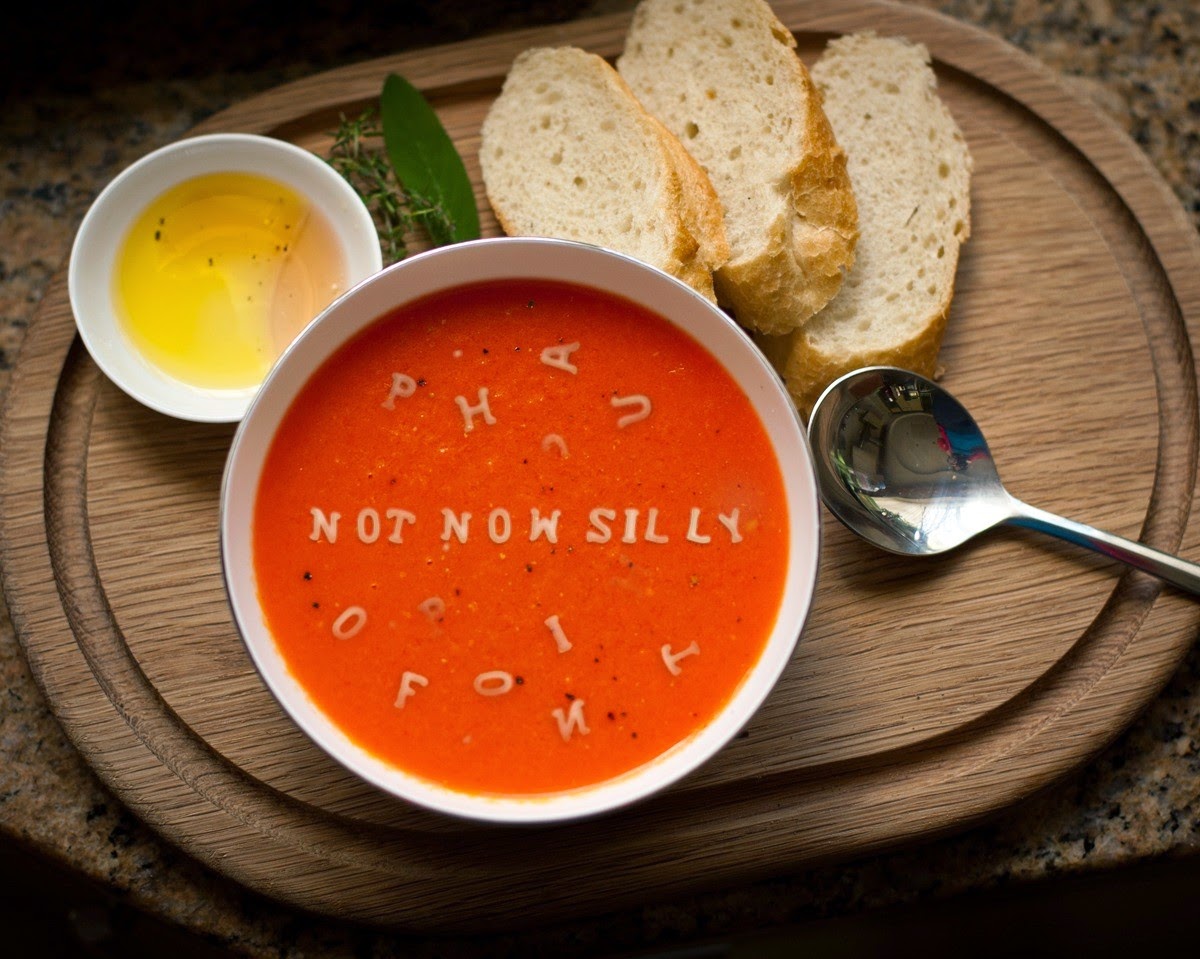 |
| “No soup for you!!!” |
Mark Levine, my band mate in Cobwebs & Strange, visited once. He rode his bicycle from Southfield, Michigan, to Oakville, Ontario, on his way to register at MIT. That’s the last time I ever saw him.
Kenneth John Wilson and his new bride visited once. In the couple of years since I had seen him Kenny had been Born Again. Most of the visit (or so it seemed at the time and in retrospect) was spent trying to convince me to accept Jesus Christ in my life. They even left me a Good News Bible, which I kept until about 10 years ago, when it became one of the few (cherished) objects left behind (no pun intended) in my last break-up (along with 3 other different versions of The Bible, which I loved showing people the contradictions. But I digress. Again.). I would love to see Kenny again and see whether he is still highly religious.
However, those were the only friends who visited me. Lately I’ve been thinking a lot about and have grown quite nostalgic for the friends that preceded the Cooksville event horizon: Dean Donaldson, who drummed for Cobwebs & Strange; Craig Portman, whose family moved to California before I moved to Canada, and I lost track of him then; Jimmy Coblentz, a few years older, who had a fleet of Studebakers and — inappropriately — moved to Normal Avenue in Los Angeles; Terry Seissor, an occasional girlfriend who wasn’t happy to learn I was moving to Canada and getting married; Jeff Deeks, whose family was so convinced that he was a drug addict (he hadn’t discovered drugs yet) and I was a bad influence on him, that they shipped him down to live with his grandparents in Hernando, Florida; Kenny Wilson; and Mark Levine are all people I’d love to find again. If you have a clue where any of them absconded to, let me know, because I’m just not as good at cyber-sleuthing on this series of tubes as some people.
 |
| A moment in time in the Not Now Silly Newsroom |
ALMOST QUIET ON THE CRAZY FRONT: Speaking of cyber-sleuths. It has grown relatively quiet since I published The Johnny Dollar Wars and started sharing the hell out of it. As of this writing it’s #6 on the Not Now Silly All Time Top Ten, with a bullet!
I might have forgotten all about the feud by now had it not been for their reflexive attacks on me. Sadly — for Koldys — The Flying Monkey Squad, his sycophantic gang of ass-kissers that used to hound me on this series of tubes, is now reduced to just one: Ashley Graham, aka Grayhammy. While crossfire has diminished considerably, the war has not ended. Whenever a new skirmish breaks out I am reminded to share The Johnny Dollar Wars with more individuals. Then I set up a whole new series of timed click bait tweets, a simple process carried out with the flick of a button. All of this to push more truth about Johnny Dollar through this series of tubes.
The Johnny Dollar Depreciation Society is your place
for all the latest on The Flying Monkey Squad and
your daily adult requirement of Fox “News” snark!
Now, you’d think a smart guy like Mark Koldys — a former-Wayne County Prosecutor, fer fuck’s sake — would have figured out a way to end the war he started. Perhaps I give him too much credit. No matter, because I am content to keep this up as long as he and his Gang of One does. However, after slapping these fools down on this series of tubes for the past 3 years, would I grow nostalgic for The Johnny Dollar Wars if it were to ever end?
TWO MORE REASONS FOR MY MOTOR CITY NOSTALGIA: I’ve started making final preparations for The 2nd Annual Sunrise to Canton Road Trip for Research. This year there are already more stops planned and more subjects for research than last year’s very successful trip. I’ll be gathering more documents, examining more microfiche, and gathering photographs for the 2014 edition of the Road Trip.
 |
| The Purple Gang trying to remain anonymous |
One of the topics I’ll be researching while up north is the history of Detroit during the 1920s through to the late ’60s for later chapters of Farce Au Pain (the long-lost book I keep promising to serialize in these pages). I’m still writing and researching parts of Farce Au Pain while I edit other parts. One never knows where research will lead. The story of Farce Au Pain is still taking unexpected turns in this series of tubes, but not everything can be found on the Information Highway, hence the The 2nd Annual Sunrise to Canton Road Trip for Research.
More specifically, I’ll be researching newspaper microfiche for articles on The Purple Gang. It surprised me that a person in Farce Au Pain, who will be introduced in Chapter Two, had a strange connection to The Purple Gang? And, who knew, that would lead to further research in Miami, a place I’ve been writing about for the last several years.
This series of tubes is an amazing place, occasionally filled with wonderful synchronicity like this, some of which make me shiver. This one had all my hairs standing on end. Get comfortable while we take a rest stop on the Information Highway:
Recently I was retweeted by the grandson of Meyer Lansky because I shared an article about his grandfather. Makes sense. No big deal, right?
This is where it gets weird. While it was accidental that the Tampa Times published an article about the daughter of the famous mobster just before Father’s Day, it was not accidental that I shared it. I shared it because Meyer Lansky has been on my mind a lot lately because that’s where the Purple connection led and I have been researching him for Farce Au Pain.

That’s why the last book I finished reading was “Mickey Cohen; The Life and Crimes of L.A.’s Notorious Mobster.” Lansky, not surprisingly, comes up 13 times in Cohen book. The next book I started reading was “The Purple Gang; Organized Crime in Detroit 1910-1945.” I’ve read it before and own it. I decided I’d read it again because it, and the Cohen book, are sources for “Farce Au Pain.” [For the record: Lansky only comes up once in the Purple book, but it was a different era.]
Without giving too much away [NO SPOILER ALERTS!] there is someone introduced in Chapter Two of “Farce Au Pain” who grew up in the Jewish ghetto of Detroit, ‘Merka’s first throwaway city. He was just in his early teens when the Purple Gang was a happening thing, but he was a cocky kid who would run errands for Harry Millman. [Incidentally, and almost besides the point, Pops was friends with Morrie (Morris) Millman, Harry’s brother. And, Morrie and Millie Millman are my sister’s Godparents, but I digress.]
As he grew up, Harry Millman paid for his education so he wouldn’t fall into a life a crime. He became a lawyer, so you’d have to argue whether Harry was successful, or not. That lawyer, almost 20 years later, connects Adrian (who you may all remember from Chapter One) tangentially to Meyer Lansky, who appears in “Face Au Pain” twice as often as he did in the book on The Purples.
It’s a series of tubes.

NOW UPDATED!!!
BACK BY POPULAR DEMAND! SECOND YEAR RUNNING!! MORE THAN 3,000 MILES OF HARD ROAD!!! WORSE FOOD!!!! SIGN UP EARLY!!!!!! DON’T MISS OUT!!!!! MORE EXCLAMATION POINTS THAN LAST YEAR!!!!!!!
 |
| CANTON, MICHIGAN
Fun fact: Canton is a township, not a town ◄ MEDIA ► ◄ WHAT’S UP IN CANTON? ► ◄ BOOKS ABOUT CANTON ► ◄ BOOKS THAT MENTION CANTON ► |
MAY 30 UPDATE: Not Now Silly has added 1 more definite stop — and one possible — on the 2014 Sunrise to Canton Road Trip for Research. Amazingly, this adds only 27 miles to the road trip because they are so close to the highway. Confirmed stops on the Sunrise to Canton Road Trip for Researchinclude: Bonita Springs, FL; Tallahassee, FL; Miamisburg, OH; Columbus, OH; Canton, MI; Elyria, OH; and Morgantown, WV; with Cleveland, OH as the possible.
I’ve also recalculated the driving time. That was based on 8 hour days. I tend to drive until I drop, so I’ve asked the computer program (Microsoft Streets & Trips) to calculate the trip based on 11 hour days, which is more realistic. That puts my driving time at 4 days, 2 hours, and 9 minutes.
ALL DATES AND TIMES SUBJECT TO CHANGE!
Read: Not Now Silly and/or Road Trips
 |
| Our next destination in Where The Sidewalk Ends, Racism Begins.
This path runs along another section of The Colour Line in |
Before beginning our second West Grove stroll, it’s worth reading the last Where The Sidewalk Ends, Racism Begins. Since it was published in December, additional info about the Coconut Grove Colour Line has been found. In Dismantling Racism: The Continuing Challenge to White America [published by Augsburg Fortress, 1991], Joseph R. Barndt writes:
A southern version of these traceable corporate decisions to create a Black ghetto exists in Miami Florida. Running through the entire area called Coconut Grove on the South End of Miami are the remains of an eight-foot stone wall, built to separate Black and white residential neighborhoods. Resolution 745, adopted at Miami City Planning Board meeting of July 21, 1941, reads as follows: “A resolution recommending that the establishment of a permanent diving line between white and colored occupancy in the area north of Grand Avenue and east of Douglas Road.” There are also later resolutions that describe the placement, size, access, roads, and responsibility for maintenance of the wall. The wall’s remains still stand, but few citizens of Coconut Grove remember its original purpose, or the decisions that created it.
Fewer remember the next Colour Line we will visit on our Where The Sidewalk Ends, Racism Begins walking tour, although it’s far less hidden. Rather than running along the backyards of a neighbourhood, it’s in plain sight. An entire block of houses stare out at it. Furthermore, it’s not just in plain sight, but maintained and fortified to this very day. Let’s go for a walk.
 |
| From where one sidewalk ends to where the next sidewalk ends. |
We begin right where we left off the last time. While standing on Douglas Road at The Colour Line facing The Wall of Shame, turn left, and cross Douglas. This will put you on Franklin Avenue. Walk east along the southern edge of the Charlotte Jane Memorial Park Cemetery, named after the wife and childhood sweetheart of E.W.F. Stirrup. This was once the only place in Miami where Black folk could be buried and, contrary to some references found on the internet, is not where Michael Jackson filmed Thriller. Past the cemetery is one modern 2-story home and then several single family homes in the Coconut Grove vernacular of being either modified Conch or Shotgun styles. Turn right at the little traffic circle at Plaza, the first street, and walk down to where the sidewalk ends. That’s where racism begins and Marler Avenue begins.
Marler Avenue is a funny little street in Coconut Grove, “little” being the operative word. It runs east-west for one short block, from Hibiscus Street to Plaza Street, with houses only along the north side. Every one of those houses looks out at a wall — overgrown with foliage and almost invisible in parts, unless you know where to look.
I first learned of Marler Avenue from an article called The Wall, which Kirk Nielsen wrote for Miami New Times way back in 1998:
One look at Marler Avenue clarifies [Marler resident David] White’s frustration: Not only are he and his neighbors fenced in at both ends of the block, but along the southern edge of the tiny street is a ten-foot fence. “This all used to be open,” White explains, standing in his driveway and pivoting 180 degrees as he points from one end of the street to the other. “We used to walk through there.” He gestures toward one section of fence with a coil of concertina barbed wire — the kind used in military operations: “Totally unnecessary,” White exclaims, shaking his head, his hands now tucked inside his back pockets.
Will Johnson, who returned home to the black Grove four years ago after eighteen years in the U.S. Army, is offended by the notion that white Grovites would put up barricades to protect themselves from their black neighbors. “The idea that a man would put that damn concertina wire on top of the fence there,” says Johnson, age 46, surveying the barrier with White. “The truth is it won’t make any difference at all. The guys know how to get over there and rob their ass anyway. It’s not a deterrent.”
White regards the barriers as vestiges of “segregation and white dominance. And I say, look, I pay taxes the same as anyone else. I don’t necessarily want to go into their community, but I do want to make sure that if I need to go over there for anything I have the accessibility. Now, if I’m going to go over to Plymouth Congregational, I gotta go all the way around” — he twirls slowly in a half-circle to indicate the circuitous route he would have to take — “instead of the way the streets were supposed to be.”
.jpg) |
| A map dated 1947-1949, before Marler Avenue was closed off on all sides. |
That wall is the Marler Avenue Colour Line, but it also demarcates the end of the backyards of houses that front along Loquat, one block south. If you look closely at the map above, you will see a faint line running west from Marler, which would have extended the street all the way to Douglas Road, also known as 37th. In fact Marler was supposed to have gone through to Douglas, as this map from the late ’40s indicates. It also shows some other Marler mysteries. For instance both Plaza and Hibiscus were also supposed to link up to Loquat Avenue.
Back then Marler, Plaza, and Hibiscus were nothing more than a dirt roads that became mired in mud during the rainy season. However, a curious thing happened on what should have been the western end of Marler Avenue. The White homeowners on Loquat Avenue illegally extended their backyards into the right of way, closing off Marler. And, that’s how Marler Avenue lost access to Douglas Road. Quietly. Illegally. Racially.
Hibiscus Street never went through to Loquat as it should have either. Eventually that land was sold off and condos built. And, that’s how Hibiscus lost access to Loquat Avenue. Even more curious is the evolution of how Plaza Street lost access to Loquat.
Plaza Street begins its southward trek at the famed US-1. At Grand Avenue, once the thriving Black business district of Coconut Grove, it takes a slight jog. Today, it continues all the way down to Marler, where the sidewalk ends. According to that 1940s map, [above] Plaza Street was supposed to take another slight jog at Marler before continuing south past Loquat in South Grove, where at Poinciana Avenue, it would make a gentle left turn to connect to Main Highway. However, that was not to be.
When the lower section of Plaza, along with Marler and Hibiscus, were paved sometime in the ’70s, this dogleg, between Marler and Hibiscus remained dirt. It was little traveled by vehicles because it wasn’t well maintained and, quite frankly, South Grove had little reason to go north into West Grove, which was considered unsafe. West Grove, for the most part, traveled north to Grand Avenue to shop and be entertained. This little section of what should have been Plaza Street eventually became an overgrown footpath that crossed the Coconut Grove Colour Line from West Grove to South Grove, Black Grove to White Grove.
It remained a footpath until some time in the early ’90s when — without warning and city approval — a chain link fence was erected that closed off the bottom of Marler Avenue entirely. No one knows who paid to have it put up, but fingers were pointed at White residents in South Grove reacting to a perception of heightened crime, accusing the perps using this path.
The chain link fence didn’t stay up very long.
IRONY ALERT: Just like it was the complaints of White folk that got Old Smokey closed down, and
just like it was the White folk that finally got the western edge of the Wall of Shame taken down, it was the White folk of South Grove who were
responsible for getting the chain link fence taken down. A good many of the residents of West Grove worked for families in South Grove as gardeners, maids, handymen, and nannies. When the Plaza extension was closed off to foot traffic, these tradesfolk started complaining to their employers because, suddenly, they were forced to walk a lot farther to get to work. The fence came down.
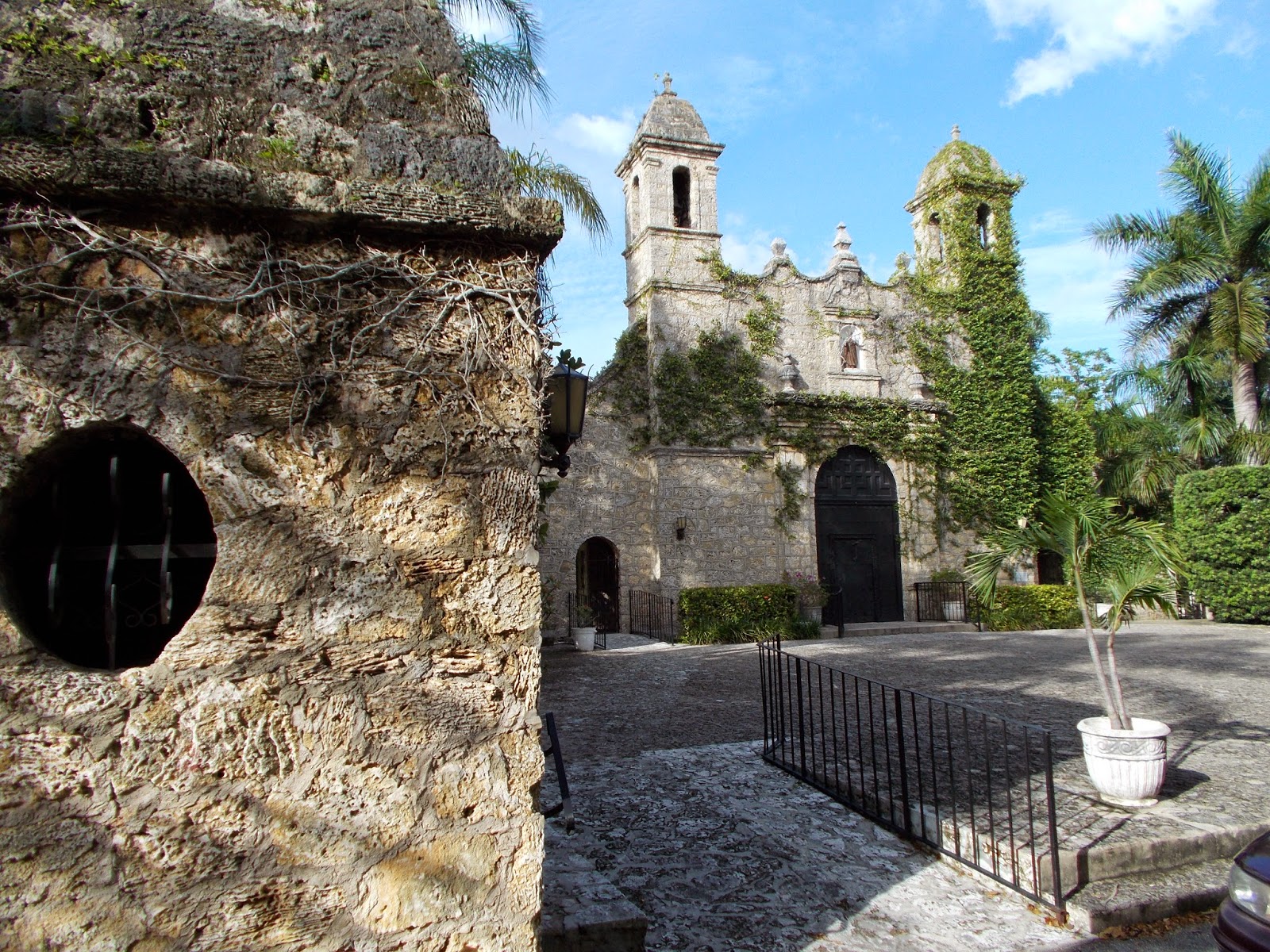
There had been other leaks in The Wall of Shame. Along the south side of Marler that section of the wall had been porous. People remember using dirt paths to take shortcuts to Loquat and walk to Plymouth Congregational Church. But over the years one link after another was closed off until the Plaza foot path became the last surviving link between West Grove and South Grove along residential streets.
For the longest time it remained a dirt path. Eventually this rough footpath was improved by the City of Miami. Paving stones were added and the foliage would be cut back occasionally. However, it was poorly maintained over the years. That is, until quite recently.
In February this reporter first visited Marler Avenue to begin research on this post, and to scope out the lay of the land. Way back then the edges of the path were falling apart. Many pavers had been stolen. Sinkholes in several places made walking a baby stroller difficult. A second visit a few weeks later showed newer destruction. The post that would keep vehicles off the foot path had been flattened, probably by a vehicle. [A big rock at the south end of the path would have kept it from exiting on Loquat, however.] A third, more recent, visit held a much bigger surprise. A new, sturdier post had been installed to keep vehicles out and the path had been repaired. All the pavers were replaced and leveled, with the edges shored up. It wasn’t until I started taking videos to document the maintenance that I noticed something very disturbing.
AFTER:
April 21, 2014: Note the brand new
addition to the fence along The Colour Line.
 |
| This is pretty much where maps say Marler Avenue should have met Douglas Road |
As the path became more navigable, and the wild foliage cut back drastically, someone must have felt far more vulnerable. Why else would another 2 feet be added to the top of The Wall of Shame, The Colour Line of Coconut Grove? Furthermore, it was done in the cheesiest way possible, by just nailing new boards on top of the old ones.
No matter. It still makes a statement about keeping Black Grove separate from White Grove in 2014, 16 years after Black residents told Miami New Times how offended they are by a constant reminder of systemic racism. Despite the One Grove mural, the Black and White communities in The Grove are quite separate, and have been for decades.
As I said in the first entry in this series:
The Coconut Grove Wall of Shame™ is not unlike the wall in my home town of Detroit known alternatively as The 8 Mile Wall, The Wailing Wall, or the Birwood Wall. A search on the Googalizer for the 8 Mile Wall turns up references, history, as well as tons of images. However, one has to go digging to find any images or references to the Coconut Grove Wall, the history of which is being buried like much of the history of West Grove.
The Coconut Grove Wall of Shame is far longer that the 8 Mile Wall. The more I research Coconut Grove, the more I realize it is the story of Race Relations in this country writ large. However, West Grove is the exception that proves the rule. What has always put Coconut Grove into stark relief is the fact that, at one time, it had the highest percentage of Black home ownership than anywhere else in the country. Consequently it couldn’t be colonized; it had to be surrounded and walled in on all sides. Much of that wall still exists and the current invisible Colour Line can still be traced.
COMING SOON: Another walking tour along the Coconut Grove Colour Line.
Read: Happy Birthday Coconut Grove!!! Now Honour Your Past
More raw Marler Avenue videos in The Colour Line at YouTube
 |
| A funny thing happened at the 32nd Annual King Mango Strut |
Back in December, when I covered the 32nd Annual King Mango Strut,
I could have hardly imagined it would be a life changing event. Yet,
almost immediately I realized it was a transformational day.
TO RECAP: I attached myself to the Coconut Grove Drum Circle to cover the King Mango Strut from the inside. The parade, which went
around a small 2-block circuit exactly one time, spent the entire morning
marshaling on Commodore Plaza. I had a lot of time to think. It took 5 times longer to get ready for
the Strut than it did to Strut. That was over almost before it began.
A journalist
straddles a tiny grey area between participant and observer. One tries
to stay out of everybody’s way, without blending too far into the background. Taking notes, taking pictures, taking impressions at once removes the
journalist from the action, while it immerses the writer in the experience at the very same time. It’s an anomaly.
One thing became clear to me during all those hours: I DID NOT want
to be covering the King Mango Strut. I just wanted to be hitting those
drums instead.
I’m no drummer. I barely have any rhythm. I’m not even a musician. The blog post My First Band ► Cobwebs And Strange
recalls my HIGH-LARRY-US teenage attempts at being a lead singer in a Rock and
Roll band. To sublimate my lack of musicianship, I love listening to
all genres of music passionately. It’s not a fair tradeoff, but it’s all I’ve got. [That and 42 linear feet of CDs, more that 25,000 tunes on my hard drive, and enough Spotify playlists to last several lifetimes. Whoever has the most music when they die, wins!]
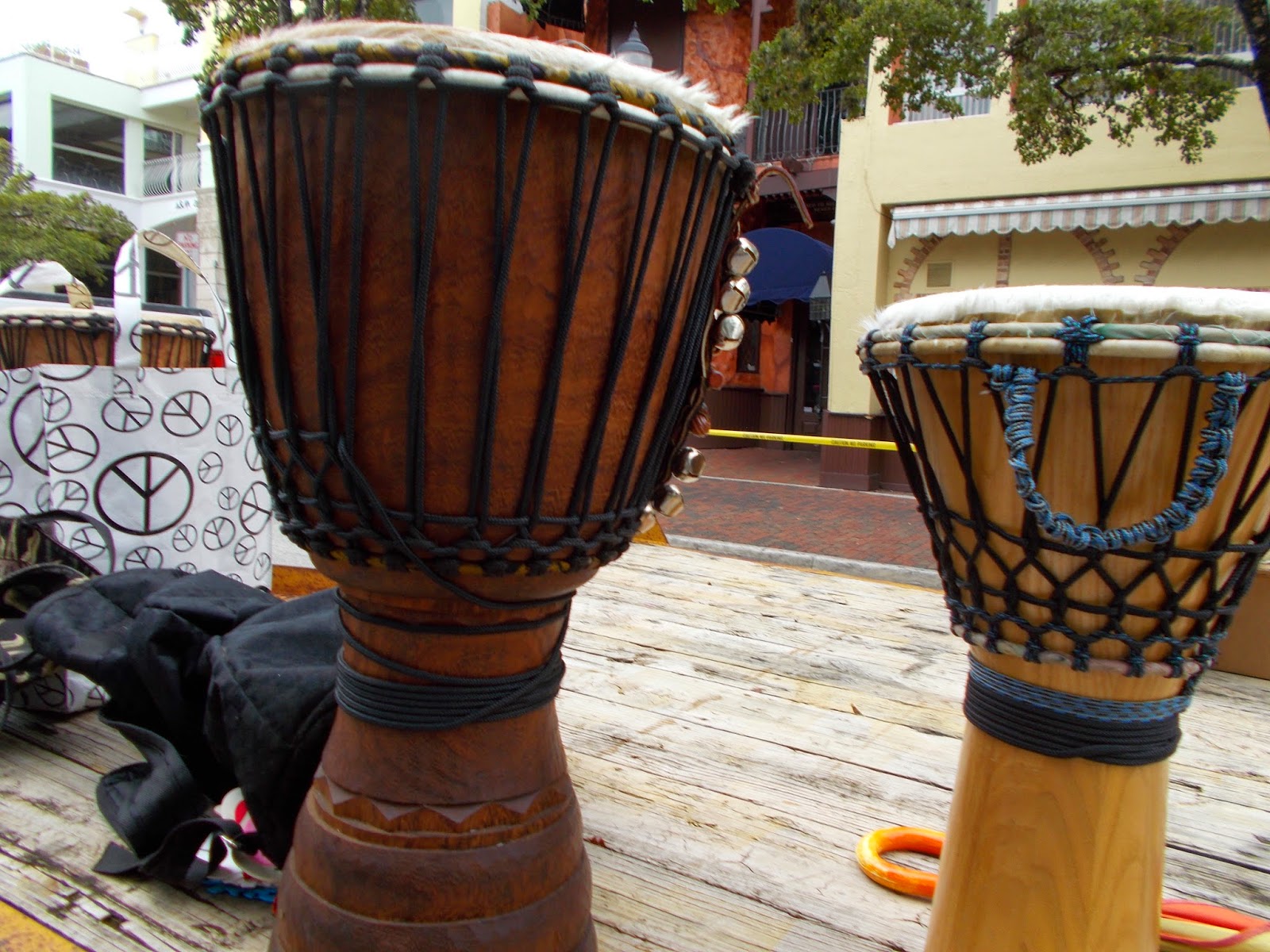 |
| Djembe drums awaiting use |
But…but…but…on
the day of the King Mango Strut, all I wanted to do was to slap those drum skins. Every once in a while one of the drummers would let me have a few
whacks on their oddly shaped drum, which I now know is called a
djembe. But, walking past a drum and giving it a few taps is different
from putting it between your legs and banging away. And, I was desperate to put one of those things between my legs and bang away. The only other time music had such an immediate, visceral effect on me is told in The Day I Met Bob Marley, another popular post at Not Now Silly.
By
the time the Strut was over, I knew I would be joining the
Coconut Drum Circle again, but this time as a participant. I would get my chance soon enough. There’s one held on the
first Saturday of every month, just a few hundred feet from where we
marshaled for the Strut.
So, skip ahead. It’s the first Saturday of the month. At the corner of Commodore Plaza and Grand Avenue I was handed a djembe. I spent the evening pounding away like a mad man, until my hands hurt. Sadly, it was nothing like what I had anticipated and it turned out to
be a very unsatisfying and deflating experience.
To begin with, I should have brought my own camping chair. I don’t mean to be churlish because I was graciously supplied with a drum and a tiny stool. But that little thing hurt my delicate ass after several hours. To make matters worse, I couldn’t hear myself. That’s why I hurt my hands. I was trying to make my drum loud enough so I could hear it over all the other drums. Not
being able to hear meant that I couldn’t tell how hitting the head in different places affected the sound. Only later did I realize I sat next to all the BIG DRUMS that people were hitting with big sticks. No wonder I couldn’t hear myself.
Worse still was the fact that, once again, I had to face up to the limitations of my left hand. Back when I was a teenager my guitar teacher told me I had no absolutely coordination in my left hand. To quote myself:
It turns out that time proved him right. Over the years I have learned
that my left hand is pretty useless for most tasks. When I smoked I
couldn’t even use my left hand to hold the cigarette because I managed
to drop it so many times. Trying to use a remote with my left hand?
Forget it! I’m the EXTREME opposite of ambidextrous. Hell! I’d give my
right arm to be ambidextrous.

It’s probably just as well I couldn’t be heard in the mix at the drum circle. Whenever I tried to find my own beats within the group’s rhythm, my left hand would lurch out spasmodically, finding crazy syncopation never intended for music of any kind, even Jazz. I drove back to Sunrise from my first drum circle dejected. It was not at all what I had hoped. Nor did it feel as if I could ever fit myself within the group’s rhythms.
Yet, there were moments that first night that transcended thoughts, transcended time, transcended my crappy rhythm. I would find myself transported, soaring through millennia of music making. I imagined myself back in Kebo, the name the original Bahamians
gave to this area of Coconut Grove a century ago when they settled here and built Miami. At night there would have been music-making. I could feel the
energy we created merging with rhythms from the past, present and future. Outside was one thing. In my head I could fuse what the circle created with Gospel melodies, horn sections, Rock and Roll, Jazz, New Orleans, and Reggae rhythms. Again, it penetrated me deeply in a way that words just seem so inadequate to describe. This paragraph will have to do instead.
I was pissed. As much as I was drawn to the drumming — as much as I wanted to be a part of it — my lack of left-hand rhythm kept me at a distance, kept returning me to reality. I was running these thoughts through my mind the next day as I listened to music. I soon became aware that, as always, I was tapping my feet and ‘drumming’ the fingers of my right hand on my desk to the tunes. What was going on?

TANGENT: My odd relationship with music didn’t quite make sense to me until I read Musicophilia by Dr. Oliver Sacks. That’s also when I started to over-think my lifetime contract [sic] with music and how I process it. I’ve been reading Sacks, who writes fascinating books about people who have anomalies, diseases, or damage in their brain, for many years. However, this book was the first time I ever thought he was talking directly about me, in part.
I happened across the Sacks book right after reading This is Your Brain on Music: The Science of a Human Obsession by Daniel J. Levitin. Musicophilia is about the [almost mystical] effect of music in (on?) the brains of case studies, both normal and abnormal. This is Your Brain describes the science of measuring the changes in the brain caused by listening to and/or playing music. These two books summed up for me my relationship to music, whether it’s shaking my eardrums or being created inside my head.
Growing up, adults always
told me I was fidgety. It took many years to realize that I wasn’t
nervous. I was keeping a rhythm to music by tapping my feet and/or drumming my
fingers. Even if there’s no music playing. Especially if
there’s no music playing. My mind is
always creating music when there is none: the ticking of a fan, the hum of florescent lighting, or the sound of footsteps can all lead to my brain over-laying a tune on top of it. My toes and fingers are reacting to that. As a child I never had the language to describe it. As a young adult I figured if I told that to people, they might lock me up. Now that I am — ahem — mature, I’m quite comfortable with the music in my brain. TANGENT OVER. MOVE ALONG.
I spent almost a week of analyzing my disappointment to my first drum circle. Friends told me I was over-thinking the whole dealie, but that’s how I process events that rub me wrong. One friend tried to make me understand that all that was needed was for me to feel the music. It wasn’t necessary to think the music. I especially didn’t need to over-think the music. But I did. I knew I did. How did I know? Because I couldn’t get the problem out of my head.
Then the light bulb went on. I realized that what I really wanted to play was what I heard in my head and what I was hearing in my head was not a drum. A drum circle plays
budda-duh-budda-duh-budda-duh-budda-duh-dum-dum-daddah. [repeat] What I was
hearing in my head was tink, tink, tink, tinka-tinkahh, tink, tink,
tink, tinka-tinkahh on top of the rhythm.
It came to while I was ‘drumming’ my fingers on the desk again. Paying better attention to what my fingers were doing — over-thinking it, you naysayers — I realized they weren’t beating out a steady rhythm at all. My fingers were popping off accents within the rhythm. I was hearing the syncopation inside the rhythm.
 |
| Mine looked exactly like this until I knocked the logo off |
Over the next week I visited a couple of music stores and tested out a number of percussion instruments. I really liked the sound of the wood blocks, but they were all far too expensive for this weird, new obsession I was chasing. What if I didn’t like it?
I finally settled on a set of claves and a cowbell. I spent the next little while practicing the claves as various genres of music played on my computer jukebox. I knew almost immediately I had found my instrument! My left hand needs to do nothing but hold a stick. How hard is that? My right hand only needs to bang another stick against it. How hard is that?
Since finding my instrument I’ve also learned about several different drum circles in my area. Until recently I had no idea drum circles were even a thing, but they’re all over the place. There are a few nearby on each full moon and several within an hour’s drive at other times during the month. There are drum circle classes and larger, yearly, conglomerations of drummers. These bring together many drum circles and people make a weekend of it and howl in the woods (in my imagination). I’m learning there’s a very primal need being fulfilled with drum circles. The journalist in me says they require further investigation. The neanderthal in me just wants to bang sticks together.
I have now guest starred with a few separate drum circles, insinuating my tink, tink, tink, tinka-tinkahh, tink, tink,
tink, tinka-tinkahh within the budda-duh-budda-duh-budda-duh-budda-duh-dum-dum-daddah. I’ve now sat in enough drum circles to note each have a different personality. I’m not quite sure how anyone else takes what I do, but I’m having a great time finally playing what I hear in my head and meeting new friends along the way.
And that’s the story of how covering something as a writer changed my life.
NOT NOW SILLY NEWS FROM THE NOT NOW SILLY NEWSROOM: There are several new posts already in the works, with the research pretty much finished. Just within the last few days so many things have occurred on Charles Avenue, that I’ve barely had time to keep up. I have a few outstanding phone calls, but that will get its own post coming up in the next few days. I’m also part-way through documenting a second chapter of Where the Sidewalk Ends, Racism Begins. And, as I keep promising, there’s a new chapter of Farce Au Pain coming up. While on the subject of books, don’t miss The Johnny Dollar Wars ► Chapter and Verse, in which I expose my crazy cyber-bullies for the malevolent creeps they are, last thing Mark Koldys wants anyone to know.
 |
| Artist rendering: Grand Avenue and Gibson Plaza |
A gala day on Grand in The Grove, for the Gibson groundbreaking. This mixed-use, residential-educational building is the first all-new affordable housing built in West Grove in almost 50 years.
Gibson Plaza has been in the planning stages for many years. However, it took a unique and unlikely group of partners to move this project forward, including the Theodore Roosevelt Gibson Memorial Fund, the Coconut Grove Collaborative Development Corporation, Miami-Dade College and the Mitchel Wolfson, Sr. Foundation. Miami-Dade County kicked in $9 million dollars, and Pinnacle Housing Group will construct the Bahamian-styled building that pays homage to West Grove’s original inhabitants.
 |
| Thelma Gibson’s 1st shovelful at the project she helped spearhead |
Gibson Plaza, named for Reverend Theodore R. Gibson and Thelma Gibson, will be geared to the 55-and-up demographic, with 56 one and two bedroom units. Among the common amenities will be an exercise room, community center, library and computer lab. However, what has the neighbourhood excited is what’s slated for the ground floor. It is dedicated to providing continuing education, job training and after school programs for the neighbourhood at large.
“It has always been a dream of ours to have affordable housing, continuing education and after-school programs for children running side by side,” the 88-year old Ms Gibson said.
Every speaker who came up to the dais to say a few words (under the white tent in the 89 degree heat) spoke of how this project will lead to a neighbourhood revitalization of a sorely neglected area of Miami. That’s why residents were so upset about Trolleygate when they learned about it. This is a neighbourhood struggling to overcome a century of racism and neglect.
While east Grand Avenue got revitalized with CocoWalk, restaurants, and fancy hotels, the west end of Grand — Black Grove, or Kebo, as the original Bahamian residents called it — has struggled and become blighted over the decades. The non-conforming diesel bus garage is just a few very short blocks away from this development. The reason people were so upset with the trolley garage is because it does not comport with the vision of those who want better for the neighbourhood. Gibson Plaza is the beginning of that revitalization plan.

The two people who came in for the most praise and sustained ovations at yesterday’s ceremony were the two people who everyone acknowledged deserved the most credit for seeing this project through to fruition. First and foremost is Thelma Gibson, who, though the Foundation named after her late husband, helped aquire the 1 acre site, parcel by parcel, and who insisted that any project of this kind simply had to have an educational componant; and Jihad Rashid. President of the Coconut Grove Collaborative Development Corporation, who worked tirelessly to bring all the partners to the table and see that they all understood the vision.
One of the politicians mentioned over and over, by speaker after speaker, is Miami-Dade Commissioner Xavier Suarez, who fought to get County Commissioners to allocate the $9 million. “On behalf of the Miami-Dade County Board of County Commissioners, and as Commissioner of Miami-Dade District 7, it gives me a great deal of pleasure to be associated with a project that I believe will spur the re-birth of the long neglected segment of our community – The Coconut Grove Village West.” Yet, that wasn’t just promotional bumf.
Thirty years ago Suarez helped set up the Gibson Memorial Fund and he’s been behind this project from the get-go.
 |
| How close is Trolleygate to Gibson Plaza? |
IRONY ALERT: Another politician got short shrift in all the speeches. That’s just as well because [allegedly] corrupt Miami Commissioner Marc D. Sarnoff arrived 10 minutes late and missed the shovel photo-op. His West Grove constituents accuse him abandoning them for monied interests and out of town developers.
Further reading: Is Marc D. Sarnoff Corrupt
Or The Most Corrupt Miami Politician?
Last year when Trolleygate erupted in controversy, Sarnoff staged The Trolleygate Dog and Pony Show to protect the profits of Astor Development and Coral Gables against the interests of his own constituents. After Sarnoff insisted he couldn’t talk about Trolleygate because it was before the courts, he presented a one-sided slide show to insist diesel fumes and bus traffic on residential streets is perfectly safe. However, it’s what he did in the middle of the meeting that Sarnoff demonstrated his despicable side. At one point in this contentious meeting this reporter heard Sarnoff covertly threaten to withdraw support for Gibson Plaza (and other projects) if the community continued its fight against Trolleygate.It was slyly done, but was not lost on anyone in the room.
So, colour me thrilled that Sarnoff missed his photo op — another way to grab credit. Judging from the sotto voce murmurings when he gave his short speech, he’s lucky he wasn’t booed.
 |
| Even as the Collaborative’s Jihad Rashid celebrated this achievement, he warned against gentrification. |
The slogan on the banner in front of which every speaker spoke read CATALYZE • REVITALIZE • TRANSFORM, which is everyone’s hope for this stretch of Grand Avenue. Immediately across the street from Gibson Plaza is the Collaborative offices. Just to the east of that is the brand new KROMA Gallery, which hosted a lunch for attendees after all the speakers were finished.
While everyone hopes Gibson Plaza leads to a revitalization of the west end Grand Avenue, the fear is that this is just another step along the process of slow gentrification that has been eating its way into West Grove. Even Rashid recognizes the danger. As Nick Madigan in the Miami Herald notes:
After waiting for a standing ovation to die down, Rashid reminded the crowd that there had been a “history of disinvestment and disenfranchisement” in the West Grove, and remarked on the irony of expensive hotels and condominiums perfectly visible only a few blocks to the east. Rashid also cautioned against the danger that the neighborhood’s longtime residents will be pushed out by construction projects and investors looking for profits.
“If they get gentrified out in the name of progress, I don’t think that’s progress,” Rashid said. Still, he concluded, Gibson Plaza is a huge step forward.
Those in the know tell this reporter that due to property speculation along Grand Avenue, nothing less than 5 stories will pay for itself. Nothing taller than 5 stories is allowed by the Miami 21 Plan. This means that only 5-storey high condo buildings will be built along Grand, making it a new canyon for colonization and gentrification. Otherwise, West Grand will continue to undergo Demolition by Neglect, which passes for progress in West Grove. There appears to be no room left for anything in between.
View pictures of the groundbreaking in this Facebook album.
View raw footage at this YouTube Playlist.

Welcome readers both new and old. Once a month, on an irregular schedule, I drop a blog post under the rubric Unpacking the Writer, where I pull back the curtain and expose some of what’s happening on this side of the keyboard, much like Toto did to The Wizard of Oz.
Which is only appropriate because I wrote under the nom de plume of Aunty Em for NewsHounds, the motto of which is “We watch Fox so you don’t have to.” Clearly, I did a very good job of exposing Fox “News” mendacity. You know how I can tell? Although I left NewsHounds more than 2 years ago, the same crazy, obsessive Fox “News” defending, cyber-stalking bullies I picked up back then continue to hound me to this very day. [See what I did there?]
BOOK CORNER: I’ve been writing about the exciting adventures battling my cyber-stalking bullies — chapter by chapter — since the day I launched this blog. They’ve been published at Not Now Silly as needed and now comprise quite a thick dossier on what crazy obsessives do in the Age of the Internet. In previous times they’d be standing on street corners babbling incoherently. This medium keeps them off the street, unless they have a phone smarter than they are.
As of late [and mentioned only to satisfy Grayhammy’s vast curiosity, because he keeps asking] I have been working with an editor to give the project more ‘”shape,” as they keep putting it. They believe The Johnny Dollar Wars could be turned into a Laff Riot Situation Comedy or a blockbuster Gothic Horror movie. [It works both ways.] Until I post a compendium, the best place to start is Anatomy of a Cyber-Feud, which is currently the #3 most popular post at Not Now Silly for the past 30 days, despite it being published way back in December. If you want to keep up with the daily shoot & miss tactics of The Flying Monkey Squad, you’re personally invited to join The Johnny Dollar Depreciation Society, on the facebookery.
 |
| Follow the day-to-day craziness of my cyber-stalking bullies at The Johnny Dollar Depreciation Society page. |
 |
| HARD WORK: Forging Farce Au Pain from the raw alphabet. |
CHAPTER TWO: My other book, Farce Au Pain, proceeds a lot slower than I ever expected when I promised serialization way back when. I anticipated having more time to work on it, but life and new Coconut Grove stories keep getting in the way. It doesn’t help that I chose to make my task more difficult. Because it’s being published on the Internet, I decided to link all the facts and references to the existing internet proofs as I edit the manuscript. There are a lot of those, which you’ll notice when it’s eventually published. I’m closing in on it, but I’ve learned better to make any hard promises, otherwise Grayhammy will squawk again. Hopefully I’ll have some news on that front very soon. Stay tuned. Check your local listings. Coming to a browser near you, and all that Jazz.
COCONUT GROVE CORNER: Still awaiting news of a Trolleygate settlement in West Grove. Almost 2 months ago I wrote Is Trolleygate Headed For An Out Of Court Settlement? To quote myself:
So confident are all the parties that an agreement is possible, that they’ve requested a 60-day freeze in all legal proceedings to see if they can all get on the bus. Based on the anger expressed at the Village Council Meeting, it may be an uphill climb on a rough road to a negotiated settlement.
The broad outline of the proposed settlement looks like this: Coral Gables agrees to drop its lawsuit against Astor Development that asks a judge to abrogate its contract with the developer. Meanwhile Astor Trolley/Astor Development agrees to stick the new fake trolley garage RIGHT WHERE IT IS NOW, more or less, as opposed to the non-conforming White Elephant on Douglas Road.
Those 60 days are just about up, if they haven’t expired already. I should put in a few calls. I’ll add that to my ever-increasing To Do List.
 |
| This is where the next sidewalk ends. This historic walkway has been fixed. |
MY LATEST WRITING PROJECT: I’ve slowing been crafting another chapter in my ongoing series Where The Sidewalk Ends, Racism Begins (of which there has been only one so far). The next one will delineate another segment of The Colour Line in Coconut Grove, pictured at left.
The Coconut Grove Colour Line has existed for decades. The line was
always meant to keep Black Grove separated from White Grove. But, it’s not just ancient history.
Current segments of The Colour Line are as concrete as the cinder block wall described in Where The Sidewalk Ends, Racism Begins.
Other parts of The Colour Line in Coconut Grove are subtle and almost
imperceptible to the naked eye, unless you know what to look for. Still
other parts of The Colour Line are as clear as black and white when
looking at maps of property values and demographics in Coconut Grove.
 |
| A close up of the fence seen in the background [above left]. Two feet have been added to the top of it within the last few weeks. |
Although the building of The Colour Line in Coconut Grove is ancient history, some of the walls along it were not only maintained, but made taller and more formidable as time went on, a process that continues to this very day. Shockingly so.
Within the last few weeks the latest spot I have been struggling to write about has had its fence — this small segment of The Colour Line — grow 2 feet taller by just nailing new boards over the old. Look for the next blog post on The Colour Line, coming soon to a browser near you.
THE CORNER OF MAIN HIGHWAY AND CHARLES AVENUE: This is where it all began for me 5 years ago when I discovered the Historical Marker and started researching and writing about this small corner of the world. Here are some quick updates:
The deal concerning the Coconut Grove Playhouse continues to unfold exactly as the residents had hoped it never would. The Miami Parking Authority has now painted HUGE arrows in the parking lot on Main Highway, directing traffic to an exit on Charles Avenue. This has increased the traffic in both directions along the Historic Roadway, along which you will find the Coconut Grove Playhouse; the Charles Avenue Historical Marker; the E.W.F. Stirrup House; the former Odd Fellows Hall; the Mariah Brown House, the first house built on Charles; ending at the Charlotte Jane Memorial Park Cemetery, named after the wife and childhood sweetheart of Mr. Stirrup and at the time of its founding the only place in Miami Black folk could be buried.
Meanwhile rapacious developer Gino Falsetto continues to chip away at The Colour Line in Coconut Grove. His Aries Development has checkmated the Coconut Grove Playhouse with the acquisition of the Bicycle Shop on Main Highway at one end. This adds to the property he’s controlled for a while: the two empty lots immediately west of the Playhouse and the E.W.F. Stirrup House immediately across the street. Now whatever people want to build in between all those properties will have to go begging to Aries Development, hat in hand.
 |
| Pops on his 88th birthday, February 14, 2014 |
PERSONAL CORNER: My family and closest friends know, but I’ve not shared this with Not Now Silly readers yet: I came to Florida after the death of my mother to look after Pops. It’s starting to weigh on me and maybe writing about it will help me work some things out.
I’ve been in Sunrise for 9 years, arriving just in time for Hurricane Wilma. When I arrived, Pops was fine, despite his having a stroke about 20 years ago. He battled back and you would never know he had had one.
Pops didn’t really need me to care for him. He was capable of accomplishing more in a day than I did. However, he is of a generation of men who knows where the kitchen is, but just doesn’t know what kind of magic gets food on the table. If I weren’t here, he’d be getting all his meals out of the microwave. A fried egg is beyond his expertise.
However, in every other way he was competent. Three or 4 days a week Pops played 9 holes of golf on the course that wends its way around the condo complex. He’d hang with his buddies at Subway or the condo clubhouse. The last few years he’s been slowing down. At first he’d only play 8 holes of golf, knocking off at the one closest to our building. Then it was 5 holes, meeting up with his crew on the 4th and playing with them through 8.
He may have battled back against the stroke, but he’s getting pummeled by the years. Within the last year he’s been admitted to the hospital twice, both times for having a bit of trouble catching his breath. The last visit was 3 weeks ago. He’s just not bounced back the way we all thought he would afterwards. And, he hasn’t played any golf since. He’s just had a round of tests to see whether we can get to the bottom of this latest problem and we’ll get the results in a few days when we visit the pulmonologist again. Meanwhile he’s on a Nebulizer twice a day and an inhaler 4 times a day and his movements are resricted by his lack of energy.
We’ve recently convinced Pops to start using a cane. After the stroke he always had a very slight imbalance. However, lately it’s been more pronounced. He seems unaware of how he tacks to the right as he walks without assistance. My biggest fear, of course, is that he’s going to fall when I’m not here or when I’m asleep. That’s why I now always make sure a walker and cane are within reach.
This all means I am getting to Coconut Grove less often than I would like, but I wouldn’t suggest Gino Falsetto relax. I still pop into Coconut Grove when I’m least expected. Recently I was fortunate enough to meet his wife Magda. Maybe one day soon I can meet the brains behind Aries Development and can ask him questions directly. Meanwhile, you can help Save the E.W.F. Stirrup House by joining the Facebook group.

 |
| The condition of the historic marker on April 21, 2014. |
It was just a week ago I posted Surprises on the Latest Visit to Charles Avenue, a summing up of the latest information about Charles Avenue, designated a Historic Roadway by the city of Miami in 2012. However, yesterday’s visit to Coconut Grove provided the biggest surprise of all:
The Charles Avenue Historical Marker has been repaired!!!
This is actually a big deal for me, forget the neighbourhood.
It was the physical condition of this historical marker that alerted me I had stumbled across an interesting story about Race Relations in ‘Merka. You can take the journalist out of the newsroom, but you can’t take the newsroom out of the journalist. I just didn’t realize how deep into the Coconut Grove rabbit hole this story would take me.
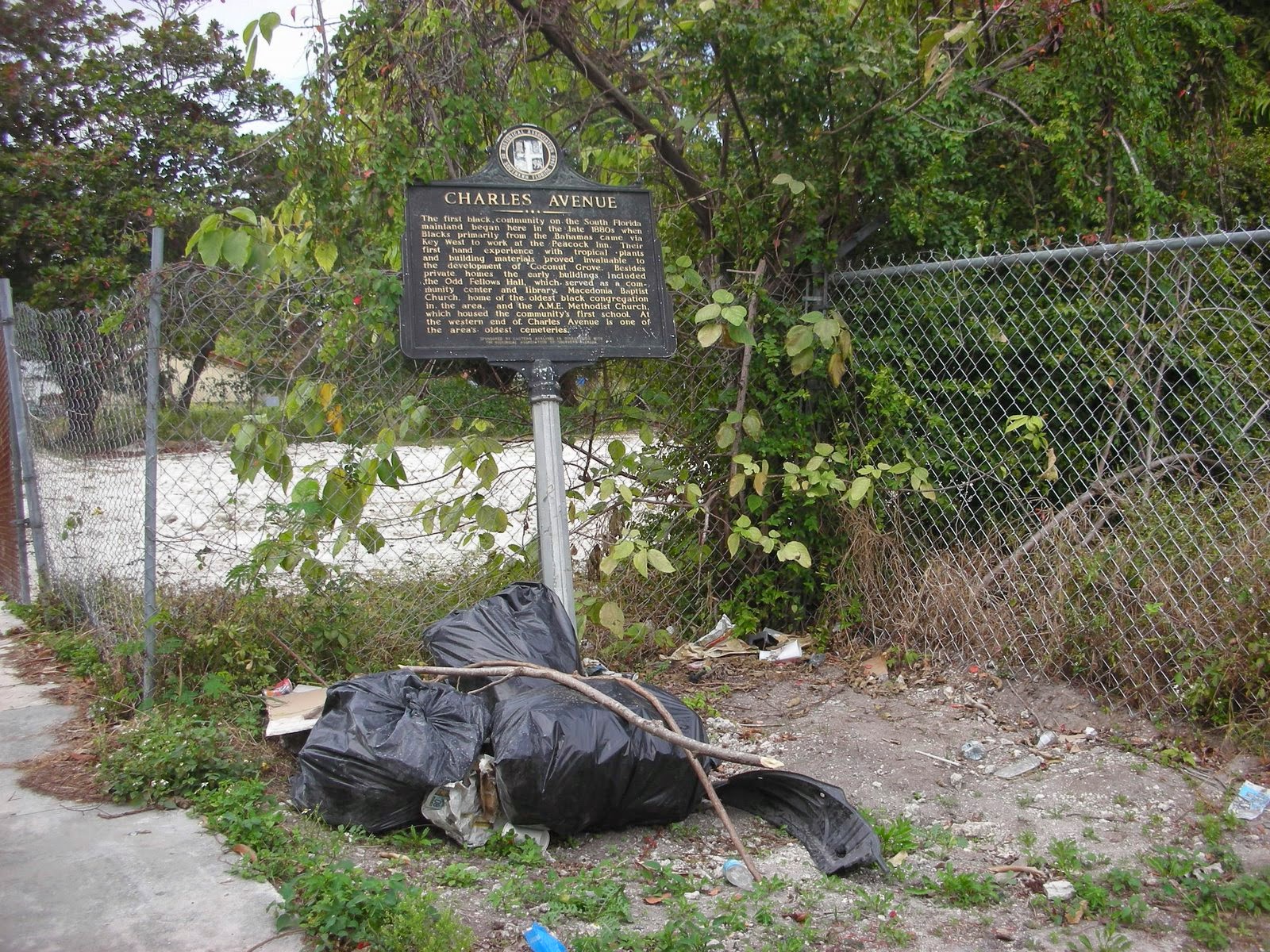 |
| The condition of the marker on January 16, 2009, the first time I saw it. The bags of garbage covered up a broken base. |
Follow the bouncing ball, dear readers:
I stumbled across the Charles Avenue Historical Marker in 2009. At the time I was still embedded in my long-form performance artist character of Aunty Em Ericann. When Aunty Em wasn’t tickling the internets, I was freelancing for a banking clearinghouse, inspecting and taking pictures of houses in foreclosure.
Still new to South Florida, it was a great way to learn my way around. My route took me from Florida City — called the Gateway to the Keys — north to Hollywood. The real estate failures I visited ran the gamut from condemned properties to multimillion dollar homes in some of the most exclusive gated communities in the entire country.
On January 16, 2009, I was working my way up from Florida City, through Cutler Bay into Miami. The GPS told me to go up Main Highway and turn left onto Charles Avenue. Almost immediately I saw the Charles Avenue Historical Marker. Markers this size are rare on a residential street. Since I’m a history buff, I had to stop. This is what I read:
The first black community on the South Florida mainland began here in the late 1880s when Blacks primarily from the Bahamas came via Key West to work at the Peacock Inn. Their first hand experience with tropical plants and building materials proved invaluable to the development of Coconut Grove. Besides private homes the early buildings included the Odd Fellows Hall, which served as a community center and library, Macedonia Baptist Church, home of the oldest black congregation in the area, and the A.M.A. Methodist Church, which housed the community’s first school. At the western end of Charles Avenue is one of the area’s oldest cemeteries.
Since I’ve studied Race Relations all my adult life — and possibly because I was in the middle of reading Sundown Towns: A Hidden Dimension of American Racism by James W. Loewen — instinctively I translated the sign and read between the lines:
Had it not been for the Black Bahamians of Coconut Grove the White folk would have starved in this God-forsaken swamp. Had the Bahamians not built it, this neighbourhood never would have existed.
 |
| My second visit on March 2, 2009 |
While 6 years of subsequent research only confirmed Aunty Em’s original conclusion-jumping, it was the garbage bags piled up all around the marker that set off my Racial Radar™. Here was a marker memorializing the first residents — Black residents — yet it became just another stop for garbage collection along the street. Six weeks later I came by the same spot only to discover a new assortment of garbage at the foot of the marker. However, this time I was able to see that the base had been broken, and not recently.
Because I never metaphor I didn’t like, for me this summed up race relations in ‘Merka over the last century. That simple discovery 5 years ago led to all my subsequent research on Coconut Grove, Charles Avenue, Trolleygate, Soilgate, the [allegdly] corrupt Miami Commissioner Marc D. Sarnoff and the E.W.F. Stirrup House.
Why is the E.W.F. Stirrup House culturally important to Miami?
Please read: Happy Birthday Coconut Grove!!! Now Honour Your Past
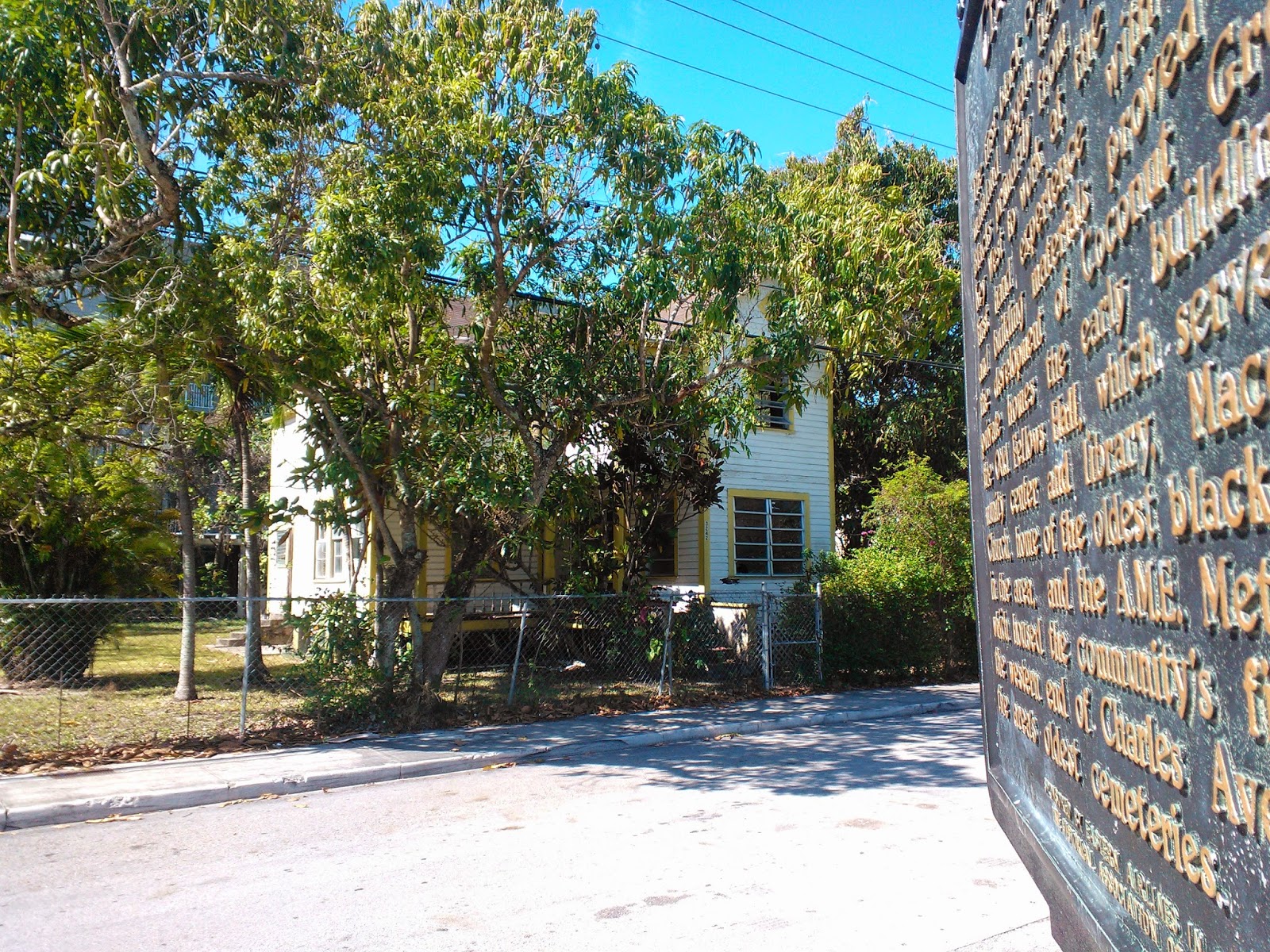 |
| The E.W.F. Stirrup House across the street from the marker. |
January 16, 2009 was also the day I first set eyes on the lovely E.W.F. Stirrup House, catercorner to the historical marker, on the south side of Charles. It was empty the first I spied it and it remains empty, as Aries Development allows it to undergo continued and deliberate Demolition by Neglect.
For the longest time nothing changed at the historical marker, either. It remained broken, leaning back against the fence. However, a few years back I noticed the sign had been straightened out. A short time later a small plant, which only recently started to justify its existence with beautiful red flowers, had been added between visits.
However, that’s all that has been done . . . until quite recently. Between my last visit and yesterday the Charles Avenue Historical Marker has been given an entire new base and pole about 2 feet east of the former location. The new pole is round steel and feels much more substantial than the previous flimsy aluminum one. The base also seems better and more deeply embedded in the ground, with concrete surrounding it. It’s also been set on a slightly different angle, giving it a greater prominence to on Charles Avenue.
IRONY ALERT: The biggest surprise of all is that no one seems to know who repaired the sign. I have now interviewed representatives of the Charles Avenue Historic Preservation Committee, the Coconut Grove Collaborative Development Corporation, and the Coconut Grove Village Council. So far it remains a mystery to everyone I’ve interviewed, as well as everyone they’ve spoken with.
Eventually we may solve the mystery of who fixed the Charles Avenue historical Marker.
 |
| April 21, 2014 panorama • Right: The refurbished Charles Avenue marker at the beginning of the historic roadway. Charles Avenue was laid out by E.W.F. Stirrup and ends at Douglas Road, the site of the Charlotte Jane Memorial Park Cemetery. This quaint cemetery is named after the childhood sweetheart and, later, wife of E.W.F. Stirrup. At one time it was the only cemetery where Black folk could be buried in the Miami area. Far left: The 5-storey Grove Gardens Residence Condominiums looming over the modest 2-storey house E.W.F. Stirrup built with his own hands for his family. The developers of The Monstrosity have been allowing the 120-year old E.W.F. Stirrup House to undergo Demolition by Neglect for more than 8 years. |
 |
| The Charles Avenue Historical Marker is across the street from the E.W.F. Stirrup House. Once called Evangelist Street, Charles is one of the oldest streets in Miami, which is why it was designated a Historic Roadway. |
Last week’s visit to Coconut Grove was full of surprises.
Ostensibly I was in The Grove for 2 semi-clandestine meetings with two of my super-duper secret anonymous sources. One wanted to go off the record on the Coconut Grove Playhouse deal. The other was my original tipster on Trolleygate.
However, there were also several loose ends I wanted to clean up concerning the Playhouse parking lots and the two vacant lots on Charles Avenue, immediately across the street from the historic, 120-year old E.W.F. Stirrup House. Despite its cultural and historic significance, the house continues to undergo Demolition By Neglect at the hands of a rapacious developer: Aries Development, controlled by Gino Falsetto.
To bring new readers up to speed: When Miami-Dade County finally carved out a deal which freed the Playhouse from purgatory, it took away the parking lot Paradise Parking, DoublePark and Caribbean Parking had been operating between the Playhouse and the Bicycle Shop. This lot was turned over to the Miami Parking Authority to administer. At the same time, the MPA also leased to Aries Development 45 parking spots immediately behind the Playhouse.
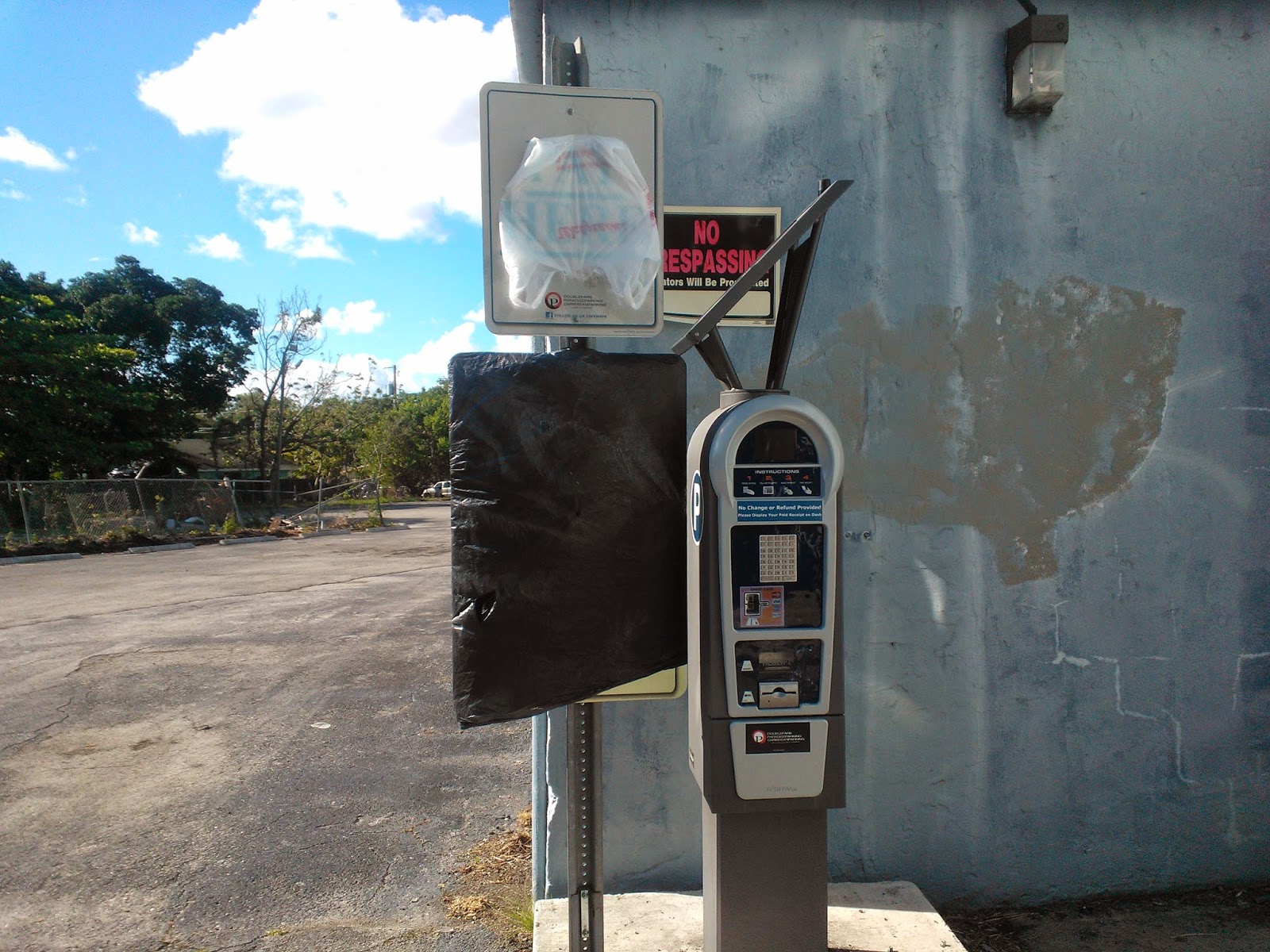 |
| March 25: A lawyer advised this was a crime in the making. Did these companies also squat on the Playhouse parking lot? |
This reporter has been investigating rumours that the Paradise parking group had been squatting on the parking lot land for the last several years. To date, no one has been able to produce a contract that gave
these companies the right to operate a parking franchise on the Playhouse
parking lot.
The last time I visited (March 25) Double Park, Paradise Parking and Caribbean Parking had erected a meter (pictured right) where they were leasing the 45 parking spaces from the MPA. They had no right to erect their own meter because it was not their own lot. It was looking as if they might be squatting again. The meter had not been activated and I needed to see whether they had started collecting potentially illegal parking fees.
Have I mentioned yet how Double Park, LLC is owned by Gino Falsetto, while the other 2 companies are owned by business associates of Falsetto?
A second, lesser, reason to reconnoiter is that — SURPRISE!!! — lines had finally been painted on this parking lot. The last time I was there I had counted the potential for 57 parking spots, judging from the barely legible lines painted years ago. Counting the spaces and documenting the fact that Paradise Parking, et al, were pocketing parking fees that should have belonged to the MPA would be a great investigative article. Another feather in the Not Now Silly Newscap.
 |
| March 25: Detail of sign above right |
I had already received a (FREE) legal opinion that squatting on a parking lot and collecting parking fees could be considered a case of theft against every driver who paid up and/or the actual owner of the property. If, as alleged, these three companies had been squatting on the Playhouse land for the past several years, that would be a lot of individual cases of theft. And, whether they squatted or not, these companies were able to rake a lot of parking fees off this parking lot over the last several years.
SURPRISE: The meter had been removed, leaving only the base. Now anyone who wants to park there has to walk a block to the nearest meter — on the far side of the Playhouse — which cannot be viewed from these parking spaces. We’ll see how that works out.
 |
| Looking past the empty residential lots to the E.W.F. Stirrup House, the 5-storey Grove Gardens Residential Condominiums dwarfing the 120-year old house. |
To be perfectly honest, I had hoped to catch Paradise Parking in what appeared to be a crime in the making because it’s a company owned by the same rapacious
developer who is allowing the E.W.F. Stirrup House to undergo Demolition by Neglect. That would be Gino Falsetto and Aries Development, which
built The Monstrosity behind the Stirrup House: the Grove Gardens
Residence Condominiums.
It was while I was counting the parking spaces — another SURPRISE: there are only 45, as per the agreement with the MPA — I looked back across the two empty lots to the E.W.F. Stirrup House. The simple 2-storey white and yellow house — designated historic — is completely dwarfed by The Monstrosity, built by the same rapacious developer who owns these 2 empty lots pictured above. There had been two little single family houses on these lots. Aries acquired the lots and knocked the houses down so the property could be used as a construction marshaling yard in order to build The Monstrosity.
Little by little Aries Development has been chipping away at this Historic Roadway. Aside from the 50-year lease on the Stirrup House, Aries now owns the Bicycle Shop, creating bookends on either side of any potential Coconut Grove Playhouse development.
As I continued taking pictures of Charles Avenue I walked from the vantage point shown above back to the E.W.F. Stirrup House, where I met a curious stranger.
THE BIGGEST SURPRISE OF ALL!!!
I was almost back at my car when I saw a woman walking across the Stirrup property towards me. The only people I’ve ever seen on that property were workmen. A red-headed, middle-aged woman in a dress was A SURPRISE, which is why I walked towards her. We met at the gate to the Stirrup property and had a heavily accented conversation after she demanded to know why I was taking pictures of her property.
 |
| Pictured: The scene of the conversation. I didn’t take her picture. |
Several times she asserted it was her property. I let the fib go because I know the history of the property better than my own family tree. It’s owned by Stirrup Properties, LLC, a company headed by 2 of the grandchildren of the original owner, E.W.F. Stirrup. A 50-year lease is held by Aries Development, which has been allowing this historic 120-year old house to undergo Demolition by Neglect. I’m pretty sure that this woman is not Aries Development Group.
Our conversation went something like this:
MF: [Accented English]: Why you take pictures?
ME: I’ve taken a lot of pictures of this building. I come here every few days and take pictures of this house. I have thousands of pictures of this house.
MF: Why you take so many pictures?
ME: I’m interested in the history of the house. It’s a famous house. This is the oldest house on the street. The second oldest house in Miami.
MF: I know. You work for newspaper?
ME: No. I have a blog.
MF: What’s your name?
ME: Headly Westerfield. [This elicited no reaction whatsoever.] What’s your name?
MF: Magda Falsetto.
ME: [Falsetto?!?! DING! DING! DING! My notebook has been in my hand all this time, so I start scribbling notes of the rest of our conversation.] M-A-G-D-A?
I was so surprised that it wasn’t until later that I realized I didn’t ask the obvious question: “Are you related to Gino Falsetto?” DOH!
MF: Yes. This is my property.
ME: So why don’t you fix up this house? This house has been empty for 8 years.
MF: Longer!
ME: Longer? Then why don’t you fix it up?
MF: It takes long time to get permits from city.
ME: You’ve had more than 8 years.
MF: It takes long time to get permits. Is problem at city.
 |
| April 4, 2014: La Bottega advertises. It has no permits to move the Farmers Market to the Stirrup Property. |
ME: Didn’t there used to be a wall there? Where did it go? [Indicates the back of the Stirrup property where a wall once separated it from La Bottega, a restaurant on the ground floor of The Monstrosity. La Bottega has started advertising the Farmer’s Market moving there beginning on the 27th of April.]
MF: We are making a garden to bring tables out here.
ME: On this property? From the restaurant?
MF: Yes. It will be beautiful garden.
ME: Don’t you think you should fix the house first? It’s an construction zone. The house looks terrible.
MF: It takes long time to get permits from city.
NO SURPRISE: She repeated this “long time to get permits from the city” sentiment about 7 times because I kept circling back to asking why the house wasn’t fixed already. One cannot get permits from the city if one has not submitted plans. The last time I checked no plans had ever been submitted to the city by Aries to renovate the E.W.F. Stirrup House.
TO BE FAIR: That was a whole 2 months ago, during the Great Tree Massacre of ’14.
Aries will need to submit up plans before it can be issued permits to renovate the E.W.F. Stirrup House. It will also have to apply for a retroactive permit for landscaping and destroying the trees on the Stirrup property. So far Aries has gotten away with having no permit for the destruction of the cinder block wall. Will it also try to get away with moving restaurant and bar seating onto the Stirrup property? Will it even try to obtain the proper permits to move the Farmer’s Market to the Stirrup property?
It’s not like Aries Development has even tried to be a good Coconut Grove neighbour, so why should it be trusted now?
IRONY ALERT: Gino Falsetto and Aries Development is on the Charles Avenue Historic Preservation Committee. More than a year ago I attended a meeting where Aries assured the Preservation Committee that it was going to fix up the Stirrup House right away. In that time Aries has only caused more destruction to the house and the property.
But, who knows? I might be surprised. Aries may finally do things legally.
Who am I kidding? I’ll have to keep an eye on them.
Why is E.W.F. Stirrup so important to Coconut Grove?
Read: Happy Birthday Coconut Grove!!!
Now Honour Your Past


