Category Archives: Unpacking

The 32nd Annual King Mango Strut

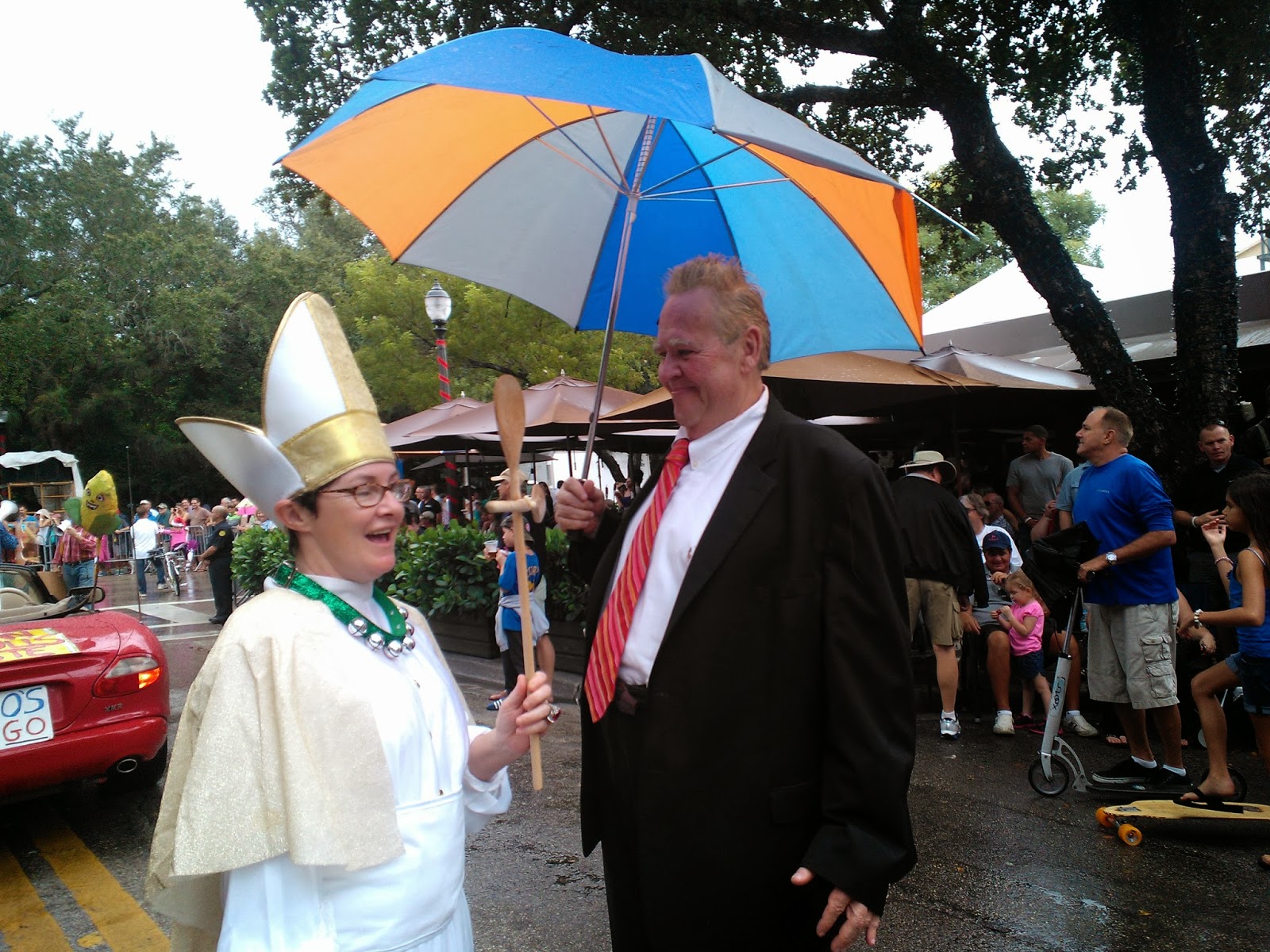
Fake Ford, Fake Francis

The IM came from a functionary of the King Mango Strut: “Can we go off the record?” 

This can be a trap for a journalist. Answer “Yes” and anything you’re told cannot be reported. Answer “No” and you may lose a good tip. What to do? What to do?

After thinking it over for 10 seconds — and remembering how an anonymous tip led to all my reporting on Trolleygate — I agreed to go “off the record.”

“The Rob Ford that will be Grand Marshall at tomorrow’s King Mango Strut is not the real Rob Ford. He’s a lookalike.”

Oh, great!!! I now have the Scoop of the Century and I can only report it if I can get 2 independent sources to go on the record. But why would I even want to?

The King Mango Strut is one of those Coconut Grove events I’ve made fun of in the past. I’ve compared the yearly Strut whoop dee doo negatively with the total lack of concern and awareness for the E.W.F. Stirrup House. However, the truth of the matter is, I have never attended one myself. I just made fun of it from a distance. This would be the year I would change all of that. I was determined to make fun of it close up.

However, before I ever made fun of the King Mango Strut in the past, I did look at hundreds of online pictures from various previous King Mango Struts. One of the things that struck me looking at all those pics is how many of the participants and observers are White. Like 98.4%.

Okay, I plead guilty to looking at everything in Coconut Grove as two societies divided by The Colour Line. The truth is that whenever I look at pictures of any Coconut Grove event, I tend to see a sea of White faces. Believe me, I obsessively look for the people who stand out, because so few do.

The E.W.F. Stirrup House is marked, with
Commodore Plaza where the blue dots stop

I hope you don’t get the impression that West Grove — Black Grove — is on the other side of town, or anything. The King Mango Strut marshals on Commodore Plaza, the next street over from Charles Avenue, just on the other side of The Colour Line. Commodore Plaza is White Coconut Grove. Just behind it is Black Coconut Grove. It’s a slow 3-minute saunter from the historic 120-year old E.W.F. Stirrup House, currently undergoing Demolition by Neglect, to the middle of Commodore Plaza.

The King Mango Strut also [in all those pics] had the faint whiff of alcohol on the breath. From the pics it just seemed like an excuse for a drunken party. Not that there’s anything wrong with that. The whole thing, in all the pics I viewed over the years, just seemed like one big goof. People didn’t take themselves, or the parade, very seriously.

In fact the whole thing started as a big Eff You to the Orange Bowl Parade years ago when King Orange put so many conditions on entering a float (No kazoos? That’s crazy!!!) that some intrepid Grovites pulled a Mickey Rooney-Judy Garland and started their own damned parade. Hence King Mango. King Orange got kicked to the curb in 2002, but King Mango lives on. The WikiWhackyWoo gets it:

The spirit of the King Mango Strut is significantly tongue-in-cheek. Participants are willing to poke fun at anything and everything. Most of the parade consists of satire of events that have happened in the last year, from world events to state to local. Nothing is off-limits, and the boundaries of good taste are often pushed or broken in the name of irreverent comedy. For example, co-founder Bill Dobson died from cancer in October 2004, but made an appearance in the 2004 Mango Strut, in the form of an urn, with ashes being strewn along the parade route. A group followed with brooms and vacuums followed, trying to “get Bill out of the road.” Organizers do have some humility, however; the ashes were not actually Bill’s remains but regular fireplace ash mixed with kitty litter. However, a sign rode along with Bill’s urn, proclaiming “Hey, I may be dead, but I can still vote in Miami.” Governor Rick Scott, Giant Snails, Global Warming and whatever is current are also “fodder for fun” skits.

When I heard early in the week that Rob Ford, the Crack Smoking Mayor of the town I call home, was going to be Grand Marshall of the 32nd Annual King Mango Strut, I had to see if I could score an interview and put Not Now Silly on the map.

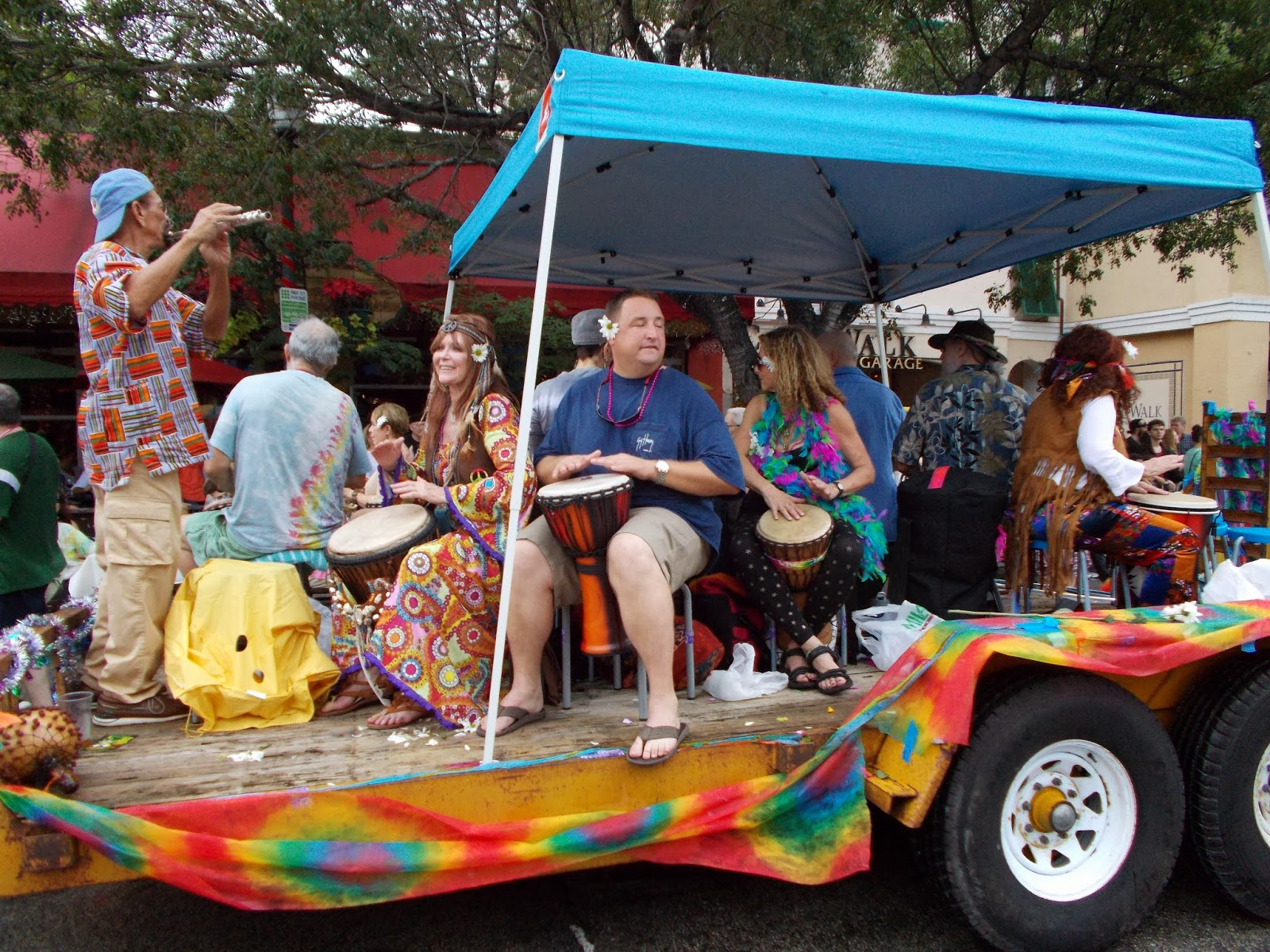
I decided my best bet for doing that would be to latch onto the Coconut Grove Drum Circle. A few weeks ago I mentioned to one of the CGDC organizers that a visit to the Grove coincided with one of their evening get-togethers and I would drop by when I was finished. However, best laid plans, and all that, and I had to skip it. Having now told the drum circle that I would be coming, I decided that it would be impolite to not show up again — just because the real Rob Ford decided not to go. Which is why bright and early Sunday I was driving the 35 miles to Coconut Grove.

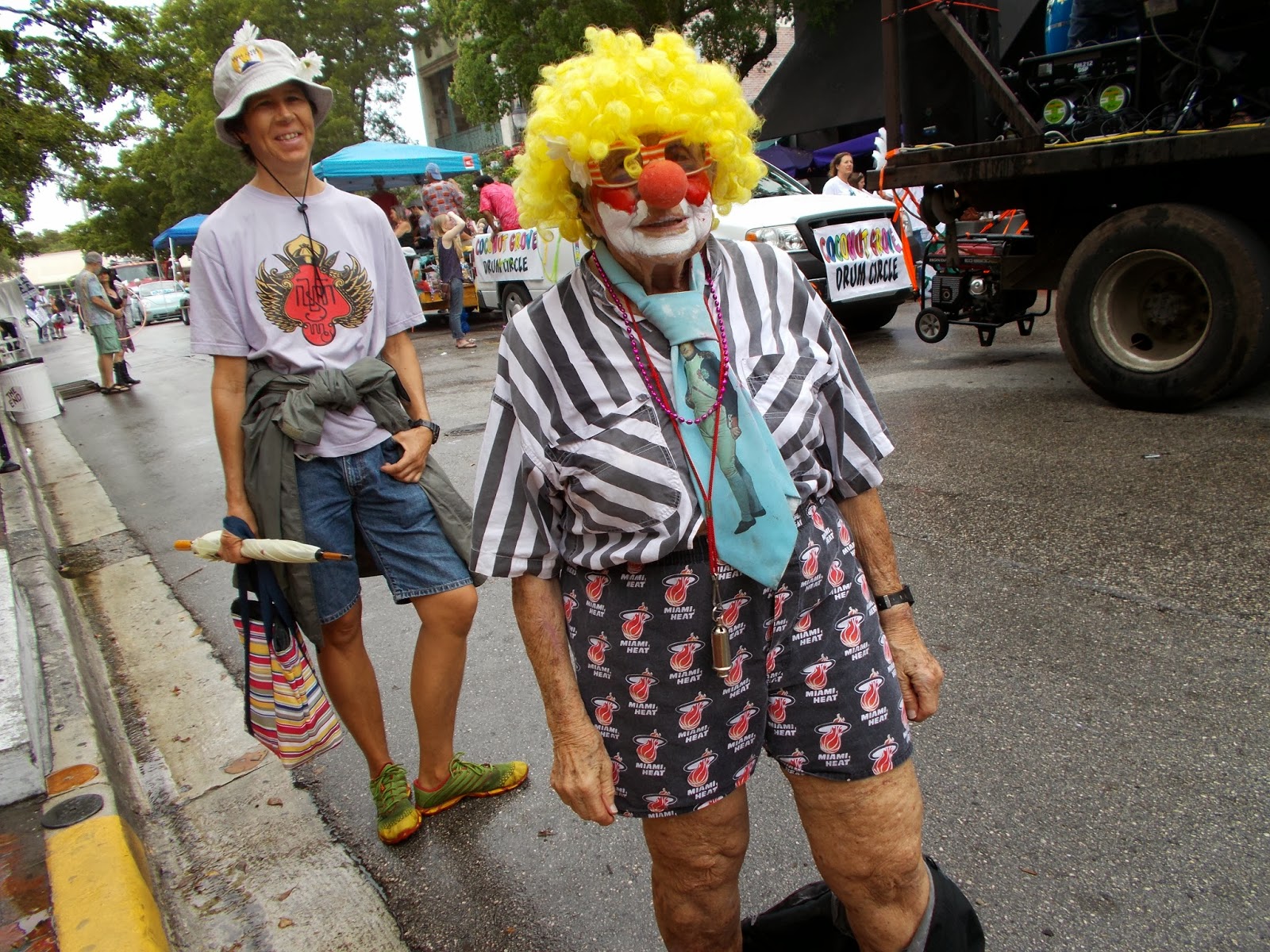
MEA CULPA: I misjudged the King Mango Strut entirely. While it’s still 98.4% White, or thereabouts, it’s not the crazy drunken bacchanal as the pictures made it appear. Oh, sure there was a lot of public drinking by both participants and observers, but I didn’t see anyone who was drunk. Except maybe for the fake Rob Ford. It’s hard to tell with that guy.

Something else that I didn’t quite get from all the pics I’ve viewed over the years is the overall vibe of the King Mango Strut, man.

While I’ve written considerably about the Bahamian history of Coconut Grove, I’ve barely touched upon the Bohemian history of Coconut Grove. As long as people have been coming to the Grove, it’s been known as an artists’ colony. From Bohemians to Hippies, The Grove has always had an alternative bent and The King Mango Strut is one of the last vestiges of that Hippie ethos that, I am told, once thrived in the small shops where Cocowalk now is and in Peacock Park. That part of the King Mango Strut actually spoke to me, since I am an unreconstructed Hippie at heart.

And, the drums!!! The incessant drums!!! The beating of the drums!!! 

The CGDC gave off more energy than any of the other floats, and it also
fed off the energy of the participants who got up to dance as they
passed. Experiencing the parade vicariously through the Coconut Grove Drum Circle took me back through the years to Kebo, the African name the original Bahamians gave to the neighbourhood — just the other side of The Colour Line, just the other side of the last century. It made me wonder how long the sound of drums have echoed through this area. The Coconut Grove Drum Circle is keeping a tradition alive that is as old as sticks and logs. All music starts with the rhythm.

A big THANK YOU to the Coconut Grove Drum Circle for allowing me to document up close their participation — from start to finish — in the 32nd King Mango Strut. There’s a much larger facebook gallery of pics here and a playlist of videos at my YouTubery channel.

And, clearly I didn’t insult anyone because the Coconut Grove Drum Circle has invited me back.

What’s Going On At The Taurus Bar?

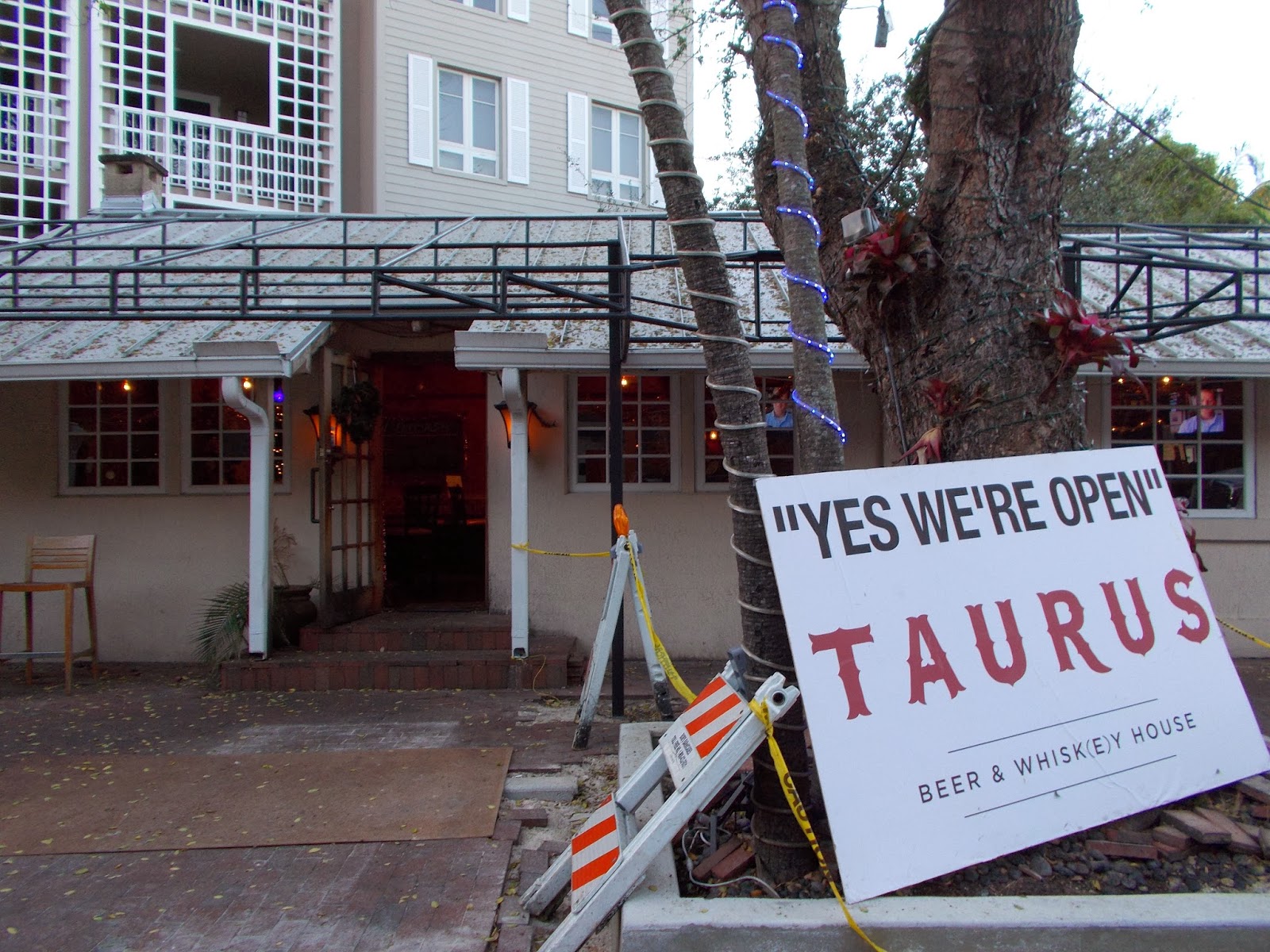
Framework for an awning is being installed on The Taurus Bar, December 19, 2013.
This work may or may not be non-conforming, may or may be contrary to previous
promises, and may or may not have been built without benefit of a building
permit. With the Grove Gardens Residence Condominiums in the background.

A recent visit to Coconut Grove to document The Bicycle Shop revealed work going on at The Taurus Bar, the venerable watering hole in front of the Grove Gardens Residence Condominiums. 

Based on my previous investigations of [allegedly] illegal work going on inside the E.W.F. Stirrup House, it’s fair to ask the following questions: *


1) Does this work conform to all Miami and Miami-Dade bylaws?
2). Does this work conform with whatever promises were made to preserve The Taurus when the GGRC was built?
3). Does the owner have a building permit for the work?

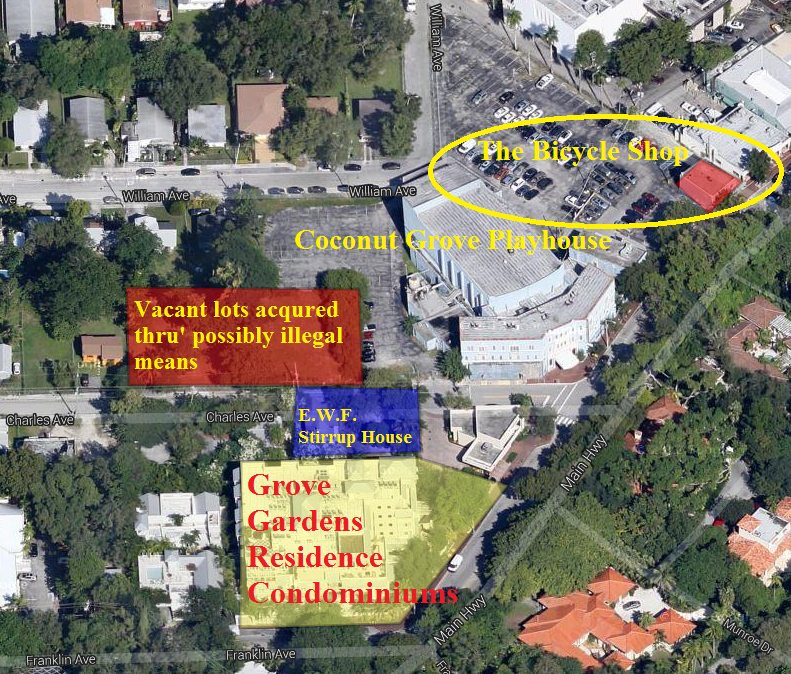
I’ve written about The Taurus briefly, and only tangentially, during my research of Coconut Grove. It’s owned by an arm of Aries Development, builder of the GGRC, the monstrosity that dwarfs the little one-room building and the 2-story E.W.F. Stirrup House. Aries also owns the two other restaurants on the ground floor of the mixed use condo complex. Aries, in case you haven’t been following along chapter by chapter, also owns the two lots on the north side of Charles Avenue immediately behind the Coconut Grove Playhouse. Furthermore, Aries is about to get title to The Bicycle Shop — extremely valuable Main Highway frontage — in exchange for reliquishing all claims against the Playhouse for a previous loan.

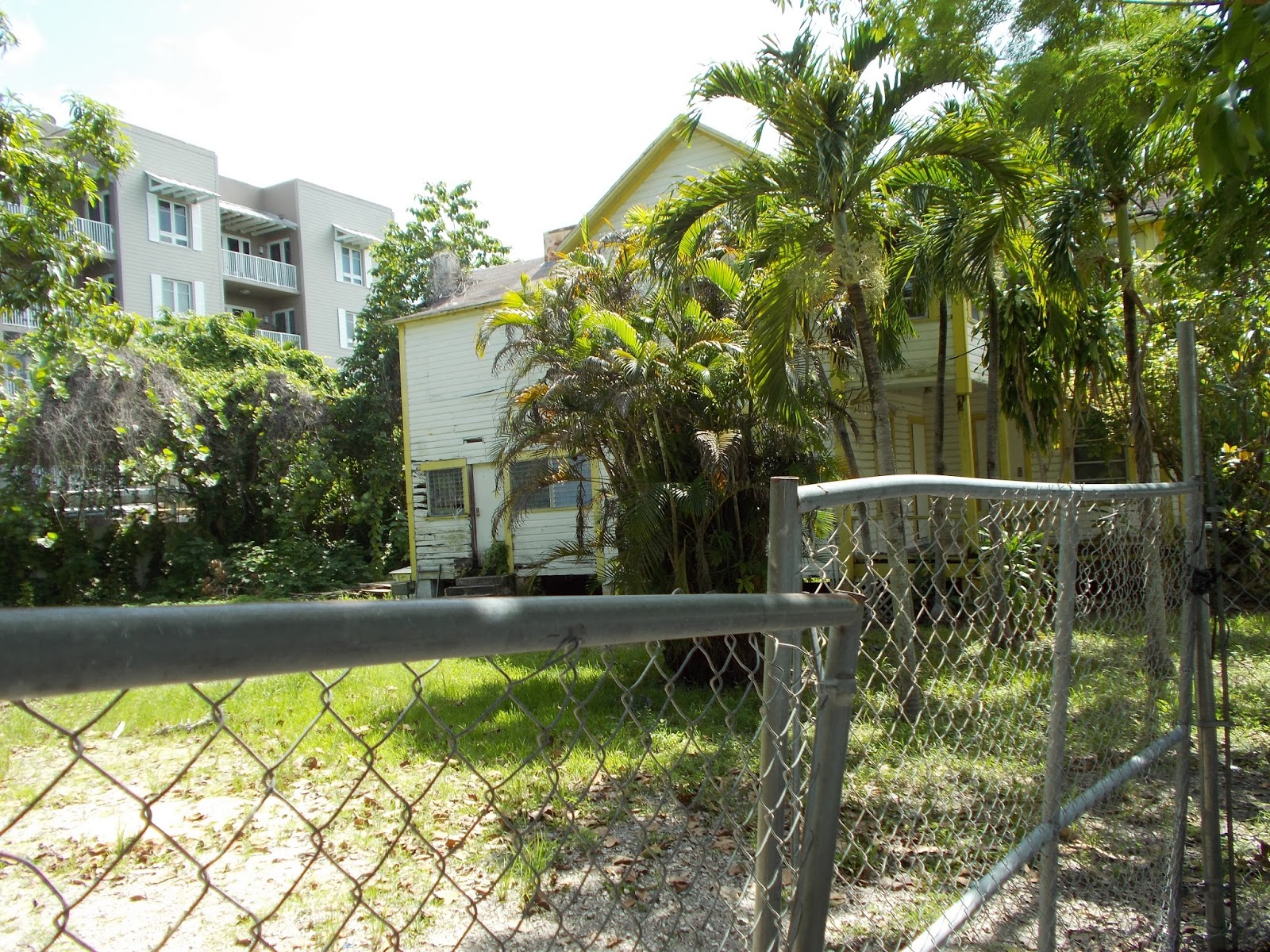
The historic 120-year old E.W.F. Stirrup House — a 2-story modified Conch-
style house — dwarfed by the 5-story Grove Gardens Residence Condominiums

Far more important, at least as far as I am concerned, is that Aries also finagled a 50-year lease on the E.W.F. Stirrup House and has been allowing it to undergo Demolition by Neglect during the 8 years it has had control of the 120-year old cultural treasure. The Stirrup House is now believed to be the 2nd oldest house in Miami, after the Barnacle, Commodore Monroe’s house, which is now a Historical State Park and less than a tenth of a mile away. 

Charles Avenue has been designated an Historical Roadway and the E.W.F. Stirrup House has also been designated historical by the City of Miami. However, the practical effect seems to be no practical effect.on Gino Falsetto, the primary owner of Aries Development. His stewardship of this historical landmark has been nothing less than shameful.

Related: Why saving the Stirrup House saves important Black History?
Please read:Unpacking Coconut Grove ► Part Two ► E.W.F. Stirrup House

Preserving the Taurus Bar was among the promises Aries Development made in order to get its permits to build the Grove Gardens Residence Condominiums. So was preserving and renovating the E.W.F. Stirrup House. It’s interesting to compare and contrast the treatment of the Taurus vs. the fate of the E.W.F. Stirrup House. 

The Taurus goes back, at the very least, to 1906, when it was a tea room for the High Society of Coconut Grove. Over the years it went from being a tea house to a neighbourhood bar. It attracted those within walking distance, but another one of the attractions, especially for the old-timers, was — as downtown Coconut Grove became overly developed — there was a free parking at the Taurus Bar in the years just before the GGRC was built. [Drinking and driving? Never mind.]

The E.W.F. Stirrup House goes back to the 1890s. I’ve written so much about the Stirrup House, I won’t go into its history here, other than its recent history. Ownership of the house remains in the hands of the Stirrup Family, as dictated by the will left behind when E.W.F. died in 1957. Aries obtained a 50-year lease on the house through a complicated property swap that’s detailed elsewhere at Not Now Silly.

While Gino Falsetto (through Aries, of course) promised to preserve and renovate both the Taurus and the Stirrup House, only the Taurus was fixed up. It’s been open almost the entire time. During a period that coincides almost perfectly with the Taurus being open, the E.W.F. Stirrup House has been empty, undergoing Demolition by Neglect, as mold, mildew and termites work away at the house.

I was told the reason no work ever progressed on the Stirrup House was because Aries ran out of money. However, The Taurus has been generating money for Aries and Aries had enough money to loan the defunct Playhouse board some of it. But, isn’t it strange Gino Falsetto never found the money to fulfill its OBLIGATION to restore the E.W.F. Stirrup House. And now it’s spending MORE money to put an awning on the Taurus before it fulfills its promises on the Stirrup House.

The Taurus Bar on December 19, 2013
TO BE FAIR: The Taurus could use an awning. Any place that hopes to have a viable outdoor patio, which The Taurus hopes to, in South Florida needs an awning. Fans and mist-ers are also a good idea. However, can you just throw an awning on any old building? What about a building more than 100 years old? What about a building more than 100 years old that you’ve promised to preserve?

And, while I’m asking questions, where’s the building permit? I looked inside and out, but saw no building permit. Does this awning affect pedestrian traffic? Was a study done of pedestrian traffic? Does the awning encroach on the public easeway for the sidewalk? How is Main Highway impacted by this awning. Is this an [alleged] infraction against Miami by-laws, Miami-Dade by-laws, or both?

Based on the past performance of Gino Falsetto these are all fair questions to ask. By sheer coincidence these happen to be the same questions I’ll be asking city and county officials in the next few days.

* The work is probably finished by now in advance of The King Mango Strut with Grand Marshall Rob Ford.

The Bicycle Shop The Latest In The Cultural Plunder of Coconut Grove

The Coconut Grove Playhouse before the hoarding was fixed

Recent news trickling out of Miami-Dade County has exposed more backroom machinations concerning the Coconut Grove Playhouse and — appearing for the very first time in any of the negotiations — The Bicycle Shop. 

Before getting too deeply into the weeds, this news proves that once again the ultimate stakeholders — the citizens of Coconut Grove and taxpayers of Miami — were played for dupes. All decisions concerning the Playhouse’s future have already been set in stone, without any public input whatsoever. Furthermore, not all those decisions have been made public yet, such as the ultimate design. 

There was a time I was ambivalent about the Coconut Grove Playhouse. I vaguely understood it to be mired in scandal and controversy. However, my cursory research showed that it was one of those things that served White Coconut Grove and I was researching the unique history of Black Coconut Grove. I was already committed to saving the historic, 120-year old E.W.F. Stirrup House; I didn’t have time for another Coconut Grove boondoggle.

My Trolleygate series proved why I need to follow all anonymous tips to see where they ultimately lead. It’s all interconnected in ways I could never have imagined when I started this research 5 years ago. The Stirrup House is catercorner to the rear of the Playhouse, just across the
street from the Charles Avenue historical marker. Oddly enough it’s been empty and undergoing Demolition by Neglect just about as long as the Playhouse has been shuttered. However, proximity and similar fates were not all that connected the two properties. I have since found two important links between Ebeneezer Woodbury Franklin Stirrup and the Coconut Grove Playhouse that finally placed it on my radar screen.

The Charles Avenue historical marker with the E.W.F. Stirrup House

The first goes all the way back to the 1920s and, to understand it, a small history lesson is in order. At that time E.W.F. Stirrup was one of the unlikeliest Movers and Shakers of a nascent Coconut Grove tourist industry. Ebeneezer Woodbury Franklin Stirrup was a Black man who, through hard work and a good business sense, became one of the Grove’s largest landowners and one of Florida’s first Black millionaires. His own house on Charles Avenue, which looked out over his holdings, was a 2-story showpiece, in a 1 story Conch house neighbourhood.

Together, with the other Movers & Shakers of the Grove, Stirrup must have anticipated reaping a financial windfall when, in the early 1920s, they commissioned The Bright Plan, the first urban renewal plan ever devised for Coconut Grove. Had the Bright Plan been implemented, Coconut Grove would have become the jewel of South Florida. A long boulevard with fountains down the middle would have led to an ornately appointed Coconut Grove City Hall, located approximately where Cocowalk is nowadays. All the designs of the buildings and fountains were based on a Mediterranean style. The Charles, Franklin, and Williams Avenue corridor would have become a golf course and the neighbourhood now known as West Grove would have been lost.

On the planning maps “Coloredtown,” would have been pushed to “the other side of the tracks,” just like in every other city in ‘Merka. That it didn’t happen is one of the things that makes Coconut Grove unique in this country. While Coconut Grove had its own Colour Line circling the traditional Black neighbourhood, it did not include railroad tracks.

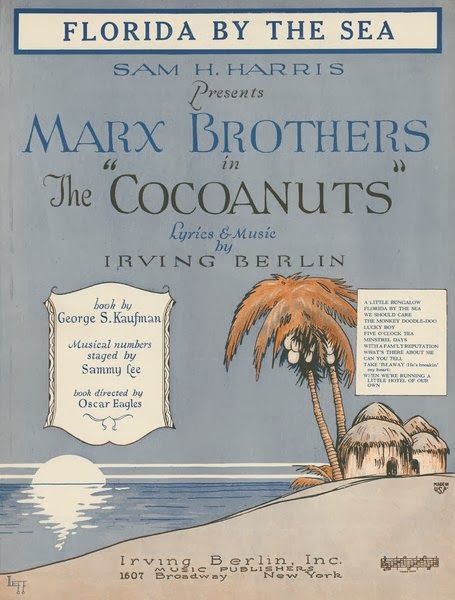
However, it was not to be. Before the Bright Plan could be implemented, the Florida land boom went bust. By 1925 the words “Florida real estate” had became a national joke, so much so that George S. Kaufman’s Broadway musical-comedy The Cocoanuts revolved around swampland, tourism, and Irving Berlin tunes. Starring the Marx Brothers, it was set in Cocoanut Grove [note the “a,” the original spelling before amalgamation] and was a huge hit. The 1929 movie of the same name, with the same Marx Brothers, further cemented the town’s reputation.

A page from The Bright Plan shows the grand boulevard from Biscayne
Bay to a Coconut Grove City Hall. The odd shape in the upper-left is
where Coloredtown would have moved had this plan been implemented.

After the Bright Plan fell apart (younger) Miami annexed (older) Coconut Grove, including all of West Grove, or Coloredtown, or Black Grove, or Kebo, the African name given by the original Bahamian residents.

And, that almost didn’t happen either. Some White folk — among them some of those same Movers and Shakers that didn’t get rewarded financially when the Bright Plan died — lobbied against including West Grove in the boundaries of the new Miami.

It was fairly common in this country, as towns expanded and new areas
annexed, to exclude any of the small Black enclaves that had developed here and
there. The mere presence of Black folk could depress property values (and still does, for that matter). Whenever possible annexation occurred around these small Black enclaves until they were eventually swallowed up by the city.

That’s because — no matter where you go and no matter the era — the Movers and Shakers are, essentially, the monied and propertied of a given area. What Movers and Shakers generally want is to acquire more money and property, in order to become bigger Movers and Shakers. The Coconut Grove Movers and Shakers were no different. It was thought not having a Black area would make the new Miami more attractive for development, rewarding those who held property in Coconut Grove.

When Miami decided to annex West Grove along with the rest of Coconut Grove, a smaller group of those Movers and Shakers were already building their own lily White city of Coral Gables, just next door to Coconut Grove. The ugly historical fact is that the creation of Coral Gables was White Flight; a reaction to the Kebo neighbourhood of Bahamians, who could not be dislodged because the land was Black-owned, all due to the hard work of E.W.F.
Stirrup.

A White city could more easily control the movements of Black folk and their presence in Coral Gables was severely restricted. Right into the ’70s (according to anecdotal reports from a 73-year old who has lived in the same house on Charles Avenue his entire life), one needed ‘papers’ to be Black in Coral Gables. This usually amounted to a letter from your employer. However, if you couldn’t produce one, you’d be arrested for vagrancy and everyone in West Grove knew it.

To this day Coral Gables is 98% White. That doesn’t happen by accident.

Statue of George Merrick,
founder of Coral Gables,
outside Coral Gables
City Hall

Related reading:

No Skin In The Game is a
series looking into some of
the disparities between
Coconut Grove and Coral
Gables, Florida

Part One looks at a protest
against Trolleygate aimed
by the citizens of Coconut
Grove to land at a debate
for mayor of Coral Gables
in order to bring awareness
to the controversy.

Part Two is a continuation
of the evening in which our
intrepid reporter daydreams
about the founding of
Coral Gables.

Part Three is all about the
exception that proves the
rule; how Coral Gables
allowed a Black conclave
within its boundaries to
house its service workers.

Which brings us to the Coconut Grove Playhouse. 

In the mid-’20s, while George Merrick was building his lily White Coral Gables and Miami was annexing Black and White Coconut Grove, one item from the Bright Plan finally got built. E.W.F. Stirrup sold a large parcel of land on the northeast corner of Main Highway and Charles Avenue on which a developer could build the Coconut Grove Theater, now the Coconut Grove Playhouse, in the same Mediterranean style dictated in the Bright Plan.

There’s one other thing that links the E.W.F. Stirrup House to the Playhouse and that’s Gino Falsetto. Falsetto is the rapacious developer who arrived in the hot Florida real estate market after walking away from a string of bankrupt restaurants in the Ottawa, Ontario, Canada, area.

It’s an open question whether Falsetto became a Miami Real Estate Mover and Shaker on the backs of the Canadian taxpayers, his vendors, and the employees from his restaurants. All lost money — estimated to be more than $1,000,000 all told — when the Canadian government seized the physical assets of the eateries. Falsetto walked away, allowing the companies to go bankrupt. How much money did Falsetto pocket? The answer to that may never be known. What is known is that bankruptcy appears to be a tactic of Falsetto’s, which has served him well so far, as you will see.

Seemingly from Falsetto’s first arrival in the over-heated Miami real estate market, his various companies have been tangled up in one lawsuit after another. However, for unexplained reasons, he seems to keep falling up. Eventually he (Aries Development) acquired property at Main Highway and Franklin Avenue, large enough to propose building the Grove Gardens Residence Condominiums. During the permitting process there were three major objections from neighbourhood groups, all of which Aries promised to satisfy:

► The rich White folk on the east side of Main Highway — in Camp Biscayne, one of the oldest gated communities in south Florida — didn’t want to lose their spectacular sunsets for which they paid several million dollars for. They wanted the height of the condo building scalled back. Done. The multi-use condo complex was limited to 5 stories and stepped back as it rose, so it didn’t present a huge facade to Main Highway;

► The White drinkers at the venerable Taurus Bar were upset that they might lose their drinking hole, one of the only bars in Coconut Grove with free parking. TO BE FAIR: The Taurus dates back to AT LEAST 1906, when it was a tea room. Regardless, the developer heard the protests. Done! The Taurus is still there (although a possibly non-conforming awning was being built when this reporter visited on December 17th);

The lay of the land:

Gino Falsetto has sewn up a number of properties along Main Highway and Charles
Avenue. Now, to release his claim to the Coconut Grove Playhouse, he is being
given ownership of the Bicycle Shop, with valuable frontage on Main Highway

► The Black residents of West Grove were concerned that the development would threaten the 120-year old E.W.F. Stirrup House.

In order to obtain its building permit Aries made certain promises and representations to preserve and restore the E.W.F. Stirrup House, either as a community museum and resource center, or a Bed and Breakfast. Anecdotal memories differ and, sadly, no one seems to be able to produce the actual meeting minutes in which the condo project was approved.

No matter what the promise MAY have been, it has been broken. Since getting his grubby little hands on it almost 9 years ago, Gino Falsetto has neglected the Stirrup House, except for some [allegedly] illegal interior demolition and destruction. This precious community resource, believed to be the 2nd oldest house in Miami, has been allowed to undergo Demolition by Neglect. Aries Development has proven to be a terrible steward of this historic 120-year old house, like no other in the neighbourhood.

IT GETS WORSE: In the same deal in which Falsetto acquired the lease on the Stirrup House, he also scooped up two double-size lots on the north side of Charles, across from the Stirrup House. However, there appears to be some subsequent irregularity — some say illegality — with those two properties.

Falsetto traded two units within the Grove Gardens Residence Condominiums — the monstrosity he built behind the Stirrup House — for outright ownership of the two lots assessed at $87,615 and the 50-year lease on the Stirrup House. Heinz Dinter tells the next part of the story:

Gino Falsetto finds himself a real estate appraiser who dares to value the two lots heavy with weed and grass at $1,000,000. With the appraisal in hand Falsetto finds a daring banker who loans Gino Falsetto $700,000 — all so legal in accordance to the 70% loan to equity ratio. What a coup!

That’s not the end of the dramatic plot. Gino Falsetto defaults on the loan, the bank forecloses with a $720,546.28 judgment in hand and none other than Pierre Heafey’s Heagrand Inc buys the land in the foreclosure sale for $200,100. [Editors note: Pierre Heafey and Gino Falsetto are partners in other companies.]

The curtain rises on the last act. Falsetto forms a new company, 3227 Charles LLC, and that new company buys the two lots from Heafey for $215,800.

The bottom line must be called a stunning performance: Gino Falsetto gives up two condominiums worth $419,050 and in return is the sole owner of two vacant lots assessed at $87,615, but possibly worth many times more depending on the neighborhood’s future, and some half a million dollars in cold cash in his pockets compliments of the American taxpayer (the bank loan was insured by FANNIE MAE).

The Bicycle Shop is the latest, and possibly last, piece in the Coconut Grove
Playhouse puzzle. In the latest deal — struck in the backrooms between the big
boys — Gino Falsetto’s Aries Development gets ownership of this property (and
a nominal $15,000) to relinquish all claims to the Coconut Grove Playhouse.

Got that? Foreclosure auctions are supposed to be at arm’s length. How is it that a company owned by Gino Falsetto managed to get its hands back on the same property after a company owned by Gino Falsetto defaulted on the original loan?

I’m not a lawyer, but that can’t be legal.

During the same period that Falsetto was scooping up valuable and culturally important Coconut Grove real estate through dubious means, he (through Aries) also loaned the defunct board of the defunct Coconut Grove Playhouse some defunct money. Holding a financial lien on the Playhouse, Aries has scuttled deal after deal for those who were trying to renovate and reopen the Playhouse. That is, until recently.

Which brings us full circle: When the news leaked that there may FINALLY be a deal to renovate the Playhouse, people were stunnded to discover it involved giving the Bicycle Shop to Aries Development. This small building at the northeast end of the Playhouse parking lot — which really was a bicycle shop a long time ago — and the nominal amount of $15,000 will be given to Aries Development to satisfy all claim on the Playhouse.

Currently the alley immediately to the north of of the Bicycle Shop [at right above] is the end of the demilitarized zone in Coconut Grove. Casual pedestrians tend not to walk any further south, unless they are walking on the OTHER side of Main Highway. The newly opened restaurant Acropolis, on the other side of that alley, is as far south as people tend to walk. Those who arrive at the restaurants on the ground floor of the Grove Gardens Residence Condominiums — just a block south — tend to arrive by car.

The Bicycle Shop is piece of Main Highway frontage that will be a goldmine once the Playhouse reopens. It will have a Playhouse on one side, restaurants on the other, with The Barnacle Historic State Park and some of the most expensive houses in all of Florida in heavily gated communities right across the street.

It’s an insult to the memory of E.W.F. Stirrup that Gino Falsetto and Aries Development will be rewarded for their avariciousness and Demolition by Neglect of the E.W.F Stirrup House. 

Before Miami-Dade gives away a piece of property worth potentially millions of dollars over the long run, why doesn’t the county see to it that Aries fulfill the promises it has already made to the people of Coconut Grove and taxpayers of Miami?

Where The Sidewalk Ends, Racism Begins *

Where the sidewalk ends. If you’re Black, you might want to stop right here.

Some day you simply must take a stroll southbound on the west side of South Douglas Road in Coconut Grove, Florida. Walk from Grand Avenue past Washington and Thomas Avenues and the Frances S. Tucker Elementary School

On your left Thomas Avenue jogs and Charles Avenue [on which the E.W.F. Stirrup House anchors the other end of the street, near Main Highway] ends; although Charles has an odd little western dogleg that can’t be seen from SW 37th Ave, aka Douglas. Crossing Charles Terrace, a street that only runs two blocks west and not at all east, you can’t help note the serene, stark beauty of the Charlotte Jane Memorial Park Cemetery on your left. While distracted you almost walk into a wooden fence as the sidewalk abruptly ends.

The wooden fence hides a cinder block wall that runs from this point west for two long blocks. The wall was built for one reason and one reason alone: to keep Black Coconut Grove out of White Coconut Grove. The sidewalk ends for one reason. Racism begins.

This wall represents the historic COLOUR LINE that divided the Black backyards on Charles Terrace from the White backyards along Kumquat Avenue. To heighten the sense of segregation, none of the streets along Charles Terrace were allowed to link to Kumquat Avenue or any of the White streets to the south or west.

The Coconut Grove Wall of Shame™ is not unlike the wall in my home town of Detroit known alternatively as The 8 Mile Wall, The Wailing Wall, or the Birwood Wall. A search on the Googalizer for the 8 Mile Wall turns up references, history, as well as tons of images. However, one has to go digging to find any images or references to the Coconut Grove Wall, the history of which is being buried like much of the history of West Grove.


A CAPSULE HISTORY OF THE 8 MILE WALL: Back in the ’40s the Wyoming-8 Mile neighbourhood was mostly farmland; while the city’s northern border was already established at 8 Mile, it hadn’t been developed yet. However, there was already a Black enclave in the area from earlier times. During The War Years Detroit was experiencing a war time boom and housing was desperately needed. Meanwhile, a developer wanted to build in the Wyoming-8 Mile area was having trouble getting Federal Housing Authority loans for the new tract due to the perceived undesirability of the adjacent Black. The developer struck a deal: It would build a 6-foot wall to separate the Whites from the Blacks. The Black folk could have their side of the wall and would be redlined out of the other side of the wall, and a lot of the rest of Detroit, for that matter.

Related: The Detroit Riots

Pic from Racial, Regional Divide Still Haunt Detroit’s
Progress
, an excellent All Things Considered on NPR

The main reason you will find thousands of pictures of the 8 Mile Wall is because parts of it have been reclaimed and decorated with gayly painted scenes of iconic Black historic moments.

The 8 Mile Wall no longer divides Black from White; White Flight has seen to that. Both sides of that wall are now predominately Black in a city that is now almost entirely Black, except for all the new carpetbagging hipsters gentrifying huge swaths of Motown. But, that’s another story for another day.

The Coconut Grove Wall of Shame is of a slightly later vintage. The following comes from a much longer article — about the much longer COLOUR LINE that has West Coconut Grove hemmed in TO THIS VERY DAY. There are two distinct sides to The Wall, as Miami New Times writer Kirk Nielsen called it 15 years ago, when he asked and answered the musical question, “How can you tell where white Coconut Grove ends and black Coconut Grove begins? Just look for the barbed wire.”

In 1946 the Miami Housing Authority approved construction of a 25-acre tract of small single-family homes for low-income blacks on Charles Terrace, west of Douglas Road. By the time the houses were completed in 1949, workers had also erected a concrete block wall along the southern boundary of the new development. As reported by the Miami Herald (and cited by Marvin Dunn in his new book Black Miami in the Twentieth Century), the city planning board required the wall in order to provide “suitable protection” for the white neighborhood. A Florida Supreme Court ruling three years earlier had rendered illegal Dade County’s segregation of black residential districts. But that didn’t stop the city from putting the wall up.

Brown and weathered, the concrete block barrier still runs a quarter-mile, from Douglas Road west to the Carver Middle School parking lot. Six feet tall, higher in some places, it divides the leafy back yards of Kumquat Avenue on one side from the tree-starved lots of Charles Terrace on the other.

Lou-vern Fisher, who moved to Miami with her parents in 1936 from Georgia, bought one of the single-family homes next to the wall with her husband back in 1950. She still lives there, with a daughter, granddaughter, and grandson. “We enjoyin’ the wall,” says the jolly 73-year-old retired maid. “They put it here for a reason. And you know the reason. To keep us from going over there,” she wags a finger, letting off a loud gravelly ha-ha-ha.

Another section of the Coconut Grove Wall of Shame™ along Charles Terrace

However, get this: When the same wall became inconvenient for the White folk of Coconut Grove, a small section of it was torn down:

While Father Gibson’s petitioning [in the ’50s and ’60s] failed to inspire city commissioners to topple the wall, the fears of white parents proved far more effective. In 1970, the year Carver Middle School (then Junior High) was racially integrated, the western end of the wall was demolished, allowing a one-lane road to be paved from Kumquat Avenue to the school. White parents had demanded that southern access to drop their kids off because they considered the other route, down Grand Avenue in the black Grove, unsafe.

This isn’t unlike how (at around the same time, in fact) the polluting incinerator nicknamed Old Smoky was only closed when [White] Coral Gables — the town that racism built — started to complain, despite years of complaints from West Grove residents. As I like to tell my followers on Twitter and facebook, “History is complicated.” Racial history even more so. I will will be documenting the Coconut Grove Colour Line more fully as time goes on, but thanks for reading the first inn an ongoing series.

That doesn’t mean we can’t Rock Out while waiting for the next exciting episode. Listen to a speech by Ambalavaner Sivanandan set to music by Asian Dub Foundation.

Crank it up!!!

* With apologies to Shel Silverstein

Unpacking The Writer ► Continued

Aunty Em!!! Aunty Em!!!

If you are a new reader, welcome to my irregular blog series in which I pull back the curtain like The Wizard of Oz — AUNTY EM!!! AUNTY EM!!! — and reveal some of the inner-workings of the Not Now Silly blog. If you are not new, then you already know this is just an excuse to beg my readers to click on some of the adverts on this blog. Those people are already happily clicking away. It’s because they enjoy my writing and know the return I get from clicks doesn’t even cover the maintenance fees I pay each month to keep Not Now Silly going, but it sure helps. So, click ’til it hurts. Then click one more time.

There’s a lot of Not Now Silly news to report this go-round, so let’s get right to it.

First off, there’s my new continuing series Headlines Du Jour, launched late last month. I created the series for 3 reasons: 

A Headline Du Jour from the Wayback Machine

1). Often the links I post on social media (the facebookery or Twitter) today, I see scattered all over the innertubes tomorrow and the next day. It so often seems like I ferret out these stories long before the rest of the twiterati. Headlines Du Jour is where my faithful readers can find the news before it’s news to them;

2). The other reason I launched Headlines Du Jour is because I actually dreamed about it several nights in a row, right down to the name. Since I never had a Not Now Silly dream before — or since, for that matter — I decided to listen to my subconscious for a change of pace;

3). Every time I type “Today’s Headlines Du Jour,” I laugh at the redundancy. 

Unfortunately, when I dreamed about Headlines Du Jour I didn’t dream the format, or how it should look. Consequently, I’m still tinkering with Headlines Du Jour and trying to find the right balance between serious and funny, smart and snarky, hard news and news you can use. If you have any suggestions, feel free to send them in over the transom.

Since my last Unpacking The Writer post, I’ve also launched another new irregular feature here at the Steam-Powered Word-0-Matic. Ablow Job is where I put Dr. Keith Ablow, the Fox “News” Channel’s pop psychiatrist, on the couch. My long-time readers might remember when I used to delve into Glenn Beck’s Freudian impulses under my nom de blog of Aunty Em at NewsHounds. This will be similar, ‘cept this time it’s Glenn Beck’s writing partner, Dr. Keith Ablow. Initial reaction has been strong, but you can help spread the word by sharing the hilarity with your friends and family.

UPDATE ON TROLLEYGATE: I’ve been writing about Trolleygate since the end of January — long before any of the local mainstream media covered it. Right from the start I called it a classic case of institutional racism. Early this month my reporting was vindicated by no less than the United States Department of Transportation, which declared Trolleygate in violation of the Civil Rights Act of 1964, specifically Title VI. Not Now Silly also broke the story of The Smoking Gun Email days before any other newspaper. However, only here will you learn about its significance and why it points to corruption within the City of Miami. So, yeah, I’m blowing my own horn: Racism was at the core of Trolleygate and [allegedly] corrupt Miami Commissioner Marc D. Sarnoff may have had a backroom deal with the developers to get it approved. Anonymous tipsters continue to send me avenues of inquiry to follow. Eventually one of these Sarnoff rumours will pan out, or lead to pay dirt — both expressions coming from the Gold Rush.

I’ve saved the best news for last!!!

The cover of Farce au Pain, by Keg — © 2013, Headly Westerfield

I know you have every reason to doubt me, because I’ve made this promise before, but I am mere days away from the serialization of Farce au Pain. I’ve been working on it for quite a while and, I am happy to report, the launch is now imminent.

While most of the delay has been totally avoidable (I work so much more diligently when I have hard deadlines), there has been one unavoidable road block. My tattooed, coffee-stained lawyer (with the grudge) has been pouring over every word of Farce au Pain, the exact same way Grayhammy pours over every word I post. Then we spent a lot of time exchanging emails to get the wording of certain passages exact. I argued some points and won. He argued some points and won. On some, we just compromised.

To be perfectly honest, I’d love to defend Farce au Pain in a court of law. While it would prove to be a laugh riot, I have much better things to do with my time. That’s why I am using weasel-words, just like I’ve accused Johnny Dollar of using. Consequently, some of my sentences are not quite as declarative as they appear on first read. I learned that from the best. “I’m just asking questions.”

That’s why I’m thrilled to announce that things are back on track for the serialization of Farce au Pain, my longest and lengthiest on-going project. A friend recently asked why I would serialize my book. Because I like comparing myself to Charles Dickens whenever I get the chance.

Oh, and if you’ve made it down this far and haven’t clicked on an advert, you’re stealing. Either click, or don’t come back. 

Trolleygate Violates 1964 Civil Rights Act ► Not Now Silly Vindicated

The non-conforming government operated vehicle maintenance
facility appeared virtually finished on a October 16, 2013 visit

Ever since I first began writing about Trolleygate, I have called it an obvious case of Racial Discrimination. Now it appears the United States Department of Transportation, writing the latest jokes in this comedy of errors, agrees with me. All brought to the good people of Miami and Coral Gables by [allegedly] corrupt Commissioner Marc D. Sarnoff.

Legal troubles over the non-conforming, polluting, government operated vehicle maintenance facility have grow exponentially since the residents of West Grove were first made aware of the project and launched a David vs Goliath legal challenge against the cities of Miami and Coral Gables, not to mention the powerful Astor Development, a company with deep pockets. Had the residents not had a legal team willing to work Pro Bono, they would have never been able to afford to take on this legal battle.

Unfortunately when the residents’ lawsuit came up for a hearing the judge, while sympathetic to the residents’ arguments, ruled not to rule, saying he had no jurisdiction. The residents’ legal team vowed to continue to fight the non-conforming, polluting, government operated vehicle maintenance facility and began to prepare an appeal.

And, it’s a good thing that legal battle continued. Intrepid tree-shaking by the West Grove legal team discovered two very important documents, the first of which is the Smoking Gun email. This internal email was from Dakota Hendon (City of Miami Building and Zoning Department) to Francisco Garcia (City of Miami Planning Director). It stated in unequivocal language that the non-conforming, polluting, government operated vehicle maintenance facility did NOT comply with the Miami 21 Plan, which specifically ruled out things called “government operated vehicle maintenance facilities.”

Rather than say “NO” to a multi-million dollar developer, there was some obvious — if not obviously illegal — jiggery-pokery performed by someone [still to be determined] within the City of Miami government. This person ordered the developer to re-write and re-submit the proposal, but this time leave out the word “maintenance.” The developer did so and the building permit was issued under this second application, even though the only thing that had changed was the wording, not the building’s intent.

However, the West Grove legal team shook out something far more important during its research. It turns out that City of Miami officials had been sitting on a report for years that said the soil at Armbrister Field contained high levels of toxins from Old Smokey, the not-so-affectionate name for the incinerator that belched out carcinogens for nearly 100 years — before it was closed down in 1970. That discovery led to soil testing at all the parks in Miami and, GUESS WHAT?!?! It turns out that toxic ash from this incinerator was used as fill all over Miami, including many of its parks. Expensive remedial action will need to be taken while the parks are closed, ironically including the Marc D. Sarnoff Memorial Dog Park.

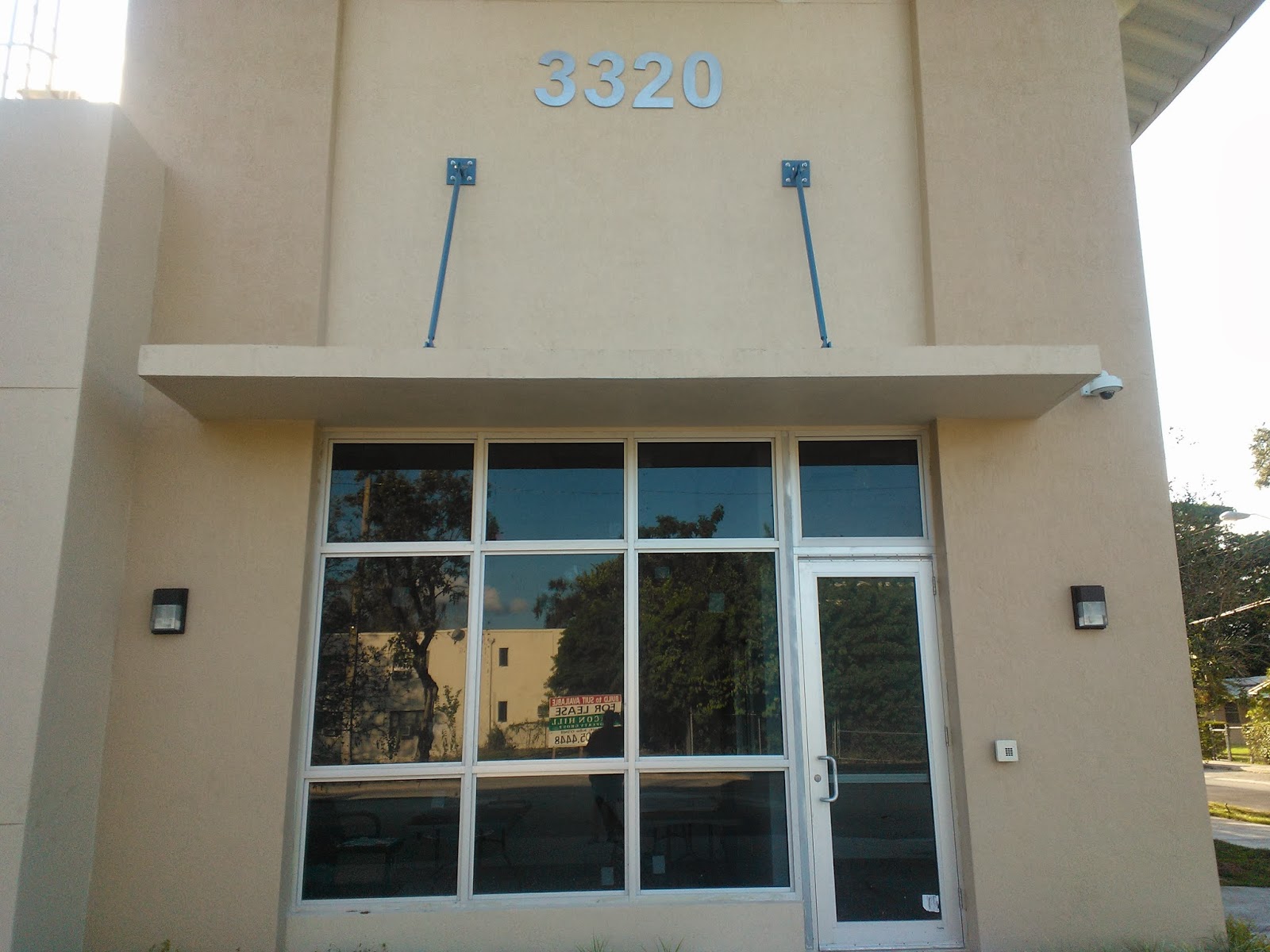
The White Elephant at 3320 South Douglas Road from another angle

NB: Don’t get distracted. Soilgate is merely a side issue to this three-ring circus.

Soon after the West Grove residents had their case tossed out of court, the City of Coral Gablesthe city that Racism builtfiled its own lawsuit against Astor Development and the City of Miami. The suit alleges, essentially, that it was duped. Coral Gables was to accept transfer of a ‘clean’ government operated vehicle maintenance facility that Astor Trolley, LLC, built in exchange for land on which Astor Development, LLC wants to make gazillions of dollars by building a massive mixed-use development. However, Coral Gables is now concerned that the non-conforming, polluting, government operated vehicle maintenance facility is encumbered in lawsuits and wants a judge to either sever the contract it has with Astor or, in the alternative, rule that the non-conforming, polluting, government operated vehicle maintenance facility actually conforms to the Miami 21 Plan, despite the fact that it doesn’t, smoking gun emails notwithstanding.

Which brings us full-circle to the [alleged] Civil Rights violations. According to a Department of Transportation investigation into Trolleygate instigated by a neighbour’s complaint, the cities of Miami and Coral Gables [allegedly] violated the Civil Rights of the West Grove residents by not ensuring the project complied with the Civil Rights Act of 1964, specifically Title VI. The 13 page letter and memorandum from the Federal Transit Administration reads in part [PDF]:

As you know, Title VI of the Civil Rights Act of 1964 (Title VI) provides that “No person in the United States shall, on the ground of race, color, or national origin, be excluded from participation in, be denied benefits of, or be subjected to discrimination under any program or activity receiving Federal financial assistance.” U.S. Department of Transportation (DOT) regulations require that public transportation services be provided in a nondiscriminatory manner. To implement this requirement, DOT regulations and the Federal Transit Administration’s Title VI guidance require that entitles receiving Federal assistance, when determining the site or location of public transportation facilities, may not make site selections with the purpose or effect of excluding persons from, denying them the benefits of, or subjecting them to discrimination with respect to, public transportation services on the grounds of race, color, or national origin.

To ensure compliance with FTA’s Title VI regulatory requirements, entities receiving Federal assistance must conduct a Title VI equity analysis for all public transportation facility siting decisions. This analysis will generally include outreach to persons potentially impacted by the siting of the respective facility, and consideration of the equity impacts of various siting alternatives. When a potentially discriminatory impact is found, the transit agency must revise its plans in order to avoid or mitigate the discriminatory impact. If, upon taking mitigating actions and reanalyzing the proposed site selection, the transit agency determines that minority communities will continue to bear a disparate impact of the proposed site selection, the transit agency may implement the site selection only [emphasis in original] if the agency has a substantial legitimate justification for the site selection and can show that there are no alternatives that would have a less disparate impact on the minority community.

The entrance and maintenance bays for the fake trolley buses as
viewed from Frow, a quiet residential street, on October 16th

Cutting through the verbiage: Because both the cities of Coral Gables and Miami accept Federal Dollars to run the free fake trolley buses, they both need to comply with the Civil Rights Act of 1964, Title VI. When Astor Development decided to build this in a predominately minority neighbourhood without consultation, it [allegedly] violated the Civil Rights of the struggling neighbourhood. Furthermore, when Coral Gables refused to give the residents of West Coconut Grove a Fake Trolley Stop, it [allegedly] violated their Civil Rights.

However, the comedy doesn’t end there. The first paragraph quoted above starts out “As you know…” It turns out that both Miami and Coral Gables claim that they didn’t know and have never considered Title VI of the Civil Rights Act. Oh! Stop!! My!!! Sides!!!! According to Jenny Staletovich of the Miami Herald:

An investigation by the U.S. Department of Transportation, triggered by a neighbor’s complaint, found the county failed to ensure the cities followed the law. The cities, in turn, violated the law by not conducting a study during the garage’s “planning stages” to ensure that race did not play a part in determining where it was built or whether the garage would have an “adverse impact” on the West Grove neighborhood, which has long struggled to attract business.

The two municipalities, which say they were unaware of the requirements, also failed to perform public outreach as required by the law, the investigation found.

[…] University of Miami law professor Anthony Alfieri, whose Center for Ethics & Public Service has helped residents fight the garage, said the ruling calls into question whether the governments violated the law in other projects where federal transportation money was used.

“This letter and memorandum raise a significant question about whether the county and these two municipalities have ever been in compliance with Title VI, because apparently they’re not aware of the objectives and have no program in effect,” he said. “Title VI is one of the main provisions of the Civil Rights Act of 1964, so this statute is 49 years old. People marched and died because of this.”

If this were really a situation comedy, this would be where the plot complications begin. Miami and Coral Gables have now committed to conducting the FTA study that should have happened long before the building permit was ever issued; just like the Trolleygate Dog and Pony Show was only mounted by [allegedly] corrupt Commissioner Marc D. Sarnoff after the residents of West Grove discovered he had worked behind their backs to grease the wheels to get this white elephant approved. That’s our sitcom character Sarnoff: Always putting the cart before the horse. Hilarity ensues.

Still not laughing? Maybe the latest finger-pointing from Astor Development will get a chuckle or two out of you. According to the same Miami Herald article:

Astor, however, believes the city should have made sure the Civil Rights Act was followed.

“The city of Coral Gables recently learned that they were subject to the rules and regulations of the FTA, of which the city manager and the city attorney were not aware of in the past,” Astor spokesman Tad Schwartz said.

“Their compliance with the FTA program was not disclosed in any way with our agreement. This wasn’t in our contract.”

Here’s where the comedy ends because: TAXPAYERS’ MONEY!!! Every dollar spent on this project so far has been a monumental waste. When [allegedly] corrupt Commissioner Marc D. Sarnoff decided to help Astor Development push this project through Miami City Hall, it had the reverse-Midas effect: Everything touched by this project has turned to manure. Astor Development purchased the land and threw up the structure. Astor, Miami and Coral Gables have all hired legal teams for the various lawsuits past, present, and future. This is throwing good money after bad and, except for Astor’s money, the taxpayers are on the hook for it all.

ROLL CREDITS: This comedy of errors has been brought to you by [allegedly] corrupt Miami Commissioner Marc D. Sarnoff, the anti-Midas, who decided a developer’s desire to build once again trumped the interests of his own constituents.

Some More Coconut Grove(s) History

Cocoanut Grove is a 1938 movie, made well
after Coconut Grove lost the “A” in its name

I’ve been collecting historic pictures of Coconut Grove as long as I’ve been researching and taking pictures of the E.W.F. Stirrup House. For the past several years whenever I stumbled over a new old picture of Coconut Grove on the innertubes, I save it to my hard drive. I have built up a pretty fair collection, but I am always looking for more. 

Direct searches for pictures, or articles, on historic Coconut Grove, Florida can be an exercise in frustration. All searches are complicated by how many things have been named Coconut/Cocoanut Grove over the years, how often the generic term “coconut grove” has appeared in print over the years, and how often things have been misspelled on the internet over the years.

The candy bar is not the village

There’s the candy bar, of course, but that’s just the beginning. High up on any Googalizer list is the famous Cocoanut Grove nightclub in the Ambassador Hotel in Los Angeles. During Hollywood’s heyday the nightclub drew celebrities and Hollywood royalty to witness shows that featured performers such as Frank Sinatra, Judy Garland, Bing Crosby, Nat King Cole, Dorothy Dandridge, Benny Goodman, and Sammy Davis, Jr., just to name a few. Long before the Oscars were ever televised, six Academy Award ceremonies were held at the Cocoanut Grove nightclub. Incidentally, Robert Kennedy gave his last speech at the Ambassador Hotel and was gunned down in the kitchen on his way out of the hotel. The kitchen, the Cocoanut Grove nightclub, and the Ambassador Hotel no longer exist, but they live on on the internet.

The Cocoanut Grove nightclub in the Ambassador
Hotel during happier and kitchier times:

Another Cocoanut Grove nightclub was built as a roof garden atop the Century Theatre by impresario Florenz Ziegfeld — who had taken over the struggling theater built a mile north of the actual Theater District — with partner and Broadway producer Charles Dilligham. Even this couldn’t save the building, which also suffered from poor acoustics, and it was knocked down to build the Art Deco Century Apartments in 1931.

The aftermath of the horrific Cocoanut Grove fire in Boston, 1942

While there’s a Cocoanut Grove ballroom and conference center on the Santa Cruz Beach Boardwalk, the most famous Cocoanut Grove nightclub was the site of the deadliest nightclub fire in history. On that night in 1942, 492 people were killed, and hundreds injured,as a fire tore through the Boston nightclub during Thanksgiving celebrations. From the WikiWhackyWoo:

As is common in panic situations, many patrons attempted to exit through the main entrance, the same way they had entered. The building’s main entrance was a single revolving door, rendered useless as the panicked crowd scrambled for safety. Bodies piled up behind both sides of the revolving door, jamming it to the extent that firefighters had to dismantle it to enter. Later, after fire laws had tightened, it would become illegal to have only one revolving door as a main entrance without being flanked by outward opening doors with panic bar openers attached, or have the revolving doors set up so that the doors could fold against themselves in emergency situations.

A lot of laws were changed in the wake of the Cocoanut Grove fire and whenever there’s another fire in a nightclub, newspapers have to make reference to the tragedy in Boston. It’s in their contract.

At least on Google video searches I’ll always stumble across one of my favourite Marx Brothers movies. While the first Marx Brothers release, “The Cocoanuts” took place in Cocoanut Grove, Florida, it was filmed in Astoria, Queens between performances of their smash hit musical Animal Crackers. It was based on the earlier Broadway hit, The Cocoanuts, something that also crops up in many Google searches; which always find Gus Arheim and His Cocoanut Grove Orchestra; Judy Garland’s opening night at Cocoanut Grove; Mercury at the Cocoanut Grove; not to mention Phil Harris and His Cocoanut Grove Orchestra. Adding to the confusion is an episode of The First 48, called Gangs of Little Havana/Execution in Coconut Grove, which pops up; as does an episode of Sell This House, when Cesar and Lisa Verde tried to unload their Coconut Grove house. Both get posted on the YouTubery occasionally, but are always removed by a copyright take-down order.

Liverpool had a nightclub called Coconut Grove; as does Sacramento; as did Dundee, Scotland; and Buffalo, New York; while a cartoon I’ve never been able to find is called The Coo-Coo Nut Grove, and spoofs the famous Hollywood nightclub; a suburb of Darwin, in the Northern Territories of Austrailia, is called Coconut Grove; not to mention a song I have yet to hear, written for the Fred McMurray movie Cocoanut Grove [poster above] by Harry Owen, of Harry Owen and his Royal Hawaiians, who also wrote one of my favourite tunes, “Sweet Leilani.” [A long time ago I created a Spotify playlist with about 100 versions of Sweet Leilani.]

Which brings us full circle. Harry Owen was able to write music for and appear in a Fred McMurray movie was because Hawaiian Music was a hot a craze in “Merka at one time. From there the interest went World Wide and now there are many several whole bucketfuls of stuff named Coconut Grove all around the world, from carpet cleaners to hole-in-the-wall diners to motels. Sometimes they make the news. Sometimes my Google ‘As It Happens’ Alerts go haywire for nothing to do with the Coconut Grove I’m monitoring. F’rinstance, remember that recent crazy FloriDuh story, that broke national, because the two convicts escaped using forged release papers, like recently when those two escaped convicts were nabbed at the Coconut Grove Motor Court.

If you think all of that makes a search for Coconut Grove complicated, I have been adding my own to the Googleopolis. All my Not Now Silly posts on Coconut Grove rank fairly high on the Googalizer now andI have to weed through those now to find anyting worthwhile.

ANd, Because I have been trying to become more multi-media savvy here at Not Now Silly, for the last week I have been learning how to use a movie making program. When I realized I had all the makings for a pretty little montage, I created my latest entry to the Google Coconut Grove search engine confusion.

Play this movie full screen for the best effect

If I still have your attention, here are a couple of other montages I’ve put together:


As always, comments welcome.

No Safe Harbour In Coconut Grove

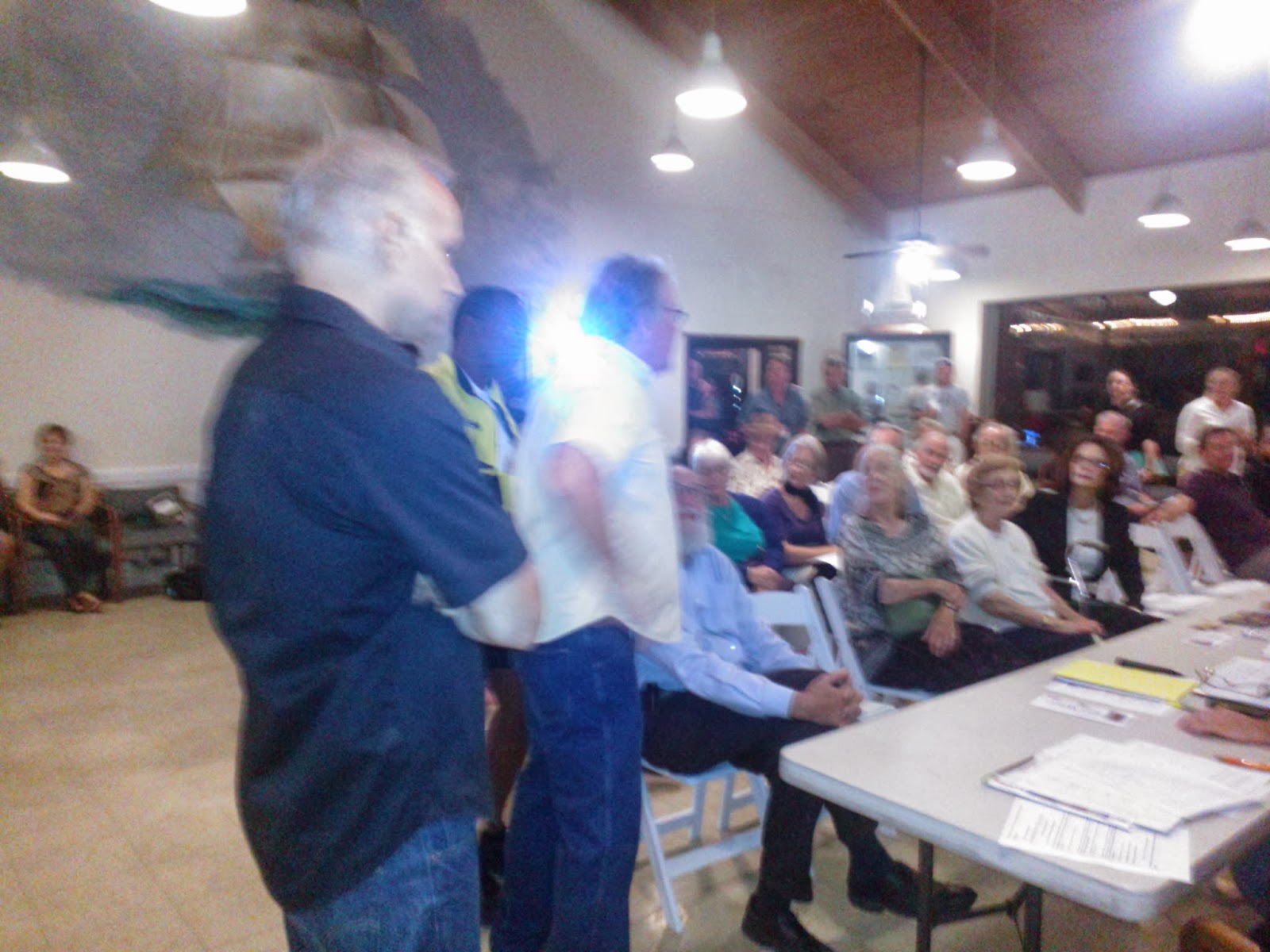
The exact moment the meeting exploded into chaos. Note
the police officer about to lead the angry gentleman away.

Last night I traveled down to Coconut Grove to attend a meeting of the Center Grove Homeowners Association. Fireworks were expected and I wanted to capture it as it happened. 

The reason for the potential fireworks was simple: many of the folks of Center Grove are vehemently against a proposed new development on the waterfront called Grove Harbour. [I like that it’s spelled the way I would spell it.] Both Miami Mayor Tomás Regalado and [allegedly] corrupt Commissioner Marc D. Sarnoff were on the agenda to sell their vision of the waterfront development and why this project is good for the community.

The exact moment the meeting exploded into chaos? When it was learned that both men skipped the meeting and Sarnoff sent his Chief of Staff, Ron Nelson, instead. That’s when all the yelling and screaming started. A police officer had to escort one man who wanted answers out of the meeting. That’s when most people left and the meeting devolved to wondering whether the meeting could be rescheduled so that [allegedly] corrupt Commissioner Sarnoff and Mayor Regalado could address their own constituents, just like it said on the agenda.

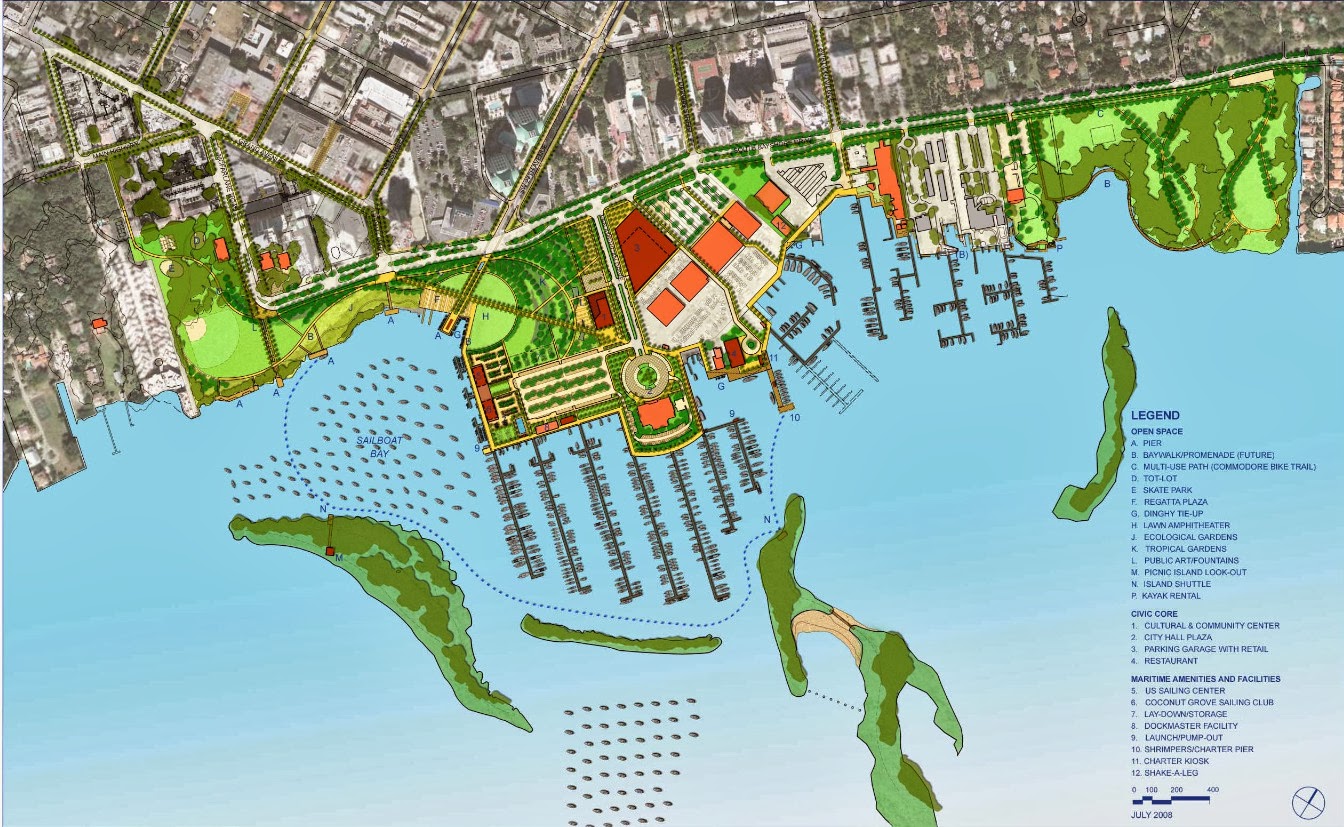
Proposed Grove Harbour development

That’s when I left as well, to go back to the footprint of what will become Grove Harbour to take another look see.

Back in August I wrote about Grove Harbour and how one of my faithful readers had urged me to get involved and come out against this latest Coconut Grove controversy. In that post, in which I stated I wasn’t going to involve myself in this controversy I made this point, to quote myself:

I’m philosophically against any development on any waterfront anywhere in the world: It blocks access to the waterfront, no matter how small the waterfront or the development. I am reminded of Frank Lloyd Wright who loved to build on hills, but said you should never build on top of a hill because you lose the hill. Same thing in my opinion.

One of 5 former airplane hangers in the footprint of Grove Harbour

However, I’ve been reconsidering my decision not to get involved in this controversy. The impetus for reversing my stand not to get involved was a brief exchange I had with Coconut Grove Village Councilor Michelle Niemeyer, who is backing the project. Neimeyer is someone for whom I have a great amount of respect. That’s what first got me thinking, “If she’s for it, how bad can it be? What am I missing?” However, I also realized that she’s a sailor and, because of that, she may have a conflict of interest on a project that includes amenities for the Coconut Grove boating crowd.

However, I had a crazy thought. I contacted Michelle and asked her whether she would show me around and walk me through the footprint of what will become Grove Harbour. She was happy to do it. To that end we met early Monday evening, appropriately at Scotty’s Landing, which is not only Ground Zero for the Grove Harbour development, but also Ground Zero for the entire controversy; because Grovites wanted to save the venerated crappy restaurant with the crappy food that everyone complained about before it appeared they would lose it. That’s when the “Save Scotty’s” campaign started.

SPOILER ALERT: I am now, conditionally, in favour of the project.

What I said above still stands. Philosophically I believe the waterfront belongs to the people and, whenever possible, waterfront should be grass and park as far as the eye can see. However, I also listed 12 edicts I would make if I were to suddenly become Emperor of Coconut Grove. The first of which said:

1). Raze every building on the east side of South Bayshore Drive from McFarlane through David T. Kennedy Park, except those few that have historic designation.

Dinner Key back in the day, with the Pan AM terminal in
the foreground and airplane hangers in the background.

And, therein lies one of the rubs of any proposed development along the Coconut Grove waterfront. Back in the day when Dinner Key was the location for the Pan American Airlines Clipper Ship flights, the company built the building that now houses Miami City Hall, as well as 5 massive airplane hangers. After Pan Am moved off Dinner Key, the airplane hangers were converted into marine use, a function they’ve served ever since.

Approximately 15 years ago then Commissioner J.L. Plummer used a pocket item (something placed on the agenda at the last minute) at a commission meeting to push for a mixed-use highrise development for Dinner Key. A group of Grovites were aghast at the idea of a massive development on Dinner Key. Springing into action they had the 5 airplane hangers registered on the index of National Historic Buildings. What this means is that these 5 former-airplane hangers will be there until Coconut Grove freezes over. Those buildings are represented on the site plan (above) by the orange rectangles. The 6th orange rectangle is the current Miami City Hall.

[Additionally, removing them would be a monumental job. While they are just large, hollow, aluminum buildings — with little to recommend them architecturally-speaking — the concrete pad on which the hangers were build are 8 feet thick.]

A list of just some of the public meetings asking for input from the community

This is just one of the many interesting facts I learned as Michelle Niemeyer and I spent the next few hours discussing the Grove Harbour development and walking the entire perimeter, as well as all through it. My first surprise was that Neimeyer was part of the team that sought public input and, as Chair, helped pilot this unwieldy ship of a project through the shoals of citizen involvement to come up with a master plan that was agreeable to as many of the citizens as possible. To that end there it took approximately 40 public meetings to come up with the Coconut Grove Waterfront Master Plan. [PDF] This Master Plan was the blueprint for the public bidding process to develop the waterfront.

Where were the people during the public input process who are now protesting vociferously against this project? Every one of them could have had their say at the public meetings that were not only publicized, but stretched over a period of several years. It seems a little late now that the boat left the berth.

Follow THIS LINK for a full series of PDF files
on the Master Plan and winning and losing bids

However, the citizens of Miami will have one more kick at the can: A November referendum puts the final project on the ballot. If the citizens of the small hamlet of Coconut Grove can convince enough Miamians to vote against this project, it’s dead in the water. However, I don’t believe they have a hope in hell of derailing this project, to mix metaphors. Coconut Grove is a miniscule part of Miami proper. It will be like sailing into the wind to get enough people to vote against this project.

When I was finished with Niemeyer’s walking tour I had a much better understanding of the issues involved. I also was able to decide for myself about the plan for Grove Harbour. It’s my opinion that what is being proposed for the waterfront is 1000% better than what is currently there. Here are some of my reasons for coming to that conclusion:

► It’s not as if they are taking pristine land and turning it into a huge development. The entire area is already developed. Grove Harbour simply makes it far more people friendly.

► Many people are disturbed by the proposed parking garage, which will be located as close to South Bayshore Drive as possible. However, the parking garage eliminates acres of hardscape, which are currently used as parking lots, next to parking lots, which are beside parking lots. Almost all of that reclaimed area will become grass and parkland.

The Chart House Bunker from the water

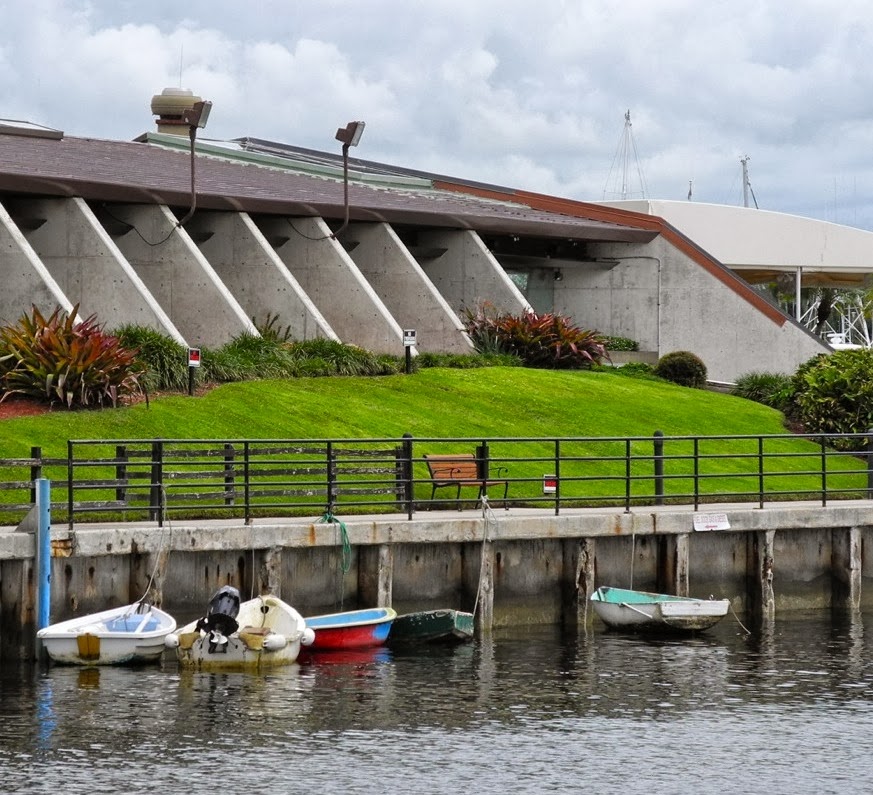
► Anything that gets rid of The Chart House can only be considered a good thing. This is easily one of the ugliest buildings I’ve ever seen, masquerading as a fine dining restaurant. People call it “The Bunker” and that’s not an inaccurate description. While it might look nice on the inside and have great views of Biscayne Bay, from the outside it’s a monstrosity that never should have been built. At the bay side walkway there is an 8 foot berm that’s totally inappropriate for the waterfront. To be fair: While I say good riddance, Curbed Miami has a differing view and believes it’s a wonderful example of organic architecture. I don’t see organic. I see something that sticks out like a sore thumb.

► New laws that went into effect after Scotty’s Landing and The Chart House were built now requite a minimum of 50 feet as a public easement along the waterfront for pedestrians. Currently both of these restaurants are virtually on the edge of the water. The Grove Harbour plan will make the pedestrian walkway much more of a boardwalk, without the boards.

One of several boat racks in the current footprint of the proposed development

► The proposed plan creates much safer pedestrian walkways that bisect Grove Harbour and cross perpendicularly. Currently families with children and strollers are forced to walk through one of the boatyards to get from the parking lot to the waterfront. This is where boats are being shunted in and out of the water by giant forklifts and a terrible accident is always a possibility there.

►The Grove Harbour plan creates a seamless walkway from Peacock Park all the way to Kennedy Park, with plenty of amenities for families, boaters, joggers, and cyclists alike.

Having said all that, there are a few things I do not like about Grove Harbour. My biggest concern is the building itself:

Looking west through Grove Harbour, showing one of the pedestrian walkways bisecting the development

The parking garage viewed from South Bayshore Drive, showing retail on the ground floor

Call me crazy, but I think a development on the water should somehow reflect the sense of place. I’ve seen buildings on waterfronts that, at first glance, seem to be
large sailboats. It’s only on the second glance that you realize it’s a
building. I don’t see this glass and chrome building as saying anything about Biscayne Bay. It’s a building that could be dropped anywhere else in Magic City and not seem out of place. Here it does, to my eyes. The only accommodation made to the site is the floor to ceiling glass walls, through which visitors will have unimpeded views of Biscayne Bay.

I am told the choice of materials used for Grove Harbour was meant to reflect the aluminum construction of the former-airplane hangers. Again, I don’t see it. The airplane hangers have a funky feel, while the renderings of Grove Harbour remind me of glitzy Vegas.

Another concern I have is about the retail space in the project. There are already empty storefronts in Center Grove, just blocks away. Could the Grove Harbour retail harm struggling businesses in Coconut Grove? It’s possible, but only time will tell. Originally the RFP was supposed to call for marine-related retail, but an editing error appears to have left it out, which leaves it open to any retail. However, a previous marine retail outlet failed in one of the hangers, so maybe that error is not such a bad thing. One of the retail outlets that seems the most welcome is a convenience store. Currently those who live on their boats in the harbour have a huge hike just to get a gallon of milk. This will alleviate them having to get in a car just to get a bottle of pop.

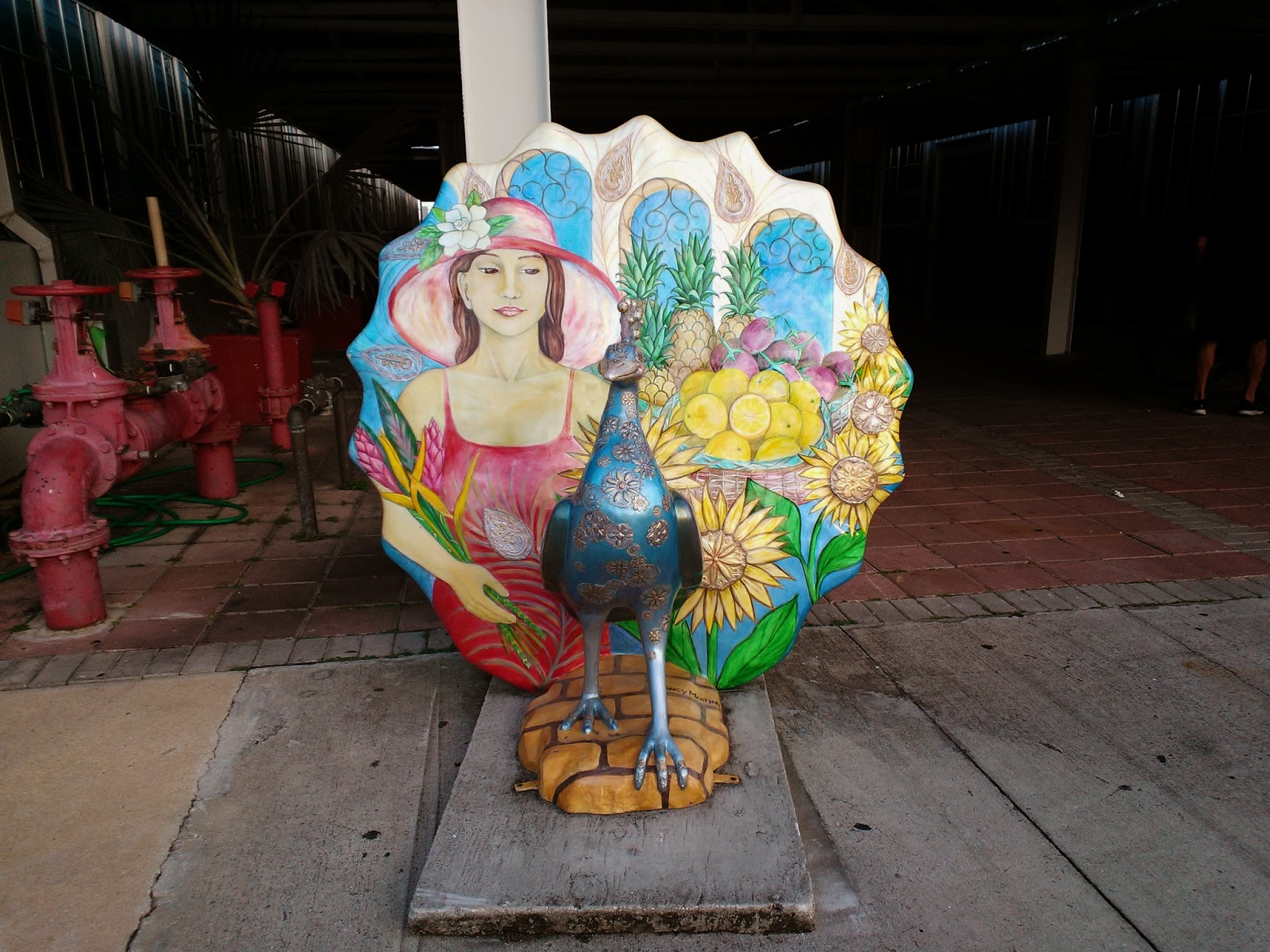
This peacock stands guard outside Fresh Market

Furthermore, there’s already retail in the footprint of Grove Harbour. In the northernmost hanger is a Fresh Market, which appears to be doing good business and will remain.

I think it’s unfortunate that so many rumours are being circulated about this development. It’s not a “mall,” as it’s being constantly described on the Coconut Grove Grapevine. The Grapevine has come out solidly against Grove Harbour and has given plenty of its blog real estate to promoting the antis.

One wonders where all these people were when there was an opportunity to have input into the project.

This is what it’s all about: A view of Biscayne Bay

Racist Memes and Blogging ► Unpacking the Writer

It’s been a rollicking month for Not Now Silly. I’ve hit new heights in readership and received my first real criticism, which we’ll examine in detail. Yes, folks, it’s time to take another look under the hood to see how the engine is ticking over. 

First things first: The month of August was a good one for this blog. For the first time readership broke 12,000 for a calendar month. While I hope not, I think it will be a while before I break 12k again. Speaking of broken records: On September 24, 2013 I hit a brand new daily record: 703 hits. I’ll take it. That’s now my daily target. 


Other ratings: While I wasn’t paying attention my post on The Detroit Riots ► Unpacking My Detroit ► Part Five overtook Brian Jones ► A Musical Appreciation on the all-time leader board. This gratifies me for two reasons. 1). I am quite proud of my article on Detroit’s several riots, having taken more than a month to write it. I feel it’s important history that so few people actually know; 2). And, it’s a much better blog post than the Brian Jones squib. That one rose to the top of the leader board almost immediately and stayed there for more than a year. I was somewhat chagrined because the Brian Jones post was something I dashed off in less than an hour.

While I’m thinking about it, I’d also like to take the opportunity to thank Curbed Miami and Al Crespo of the Crespogram Report. Both sites recently linked to stories on Not Now Silly. My stats reflect a spike in hits directly from those links. I’m gratified Curbed Miami and The Crespogram Report found enough to like here to recommended Not Now Silly to their readers.

Now about that criticism: Some criticism is easily ignored. However, it’s not easily ignored when it comes from people whom I respect. That’s what happened with my most recent post on Coconut Grove. A Century of Coconut Grove Racism ► Soilgate Is Trolleygate Writ Large is an essay on a theme similar to several I’ve posted before. It compares the Racist attitude of almost 100 years ago with the Racist attitudes of today in Coconut Grove. In the late ’20s Miami allowed a polluting incinerator to be built in a Black neighbourhood. Just this year Miami allowed a polluting diesel bus garage in the same Black neighbourhood. Same as it ever was.

When I am being polite I call this attitude Modern Day Colonialism and Trolleygate, as I did in a post back in February. However, when I’m not being polite I call it what it really is: RACISM, pure and simple. West Grove has suffered under a century of it, which I keep discovering over and over again the deeper I research Coconut Grove. The thrust of my most recent post is that Racism is with us today and Trolleygate is merely the physical manifestation of that ugliness.

These blog posts go through several drafts before I press the PUBLISH button; some more than others. One of my earliest mentors in the writing game told me, “There is no good writing, only good rewriting.” I’ve made that my #1 motto and there have been sentences I’ve kicked at dozens of times before I’m finally satisfied.

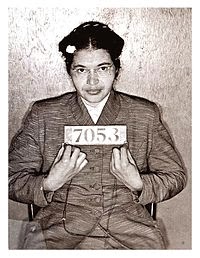
During the earliest drafts of A Century of Coconut Grove Racism ► Soilgate Is Trolleygate Writ Large I used images like the one to the right to illustrate my post. However, I the longer I edited the post the more I came to resent the pictures I was using. My words said Racism exists TODAY. However, all the pics were of Racism in the oldie moldy past: Rosa Parks, Martin Luther King, and Racist signs from the ’40 and ’50s. The words and the pictures created a tension that I didn’t like. They contradicted each other.

I have several dozen pictures on my computer hard drive that illustrate racism over the centuries. Several of them have been collected since President Obama took office. It occurred to me that those recent memes were the ones that best illustrated the point I was making. I removed all the historical images and substituted contemporary pictures instead. When I finished editing the post — when I was finally satisfied with what I had — I knew the pictures would rankle some people. I actually consulted a small group of folk whose opinion I trust. I call these people my de facto editors, because they’re all I’ve got as a Lone Wolf Citizen Journalist to bounce ideas against. None seemed to object and one said, “Go for it.”

The push back against A Century of Coconut Grove Racism ► Soilgate Is Trolleygate Writ Large began almost immediately. Here’s the predominant sentiment, sent to me by email:

I think it distracts from the serious discriminatory ridership routes and Env[ironmental] justice issues. I would suggest more serious photos of Rosa Parks, Jim Crow signs on buses, etc…. It is important to depict civil rights leaders, including our President, in a complimentary light to inspire youth to greatness, not ridicule upon achievement. The images posted distract from our serious issues.

Believe me, I’m sympathetic to that point of view. Racism is ugly. Racism is not polite. Having said that, I do my readers a disservice if I turn away from the ugliness of Racism. I do my readers a disservice if I use metaphors and euphemisms to describe Racism. Racism needs to be treated as you do with a dog who has just taken a crap on the rug: You rub its nose in it and use stern words. NO! BAD DOG!

I’m not going to sugarcoat Racism. That plays into the hands of Racists, who hope you will be far too polite to call them out on their Racism. I also disagree that the images I used were not serious. They were as serious as a cancer cluster. If a picture is worth a thousand words, these few pictures (which, by the way, are not the most incendiary I have) comprise an entire book. I won’t apologize for using contemporary pictures of Racism to illustrate modern day racism. Therein lies madness.

Tune in next month for another exciting episode of Unpacking The Writer, a leisure-time activity of Not Now Silly, the home of the Steam-Powered Word-0-Matic.

A Century of Coconut Grove Racism ► Soilgate Is Trolleygate Writ Large

One of hundreds of thousands of Racist internet memes

Follow the bouncing ball: Trolleygate is modern day Racism, pure and simple. Furthermore, the Racism that allowed for Trolleygate is exactly the same Racism that thought West Grove was the perfect place for Old Smokey, an incinerator that belched carcinogenics into the air for 5 decades. Racism — which is a cancer on our body politic — may have led to actual cancer clusters in Coconut Grove. I’m here to prove that thesis. 

Let’s start here: It’s been a truism since the founding of ‘Merka that People of Colour have always gotten the short end of the stick. There is no disputing that. But that’s a thing of the past, according to modern day Racists, because we now have a Black president. We are now living in a post-racial society. MISSION ACCOMPLISHED!!! Right?

For an explanation on the pics used to illustrate this article, please read my essay Racist Memes and Blogging ► Unpacking the Writer

Not even close. While some Racism is less blatant than it has been in previous decades, one can find hundreds of thousands of Racist memes against President Obama, each more disgusting than the next. However, make no mistake: It’s still Racism. Racism doesn’t have degrees. Like being pregnant, a meme can’t be a little bit Racist. It’s either Racism, or it isn’t. The entire story of Coconut Grove depicts a Racism that continues to this very day, culminating in Trolleygate.

West Grove is a quiet residential neighbourhood that has remained predominantly Black since its founding in the late 1880s. It was settled by Bahamians who came up through Key West, at one time Florida’s largest city. The Black Bahamians who settled in Coconut Grove worked for The Peacock Inn and Commodore Ralph Monroe, among the earliest residents. As a nascent tourist trade flourished, more Black folk arrived to do all of the backbreaking work and menial labour that made it all happen.

That West Grove wasn’t razed is due almost entirely to the efforts of one man, Ebeneezer Woodbury Franklin Stirrup. E.W.F. Stirrup was one of Florida’s first Black millionaires and, at one time, the largest landholder in Coconut Grove. On some of the land he owned he threw up more than 100 houses with his own hands. These he rented, sold, and bartered to other Bahamians. That’s why, at one time, Coconut Grove once had the highest percentage of Black home ownership in the entire country, making it unique.

It’s for that reason and that reason alone that The Powers That Be were unable to dislodge the Black residents of Coconut Grove. Overtown, just up the road and the second Black neighbourhood in Miami, had I-95 rammed through the middle of what had been the Black Shopping and Entertainment district. However, Overtown was mostly renters with absentee landlords, who were happy to cash out on their investments. The same pattern took place in Paradise Valley, in my home town of Detroit, which was leveled for I-75. The same scenario played out all across the country.

It’s not as if the Powers That Be didn’t try to get rid of Black Grove. There were three separate attempts to get rid of the neighbourhood. In 1921 an urban renewal project called The Bright Plan, approved but never realized due to an economic downturn, would have created a golf course on everything west of Main Highway to Douglas and north to Grand Avenue. In 1925 City Fathers tried to get Miami to annex around what was called Coloredtown, instead of including it. Miami decided to annex it all instead, which led to the creation of Coral Gables, the city that Racism built. In the ’50s, long after the rest of the city had indoor plumbing, West Grove still used outhouses. Honey wagons were just a way of life long after every surrounding neighbourhood (read: White neighbourhoods) had an indoor toilet. In the ’50s. The city wanted to raze the entire blighted neighbourhood and start all over, but the high percentage of Black home ownership defeated the proposal. People, who in some cases were now the 2nd or 3rd generation in the same house, refused to sell. They knew better. Where could they go? They would be redlined out of any neighbourhood they wanted to buy into. It was better to stay put and bequeath their homes to their children and their children’s children.

Which is to explain why the neighbourhood has remained predominately Black. That and the fact that White folk tend not to move into Black neighbourhoods. I’ll now let Nick Madigan, writing in yesterday’s New York Times, pick up the story of Old Smokey:

MIAMI — When she was little, Elaine Taylor remembers rushing home whenever Old Smokey fired up. Clouds of ash from the towering trash incinerator would fill the air and settle on the ramshackle houses and the yards of the West Grove neighborhood.

Her mother, who took in laundry, would be whipping sheets and shirts off the clotheslines. Often, the soot would force Elaine and her mother to wash everything again, by hand.

Old Smokey was shut down in 1970, after 45 years of belching ash, but its legacy might be more ominous than mere memories of soiled laundry. Residents of the neighborhood, established by Bahamian immigrants in the 1880s, have become alarmed by recent revelations that soil samples there show contamination from carcinogens like arsenic and heavy metals, including lead, cadmium and barium.

Ash from the old incinerator is being blamed, and residents are asking why none of this came to light sooner.

Something that Madigan leaves out of his story — because it makes a simple story of soil pollution and subsequent coverup far too complicated — is that the coverup was only discovered due to Trolleygate, the story I’ve been following since January. The documents were discovered by the pro bono legal team researching Trolleygate while preparing its case against Miami, Coral Gables, and Astor Development. While that suit was thrown out of court for a lack of jurisdiction, the documents kicked loose during the research are still bearing fruit. Friday I wrote about an email from a City of Miami Zoning and Building Department official who said that Trolleygate did not conform to the Miami 21 Plan. Yet, after some undetermined jiggery-pokery, [allegedly] corrupt Commissioner Marc D. Sarnoff managed to get the project approved anyway, despite the fact that it screws his owns constituents and rewards a developer in the next town over. But, that’s now a side issue to Soilgate, the discovery of toxic soil throughout Coconut Grove and greater Miami. [Coral Gables is now suing to get out of ever having to use the polluting diesel bus garage.]

The Racism that decided a Black neighbourhood was the perfect place for a polluting diesel bus garage — despite it not being zoned for it — can be seen as a parallel to the decision in the 1920s to build Old Smokey, the incinerator that polluted Miami. Miami needed an incinerator. Why not stick it as far away from the White folk as possible? Stick it in West Grove. Again from the New York Times:

Across the street from Old Smokey’s former site lies Esther Mae Armbrister Park and its playground. Down the block is George Washington Carver Elementary School, a once all-black institution that traces its history to 1899. Former students recall ash blowing in through the school’s open windows.

[University of Miami law] Professor [Anthony V.] Alfieri [of the Environmental Justice Project] said that the construction of Old Smokey “in the middle of a Jim Crow community” in 1925 exemplified the city’s pattern of neglecting the West Grove, an area that has never experienced the prosperity so evident in its neighboring communities. In a 1950 article in Ladies’ Home Journal, Marjory Stoneman Douglas wrote that when the city installed a water and sewage system in Coconut Grove, its western neighbor was left out of the project, and for years residents continued to use wells and outhouses.

Old Smokey was shut down in 1970 after many years of neighbourhood protests and a successful legal battle initiated by the White folk of Coral Gables. Yet, 98% White Coral Gables learned nothing from that court battle. When it needed a place to build its polluting diesel bus garage, Astor Development chose West Grove. This is the neighbourhood that’s been given the short end of the stick since it was called Kebo by the original Bahamian settlers almost 130-years ago. Even if you attempted to argue, against all logic, that the developer was unaware it was a Black neighbourhood, the only reason the land was cheap was due to the last century of systemic Racism, that depressed every economic indicator you can name in West Grove, especially when compared to the rest of the 33133 Zip Code, now considered one of the most exclusive in the entire country.

The Supreme Irony: Air pollution — emanating from a fake diesel-powered trolley bus or a giant incinerator — doesn’t abide by the Colour Line, of course. There appears be less pollution the closer one gets to Old Smokey’s former site. As the expression says, “What goes up, must come down.” It seems a lot of Old Smokey’s toxins came down in the Marc D. Sarnoff Memorial Dog Park. Coincidentally, or not, that’s right across the street from where [allegedly] corrupt Commissioner Marc D. Sarnoff lives. The New York Times again:

“Everything is testing to be residential standard,” Mr. Sarnoff said, referring to contaminant levels permitted under environmental regulations.

That may not be the final word. A cancer researcher at the University of Miami said that she and several colleagues discovered a cluster of pancreatic cancer cases in the West Grove several years ago.

“That’s the little region that lights up,” said the researcher, who spoke on the condition of anonymity because of the delicate nature of the issue. Although she found the discovery “puzzling,” she said she did not pursue it because of a lack of funds. But when she read a newspaper article this year about Old Smokey that said its ash had spewed arsenic and heavy metals into the neighborhood, she said “everything started making sense.”

The researcher noted that no correlation could be established between the cancer cluster and the old incinerator without more research.

Institutional Racism could be the answer as to why so many people in Coconut Grove are now being diagnosed with cancer. Yet, despite this ugly history of sticking the Black neighbourhood with what the White neighbourhood doesn’t want, [allegedly] corrupt Commissioner Marc D. Sarnoff, the City of Miami, and Astor Development all still think it’s appropriate for them to have played a shell game in order to get Trolleygate approved.

That’s nothing but Modern Day Racism, pure and simple.

Enjoy some videos of the Marc D. Sarnoff Memorial Dog Park from September 13, 2013, as the soil testing was occurring.