Category Archives: Unpacking

Cops Try To Scare Me As I Cover A Non-Protest

No protesters at Dirty Blondes

The Dirty Blonde protest didn’t come off as planned. I don’t know how many people they expected, but I’m the only one here, except for 2 cops who both took my picture and tried to intimidate me.

To make a short story long:

I went down to the protest out of curiosity and because I had successfully pitched an article to PoliticusUSA on the power of social media. I’ve never seen anything go viral this fast. On July 28th Keeland Dumont posted a 15-second video on Instagram. It showed an alleged beat down of Alexander Coelho and David Parker by bouncers from Dirty Blonde’s Sports Bar. Watch:


Video courtesy Carlos Miller, Photography Is Not A Crime

Alexander Coelho showing his alleged
injuries from his alleged beat down

I became aware the video the very next morning from Photography Is Not A Crime (a website I highly recommend), where Carlos Miller has been updating the story ever since. Then it was rapidly picked up by Broward New Times, but it spread quickly after that. By the end of 29th it was everywhere. Then a “Boycott Dirty Blonde’s” Facebook page sprang up from nowhere, only to have the inevitable article appear because someone (from Dirty Blonde’s maybe?) reported the page as offensive: ‘Boycott Dirty Blondes’ Facebook Page Temporarily Disabled As Response To Bouncer Beating Video Grows. However, the Facebook page was restored the next day as the legit Dirty Blonde’s Facebook wall was first defaced and then deleted, presumably by Dirty Blonde’s which was having trouble keeping up deleting comments. After that the local tee vee stations jumped on the bandwagon and broadcasted the video. From there it spread across the nation and then around the world. A
friend in Canada sent me a copy, as did another friend overseas.

That made the Fort Lauderdale police sit up and take notice. You see they had taken the bouncers word for it because they actually charged the victims before the video went viral. The public outcry — and the fact that video shows that Coelho was clearly (allegedly) cold-cocked and then kicked several times — forced the police to say they were investigating. Today Fort Lauderdale police charged bouncer Arnald Thomas-Darrah with Felony Battery. His alleged partner-in-crime, Jovan Ralfhel Dean, was charged with Misdemeanor Battery.

I am always curious about things that go viral on the innertubes. Why does one thing explode while other equally compelling stories do not? It’s not for nothing I want to know. I’ve been trying to get my campaign to save the E.W.F. Stirrup House to go viral. After several years of trying, I still feel like I’m pissing in the wind. Yet, a 15-second video is dropped on Instagram and it becomes the shot heard round the world by the next day (not that it didn’t deserve the attention it received).

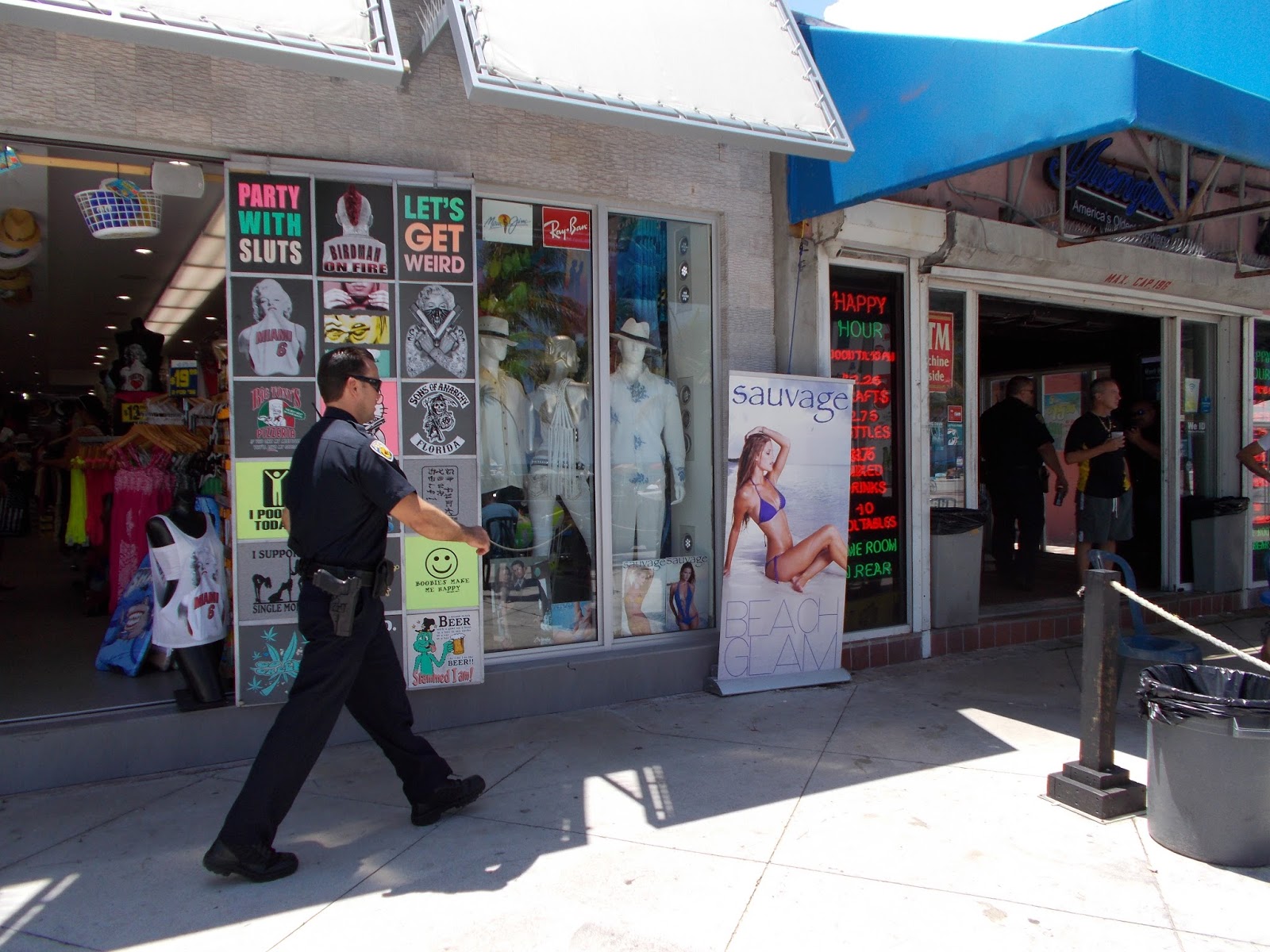
It was this curiosity that brought me to the Fort Lauderdale beach today. I stayed until about 3:30 and, when no protestors came out, I turned my curiosity to something else: Two police officers protecting Dirty Blonde’s from a protest that wasn’t happening. It’s hard to know exactly why the police officers were even there, since there was no protest whatsoever. *

I first noticed them when they strode purposefully towards the bar. They were the only thing of interest at the non-protest, so I snapped pictures of their arrival:
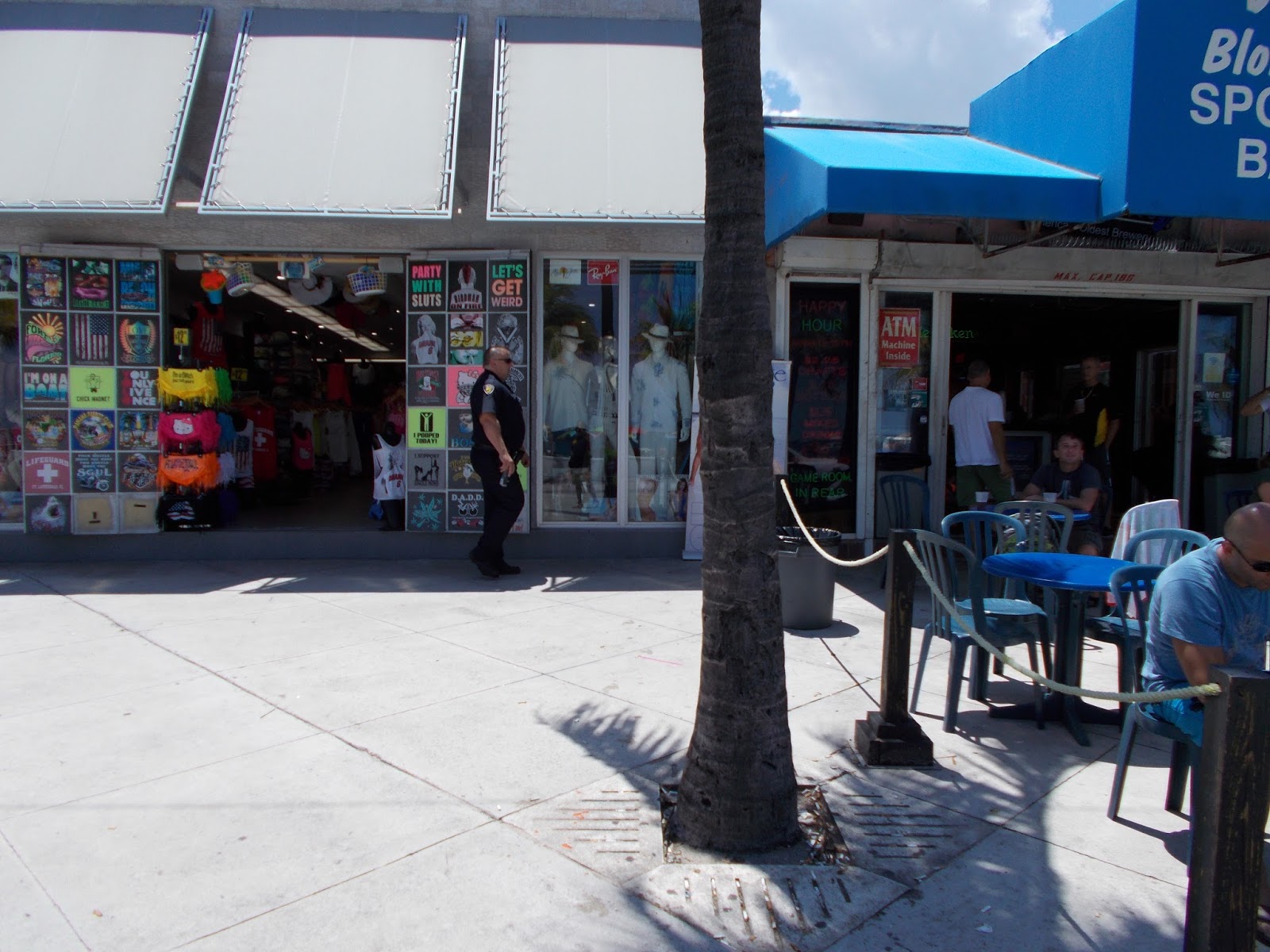
This was the first officer to arrive. I’ll call him Corpulent Cop.

This officer was the 2nd to arrive so he saw me take a pic of his partner.
He pretended not to see me after I saw him see me. He was the1st officer to take my picture.

 My first thought was to wonder if they were on the city clock or whether
they had been hired by Dirty Blonde’s to keep the piece. That’s the
only reason I even took their picture. I thought I might ask the police department a question or two and see if that led anywhere. In the meanwhile, I had their pictures.
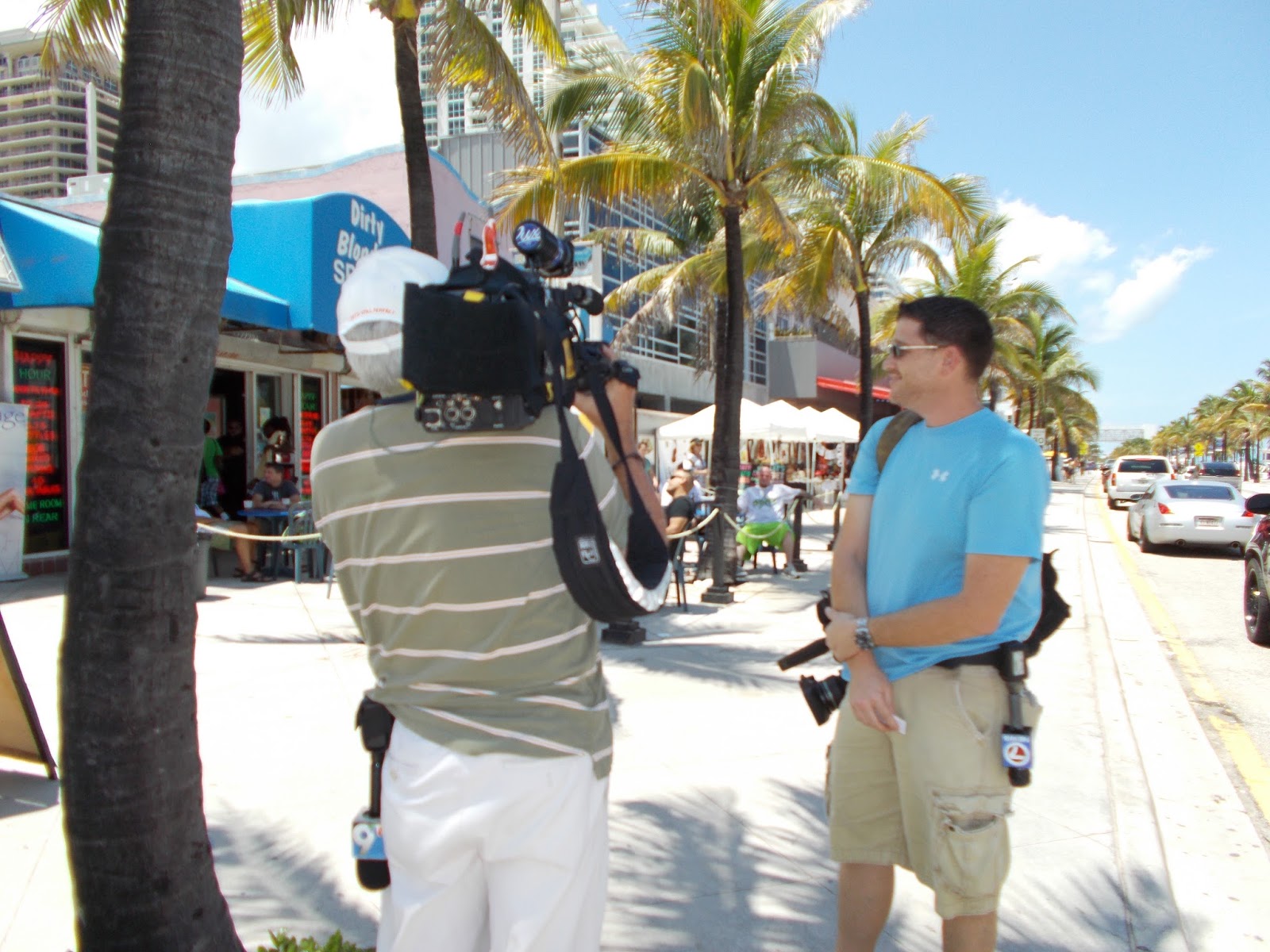
Nothing to do; no protest to shoot

A few minutes later, when I was talking with with two television cameramen sent out to cover the nonexistent protest, I noticed the first officer taking pictures of me from inside Dirty Blonde’s. I was in the process of wiping my brow with a red handkerchief, so I waved it at him and he waved back. By the time I got my camera out to take his picture he had stopped.

A few minutes after that I noticed Corpulent Cop also taking my picture. I pulled out my camera and managed to take a number of shots of him taking pics of me, like so:
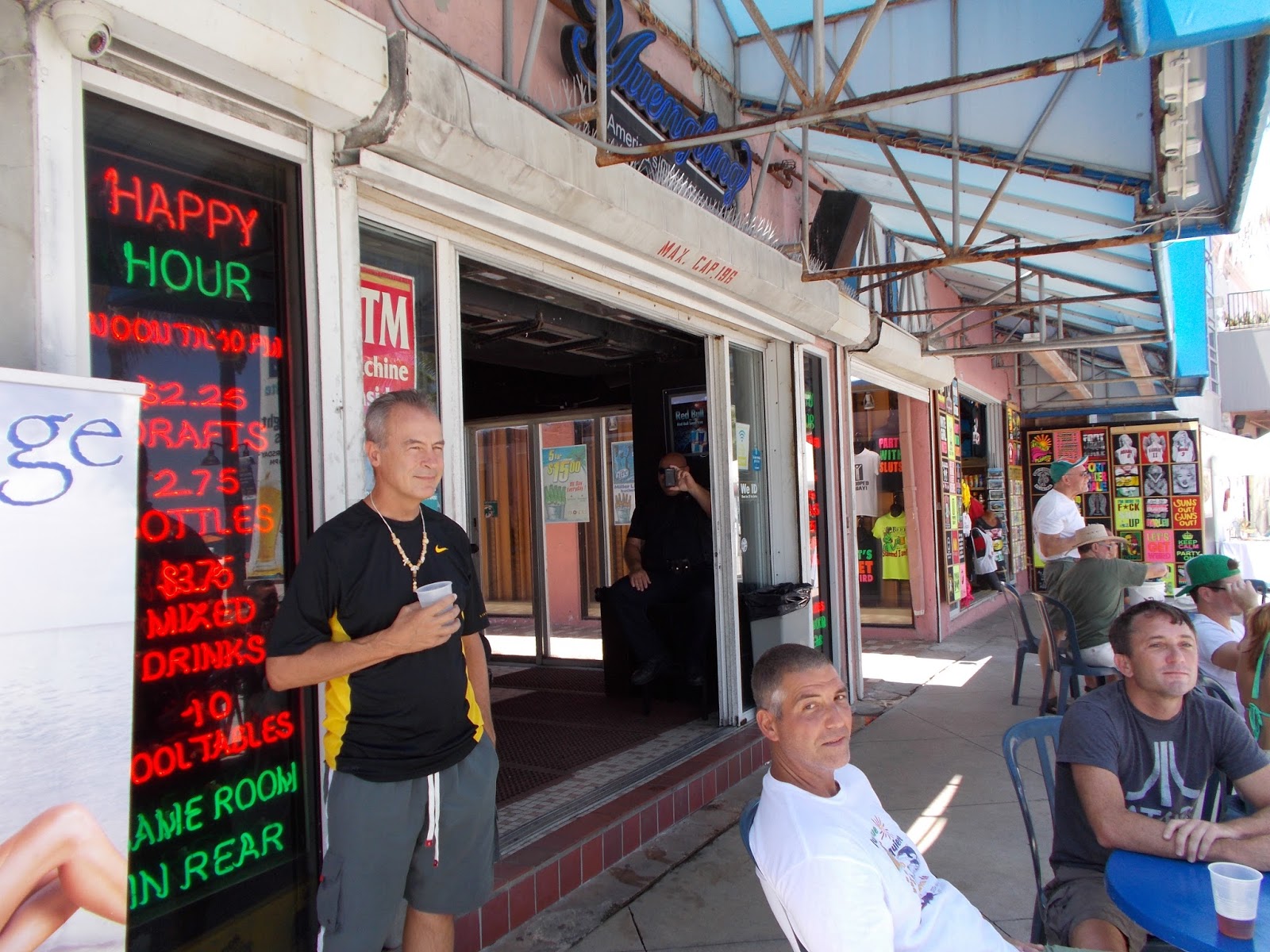
Corpulent Cop taking my picture as I take his.

Taking my picture is clearly an attempt at intimidation. However, what am I to make of his shouted comment as I took his picture, “You are a stupid, stupid man.”
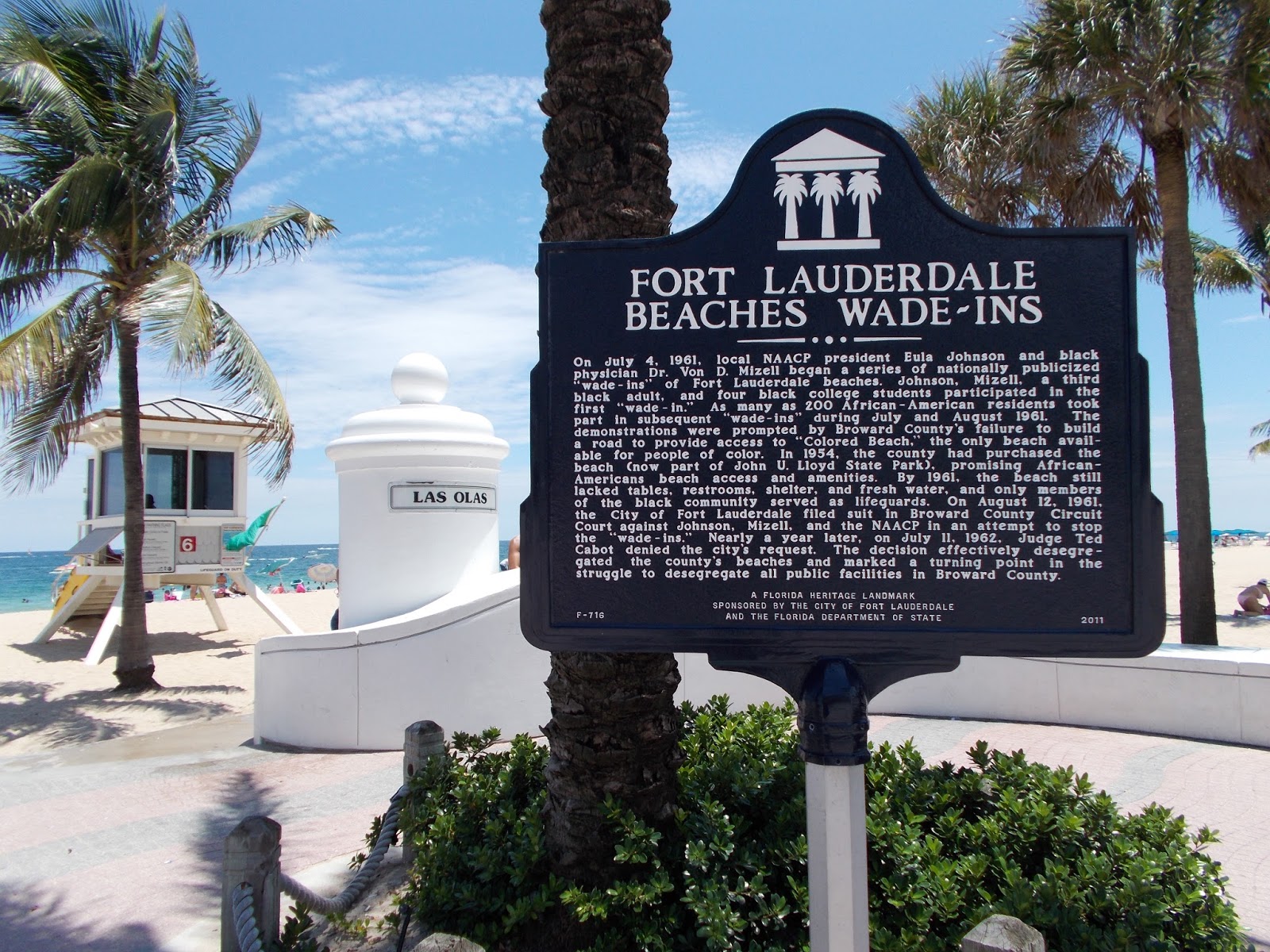
The historical marker at A1A & Las Olas

While I didn’t care he had taken my picture, having him yell what I interpreted as a threat was intimidating. Remember: I read Photography Is Not A Crime almost every day. Every post Miller writes is about some poor schnook
who has been thumped and/or arrested simply because cops felt they could
get away with it.

More and more, due to sites like PINAC, dirty cops
are not getting away with it, but that doesn’t mean I want to be assaulted by a macho cop trying to prove he’s as tough as the bouncers he was sent to protect.

From that moment on I made sure I was not blocking the sidewalk. Prior to that exchange I had been casually crossing back and forth from one side of A1A to the other. From that moment on I crossed at the light at Las Olas so that I couldn’t be arrested for jaywalking. I wasn’t going to give this loudmouth an excuse to harass me, not that he’d really need one. Corpulent Cop could just invent one, like what seems to have happened when police showed up on the evening of July 28th to arrest the victim, Alexander Coelho. The arresting officer claimed that Coelho pushed him. I find it extremely hard to believe that after Coelho had just suffered the beating of his life, he’d be stupid enough to assault a police officer. Yet, he was charged with “battery of a law enforcement officer,” despite all the independent witnesses.

Ironically, as I was leaving I ran into a real protest. People were holding signs in favour of Obamacare.
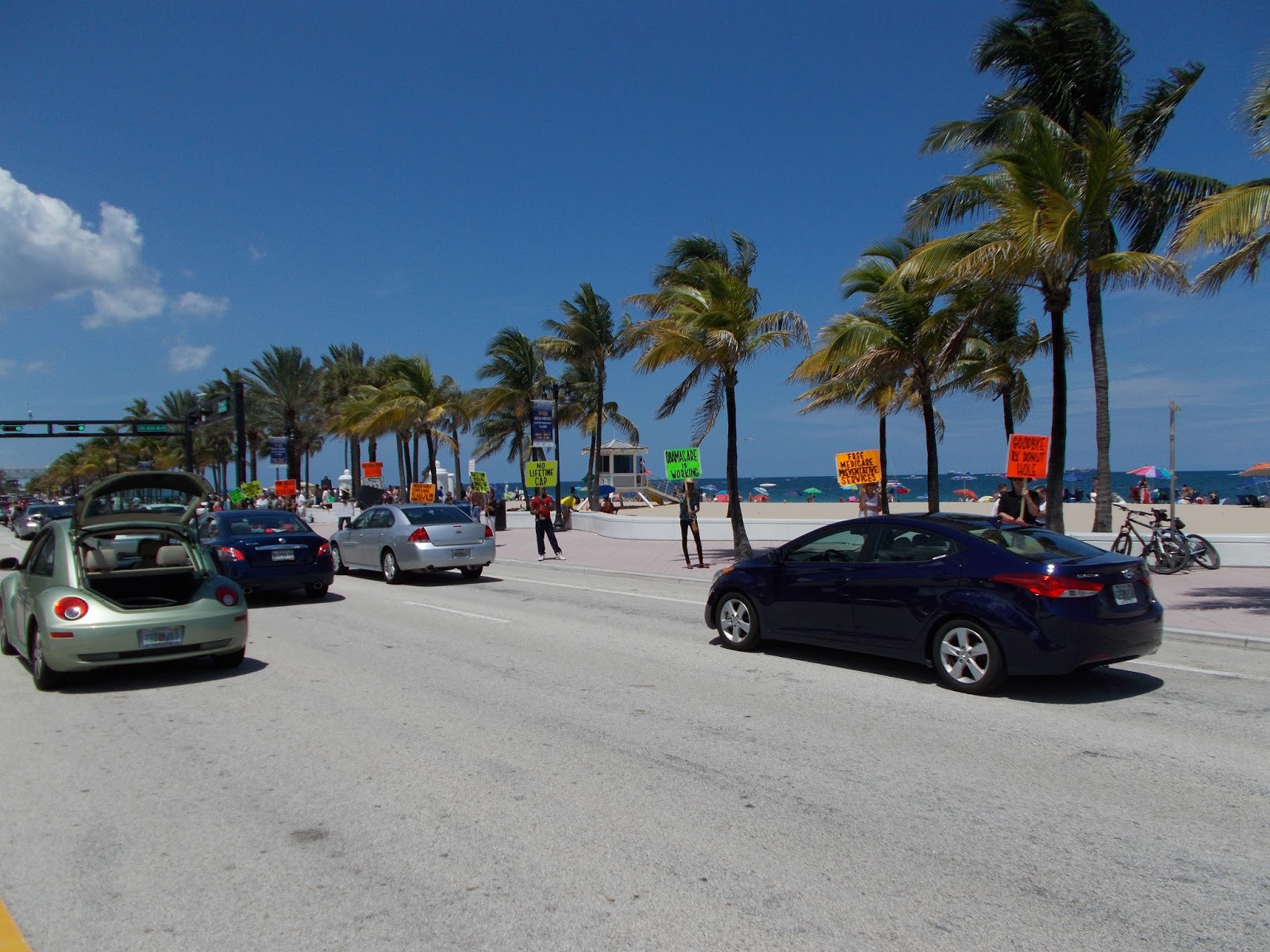
* Apparently the Dirty Blonde’s protestors showed up after I left.

Where Did July Go? ► Unpacking The Writer

As July almost comes to a close, it’s time to look back on what has been an especially exciting month for me. A website I read and respect has seen fit to publish a few of my articles this month. 

My more faithful readers may have already found Why Florida’s Stand Your Ground Law Has Got To Go and Detroit is the New Conservative Wet Dream over at PoliticusUSA. If you’ve not been over there, take a look and let me know what you think. Thanks go to Managing Editor Sarah Jones who recognized my writing ability. While I will still keep updating Not Now Silly several times a week, I will also be freelancing for other publications, such as PoliticusUSA. I already know this writer/editor relationship won’t be the total disaster WebVee Guide turned out to be.

However, by far the best new thing on the internet this month — maybe the entire year — is what happens when you plug “Flying Monkey Squad” into the Googalizer Image Search Engine:

For the uninitiated, The Flying Monkey Squad™ is the name I’ve given to Mark Koldys, aka Johnny Dollar, Ashley Graham, aka Grayhammy, and the entire crew of J$’s ass-kissing sychophants. I don’t know of any of those fancy, schmancy SEO tricks, but clearly I must be doing something right.

Facts & Figures: Top Ten for July

Another thing I must be doing right is delivering words people want to read. The Top 10 for the month are, for the most part, blog posts I’m quite proud of. You can compare how this month stacks up with my All Time Top Ten by taking a gander at the column on the right.

The Top Ten For July

  1. The Detroit Riots ► Unpacking My Detroit ► Part Five
  2. Another Dispatch From Detroit, ‘Merka’s First Throwaway City
  3. Loofah Lad’s Attack Dog Jesse Watters Attacks LGBT Folk
  4. The First Three Stooges ► Nostalgia Ain’t What It Used To Be
  5. Brian Jones ► A Musical Appreciation [My all time most popular post]
  6. No Skin In The Game ► Part One
  7. How Jamaica Conquered The World ► The Day I Met Bob Marley
  8. Happy Birthday Doc Pomus ► A Musical Appreciation
  9. The Case of the Growing Child ► Perry Mason and Me
  10. Dance Music To Change The World ► Happy Birthday Nelson Mandela

If you’ve gotten this far, it’s because you care. Show you truly care by clicking on one of the adverts in the right column on this page. It won’t cost you a thing, but I make a few pennies, and I do mean few. Show you really, really care by clicking two adverts.

Advertising makes the world go round.

Another Dispatch From Detroit, ‘Merka’s First Throwaway City

Once upon a time Detroit was called “The Arsenal of Democracy.” However, the consequences of 60 years of White Flight — systemic racism, to be blunt — finally came home to roost in Detroit, my hometown. On July 18, 2013, at approximately 4:06 PM EDT, Detroit’s unelected, possibly illegal, Emergency Manager Kevin Orr filed for bankruptcy. 

It’s conventional wisdom — conventional, but completely wrong — that Detroit’s White Flight began after the 1967 riot. White Flight had already been going on for almost 20 years at that point. The ’67 riot only accelerated the exodus.

Detroit: The Arsenal of Democracy

Detroit’s race problems go right back to the earliest days of the city. In my earlier [very long] essay The Detroit Riots I report on the little known 1943 riot and the far lesser known 1863 riot. Understanding these earlier riots is the key to understanding Detroit’s current demographics. Both of these earlier riots not only set the table for the 1967 riot, but also set the table for the Detroit’s systemic racism, which manifested itself in the White Flight that eventually killed the Motor City.

The 1863 Detroit riot exploded in the wake of Lincoln’s Emancipation Declaration. There had already been tensions between Blacks and Whites, and the openly racist Detroit Free Press was happy to fan the flames for months on end. When a rumour swept through the neighbourhoods that a Black man did something, something, something to a White person, White folks went crazy. [Isn’t that always the way? See: May 31, 1921 ► When Whites Went Crazy In Tulsa] They roamed the streets screaming, “Kill all the niggers,” beating people on sight. At the time it became known as “the bloodiest day that ever dawned on Detroit.”

Prior to that day Detroit did not have a police force. However, one was quickly formed and in the original incorporating documents the city fathers of Detroit made it clear that one of its primary jobs would be to keep the Blacks folk in line.

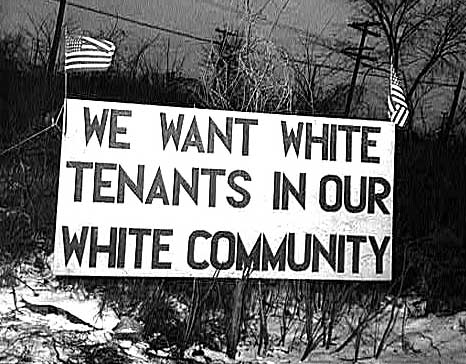
A sign in Detroit during the war, when the Feds proposed
to build Black housing to relieve overcrowding

The 1943 Detroit riot came during war time, but it also came in the midst of what has been called The Great Migration, when rural and southern Blacks made their way to cities in the north. Detroit was clamoring for unskilled workers and Black folk came by the tens of thousands. However, that didn’t mean anyone wanted to share their neighbourhoods with Black folk, nor work side-by-side with them. The 1943 riot was a result of these tensions and more.

[This is the simplified version. The conditions that led to these 3 riots are explained in much greater detail in The Detroit Riots, my earlier article on these topics.]

As soon as World War Two was over, prosperity reigned, in Detroit and across the nation. Part of that prosperity was due to the fact that all across the country houses had to be built for all the returning soldiers. ‘Merka saw a housing boom like no other. This was great for the economy and for the growing White Middle Class. However, it didn’t trickle down to Black folk.

In the Detroit area, developers started building north of 8 Mile, the city limits made famous by Eminem’s 2002 movie. These suburbs grew exponentially during the ’50s and ’60s and were attractive to the people with the same mindset as those who refused to share their neighbourhoods and work places with Blacks during the 40s.

The last remnant of a vibrant Black
neighbourhood and business district

Black families were redlined out of the suburbs, just as they were from most of the neighbourhoods in north Detroit. During the ’40s and ’50s Blacks were unable to expand much beyond Black Bottom and Paradise Valley, the neighbourhoods they already occupied. During the early ’50s a few Middle Class Blacks moved to the 12th Street area, which had been predominantly White. That’s when the first Whites started leaving because — you guessed it — they didn’t want to live in the same neighbourhood as Blacks. By the time Black Bottom and Paradise Valley were razed for I-75, the die was cast. The only area accepting Black folk was surrounding 12th Street, because the first Blacks had already “busted the blocks,” in the parlance of the day. White folk fucked off in droves. The entire demographics of the neighbourhood reversed itself in a single decade. [This is also told in greater detail in The Detroit Riots.]

Then came several decades of terrible local government, which just made
everything in Detroit a whole lot worse. But, let’s be clear. What these
politicians made worse was already there: an absolute division of Black
and White and the continued blighting of a once great city. Systemic
racism is the foundation on which it was built. The White folk of Wayne
County moved across 8 Mile and, quite literally, turned their back on
Detroit.

That, dear reader, has been the story of Detroit from the very beginning. As soon as Black folk gained a small toehold in a neighbourhood, that neighbourhood eventually turned all Black. Block by block. Neighbourhood by neighbourhood. Until the entire city was virtually Black, while the suburbs became predominantly White. Eventually integration came to the suburbs, but it never had a chance in the City of Detroit.

IRONY ALERT:
Detroit’s seal, which represents the fire of 1803
Speramus Meliora = We hope for better things
Resurcet Cineribus = It will rise from the ashes

This White Flight to the suburbs reduced Detroit’s population and ‘Merka’s systemic racism kept it low. At one
time there were almost 2 million people in Detroit proper. When I was
growing up in Detroit, we were proud to call Detroit the 5th largest
city in the country. Now it’s the 18th, sandwiched between Charlotte,
North Carolina, and El Paso, Texas. Its population of just over 700,000
is about a 3rd of what it was during the go go ’50s. As the city’s
population shrank, so did it’s tax base. These are the conditions that led to Detroit’s bankruptcy.

This would be as good a time to remind people that Detroit is responsible for two things that not only made ‘Merka better, but made ‘Merka great: Cars and Motown. These products of Detroit have been bought and sold all around the country during the same 6 decades that Detroit has slid into decline. Detroit cars and Motown — and it almost seems like they were made for each other — were bought and sold all around the world over the last 6 decades.

The people north of 8 Mile, the greater country at large, and the rest of the world took ittle notice of the problems facing Detroit until recently. During the last 6 decades they couldn’t have cared less what was happening to the city. That’s why I call Detroit ‘Merka’s first throwaway city.

Take it away, MC5:


CRANK IT UP!!!

Further Reading on Not Now Silly:
Unpacking My Detroit

50 Years Ago ► St. Augustine Beaches Integrated ► History Is Complicated

Florida Memory reminds us that it took blood and guts to integrate Florida beaches. On this day — June 25, 1964 — White segregationists attacked the participants of a “Wade-In” at St. Augustine, Florida:

Demonstrators held several nonviolent “wade-ins” at segregated hotel pools and beaches. This film shows footage taken by the Florida Highway Patrol of one of the largest demonstrations, a wade-in held at St. Augustine Beach on June 25, 1964 (see full-length version).

Civil rights leaders, such as Martin Luther King Jr., came to northeast Florida to show their support for the Movement. King is said to have remarked that St. Augustine was “the most segregated city in America” at the time. He pledged to defeat segregation using nonviolence, even “if it takes all summer.”


Fort Lauderdale’s beaches were integrated a few years earlier. Two years ago Fort Lauderdale celebrated 50 years of integrated beaches, which began with illegal Wade Ins in 1961. According to CBS Miami:
On July 4, 1961, Lorraine Mizell, her sister, her uncle and some friends waded into the ocean on a beach where blacks were not allowed. Mizell would later say she didn’t know how significant her actions would be.

Fort Lauderdale’s beaches had been segregated since 1927. Civil rights pioneer Eula Johnson led wade-ins like Mizell’s over the summer of 1961 in spite of threats. A year later, a state judge ruled against the city and its whites-only beach policy.

As the Sun Sentinel tells it:

Lorraine Mizell remembers the looks of disgust and catcalls as she crossed the sand. She remembers other beachgoers fleeing from the water as she waded in.

She remembers not being afraid.

For the 19-year-old college freshman, the Fourth of July in 1961 started with a phone call from her uncle. He wanted to know if she, her sister and some of their friends would like to go to the beach with him.

Their outing will be commemorated on Monday as a turning point in the history of Fort Lauderdale and racial equality.

Her uncle, Von D. Mizell, and fellow civil rights activist Eula Johnson had decided the time had come to force the city to open its beaches to all people, both black and white. July 4 began a series of wade-ins that led to a court-ordered end of segregation on Fort Lauderdale beaches.

“When we did it, I didn’t realize how significant it would be,” said Lorraine Mizell, now 69. “I knew we were doing something to break down barriers. This was a beach that I had never been able to go to, never able to put my feet in the sand. But I didn’t know we were going to be able to change things.”

If this whetted your appetite read this PDF: The Long Hard Fight for Equal Rights: A History of Broward County’s Colored Beach and the Fort Lauderdale Beach ‘Wade-ins’ of the summer of 1961

Fifty years is not that long ago and fifty years later there are still inequities built into the system.

Final Note From The Road

After a good night’s sleep following my whirlwind trip, here are some final observations from the road — all 2,991 miles of it. Because, if there’s one thing one can do during 46 hours of driving, that’s think:

• I did something on The Sunrise To Canton Road Trip For Research that I’ve always wanted to do, but the innertubes made it so easy. I couch surfed from home to Canton, visiting cyber-friends along the way. These are people I’ve known for years in the space of cyber, but whom I had never met;

• All the people I know who lent me a couch, bed, or just stoked me up with coffee for my next leg of the road, were all more wonderful than I had imagined from just the communication on the innertubes;

• Every family has their own shit to deal with. While it was not the topic of discussion with any of my couch-suppliers, every one of them alluded to trouble in their family that led to a current sitch-eee-ay-shun of family psycho-drama;

TO BE FAIR: I participated in my own family drama when I saw some of my relatives this weekend between trips to Canton, Michigan;

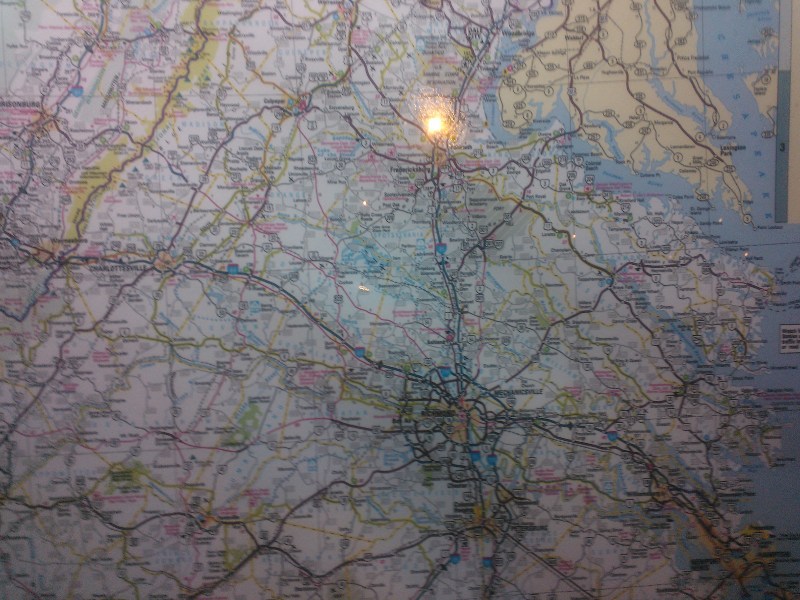
• One gets no sense of topography from maps, which are as flat as South Florida. It was nice to be reminded that there are places not at sea level which won’t flood during the upcoming Great Glacier Melt™;

A panoramic example of topography from Morgantown, West Virginia. Note the cemetery in the far background.

 • Professional truckers still understand the courtesies of the road. I’d signal my brights at them to let them know it was safe to merge. They never failed to signal back as a “thank you;”

• Civilian drivers tend to be rude fucks who only seem to be concerned with getting there first;

• No matter where I drive I always do the speed limit, unless conditions require a slower, safer speed. I am always the slowest car on the road. In fact, there are times I feel like an impediment to the flow of traffic by hewing to the speed limit;

• The invention of car turn signals was a total waste of time;

• I had no idea Canton was so large. Because it’s an unincorporated township, as opposed to town or city, I thought it would be so much smaller. I guess at one time it was, but now it’s pretty much suburban sprawl from one end to another. Traversing Canton always took longer than I expected it would;

• No one has led a 100% exemplary life;

• Be good to your neighbours because you never know when a journalist will come sniffing around for information;

• A solution to a problem I was having in my novel jumped out at me from out of nowhere and I almost hit it with the car. I wasn’t even thinking of the book when it happened;

• One meets a lot of nice people along the road, provided one takes the time to talk to them;

• I was once able to get a much better sleep on the back seat of a car;

• I kept seeing signs that said “Trucks over 3 axles use right two lanes.” You mean straddling the line? Wouldn’t it be simpler to say “Trucks over 3 axles prohibited in left lane?”

• I had the misfortune to hit morning rush hour traffic in Jax while on the southbound I-95;

• The last 100 miles I could see the smoke of several brush fires rising into the air on both the east and west side of I-95. Yet I turned on the news and searched online and could find no reference to it;

• With approximately 10,000 tunes on my music machine playing on random shuffle, here were the Top Five Played Artists [in descending order]: The Beatles, The Beach Boys, The Beatles Bootlegs [a separate category to any die-hard Beatles fan], Willie Nelson, Alberta Hunter. Oddly enough the first 4 have multiple albums on the music machine. Alberta Hunter only has 1 album on there, plus a few selected tunes from her early days singing with Eubie Blake. More proof, if any is needed, that random shuffle is quite random;

• I never thought I’d say this, but that was entirely too much Wliie Nelson. I’ll have to winnow it down a bit;

As I tell people: I love to drive, provided I have tunes. This may have been a long drive, but I enjoyed every minute of it. I would also like to thank the friends I met along the road. You were all so terrific and any time you’re in the neighbourhood, don’t hesitate to call.

Further Reading on Not Now Silly

Notes From The Road
More Notes From The Road
And Still More Notes From The Road

And Still More Notes From The Road


• IRONY ALERT: I had to get something from the trunk of the car and needed to move the First Aid kit. I managed to slice my hand open on a sharp edge of plastic. It bled like a stuck pig. Good thing I had a First Aid kit.

• After I went through Dayton, Ohio I caught an earworm of Randy Newman’s tune that lasted for hours;

• The sweetest sound you’ll even hear is “I’m going to let you off with a warning.”

• Many signs warning that bridges ice up before the roadway, but I didn’t see any ice.

• Cigarette smoking in restaurants is still allowed in South Carolina.

I’m kipping for the night. I have about 8 hours driving ahead of me tomorrow.

Night, night.