Tag Archives: Let’s talk music

National Velvet ► Nostalgia Ain’t What It Used To Be

During my long career as a professional writer, there have been times that I was on staff and on a publication’s masthead and other times that I freelanced. As a freelancer, I would take just about any job that involved jamming words together. Once I wrote an entire work of fiction for a corporate brochure that made Scarborough, Ontario, Canada sound like a great place to live and work. It was fiction because I didn’t really feel that Scarborough was a great place to live and work. Despite my dislike for Scarberia, as it is derisively called, the brochure won an award by the City of Scarborough, which couldn’t read through to the sarcasm.  Another of my freelance jobs was writing for record companies. Occasionally these were the dry sales sheets, 200 words tops, which the salesmen would use to get the rack-jobbers to stock the LP. These were boring and tedious to write, but I could bang off up to 10 a day. However, my favourite writing for record companies was when I was hired to write artist biographies. These always involved meeting and interviewing the artists and I liked to spend as much time as possible with the artist/band before I ever sat down to write. And that’s how I came to meet National Velvet, when I was hired to write their biography.
 
Aside from the actual music, artist bios are one of the most important calling cards a band and/or record company has.
Before the first note of music is even heard, the artist biography is
often fully digested. Artist bios are a tricky business. Every word must
be right. The bio needs to capture the essence of the band or artists. It needs to make the reader WANT to play the record. It needs to tell you everything you need to know about the band, yet retain some mystery that can only be solved by listening to the music. There is no formula for writing an artists’ bio. Every one is different because every artist is different.

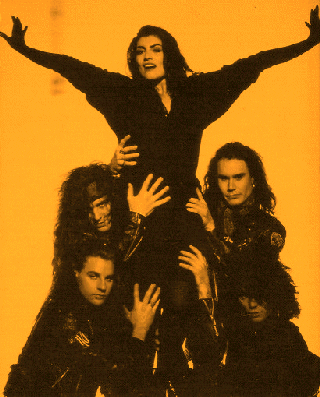
National Velvet were more different than most. NV was a Canadian Goth band before Goth was named Goth. Intrepid Records, distributed by Capital Records Canada, was preparing the release of their first National Velvet LP and hired me to write the bio. I spent about a week with the band, on and off. I went to a few rehearsals, met them in a coffee shop or two, and then someone’s living room. I took notes on how they interacted while recording all their words for posterity. When I felt I had enough, I went back to my belfry to write. One of the things I was struck with after re-reading all the notes I had taken (and which I still have and just used to refreshed my memory) is how thoughtful the band was about their place in the city, the music industry, the record business. I decided that the band’s thoughtful considerations deserved a thoughtful consideration in the biography, which I would blend with the dark, back alleys of the city. Sort of The Dark Knight meets The Hudsucker Proxy.

When I finally had a 1st draft I was happy with I showed it to the record company, the client.  That’s how it worked. Once I had something I liked, I would show it to the client who would tell me whether they liked the path I was on. If so, we’d kick the first draft around 5 or 10 or 15 times, until everyone was happy with the final product. If, in the alternative, the client hated it I would be back at square one, using their ideas to form an entirely new first draft.

In this case Intrepid Records didn’t much like the bio. While it managed to capture the band and the dark underbelly of the city, it came across as far too portentous, far too weighty.  They said, “We like everything about it, except it’s far too serious. What if we made it a cartoon instead?”

It must be noted that the band was not my client. I only had to make the
record company happy. If the band liked the biography the record company
chose to represent them with, that it was a happy bonus.

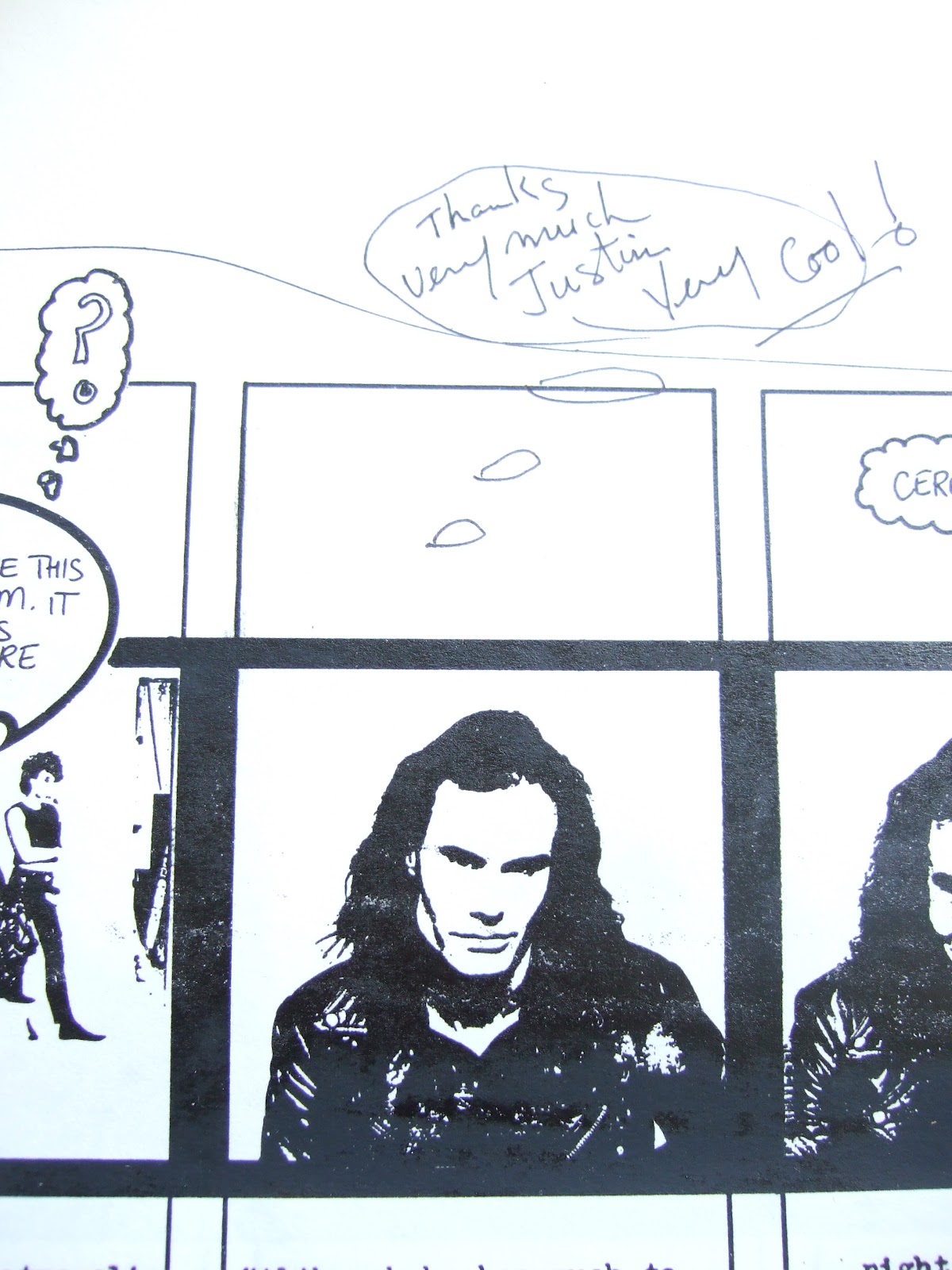
I wasn’t sure how this raw-edged Goth band would like being turned into a cartoon, but that was hardly my problem. The record company was paying the shots and I won’t get paid until they approve a final draft. So I go back to my belfry with a new task: Create a band biography that is dark without being serious because it needs to come off as a cartoon while, at the same time, capture the essence of these individuals.  Amazingly, that’s just what I did. I used contact sheets of the band’s photo session to create a comic book featuring the band collectively and individually. The words inside the word balloons were their own words. The words of the comic book narrator (me) conveyed the dark throb of the city surrounding the band, while the off-camera record company exec kept putting his 2 cents in for the commercial considerations. Yeah, I know; it was weird as hell. When I went back with that new 1st draft I was fully prepared for them to reject it and throw me out of the office forever.

However, that’s not what happened. It was one of the few times in my career that a first draft of something was also the last draft. Everyone loved it except me. It’s not that I didn’t like the words I wrote, or the concept. It had always been the execution that bothered me. It was supposed to mimic a comic book, but I felt there was only a passing resemblance to a comic book. A typed narration at the bottom, with intentional strike-outs over intentional typos was not part of my concept.

No matter. I got paid.

Skip ahead some 25 years. . . .

Skip ahead some 25 years and my son, who was so much of a National Velvet fan when he was a teen that he bought the LP, tells me he’s going to be seeing National Velvet in Ottawa and will be taking one of the biographies I gave him a million years ago with him.

He returned with a happy surprise: The band not only autographed the bio, but part of the inscription was praise for the concept that I felt never worked properly.

THANKS MARIA!!!

Click to enlarge.

Click to enlarge.

Click to enlarge.

And thanks, Justin!!!

Here’s National Velvet’s big hit!!! Flesh Under Skin!!!

Elvis Presley and Frank Sinatra ► Nostalgia Ain’t What It Used To Be

Dateline: May 12, 1960 – Elvis Presley, newly returned from the U.S. Army, serving Uncle Sam, makes his first network tee vee appearance with Chairman of the Board, Frank Sinatra:


And here is Elvis in his prime, in 1956, with one of his earliest hits:


Elvis loved Gospel Music. Listen to his sensitive treatment of the classic “It Is No Secret.”


Fifty-two years ago today!!!

Happy Birthday Dennis Cowan ► Bonzo Dog Band ► May 6

The Bonzo Dog Band

Happy Birthday to Dennis Cowan, celebrating the big Six Five today. Dennis was bassist for the Bonzo Dog Band, originally The Bonzo Dog Dada Band, then The Bonzo Dog Doo Dah Band, before finally settling on the name everyone knows and loves.  The Bonzos, as they are affectionately known among fans, were the most influential band you never heard of and almost indescribable, but I’ll try. Cross a smattering of Lawrence Welk, with heavy doses of Spike Jones and his City Slickers, Frank Zappa and The Mothers of Invention, and Weird Al Yankovic and you’d get the Bonzo Dog Band…but Bonzos are funnier.

A little lesson in British comedy: One can draw a very crooked line from the surreal ’50s radio show The Goon Show–from which Peter Sellers sprang–to the anarchy of Monty Python’s Flying Circus. Between the two was the seminal children’s show [sic] Do Not Adjust Your Set. Later-Pythons Eric Idle, Terry Jones, and Michael Palin wrote and starred in this Thames tee vee series. However, people of all ages tuned in to see the antics of The Bonzo Dog Band, which featured today’s Birthday Boy Dennis Cowan on bass.

Here’s some very early Bonzos from Do Not Adjust Your Set:

People know the band Death Cab For Cutie. However, few know that the name is a tribute to the song of the same name that The Bonzo Dog Band performed in Magical Mystery Tour. This tasty little morsel of Doo Wop is one of few highlights in this horrible film that will always be an albatross around Paul McCartney‘s neck:

Neil Innes also came from the Bonzos and he became, almost, an auxiliary member of Monty Python Flying Circus. As told (accurately) by the WikiWackyWoo:

Innes wrote the songs for Monty Python and the Holy Grail. He appeared in the film as a head-bashing monk, the serf crushed by the giant wooden rabbit, and the leader of Sir Robin’s minstrels. He also had a small role in Terry Gilliam‘s Jabberwocky. Because of these long-standing connections, Innes is often referred to as “the Seventh Python”.

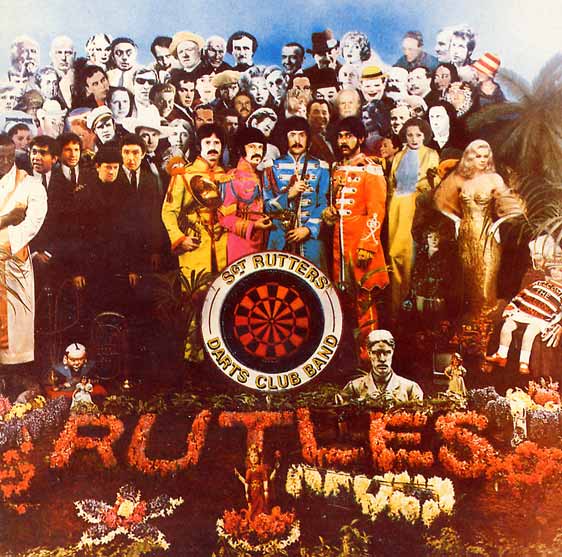
And, indeed, a Neil Innes documentary was called The Seventh Python. Innes was also Ron Nasty in The Rutles, which makes him one
of the Pre-Fab Four. But this isn’t about Innes, which would be a fun transgression.

Photo © Barrie Wentzell
L to R: Dennis Cowan, Roger Ruskin
Spear & Rodney Slater 1969
Photo © Barrie Wentzell, who
sells beautiful prints of early
Bonzo Dog Band and more.

The Bonzo Dog Band classic 1967 recording The Intro and the Outro lampooned every band that ever name-checked and introduced the members of the band. Vivian Stanshall voiced the introductions. This song was the inspiration for Mike Oldfileld when he recorded his solo album Tubular Bells, famously used as the theme music for The Exorcist. Oldfield’s long version introduced all the instruments he played, voiced by none other than the very same Vivian Stanshall.

Lastly, for fans of Beatles trivia, like James Rosen of Fox News (who I stumped. That story coming.), here’s a real rarity: The promotional film for I’m The Urban Spaceman. The original recording of Urban Spaceman was produced Apollo C. Vermouth, which was a pseudonym for Paul McCartney. Enjoy.

R.I.P. ► Lloyd Brevett ► Skatalites Bassist

Jamaica mourns one of her native sons in the passing of Lloyd Brevett, original bassist for The Skatalites, at the age of 80. Brevett was there at the beginning. It is not hyperbole to say that The Skatalites were one of the most influential bands ever, and not just in the narrow genre of Ska. Ask anybody who knows. No less an authority on Ska Music than the New York Times noted: 
Mr. Brevett, a trained jazz bassist, was an original member of the
Skatalites, which was formed in 1964 during the evolution of Jamaican
music from American-influenced rhythm and blues and jazz to the
homegrown syncopated style known as ska, the precursor of reggae, rock
steady and dub. The band members were also active as studio musicians
and backed up the Wailers and other groups.
The Skatalites broke up in the mid-1960s but regrouped in New York 20
years later. Two of their albums, “Hi-Bop Ska!” and “Greetings From
Skamania,” were nominated for Grammy Awards in the 1990s. 

Not just anyone rates a NYT’s obit. Or condolences from a former Jamaincan Prime Minister, who just happened to be Brevett’s tour manager way back when.  According to David McFadden of the Associated Press:
Former Prime Minister P.J. Patterson, who was
once a tour manager for The Skatalites, said that while the band’s great
horn section often drew most of the accolades, it was “Brevett who
quietly provided the mesmerizing backbone to the Skatalites’ sound.”

“To say that Brevett was a creator of both ska and dub is not to use hyperbole,” Patterson said in a statement.

[…]

Legendary Jamaican musicians say it’s difficult to overestimate the role the trained jazz bassist and the rest of the original Skatalites played in developing the Caribbean island’s unique music.

“He was there from the beginning,” Bunny Wailer told The Associated Press. “All my bass lines from all my recordings have been attributed to bass lines from Lloyd Brevett.”

Wailer, the reggae legend who was one of the original Wailers along with Bob Marley and Peter Tosh, praised Brevett as a devout member of the Rastafarian faith and an elder statesman of the island’s culture.

“Brother Brevett’s music is eternal,” Wailer said.

The Skatalites worked with everybody in the Ska-Reggae-Dub genres. In a way similar to Easy Star All Stars many of The Skatalites biggest hits were Ska reworkings of familiar tunes, even if they seemed to be strange choices for a Ska band. However, listen to the playing and the arrangements. This is some excellent musicianship working against the back beat.
Here’s a little Skatalites Jukebox:…and you’ll be dancing when it’s all over:

Rock on, Lloyd Brevett!!! Rock On!!!

Happy Birthday Willie Nelson – Still Crazy After All These Years

Willie Nelson turns 79 today and he’s still going strong, dropping his new CD “Heroes” next month, featuring Merle Haggard, Snoop Dogg, Kris Kristofferson, Billy Joe Shaver,
and Sheryl Crow, among others. Who would have predicted that back in 1961, when Willie was just an itinerant song-plugger trying to sell “Crazy” to Patsy Cline, that one day he would be singing for presidents?

Here’s a Willie Nelson jukebox:

It’s Duke Ellington Day in NYC!!!

New York City Mayor Michael Bloomberg has declared today Duke Ellington Day, on what would have been the 110th birthday of the musical legend.  Edward Kennedy “Duke” Ellington died in 1974 at the age of 75, but his music will never die. According to UPI:

To commemorate the musician’s life, The Islands of the Bahamas said
they are sponsoring a special run of New York’s last surviving 1939 A
Train, made famous in Ellington’s signature tune “Take the A Train.”

Take the A Train,” written by Billy Strayhorn while he was taking the A Train to rehearsal, I have dozens of recordings of “Take the A Train,” by Ellington because he recorded it so many times.  Some live.  Some solo.  Some with a small group.  Some with a full orchestra. Every single one holds new surprises, no matter how familiar I am with the tune. Here are three great versions of Ellington’s signature tune. The first is Duke with a rockin’ trio, followed by an early version with his orchestra, and finally, one with Ella Fitzgerald on vocals.

With thousands of compositions, and so many interpretations of Duke Ellington tunes, it was hard to pick a stand-out performance until I remembered Dr. John’s tribute CD “Duke Elegant.”  Boogie now!!!

Okay, I’ll Confess. I Love Bing Crosby!

People, who know that Dub Reggae is my favourite musical genre, and that I was also a ‘60s psychedelic, hard-driving, product of Detroit, are often surprised to learn that my favourite singer of all is Mr. Bing Crosby. Here’s something totally stupid and incomprehensible to whet your appetite while I try and convince you that Bing was best.

I admit. I didn’t come to appreciate Bing until about 10 years ago. I was born in the early ‘50s. By the time I was rocking out to the MC5 and Iggy Stooge at the Grande Ballroom, I had pretty much dismissed Bing Crosby in my mind as an untalented hack that had only lucked into a singing and acting career. He was the guy that was so easy to imitate—so ubiquitous—that anyone saying “buh buh buh blooo” was referencing him. You couldn’t escape the muther. He would pop up as a caricature in kiddy cartoons of my youth. Nothing says “has been” more to a kid than a caricature someone popping up in a cartoon.  Nothing demonstrates this better than the Warner Brother’s cartoon, “Bingo Crosbyana.”

Of course, this was long before I knew what “homage” meant.

Another thing I disliked about Bing Crosby is that he owned Christmas. As a Jewish boy being called kike in the ‘50s and ‘60s, I was sure that Bing was somehow connected with it all. Hell, maybe he was behind it all, for all I knew. According to Gary Giddins (see below) Crosby “made the most popular record ever, ‘White Christmas,’ the only single to make American pop charts twenty times, every year but one between 1942 and 1962. In 1998, after a long absence, his 1947 version hit the charts in Britain.” And let’s not even talk about all the Christmas movies.

However, worst of all, Bing Crosby was the guy who almost ruined David Bowie for me for all time. I heard Bowie was going to make a rare appearance on a Bing Crosby Christmas special. Wait! What? Yes. True. It took me a long time to forgive Bowie for that. Crosby’s Christmas specials occupy its own niche in the category of Hollywood kitsch. On reflection, with so many years to assuage hurt feelings, the harmonies are lovely and the arrangement of “Little Drummer Boy/Peace on Earth” medley is clever. Still, you have to admit this is the low point of David Bowie’s career, especially the 1st minute, forty nine. Watch:


Here’s what I’m trying to say: I had absolutely no appreciation of Bing Crosby. This, despite being a huge Frank Sinatra fan. I just didn’t think Bing was fit to hold Sinatra’s trench coat.

This began to change about 10 years ago. I was watching a documentary on Louis Armstrong (a musical hero of mine) and in it Mr. Armstrong made 2 remarks: 1). All singing begins and ends with Bing Crosby; 2). Bing’s voice was like honey being poured out of a golden cup.

Well, Louis Armstrong ain’t no slouch and he knows his Jazz. If he’s saying these wonderful things about Bing Crosby, maybe I should reassess my opinion. I started doing a little reading and found that pretty much every singer subsequent to Bing said they merely imitating Crosby and owe it all to him. Elvis name-checked him as an influence, as did both Sinatra and Dean Martin. Here’s a clip from “Robin and the Seven Hoods,” where Sinatra and Martin have a whole lot of fun with Bing’s sartorial choices in “Style.”


Now I was more curious than ever. What was I missing?

Coincidentally (or just another instance of synchronicity), right at this same time I happened to see a book on my local retailer’s remainder table called “Bing Crosby; A Pocketful of Dreams; The Early Years; 1903-1940” by Gary Giddins (who was quoted extensively in that Armstrong documentary referenced above). Amazingly this 592 page book (published in 1991) ends at “White Christmas” and is merely the first volume in a proposed 2-volume set. While reading the book, I also immersed myself in Bing’s earliest recordings, something I had never taken the time to do before.

The light went on!!! I am now a believer!!!

There were recordings I knew, but didn’t realize they were by a young Bing Crosby because his voice had changed so much over the years. His “Pennies From Heaven” or “Brother, Can You Spare A Dime?” are transcendent, blissful, and (here’s the most important part) are full of pathos. His voice carries the drama of the songs in a way that few singers have ever been able to pull off. For so many people of my parent’s age these songs, and Bing Crosby’s version of them, represented the Great Depression.

Everyone knows the dreadful David Lee Roth rip off of the Louis Prima arrangement of “Just a Gigolo/I Ain’t Got Nobody,” however those arrangements make the song swing and being a gigolo doesn’t seem like such a bad life. Even Louis Armstrong’s version swings. However, I never really understood the song until I heard Bing Crosby’s version of “Just a Gigolo” To begin with, it’s a very, very sad song, something you don’t get from Prima, Roth, or Armstrong. When Bing sings it, you hear every ounce of the pathos in the song. Bing also sings the introduction, left off most other versions. I can’t listen to Bing’s version without feeling great empathy for that sad, unemployed, World War One doughboy. Get out a hanky:


I now own a great deal of Bing Crosby’ recordings and I hear something new in them every time I listen.

Finally, here’s a partial list of Bing’s accomplishments, by Giddin in the Introduction to his book, I find most impressive, especially the second-to-last, because that changed Show Business forever: 

  •  He was the first full-time vocalist ever signed to an orchestra. 
  •  He made more studio recordings than any other singer in history (about 400 more than Sinatra). 
  •  He made the most popular record ever, “White Christmas,” the only single to make American pop charts twenty times, every year but one between 1942 and 1962. In 1998, after a long absence, his 1947 version hit the charts in Britain. 
  •  Between 1927 and 1962 he scored 368 charted records under his own name, plus 28 as vocalist with various bandleaders for a total of 396. No one else has come close; compare Paul Whiteman (220), Sinatra (209), Elvis (149), Glenn Miller (129), Nat “King” Cole (118), Louis Armstrong (85), The Beatles (68). 
  •  He scored the most number one hits ever, thirty-eight, compared with twenty-four by The Beatles and eighteen by Presley. 
  •  In 1960 he received a platinum record as First Citizen of the Record Industry for having sold 200 million discs, a number that had doubled by 1980. 
  •  Between 1915 and 1980 he was the only motion-picture star to rank as the number one box office attraction five times (1944-48). Between 1934 and 1954 he scored in the top ten fifteen times. 
  •  “Going My Way” was the highest-grossing film in the history of Paramount Pictures until 1947; “The Bells of St. Mary” was the highest grossing film in the history of RKO Pictures until 1947. 
  • He was nominated for an Academy Award for best actor three times and won for “Going My Way.” 
  • He was a major radio star longer than any other performer, from 1931 until 1954 on network; 1954 until 1962 in syndication. 
  •  He appeared on approximately 4,000 radio broadcasts, nearly 3,400 of them his own programs, and single-handedly changed radio from a live-performance to a canned or recorded medium by presenting, in 1946, the first transcribed network show on WABC — thereby making that also-ran network a major force. 
  •  He financed and popularized the development of tape, revolutionizing the recording industry. 
  •  He created the first and longest-running celebrity pro-am golf championship, playing host for thirty-five years, raising millions in charity and was the central figure in the development of the Del Mar racetrack in California. 

Taste is subjective. We won’t all like the same things in food or music, f’rinstance. However, I suggest you take another listen to Bing Crosby. He’s a lot better than your parents ever told you.

Quality never goes out of style and Bing Crosby has quality!

Nostalgia Ain’t What It Used To Be – Billy Preston

I really miss Billy Preston.  While many musicians recorded with The Beatles, Preston is the only one ever given credit on the record label or liner notes.  That’s because he was already a star with an international reputation.  Billy Preston had been a star since his childhood.  Here he is performing with Nat “King” Cole on the latter’s national television show, a groundbreaking show for Blacks in ‘Merka.

It needs saying: I miss Nat “King” Cole, too.

Let’s talk music.