Tag Archives: Musical Appreciation

Mrs. Miller ► Monday Musical Appreciation

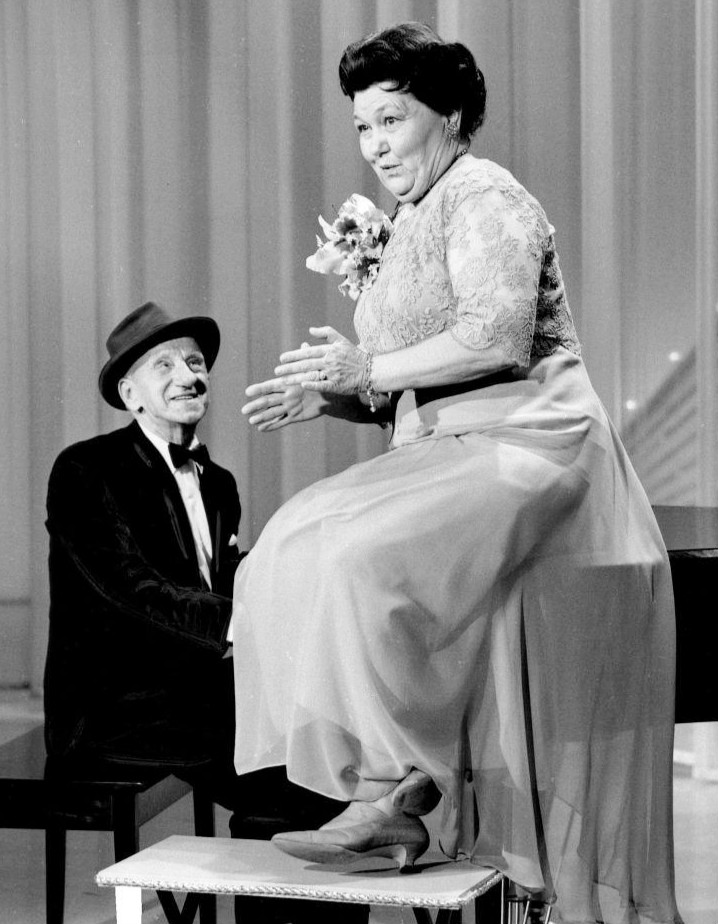
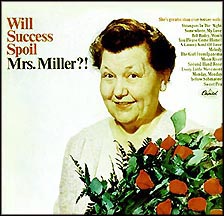
The ’60s are known for great discoveries in music, from Motown to The British Invasion to Psychedelia. However, there was no greater discovery than Mrs. Miller, born on this day in 1907. 

Mrs. Miller was Kitch before Kitch was Kool.

She was discovered in the early ’60s by LA DJ Gary Owens, better known as the announcer on Laugh-In. However, her star didn’t begin to rise until she was signed to Capitol Records in 1965. According to the WikiWackyWoo:

Singing in an untrained, Mermanesque, vibrato-laden style, according to Irving Wallace, David Wallechinsky and Amy Wallace in The Book of Lists 2, Miller’s voice was compared to the sound of “roaches scurrying across a trash can lid.” [1]

While growing up in the ’60s, I was fascinated by Mrs. Miller. I couldn’t wait for her many appearances on the various talk shows of the day. I thought, “If she can make it in Show Biz, then so can I,” which may have been my impetus for starting Cobwebs and Strange, a band I formed with my childhood friends.


According to Searching For Mrs. Miller:

From Claremont [where she lived] to Capitol is two hours in average traffic. There is a piece of story missing here, being that an organist/pianist on these sessions, Fred Bock, by all accounts a smart man with a sharp sense of humor, knew he’d found something unique. Fortunately, he knew somebody of consequence in the music business.

Lois Bock recalls: “Mrs. Miller would come to the L.A. studios and make recordings to send as gifts to orphanages those old, old songs like ` Alice Blue Gown’ in what she called her `operatic style’, and, on one of these sessions, Fred talked her into doing `Downtown’, which he took to Lex, who was an employee of Capitol at the time, and he heard something there.” She was signed to the venerated label, and work began on her debut, Mrs. Miller’s Greatest Hits.

Barry Hansen, a/k/a Dr. Demento raised an interesting point. “It took some imagination on Lex De Azevedo’s part to make an album of her doing all rock ‘n’ roll songs. It certainly was a departure from what she had recorded before.” Conventional legend has it that Mrs. Miller had no idea that she was a novelty act, but Lois Bock is quite clear about what Mrs. Miller was told. “Fred and I were honest with her. We told her it would be funny. And the audience loved it. The more they laughed, the more she would, you know, work it. I don’t know if she knew more than she let on, because she was always quite a character. But she loved audiences.”
Like so many superstars that burned far too bright, Mrs. Miller eventually flamed out:

As Lois Bock said, “She had a good run for eighteen months, which was seventeen-and-a-half more than anyone had a right to expect.” Mrs. Miller continued to perform sporadically, playing more benefits than just about any performer I can name, including one to raise funds to build a hospital in her hometown Jetmore, KS. When the hospital was built, she personally furnished the nurse”s lounge. She also devoted much time to raising her niece, Audrey.

[…] She retired officially in 1973, resigning from the Screen Actors’ Guild in honorable standing, and eventually settled into a condo at 9535 Reseda Blvd in Northridge, CA (the Valley). Unfortunately, in January 1994, the huge Northridge Quake destroyed the complex. Old age took its toll. Elva relocated to the Garden Terrace Retirement Center, in Vista, CA, where she died in 1997, at the age of 90. She is interred at the Pomona Mausoleum, near her beloved Claremont.

However, we still have her music to keep us warm on those cold nights:

Tuli Kupferberg ► Monday Musical Appreciation

Today we celebrate the life, poetry, and music of counter-culture icon Tuli Kupferberg, born on this day in 1923. He was a ground-breaking New York City Bohemian in the right place, at the right time, to find his claim to fame in the Hippie era.

According to his obituary in the New York Times:
The Fugs were, in the view of the longtime Village Voice critic Robert Christgau,
“the Lower East Side’s first true underground band.” They were also
perhaps the most puerile and yet the most literary rock group of the
1960s, with songs suitable for the locker room as well as the graduate
seminar (“Ah, Sunflower, Weary of Time,” based on a poem by William
Blake); all were played with a ramshackle glee that anticipated punk
rock.

With
songs like “Kill for Peace,” the Fugs also established themselves as
aggressively antiwar, with a touch of absurdist theater. The band became
“the U.S.O. of the left,” Mr. Kupferberg once said, and it played
innumerable peace rallies, including the “exorcism” of the Pentagon in
1967 that Norman Mailer chronicled in his book “The Armies of the Night.” (The band took its name from a usage in Mailer’s “Naked and the Dead.”)

When I was growing up The Fugs and Frank Zappa were my introduction to the counter-culture. While the ’60s was filled with psychedelic bands, the fact that their records appeared on mainstream corporate record companies took them down a notch in my opinion. But, not The Fugs. They were as real as real could be.
Rolling Stone’s obit reads in part:

The Fugs formed in 1964 when bookstore owner Sanders and poet
Kupferberg, both barely musicians, teamed up to play an unpolished rock
& roll combined with lyrics stocked with political satire and
profanity. Because of their anti-war imagery — “Who can train guerillas
by the dozens? Send them out to kill their untrained cousins?” asks
frontman Kupferberg in “CIA Man” — and rambunctious live shows in the
mid-’60s, the FBI reportedly investigated the Fugs. The band ultimately
recorded six albums between 1964 and 1969, with Tupferberg contributing
some of the band’s most renowned tracks: “Nothing,” “Kill for Peace,”
“The Ten Commandments” and “CIA Man.” After a 15-year hiatus, Kupferberg
and Sanders reformed the Fugs with a new lineup.

Kupferberg earned a reputation as one of New York’s foremost
bohemians, and even served as the inspiration for the man who jumped off
the Brooklyn Bridge and survived in Allen Ginsberg’s epic poem “Howl.”
Kupferberg “jumped off the Brooklyn Bridge this actually happened and
walked away unknown and forgotten into the ghostly daze of Chinatown,”
Ginsberg wrote. Kupferberg later admitted he was the jumper of
Ginsberg’s poem.

Whenever things get too real for me, I remember The Fugs Gospel-inspired tune Wide, Wide River, which, in a perfect world, should have been Number One on the Hit Parade longer than Carole King’s reign on the top of the charts. Crank it up!!!

PSF:What did think of the Beat movement when it first started happening?

I remember being shocked by it. I guess I was still in some sort of
traditional mode. Shocked, jealousy and then adaptation. It was
liberating. I was shocked by Ed Sander’s freedom of sexual expression.
I’m sure people were shocked by mine when I started. Ginsberg is your
best example of a liberating force. It’s not just the language or the
freedom of the language because that just reflects character structure.
A person who drops dead or wants to kill someone would use all those
words you’re not supposed to use. It’s more than language. It’s
attitude towards sexuality and human relations along with domination and
love. It’s not that people who shout about sexual freedom understand
everything that’s involved. In order to have good sex, you have to have
good human relationships and vice versa. When I grew up, in my
community, you weren’t going to have sex until you got married- this was
a middle-class Jewish community. Maybe you went to a prostitute…
But that gradually broke down. That was all for the good and not just
for me but also for most of America.

PSF: So you got to be part of the Beats yourself then?

Everyone was. But I felt that they had a heritage with the
bohemians. The term comes from 12th century University of Paris. The
craziest students came from Bohemia and they gave them this name.
There’s this old tradition of living outside of the mores of society.
Until the burgeouis revolution, most artists lived on the patronage of
the ruling class. LA VIE DE BOHEME, the libetto for that opera, tells
you what was happening then in the 18th century. So that’s a 150 year
old tradition that’s still going on. It used to be linked to geography
with places like New York, San Francisco, Munich, Paris. But now, with
the Internet, you could be crazy, wild, free and self-destructive
anywhere you want. But hopefully, there’s still communities of people
out there. Utopian colonies who are just friends.

It was always about the poetry. Here’s Tuli in recitation:

Tuli died in 2010 at the age of 86, but his poetry and music live on forever.

A Peruvian Princess Sings ► Monday Musical Appreciation

She’s now considered the Queen of Exotica, the musical genre that encompasses a previous era’s Kitch, but at one time Yma Súmac was considered to be a Peruvian princess.

I discovered Yma Súmac in the early ’60s. Among my mother’s LPs were a couple by Yma Sumac. As a kid I was attracted to crazy colours and costumes on the covers, but once I dropped the needle on the record, I WAS HOOKED!!! That voice! Those songs! I had never heard anything like it before and have been a fan ever since.

There has never been anything else like her. Listen:

Zoila Augusta Emperatriz Chávarri del Castillo, was born on September 13, 1922 in Callao, Peru, but took the name Yma Súmac, which had various spellings until she signed with Capital Records in 1950.

According to the WikiWackyWoo:

Stories published in the 1950s claimed that she was an Incan princess, directly descended from Atahualpa. The government of Peru in 1946 formally supported her claim to be descended from Atahualpa, the last Incan emperor”.[7]
She was the subject of a series of publicity campaigns designed to
shroud her origins in mystery: was she an Inca princess, one of the
chosen ‘Golden Virgins’? Whatever her heritage, what was abundantly
genuine was Sumac’s four octave range, ascending from ‘female baritone,
through lyric soprano, to high coloratura’.

According to her obituary in the LA Times:

Bursting onto the U.S. music scene after signing with Capitol Records in 1950, the raven-haired Sumac was known as the “Nightingale of the Andes,” the “Peruvian Songbird” and a “singing marvel” with a 4 1/2 -octave (she said five-octave) voice.

“She is five singers in one,” boasted her then-husband Moises Vivanco, a composer-arranger, in a 1951 interview with the Associated Press. “Never in 2,000 years has there been another voice like hers.”

After Sumac performed at the Shrine Auditorium with a company of dancers, drummers and musicians in 1955, a Los Angeles Times writer observed:

“She warbles like a bird in the uppermost regions, hoots like an owl in the lowest registers, produces bell-like coloratura passages one minute, and exotic, dusky contralto tones the next.”

Yma Súmac died in a Los Angeles assisted living facility in 1988. You can read all about her amazing life on the internet, but, as always, it’s really about the music. Take a listen:

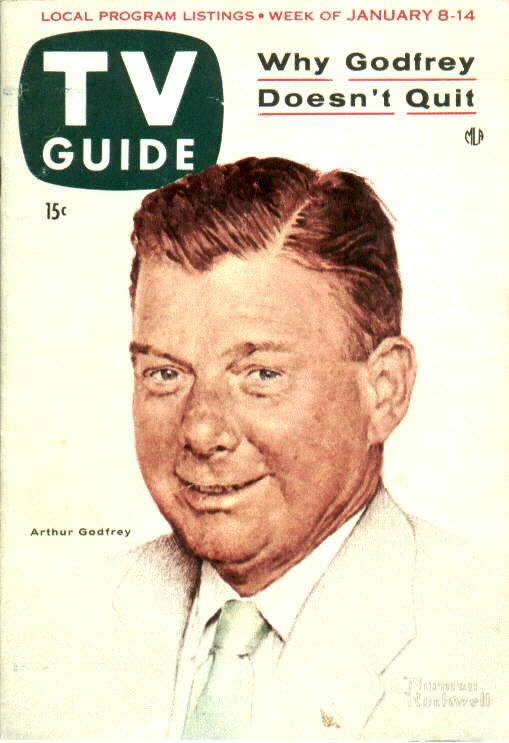
Arthur Godfrey ► A Monday Musical Appreciation

Celebrating a birthday today is Arthur Godfrey, born in 1903. Godfrey rose from a lowly radio announcer to being one of ‘Merka’s biggest celebrities.

Godfrey served in the Navy as a radio operator. Later he joined the Coast Guard, where he appeared on a local Baltimore radio show. When he left the Coast Guard in 1930, he got a job as a radio announcer at a Baltimore station, followed by a stint in Washington, D.C.

While laid up after a car crash, Godfrey listened to his competition. According to the WikiWackyWoo:

[H]e decided to listen closely to the radio and realized that the stiff, formal style then used by announcers could not connect with the average radio listener. The announcers spoke in stentorian tones, as if giving a formal speech to a crowd and not communicating on a personal level. Godfrey vowed that when he returned to the airwaves, he would affect a relaxed, informal style as if he were talking to just one person. He also used that style to do his own commercials and became a regional star.

He kicked around in radio until:

Godfrey became nationally known in April 1945 when, as CBS’s
morning-radio man in Washington, he took the microphone for a live,
firsthand account of President Roosevelt’s funeral procession. The
entire CBS network picked up the broadcast, later preserved in the Edward R. Murrow and Fred W. Friendly record series, I Can Hear it Now.
Unlike the tight-lipped news reporters and commentators of the day, who
delivered news in an earnest, businesslike manner, Godfrey’s tone was
sympathetic and neighborly, lending immediacy and intimacy to his words.
When describing new President Harry S. Truman‘s
car in the procession, Godfrey fervently said, in a choked voice, “God
bless him, President Truman.” Godfrey broke down in tears and cued the
listeners back to the studio. The entire nation was moved by his
emotional outburst.

In the meantime, he released songs that could never be played on the radio in today’s manufactured outrage society.

Godfrey kept moving up. It was far simpler times and Godfrey’s folksy charm was just perfect for the times, where he eventually became one of tee vee’s biggest stars. It started in 1948 with Arthur Godfrey’s Talent Scouts, the precursor to today’s reality talent shows. It was simulcast on both radio and that new invention called television. By 1952 Arthur Godfrey Time was also running on radio and tee vee. Also according to the Woo:

Godfrey’s
skills as a commercial pitchman brought him a large number of loyal
sponsors, including Lipton Tea, Frigidaire, Pillsbury cake mixes and Liggett & Myers‘s Chesterfield cigarettes.

He found that one way to enhance his pitches was to extemporize his
commercials, poking fun at the sponsors (while never showing disrespect
for the products themselves), the sponsors’ company executives, and
advertising agency types who wrote the scripted commercials that he
regularly ignored. (If he read them at all, he ridiculed them or even
threw aside the scripts in front of the cameras.) To the surprise of the
advertising agencies and sponsors, Godfrey’s kidding of the commercials
and products frequently enhanced the sales of those products. His
popularity and ability to sell brought a windfall to CBS, accounting for a significant percentage of their corporate profits.

Here is sample of his television work:

And, Godfrey continued to pump out music that the public bought by the barrel full.

Miami renamed 41st Street Arthur Godfrey Road after him

While Godfrey came across as everyone’s favourite avuncular uncle, behind the scenes he was a control freak and abusive to the “Little Godfreys,” which is what he called his supporting company.

Then came the Julius LaRosa incident, which burst Godfrey’s carefully cultivated personality. According to many reports, jealousy was partially to blame. Godfrey had hired LaRosa as a nobody, after he wowed the audience of Talent Scouts. Eventually LaRose became one of the most popular performers on the show, his fan mail outpacing Godfrey’s. Watch:

The public turned against him and that was the beginning of the end for Godfrey. “No humility,” the phony excuse Godfrey made after-the-fact for firing LaRosa, became a national punchline. Comedians from coast to coast made fun of Godfrey.

While Godfrey remained in show biz for several decades after that, he never again held the huge audience he had during the height of his career.

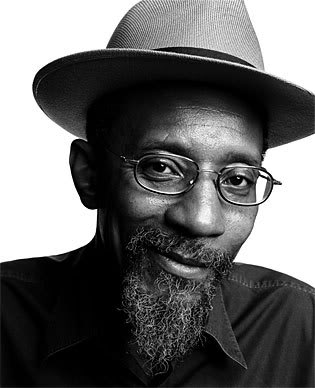
Linton Kwesi Johnson ► A Monday Musical Appreciation

Celebrating a birthday today is Linton Kwesi Johnson, the first Dub Poet. I first became aware of him through Island Records Canada, which I worked for in the ’70s, and he was already a force in Britain. In 2012, according to the The Guardian:

Father of dub poetry Linton Kwesi Johnson will join names including Harold Pinter, JG Ballard and Doris Lessing as winner of the Golden PEN award, for a lifetime’s distinguished service to literature.

Known for his controversial poem “Inglan Is A Bitch“, and for “Di Great Insohreckshan“,
a response to the 1981 Brixton riots in which he stated “It is noh
mistri / we mekkin histri”, Johnson writes what he calls “dub poetry”, a
blend of reggae music and verse written in a Jamaican-London
vernacular. Often performing with the Dennis Bovell Dub Band, he has
been writing and performing since the mid-1970s. In 2002, he was the
second living poet, and the only black poet, to be included in the
Penguin Modern Classic Series.


Linton Kwesi Johnson accepting his Golden PEN award

Johnson was chosen by the trustees of English PEN to receive the
honour. President and author Gillian Slovo described him as “an artistic
innovator, a ground-breaker who has used poetry to talk politics and
who first gave voice to, and who continues to give voice to, the
experience of moving country and of living in this one”.

Johnson himself said he was “surprised and humbled” to win the prize,
because his poetry is from the “little tradition” of Caribbean verse.
“I hope that by conferring on me this award, English PEN will involve
more black writers in its important work and that more black writers
will support English PEN,” he said.

His British Council Literature page says, in part:

He joined the Black Panther movement in 1970, organising a poetry workshop and working with Rasta Love, a group of poets and percussionists. He joined the Brixton-based Race Today Collective in 1974. His first book of poems, Voices of the Living and the Dead, was published by the Race Today imprint in 1974. His second book, Dread, Beat An’ Blood (1975) includes poems written in Jamaican dialect, and was released as a record in 1978. He is widely regarded as the father of ‘dub poetry’, a term he coined to describe the way a number of reggae DJs blended music and verse. Johnson maintains that his starting point and focus is poetry, composed before the music, and for this reason he considers the term ‘dub poetry’ misleading when applied to his own work. He recorded several albums on the Island label, including Forces of Victory (1979), Bass Culture (1980), LKJ In dub (1980) and Making History (1984) and founded his own record label – LKJ – in the mid-1980s, selling over two million records worldwide. 

According to John Dougan’s Artist Biography at All Music:

Although he has only released one album of new material in the last ten
years, and virtually retired from the live stage after his 1985 tour, Linton Kwesi Johnson remains a towering figure in reggae music. Born in Kingston, Jamaica and raised in the Brixton section of London, Johnson invented dub poetry, a type of toasting descended from the DJ stylings of U-Roy and I-Roy. But whereas toasting tended to be hyperkinetic and given to fits of braggadocio, Johnson‘s
poetry (which is what it was — he was a published poet and journalist
before he performed with a band) was more scripted and delivered in a
more languid, slangy, streetwise style.

But, as always, it’s all about The Music:


The Monday Musical Appreciation is a brand new Not Now Silly feature, bringing insight into the music that turns me on.

Happy Birthday Doc Pomus ► A Musical Appreciation

Doc Pomus singing at the Pied Piper with Uffe Bode,
Sol Yaged, John Levy and Rex William Stuart (1947)

Light 88 candles — the same as the number of keys on a piano — for Doc Pomus, one of the greatest names in Rock and Roll you never heard of; a Founding Father and a Brill Building Blues-shouting Jew.

Born Jerome Solon Felder on June 27, 1925, in Brooklyn, he walked with crutches due to a bout of polio at the age of six. He fell in love with The Blues after hearing a Big Joe Turner tune and took the stage name Doc Pomus as a teenager when he started performing in Blues clubs as a teenager. More often than not, he was the only White person in the club. During these years he recorded some 40 songs for small labels.

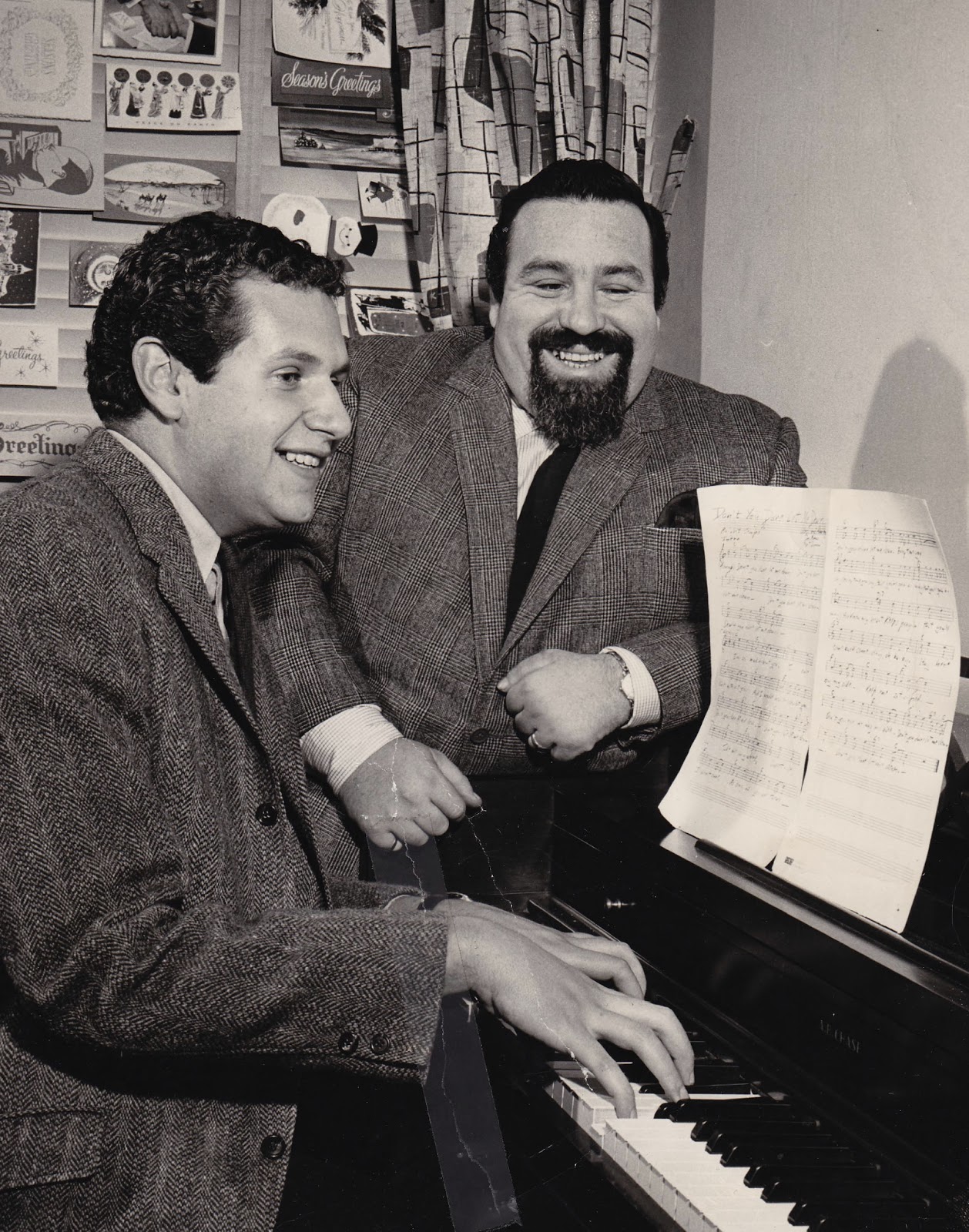
Mort Shuman and Doc Pomus

According to the Songwriter’s Hall of Fame:

At first, penning songs for his own recordings, he soon became a major song source on the New York scene and a regular at the new Atlantic Records’ office, creating classics for Laverne Baker, Ruth Brown, Lil Green, Ray Charles and Big Joe Turner. He enjoyed his first rhythm and blues top ten hit with “Lonely Avenue” by Ray Charles. Hooking up with a team of two other young songwriters, Jerry Leiber and Mike Stoller, he hit big with the Coasters’ “Young Blood.”

Pomus, by coincidence, met a talented teenaged fledgling songwriter Mort Shuman, who was dating Pomus’ cousin. He took Shuman under his wing and eventually the two became full partners despite the 15-year age difference between them.

Ultimately, the pair enjoyed a wonderful nine-year association resulting in a major body of work which, collectively, became a dominant force on the record charts and led to sales of well over one hundred million. The songs included, “This Magic Moment,” “Save The Last Dance For Me,” “Teenager in Love,” “Can’t Get Used To Losing You,” “Turn Me Loose,” “Hushabye,” “I Count The Tears,” “Sweets for My Sweet” and “Seven Day Weekend,” among many others. For Elvis Presley, they produced a series of major hit songs, including “Little Sister,” “Viva Las Vegas,” “His Latest Flame,” “Surrender,” “Suspicion,” “A Mess of Blues” and “Long, Lonely Highway,” to mention a very few.

Just last year a documentary on the great Doc Pomus was released. Making fun of his almost anonymous fame, the movie is called A.K.A. Doc Pomus:

Jeff Tamarkin, in his review of Lonely Avenue; The Unlikely Life and Times of Doc Pomus, by Alex Halberstadt, gets to the bottom of the contradictions:

It wasn’t until long after the hits, after the Beatles and Dylan made irrelevant the songwriting mills, after a 10-year writing sabbatical when high-stakes poker brought in more cash than his royalties, that Pomus began to feel comfortable in his skin. He began writing again, and though his collaborations with the likes of Dr. John and Willy DeVille never came close to the charts, he felt at home with these younger singers, who respected the same traditions he did.

By the ’80s, he had recast himself as an eccentric, ebullient man about town, dressing loudly, throwing lavish parties, turning up nightly at clubs where bouncers cleared a path for his wheelchair and set him in the prime spots. But he also became a magnet for all manner of hangers-on and hucksters, and he took to carrying a business card that read “Doc Pomus — I’ve Got My Own Problems.”

Despite the overhanging gloom, Lonely Avenue — which takes its name from the 1956 Ray Charles hit that put Pomus on the map — is anything but depressing. Halberstadt’s re-creation of period detail is rich as is his portraiture of the myriad characters who flit in and out of Pomus’s life — Muhammad Ali, Veronica Lake (with whom Halberstadt claims Pomus had an affair), Rodney Dangerfield, John Lennon. With access to family and friends, as well as to the late songwriter’s journals — he died in 1991 — Halberstadt (who never met his subject) gets at the heart of Pomus’s often conflicting personal and professional lives.

However, as always, it’s about the music. Here’s a Doc Pomus Jukebox which includes some of his early Blues sides, as well as some of his tunes made famous by others.


As always: CRANK IT UP!!!

Music Brings Our World Together For The First Time

Dateline June 25, 1967 – Our World is broadcast to the entire world, via the very first live, global, satellite hookup. Taking part in the broadcast were creative artists from 19 countries around the globe, including Maria Callas, Pablo Picasso, Marshall McLuhan and The Beatles. More than 350 million people tuned in.

According to the WikiWackyWoo, it took more than 10,000 technicians, producers and translators to pull off the two and a half hour broadcast. The project took 10 months to plan. The countries that participated promised that their segments would be 100% live and no politicians or heads of state could appear. A last minute problem came close to scuttling the project, when the entire Eastern Bloc, directed by the Soviet Union, pulled out in protest over response to the Six Day War.

More from the WikiWackyWoo:

The opening credits were accompanied by the Our World theme sung in 22 different languages by the Vienna Boys Choir.

Canada’s CBC Television had Marshall McLuhan being interviewed in a Toronto television control room. At 7:17 pm GMT, the show switched to the United States’ segment about the Glassboro, New Jersey, conference between American president Lyndon Johnson and Soviet premier Alexei Kosygin; since Our World insisted that no politicians be shown, only the house where the conference was being held was televised. National Educational Television’s (NET) Dick McCutcheon ended up talking about the impact of the new television technology on a global scale.

The show switched back to Canada at 7:18 pm GMT. Segments that were beamed worldwide were from a Ghost Lake, Alberta ranch, showing a rancher, and his cutting horse, cutting out a herd of cattle. The last Canadian segment was from Kitsilano Beach, located in Vancouver, British Columbia’s Point Grey district at 7:19 pm GMT.

At 7:20 pm GMT, the program shifted continents to Asia, with Tokyo, Japan being the next segment. It was 4:20 a.m. local time and NHK showed the construction of the Tokyo Subway system.

The equator was crossed for the first time in the program when it switched to the Australian contribution, which was at 5:22 a.m. Australian Eastern Standard Time (AEST). This was the most technically complicated point in the broadcast, as both the Japanese and Australian satellite ground stations had to reverse their actions: Tokyo had to go from transmit mode to receive mode, while Melbourne had to switch from receive to transmit mode. The segment dealt with Trams leaving the Hanna Street Depot in Melbourne with Australian Broadcasting Commission’s Brian King explaining that sunrise was many hours away as it was winter there. A scientific segment, later on in the broadcast, was also included that dealt with the Parkes Observatory tracking a deep space object.

For the Beatles segment John Lennon wrote All You Need Is Love specifically for the broadcast (though like all their Beatles’ songs it’s credited to Lennon-McCartney). The song premiered that night to the entire world at the very same time. Watch:


The Beatles – All You Need is Love from gledson_adriel on Vimeo.

All recordings of All You Need Is Love were in black and white. This colourized version is from The Beatles Anthology series. Watch it while you can because EMI & The Beatles seem to remove any copies found on the innertubes.

The Beatles released All You Need Is Love as their next single, on July 7, 1967. However, it wasn’t the exact performance from the satellite broadcast. John had been unhappy with his vocals, so he re-recorded them and Ringo fixed a few of the drum tracks, including substituting a drum roll for a tambourine shake during the La Marseillaise section of the tune. The single went straight to the top of the charts, where it stayed for 3 weeks.

A Tribute To Fats Waller ► A Musical Appreciation

If Fats Waller had only written “Honeysuckle Rose” he would have been famous. If Fats Waller had only written “Ain’t Misbehavin’” he would have been famous. If Fats Waller had only written “Squeeze Me” he would have been famous. If Fats Waller had only written “Jitterbug Waltz” he would have been famous. If Fats Waller had only written “(What Did I Do to Be So) Black and Blue” he would have been famous.

Celebrating the joyous birthday of the greatest Stride piano player this country ever produced. Thomas “Fats” Waller was born on May 21, 1904, and died at the young age of 39. Yet in his time he copyrighted more than 400 tunes. He made money off some of them. Others he sold off cheap when he was hurting for cash. Some he lost completely. According to the WikiWackyWoo:


Waller composed many novelty tunes in the 1920s and 1930s and sold them for relatively small sums. When the compositions became hits, other songwriters claimed them as their own. Many standards are alternatively and sometimes controversially attributed to Waller. Waller’s son Maurice wrote in his 1977 biography of his father, that once he was playing “I Can’t Give You Anything but Love, Baby” when he heard his father complaining from upstairs and came down and admonished him never to play that song in his hearing, saying that he had to sell that song when he needed some money. He even made a recording of it in 1938 with Adelaide Hall who, coincidentally, had introduced the song to the world (at Les Ambassadeurs Club in New York in 1928), in which he played the tune but made fun of the lyrics.[2] Likewise, Maurice noted his father’s objections whenever he heard “On the Sunny Side of the Street” played on the radio.[3]

Fats had been taught to play piano by the great James P. Johnson. Johnson was 10 years older and had practically invented Stride piano (often mistakenly called Ragtime piano). He got Fats his first piano roll and recording gigs and they became good friends. However, even Johnson admitted the student had surpassed the teacher.

As a great a piano player Fats was, his favourite instrument was the pipe organ. His father was a preacher and, after taking up the piano at 6, Fats started playing organ in the church at the age of 10. Later he played organ during the silent movies. Once he had gained a bit of fame he was allowed to record syncopated Jazz on the pipe organ, both solo and with “his Rhythm,” the name of his 5 and 6 man combos.

Recording a Jazz group that had a pipe organ as a lead instrument proved to be a technical challenge. It was during the days before electronic microphones had been invented. Performers had to be carefully arranged around a horn, from quietest to loudest, to balance the sound properly. A pipe organ is LOUD! So loud that the recording equipment and Fats’ band had to be on the opposite side of a cavernous room from the pipe organ. That presented a new problem. A slight delay due to the speed of sound caused havoc with the syncopated rhythms. Only the supreme musicianship of “his Rhythm” was able to overcome that challenge. I am most excited by the organ music that Fats recorded.

Sadly Fats Waller made few movies. His over-sized personality and mugging were just perfect for motion pictures, as these two clips attest:


However, the times being what they were, there was not a lot of call for Black performers in the Hollywood of the ’30s and ’40s.

Having said all that, maybe it’s a good thing that Fats Waller didn’t live to his 50s or 60s. I often think of how painful it must have been for Louis Armstrong, accused of being an Uncle Tom during the Civil Rights Era because he felt that putting on an entertaining performance, which included Satchmo’s trademark handkerchief and onstage mugging. However, no one mugged bigger and wider than Fats Waller. I doubt he would have escaped this criticism had he lived.

There are so many great songs and performances that I am having trouble putting together a representative Fats Waller jukebox. I have 515 Fats Waller MP3s, all from my own CD collection. As well, Spotify has identified 1,327 tunes for listening. However, I have tried to include some of his greatest tunes, both solo and band performances, with and without pipe organ. I also included a few interpretations of his music. Enjoy!

***

***

The Very First Grammy Awards ► Musical Appreciation

Domenico Modugno singing his big hit “Nel blu dipinto di blu”

Dateline May 4, 1959 – The very first Grammy Awards are presented to a diverse group of artists and genres for the music of 1958. I thought it might be instructive to take a look back and see what was on The Hit Parade 55 years ago.

There’s no denying that the BIG winner of the night, with both Record of the Year AND Song of the Year, was Domenico Modugno. Let’s hear a round of applause for Domenico Modugno!

Who the hell is that? Oh, c’mon. You know his huge hit tune “Nel blu dipinto di blu.” It was on everyone’s lips in 1958. No? Does this remind you?

How’d you like that interpretive dance near the end? Don’t tell me you skipped that part. Ed Sullivan knew how to pick ’em.

Domenico wasn’t the only one who walked away with a Grammy. Henry Mancini picked up Album of the Year for The Music of Peter Gunn. Everybody sing-a-long:

It was also a very big night for Alvin and the Chipmunks. They also garnered two Grammys, taking home the prize for both Best Children’s Recording AND Best Comedy Recording:

But Domenico and Alvin weren’t the only double award winners that night. Ella Fitzgerald took home two different awards for two different LPs. The Best Jazz Performace by an Individual Grammy award went to Ella for The Duke Ellington Songbook.:

That cut is not from the Ellington songbook LP, but it’s one of my faves from a live performance of Ella with Duke Ellington in Japan. Ella won another Grammy that night in the Pop music category of Best Vocal Performance for her interpretation of the Irving Berlin Songbook:

One of my favourite shows, The Music Man, won for Best Original Cast LP. While it’s cheating to use the 1962 movie version, that’s the one I know best. And since it’s one of my favourite musicals, here are 3 of my fave tunes from it, and the re-release trailer.


With songs like Perry Como’s “Catch A Falling Star” or “That Old Black Magic” by Keely Smith and Louis Prima also grabbing Grammys, there wasn’t a lot of youth culture represented. The only thing resembling Rock and Roll was this song by The Champs, who took home the Grammy for Best Rhythm and Blues Performance.

***

***

Musical Appreciation ► AUNTY EM!!! AUNTY EM!!!

2005 stamp issued by the U.S. Postal Service

Dateline April 8, 1896 – Somewhere over the rainbow, in New York City’s Lower East Side to be exact, Isidore Hochberg was born.

He later changed his name to Edgar Harburg, but he was always known by his nickname “Yipsel” or “Yip.” As Yip Harburg he wrote the lyrics to some of the most popular songs in the ‘Merkin songbook, including Brother, Can You Spare a Dime; April In Paris; It’s Only a Paper Moon; Lydia the Tattooed Lady; and every song in The Wizard of Oz. He won an Academy Award for Best Music, Original Song for “Over the Rainbow.”

It should not be forgotten that Yip Harburg was later a victim of the Hollywood Blacklist in the ’50s. From 1951 to 1962 was unable to work in Tinsel Town due to his leftist leanings. He was luckier than some who were Blacklisted, since he was still able to write musicals for Broadway.

Here are just a few interpretations of Yip Harburg’s most famous songs:


E.Y. Harburg was inducted into the Songwriters Hall of Fame in 1972.