Tag Archives: Nostalgia Ain’t What It Used To Be

Today’s Irony ► Malicious Virus Spoils Birthday Celebrations in Oceania

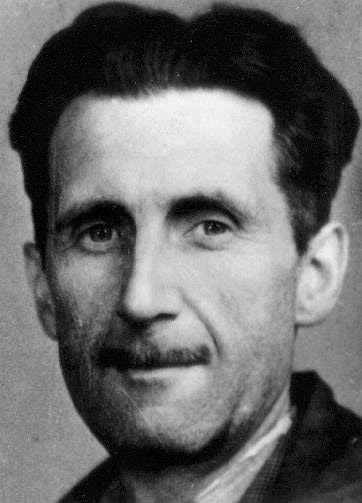
Dateline June 25, 1903 – Future, and futurist, English writer George Orwell is born as Eric Arthur Blair in Motihari, Bihar, India. Today “Orwellian” is an adjective everyone knows. That Big Brother is watching over us was his concept, as was the idea of “Thoughcrime” and “thoughtpolice,” words now used daily.

However, we only know Orwell as a novelist. In his lifetime he was best known as a journalist and Socialist. According to the WickiWackyWoo:

During most of his career, Orwell was best known for his journalism,
in essays, reviews, columns in newspapers and magazines and in his books
of reportage: Down and Out in Paris and London (describing a period of poverty in these cities), The Road to Wigan Pier (describing the living conditions of the poor in northern England, and the class divide generally) and Homage to Catalonia. According to Irving Howe, Orwell was “the best English essayist since Hazlitt, perhaps since Dr Johnson.”[86]

Modern readers are more often introduced to Orwell as a novelist, particularly through his enormously successful titles Animal Farm and Nineteen Eighty-Four. The former is often thought to reflect degeneration in the Soviet Union after the Russian Revolution and the rise of Stalinism; the latter, life under totalitarian rule. Nineteen Eighty-Four is often compared to Brave New World by Aldous Huxley; both are powerful dystopian novels warning of a future world where the state machine exerts complete control over social life. In 1984, Nineteen Eighty-Four and Ray Bradbury‘s Fahrenheit 451 were honoured with the Prometheus Award for their contributions to dystopian literature. In 2011 he received it again for Animal Farm.

Here’s the supreme irony:

Maybe we already live in a dystopian society and we just don’t recognize it yet. I would have preferred to quote from the official George Orwell site. However, it’s been infected by malware. Clicking on it garners this message:

Warning – visiting this web site may harm your computer!

However, let’s forget all that unpleasantness and watch this wonderful BBC drama of 1984, broadcast in 1950, just two years after the novel was published. The more things change, the more they stay the same:

And, if you’ve never seen the animated Animal Farm from 1954, here’s a treat for you:

Finally, the late Christopher Hitchen at the 2002 Hay Festival, on his book “Why Orwell Matters.”

Remember: Some animals are more equal than others. Just ask today’s GOP.

A Tribute To Alan Turing ► The Man Who Saved The World

Dateline June 23, 1912 – Alan Turing was born on this day. Who dat? Oh, just the man who saved millions of lives and maybe the world during World War Two by cracking the Nazi U Boat codes and building the Enigma machine. Doesn’t ring a bell yet? Surely you know him. He’s the guy who, in 1936, built the Universal Turing Machine, which used stored programs, making it a direct descendant of whatever device you are reading this on at this exact moment; essentially a modern computer. 
Yet, why have so few people heard about Alan Turing? He died young to start with, at 42, by his own hand after (rumor has it) he ate a poisoned apple in 1954.* But here’s the real reason we don’t know his name: In 1952 Turing was prosecuted as a homosexual, which was a crime at the time. In order to avoid a prison term he agreed to be chemically castrated. However, his security clearances were revoked and he could no longer carry on his work for the government. He committed suicide on my birthday, June 7, 1954. * In 2009 British Prime Minister Gordon Brown apologized for Turing’s treatment at the hand of the government, which he called “appalling.”

Thousands of people have come together to demand justice for Alan Turing and recognition of the appalling way he was treated. While Turing was dealt with under the law of the time and we can’t put the clock back, his treatment was of course utterly unfair and I am pleased to have the chance to say how deeply sorry I and we all are for what happened to him … So on behalf of the British government, and all those who live freely thanks to Alan’s work I am very proud to say: we’re sorry, you deserved so much better.

To honour the centenary of a very important, but almost forgotten, person, Google produced one of it’s most comprehensible doodles ever:

Events are planned all around the world today, and for the next year, which has been dubbed Alan Turing Year. As well, the Science Museum in Kensington opened a year-long exhibit this week called “Codebreaker – Alan Turing’s Life and Legacy.” The web site states:

Alan Turing is most widely known for his critical involvement in the codebreaking at Bletchley Park during the Second World War. But Alan Turing was not just a codebreaker.

This British mathematician was also a philosopher and computing pioneer who grappled with the fundamental problems of life itself. His ideas have helped shape the modern world, including early computer programming and even the seeds of artificial intelligence. This exhibition tells the story of Turing and his most important ideas.

At the heart of the exhibition is the Pilot ACE computer, built to Turing’s ground-breaking design. It is the most significant surviving Turing artefact in existence.

It offers a small documentary on Turing’s life and work:

Is there any doubt that had Alan Turing not been labeled homosexual, everyone would know his name today?

* At a conference at Oxford today, Professor Jack Copeland was sheduled to present his theory on why Turing’s death might not have been a suicide after all.

Happy Birthday, Moe Howard ► Nostalgia Ain’t What It Used To Be

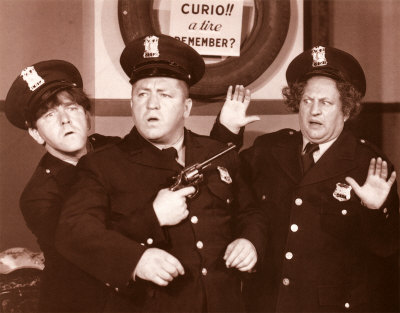
Dateline June 19, 1897 – Moe Howard, future leader of The Three Stooges, was born Moses Harry Horwitz on this date. He would be joined later in life with older brother Samuel (Shemp) and younger brother Jerome (Curly) at different times in one of the longest-running comedy teams in show bidnezz.

Moe Howard began in vaudeville with “Ted Healy and his Stooges,” along with brother Shemp. Soon Healy hired violinist Larry Fine and the Three Stooges were born, more or less, even tho’ they weren’t called that yet. Shemp made one ‘Stooge’ movie with Healy and quit the Stooges to start a solo career. Moe suggested younger brother Jerome/Curly and, after they managed to get rid of Healy, this was the trio that starting making all those Columbia shorts over the years, starting in 1934, and eventually running to 190 with a few cast changes.

In 1946 Curly had a stroke and was replaced by Shemp, who returned to the act where he started. According to the WikiWackyWoo the three Howard brothers made one movie together: 1949’s Hold That Lion. However, further strokes led to Curly’s death in 1952, the year of my birth. Yet, he was very much alive for my childhood.

Shemp died in 1955, yet appeared in four more Three Stooges movies after that, since there was enough footage in the can, but was eventually replaced by Joe Besser. Columbia sold off the Stooge film library to tee vee through the company Screen Gems and that’s when and where subsequent generations learned how to poke people’s eyes out and hit each other over the head with hammers.

Their tee vee poularity led to Moe forming a new Three Stooge ensemble, replacing Joe Besser with Joe DeRita, or Curly-Joe. This trio made several feature length movies and a few guest appearances until they were reduced to a cartoon with filmed live segments bookending the whole dealie.

When he died Moe Howard left behind an unfinished autobiography that was tentatively entitled I Stooge To Conquer, which I would have loved to have been able to read. For many years I belonged to The Official Three Stooges Fan Club [and recently came across all the newsletters in my file cabinet] and read a great deal about their history. The Three Stooges occupy a very narrow niche in Show Biz: Vaudevillians who transitioned to movies who transitioned to tee vee. There were many comedians, none of them slapstick comics for obvious reasons, who transitioned to radio before taking on tee vee.

Yet, despite my love for all things Stooge, this was the worst idea for a remake ever:

The Three Stooges Movie

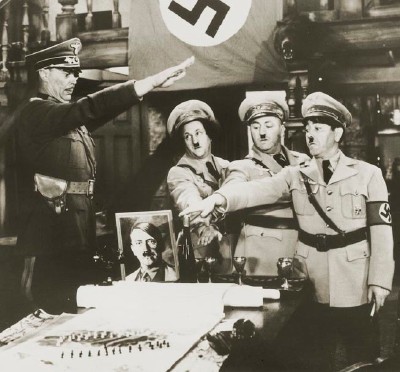
A dishonour. Watch a real Three Stooges classic. Moe Howard was imitating Adolph Hitler before Charlie Chaplin.

What’s really crazy is how much of this I knew by heart, only using Der Googlizer to make sure I had the dates right. I did. I’m such a dork.

Musical Appreciation ► Cole Porter

An example of a “coal porter,”
a man who delivers the coal.
© 2012 Friedrich Seidenstücker,
from the MoMa collection
Another example of a coal
porter is a rail car for coal.
It’s my opinion that no ‘Merkin songwriter has ever been more
deft at the lyric than Cole Porter.
While there are many wonderful things to praise in his music, I would like to
praise his wordplay and his sense of the rhythm of the syllables of spoken,
contemporary English, while imbuing that honest, simple language with more than
a hint of sophistication. His love of language is clear in his lyrics. I have always wondered whether he got his penchant for playing with words because his name is, in fact, a pun, not unlike Aunty Em Ericann.
With a string of songs ranging from “I Get A Kick Out Of You” to “You’re The Top” to “Don’t Fence Me In” to “When We Begin The Beguine” to “Let’s Do It (Let’s Fall In Love)” to “Night and Day” to “Anything Goes” to “Let’s Misbehave” there are so many wonderful Porter lyrics, so let’s get started and break some of them down to celebrate Cole’s 121st birthday.
Ella Fitzgerald has agreed to help me out with this first set of lyrics with “Anything Goes.” Take it away, Ella:

Look at the cadence of these words and the tune, which we all know by heart, just fall into place, that’s how closely locked the words are with the actual rhythms of the song. And, look at where the rhymes fall: both at the ends of lines and within the middle. And, in the middle of the middles are other rhyming words. Look:

In olden days, a glimpse of stocking
was looked on as something shocking.
Now heaven knows, anything goes.
Good authors too who once knew better words,
now only use four-letter words writing prose,
anything goes.
The world has gone mad today,
and good´s bad today, and black´s white today,
and day´s night today,
When most guys today that women prize today
are just silly gigolos.
So though I´m not a great romancer,
I know that you´re bound to answer
when I propose, anything goes.
Isn’t that tasty?

Louis Armstrong and my fellow Canadian Oscar Peterson will be demonstrating a whole different sly word play with “Let’s Do It (Let’s Fall In Love),” which, in 1928, was considered quite risqué for its time. Armstrong sings more different verses than anyone else in this almost 9 minute version and every one of them is clever as all hell.

One of my favourite Cole Porter tunes has to be “You’re The Top” also from the Broadway show “Anything Goes.” It’s filled with clever wordplay, funny pop cultural references which would have, in its time, been known by everyone in the audience, and a wonderful sentiment all wrapped up in that wonderful sense of cadence that the words have on their own. This time Cole Porter has agreed to sing his own song for us and he’s asked us all to sing along:

At words poetic, I’m so pathetic
That I always have found it best,
Instead of getting ’em off my chest,
To let ’em rest unexpressed,
I hate parading my serenading
As I’ll probably miss a bar,
But if this ditty is not so pretty
At least it’ll tell you
How great you are.

You’re the top!
You’re the Coliseum.
You’re the top!
You’re the Louver Museum.
You’re a melody from a symphony by Strauss
You’re a Bendel bonnet,
A Shakespeare’s sonnet,
You’re Mickey Mouse.
You’re the Nile,
You’re the Tower of Pisa,
You’re the smile on the Mona Lisa
I’m a worthless check, a total wreck, a flop,
But if, baby, I’m the bottom you’re the top!

Your words poetic are not pathetic.
On the other hand, babe, you shine,
And I can feel after every line
A thrill divine
Down my spine.
Now gifted humans like Vincent Youmans
Might think that your song is bad,
But I got a notion
I’ll second the motion
And this is what I’m going to add;

You’re the top!
You’re Mahatma Gandhi.
You’re the top!
You’re Napoleon Brandy.
You’re the purple light
Of a summer night in Spain,
You’re the National Gallery
You’re Garbo’s salary,
You’re cellophane.
You’re sublime,
You’re turkey dinner,
You’re the time, 

of a Derby winner.
I’m a toy balloon that’s fated soon to pop
But if, baby, I’m the bottom,
You’re the top!

You’re the top!
You’re an arrow collar
You’re the top!
You’re a Coolidge dollar,
You’re the nimble tread
Of the feet of Fred Astaire,
You’re an O’Neill drama,
You’re Whistler’s mama!
You’re camembert.
You’re a rose,
You’re Inferno’s Dante,
You’re the nose
On the great Durante.
I’m just in a way,
As the French would say, “de trop”.
But if, baby, I’m the bottom,
You’re the top!

You’re the top!
You’re a dance in Bali.
You’re the top!
You’re a hot tamale.
You’re an angel, you,
Simply too, too, too diveen,
You’re a Boticcelli,
You’re Keats,
You’re Shelly!
You’re Ovaltine!
You’re a boom,
You’re the dam at Boulder,
You’re the moon,
Over Mae West’s shoulder,
I’m the nominee of the G.O.P.
Or GOP!
But if, baby, I’m the bottom,
You’re the top!

You’re the top!
You’re a Waldorf salad.
You’re the top!
You’re a Berlin ballad.
You’re the boats that glide
On the sleepy Zuider Zee,
You’re an old Dutch master,
You’re Lady Astor,
You’re broccoli!
You’re romance,
You’re the steppes of Russia,
You’re the pants, on a Roxy usher,
I’m a broken doll, a fol-de-rol, a flop,
But if, baby, I’m the bottom,
You’re the top!

That’s poetry. And it’s such a clever use of the English language. They don’t make songwriters like that anymore.

Here are some more classic interpretations of Cole Porter songs. I’ve also included a few instrumentals, one parody, a few unearthed gems sung by Cole himself (who wasn’t much of a singer), and two totally different versions and arrangements by Julie London, so you can also hear what a terrific tunesmith he was. Cole Porter is The Tops!

Day In History ► It’s My Birthday

Today is the very best day in all of history because today is the day commemorating my birth 60 years ago. Here are just some of the other people I have allowed to share my birthday:

1502 Pope Gregory XIII introduced Gregorian calendar in 1582
1770 Earl of Liverpool (C) British PM (1812-27)
1778 George Bryan “Beau” Brummel, London England, English dandy
1811 Sir James Young Simpson, Scotland, obsterician (used chloroform)
1843 Susan Elizabeth Blow, US, pioneered kindergarten education
1848 Paul Gaugin [Eugene Henri], French post-impressionist painter
1896 Robert Mulliken, US, chemist/physicist (Nobel 1966)
1897 George Szell, Budapest Hungary, conductor (Metropolitan 1942-45)
1909 Congressman Peter Rodino (D-NJ); chaired Watergate hearings
1909 Jessica Tandy, London, actress (Birds, Cocoon, Batteries Not Included)
1917 Dean Martin, singer/comedian (partner for Jerry Lewis)
1917 Gwendolyn Brooks, US poet (The Bean Eaters)
1922 Rocky Graziano, boxer/entertainer (Pantomime Quiz, Martha Raye Show)
1924 Dolores Gray Chic Ill, singer/actress (Designing Woman, Kismet)
1926 Dick Williams, Wall Lake Iowa, choral director (Andy Williams Show)
1929 John Turner, Richmond England, (L) 17th Canadian PM (1984)
1931 Lang Jeffries, Ontario Canada, actor (Skip-Rescue 8)
1937 Neeme J„rvi Tallinn, Estonia, conductor (Estonia Opera 1971)
1940 Tom Jones, Pontypridd Wales, singer (What’s New Pussycat)
1941 Jaime Laredo, Bolivia, violinist (Qn Elisabeth of Belgium prize 1959)
1943 Ken Osmond, actor (Eddie Haskel-Leave it To Beaver)
1943 Nikki Giovanni, poet (LHJ Woman of the Year 1973)
1944 Bill Rafferty, Queens NY, comedian (Laugh-In, Real People)
1944 Clarence White, guitarist (The Byrds-Turn! Turn! turn!)
1946 Bill Kreutzman, drummer (Grateful Dead-Uncle John’s Band)
1947 Thurman Munson, NY Yankee (captain/catcher)
1954 Lui Passaglia, Vancouver BC, CFL place kicker (B.C. Lions)
1955 Joey Scarbury, Ontario Calif, singer (Greatest American Hero)
1958 Christopher Marcantel, Smithtown NY, actor (Chip-Nurse, Loving)
1958 Prince [Rodgers Nelson], rocker/actor (1999, Purple Rain)
1962 Paddy McAloon, rocker (Prefab Sprout-2 Wheels Good)
1971 Mark Wahlberg, Mass, rapper

Here are some of the events I allowed to happen on my birthday:

555 Vigilius ends his reign as Catholic Pope
1614 2nd parliment of King James I, disolves passing no legislation
1654 Louis XIV crowned king of France
1692 Porte Royale Jamaica slides into harbor after earthquake
1769 Daniel Boone begins exploring the Bluegrass State of Kentucky
1775 United Colonies change name to United States
1776 Richard Lee (VA) moves Decl of Independence in Continental Congress
1839 Hawaiian Declaration of Rights is signed
1860 Workmen start laying track for Market Street Railroad, SF
           1st US “dime novel” published: “Malaseka, The Indian Wife
           of the White Hunter,” by Mrs Ann Stevens
1863 Mexico City captured by French troops
1864 Abe Lincoln renominated for Pres by Republican Party
1866 Irish Fenians raid Pigeon Hill, Qu‚bec
1887 Monotype type-casting machine patented by Tolbert Lanston, Wash DC
1892 John J Doyle of Clev Spiders is 1st to pinch hit in a baseball game
1896 G Harpo & F Samuelson leave NY to row the Atlantic (takes 54 days)
1898 Social Democracy of America party holds 1st national convention, Chic
1901 M Wolf discovers asteroid #471 Papagena
1905 Norway dissolves union with Sweden (in effect since 1814)
1909 Cleveland Industrial Exposition opens
1912 St Pius X encyclical “On the Indians of South America”
1912 US army tests 1st machine gun mounted on a plane
1924 George Leigh-Mallory disappears 775′ from Everest’s summit
1929 Vatican City becomes a soverign state

1936 Yanks beat Indians 5-4 in 16; longest game without a strikeout
1938 1st play telecast with original Broadway cast, “Susan & God”
1938 Boeing 314 Clipper flying boat 1st flown (Eddie Allen)
1939 1st king & queen of England to visit US, George VI & Elizabeth
1939 Cleve Indians sets AL record of 16 inning game without
           striking out, however lose the game 5-4 to NY Yankees
1941 Whirlaway wins the Belmont Stakes & the triple crown
1942 USS Yorktown sinks near Midway Island
1953 1st color network telecast in compatible color, Boston, Mass
1954 1st microbiology laboratory dedicated (New Brunswick NJ)
1955 “The $64,000 Question” premiers on CBS TV
1955 1st President to appear on color TV (Eisenhower)
1959 KLX-AM in Oakland Calif changes call letters to KEWB (now KNEW)
1962 NASA civilian test pilot Joseph A Walker takes X-15 to 31,580 m
1963 1st Rolling Stones TV appearance (Thank Your Lucky Stars)
           & release 1st single, “Come on”
1965 Gemini 4 completes 62 orbits
1967 2 Moby Grape members arrested for contributing to deliquency of minors
1967 Israel captures Wailing Wall in East Jerusalem
1968 Sirhan Sirhan indicted for Bobby Kennedy assassination
1969 Bob Dylan & Johnny Cash combine on a Grand Ole Opry TV special
1969 Tommy James & the Shondells release “Crystal Blue Persuasion”
1970 Jockey Willie Shoemaker passes Johnny Longden with his 6,033 win
1970 The Who’s Tommy is performed at NY’s Lincoln Center
1971 Soviet Soyuz 11 crew completes 1st transfer to orbiting Salyut
1972 German Chancellor Willy Brandt visits Israel
1975 Spain’s Manuel Orantes wins US Open, beating Jimmy Connors in 3 sets
1977 Anita Bryant leads successful crusade against Miami gay rights law
1978 Bullets beat Supersonics for NBA championship, 4 games to 3
1979 Bhaskara 1, Indian Earth resources/meteorology satellite, launched
1979 Rocker Chuck Berry is charged with tax evasion
1980 John McEnroe beats Bj”rn B”rg for US Open
1980 Temperance Hill wins Belmont Stakes (50:1 long shot)
1980 Tommy John wins his 200th, 3-0 on a 2-hitter
1981 Bjorn Borg wins his 6th French Open singles (defeats Ivan Lendl)
1981 Israel destroys alleged Iraqi plutonium production facility
1982 NY Mets draft Dwight Gooden, Roger McDowell & Randy Myers
1982 Pres Reagan meets Pope John Paul II & Queen Elizabeth
1983 A Gilmore & P Kilmartin discovers asteroid #3152
1983 Steve Carlton temporarily passes Nolan Ryan with his 3,552 strike out
1986 Madonna’s “Live to Tell,” single goes #1
1989 23 year old olympic barefoot South African runner Zola Budd retires
1989 Atlanta Fulton County Comm approves $210M stadium for the Falcons
1989 Wayne Gretzky wins his 9th NHL Hart (MVP) Trophy in 10 years
           1st Baseball game to start outdoors and end indoors, as Toronto Blue
           Jays stadium closes roof during game at 8:48, & beat Brewers 4-2
1990 Michael Jackson hospitalized for chest pains
1991 Singer Jimmy Osmond weds Michelle Larson

h/t Scope Systems; ANYDAY Today In History

When Whites Went Crazy In Tulsa ► May 31, 1921 ► A Day In History

Otis G. Clark died last week at the ripe old age of 109. Mr. Clark was the last
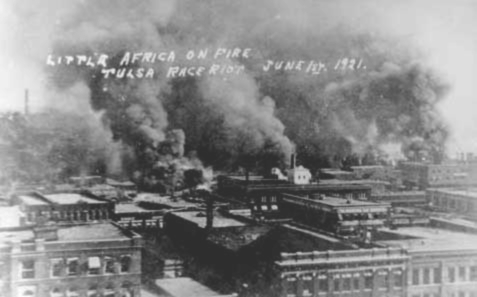
survivor of the terrible Tulsa Race Riot on May 31, 1921, ninety one years ago
today.

The Tulsa Race Riot of 1921 is considered one of the worst race riots in U.S. history, and yet barely anyone knows about it. This history was whitewashed, pun intended, and for decades it wasn’t taught in any Oklahoma history classes. Many people are unaware that during the riot Whites took up in planes left over from World War One. They dropped bombs on and shot at Blacks on the ground.

Otis Clark was just a young man of 18 when the Whites in Tulsa went crazy 91 years ago. According to his obituary at WashPo:

For years, few people dared to speak about what happened on the night of May 31, 1921, during one of the most deadly and devastating race riots in the nation’s history. Otis G. Clark, who was 18 at the time, had grown up in Greenwood, a thriving African American section of Tulsa.

During a night that history almost forgot, Mr. Clark dodged bullets, raced through alleys to escape armed mobs and saw his family’s home burned to the ground. He fled Tulsa on a freight train headed north.

He would eventually move to Los Angeles, where he was the butler in the home of movie star Joan Crawford. He later turned to preaching and was known as the “world’s oldest evangelist.”

Here’s a news report on Mr. Clark when he was just a young pup of 106:

The Tulsa
riot of 1921 began as so many of these other disturbances did: A White person
took offense at something a Black person is alleged to have done and Whites went crazy.

The Oklahoma
Historical Society
has more:

Believed to be the single worst incident of racial violence
in American history, the bloody 1921 Tulsa
race riot has continued to haunt Oklahomans to the present day. During the
course of eighteen terrible hours on May 31 and June 1, 1921, more than one
thousand homes and businesses were destroyed, while credible estimates of riot
deaths range from fifty to three hundred. By the time the violence ended, the
city had been placed under martial law, thousands of Tulsans were being held
under armed guard, and the state’s second-largest African
American
community had been burned to the ground.

[…]

Tulsa
was also a deeply troubled town. Crime rates were sky high, while the city had
been plagued by vigilantism, including the August 1920 lynching,
by a white mob, of a white teenager accused of murder. Newspaper reports
confirmed that the Tulsa
police had done little to protect the lynching victim, who had been taken from
his jail cell at the county courthouse.

Eight months later an incident involving Dick Rowland, an
African American shoe shiner, and Sarah Page, a white elevator operator, would
set the stage for tragedy. While it is still uncertain as to precisely what
happened in the Drexel
Building on May 30, 1921,
the most common explanation is that Rowland stepped on Page’s foot as he
entered the elevator, causing her to scream.

The next day, however, the Tulsa
Tribune
, the city’s afternoon daily newspaper, reported that Rowland,
who had been picked up by police, had attempted to rape Page. Moreover,
according to eyewitnesses, the Tribune also published a now-lost editorial
about the incident, titled “To Lynch Negro Tonight.” By early evening
there was, once again, lynch talk on the streets of Tulsa.
The riot was on. Read more at:
Watch these spaces for an upcoming post about the several Detroit Riots in an upcoming episode of “Unpacking My Detroit.” Or read Part One and Part Two.

Nostalgia Ain’t What It Used To Be ► Mr. Bojangles ► May 25

Dateline May 25, 1878 – Bill “Mr. Bojangles” Robinson was born. It hardly matters that the Jerry Jeff Walker song was written about a White guy in jail in New Orleans. It will always be associated with the renowned star of stage and movies who managed to break thru’ the colour barriers of his time. In the day Black musical performances in movies were filmed in such a way so that they could be cut later when the movie played in the south. Bill Robinson’s dance with Shirley Temple in
The Little Colonel

was the first time audiences saw a Black man dancing with a White girl, with Robinson reprising his famous stair dance.

It hardly seems radical today, but it was groundbreaking in 1935. Yet, he will always be known more for his for his dancing than being the first this or that…which is the way it should be. Here’s his sand dance from “Stormy Weather.”

He just makes it look so easy:

Bill Robinson’s last public appearance was on the Ted Mack Amateur Hour in 1949, just weeks before he died:

As for the song itself? Here’s Jerry Jeff Walker performing it live:

The person who popularized the song, and made it synonymous with Bill Robinson — more than anyone else — was Sammy Davis, Jr., who made it a signature part of act for years.

However, in montage, here’s Sammy describing why emotionally it was such a difficult song for him to perform:

However, this post wouldn’t be complete without Harry Nilsson’s version of Mr. Bojangles. Enjoy:

National Velvet ► Nostalgia Ain’t What It Used To Be

During my long career as a professional writer, there have been times that I was on staff and on a publication’s masthead and other times that I freelanced. As a freelancer, I would take just about any job that involved jamming words together. Once I wrote an entire work of fiction for a corporate brochure that made Scarborough, Ontario, Canada sound like a great place to live and work. It was fiction because I didn’t really feel that Scarborough was a great place to live and work. Despite my dislike for Scarberia, as it is derisively called, the brochure won an award by the City of Scarborough, which couldn’t read through to the sarcasm.  Another of my freelance jobs was writing for record companies. Occasionally these were the dry sales sheets, 200 words tops, which the salesmen would use to get the rack-jobbers to stock the LP. These were boring and tedious to write, but I could bang off up to 10 a day. However, my favourite writing for record companies was when I was hired to write artist biographies. These always involved meeting and interviewing the artists and I liked to spend as much time as possible with the artist/band before I ever sat down to write. And that’s how I came to meet National Velvet, when I was hired to write their biography.

 
Aside from the actual music, artist bios are one of the most important calling cards a band and/or record company has.
Before the first note of music is even heard, the artist biography is
often fully digested. Artist bios are a tricky business. Every word must
be right. The bio needs to capture the essence of the band or artists. It needs to make the reader WANT to play the record. It needs to tell you everything you need to know about the band, yet retain some mystery that can only be solved by listening to the music. There is no formula for writing an artists’ bio. Every one is different because every artist is different.

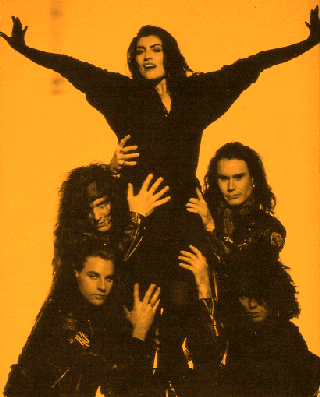
National Velvet were more different than most. NV was a Canadian Goth band before Goth was named Goth. Intrepid Records, distributed by Capital Records Canada, was preparing the release of their first National Velvet LP and hired me to write the bio. I spent about a week with the band, on and off. I went to a few rehearsals, met them in a coffee shop or two, and then someone’s living room. I took notes on how they interacted while recording all their words for posterity. When I felt I had enough, I went back to my belfry to write. One of the things I was struck with after re-reading all the notes I had taken (and which I still have and just used to refreshed my memory) is how thoughtful the band was about their place in the city, the music industry, the record business. I decided that the band’s thoughtful considerations deserved a thoughtful consideration in the biography, which I would blend with the dark, back alleys of the city. Sort of The Dark Knight meets The Hudsucker Proxy.

When I finally had a 1st draft I was happy with I showed it to the record company, the client.  That’s how it worked. Once I had something I liked, I would show it to the client who would tell me whether they liked the path I was on. If so, we’d kick the first draft around 5 or 10 or 15 times, until everyone was happy with the final product. If, in the alternative, the client hated it I would be back at square one, using their ideas to form an entirely new first draft.

In this case Intrepid Records didn’t much like the bio. While it managed to capture the band and the dark underbelly of the city, it came across as far too portentous, far too weighty.  They said, “We like everything about it, except it’s far too serious. What if we made it a cartoon instead?”

It must be noted that the band was not my client. I only had to make the
record company happy. If the band liked the biography the record company
chose to represent them with, that it was a happy bonus.

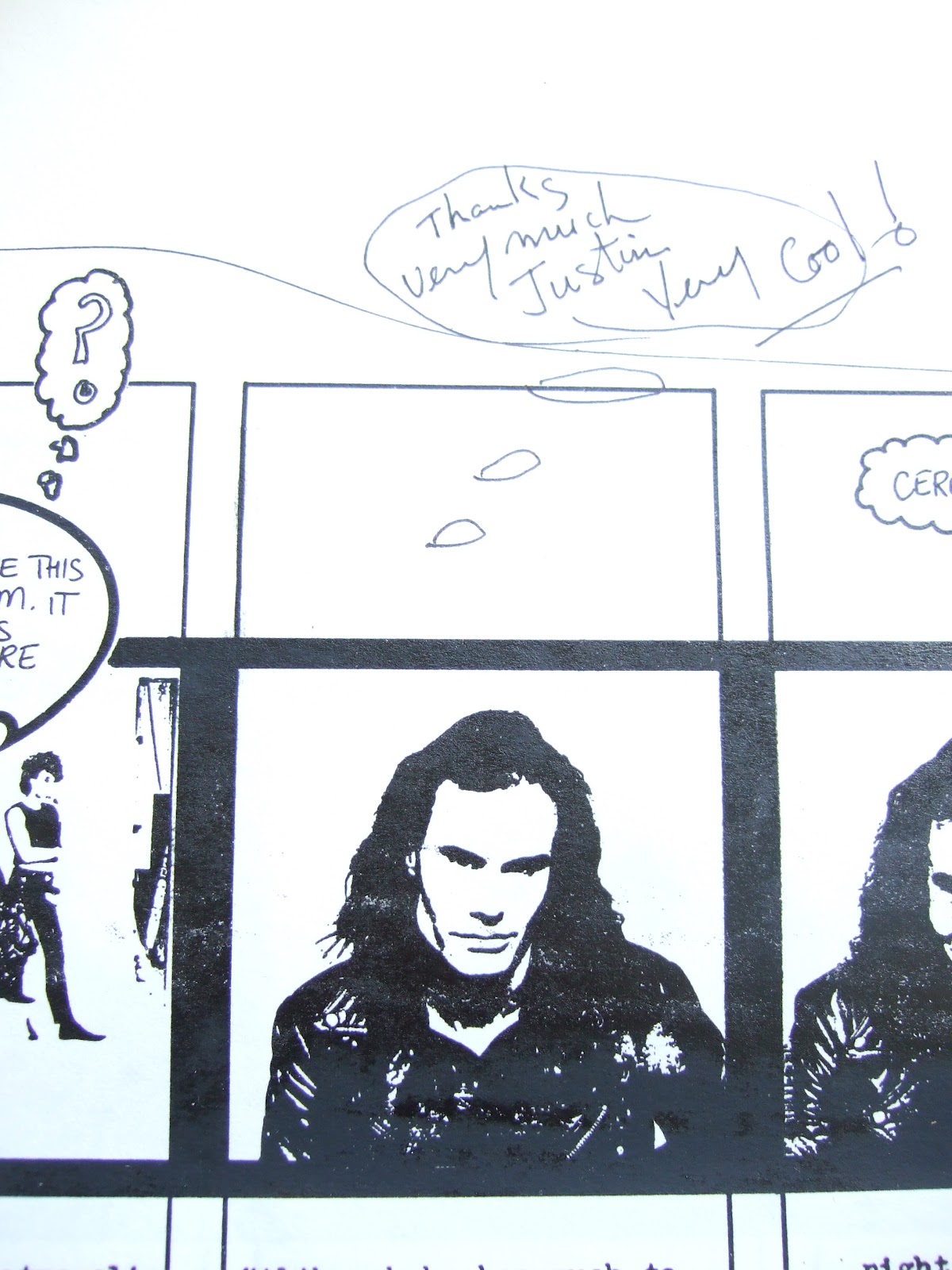
I wasn’t sure how this raw-edged Goth band would like being turned into a cartoon, but that was hardly my problem. The record company was paying the shots and I won’t get paid until they approve a final draft. So I go back to my belfry with a new task: Create a band biography that is dark without being serious because it needs to come off as a cartoon while, at the same time, capture the essence of these individuals.  Amazingly, that’s just what I did. I used contact sheets of the band’s photo session to create a comic book featuring the band collectively and individually. The words inside the word balloons were their own words. The words of the comic book narrator (me) conveyed the dark throb of the city surrounding the band, while the off-camera record company exec kept putting his 2 cents in for the commercial considerations. Yeah, I know; it was weird as hell. When I went back with that new 1st draft I was fully prepared for them to reject it and throw me out of the office forever.

However, that’s not what happened. It was one of the few times in my career that a first draft of something was also the last draft. Everyone loved it except me. It’s not that I didn’t like the words I wrote, or the concept. It had always been the execution that bothered me. It was supposed to mimic a comic book, but I felt there was only a passing resemblance to a comic book. A typed narration at the bottom, with intentional strike-outs over intentional typos was not part of my concept.

No matter. I got paid.

Skip ahead some 25 years. . . .

Skip ahead some 25 years and my son, who was so much of a National Velvet fan when he was a teen that he bought the LP, tells me he’s going to be seeing National Velvet in Ottawa and will be taking one of the biographies I gave him a million years ago with him.

He returned with a happy surprise: The band not only autographed the bio, but part of the inscription was praise for the concept that I felt never worked properly.

THANKS MARIA!!!

Click to enlarge.

Click to enlarge.

Click to enlarge.

And thanks, Justin!!!

Here’s National Velvet’s big hit!!! Flesh Under Skin!!!

Elvis Presley and Frank Sinatra ► Nostalgia Ain’t What It Used To Be

Dateline: May 12, 1960 – Elvis Presley, newly returned from the U.S. Army, serving Uncle Sam, makes his first network tee vee appearance with Chairman of the Board, Frank Sinatra:


And here is Elvis in his prime, in 1956, with one of his earliest hits:


Elvis loved Gospel Music. Listen to his sensitive treatment of the classic “It Is No Secret.”


Fifty-two years ago today!!!