Tag Archives: William Randolph Hearst

Little Nemo In Slumberland ► Saturday Morning Cartoons

Click HERE for larger size

Little Nemo In Slumberland is not really a Saturday morning cartoon, but a weekly comic strip created by famed artist Winsor McCay, sometimes called The Father of American Animation.

If Nemo were his only creation, McCay would still go down in history. However, Zenas Winsor McCay was also the artist behind 1914’s Gertie the Dinosaur, considered the first example of true character animation. The WikiWackyWoo also tells us:

Although Gertie is popularly thought to be the earliest animated film, McCay had earlier made Little Nemo (1911) and How a Mosquito Operates (1912). The American J. Stuart Blackton and the French Émile Cohl had experimented with animation even earlier; Gertie being a character with an appealing personality distinguished McCay’s film from these earlier “trick films”. Gertie was the first film to use animation techniques such as keyframes, registration marks, tracing paper, the Mutoscope action viewer, and animation loops. It influenced the next generation of animators such as the Fleischer brothers, Otto Messmer, Paul Terry, and Walt Disney. John Randolph Bray unsuccessfully tried to patent many of McCay’s animation techniques and is said to have been behind a plagiarized version of Gertie that appeared a year or two after the original. Gertie is the best preserved of McCay’s films—some of which have been lost or survive only in fragments—and has been preserved in the US National Film Registry.

Little Nemo began his life as a comic strip, running in the New York Herald from 1905 to 1911. Hired away by William Randolph Hearst — in an early dispute about Intellectual Property — the Herald won the rights to the Little Nemo name, but McCay was able to move the characters he created to the New York American, where they reappeared under the name “In the Land of Wonderful Dreams.”

McCay led a fascinating life. During his time with the Hearst papers, he also debuted a vaudeville act, where he would produce drawings at a rapid pace. He would also appear with his animated creation Gertie in an interactive show. A live McCay would command the animated figure, who would comply.

It was a box office hit in much simpler times.

Eventually, Gertie toured the country in the form seen above, without the live segments, using intertitles instead.

Hearst, who seemed to think he owned McCay, objected to his vaudeville career because he thought the strip suffered. When he couldn’t reach McCay because he was on stage, Hearst ordered his papers not to run advertising for the stage show. Eventually the artist was forced to limit his stage appearances and, in the end, Hearst got McCay off the stage almost completely. However, he also agreed to pay McCay more to make up for the loss of the box office income.

In the ’70s I became interested in comic strips that came before my time. Starting with what’s considered the Golden Age of Superheroes, I worked backwards.

I fell in love with Little Nemo the second I found him. He’s been my favourite comic strip character ever since. I’ve bought large coffee table books filled with Slumberland comics and return to them often.

Little Nemo is simply gorgeous to look at. Each viewing brings out details not noticed before. While McCay created much of the later vocabulary of the graphic artist, no other comic strip before, or since, looks this way. Cartoonists ever since have tried to imitate him, but nobody has ever come close.

However, it’s appeal to me is based on more than that. Little Nemo has always appealed to both the child and the cynic in me: Dreaming big but waking up in the same mundane world day after day no matter how exciting a night I may have had.

Apparently there was a crappy animated movie made in 1989 called Little Nemo: Adventures in Slumberland. From all reports I’m glad I missed it.

The images for this post came from (were swiped at) The Comic Strip Library, a wonderful source. Here are a couple more full size:


Prohibition Then and Now

Detroit on January 16, 1920, the day before prohibition began.

DATELINE October 28, 1919 – The House overrides President Woodrow Wilson’s veto to pass the 18th Amendment, also known as the Volstead Act. The Senate went along the following day, which brought in prohibition across the nation the following January. Prohibition lasted for almost 14 years — 14 years of extreme lawlessness. It was a complete failure. As PBS tells us

Prohibition turned law-abiding citizens into criminals, made a mockery
of the justice system, caused illicit drinking to seem glamorous and
fun, encouraged neighborhood gangs to become national crime syndicates,
permitted government officials to bend and sometimes even break the law,
and fostered cynicism and hypocrisy that corroded the social contract
all across the country. With Prohibition in place, but ineffectively
enforced, one observer noted, America had hardly freed itself from the
scourge of alcohol abuse – instead, the “drys” had their law, while the
“wets” had their liquor. 

 I highly recommend the three-part Ken Burns-Lynn Novik documentary Prohibition. Here’s a taste:

Watch Al Capone Beer Wars on PBS. See more from Prohibition.

Prohibition Now

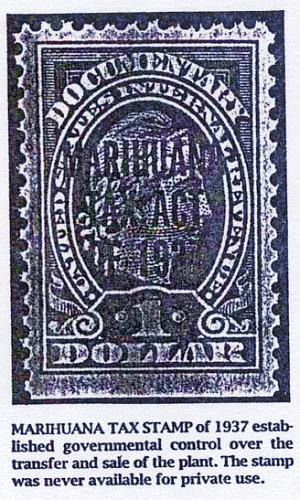
‘Merka learned almost nothing from Prohibition. No sooner did the country do away with Prohibition, it brought in the Marihuana [sic] Tax Act of 1937. Oddly enough, the law did not outlaw marijuana; it merely required paying a tax of about a dollar to deal in hemp, marijuana, or cannabis. However, it was impossible to obtain a tax stamp. This effectively made marijuana illegal even though there are many uses for marijuana, whether for smoking or making products out of hemp, such as paper.

The outlawing of marijuana was a perfect storm of business interests and racism, all whipped up by Harry J. Anslinger, who was appointed to the Federal Bureau of Narcotics in 1930 by Treasury Secretary Andrew W. Mellon. One of the Mellon Bank’s financial interests was DuPont, which was moving out of munitions and into plastics and synthetic fibers. Hemp, which had been a huge industry at the time, was a threat to DuPont’s plans.

One of Anslinger’s weapons in his campaign to outlaw marijuana was undisguised racism, as DrugWarRant.com clearly lays out in its report on Why Is Marijuana Illegal:

He also promoted and frequently read from “Gore Files” — wild reefer-madness-style exploitation tales of ax murderers on marijuana and sex and… Negroes. Here are some quotes that have been widely attributed to Anslinger and his Gore Files:

    “There are 100,000 total marijuana smokers in the US, and most are Negroes, Hispanics, Filipinos, and entertainers. Their Satanic music, jazz, and swing, result from marijuana use. This marijuana causes white women to seek sexual relations with Negroes, entertainers, and any others.”

“…the primary reason to outlaw marijuana is its effect on the degenerate races.”

“Marijuana is an addictive drug which produces in its users insanity, criminality, and death.”

“Reefer makes darkies think they’re as good as white men.”

“Marihuana leads to pacifism and communist brainwashing”

“You smoke a joint and you’re likely to kill your brother.”

“Marijuana is the most violence-causing drug in the history of mankind.”

And he loved to pull out his own version of the “assassin” definition:

“In the year 1090, there was founded in Persia the religious and military order of the Assassins, whose history is one of cruelty, barbarity, and murder, and for good reason: the members were confirmed users of hashish, or marihuana, and it is from the Arabs’ ‘hashashin’ that we have the English word ‘assassin.’”

Yellow Journalism

Harry Anslinger got some additional help from William Randolf Hearst, owner of a huge chain of newspapers. Hearst had lots of reasons to help. First, he hated Mexicans. Second, he had invested heavily in the timber industry to support his newspaper chain and didn’t want to see the development of hemp paper in competition. Third, he had lost 800,000 acres of timberland to Pancho Villa, so he hated Mexicans. Fourth, telling lurid lies about Mexicans (and the devil marijuana weed causing violence) sold newspapers, making him rich.

Movies such as Reefer Madness (1936) helped to drive the national hysteria:

While the Marijuana Tax Act of 1937 was supplanted by various laws over the years, the result is the same: Marijuana is still illegal. Some of the costs of the War on Drugs include:

  • Amount spent annually in the U.S. on the war on drugs: More than $51,000,000,000
  • Number of people arrested in 2010 in the U.S. on nonviolent drug charges: 1,638,846
  • Number of people arrested for a marijuana law violation in 2010: 853,838
  • Number of those charged with marijuana law violations who were arrested for possession only: 750,591 (88 percent)
  • Number of Americans incarcerated in 2009 in federal, state and local prisons and jails: 2,424,279 or 1 in every 99.1 adults, the highest incarceration rate in the world
  • Fraction of people incarcerated for a drug offense in state prison that are black or Hispanic, although these groups use and sell drugs at similar rates as whites: 2/3
  • Number of states that allow the medical use of marijuana: 17 + District of Columbia
  • Estimated annual revenue that California would raise if it taxed and regulated the sale of marijuana: $1,400,000,000
  • Number of students who have lost federal financial aid eligibility because of a drug conviction: 200,000+
  • Tax revenue that drug legalization would yield annually, if currently-illegal drugs were taxed at rates comparable to those on alcohol and tobacco: $46.7 billion

Gary Johnson, former Governor of New Mexico and current candidate for President of the United States for the Libertarian Party argues

It’s time we tax and regulate marijuana. The War on Drugs is a proven failure.  We have spent several decades and close to a trillion dollars trying to eliminate drugs.

Consider these facts:

  • The last three Presidents and half of American adults have said they have smoked marijuana.
  • More children have tried marijuana, which is illegal, than cigarettes, which are regulated.
  • Last year we arrested 850,000 people for marijuana, mostly for possession.
  • So far, fourteen states have passed medical marijuana laws enabling sick people to benefit.
  • Massachusetts, Denver, and Seattle have either successfully decriminalized, or instituted lowest priority law enforcement policies for marijuana possession.

We learned a valuable lesson with alcohol prohibition in this country. Prohibition created black markets and violence as gangs fought to control the market. The same thing is true today.  Mexican cartels make the majority of their profits distributing marijuana in 230 American cities, and the resulting violence is tragic. That’s why the presidents of many Latin American countries signed a declaration that the war on drugs needs to be ended.

Isn’t it time to do away with the War on Drugs?

Ron Mann’s 1999 documantary Grass: The History Of Marijuana is a great overview of how marijuana became illegal.

Day In History ► May 1 ► Citizen Kane Premiers

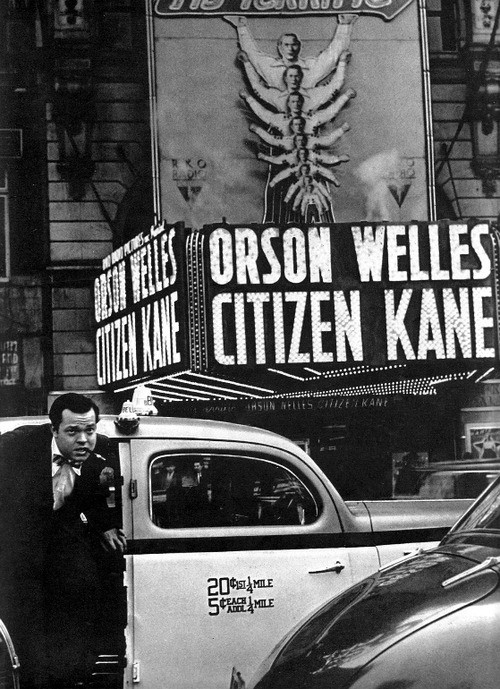
DATELINE 1941 – After a fight between William Randolph Hearst and RKO Radio Pictures, Citizen Kane is finally released to the public. This film both created and cemented the reputation of Orson Welles, who never had final control of a movie again.
Welles had been a hot commodity after his Mercury Theatre (it’s an ironic insult that Glenn Beck’s company name pays tribute to Welles) scared the crap out of ‘Merka with his radio drama of H.G. Wells “War of the Worlds.” Soon afterwards RKO signed him to an unprecedented picture deal with full artistic control and the rest is history and allegory.
Orson Welles arriving at the premier
Over the years the reputation of Citizen Kane has grown and many, including myself, think it’s the greatest film ever made. Much of the film’s language was adapted by directors over the years. Therefore Citizen Kane hardly looks as revolutionary as it was back in the day. Welles went on to make many movies over the years, but none were as TERRIFIC as Citizen Kane
As always the nonconformist, here’s Welles’ trailer for Citizen Kane, which includes many scenes not in the final movie, some which appear to have been created for this advert and some back-stage tomfoolery. Enjoy:

Rosebud!