All posts by Headly Westerfield

About Headly Westerfield

Calling himself “A liberally progressive, sarcastically cynical, iconoclastic polymath,” Headly Westerfield has been a professional writer all his adult life.

Happy Birthday Roger Ruskin Spear ► Bonzo Dog Band

It wasn’t all that long ago that I celebrated the birth of Dennis Cowan, a founding member of The Bonzo Dog Dada Band. Today let’s all press our trousers for Roger Ruskin Spear, another founding Bonzo. Music/Not Music called Spear “The Forgotten Bonzo” just 12 days ago. Not for me. While Spear never achieved the later fame of Neil Innes, for me Roger Ruskin Spear was the one who put the Dada in The Bonzo Dog Dada Band, those off-the-wall tangents into clothing and other fashion accoutrements that’s clearly a Spear obsession. Ironically, while he played many instruments — tenor saxophone, trumpet, xylophone, bells, clarinet, guitar, oboe, accordion, glockenspiel, as well as sang — he is still best know for playing The Theremin Leg, most notably on the recording “Noises For The Leg.”

Here Roger Ruskin Spear plays the dress form to piano accompaniment on Strauss’ Blue Danube:

I was fortunate to see The Bonzo Dog Doo Dah Band live once at, of all things, The First Annual Detroit Rock and Roll Revival, in May of 1969, my last summer in ‘Merka. That’s where I first heard Bonzo Dog Band and was amazed at the performance they put on. Check out that line-up: Among the other band that performed that weekend
were MC5, Chuck Berry, Sun Ra, Dr. John, Johnny Winter, Stooges, Amboy
Dukes, SRC, The Frost, The Rationals, Teegarden & Van Winkle, Lyman
Woodard, Up, Wilson Mower Pursuit, Grand Funk Railroad, Third Power, New
York Rock & Roll Ensemble, David Peel & The Lower East Side,
Red White & Blues Band, Sky, The Train, Savage Grace, James Gang,
Caste, Gold Brothers, Dutch Elm, Plain Brown Wrapper, Brownsville
Station.

When I moved to Canada, I took with me my love of the Bonzos with me. However, I found that most of the people I tried to turn on to The Bonzos already knew who they were, from the British/Monty Python influence.

Bonzo Dog Band performing at the First Annual Detroit Roch and Roll Revival. Photo by Alan Gotkin.

Because people always get the various Bonzos confused, here’s a handy introduction:

Amazingly, I find that Roger Ruskin Spear still has a few dates on his calendar, even tho’ Neil Innes has him retired, with Three Bonzos and a Piano.

I will go on record again: Bonzo Dog Band is the most influential band no one knows. 

Let’s end with a Roger Ruskin Spear Jukebox:


As always CRANK IT UP!!!

Happy Birthday ► Mel Kaminsky

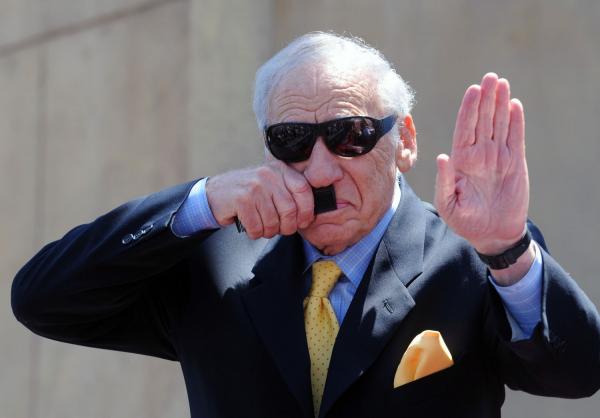
Dateline June 28, 1926 – Melvin Kaminski is born in Brooklyn, New York. It will be many years before he changes his name to Mel Brooks and makes the world laugh. Born only in 1926? Feels like Mel Brooks is as old as The Bible.

I’m not sure I believe that birth year. Mel Brooks has offered proof over and over he is at least a 2,000 Year Old Man.

Deep down inside, Mel Brooks wants to be known as a song and dance man. Over the years he’s given us some terrific Musical numbers.

No one in Pop Culture, including Glenn Beck, has made more references to Nazis.

Brooks has also mined Rap more than once, with equally fun results.

And, this is why people call me Hedley Lamarr:

However, my favourite Mel Brooks movie is the little known The Twelve Chairs, which was released in 1970 between The Producers and Blazing Saddles. Here is the whole movie:

Happy Birthday, Mel!!! Thanks!!!

Musical Appreciation ► Georgie Fame

I first heard Georgie Fame as did many other ‘Merkins, as the singer of “The Ballad of Bonnie and Clyde” in 1967. It was one of those out-of-the-box hits that always appealed to me. I was unaware of his earlier hits “Yeh Yeh,” which knocked The Beatles off the #1 on the British charts, and “Getaway.” Nor did the name Georgie Fame register with me. Therefore, I was surprised many years later when my boss at Island Records Canada handed me a record to promote. One of the tracks was “The Ballad of Bonnie and Clyde” and I knew every note and nuance, even if I didn’t know the name Georgie Fame. I later learned this was a compilation LP by Georgie Fame. (I’m not sure how that came about. My assumption, which could be wrong, is that Island Records licensed the tracks for markets other than Great Britain.) However, I soon learned “The Ballad of Bonnie and Clyde” was not representative of the music Georgie Fame and the Blue Flames (a name that didn’t appear on the sleeve, if memory serves) had been making. I immediately became a fan, precisely because his music is so hard to pigeon-hole, playing Jazz, Ska, R&B, Rock and Roll, Pop, and Standards.


This clip shows a nice bit of Georgie Fame’s history, along with Bonnie & Clyde’s.

Georgie Fame performing his earlier hit “Yeh Yeh” live for a Swinging Sixties tee vee show:

Georgie Fame & Alan Price performing one of their best known songs: Rosetta:

Let’s not forget that Georgie Fame was such a huge fan of Ska, that he started performing it in the ’60s, which only helped popularize the genre throughout the British Colonies. That’s why he can hold his own with Prince Buster and Suggs from Madness, (along with getting his own shout-out:

Presenting a Georgie Fame Jukebox, which includes a few renditions of a song all about him, while you read a short little bio of Georgie Fame:

As always, CRANK IT UP!!!

Born on June 26, 1943 in Leigh, Lancashire, where his father played in an amateur dance band and where music was a intregal part of home life. Early training on the piano led to a love of some of the early rockers like Fats Domino, Jerry Lee Lewis and Little Richard. Soon he was performing with his own band “The Dominoes.” As the story on the official web site goes:

In July 1959, at a summer holiday camp, Clive was spotted by Rory Blackwell, the resident rock and roll bandleader. Blackwell offered the young singer/pianist a full time job and the teenager happily left his job at the weaving mill. Rory and the Blackjacks departed for London, their hometown, when the summer season ended prematurely and Clive went with them. The promise of lucrative work in the music business didn’t materialize, however, and the band broke up. The determined young man from Leigh opted to stay on in London, but for a time it proved rough going. He tried unsuccessfully to make his way back home, and eventually he had the good fortune of finding “lodging” at The Essex Arms pub in London’s Dockland, where the kindly landlord provided him a room where he could sleep.

In October of that year, the Marty Wilde Show was performing at the Lewisham Gaumont and Rory Blackwell arranged for Clive to audition “live” for impresario Larry Parnes. After walking on stage, without any rehearsal, he sang Jerry Lee Lewis’ High School Confidential and was promptly hired as a backing pianist for the Parnes “stable” of singers. As with all the other young talent Parnes had taken on (such as Billy Fury and Johnny Gentle), he renamed Clive Powell “Georgie Fame,” and the name has stuck to this day. By the age of 16, Georgie had toured Britain extensively, playing alongside Marty Wilde, Billy Fury, Eddie Cochran, Gene Vincent, Tony Sheridan, Freddie Canon, Jerry Keller, Dickie Pride, Joe Brown and many more. During this time, Billy Fury selected four musicians, including Fame, for his personal backing group and the “Blue Flames” were born. At the end of 1961, after a disagreement, the band and Fury parted company.

I was also unaware Fame’s earlier work with Alan Price. Price was already well-known in the world of Pop music. He had hired a young Eric Burton to sing with his “Alan Price Rhythm and Blues Combo” in 1962, which by 1964 had become The Animals, mining old Blues songs. Price’s arrangement of “House of the Rising Sun” was a worldwide hit. Skipping ahead some 7 years, as the Alan Price web site tells us:

He then began a partnership with fellow-blues keyboardist and old chum, Georgie Fame, which gave birth to a hit single, Rosetta (which reached No. 11 in 1971), a highly-rated album (Price And Fame Together), their own television series (The Price Of Fame), and regular appearances on many others.

It was during one of the duo’s road tours that Malcolm MacDowell and Lindsay Anderson approached Alan about composing the music for the legendary cult film, O Lucky Man (in which he also appeared as himself). The phenomenal success of this project earned Price a BAFTA award, an Oscar nomination, and yielded his first US chart album.

Georgie Fame has been performing his own brand of music for more than 50 years. I feel lucky I got see him in a club on Jarvis Street in Toronto years later. Happy Birthday, George. You brought me many years of terrific music.

Today’s Irony ► Malicious Virus Spoils Birthday Celebrations in Oceania

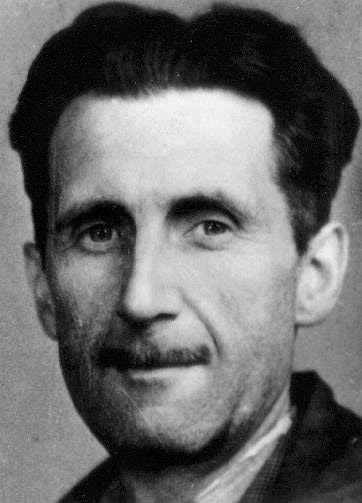
Dateline June 25, 1903 – Future, and futurist, English writer George Orwell is born as Eric Arthur Blair in Motihari, Bihar, India. Today “Orwellian” is an adjective everyone knows. That Big Brother is watching over us was his concept, as was the idea of “Thoughcrime” and “thoughtpolice,” words now used daily.

However, we only know Orwell as a novelist. In his lifetime he was best known as a journalist and Socialist. According to the WickiWackyWoo:

During most of his career, Orwell was best known for his journalism,
in essays, reviews, columns in newspapers and magazines and in his books
of reportage: Down and Out in Paris and London (describing a period of poverty in these cities), The Road to Wigan Pier (describing the living conditions of the poor in northern England, and the class divide generally) and Homage to Catalonia. According to Irving Howe, Orwell was “the best English essayist since Hazlitt, perhaps since Dr Johnson.”[86]

Modern readers are more often introduced to Orwell as a novelist, particularly through his enormously successful titles Animal Farm and Nineteen Eighty-Four. The former is often thought to reflect degeneration in the Soviet Union after the Russian Revolution and the rise of Stalinism; the latter, life under totalitarian rule. Nineteen Eighty-Four is often compared to Brave New World by Aldous Huxley; both are powerful dystopian novels warning of a future world where the state machine exerts complete control over social life. In 1984, Nineteen Eighty-Four and Ray Bradbury‘s Fahrenheit 451 were honoured with the Prometheus Award for their contributions to dystopian literature. In 2011 he received it again for Animal Farm.

Here’s the supreme irony:

Maybe we already live in a dystopian society and we just don’t recognize it yet. I would have preferred to quote from the official George Orwell site. However, it’s been infected by malware. Clicking on it garners this message:

Warning – visiting this web site may harm your computer!

However, let’s forget all that unpleasantness and watch this wonderful BBC drama of 1984, broadcast in 1950, just two years after the novel was published. The more things change, the more they stay the same:

And, if you’ve never seen the animated Animal Farm from 1954, here’s a treat for you:

Finally, the late Christopher Hitchen at the 2002 Hay Festival, on his book “Why Orwell Matters.”

Remember: Some animals are more equal than others. Just ask today’s GOP.

A Tribute To Alan Turing ► The Man Who Saved The World

Dateline June 23, 1912 – Alan Turing was born on this day. Who dat? Oh, just the man who saved millions of lives and maybe the world during World War Two by cracking the Nazi U Boat codes and building the Enigma machine. Doesn’t ring a bell yet? Surely you know him. He’s the guy who, in 1936, built the Universal Turing Machine, which used stored programs, making it a direct descendant of whatever device you are reading this on at this exact moment; essentially a modern computer. 
Yet, why have so few people heard about Alan Turing? He died young to start with, at 42, by his own hand after (rumor has it) he ate a poisoned apple in 1954.* But here’s the real reason we don’t know his name: In 1952 Turing was prosecuted as a homosexual, which was a crime at the time. In order to avoid a prison term he agreed to be chemically castrated. However, his security clearances were revoked and he could no longer carry on his work for the government. He committed suicide on my birthday, June 7, 1954. * In 2009 British Prime Minister Gordon Brown apologized for Turing’s treatment at the hand of the government, which he called “appalling.”

Thousands of people have come together to demand justice for Alan Turing and recognition of the appalling way he was treated. While Turing was dealt with under the law of the time and we can’t put the clock back, his treatment was of course utterly unfair and I am pleased to have the chance to say how deeply sorry I and we all are for what happened to him … So on behalf of the British government, and all those who live freely thanks to Alan’s work I am very proud to say: we’re sorry, you deserved so much better.

To honour the centenary of a very important, but almost forgotten, person, Google produced one of it’s most comprehensible doodles ever:

Events are planned all around the world today, and for the next year, which has been dubbed Alan Turing Year. As well, the Science Museum in Kensington opened a year-long exhibit this week called “Codebreaker – Alan Turing’s Life and Legacy.” The web site states:

Alan Turing is most widely known for his critical involvement in the codebreaking at Bletchley Park during the Second World War. But Alan Turing was not just a codebreaker.

This British mathematician was also a philosopher and computing pioneer who grappled with the fundamental problems of life itself. His ideas have helped shape the modern world, including early computer programming and even the seeds of artificial intelligence. This exhibition tells the story of Turing and his most important ideas.

At the heart of the exhibition is the Pilot ACE computer, built to Turing’s ground-breaking design. It is the most significant surviving Turing artefact in existence.

It offers a small documentary on Turing’s life and work:

Is there any doubt that had Alan Turing not been labeled homosexual, everyone would know his name today?

* At a conference at Oxford today, Professor Jack Copeland was sheduled to present his theory on why Turing’s death might not have been a suicide after all.

Day In History ► Day In Music ► June 21st

Dr. Goldmark examining creation of a 33 1/3 record.
Pic used by Fair Use, even tho’ Corbus thinks it owns it.
Dateline June 21, 1948 – Dr. Peter Goldmark, of CBS, demonstrated the first 12 inch LP, “Long Playing” record, that spun at 33 1/3 revolutions per minute, as opposed to the 10 inch 78 RPM record. You could only shove about three and a half minutes of music on one side of a 78. A symphony or opera issued on 78, would come in an album with any number of platters to spin out the entire length of the piece. In contrast the LP would hold about 28 minutes of music a side. With this the format wars wars ON! RCA refused to pay CBS for the license to press LPs, so it came out with its own format, the 45 RPM disc, 7″ wide with a bigger hole in the middle. The 45 could hold more music than a 78, but not nearly as much as a LP. No one really won this format war. These two systems remained viable formats side-by-side until the digital compact disc, CD, almost put vinyl out of business.
Dateline June 21, 1969: The worst song ever released!!! On this day One Hit Wonders Zager & Evans release the biggest piece of crap in all of recorded music, and that includes “An Evening With Wild Man Fisher.” Ladies and gentlemen, I give you “In the Year 2525.” REMEMBER: I tried to warn you.

What’s your least favourite song?

How Jamaica Conquered The World ► An Update

Back on April 20 I wrote about my small part in “How Jamaica Conquered the World.” Every once in a while producer Roifield Brown sends out an email, telling me about the latest progress for this amazing FREE documentary. I’ve combined a few of them to bring you the latest in “How Jamaica Conquered the World” News:

It never rains good news but it pours good news. As of next week, How Jamaica will be promoted by iTunes as its podcast of the week in the UK.

Earlier Roifield sent along more iTunes progress:

Hello, just thought I should send you an email to keep you updated with the progress of the project “How Jamaica Conquered the World.” I’ve been working on the project for some 8 months now and in the last week we seem to have made some real and significant progress with getting the message of Jamaica’s influence throughout the world out there.

The series is now on iTunes and we are experiencing hundreds of downloads each day and we have been promoted by iTunes on the “new and noteworthy” section which is absolutely brilliant. What is important is that we get as many reviews on iTunes as possible, so at the end of this email are itunes links to HJCW so that you can subscribe, tell your friends and hopefully write review. On iTunes the shows are released weekly, with the new episode going up every Sunday evening. Currently there are 5 published.

As well as our success on iTunes where I’m now featured mix on www.mixcloud.com. As well as increasing downloads we had taken on board a PR company which will be getting us press and media exposure for the whole project.

This week was rounded off by a fruitful telephone conference with SABC, South African broadcasting Corporation who are interested in the rights to the project, so the film could well be starting in production in the next two months.

However, the email that excited me the most said:

Hello all, working on this podcast has made me realise that I have way too much material and a lot of good content is being left on the cutting room floor as I try to condense every topic into a 10 minute show. So to remedy this I will be creating a new podcast entitled the Reggae Monologues or the Dublogues. These will feature your interview in full with myself edited out but with a dub soundtrack. I feel that this will be great extra content for people that want to know more about your feelings and insight into the given topics being discussed.

It will be a few weeks before I put up the first episode on iTunes but I will alert you when your show is live.

The thought that I might become a part of a Dub soundtrack is one of the thrills of my life. Thank you, Roifield.

Happy Birthday, Brian Wilson: Genius ► A Musical Appreciation

There’s no point in writing a Brian Wilson biography; every one knows the high points of his life. What started as a love of the four-part harmonies of The Four Freshmen consumed a lad in Hawthorne, California, who went on to write music that defined several generations. As the leader of The Beach Boys and beyond Brian Wilson has created true art in the form of music. For me it’s sufficient that Brian Wilson’s music is the background to so many of my memories. His music will stand the test of time, but it’s an absolute bonus that he’s come back around to playing music again, both without and with The Beach Boys. Celebrating their 50th Anniversary The Beach Boys are touring again, with Bruce Johnston and David Marks. Too bad Glen Campbell couldn’t join them. They have also released a new album, “That’s Why God Made the Radio,” which will be a fitting capstone to their career, if they decide to wrap it up.

Brian Wilson still has the ability to write an instant classic:

The first 45 I ever bought (kids, ask your parents) was “I Get Around,”
because it was all the money I had left over after buying “The Best of
the Lovin’ Spoonful.” I have been a huge Beach Boys, Brian Wilson fan ever since; collecting bootlegs like I also did with The Beatles. One of the things that I have found thrilling is that 20 years ago, starting with the 4-CD box set of “Good Vibrations; Thirty Years of The Beach Boys,” the band has been releasing alternative takes and works-in-progress in the studio. [Sadly, that box can’t be shared on Spotify.] It was also done with The Pet Sounds Sessions and culminated in the semi-recent massive box for The SMiLE sessions. These give the listener the total Fly on the Wall experience. With SMiLE, we can hear just how close Brian Wilson really was to releasing his Magnum Opus. Collectors of bootlegs have, over the years, put together the fragments based on scant evidence. It’s great to finally hear SMiLE as Brian envisioned. It was worth the wait.

SMiLE took his sanity and some 35 years to finally finish, but Brian Wilson and The Beach Boys are back and, if show biz metrics mean anything, back on the top of the game. This week The Beach Boys broke a record set by The Beatles. As Billboard tells us:

 As their reunion set, “That’s Why God Made the Radio” (their first album of all-new material since 1992), bursts onto the chart at No. 3,
the Beach Boys break a record by expanding their span of Billboard
200 top 10s to 49 years and one week. They first graced the top 10
with “Surfin’ U.S.A.” the week of June 15, 1963.

 The
Beach Boys’ stretch between their first week in the Billboard 200
top 10 to their most recent is now the longest among groups, passing
the Beatles, whose top 10 span covers 47 years, seven months and
three weeks. The Fab Four first entered the top bracket when “Meet
the Beatles” rocketed 92-3 on the Feb. 8, 1964, chart at the
blastoff of Beatlemania. The group most recently appeared in the top
10 with “1” the week of Oct. 1, 2011.

 Now with sell-out concerts and current hits on the radio. Here’s a Brian Wilson Jukebox for your listening pleasure, with some rarities, some well-known songs, and some versions you’ve never heard before:


 As always, CRANK IT UP!!!

A BRIAN WILSON – BEACH BOYS BONUS:

For people who are as certifiably insane as I am, here is every version of Heroes and Villains I could find. Set on crossfade and you will never need another song. Ever!

Happy Birthday, Moe Howard ► Nostalgia Ain’t What It Used To Be

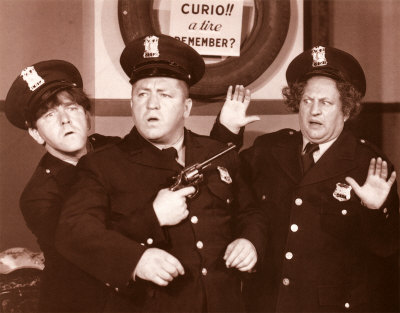
Dateline June 19, 1897 – Moe Howard, future leader of The Three Stooges, was born Moses Harry Horwitz on this date. He would be joined later in life with older brother Samuel (Shemp) and younger brother Jerome (Curly) at different times in one of the longest-running comedy teams in show bidnezz.

Moe Howard began in vaudeville with “Ted Healy and his Stooges,” along with brother Shemp. Soon Healy hired violinist Larry Fine and the Three Stooges were born, more or less, even tho’ they weren’t called that yet. Shemp made one ‘Stooge’ movie with Healy and quit the Stooges to start a solo career. Moe suggested younger brother Jerome/Curly and, after they managed to get rid of Healy, this was the trio that starting making all those Columbia shorts over the years, starting in 1934, and eventually running to 190 with a few cast changes.

In 1946 Curly had a stroke and was replaced by Shemp, who returned to the act where he started. According to the WikiWackyWoo the three Howard brothers made one movie together: 1949’s Hold That Lion. However, further strokes led to Curly’s death in 1952, the year of my birth. Yet, he was very much alive for my childhood.

Shemp died in 1955, yet appeared in four more Three Stooges movies after that, since there was enough footage in the can, but was eventually replaced by Joe Besser. Columbia sold off the Stooge film library to tee vee through the company Screen Gems and that’s when and where subsequent generations learned how to poke people’s eyes out and hit each other over the head with hammers.

Their tee vee poularity led to Moe forming a new Three Stooge ensemble, replacing Joe Besser with Joe DeRita, or Curly-Joe. This trio made several feature length movies and a few guest appearances until they were reduced to a cartoon with filmed live segments bookending the whole dealie.

When he died Moe Howard left behind an unfinished autobiography that was tentatively entitled I Stooge To Conquer, which I would have loved to have been able to read. For many years I belonged to The Official Three Stooges Fan Club [and recently came across all the newsletters in my file cabinet] and read a great deal about their history. The Three Stooges occupy a very narrow niche in Show Biz: Vaudevillians who transitioned to movies who transitioned to tee vee. There were many comedians, none of them slapstick comics for obvious reasons, who transitioned to radio before taking on tee vee.

Yet, despite my love for all things Stooge, this was the worst idea for a remake ever:

The Three Stooges Movie

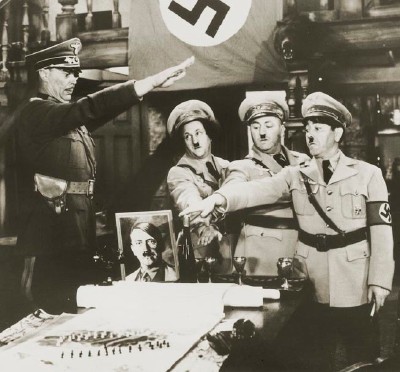
A dishonour. Watch a real Three Stooges classic. Moe Howard was imitating Adolph Hitler before Charlie Chaplin.

What’s really crazy is how much of this I knew by heart, only using Der Googlizer to make sure I had the dates right. I did. I’m such a dork.