Category Archives: TeeVee

Johnny Carson’s Last Tee Vee Appearance ► Another Magical Tee Vee Moment

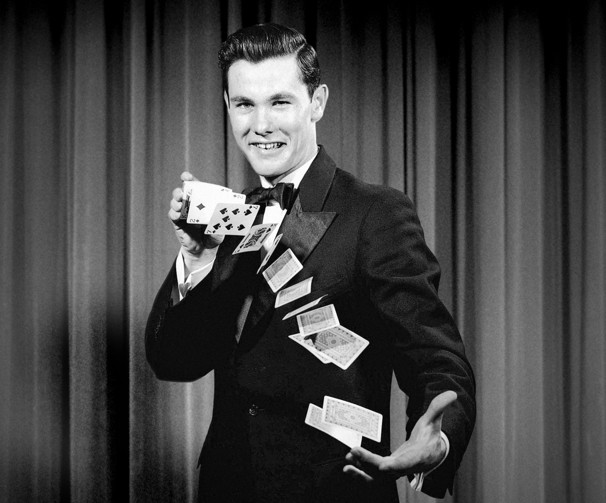
Johnny Carson got his start in Show Biz as a magician

Dateline May 13, 1994 – Johnny Carson makes his last tee vee appearance ever, fittingly on David Letterman’s show.

Carson was a tee vee institution for over 30 years. While other people hosted the Tonight Show both before and after him, Carson will always be the gold standard against which all others are judged. Carson retired from his show on May 22, 1992.

Johnny Carson always felt that David Letterman was the natural heir to the Tonight Show seat and was sorely disappointed that the show was given to Jay Leno instead. “Some people say” that’s why Carson declined to appear in NBC’s 75th Anniversary Special. “Other people say” that Carson never forgave NBC for destroying all the early Tonight Shows to make shelf room for newer shows. It very well could have been both.

Either way, it’s so appropriate that Carson’s last appearance was on Letterman’s show, almost 2 years to years to the day after his retirement. Letterman sprung Carson’s appearance as a surprise and the audience gave him a sustained standing ovation. After waiting out the applause for a while, Carson left the stage without saying a word. It looked like he had some lines, which he decided not to deliver at the last minute because anything he said would be an anti-climax. Remember: Carson was the master of Show Biz Timing™. Later Carson said he pulled his Marcel Marceau act due to acute laryngitis. This clip makes it clear he was going to say something.

This was one of the rare post-retirement appearances Carson made on tee vee, and the very last. On January 23, 2005 Johnny Carson died of respiratory failure from emphysema at the age of 79. After his death David Letterman did a Johnny Carson tribute show, which included an entire monologue written by Carson. It turned out that Carson regularly faxed jokes to the Letterman show just for the thrill of having then delivered on air.

Johnny Carson was the Comedian’s Comedian to the very end.

Here’s David Letterman’s tribute show to Johnny Carson:

Further Reading at Not Now Silly

Last Tonight Show with Johnny Carson ► Day In History
I’ve Got A Secret ► Another Magical Tee Vee Moment
Andy Kaufman ► Another Magical Tee Vee Moment

***

***

Bob Dylan Walks Out On Ed Sullivan

Dateline May 12, 1963 – Back in the day you couldn’t really say you were in Show Biz unless you had appeared on the Ed Sullivan Show. As much as Bob Dylan was known as a Protest singer, he still craved Show Biz legitimacy. That’s why he allowed himself to be booked on the Sullivan Show on this day in 1963. However, always the contrarian, Dylan walked off the show before he was to appear.

Ed Sullivan was a Tee Vee institution. Beginning in 1948 as Toast of the Town, his show ran for 23 seasons — 22 of them in the same Sunday night time slot of 8PM. Entire families would gather around the only tee vee set in the house and watch one of the only 3 tee vee networks in existence. The Sullivan Show had something for everyone in the entire family. It was a variety show, in the Vaudevillian tradition; a solo singer might be followed by a ventriloquist, who was followed by a plate spinner, with a Big Band performance next, to be followed by a comedian, and then, maybe, wrapped up with a scene from a Broadway musical. In a classic example of Art imitating Life, this “Hymn for a Sunday Evening,” from “Bye Bye Birdie,” sums up the importance of an appearance on the Sullivan show.

In ’63 Dylan was just an up-and-coming singer/songwriter, barely known outside the small, cultish world of Folk enthusiasts. If people knew him at all it was from Peter, Paul and Mary’s cover version of Blowin’ in the Wind. His 2nd LP, The Freewheelin’ Bob Dylan, with his own version of “Blowin’ In The Wind,” was just days away from being released. A Sullivan appearance would have been a huge boost to Dylan’s career and fame. However, according to the Official Ed Sullivan Show webeteria:

Bob Dylan was slated to make his first nationwide television appearance on The Ed Sullivan Show on May 12, 1963.  For the show, Dylan decided to perform “Talkin’ John Birch Paranoid Blues”, a satirical blues number skewering the conservative John Birch Society and the red-hunting paranoia associated with it.  A few days earlier, Bob Dylan auditioned the song for Ed Sullivan who seemed to have no issue with it. However, on the day of the show during the dress rehearsal, an executive from the CBS Standards and Practices department decided Dylan could not perform the song due to its controversial nature.  When the show’s producer, Bob Precht, informed Dylan of the decision, Dylan responded saying, “No; this is what I want to do. If I can’t play my song, I’d rather not appear on the show.”  Rather than choose a new song to perform or change the lyrics (as the Rolling Stones and the Doors on Ed Sullivan would agree to do), a young Bob Dylan walked off the set of the country’s highest-rated variety show.

The story got widespread media attention in the days that followed helping to establish Dylan’s public reputation as an uncompromising artist. The publicity Bob Dylan received from this event probably did more for his career than the actual Ed Sullivan Show performance would have. Unfortunately, this leaves us with no performance footage of Bob Dylan on The Ed Sullivan Show.

Here’s a live version of “Talkin’ John Birch Paranoid Blues,” which Dylan introduces by saying, “And, there ain’t nothing wrong with this song.”

No wonder they didn’t want the song performed on the show. In 1963 “Talkin’ John Birch Paranoid Blues” would have still been politically explosive. However, Ed Sullivan was a known control freak, who had his fingers in every aspect of his show. It’s hard to believe he wasn’t part of this decision, if not the instigator. An alternative theory is that Sullivan found the song a bit too far for his family audience, but wanted to come off as Mr. Nice Guy, so he told Bob Precht to deliver the bad news to Dylan. Blaming the CBS Standards and Practices office was probably just Standard Operating Procedure at the time.

Regardless of who made the decision, it resulted in Dylan’s “boot heels to be wandering.”

***

***

The Bible, Subliminal Satan, and Racism

Left: Satan wearing his hoodie. Right: without hoodie.

I have been watching this miniseries . . . err . . . religiously. What can I say, I love Sand & Sandal epics, even if they are epic fails. This thing is horrible on a number of levels, but I’m not here to review the series.

While watching the most recent episode where the snake turns into Satan and Satan turns into President Obama, I was shocked! Most people have only seen the still, but I caught it as it was broadcast. However, it was a quick flash. It happened so quickly. You never got a really good look, because the
face was mostly shrouded in darkness except for that quick flash.

I suddenly blinked thinking, “Did I just see what I thought I saw? Nah! That would be too blatant.” In the end I decided I hadn’t seen what I thought I had seen.

Then . . .

The meme and controversy with the still [above] started immediately the next morning. That’s when I was convinced there was no fucking way this was accidental. When I was in my 20s “Subliminal Advertising” was the book to read and I’ve reread it several times since.

Then . . .

I’ve now seen the Christian Fundamentalist and the Reality Show Creator (both professions which are an evil abomination foisted upon our society) deny this was intentional several times. I still ain’t buying it. Controversy sells. They have a product to sell.

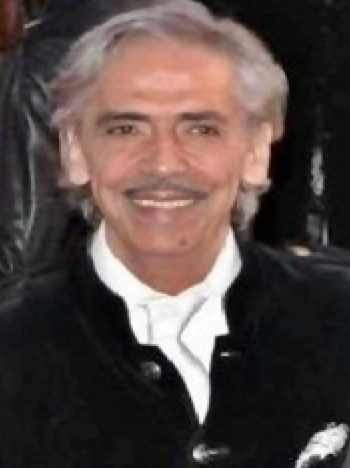
Note the resemblence Mohamen Mehdi Ouazanni
has with President Obama? Me neither!

Then . . .

I saw a publicity photo of Mohamen Mehdi Ouazanni, the actor who played Satan in The Bible. He looks nothing like President Obama. It would take a great make-up artist to make him look even remotely like President Obama.

Then . . .

Remember I said that I’ve been watching? I have noticed something subtle. Most of the leads in the miniseries are White or Mid-Eastern (which qualifies as White on every census here). However, there would have been too much backlash if the producers hadn’t included some Black folk, especially since there were loads of ’em back in biblical times.

However, the Black folk depicted tend to lean more towards either Satan, or Samson. Now this Samson is the darkest Black person in the entire miniseries so far. He’s as dark as a man can be without actually being a crow. And, he had long dreadlocks! YA, MON!!!

But . . . it’s the depiction of Satan that made me sit up and take notice. In the miniseries Sampson is usually behaving like a raging animal. Oh sure, he had his soft and tender side (and the Delilah depiction made for an interesting interracial relationship). And, credit where credit’s due, when he spoke he didn’t sound like a moron, but an intelligent and thoughtful man. However, most of the time Sampson was simply destroying shit. And, when he destroyed shit he grunted, and growled, and shouted long, unintelligible cries of hate and anguish.

Since this was one of the few leads who was Black, as opposed to a supporting character, I couldn’t help but think that this was also a conscious: Black Guy = Raging Madman, who has divine justification because . . .  because . . . because he’s on a mission from God.

Taking a page right out of Fox “News,” the station that perfected this tactic, I like how the producers of The Bible found a Black man to explain why Sampson is Righteous, with a capital R, even tho’ he’s a Scary Black Man™. Bonus points: He’s also named Sampson. Watch:

Yannow who else was on a mission from God? That’s right!

Did Roger Ailes Dupe James Rosen, Or Did Rosen Dupe ‘Merka?

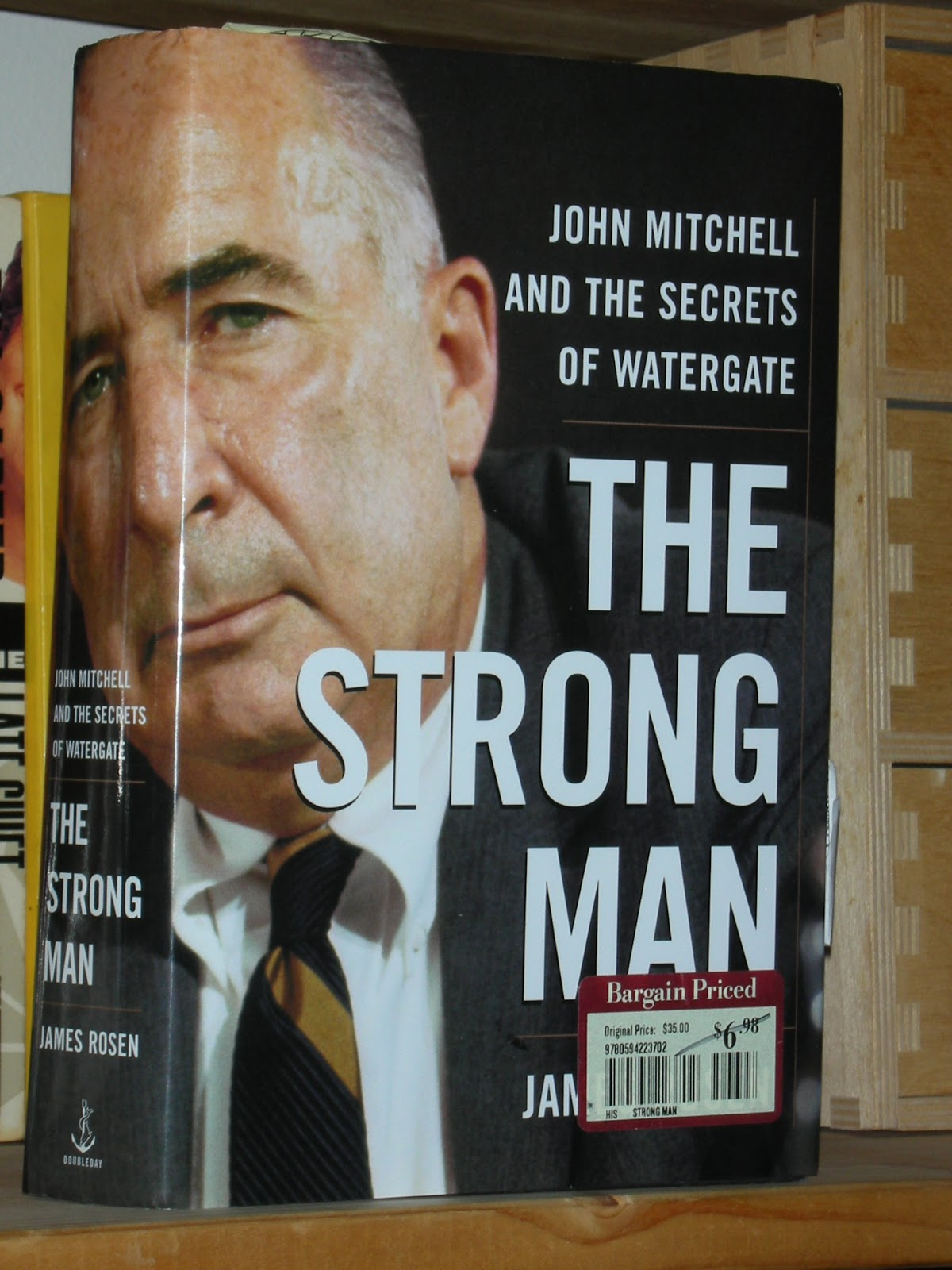
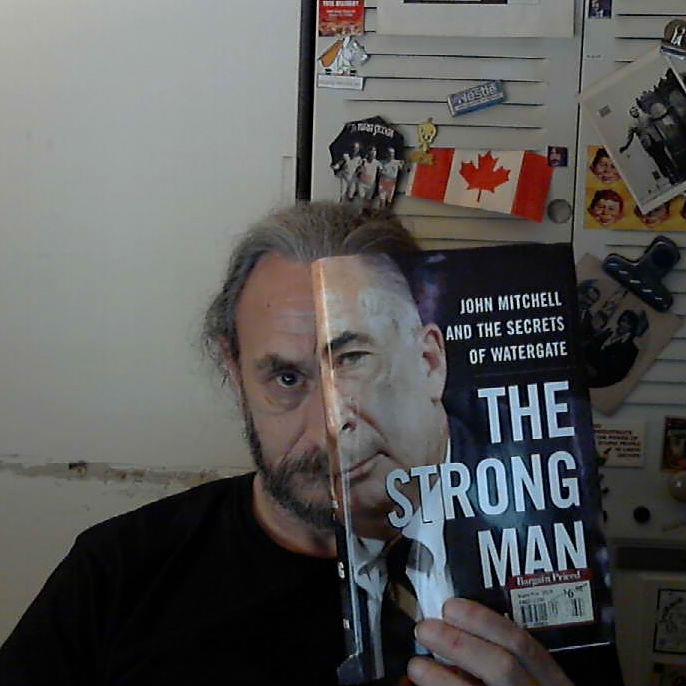
My remaindered copy of The Strong Man

Five years ago James Rosen, Fox “News” Chief Washington Correspondent, published a book on Watergate with a gigantic lie in it (surrounded by all kinds of smaller falsehoods). This lie continued the cover up of Richard Nixon’s treason during the 1968 presidential campaign.

Rosen is unjustifiably proud of his revisionist history called “The Strong Man,” which purports to tell the truth about John Mitchell, Richard Nixon’s Attorney General and, later, head of CREeP, the unfortunately accurate acronym for the Committee to ReElect the President.

Back in May I told the HIGH-LARRY-US story of my electronic bun fight with Rosen, but only hinted at The Big Lie. Even though I promised a full book review, I got bored with poking Rosen with a stick and let the topic die. However, it needs to be asked: Why did Rosen include this massive lie in his book when the truth was already known?

To understand this story one must go deeply into the Watergate Weeds. While most people use the term “Watergate” to refer only to the break-in at DNC headquarters that brought Nixon down, there was a whole litany of wrongdoing that falls under the rubric of Watergate, including this story. It goes back to the 1968 presidential election. President Johnson had already decided he would not run for office and Hubert Humphrey was the Democratic candidate. Meanwhile, LBJ had been pushing all parties involved to come to the Paris Peace talks in an effort to end the war in Vietnam.

An early picture of Anna Chennault,
nicknamed “The Dragon Lady”
by the Nixon White House.

Nixon didn’t get the nickname Tricky Dickie for nothing. Using a woman named Anna Chennault, a member of the so-called China Lobby, Nixon went around President Johnson to the South Vietnamese leader to scuttle the peace talks. She carried word from Nixon who said, in essence, if you don’t go to the Paris Peace Talks you’ll get a better deal from Nixon when he’s elected.

The broad outline of this treason has been known for decades (but more proof keeps coming to light). That’s why it was so puzzling that Rosen, in his laughable rewriting of history, would write:

James Rosen, historical revisionist

“A source close to the [Anna Chennault] affair–who demanded anonymity–strongly challenged the veracity of the prime witness.”

The demand for anonymity is backed up by end note 66 on page 514, which reads: “E-mails from [a confidential source] to the author, January 21, 2003, 6:16 p.m.; and Wednesday January 22, 2003, 3:25 p.m.”

Here’s the full quote from the book [Pages 61, 62]:

A source close to the affair — who demanded anonymity — strongly challenged the veracity of the prime witness. “Simply do not trust what Anna Chennault says about this incident,” said the source, a senior policy adviser to Nixon and other GOP politicians in later years. “She manufactured the incident, then magnified her self-importance.”

She caused untold problems with her perpetual self-promotion and, actually, self-aggrandizement, because she was only interested in the money. I do not put it in the realm of fantasy that she was paid by the SVs [South Vietnamese]; she had them bamboozled, believing she was an authentic and important “channel” to the campaign. John Mitchell . . . did not have the bullocks to kiss her off, a tough and persistent woman who could grind you down. . . . . Anna thought of herself as a puppet master. She had no assignment, no tasks, and was an over-the-transom type that can never be suppressed in a campaign.

Yet the Chennault affair continued to haunt Nixon’s presidency. His infamous orders to burglarize the Brookings Institution, issued in the summer of 1971 following publication of the Pentagon Papers and never carried out, stemmed from the president’s concern that the Washington think tank possessed documents related to “the bombing halt” — a euphemism for Nixon’s and Mitchell’s own back-channel machinations to counter it.

Keep in mind that James Rosen challenged me to read his book for myself and not “let @JohnWDean (x-felon) bully” me about it being revisionist history. Rosen’s mistake is that I know almost as much about Watergate as I do about Beatles trivia. The minute I came to that passage on Page 61 I knew that he was hoodwinking his readers. The broad outline of the Anna Chennault story has been known for decades, but the actual proof has only come in drips and drabs over the years. However, by the time Rosen wrote “The Strong Man” it was generally acknowledged that Chennault was telling the truth and Rosen’s secret source was lying through his teeth.

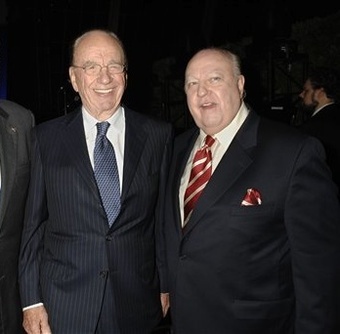
Corpulent liar Roger Ailes [right]
with his evil overlord Rupert Murdock

As soon as I read that passage I started to think, “Who the hell is still around that would still want to cover up Nixon’s treason? Who’s left? The only people who would want to cover it up are all dead.”

Then suddenly it struck me. There is still one person who needs to cover it up. Just to confirm my hypothesis I jumped to the index to look for “Ailes, Roger.” Well, whaddaya know about that? Roger Ailes, Nixon’s media man and John Mitchell’s behind-the-scenes right-hand media man in the ’72 reelection campaign, is NOT mentioned anywhere in the index. Nor does his name ever come up in the 498 pages of the book.

There is no doubt in my mind that Roger Ailes is the “senior policy adviser to Nixon and other GOP politicians in later years” who Rosen so blithely quotes calling Anna Chennault a liar. And, if I knew that the passage was a lie when I was reading it, why didn’t James Rosen know it was a lie when he was writing it? Did James Rosen help cover up his boss’ treason? Because, make no mistake, covering up treason is a treasonous act in and of itself. Therfore, James Rosen, if he knew the truth — but printed the lie — has also commited treason.

When I started asking Rosen uncomfortable questions on Twitter as I was reading his book, he very quickly blocked me. He claimed he did it because I wrote negatively about him for NewsHounds, which, if true, just shows he’s as thin-skinned as Bully Boy Bolling. However, I have always believed it was because he knew I wasn’t buying the bullshit he was selling in his book. Over the last 10 months, since I first wrote about my bun fight with Rosen, I have left many phone messages at Fox “News” for him. All I want to do is clear up the mystery of who is his secret source on Page 61 of The Strong Man. Rosen never returns my calls.

There’s only one conclusion I can come to: James Rosen is a treasonous coward who is covering up for his treasonous boss Roger Ailes. Now, go ahead and sue me. I double-dog dare you.

A Watergate Interlude ► The Saturday Night Massacre

Watergate complex

DATELINE October 20, 1973 – President Richard Nixon fires Special Prosecutor Archibald Cox and Attorney General Elliot Richardson and Deputy Attorney General William Ruckelhaus resign rather than have to carry out the job. The press immediately dubbed this The Saturday Night Massacre.

Archibald Cox

Cox and Nixon seemed destined to come to loggerheads. Archibald Cox had been the U.S. Solicitor General under President Kennedy, who was a sworn enemy of Nixon, long before he defeated him in the 1960 presidential election. After serving in the Kennedy and Johnson administrations Cox returned to private life and Harvard Law School in 1965, where he had been before serving in government. When, in May of 1973 the government was looking for someone squeaky clean to look into the growing Watergate Scandal, Cox was tapped for the job. However, it wasn’t as smooth as that makes it sound.

Richard Kleindienst had been Nixon’s Attorney General, but resigned on April 30, 1973, the same day that John W. Dean was fired and H. R. Haldeman and John Ehrlichman were allowed to quit. When Elliot Richardson was nominated to become the new Attorney General the Senate made Cox’s appointment a condition before confirming Richardson.

Special Prosecutor Cox learned of the extensive White House taping system at the same time the rest of ‘Merka did, at the Watergate Hearings. He knew the tapes might settle some of the questions of who knew what when. That’s when a 4 way power struggle began; with Nixon on one side, and the Senate Watergate Committee, Judge John Sirica — who had issued a Grand Jury subpoena for the tapes — and Cox on the other. All wanted the White House tapes and President Nixon stalled for months rather than turn them over.

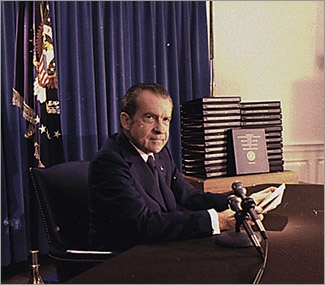
President Nixon posing with the rejected transcripts

At first Nixon claimed Executive Privilege. Finally Judge Sirica ordered Nixon to turn over the tapes. Nixon stalled again by offering a compromise. He’s have Democratic Senator John Stennis listen to the tapes and prepare a summary of the tapes, based on transcripts prepared by the White House. This was rejected by Special Prosecutor Cox on October 19, who held a press conference the following day to outline his reasoning.

That evening Richard Nixon ordered Attorney General Elliot Richardson to fire Cox. Richardson resigned rather than do so. That left it to Deputy Attorney General Ruckelshaus to carry out Nixon’s order. Ruckelshaus resigned as well. During the Watergate scandal there were not many acts of integrity from the Nixon administration. That is why these stood out in sharp contrast.

In the end it was left to Solicitor General Robert Bork, who was now acting head of the Justice Department, to fire Archibald Cox. And the shit hit the fan. There was far more at stake than just the tapes and Nixon’s presidency. As the Washington Post of the following day noted:

The action raised new questions as to whether Congress would proceed to confirm House Minority Leader Gerald R. Ford of Michigan to be Vice President or leave Speaker of the House Carl Albert (D-Okla.) next in line of succession to the highest office in the land.

It was all downhill for Nixon from here on in. As the WikiWackyWoo reports:

On Nov. 14, 1973, Federal District Judge Gerhard A. Gesell ruled that the dismissal of Mr. Cox was illegal, in the absence of a prior finding of extraordinary impropriety as specified in the regulation establishing the special prosecutor’s office.

Congress was infuriated by the act [of the Saturday Night Massacre], which was seen as a gross abuse of presidential power. The public sent in an unusually large number of telegrams to both the White House and Congress. And following the Saturday Night Massacre, as opposed to August of the same year, an Oliver Quayle poll for NBC News showed that a plurality of American citizens now supported impeachment, with 44% in favor, 43% opposed, and 13% undecided, although with a sampling error of 2 to 3 percent. In the days that followed, numerous resolutions of impeachment against the president were introduced in Congress.

Nixon was forced to allow Robert Bork to appoint a new Special Prosecutor, Leon Jaworski. If the White House thought Jaworski would be more amenable to pressure, it was sorely mistaken. Jaworski continued to press for the release of the tapes, as well as the expansion of the investigation beyond the original Watergate burglaries.  Later Nixon released transcripts of the tapes, which satisfied no one and made “expletive deleted” a national punchline. It still took another 10 months until Nixon finally resigned to avoid impeachment and possible conviction.

Some of my books on President Nixon and
Watergate. Behind those books are more books.

Richard Nixon has long been a fascination of mine. For further reading try my other posts on Watergate:

Aunty Em Ericann’s Bun Fight With James Rosen of Fox “News”

Unpacking The Aunty Em Ericann Blog ► Part New 

Watergate ► The Beginning of the End

Watergate ► The End of the End 

Nostalgia Ain’t What It Used To Be ► Happy Birthday Martha Mitchell

Nostalgia Ain’t What It Used To Be ► Vice Presidents We Have Known

Andy’s Gang ► Another Magical Tee Vee Moment

Dateline October 7, 1905 – Andrew Vabre “Andy” Devine is born in Flagstaff, Arizona. With his trademark raspy voice, Andy Devine went on to become one of the great character actors in Hollywood. He appeared in more than 400 hundred flicks, often playing the sidekick. He was Cookie alongside Roy Rogers and appeared in several John Wayne movies, including the original Stagecoach, Island in the Sky, and The Man Who Shot Liberty Valance, where he played the cowardly marshal. Among his other movie credits are Romeo and Juliet, the original A Star Is Born, the original Geronimo, the Jack Benny comedy Buck Benny Rides Again, Pete Kelly’s Blues, and dozens of others.

However, there’s a whole generation of kids, who are now my age, that know him for the phrase “Plunk your magic twanger, Froggy” when, in mid career, he hosted the children’s show “Andy’s Gang.” Each show began with Andy leading the kids in a song that parents would go nuts if they heard it today:

♫ ♪ ♫
I got a gang,
You got a gang,
Everybody’s gotta have a gang,
But there’s only one real gang for me, 
Good ol’ Andy’s Gang.
♪ ♫ ♪

Here are some wonderful excerpts from Andy’s Gang, when children’s programming on tee vee was still in its infancy.


Jimmy Buffett name-checked Andy Devine in his song Pencil Thin Moustache, which is as good way as any to play out this blog post. Enjoy:

Another Magical Tee Vee Moment ► Richard Nixon’s Checkers Speech

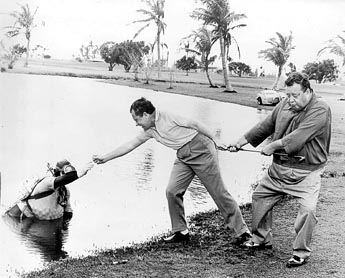
Jackie Gleason keeping Richard Nixon from falling in the
drink in Inverrary, Florida, a few miles from where I live.

Dateline September 23, 1952 – Under fire for taking money from his private backers to pay expenses, Richard Nixon went on national tee vee and delivered what has come to be known as The Checkers Speech.

At the time he was Senator Richard Nixon, having won over Helen Gahagan Douglas in 1950 after accusing her of being a Communist, who was “pink right down to her underpants.” Tapped to be General Dwight D. Eisenhower’s vice presidential running mate, Nixon ran into trouble two months later when the press learned of a fund that ‘topped off’ Nixon’s salary of $12,500 (which was about $150,000 in 2009 dollars, according to the WikiWackyWoo). As demands grew for Nixon to resign from the ticket and his senate seat, Eisenhower started to distance himself from the party’s GOP pick. To save his position on the GOP ticket, not to mention his seat in the Senate, Nixon convinced Ike to allow him to go on tee vee and make his case directly to the ‘Merkin people. However, Nixon wanted Eisenhower to make a decision on whether to keep him on the ticket immediately after the broadcast. Eisenhower wouldn’t agree to that, so Nixon famously said to the General who saved Europe for democracy, “[G]eneral, there comes a time in matters like this when you’ve either got to shit or get off the pot.” Even at that, Eisenhower said it would take a few days to determine which way the wind was blowing.

At 9:30 PM EST Nixon gave the following speech to all of ‘Merka:

The speech was both maudlin and heart-warming. It became known as The Checkers Speech, a term Nixon hated, for this passage:

One other thing I probably should tell you because if we don’t they’ll probably be saying this about me too, we did get something—a gift—after the election. A man down in Texas heard Pat on the radio mention the fact that our two youngsters would like to have a dog. And, believe it or not, the day before we left on this campaign trip we got a message from Union Station in Baltimore saying they had a package for us. We went down to get it. You know what it was?

It was a little cocker spaniel dog in a crate that he’d sent all the way from Texas. Black and white spotted. And our little girl—Tricia, the 6-year-old—named it Checkers. And you know, the kids, like all kids, love the dog and I just want to say this right now, that regardless of what they say about it, we’re gonna keep it.

Nixon ended the speech with direct appeal to the ‘Merkin people to let their views be known:

I am submitting to the Republican National Committee tonight through
this television broadcast the decision which it is theirs to make. Let
them decide whether my position on the ticket will help or hurt. And I
am going to ask you to help them decide. Wire and write the Republican
National Committee whether you think I should stay on or whether I
should get off. And whatever their decision is, I will abide by it.

But just let me say this last word. Regardless of what happens I’m
going to continue this fight. I’m going to campaign up and down America
until we drive the crooks and the Communists and those that defend them
out of Washington.

The ‘Merkin people did as Nixon had asked. They inundated the GOP with letters and telegrams, Eisenhower decided to keep him on the ticket, and Senator Richard Nixon lived to fight another day, going on to become Vice President of the United States for the next 8 years.

Another Magical Tee Vee Moment ► Chuck Jones

Dateline September 21, 1912 – Cartoonist extraordinaire Chuck Jones is born in Spokane, Washington. According to Jones, he credits his father, a failed businessman, with his love of drawing. Says the WikiWackiWoo:

His father, Jones recounts, would start every new business venture by purchasing new stationery and new pencils with the company name on them. When the business failed, his father would quietly turn the huge stacks of useless stationery and pencils over to his children, requiring them to use up all the material as fast as possible. Armed with an endless supply of high-quality paper and pencils, the children drew constantly. Later, in one art school class, the professor gravely informed the students that they each had 100,000 bad drawings in them that they must first get past before they could possibly draw anything worthwhile. Jones recounted years later that this pronouncement came as a great relief to him, as he was well past the 200,000 mark, having used up all that stationery.

Like so many children of my generation, Chuck Jones entertained me endlessly. While his cartoons were made for movie theaters, they were all over the tee vee dial when I was growing up and the cartoons are all that matter. Here are just a few:

Great Performances,” on PBS, profiled Chuck Jones in one of its previous seasons. The program included some terrific behind-the-scenes descriptions of how cartoons are created and clips of some of the great cartoons. [Unfortunately PBS has removed this from its web site. I searched hard to find one with the proper aspect ratio, but could only find bits and pieces and not the entire documentary. Here is the full documentary with the aspect ratio skewed.]

***
***

Another Magical Tee Vee Moment ► Philo T. Farnsworth

Dateline September 7, 1927 – On this day Philo Taylor Farnsworth demonstrated his radical new invention: electronic television. Prior to this all televisions (which were still in the experimental stage) used a clunky mechanical system with a rotating disk. Farnsworth’s radical design used image dissection, an electronic scanning of a series of lines. He was only twenty-one.

More amazingly, he came up with the idea when he was just a 14-year old farm boy. The brainstorm came to him while plowing a field; the plow moves across a field, then back the other way for the next row. He drew his idea on a chalkboard for his science teacher John Tolman, who was so impressed with it that he made a contemporaneous sketch of it. This proved fortuitous years later when he was sued by RCA over patent infringment. The teacher’s sketch made in 1922 won the case for Farnsworth.

Indeed it was Another Magical Tee Vee Moment. Here’s just one more:

Electronic television is no longer with us, having gone the way of the horse and buggy. A whole generation has now grown up viewing tee vee on a cathode ray tube that necessarily made the living room tee vee deep in dimension. Now tee vees can be hung on a wall like a painting.

***


***

Another Magical Tee Vee Moment ► President Clinton Addresses the DNC

Last night William Jefferson Clinton, the 42nd President of the United States, officially nominated President Barack Obama for reelection at the Democratic National Convention. It was a barn-burner of a speech, which listed all the reasons why President Obama should get a second term and what separates the Democratic Party from the Republican Party in 2012. The crowd loved it because it was quintessential Clinton and, of course, they are all Democrats.

If you haven’t seen it yet, you really should.

The election is in exactly 2 months from today. Make sure you get out and vote.

***

***