Category Archives: Unpacking

An Introduction to Trolleygate

The Coral Gables “Trolley” is not. It is a bus with a diesel-powered
internal combustion engine disguised to look like a cute old-style trolley.

Anger is beginning to roil to the surface in Coconut Grove over the latest scandal involving Miami City Hall. In a nutshell: the city of Coral Gables has been allowed to plunk a polluting diesel bus garage into the middle of a West Coconut Grove residential neighbourhood attempting to rehab. While residents and businesses in Coconut Grove are used to Miami running roughshod over their interests, Trolleygate might just be the straw that breaks the camel’s back. 

This will be the first in what will no doubt be a continuing series as I peel back the layers of the onion of Trolleygate. To understand this scandal first one needs to understand some of the players:


• Coral Gables, a fully incorporated town [which calls itself a city] of about 47,000 people which abuts Miami on the western edge of Coconut Grove. Coral Gables has been called the “first planned community” in Florida, but that designation has also been disputed. Whether it was the first, or not, is immaterial to the reason for its creation. More about that later.

• Miami City Council. Control for everything that has ever happened in
Coconut Grove has resided with Miami City Council since annexation in 1925.

Coconut Grove Village Council. The Coconut Grove Village Council has no power whatsoever to do anything anywhere, except to pass along recommendations to the City of Miami, which then appears to promptly ignore them.

Ironically at one time there was a real Coral Gables Trolley.
This pic is of the Colonnade Building and Coral Gables
Trolley, mid 1920′s. State of Florida Archives.

• The Coral Gables “Trolley.” The word “trolly” is a misnomer. A trolly is defined as:

1. a trolley car. 2. a pulley or truck traveling on an overhead track and serving to support and move a suspended object. 3. a grooved metallic wheel or pulley carried on the end of a pole (trolley pole)  by an electric car or locomotive, and held in contact with an overhead conductor, usually a suspended wire (trolley wire)  from which it collects the current for the propulsion of the car or locomotive. 4. any of various devices for collecting current for such a purpose, as a pantograph, or a bowlike structure (bow trolley)  sliding along an overhead wire, or a device (underground trolley) for taking current from the underground wire or conductor used by some electric railways. 5. a small truck or car operated on a track, as in a mine or factory.

Nowhere in that definition is there room for a bus with rubber tires and a diesel-powered internal combustion engine freely running on roads, not rails. That’s what the Coral Gables “Trolley” really is. Forget the word “trolley.” This is Trolleygate.

Marc D. Sarnoff is a Coconut Grove resident, the City of Miami Commissioner for District 2, Vice-Chairman of the City of Miami Commission (which sounds so much fancier than city council) and uncrowned (and never publicly declared) Emperor of Coconut Grove. It has been said that Marc D. Sarnoff never met a developer he didn’t like (to side with and support above the wishes of the local community).

• Always last and always least: The West Grove, aka Black Coconut Grove. As much as Coconut Grove is used to being ignored by Miami City Hall — which ironically is in Coconut Grove — Black Coconut Grove is used to being ignored by everybody.

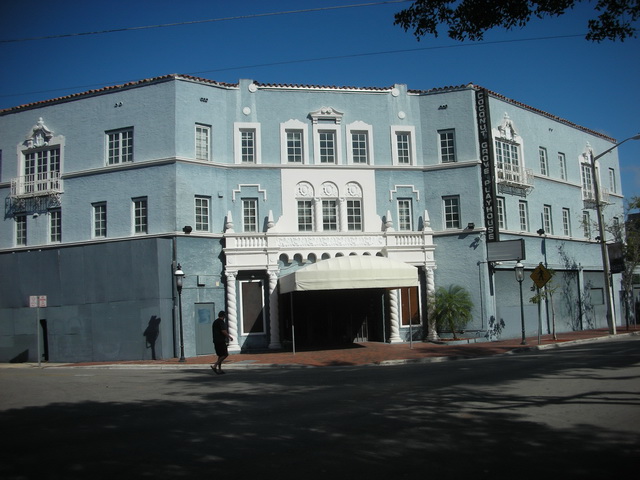
The long-abandoned Coconut Grove Playhouse.
Pic by author.

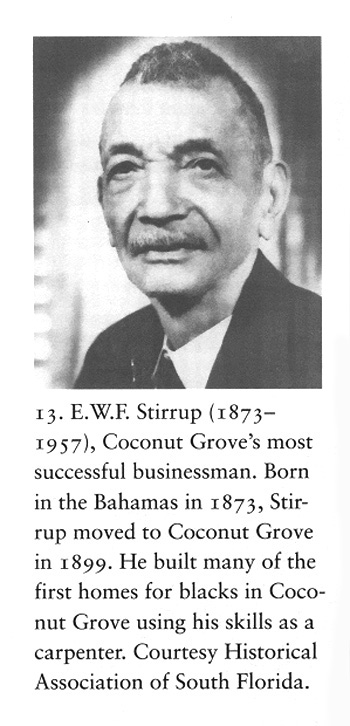
Black Coconut Grove owes its continued existence due to the foresight of E.W.F. Stirrup [a story told elsewhere on this blog at length, so I won’t go into it here]. It was his vision that gave Coconut Grove the highest Black home ownership in the country. That high percentage of Black home ownership is what prevented the city from razing the entire neighbourhood in the 1950s because unlike all the surrounding residential areas, it didn’t have internal plumbing or sewer connections. Way back in 1919, in the wake of the “Bright Plan,” the Charles Avenue neighbourhood was almost lost as well. The entire area was to be turned into a golf course. Several factors — the depression, annexation, hurricanes and the high degree of Black home ownership — put a stop to all that. However, the Bright Plan was based on a Mediterranean-style of architecture. Before the Bright Plan had been abandoned, it brought forth the Coconut Grove Theater (later Coconut Grove Playhouse, which is a whole ‘nother scandal in itself), which is why the theater is in the Mediterranean-style. [Incidentally, E.W.F. Stirrup sold the land on which the Coconut Grove Theater was built.] However, all that to explain why there has always been a Black community in Coconut Grove strong enough to resist most efforts at urban renewal.

The Mediterranean-style of architecture also appears to have influenced George Merrick, who developed Coral Gables. The prevailing architectural style in Coral Gables is Mediterranean. In what appears to be an early example of White Flight, there is strong anecdotal evidence that the founding of Coral Gables was — in and of itself — a racial statement against Coconut Grove’s Black community. The Bahamians, and other Blacks, were fully entrenched and could not be dislodged because of the high percentage of Black home ownership. Hence one could build a Coral Gables. This has been very difficult to confirm because this is not the kind of thing that is recorded in history books.

A man who has lived on Charles Avenue for all of his 73 years told this reporter what it was like for the folks of West Grove who wandered into Coral Gables back in the old days. It wouldn’t take long before you were stopped by police and asked for your “papers.” These consisted of a letter from an employer: “George works as a handyman for our estate” or “Rose is our domestic and needs to come and go as is necessary.” [Editor’s note: invented letters.]

Redlining and racism kept Blacks out of Coral Gables ever since. To this day Coral Gables is overwhelmingly White. Coral Gables own website cites the most recent demographics almost as if they are proud of it: White population: 90.76%; Black population: 2.86%. That doesn’t happen by accident. It looks even worse when compared to Miami’s population with 18.67% Black and 74.05% White residents.

Artists rendering of the diesel bus garage currently
under construction in the West Grove. Do those shutters
and that landscaping make the bus fumes go away?

What is Trolleygate?

Here’s where it gets tricky for a journalist. Recently this writer joined a few gentlemen for what I thought would be chit chat about music, which it had been the last time we were together. The mistake I made was telling these people that I wasn’t there as a journalist, so it was all off the record. I actually used those words. Who knew that it would turn into a meeting about Trolleygate? That’s where I first heard the word. Consequently, much of what I learned is off the record. However, that doesn’t mean I can’t bring you up to speed:

One recent day the residents of the West Grove woke up to find construction beginning on a diesel bus garage at Douglas and Frow in the West Grove. It turns out that Astor Development acquired the land adjacent to the current Coral Gables diesel bus garage. It made a deal with Coral Gables to knock down the garage, locating it elsewhere, and redevelop the entire site for high-end commercial and residential  properties, the last place you’d want a bus garage. Coral Gables loved the idea of new development. However, Coral Gables, oddly enough says it could find no suitable land anywhere in Coral Gables for the Coral Gables diesel bus garage. Through some kind of land deal [that still needs to be explored further] the land at Douglas and Frow — in the City of Miami, no the city of Coral Gables — was purchased and construction began before anyone knew what hit them.

The neighbourhood is pissed, to put it mildly.

Article continues below the pics . . .

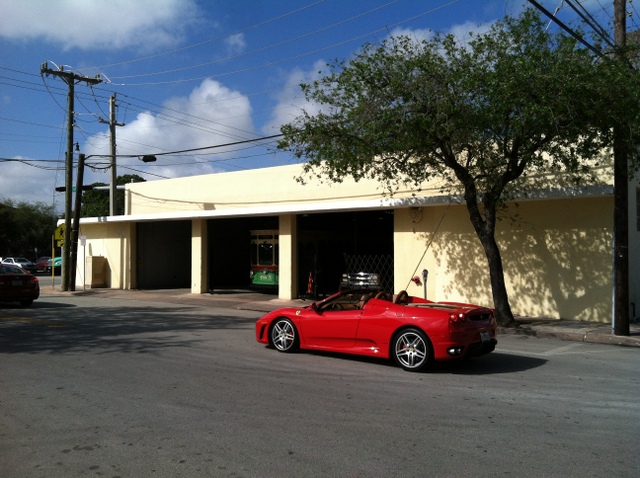
The current diesel bus garage. Just put some shutters on it and add some landscaping and you’re golden.

A diesel bus pretending to be a “trolley” in a real bus garage.
Current state of the new bus garage. Residents say it appears work has accelerated along with the public outcry.
It appears as if the developer is hoping this diesel bus garage is so far gone it will be a fait accompli. Some residents appear to be willing to settle for a bus stop, at the very least. Others want it torn down, as it will change the entire character of the neighbourhood and does not conform with any of Miami’s zoning by-laws.

 
Marc D. Sarnoff made some kind of deal with somebody because nothing can happen in Coconut Grove without the imprimatur of Emperor Sarnoff the First. Sarnoff seems to have negotiated with Astor Development and Coral Gables about this project, but no one in West Grove recalls him bringing such a non-conforming building up for public consultation. The issue of building a diesel bus garage in the West Grove appears to have been passed at a Miami City Commissioner’s meeting. However, one of my off-the-record sources, who has attended hundreds of redevelopment meetings in more than one city, says approval was faster than “a hot knife through butter.” No one can remember something like this getting through Miami City Hall so quickly, without someone in the neighbourhood being aroused to public meetings. Which was probably the point to keeping it under everyone’s radar.

Meanwhile, Black Coconut Grove gets stuck with all the negatives of a
diesel bus garage from a neighbouring city. Furthermore, while it gets
the increased traffic and pollution, the residents will not even get
what is normally a benefit of a bus garage: a bus stop. Having a bus
stop might allow Black Grove to get on the bus and ride to Merrick Park,
or Miracle Mile, or any of those other swank places, including any
multimillion dollar project by developers named Astor. It reminds me of
how Robert Moses,
who built the Long Island Expressway, purposely built all the
underpasses too low to allow for buses. That’s so the ‘great unwashed’
couldn’t go to his beaches at Fire Island and Jones Beach.

There’s
not a single positive to the deal, unless Coral Gables is paying Miami
taxes on the land, but no one is alleging that yet.

According to the Miami Herald, this has awoken a paper tiger:

The Coconut Grove Village Council on Thursday joined the chorus of opposition to a new trolley-bus fueling and maintenance garage now under construction on Douglas Road in the predominantly black West Grove.

Meanwhile, West Grove residents have lined up lawyers to fight the project, and a University of Miami law professor is asking federal authorities to assist the residents with possible civil rights issues.

Message sent out by the paper tiger, which also said it only
learned about the bus garage from media reports. Grrr.

That’s not a stretch. I viewed this as a Civil Rights issue the minute I heard about it due to my 4 years of research into Coconut Grove. And, I’m not the only one: the University of Miami’s Center for Ethics and Public Service agrees with me and issued a press release:

Professor Anthony V. Alfieri, Dean’s Distinguished Scholar, Director of the Center for Ethics and Public Service, and Founder of the Historic Black Church Program, has taken up the call with residents of West Grove to try to halt the construction of large trolley garage adjoining a single-family home residential neighborhood. Professor Alfieri, with Zachary Lipshultz, a Post-Graduate Fellow with the Environmental Justice Project, and Dr. Steven Lipshultz, a Professor of Pediatrics and the George E. Batchelor Pediatric Cardiology Endowed Chair at the University of Miami Miller School of Medicine, have been providing those opposing the construction with valuable legal advice and raising awareness through meetings and rallies.

In their most recent salvo in an opinion piece for The Miami Herald, they point out the public health concern caused by exposure to diesel fumes from having a 12-bay garage housing the current fleet of six Coral Gables trolley cars located in a residential neighborhood and the seeming injustice of moving the garage from its present location in an industrial area in Coral Gables into a predominantly black, low-income neighborhood in the City of Miami.

They write: “The recent protests of Coconut Grove and Coral Gables homeowners in opposition to the City of Miami’s decision to approve construction of a new Coral Gables Trolley garage in the West Grove raise important public health and environmental justice concerns. For the West Grove, a predominantly black, low-income neighborhood, the protests arise against the historical backdrop of decades-long racial discrimination, municipal neglect, and Jim Crow segregation. Indeed, during the 1960s, the City of Miami operated a noxious incinerator “Old Smokey” in the West Grove closely abutting homes and schools. Now, years after Florida courts ordered the incinerator shut down as a public nuisance, the City of Miami again seeks to impose the social costs of polluting facilities on the West Grove without any concern for the public health of the community.”

Coincidentally, today’s Melissa Harris-Perry Show was making the same point. Not about Coral Gables’ dirty buses, but in her words, “the ugly, but real link between environmental and racial justice” and what we dump “we don’t dump in our backyard we dump in somebody else’s backyard […] and those are pretty predictably disempowered communities.” It’s as if she was talking about Trollygate. Watch:

Visit NBCNews.com for breaking news, world news, and news about the economy

Public outcry has been such that a there is now a Stop construction of Coral Gables Trolley Garage in historic Coconut Grove petition at Change.org, which begins:

This depot will disrupt our neighborhood, lower property values, bring an industrial project into a residential area, pose a danger to our children, violate zoning codes, and undermine the healthy and prosperous development of our community.

Marc D. Sarnoff appears to be running scared. He knows he awoke a sleeping Black giant. He will never escape the accusations of Racism, but he is certainly going to try at the EMERGENCY TOWN HALL he’s called for Thursday at Miami City Hall at 5:30 P.M.

There is far more to Trolleygate than I can mention here until I get people to go on the record. However, in a last bit of synchronicity for the day: the very White city of Coral Gables is currently advertising for a Trolley [sic] Manager. I presume that Blacks are allowed to apply.

Welcome Back Coconut Grove Grapevine

Despite my minor feud with Tom Falco, it was with great interest that I noted that he’s fired up the Coconut Grove Grapevine again. For those not paying attention, Falco wrote back in September


I have decided to end the Grapevine, but maybe not totally end it, I don’t know yet. What I am doing is stopping daily publication for now, only because I feel that I have other things I need to do and I believe that you physically have to shut one door to have another door open. I want to immerse myself into the cartooning world and so that is what I am going to do. I plan on traveling often, my first trip is to New York for the New York Comic Con, where I can mix and mingle and pick up tricks from other cartoonists. I need to promote myself and my comic, Tomversation, full time. While I bought a 4-day pass, I was also given a press pass, so I will be covering the event for publication, maybe for the Huffington Post.

I could keep the Grapevine up and running, but not on a daily basis, but I feel that would be doing it in a half-assed way. I don’t want to do that. I have tried hiring photographers and writers but it doesn’t seem to work. So rather than run the thing into the ground, I will take this break, most likely it will be final, but I am a Gemini and I change my mind often, so maybe I’ll start it up again in a few months, we’ll see. [Editor’s note: That’s a hell of a run-on sentence, Tom.] There are almost 9000 stories here believe it or not, all done in the 7.5 years we’ve been up and running, so you can always go back into the archives and have a laugh or two if you feel like it. [And, again.]

Tomversation, Falco’s cartooning site,
is also part of his vast publishing empire.

However, 4 months later comes word that it’s all been a terrible dream and Bobby was just in the shower for the season. The other day Coconut Grove Grapevine announced:

I’m a bit rusty, but I am thinking of returning to the Grapevine. Why? I need the money. My business has been floundering, like many in this economy, I assume, and I am stopped daily, literally daily, on the street, and asked by people to come back. [Same Ed. note] I am thinking of doing so, but with some changes.

One big change — no politics. I don’t want to get back into that. I really don’t I never enjoyed that part of it and sort of got sucked in years ago and never got out. Most people who stop me on the street tell me they want news but news of what’s going on around the village, you know, what’s new? what’s coming in, what’s going out, etc. I’ll do that. I will also cover events and such, but this is going to be a money making venture now. In the past, I had ads, but 99% of those ads were not paid for.

I’ve been cheated by people, one prominent restaurant still owes me lots of money, oh wait, I said I wouldn’t go there. But most of the ads were friends or trades or things like that. I didn’t make money in the past. I honestly didn’t. Now I plan to make money. I am going to charge for coverage.

No politics? That’s really a damned shame, Tom. As I have been trying to get you to understand since we first made contact, you have (had?) a strong voice in the community and could use it for good. When you gave my blog just ONE mention, I received 122 visits from your readers. That’s still the largest referring URL to my blog (discounting my own front page). That’s a testament to the influence you have (had?).

And it’s not like there are no serious political issues to explore in Coconut Grove, Tom. Certainly the E.W.F. Stirrup House (my own pet project) is one. The Coconut Grove Playhouse is another. That Marc D. Sarnoff runs Coconut Grove like an Imperial and Imperious Emperor is another. You almost touched on politics this morning when you mentioned Emperor Marc Sarnoff’s upcoming meeting on Trolleygate. You’re really missing a trick here, Tom. Trolleygate is a scandal that’s tailor-made for a good muck-raking journalist working for the interests of ALL the people of Coconut Grove. Too bad you aren’t that guy. Hopefully, someone will come along and take up the mantle of Coconut Grove Muckraker, but it won’t be me. I am too far removed geographically from the Grove to do an adequate job, as much as I have fallen in love with the West Grove and would love to be that guy.

SPOILER ALERT: However, I will tackle Trolleygate, Tom, so stay tuned for my new series on the so-called Trolley Garage. Overall it will be about the wisdom of putting a mechanical garage for diesel buses smack dab in the middle of a residential neighbourhood that’s trying to rehab itself with several urban renewal projects — literally — on the drawing boards pending approval. It’s a story I will be able to use to prove my original thesis about Coconut Grove: That its curious development over the years, from Mariah Brown right up to today, is the result of systemic racism. Same as it ever was.

IRONY ALERT: During my previous criticism of the Coconut Grove Grapevine I accused Tom Falco of only writing about topics that would help his bottom line, such as stores in the Grove and community events with an advertising budget. I also accused him of not writing about topics that might hurt his bottom line. F’rinstance, as just one example: writing about the Coconut Grove Playhouse and/or the E.W.F. Stirrup House might anger the rapacious developer Gino Falsetto, who controls both and owns restaurants that advertise in the Coconut Grove Grapevine. Accused (by me) of not wanting to bite the hand that feeds him, Falco denied this most vociferously. However, it appears I gave him an idea. You’re welcome, Tom:

So I’ve come up with a price schedule for coverage, also for running regular, good old fashioned ads that will surround the content.

I am going to offer actual ads in the content area, you know, event flyers, then, there is a price for press releases, photos and also having me actually come out and cover an event. I feel these prices are fair. I went by the monthly circulation to see how many eyes will see the content, keeping in mind that various other publications also pick up and share my content. The Huffington Post links to the Grapevine and also the actual stories are picked up, so many eyes see these Grapevine posts from other publications, too. And keep in mind that once your name or business name is posted, it is picked up by the search engines, which gives you extra cache.

I think by now that we all know that everyone reads the Grapevine and if you want to get your event, business or party noticed, this is the place to be seen. All the other Grove publications are now gone and Community Newspapers and Neighbors stories are few and far between. By the way, you’ll notice the Herald ran a story on the new Pan Am Museum/store last week and it is running in today’s Neighbors in print. My content (your content) gets around.

So, if you want to learn about what all the cool, groovy White hipsters in The Grove are doing, read the Coconut Grove Grapevine. If you care about what’s really happening in the Grove, you may have to go elsewhere.

Welcome back, Tom. Hopefully Coconut Grove politics will get along fine without you.

Unpacking Coconut Grove ► A Compendium [UPDATED]

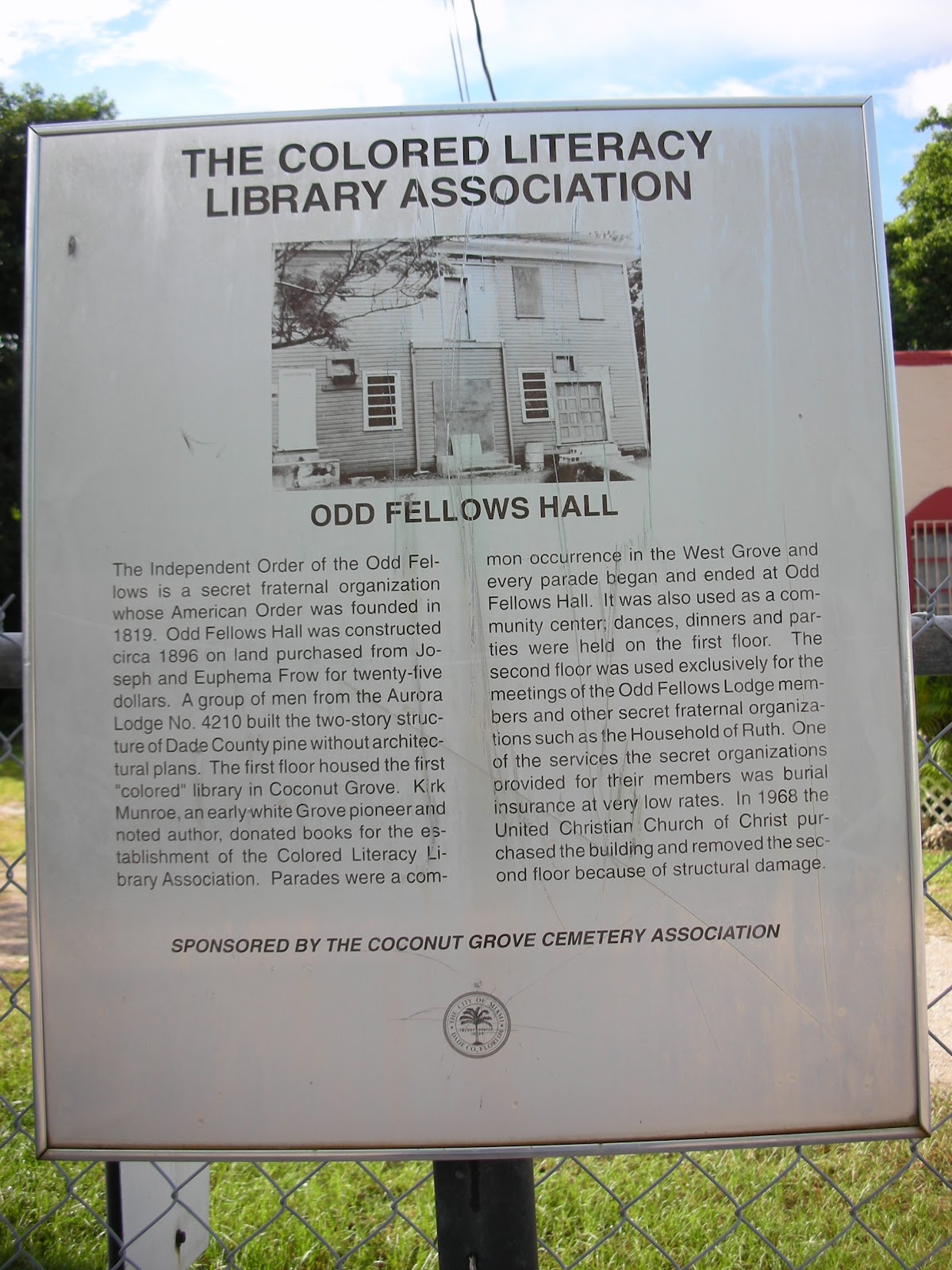
This is the historical marker I just happened to discover
one day in early 2009. It led to all the research that followed.

As I add chapters to my ongoing series “Unpacking Coconut Grove” this compendium will be updated with the latest on top. The first entry for 2013 is:

Happy Birthday Coconut Grove!!! Now Honour Your Past

In which I briefly lay out the history of Coconut Grove from the mid-1800s to the present-day and make the case that systemic racism is the reason the E.W.F. Stirrup House and the Mariah Brown House have not been renovated, despite promises to do so.

Previous chapters:

The corner of Charles Avenue and
Main Highway
in Coconut Grove.

Unpacking Coconut Grove, Florida – Part One

This is an overview of the area, the issues at stake, how I came to discover Coconut Grove, and why I became so passionate about it.

Unpacking Coconut Grove, Florida – Part 1.1

This chapter contrasts the 120-year old E.W.F. Stirrup House, currently undergoing Demolition by Neglect, with a house built in 1964 less than a mile away. One is rotting away and the other is for sale for $22,000,000.

Unpacking Coconut Grove – Part Two – E.W.F. Stirrup House

The E.W.F. Stirrup House,
standing proud on Charles Avenue.

This chapter delves deeper into the history of the E.W.F. Stirrup House and the history of Ebenezer Woodbury Franklin Stirrup. It explains why this proud Bahamian man’s legacy is in need of preserving for the community, as opposed to rapacious developers. E.W.F. Stirrup almost single-handedly created a Black community unique in the entire United States.

Unpacking Coconut Grove – Part 2.2 – The Neighbourhood Around The E.W.F. Stirrup House

Musings upon recent discoveries in my continued research of Coconut Grove, Charles Avenue and the Grove Gardens Residence Condominiums immediately behind the E.W.F. Stirrup House. It also includes a close up photo essay showing the damage that years of neglect have caused on the E.W.F. Stirrup House.

Unpacking Coconut Grove – Part 2.3 – The Charles Avenue Rabbit Hole Leads To Canada

Imagine my surprise when I discover my ongoing research on the E.W.F. Stirrup House leads to Canada, the country I chose to become a citizen of.

Unpacking Coconut Grove – Part Three – Who Controls What On Charles Avenue

The Coconut Grove Playhouse at the corner of Charles Avenue
and Main Highway. The City of Miami has been trying to wrest
control of it back, but one person is holding up all progress.

After extensive research I share what I have learned on who controls, or owns, properties along Charles Avenue. It turns out it’s all the same guy, or companies owned, in part, by the same guy, or properties controlled by the same guy. And, that even includes the Coconut Grove Playhouse, which I never even considered to be a part of my original research. Come on down, Gino Falsetto.

Unpacking Coconut Grove – Part Four – Open Houses and Broken Laws

In which I discover that demolition work is proceeding within the E.W.F. Stirrup House without the benefit of a Building Permit issued by the City of Miami. Also, for the first time, I get inside the Stirrup House after being invited inside by one of the men doing the demolition. This entry has lots of pictures of the inside of this historic 120-year old architectural treasure.

Unpacking Coconut Grove – Part 4.1 – A Photo Essay

Another visit to Charles Avenue seems to indicate that my blog posts are being read because the property is locked up tight again and all (allegedly) illegal demolition work appears to have stopped after being reported to the City of Miami Building Department. 

Unpacking Coconut Grove – Part Five – A Charles Avenue Love Story

180 degree panorama of the entrance to the Charlotte Jane Memorial Park Cemetery,
at one time the only place around where Black folk could bury their dead.

I would like to know more about the love affair between E.W.F. Stirrup and his childhood sweetheart, and wife, for whom the Charlotte Jane Memorial Park Cemetery, at the far end of Charles Avenue, is named. Here is the little I have been able to learn so far.

One of the informational
signs along Charles Avenue.

Unpacking Coconut Grove – Part Six – Still Building With No Building Permit

An update a week later, where I discover that (allegedly) illegal work is still proceeding within the E.W.F. Stirrup House without benefit of a work permit on prominent display.

Unpacking Coconut Grove – Part 6.1 – An Open Email to the City of Miami

Since the City of Miami has not seen fit to respond to my email, I have printed it here for all the world to read.

Unpacking Coconut Grove – Part Seven – Signs along Charles Avenue

At some point in the recent past a series of informational signs were erected along Charles Avenue. Here they are for you to read.

Unpacking Coconut Grove ► Part Eight ► The Powers That Be

Read along as I try to unpack the power structure in Coconut Grove. Pay no attention to the man behind the curtain, even if it is Gino Falsetto, a Canadian who left a string of bankruptcies behind before he left cold Canada for warm Miami.

Unpacking Coconut Grove ► Part Nine ► Good Neighbours and Bad Neighbours 

What makes a good neighbour and what makes a bad neighbour? In this latest chapter of Unpacking Coconut Grove I state the difference and name names.

Unpacking Coconut Grove ► Part 9.1 ► A Bad Neighbour Photo Essay 

A follow-up to last week’s entry with some hot, new information: How did The Bad Neighbour acquire his 50-year lease on the E.W.F. Stirrup House? It wasn’t by putting up any hard-earned cash. Read this chapter to find out how a (alleged) scumbag works real estate a deal.

Unpacking Coconut Grove ► Part 9.2 ► A Photo Essay Follow Up

Why did the alleged scumbag, aka The Bad Neighbour, allow the owners of the E.W.F. Stirrup House to be cited for contravening city by-laws by the City of Miami?  ALSO: More on how the alleged rapacious developer, aka Gino Falsetto, managed to acquire his 50-year lease on the E.W.F. Stirrup House. It isn’t pretty.

***

***

Happy Birthday Coconut Grove!!! Now Honour Your Past

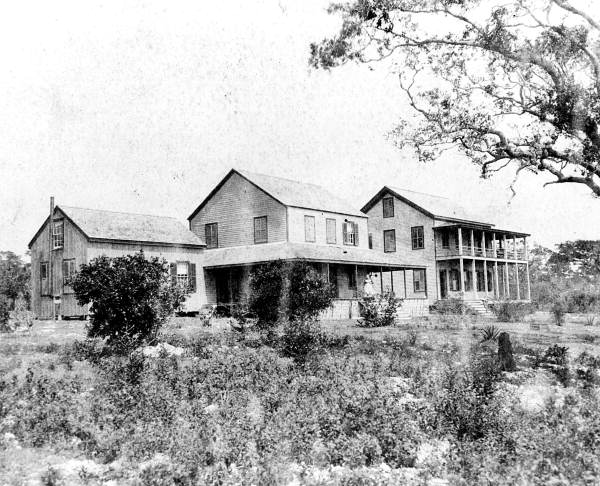
Peacock Inn circa 188?.
Courtesy State Archives of Florida, Florida Memory

Dateline January 6, 1874 – Dr. Horace P. Porter establishes the first post office in Cocoanut Grove. In the 138 years since, Coconut Grove dropped the “a” and became one of the most exclusive areas in the country, as it continues to bury its past in a way that can only be viewed as racist.

One of the first tourist attractions in south Florida was the Bay View House, built in 1883 by Charles and Isabella Peacock. It was later renamed the Peacock Inn (and is now the site of Peacock Park). Ralph Middleton Monroe also began building The Barnacle (now Barnacle Historic State Park) around the same time and Camp Biscayne a little later. While Cocoanut Grove (it didn’t lose the “a” until it was annexed by Miami in 1925) was still a virtually swamp infested wilderness, all of this development required staffing. Consequently, a parallel service industry grew around this progress and, as has always been the case in ‘Merka, these people tended to be Black.

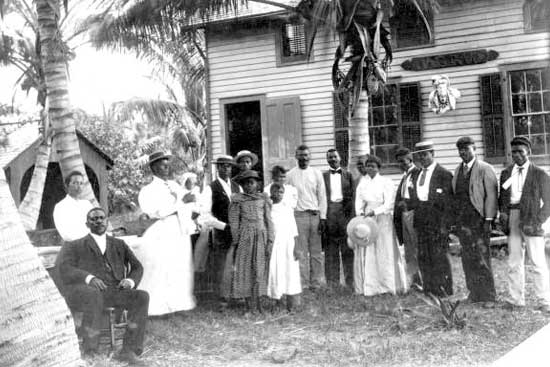
“Black citizens of Coconut Grove”
The entire Black community of Coconut Grove gathered
together in front of Commodore Ralph M. Munroe’s
boathouse. Photo taken 189?
Courtesy State Archives of Florida, Florida Memory

A Black population requires a Black enclave, of course; a place where White people don’t want to live, mostly because any Black person is welcomed. What is now known as West Grove became the area where Blacks, mostly from the Bahamas, congregated. One of the first was Mariah Brown, a Bahamian who lived in Key West. She had been hired by The Peacocks and, as “Mary the Washerwoman,” originally lived at the Inn. However, after she married Charles Brown they purchased a lot from Joseph Frow (who sold the Peacocks their plot of land as well), and built a house on Evangelist Street (now Charles Avenue) around 1892.

Joseph Frow was the first person to buy property off Biscayne Bay, in what later became Cocoanut Grove. His father Simeon had been appointed Cape Florida Lighthouse keeper in 1859. His brother John became lighthouse keeper in 1868. The lighthouse is on the southern tip of Key Biscayne and is the oldest standing structure in Miami-Dade county, even though it had to be rebuilt in the 1840s. Well familiar with the area, Joseph Frow bought up a very large chunk of land which he parceled off over the years.

1774 Map of Biscayne Bay, with Key Biscayne almost dead center.
Note: Where Coconut Grove would be located 100 years later
is labeled Grand Marsh. It was one. Map courtesy of Janthina Images,
which sells beautiful photo cards of the Cape Florida Lighthouse.

One of the men who worked in Cocoanut Grove was Ebenezer Woodbury Frankin
Stirrup, another Bahamian who came up through Key West. Being a carpenter
by trade, Stirrup’s skills were probably in high demand. It’s likely
that he worked for a variety of employers, Joseph Frow undoubtedly among them. Stirrup cleared land for Frow and it was backbreaking work. The area was little more than swamp land with occasional dry hummocks. Frow repaid Stirrup with land; for every plot of land Stirrup cleared, Frow deeded him a plot of land. Eventually E.W.F. Stirrup became one of the largest landowners in Coconut Grove and, eventually, one of Florida’s first Black millionaires.

From Black Miami . . . a brief look back

E.W.F. Stirrup was a man well ahead of his time. He believed that home ownership was important to growing Black families. To that end he used his land on which to build more than 100 houses on the streets surrounding Evangelist Street, which he sold or rented to the families that had emigrated to serve the growing tourist trade. This is also what made Coconut Grove unique. It had a higher Black home ownership than any other Black enclave in ‘Merka.

Over the years the neighbourhood has remained predominately Black, as families passed the homes down from one generation to the next, the way some families pass down precious jewels. This is also what kept the neighbourhood intact, as one urban renewal plan after another faltered when the City of Miami and developers couldn’t convince the homeowners to sell their most prized possession for peanuts.

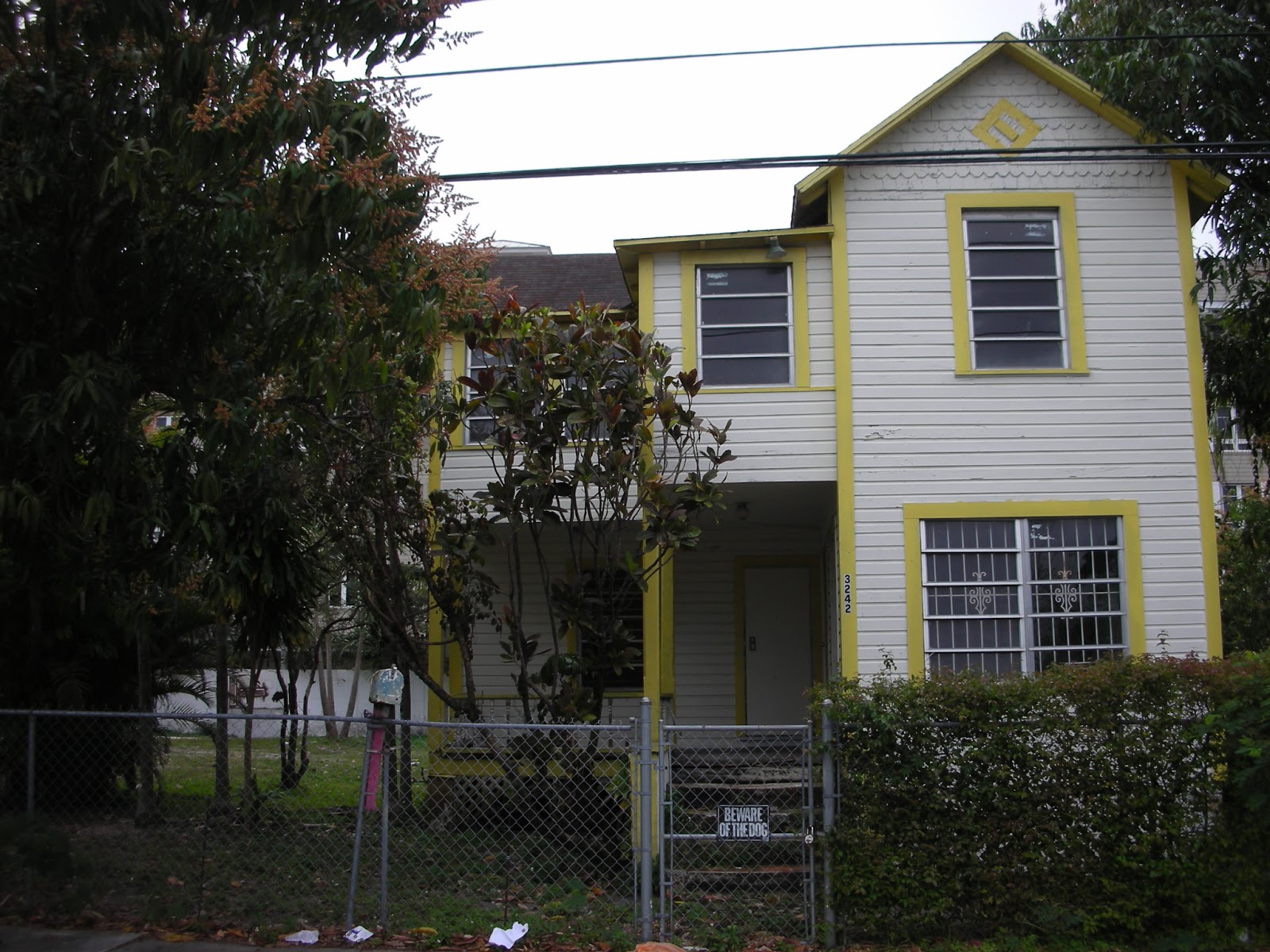
Stirrup built his own home, of course, in late 1890s. The E.W.F. Stirrup House is the showplace he built for himself near the corner of Charles Avenue and Main Highway. Unlike most of the other houses in the West Grove, the Stirrup House is 2 stories. While it’s based on the simple Conch Style that informs the Mariah Brown House, it has been elaborated upon and added to over the years. At one time the house looked out over Stirrup’s substantial holdings. According to a report prepared by the City of Miami [PDF] to consider an historical designation for the E.W.F. Stirrup House:

The contributions of the African-American community to the City of Miami actually predate the City’s incorporation in 1896. As early as 1880, Black Bahamians arrived in Coconut Grove and began a community that still thrives today. Ebenezer Woodbury Franklin Stirrup migrated from the Bahamas to South Florida in 1888 and worked as a carpenter’s apprentice in Key West, and then as a laborer in a pineapple field in South Dade. He ultimately became a millionaire Coconut Grove property owner. Stirrup built his home in Coconut Grove, using all his construction skills to create an impressive, yet understated, residence for his family. Mr. Stirrup lived in the house until his death in 1957, a total of 58 years.

Mr. Stirrup is remembered today as an extraordinary example of entrepreneurship, a man who made the transition from immigrant to enormously successful Coconut Grove landholder, and who built more than 100 houses for African-Americans. His is an amazing legacy, as his success is all the more incredible when it is remembered that his accomplishments took place in an overwhelmingly segregated and discriminatory environment. When Ebenezer Woodberry Franklin Stirrup died in 1957 at the age of 84, he was not only one of the largest landholders in Coconut Grove, but also had done much to improve the housing conditions of the African-American community.

Panorama by author of E.W.F. Stirrup House with the Charles Avenue Historical Marker in foreground

Meanwhile, the E.W.F Stirrup House — the last remaining symbol of an important man who once shaped what is now one of the most exclusive areas in the country — is allowed to undergo Demolition By Neglect by a rapacious developer who hopes to develop the property.

There can be no doubt that if Mr. Stirrup were White, his home would have been a shrine by now. The Barnacle, Commodore Monroe‘s old homestead just a block away from Stirrup’s, is now a state park and the house restored to its earlier splendour. Commodore Plaza, which begins two blocks north of the Stirrup House, is named after him. However, try and find something named after E.W.F. Stirrup, aside from E.W.F. Stirrup Elementary School, which is 10 miles from the community in which he made his fortune. Not even the historical marker across the street from his property, which honours the original Black Bahamian immigrants, mentions E.W.F. Stirrup by name.

Likewise the Mariah Brown House. If Brown were White, and owned the first house in an important historical district, her house would not sit empty and boarded up today. Even worse, the Mariah Brown was slated to have been renovated as a museum and community/historical resource. That project started in 1995 and has been stalled since 2000!!! However, unlike the Stirrup House, the current Mariah Brown house is not even the original structure. According to GrandAveNews:

The original house, 3298 Charles Ave., was built in 1889. The Coconut Grove Cemetery Association bought the home, which was in severe disrepair. The group razed it in 1999 and built a replica in 2000.

However, the E.W.F. Stirrup House is the real deal. While there appears to have been been several additions over the years, it’s still the original house, much of it built by Ebenezer’s own hands. As it continues to undergo Demolition by Neglect, the E.W.F. Stirrup House is also a symbol of something else in Coconut Grove: the quiet racism that has kept West Grove impoverished right from the beginning. Despite the The Grove’s reputation for more than a century as a laid-back, funky, village which attracted painters, Bohemians and later Hippies, Black Coconut Grove has been allowed to slowly slide into disrepair as White Coconut Grove has become one of the ritziest in the country. The 33133 Zip Code is now considered one of the most exclusive in the country. Within a mile’s radius of the Stirrup House today one can find homes, condos, and townhouses priced from a million dollars all the way up to $22 million, or so.

Developer Gino Falsetto controls the Stirrup property through a 50-year lease. However, due to provisions in Ebenezer Stirrup’s will the Stirrup House must remain in the hands of the Stirrup Family. Ever since he wrested away control from E.W.F. Stirrup’s descendants several years ago, Falsetto appears to have conducted a deliberate campaign of Demolition By Neglect. It has been empty for many years now and he has not even done the barest minimum to ensure the house doesn’t fall apart. The house is entirely exposed to the elements with glass not in several of the window frames facing the ocean, where the prevailing winds come from. Vines have been allowed to grow up the walls and across the roof, with roots no doubt causing damage to those areas of the house. There is exposed wood rot all around the outside of the house, mold and mildew being one of the greatest concerns for any wooden structure in south Florida, which is why wood is no longer used as a building material here. The mold continues inside the house as well, living along side the termites that are eating the structure away from the inside. The property has been cited several times by City of Miami inspectors because of a lack of upkeep, in contravention of several Miami by-laws. Between citations by the City of Miami, the E.W.F. Stirrup property is allowed to become a trash heap, until it’s cited all over again.

Eventually City of Miami building inspectors will come along and condemn
the structure, saying it’s too far gone to save. No doubt this is what
Aries Development, the company that holds the Stirrup lease,
wants. The E.W.F Stirrup House stands in the way of Aries making mega-millions of moolah.

From the large white structure on the bottom (Grove Gardens Residence
Condominiums) to the larger white structure at the top (Commodore Plaza)
is a massive area that could be developed for mixed-use by Aries if only
that pesky E.W.F. Stirrup House didn’t stand in its way. Click to enlarge.

Follow the bouncing ball: Aries developed the Grove Gardens Residence Condominiums, the white building immediately south of the E.W.F. Stirrup House (yellow rectangle in map on the right). Right across Charles Avenue are two vacant lots (the orange rectangle) that also appear to be controlled by Gino Falsetto and/or Aries Development and/or a shell company. Aries had owned these lots previously, but defaulted and the bank took them back in foreclosure. However, who should win the auction, but Gino Falsetto’s long-time partner-in-(alleged)-crime Pierre Heafy. It hardly appears to be a hands-off sale. Lastly, Immediately to the east of those vacant lots is the Coconut Grove Playhouse, which the state of Florida just recently took back from the bankrupt board that ran it into the ground 7 years ago. Through a loan that Aries claims it made to the board several years ago in an attempt to keep it solvent, Aries has always claimed a legal control of The Playhouse as well. Until recently that has stalled any progress on the Playhouse being renovated. Aries doesn’t appear to have dropped its claim, so it might have to be tested in a court of law no matter what happens to the Playhouse down the road. The state of Florida has put the property up for sale as surplus.

As tangled as all of that sounds, here’s the simple takeaway: The E.W.F. Stirrup House is the only remaining impediment to Aries Development (Gino Falsetto) having one of the last sizable properties that could be zoned for mixed-use in Coconut Grove. No doubt that’s the reason Gino Falsetto has done nothing to protect the E.W.F. Stirrup House. It stands in the way of progress and a huge profit.

It’s time for Coconut Grove to honour its entire history — the Black as well as the White that’s already been memorialized — and say no to a developer who is trying to destroy an important part of Coconut Grove history.

SAVE THE E.W.F STIRRUP HOUSE!!!


Read my entire “Unpacking Coconut Grove” series by clicking the link below:

Unpacking Coconut Grove ► A Compendium

Unpacking the Aunty Em Ericann Blog

Welcome to my occasional entry of Unpacking the Aunty Em Ericann Blog, where I ask my readers to pay attention to the man behind the curtain, who used to be “Aunty Em Ericann,” the woman behind the curtain.

Before I left Canada, 7 years ago, I told several people (who may now be too embarrassed to admit to knowing me) that I was going to become a nationally-known pundit in ‘Merka under the nom de plume “Aunty Em Ericann.” To that end I created the meta-character named Aunty Em Ericann, who eventually came to write at NewsHounds. The back story for Aunty Em was deceptively simple. Here’s her biographical profile:

Emily Ericann. That’s my real name. Well it was, before I went back to my maiden name after the divorce. My ex and I were dating for 2 months before we realized that if we got married my name could be pronounced “american” (Em Ericann). After it all went bad, I realized that’s the only real reason we got married. Ironically, I am a former American. However, I lived in Canada three and a half decades and became a Canadian citizen along the way. And yet, I recently returned to The Land of My Birth to take care of my aged father. Shocked by the before and after differences in America, I will use this forum to speak out. 

Some members of the Miklós Rózsa Society. Miklós
Rózsa
is in the center. The sack of shit who hides
behind the name of Johnny Dollar is on the far left.

I got away with the nom de plume for a number of years before the two-legged piece of excrement named Johnny Dollar decided it was his mission in life to expose Aunty Em’s identity, along with my sex life. That story is outlined in Johnny Dollar Has Proven Himself To Be A Very Dangerous Person, the very first post on this blog.

However, my long-time readers already know that story. If they’ve been paying attention they also know that my Unpacking Aunty Em Ericann Blog series is merely an excuse to find clever ways to remind them to click on some of the advertising, so I can keep the Aunty Em Ericann Blog rolling. It won’t cost you anything, but will add a few pennies (and I do mean few) to my coffers, helping to support this enterprise.

I’m looking at YOU!

Meanwhile, one statistic I can access through the Blogger platform is
what search terms people have used to find their way to the Aunty Em Ericann Blog. Take a look at this chart for this week:

Top Ten search terms delivering readers to the “Aunty Em Ericann” blog this week. They all make sense except #8.

I don’t know what disturbs me the most: That this week one of the search terms that people used to arrive here was “boy staked to the ground”; that three separate people used the search term “boy staked to the ground”; or that, somehow, “boy staked to the ground” brings people to my blog, even though I’ve tried it without any luck. While I’m thinking about it, I’m not so sure of Arawak People being on this blog either.

From time to time I also like to review what my Top Ten posts are. I can see which ones are highly-rated at any given moment in time, or by the day, by the week, by the month, and of all time since the Aunty Em Ericann Blog launched.

My Top Ten most popular posts of All Time

My Top Ten Posts of All Time™ in handy clickable hypertext:


Click on one of the links above to read one of my Top Ten blog entries, or just go exploring from the front page. There’s guaranteed to be a story or two you like, or maybe something that merely pisses you off. However, just keep in mind that it would be a small favour to me for you to click on one of the adverts . . . or two . . . on the Aunty Em Ericann Blog.

Montgomery Bus Boycott ► Nostalgia Ain’t What It Used To Be

Dateline December 5, 1955 – Rosa Parks and E.D. Nixon began the Montgomery Bus Boycott. It lasted for just over one year. 

This is something that happened within my lifetime. It’s not all that long ago: a mere 57 years.

The Montgomery Bus Boycott didn’t end racism, of course. It’s just not institutionalized and is far less overt. Hell, President Obama’s reelection hasn’t ended racism. It’s just done through dog whistles these days.

Some years later my father had a store on 12th Street in Detroit, the city to which Parks had moved in 1957. Twelfth Street was at the epicenter of the 1967 riot and was eventually renamed Rosa Parks Boulevard.

Rosa Parks died in Detroit on October 24, 2005.

Further reading:

Unpacking My Detroit; Part Five ► The Detroit Riots

Unpacking The Writer ► First In A New Series

I started my professional career on a machine like this.
I still bang my keyboard as if it’s a manual typewriter
and I wear off the most used letters within a year.

Welcome to the inaugural post of a new, occasional blog series that will look into the machinations of being a professional writer. Pay attention to the man behind the curtain.

Last night I found dozens of files in a folder that was buried inside a folder, which was nested in another folder, that was interred deeply on the hard drive of my computer. I didn’t realize I was still lugging this stuff around. It’s not all that heavy.

It’s a strange melange of files and contains a lot of crap, but there’s also some wonderful stuff that would be called ephemera, if it were actually printed on paper. Some of it’s fascinating; some is dross. There are angry letters, email from the early ’90s, query letters to editors, articles I clipped and saved, research links, sketches for short stories, articles I started writing “on spec” but never found a place to publish, and some files that I don’t even remember how they got there or who wrote them.

Included are several early drafts of published articles. Like the one below. This article was originally published by Hamilton Magazine and was a lot of fun to write. At the time I was fairly new to Hamilton, Ontario, and knew almost nothing of its history. Consequently, then entire article had to be researched extensively. Before it could be narrowed down to 50 items, I had to come up with a list of some 100 items, which me and an editor whittled down. The file is named DRAFT 15. There still would have been changes and corrections made before
it was published [and I see a few I would make], but
this is the version that was approved and for which I finally
got paid. I am publishing it as is. However, I added the illustrations, a few hyperlinks, and a couple of writer’s notes that I couldn’t resist.

Since Hamilton Magazine is not using it any longer, I will. I presume the copyright has reverted back to me by now. If not: Oh well.


Hamilton Magazine’s
Silver Anniversary
25 Years to Remember & Forget

It’s been a wild ride.

From good to bad and back again, Hamilton
Magazine has been there.
It’s not been all Sterling Silver. Some of
it has been merely Silver-Plated. A lot of it was steel. From polluted air and
harbours to the comeback of Cootes Paradise. From Opening
Nights to Closing Days. From Mayor Jack MacDonald to
the dawn of Morrow to Mayor Rob Wade. Disasters.
Parks. Eateries.
When an anniversary rolls around, it’s hard
not to get a little nostalgic and want to look back. So indulge and forgive
Hamilton Magazine if we reminisce on the last two and a half decades and
commemorate moments worthy of distinction – and some we would just as soon
forget. Which we plan to do, as soon as we get it out of our
system.
Your own mileage may vary.

1.     
OUR COPPS IS TOPPS: There may be no
bigger booster of Hamilton
than Sheila Copps, Liberal MP for Hamilton East and daughter to the city’s
second longest-serving mayor Victor. Sitting in cabinet in Ottawa variously as Deputy Prime Minister,
Environment Minister, and of late, Heritage Minister, she has been quick to
find and send federal money our way. Her defenders say that because she’s a
smart, confident and outspoken woman, she threatens the male power structure
and that’s the reason she gets a bad rap. From the first Copps hasn’t allowed
the sexist baiting to get the best of her. When, as new MPP at Queen’s Park
she was directed to “go back to the kitchen” she responded by presenting the
offender an autographed Liberal cookbook. She’s thrown her hat in the ring to
be the next Leader of the Liberal party and, if something happens to the Paul
Martin juggernaut, the former Rat Packer could become our next Prime
Minister.

  1. COPPS AN ATTITUDE: Sheila Copps has not always brought welcome press and been a
    positive ambassador for Hamilton.
    In her various squabbles at Queens
    Park and
    Parliament, she has variously been described as “the Princess of
    Innuendo,” “yattering,” “Goddamn ignorant
    bitch” (by former-Burlington Tory MP Bill Kempling),
    “baby,” and “slut” (again by Kempling). A
    constant knock against “Tequila Sheila” is that she’s shrill. And, no,
    it’s not just a gender thing. Women feel that way too. Even Sheila. In
    January of ’73, she admitted “Because I am a woman, my vocal cords
    tighten up when I get excited and I sound shrill.”

    Her defenders say a male politician would never be subjected to scrutiny
    by Blackwell, but that didn’t stop the fashion maven from declaring,
    “Her hair would look good on a man” and “As a fashion statement, she’s
    zero.”

    Sheila Copps with the recently
    deceased Lincoln Alexander.

    For better or worse, she’s our Sheila Copps.

2.     
SEASONS IN THE SUN: In 1986,
Hamiltonians celebrate as the Tiger Cats humiliate the Edmonton Eskimos, by a
score of 39-15, to take home the Grey Cup.

Thirteen years later: The Ti-Cats do it all over again, trouncing the Calgary
Stampeders 32-21 to the delight of 1999 fans.

  1. SEASONS IN THE
    SHADE:
    Could the worst Ti-Cat season be 1989
    when, at the end of their best season on record (12 wins), they lost the
    Grey Cup to Saskatchewan by  a
    field goal in a 43 to 40 game (which, incidentally, still holds the
    record for the most points ever scored in a Grey Cup game)? Or, could it
    be the 1998 season, when the Ti-Cats lost another Grey Cup to Calgary by the
    narrower margin of 26 to 24? Was it possibly the dismal ‘97 season, when
    the Ti-Cats finished the year with only 2 wins and a whopping 16 losses?
    Or, could it be the entirety of The Ballard Years (1978 -1989), when King
    Harold of Hockey ruled the team? You decide.
Martin Short (on the right) with Eugene Levy

3.     
HAMMER & NAILS: There’s a game Hamiltonians
love to play. With great pride we will point to those local guys and gals who
have made good on the world stage. At the drop of a hat we will list their
accomplishments and their entire CVs.

It is always with great pride we note Martin Short and Eugene Levy are from
Hamilton, both graduates of Westdale
High School. Working
together, they gave us the brilliant SCTV Comedy Network and a hilarious mockumentary
called The Canadian Conspiracy, about how Canadian comedians are taking over
the United States.
This duo also appears together in Father of the Bride, Parts I and II, both
box office bonanzas.  Separately they have
appeared in such masterful comedic fare as “Primetime Glick”,
Mumford, Mars Attacks!, ¡Three Amigos!, “Saturday Night Live”, Best
in Show, American Pie, Waiting for Guffman, The
Last Polka, Splash, and Tears Are Not Enough.

If it were just these two Distinguished Canadians, Hamilton could simply rest on those
laurels. However, we also want to claim Ivan Reitman, who discovered his
ability to direct movies while at McMaster
University.

Two pairs of sibs are also embraced by The Hammer: Gema Zamprogna (Felicity, Road to Avonlea) and Dominic Zamprogna (Edgemont, The Boy’s Club) F/x2) are making
inroads in the acting profession, while Ian and Dave Thomas took separate
roads; one a musician/songwriter, the other a comedian also coming out of
SCTV.

If that were not enough we can also lay claim to Roberta Bondar
(another McMaster grad), who has explored Outer Space and Daniel Lanois who has probed the Inner Spaces of music.

Still on the musical front, Hamilton
also claims Lorraine Segato (Parachute Club), who
grew up on the Mountain and Tom Wilson (Junkhouse
and Blackie and the Rodeo Kings), who may never grow up, hopefully.

Ivan Reitman (on the right) with Raffi?
Do parents hold it against Daniel Lanois for Raffi?
  1. SCREWS:  Do we really want to
    claim Reitman? As a director he helped Eugene Levy perpetrate Cannibal
    Girls and also brought us such disasters as Kindergarten Cop and the more
    recent Evolution.

    Or even Short and Levy for that matter. They’ve given us such turkeys as
    Clifford, Pure Luck, Josie and the Pussycats, Holy Man, Speed Zone!,
    Armed and Dangerous, and Going Berserk.

    Even Lanois is suspect. To all those parents
    who were tortured by hours of Raffi, it is
    only fair to point out that Lanois was both
    engineer and musician on many of those releases.

    [Writer’s note: It’s always fun when one
    can work a friend into an article. I’ve
    known Lorraine Segato for what seems
    like centuries. We were in college together
    and, as station manager, I gave her a radio show on Radio Sheridan at Sheridan College in Oakville, Ontario. I have followed her career ever since.]


4.     
FOUNTAIN OF YOUTH: To celebrate Hamilton’s 1996 Sesquicentennial, the city decides to
restore the beautiful old Victorian fountain – condemned and removed in the
‘50s – to Gore Park. The spire and top bowl of the
original fountain were slated to be installed in Sam Laurence
Park at the top of the
Jolley Cut, until the new proposal is passed. As with anything involving Gore Park
after the Chainsaw Massacre [see # 4 to the right] the plan was mired in
controversy. Eventually, the more favoured spot, both politically and
architecturally, in the middle of Hughson
Street, intersecting the park, was rejected by
the public in favour of putting the fountain right back where it had been 40
years earlier.

  1. THEY PAVED PARADISE: The darkest
    day in downtown is, without a doubt, June 18, 1983 in what has thereafter
    been known as The Gore Park Chainsaw Massacre. Century old trees are
    hacked to the ground to make way for a snack bar, amphitheatre, and
    other projects. By the time the construction dust settled in October
    (and only after the city issued a Stop Work Order), it was decided to
    tear down the half-finished new structures and re-landscape the park
    under a brand new master plan. In the interim, we were left with little
    more than a construction site in the downtown core for well over a year.
    After the usual calls to fire city employees, and a decision not to hold
    a Public Inquiry, it turns out city politicians had been asleep at the
    switch and no one knew what the plan had been before the Parks
    Department ordered in the chainsaws. Taxpayers were on the hook for all
    the changes – and the changes to the changes – but no amount of money –
    only time –will bring back the old growth in the park.
5.     
AN ENDANGERED SPECIES: It is now the
last of its kind in Hamilton,
but when the Westdale Theatre opened in September of 1935 the printed program
proudly proclaimed it had been built with local labour and local materials. By
today’s standards its one, large screen – and 490 seats – harkens back to a
simpler time – a time when an evening out began with a boisterous rendition
of God Save the King and closed the same way.

Opening night at the Westdale was no different. In between was a speech by
city controller F. F. Trealeven, followed by a
colour travelogue of Los Angeles.
Before the Intermission the audience was treated to a Charlie Chase comedy
short. After the intermission came the main feature: “Dance Band,” starring
Charles “Buddy” Rogers.
(Rogers was known as “America’s Boyfriend,” and the following year, would
marry Mary Pickford, a former-Torontonian called “America’s Sweetheart.” They would
remain devoted to each other until her death in 1979. See? A much simpler
time.)

During the last 25 years, when other movie palaces were bulldozed to make way
for today’s Multi-Plex Modernity, the Westdale has
stood proudly, if a little threadbare, as one of the great examples of the
intersection between Art and Commerce.

  1. WATER, WATER
    EVERYWHERE:
    The Great Flood of January 2003
    can be looked at as a cautionary tale of how budget cuts due to
    amalgamation could turn around and bite us when we least expect it.
    Residents along Herkimer and Charlton West were rudely awakened by the
    sound of rushing water, in many cases rushing right into their basements
    by the force of the raging water blowing in the windows. As water always
    does, it worked its way to low ground, mirroring the path of an ancient
    streambed, which had long since been covered over by development.

    When the waters finally receded untold dollars of damage were being
    added up, home owners fought with insurance companies and no one would
    ever look at Hamilton’s crumbling infrastructure the same way again.

    [Writer’s note: I lived on Charlton West during the Great Flood of Oh Three.]

6.     
CHILD’S PLAY: The opening of the
Hamilton Children’s Museum on July
22, 1978 created a world-class retreat for families and
classrooms in the heart of Gage
Park. Which is ironic
considering the original name of the house was The Retreat. The Gage Family
left Jubilee Farm to the city and the red brick house they built about 1875
was always called The Retreat. The Hamilton Children’s Museum is second only
to Dundurn Castle for the number of yearly visitors.

  1. NO MORE RAIN: The Earthsong Festival banner
    waived for a magical decade over Princess Point in picturesque Cootes
    Paradise. The official reason for the failure of Earthsong
    was reduced funding. However, there was also some talk the festival was
    hard on the fragile environment of Cootes Paradise and Westdale
    residents complained long and loud about congestion and litter. No
    matter what the reasons, when Earthsong ended Hamilton lost a
    wonderful multi-ethnic celebration, but many people remember the smells
    of the ethnic food wafting over Princess Point.
7.     
SUBURBAN RENEWAL: The first shovel of
dirt should be turned any day now on what will become the Red Hill Expressway.
Mountaineers have long complained how hard it is to get on and off the
escarpment and this roadway will ease the pain. When it will be finished is
anyone’s guess.
  1. SUBURBAN RUIN: A highway rammed through the pastoral Red Hill
    Valley is
    something environmentalists want to stop at any cost. They say the Red
    Hill Expressway is a mistake still on the drawing board that’s not too
    late to cancel.

8.     
PARADISE FOUND: Cootes Paradise, which
straddles Hamilton and Burlington,
is as beautiful a spot as anywhere in Canada. All through its long
history, it has remained undeveloped by either housing or commerce, but that
didn’t stop it from becoming polluted. In the last 25 years, Cootes Paradise
has been brought back from the brink by many projects, spearheaded by the
RBG, the Bay Area Restoration Council (BARC), and various local environment
groups. Now one can see rare egrets in the bay. The blue heron are back.
Swans regularly use the inner bay for nesting. An estimated 14-16 million
fish can be found in the western end of Cootes. Pollution is down, although
not out, and the system of trails criss-crossing Cootes Paradise makes for
one of the nicest walks anywhere in Hamilton.
When in the thick of Cootes it’s easy to forget you are surrounded by two
major cities. It just feels so remote.

  1. DOWNTOWN IN DECLINE: The collapse of downtown Hamilton happened over a period of
    time and came in stages. Among the contributing factors:

    When Jackson Square opened it pulled people off King Street, which hurt area
    businesses.

    In the economic downturn of the ‘80s, businesses closed their downtown
    offices, leading to fewer customers, leading to more storefronts being
    shuttered.

    Eaton’s, the anchor store in City Centre closed.

    Still fewer customers at Jackson
    Square so most of the chains started
    closing in the downtown mall.

    Shopping habits moved to the new suburbs and the Big Box Stores. What
    was once a burgeoning downtown is now just an economic shadow of its
    former self.

9.     
GOING TO POT?: Marijuana activists
Michael Baldarsaro, 53, and Walter Tucker, 69, have
been battling the marijuana laws of the country since founding the Church of the Universe on September 11, 1982. Their nascent religion claims marijuana
as a sacrament and it’s been getting those wacky boys in trouble ever since.
With the Feds promising to decriminalize the country’s marijuana laws, it
appears Baldarsaro and Tucker were way ahead of
their time. As prescient as they may have been, it’s hard not to laugh at
their antics. Like the time they were busted for sending Health Minister Alan
Rock a baggie of their best to test for medical marijuana trials or the
various times one of them has run for mayor. In fact, in the next municipal
election Baldarsaro was first at the gate to
register to run. That’s dedication. Whether you are outraged or just think
they are simply outrageous, darling, there’s no denying The Church of the
Universe is always good for a laugh.

  1. A NEW YORK STATE OF MIND: In
    a misguided attempt to create an entrance corridor into Hamilton, the city
    expropriated businesses and homes along York Street, stretching from
    Dundurn to Bay, including historic homes at 518 and 555-7 York Street. More than 210
    business owners and residents – incorporating 111 properties – are
    relocated. Those businesses that could not afford to relocate closed
    outright. Widening York
    Street did create a corridor into the city,
    but the grand urban renewal projects slated for along the boulevard
    never materialized and a local neighbourhood is decimated by the
    wrecker’s ball.
10.  A BLOOMING GOOD TIME: Small thing also serve to beautify a city. The Keep Hamilton
Blooming campaign, run by Hamilton City Parks and Recreation Department,
matches companies and individuals to streetscapes and medians. This match
results in annuals and perennials being planted along Hamilton streets, which bloom throughout
the warm season. A beautiful thing indeed.

Alas, this program is being threatened by the budget cuts forced by
amalgamation. In another 25 years, we may see this topic on the other side of
the ledger.

  1. URBAN URINE: Another dark day for downtown came when the Comfort Station
    below Gore
    Park was flushed
    away, despite it having received 1981’s coveted “Best Public Washroom”
    award from Today Magazine. The decision to wash our hands of the
    facilities came in May of 1984, a year after The Rape of Gore Park [see
    above]. By the time the Gore’s redesign of the redesign went ahead, the
    entire project was so far over budget that something had to be cut and
    it was decided it would be the lovely tiled, well-kept, and
    well-remembered washrooms under The Gore.

11.  COPPS OUT?: Although we now rent it out as a movie set, the Victor Copps
Trade Centre Arena, or Copps as it is more commonly known was a big deal when
it opened on November 30, 1985. Opening ceremonies began at 11:30 a.m. followed by an
old-timers hockey game pitting the former Hamilton Red Wings against the St. Catharines Black Hawks and Teepees.
The first wrestling match at Copps, Mosca Mania,
was held just two months later, on February 2, 1986. It’s been downhill ever since.

  1. BLACK DAY IN JULY: On July
    11, 1997, a black cloud rose over Hamilton, both literally and
    figuratively. By the time firefighters finally knocked down the Plastimet inferno on the 12th, the city
    had declared a state of emergency and about 650 people had been
    evacuated. The dense, black, toxic plume put Hamilton on the map for hundreds of
    miles in every direction. While Public Health Department officials say
    there should be no long-term effects, residents, firefighters, and
    police officers all report troubling symptoms.

    In an odd twist, Hamilton’s
    previous state of emergency concerned the same property. Early in the
    ‘90s, a metal recycling plant on the site had closed. In 1993 some teems
    broke into the abandoned factory and made off with a quantity of deadly
    mercury.

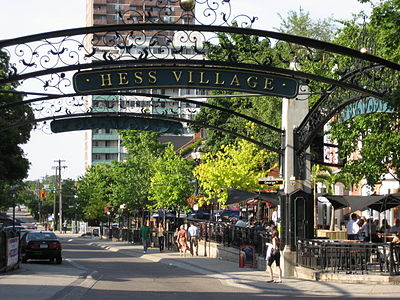
12.  IT TAKES A VILLAGE: In the last 25 years, Hess Village has become the most vibrant
place in Hamilton
for Night Life. Yet, year after year its existence is threatened and
activities curtailed by ongoing complaints from area residents.

Hamilton Magazine humbly makes two suggestions for keeping Hess Village
thriving for another 25 years: a). Local residents with noise complaints
should do it quietly; b). those who go to Hess Village
to party should make less noise than the residents.

Why can’t we all get along?

  1. BOUGHT THE FARM: Upper James, in fact much of the Mountain, was once a place
    where farms flourished. However, like all cities, Hamilton had to expand. In the
    process, all the lovely farms up on the escarpment were bulldozed to
    create the same Shopping
    Theme Park found
    on the outskirts of any city anywhere.

13.  THE MORE THINGS CHANGE:  Beautiful
Downtown Dundas is as quaint and perfect an example of small town Ontario still existing among the urban sprawl in the Oshawa – Hamilton
corridor. While other small towns have lost many of their older buildings, Dundas’ storefronts
retain that same nostalgic quality, while serving a vibrant and active local
community.

  1. PUT THE LIME IN THE
    COCONUT:
    Be honest: Who hasn’t called it Slime
    Ridge Mall at one time or another? When Lime Ridge Mall opened, it
    changed forever the shopping patterns of Hamilton residents.

14.  FAVOURITE SON: The Honourable Lincoln “Call me Linc” Alexander has had many accomplishments
in his 80 plus years. He was the first Black Member of Parliament,
representing Hamilton West from 1968 through 1980. Named Ontario’s first Lt. Governor of colour, he
served as the Queen’s representative from 1985 to 1991. In addition, in 1997,
a highway was named after him. How perfect is it that the affectionate nickname
for the roadway that brings Hamiltonians together is The Linc? Making the
irony even more delicious is the fact that Linc has never driven a car in his
life. License or not, at his 80th Birthday Bash then-Premier Mike
Harris presented him with his own provincial vanity plate reading LINC 80.

  1. BIGGER IS NOT
    ALWAYS BETTER:
    With the stroke of midnight January 1st 2001, the city of Hamilton swallowed Stoney Creek, Flamborough, Ancaster,
    and Dundas
    in. Overnight the city’s population jumped from 387,000 to 489,457. Like
    all the other amalgamations across the province it was sold to us as
    revenue neutral, but taxpayers have lost dearly as costs are downloaded
    onto residents.

15.  A BRIDGE TOO FAR: After years of arguments, proposals, studies, cancelled tunnels,
and construction the newly twinned Burlington
Skyway Bridge
is officially reopened on October
10, 1985 and dubbed the Burlington Bay James N. Allan Skyway at a
cost of $41.8 million. In attendance was James N. Allan himself.

  1. BRIDGE OVER
    TROUBLED WATERS:
    OPP Constable Paul Brammer has the dubious honour of investigating the
    first fender-bender on the newly opened Burlington Bay James N. Allan
    Skyway, a mere 14 minutes after the official dedication. The crash pits
    Transportation Ministry official Alfred Wittenberg’s 1984 Datsun against an ’85 Mazda, driven by St. Catherines reporter Kevin
    Hodges. The damage? Four-hundred dollars and some bruised egos.

16.  A BRIDGE TOO FAR; THE
SEQUEL:
The High
Level Bridge
has always made a grand, if understated, entrance into Hamilton. On July 11, 1988, the High
Level Bridge
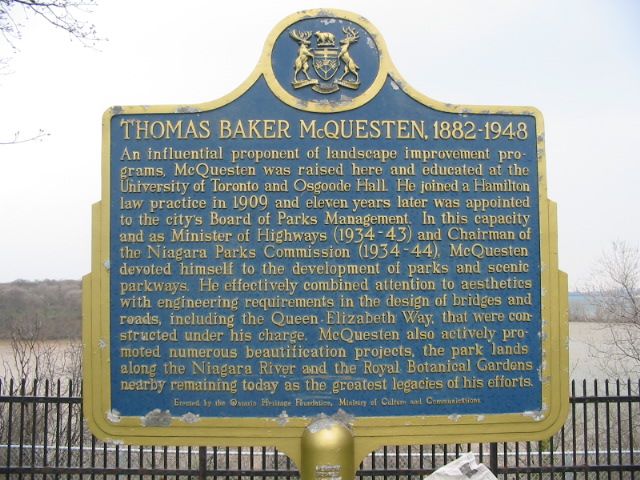
was refurbished and rededicated the Thomas
B. McQuesten High
Level Bridge,
honouring both the city’s past and a man crucial to Hamilton’s development. Thomas McQuesten is largely responsible for the RBG and the
province’s system of highways. The High
Level Bridge,
by any name, is an architectural treasure and the best way to enter Hamilton.

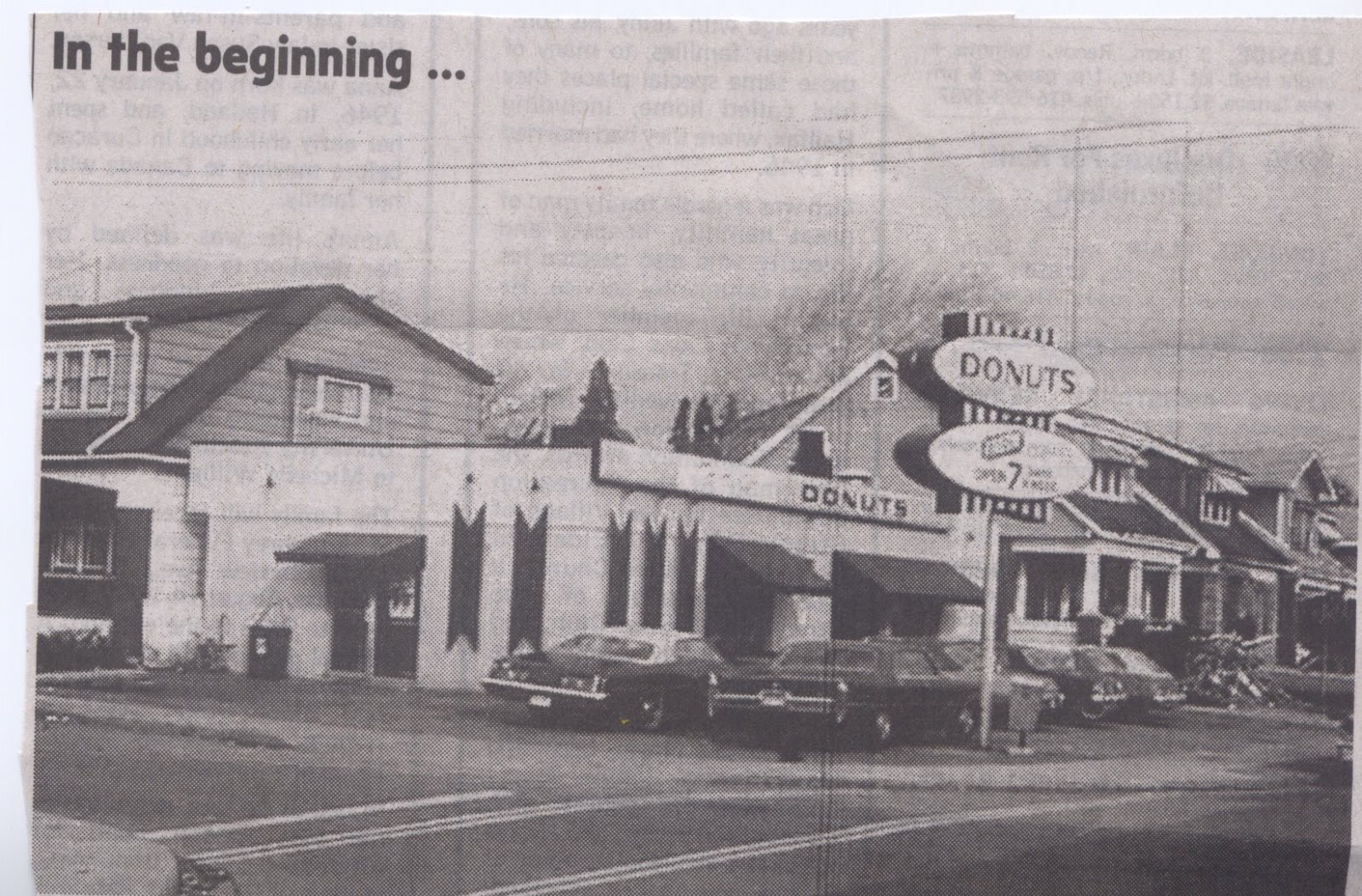
  1. DOLLARS TO DONUTS: In October
    1999, Hamilton’s
    World Famous Tim Hortons
    Store Number One re-opened after extensive renovations. However, rather
    than using the opportunity to create a time capsule to reflect its 1964
    origins, the donut shop on Ottawa near Main was redecorated to look like
    any other Timmys anywhere else in the world.
    Gone was the chance to give Hamilton an
    interesting cultural donut Mecca
    to remind the city of its working-class roots. Oh well. At least they
    erected a nice big plaque to commemorate the event.

17.  BORIS AND NATASHA: Despite Boris Brott calling Hamilton Magazine one of his pet
peeves in a 1981 Hamilton Spectator article, we are going to show how
magnanimous we can be by including the Peripatetic Maestro on the To Be
Remembered List. Love him or hate him – there seems to be no middle ground –
Brott has invigorated the Hamilton
music scene since his 1969 arrival to twirl baton for the Hamilton
Philharmonic Orchestra. He wears his Order of Canada with pride and has never
stopped being a booster of the city of Hamilton,
with his Summer Music Festival, despite all the bad press he has received
over the years.

  1. THE FOUR HORSEMEN
    OF THE APOCALYPSE:
    The beautiful Birks Building, at the corner of King
    and James streets, was already gone when Hamilton Magazine began
    publishing, but the ornate “Charging Horsemen” clock that
    greeted passers-by remained. However, in 1984 it was taken away and
    reinstalled two years later outside Jackson Square following extensive
    repairs. Only two weeks after the clock was put back into the downtown
    area, the plug was pulled. The charging horsemen were not working
    properly. The clock was beginning to sag, causing the horsemen to run
    into each other. The clock has had many problems and been repaired many
    times since and although the “Charging Horsemen” no longer charge
    the clock still sits outside of Jackson Square.

18.  URBAN RENEWAL #? If you have ever watched Anne of Green Gables, you have seen it.
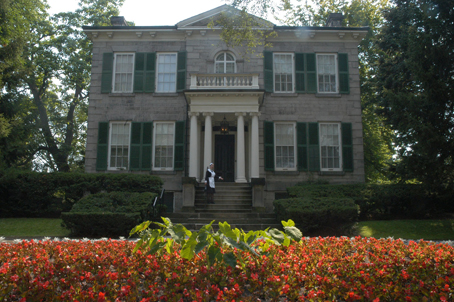
If you’ve driven past Whitehern, at 41
Jackson Street West, you come to understand why
it’s considered one of the best examples of Victorian life in Canada.
It is also one of Hamilton’s
greatest architectural treasures. In 1991, the Natural Historical Sites and
Monuments Board recognized Whitehern for its historical and architectural
significance and once again an honour was bestowed upon Thomas McQuesten, Whitehern being his former-estate. Future
generations of Hamiltonians will be able to tour a truly beautiful building
and grounds and future movies will be able to film there.

  1. CHOCOLAT: When Laura Secord closed its doors at 113 King Street East in 1984, for
    the last time, they had been in business in the same location for more
    than seven decades. They opened on October 20, 1913 to supply the City of Hamilton with
    Laura’s famous candies.
19.  URBAN RENEWAL # ?: A $125,000 facelift in 1995
saved one of the architectural treasures of downtown Hamilton. The Right House was built between
1890 and 1893, and has watched over the corner of Hughson and King for well
over 100 years. When it was converted into spaces for service oriented
businesses, it gave The Right House, Hamilton’s
first department store, a new lease on life. [DRAFT] William Stewart &
Son architectural wonder that was the Right House is retained on King Street.
[DRAFT]
  1. IS THIS THE RIGHT
    HOUSE?:
    It was a
    sad day indeed when, in January of 1983, The Right House – Hamilton’s first
    large department store – closed its doors for the last time.

20.  CHINA FOOD: The Pagoda Chop Suey House at 85 ½ King Street East
is the oldest established restaurant in Hamilton,
having opened in 1942. At one time, it was the only place to buy ethnic eats
in Hamilton.
However, as Hamilton
has come of age more restaurants, representing every corner of the globe,
have opened. The discerning diner can eat in Thailand one night and taste
Indian curry the next. Typical of this trend is The Roti
Hut on Main Street East.
A Roti is Caribbean
fast food and is singularily delicious. When you
can buy a tasty Roti, you just know a city has come
of age.

  1. CHINA DOLL: For more than six decades, neighbour to Laura Secord was the
    Herbert S. Mills China Shop, with an international reputation. The shop
    originally opened at 11
    King Street in 1924 and was one of the
    first china shops in North America to
    stock fine bone china. Among customers was Franklin D. Roosevelt’s mother,
    who bought china for the White House in the ‘30s. An order for the
    Japanese Embassy in Washington,
    D.C. alarmed the F.B.I.
    and concluded in some cloak and dagger operations. The spooks learned
    the order was placed by a December 6, 1941 telegram demanded the china be
    shipped before the next day, or not at all. This convinced them the
    ambassador must have known about Pearl Harbor since he was too anxious for the
    Mills order. The Herbert S. Mills China Shop closed in 1985.

21.    A DAY AT THE BEACH: The natives called it “Daonasedao,”
meaning “where the sand forms a bar.” Étienne Brûlé may have been
the first European to see when he passed through these parts in 1615. A
strategic site militarily, skirmishes were fought there during the War of
1812. In the mid-‘70s battle lines were drawn again on the Hamilton Beach Strip, as the city bought up properties in order to form a huge park. In the
end 170 houses were razed and the residents were
upset by this plan to turf them out.  Hamilton’s Beach Strip was officially sanctioned as a
residential area in 1983 and it is now a thriving community.

  1. WHEN CHICKENS COME
    HOME TO ROOST:
    It was certainly a day worthy
    of forgetting when the sheriff bolted the doors and seized the property
    at The Chicken Roost in 1986. Today it’s the site of Cheapies Record
    Store, but at one time, the lines snaked down the block to get into one
    of Hamilton’s
    most fondly remembered restaurants. The Roost opened at 67-69 King Street East
    on October 1, 1948
    by the Mintz Brothers Max and Benny. The desired
    delicacy was the signature Chicken on a Bun, with BBQ Sauce, a recipe
    smuggled from Toronto.
    For a while CHML’s Meet at the Chicken Roost,
    with Gordie Tapp,
    could be heard on the radio every Saturday night. The original owners
    sold to out-of-town businessmen in 1984, but they could not make a go of
    it. On May 11, 1986,
    interested parties could wander aimlessly in a Frid Street warehouse where the
    former contents would be auctioned, ending an illustrious run as one of Hamilton’s great
    eateries.
22.  THAT’S THE WAY NIAGARA FALLS: It has stood for millions of years, carved out by the glaciers
that scoured the countryside as they advanced and retreated. When the last
Ice Age ended Head of the Lake was left with
its unique geography and geology.

On February 8, 1990
UNESCO (The United Nations Educational, Scientific and Cultural Organization)
recognized what Hamiltonians have long known and declared the Niagara
Escarpment as an International Biosphere reserve.

The Bruce Trail
runs through the escarpment for more than 800 kilometres, from Queenston near Niagara to Tobermory
on The Bruce Peninsula, making it the largest footpath in Canada. And, some of its
loveliest sites are right here in Hamilton.

  1. WATER, WATER
    EVERYWHERE; PART TWO:
    They tell us it’s not
    as bad as it once was and we are winning the battle against pollution in
    Hamilton Harbour. However, the question
    still begs itself: When will it be safe for our children to swim there?
23.  TO MARKET, TO MARKET: Unlike many cities and even smaller towns, Hamilton has managed to retain its Farmer’s
Market. Now housed under the Main Library (where much of the research for
this article was conducted, incidentally), the market has operated, in one
form or another, since April 14, 1837 when Andrew “Yankee” Miller deeded the
land to the city for 5 shillings in tax arrears. At the ripe old age of 166
years it is still one of the liveliest places in the city to buy fresh
produce and meats and a walk through The Market is like a walk around the
world.
  1. THIS LITTLE PIGGY
    STAYED HOME:
    The Farmer’s Market moved to
    its current location in 1980. At the time Rick Butwick,
    a Waterdown farmer and Market vendor said
    about the new facilities, “It looks more like the inside of a battleship
    than a market.” And it still looks the same way 23 years later. Which
    begs the question: Whose crazy idea was it to put the Farmer’s Market in
    a concrete barn of a space?
24.  WADE INTO DEEP WATERS: Although current-Mayor Rob Wade has stuck with his predecessor’s
decision not to make any more proclamations [See #24 to the right], he has
been more proactive by walking in the Hamilton Gay Pride March and has even
allowed the rainbow flag to fly over city hall. Nary was a protest heard.
Maybe Hamilton
is growing up.
  1. MAYOR McCHEESE: In 1991, former-mayor Rob Morrow gained the ire of Gays and
    Lesbians nationwide when he steadfastly refused to proclaim Gay Pride
    Week in Hamilton.
    Angered at the mayor’s intransigence, Joe Oliver decided to take the
    case to the Ontario Human Rights Commission, arguing he was discriminated
    against based on his sexual orientation. After almost 4 years, the OHRC
    agreed, ordering Mayor Morrow to proclaim Gay Pride Week if asked again.
    He was in 1985, and so he did. That was the last proclamation ever made
    by the Mayor’s Office. In order to avoid having to ever proclaim Gay
    Pride Week again, the mayor promptly went out of the proclamation
    business. Say goodbye to McHappy Day.
25.  HAMILTON GOES INTERNATIONAL: After several years of investigation, followed by a complete
exoneration, John C. Munro gets his final reward from the federal government
when Mount Hope
Airport was renamed the John C.
Munro Hamilton
International Airport
on April 6, 1998.
Munro – like Sheila Copps who took over his seat when he retired – Munro
never forgot his Hamilton roots and always
managed to make sure the city came in for Ottawa’s largess when money was being doled
out.
  1. RETURN TO SENDER: John C. Munro’s “Return to Greatness” mayoralty campaign in
    2000 was a disappointment for his backers and the once mighty federal
    minister who could do no wrong. He spent $206,782 to garner a mere
    14,308 votes, or about $14.50 per vote.

Unpacking The Aunty Em Ericann Blog ► Shit Just Got Real

Pictures in the public domain stitched together by author

From time to time I like to unpeel the onion and reveal a bit of what it takes to put this blog together. I call the series “Unpacking The Aunty Em Ericann Blog,” Aunty Em being my nom de plume when I was writing at NewsHounds.

However, as I have explained to my faithful readers, this series has always been nothing more than an excuse to find clever ways to beg my readers to click on an advert or two (in the right-hand column) while they are here. When someone clicks on an advert, I get a few pennies . . . and I do mean “a few.” Finding clever ways to get my readers to click on the adverts has become more crucial than ever. Yesterday I learned two things simultaneously:

  1. Blogger has a limit for FREE data storage;
  2. I had JUST reached that upper limit.

I felt as if someone had just said to me, “Psst! Hey kid! The first one’s free! Now it’ll cost you.”

Faced with this dilemma there was only one practical thing to do: So that I can continue to bring to my vast reading audience all its favourite series, I’ll start to pay the monthly fee for the data storage.

All your favourites are here: Unpacking Coconut Grove, Unpacking My Detroit, Another Magical Tee Vee Moment, The Fox “News” Spin Cycle, Judge Not, Nostalgia Ain’t What It Used To Be, Fox “News” Snark, Music Reviews, Chow Mein and Bolling, and my other various looks at various topics, as varied as Watergate right up to Today in History.

Think of this series like a PBS Pledge Break: If you want to see your favourite EmTV series to continue, call the number at the bottom of your . . . Wait!!! What??? There’s no number? Then click on several ads while you’re here and keep this blog in data storage.

Pretty please with sugar on top?

You can also connect with me at facebook and Twitter. The more the merrier.

Unpacking Aunty Em ► My Shocking Confession

“Hanging” Chad. Despite his
name, Chad’s a wonderful dancer.

I have never voted in an election in my entire life. In fact, it’s somewhat of a family tradition. I am a Second Generation Non-Voter™. 

I had always assumed that Pops voted before I moved back in with him to help him out. I was shocked to learn he never voted in his life. I’ve asked Pops why he doesn’t vote and simply put: he thinks they’re all crooks and doesn’t want to encourage them. People ask me why I’ve never voted and I say, “It’s complicated.”

Get comfy, kidz.

When I became of a voting age, I was already living in CanaDuh, where I moved after growing up in ‘Merka. However, I wasn’t a Canadian citizen. I was merely a “Landed Immigrant,” which is the equivalent of having a Green Card. You must be a Canadian citizen to vote in a Canadian election, just as you have to be a ‘Merkin to vote in ‘Merka.

I lived in Canada as a Landed Immigrant for quite a while. During that period I covered several elections for several publications. I also worked for the #1-rated tee vee newsroom for a decade, which had me working during several long election nights live — some in the newsroom and some as a Field Producer producing, err, out in the field at an election headquarters.

Having no stake voting in Canadian elections, I looked at them from afar, the same way I get to look at the Christmas hysteria every year. It’s a very different experience when watching the sausage get made, especially when one can’t even vote. Having no stake in ‘Merkin elections, I looked at them from even more of an afar, the same way I get to look at the Super Bowl hysteria every year.

If truth be told, I could have voted absentee in ‘Merkin ‘lections. I became eligible to vote there in 1971. Since then there have been no matchups exciting enough for me to go through the process of learning how: Nixon-McGovern; Carter-Ford, Carter-Reagan, Reagan-Mondale, GHW Bush-Dukakis, GHW Bush-Clinton, Clinton-Dole, Bush-Gore, Bush-Kerry. Sorry, but in my opinion none of those races were worth getting out of bed for. Besides, I lived in Canada and never anticipated moving back to ‘Merka. What did I care?

John and Sandra are not related.
Anne and Pierre are cousins.

However, ‘Merka could learn several things from the elections of those crazy Socialists to the north. Lesson Number One: Ballots are uniform across the country. What’s more, they couldn’t be simpler to understand. Make an “X” in a circle on a piece of paper. That’s it. No butterfly ballots. No hanging chads. If there needs to be a recount, all those paper ballots are right there to be recounted. If there’s a dispute? All those paper ballots are right there to be examined.

In Canada electronic voting machines are not owned by one of the candidate’s sons. I put no trust in electronic voting. If entire countries can be hacked, so can your vote. Besides, electronic voting has no paper trail. If you get a receipt for a donut, why not for something as important as your vote?

Lesson Number Two: The Suspense. ‘Merkin ‘lection campaigns always seem to be happening. And, the elections come like clockwork. Senators serve 6 years. Presidents serve 4 years. Congress critters serve 2 years. There always seems to be an election of national import going on in ‘Merka. It seems no sooner that one election is finished, the signs go up for the next election. Those who serve in Congress have it worse. They begin their next campaign on Wednesday.

Suspense is one of the best parts of the Canadian election system. In Canada elections tend to happen every five years, because that’s as long as a government can sit legally without calling one. UNLESS one is called before 5 years have passed. Under the parliamentary system, a Prime Minister
can call an election at any time. If he thinks the party could pick up
more seats in the House, he might call a snap election. But, since Canadians hate being asked to make a firm decision about anything, especially politicians, he better have a good reason to call an
election. He could be punished at the polls if he misreads the mood of the public. Another case in which a snap election can be called — in fact, must be called — is when a minority/coalition government loses a “vote of confidence” in the House.

Lesson Number Three: Most of my ‘Merkin friends would love how there are three viable parties in Canada, as well as a few rump parties that also garner votes. Consequently, if a candidate wants to win, she cannot just appeal to the extremist wackadoodles on one side or another, like what happens in ‘Merkin ‘lections. Having multiple political parties also means that minority/coalition governments are possible. A minority government is the circumstance best for the public in the long run. Political parties have to compromise and work together to get any laws passed. If a government falls due to a vote of “non-confidence,” the party that showed the most intransigence leading to the snap election could be punished at the polls. 

My Majesty’s a pretty nice girl,
but she doesn’t have a lot to say.

Lesson Number Four: The election cycle in Canada is mercifully short. The
legislated minimum length of an election campaign is 36 days. While there’s no maximum legislated length, other laws about
when a government MUST sit in the House would kick in.
This would effectively limit an election campaign to a year. However, and this is the blissful part, Canadian election campaigns generally only last about 5 weeks, TOPS! Then it’s done. Finished.
Kaput. Over. And Canadians forget all about politics until the next election.

However, this essay is supposed to be about me not voting. I digress.

All the time I lived in Canada, it bothered me that I couldn’t vote. All I would have needed to do was become a Canadian Citizen. However, somewhere deep in my heart and psyche I was still a ‘Merkin. There was something about having to swear allegiance to The Queen — a MONARCH, fer fuck’s sake!!! — that went against the grain. Charles Roach — a man I respected who passed away last month — took the same stance as I did. He went further and wanted to abolish the entire monarchy. I didn’t care that much. However, as a ‘Merkin I still couldn’t bring myself to pledge allegiance to a MONARCHY!!! Ain’t that what ‘Merkins spilled blood over way back when, or did I confuse my wars again? They all look alike.

Pics in the Public Domain stitched together by author.

However, it was decades of watching ‘Merkin ‘lections, while fully immersed in a Canadian news stream, that made me 100% cynical about ‘Merkin politics. What can you say about a populace who elected Richard Nixon twice, despite the fact that he was always Tricky Dickie, and always would be? ‘Merkins elected Dubya — not once, but twice!!! That’s when I finally gave up on ‘Merka and decided to take out my Canadian citizenship — oath be damned — just in time to return to ‘Merka to take care of Pops.

That was the supreme irony. While I hold dual citizenship, there were other parts of that
solemn oath I swore to The Queen, and all her heirs and assigns. I also swore
that I would not vote in another country’s elections, nor serve in
another country’s armed forces. I took that part of the oath seriously. Therefore, I am still prohibited from voting. I wonder if I can vote absentee in Canadian elections?

When I returned to ‘Merka, after 3.5 decades outside the country, I decided to adopt the nom de plume “Aunty Em Ericann.” It seemed to fit because I felt almost like a “Stranger in a Strange Land.” The country was familiar on the surface, but once I started digging deeper, I didn’t recognize ‘Merka anymore. She was uglier and meaner than I ever expected her to be. There was far more of “I got mine, Jack. Fuck off” than I ever would have imagined.

However, after careful consideration, I realized the fault was all mine. I came to realize that I had retained an idealized, halcyon, childhood, rose-coloured image of ‘Merka in my mind all of those years in Canada, where there are enough safety nets to catch almost everyone.

I watched the election of Barack Obama from Florida in 2008 with alarm. There was far more racism than I ever could have imagined. Little of that was reflected in the mainstream media news stream (which includes Fox “News”). It was the deeply racist rumblings in some of the circles I found myself immersed in, on the patio at Starbucks, overheard in line at the store. Because people thought I belonged to the same White Skin Club, they’d say the most outrageous things to be unbidden.

‘Merkin racism has only gotten — Yannow, I was going to say “worse,” but I’m not sure it’s worse. I think it has just become more acceptable to express, so it is just out in the open these days. Some people believe because there is a Black president, racism ended. Therefore, they feel more comfortable blurting out the stupidly racist shit that’s dangled at the end of their tongue unexpressed all those years.

Edward Everett Hale, 1865

But I digress and am about to do so again, but I’ll connect it all up at the end.

When I was growing up, there was a short story that deeply affected me. It always brought me to the verge of tears. I recently re-read it and my reaction was even more visceral. How did I know as a child how deeply it would affect me as an adult? But I did.

The Man Without a Country was a short story originally published anonymously in The Atlantic Monthly in 1863. The author was later revealed to have been Edward Everett Hale and it purports to be a true story. However, it is not, something I only learned while researching this paragraph. Yet, that doesn’t change the way I feel about this story. It seems to describe me in a way that I never could have imagined when I first read it as a child.

When I am finally allowed to vote, I will no longer feel like Philip Nolan, whose obituary begins The Man Without a Country.

Harry Houdini’s Last Performance

Dateline October 24, 1926 – It was on this day that illusionist and
escape artist Harry Houdini gave his last performance in 1926 at
Detroit’s Garrick Theater. He was to die of peritonitis from a ruptured
appendix room 401 of Grace Hospital on Halloween at the age of 52.

Harry Houdini was a sensation in the early part of the last century.
Born Erik Weisz in Budapest, Hungary, on March 24, 1874, he emigrated
with his family to America in 1878, at first settling in Appleton,
Wisconsin where his father was a Rabbi. In 1887 the family moved to New
York where the young Ehrich Weiss (both names having been Americanized)
performed at the age of 9 as a trapeze artist. In 1891 began his career
as a magician, calling himself Houdini in honor of famous French
Magician Jean Eugène Robert-Houdin.

At first he wasn’t very successful and had to double as “The Wild
Man” at the circus. While he concentrated on card tricks at first,
Houdini eventually began to add escape acts to his repertoire. He was
also a master of publicity, challenging police in every city he
performed in to see if they could lock him up in a way he could not
escape. No one ever could. It took years before Houdini found success,
but once he hit, he hit it big. For a while he was the highest paid
performer in Vaudeville and the toast of society on every continent,
feted by both royalty and high society.

One of Houdini’s claims led to his downfall. He was known as being
able to withstand any blow to his stomach. While performing in Montreal,
he was asked by a McGill University student if this was true. Houdini
said it was, but before he had time to contract his muscles, J. Gordon
Whitehead hit him with a series of body blows. Apparently Houdini had
been suffering from appendicitis for several days, but had not sought
medical attention. While doctors say his appendix would have burst
without the punches, certainly the punches didn’t help matters. While in
severe pain, Houdini still didn’t seek medical attention and traveled
to his next date in Detroit. Despite rinning a fever of 104 °F and a a
diagnosis of acute appendicitis, ‘the show must go on,’ as the slogan
goes. He performed, with one report saying he passed out and was revived
at one point during the show. After the show, he allowed himself to be
taken to Detroit’s Grace Hospital, where he died of peritonitis 7 days
later.

This article first appeared on Stones Detroit, where I place some of my posts about Detroit, my home town.