Category Archives: Unpacking

Not Now Silly Turns To The Dark Arts

I can now reveal what I was only able to hint at last week: I am moving to the dark side of politics. I am collaborating on a book with a politician, Miami District 2 Commissioner Ken Russell.

I became a writer because I wanted to tell stories — because I needed to tell stories. It was less that I chose writing than writing chose me. Words just tumbled out of me. Putting it down on paper was my only outlet. In the beginning, it was fiction and furtive. Short stories that no one ever saw, thankfully.

I look back on my earliest stuff and shudder. However, I’ve worked these past 4 decades honing my craft. From a giveaway music fanzine in the ’70s, to hired wordsmithing for a Canadian trade publication read around the world. By the time I was 25 I could truly call myself a professional writer. Over the years I written everything from Investigative Journalism, Record Reviews, Artist Profiles, Copy Writing, Hollywood Reporter, finally landing at Citytv, Toronto, for a decade as a Tee Vee News Writer. I called myself a ventriloquist because I put the words in the mouths of the meat puppets (a joke that has not endeared me to my former colleagues).

I parlayed my knowledge of tee vee news into writing Fox “News” criticism, first at NewsHounds and, later, PoliticusUSA. I’ve also become an internationally known pundit — if you call what I do on Twitter and the facebookery punditry.

What I’m most proud of is the Not Now Silly Newsroom and my stories about the City of Miami and Coconut Grove. The Grove had more stories to tell than I had time for.

Now there are stories that I will no longer be able to write — some of which are already in the pipeline — because I have to recuse myself from stories about Miami. I’ve joined the other side.


Q: What does Headly Westerfield and Jeffery Beauregard Sessions have in common?
A: They have both recused themselves.


If I’ve written anything at all about politicians in the past 10 years, it’s to call them names and make fun of them. Especially now that we’ve arrived in the Trump Era. However, I’ve long been fascinated by Russell from the day we first met.

He was still a private citizen back then.

I was still trying to land my White Whale: [allegedly] corrupt Miami District 2 Commissioner Marc D. Sarnoff. Russell was fighting Sarnoff’s inadequate plan — developed in secret (as many of Sarnoff’s plans were) — to remediate the toxic soil in Merrie Christmas Park, which was across the street from his house.

This was one of 8 parks in the city closed after toxic soil was found in each of them.

Aside from the inadequate remediation, Sarnoff had also ILLEGALLY declared the park and its surrounds a Brownfield site, without any of the proper public hearings and neighbourhood notifications. As one of the first journalists to report on Soilgate, I cold-called Russell to interview him on the toxic soil issue.

We met in a coffee shop and had a pleasant enough interview. However, in the back of my mind I was thinking, “Okay. I get it. He’s worried about the toxic soil, because his kids play in the park, and his own property values.”

However, near the end of the interview, he surprised me. He said something to the effect of, “Now that we’ve hired a lawyer, it appears Merrie Christmas Park will be remediated properly. However, I’m worried about the parks in the neighbourhoods where people don’t have the resources to take on the City of Miami.”

Well, whaddaya know? This guy has a social conscious.

But that’s where it ended. I had no reason to contact Russel again until he decided to run for Miami District 2 Commissioner to replace Sarnoff, who had been termed out. Russell was considered a dark horse in a race that had 8 people vying for the seat, most of whom had better name recognition that he did.

Renewing contact, Russell allowed me to go with him on Door Knocks. Rain or shine, he visited nearly every house and condo in the district, talking to voters in both English and Spanish; 2 of the 6 languages he’s conversant in. In between houses we talked and I got to know him better. More importantly, I got to like him.

I had never liked a politician before.

While Russell didn’t win on the first ballot, he won the run-off against Teresa Sarnoff, the wife of the term limited Commissioner.

On the day he took his Oath of Office to the City of Miami, Russell graciously allowed me to embed myself with him for the entire day. I met his family, who turned out to be one of the most photogenic families I’ve ever seen. Also, one of the more multicultural families.

Here’s the Cliff Notes version of the Ken Russell story.

His father Jack was a a professional Yo Yo Champion. In the ’40s he invented and patented an improvement to yo yos that became the industry standard. If you’ve ever played with a yo yo, it’s likely it was a Genuine Russell Yo Yo.

This took Ken’s father around the world, promoting the Russell Yo Yo. While in Japan he met that country’s Yo Yo Champion, fell in love, and married her. How’s that for a Meet Cute story?

Eventually along came Ken, who also became a professional Yo Yo Champion, traveling the world — and promoting the product — like his father and mother had done before him. Daft Punk has even licensed the Russell Yo Yo for branded merchandise.

While he can still be cajoled into performing yo yo tricks, Ken eventually moved into woodworking and started a paddle/surf board company, which is what he was doing before he found politics. Or. did politics find him?


Coconut Grove, the community I adopted, is a small part of Russell’s District 2, which also includes downtown.

As a result I often found myself contacting Russel’s office for comments and quotes. I watched Ken as he stumbled and made some missteps while trying to wrap his arms around the intricacies of the office. The learning curve in becoming a politician — and understanding the city machinery — has been tremendous. Russell has made some rookie mistakes, which he acknowledges. However, he’s also identified some creative solutions that, if adopted, could address the poverty and systemic racism that has kept West Grove down during the last century.

Recently Russell was approached by some Movers and Shakers to run for Congress in Florida’s 27th District, to replace Ileana Ros-Lehtinen, who has decided she’s had enough politics for the time being.

He’s still pondering his decision, deciding whether it makes sense to declare as a candidate for the 2018 midterms.

Let this sink in for a second: Russell has been a City of Miami Commissioner — his first elected post ever — less than 2 years. Yet there are already people who think he could go further. The entire concept is a surreal.

However, this got me thinking: If anybody is going to write what I’ve taken to calling The Ken Russell Story (for the lack of a better name), I wanted it to be me.

About a month ago I approached Russell with the idea to collaborate on a book. Miraculously, he didn’t tell me to GTFO. In fact, he listened carefully as I outlined several different approaches such a book could take. After pondering it for a while, Russell agreed to collaborate.

That’s why I have now recused myself from writing about Miami politics.

I have officially crossed over to the other side. I am excited about being able to watch the sausage being made. Whether Russell decides to run for Congress, and win or lose, we’ve agreed that this book will go forward.

I’ll still publish various kinds of stories in the Not Now Silly Newsroom (several of which are already in the pipeline). However, now that I am shadowing the Commissioner, I have signed a non-disclosure agreement. I can’t use anything I learn while being a fly-on-the-wall in meetings until the book is published, or I am released from this agreement, whichever comes first.

This is a brand new adventure for me. Wish me luck.

The Write Stiff and New Opportunities ► Unpacking The Writer


The NNS Newsroom hard at work.

It’s been more than a month since Write of Refusal, the previous chapter in my (semi-regular) Unpacking The Writer series.

As regular readers can attest: From time to time the Not Now Silly Newsroom likes to pull back the curtain and show you what’s happening behind the scenes. This update has BIGLY NEWS, some of which I can talk about and some of which I can only hint at.

Here’s what I can say: In our last exciting episode, I started out by touting my regular Friday Fox Follies for PoliticusUSA, which I had been writing almost every week for the last 2.75 years.

Yes, I’m still crafting my regular Friday Fox Follies for PoliticusUSA, a column of Fox “News” criticism I’ve been doing since October 2014. However, that’s the only freelancing I’m doing for other publications at the moment.

After publishing that, I never wrote another Friday Fox Follies. I just upped and quit.

To knock down any rumours, there were no issues with PoliticusUSA. I wish them all the best. I should have given more notice to my editors and faithful readers. For that I apologize. However, on the morning of June 30th I stared at my notes, stared at my computer screen, and realized I simply didn’t have another FFF in me. I hit the wall. I no longer believed in my ability to find a new way to say the same old thing about Fox “News” — and its slavish devotion to Emperor Trump — and still make it funny. I wanted to go out on a high, before I started repeating my best jokes.


Aunty Em Ericann writing about Climate Change

I’ve been writing Fox “News” criticism for 8 years, first at NewsHounds, writing under the nom de troll of Aunty Em Ericann, then PoliticusUSA. Not to mention the Fox “News” Snark published here in the Newsroom.

As yesterday’s Eric Bolling Is A Dick proves, I’ll still keep my hand in and comment on Fox “News” when the time and inclination hit. However, (for the time being) I am ruling out any regular look at Fox “News” unless someone is offering big money. [Reasonable rates.]


My other news is even biglier, which is a BFD, but still secret.

I need to be very careful about what I say, so I’ll drop a few transparent clues: It’s in the writing field. In fact, it’s a book. There’s a verbal agreement in principle with the principal of said book. And, no, they don’t work in a school. However, until signatures are affixed to some boilerplate, I should stop right there.

Oh! The big clock on the wall says that’s all the time we have for today, kids. Stay tuned to out next exciting episode called “Book Deal? What Book Deal?” where (hopefully) I reveal a new wizard behind the curtain.

AUNTY EM!!! AUNTY EM!!! 

Write of Refusal ► Unpacking The Writer

First things first: An apology to my regular readers. I’ve not published nearly enough lately. Sorry.

Yes, I’m still crafting my regular Friday Fox Follies for PoliticusUSA, a column of Fox “News” criticism I’ve been doing since October 2014. However, that’s the only freelancing I’m doing for other publications at the moment.

The rest of my output, such as it is, has all been here and on mindless social media.

Since the last time we’ve had one of these little talks, I’ve started a new series, UpLyfting Thoughts, which has been very well received. Maybe too well received. I created it for two 2 simple reasons: 1). Interesting things happen in the Grey Ghost and I wanted to share them with my readers; and 2). It was a stopgap measure. I knew would have less time to write. UT is something I can put together fairly quickly. It’s based on notes jotted down at traffic lights and coffee shops while I’m out and about. I already have 3 more in the hopper, but I certainly don’t want this to become a Lyft blog.

A recent email from one of my secret sources in The Grove said:

Just an FYI, a lyft blog is a great story….
While not as satisfying, it makes a connection with readers.
My 2 cents.

Sadly, they are right. It’s not nearly as satisfying.

Now, don’t get me wrong. I love writing UpLyfting Thoughts — and I have some really interesting ones partially written — but the truth is they take little time and effort to bang out. There’s no research. They are merely anecdotes, which I attempt to make pithy in the editing process. [You be the judge.]

I could probably drop one of these every day but I don’t want it to become a Lyft blog. The other topics are what keep my interest and, hopefully, the interest of readers who come back for more.

My (now semi-)regular series Monday Musical Appreciation and Throwback Thursday provided more of a writing challenge as well. I’d wake up at 5 and start the coffee. After catching up with some mindless social media, I’d take a look at a few history sites until I found the music or event I wanted to highlight. I’d do some research, craft an essay, move paragraphs around in the editing process, add pics and/or vids, and — finally — publish the sucker by 9. It was like being given an assignment with the due date RIGHT NOW!

You may be surprised to learn that the Not Now Silly Newsroom is a non-profit . . . and that’s not by design. That wouldn’t be the case if more people clicked on the adverts. However, I can’t game the system by asking. I just need to hope that people think of it on their own when they’re here. It also wouldn’t be the case if more folks contributed to the Go Fund Me at the bottom of every NNS page, but I’m not going to beg.

You may also be surprised that the bills to keep the bricks and mortar Newsroom afloat continue to come in every! single!! month!!!

That’s why I traded in the immaculate Lexus for the Grey Ghost and taken up driving for Lyft: to pay the bills. The Lexus, as deluxe as it was, was simply too old to meet Lyft’s requirements.

Lyfting changed everything. I am still trying to adapt to an entirely new writing schedule because it leaves far less time for Not Now Silly.

The best time to Lyft is early in the morning, soon after I wake up. I shower, jump into my shoes, and log into the Lyft app. I spend a few hours every morning meeting new Lyftees. When things slow down, I go home. All too often, when I get there, I don’t feel much like writing.

My best writing has always been done early in the morning. I’ve found that, as I get older, my writing suffers later in the day. It’s not as sharp and focused as what I craft early in the day. It’s more of a struggle to find the right words and craft sentences that are not typo-filled. That’s one of the reason I gave up writing after noon. By then, because I’m up at 5, I already have some 5-7 hours of writing behind me.

However, I’m trying to adapt my writing habits in various ways. First I am using my downtime between Lyftees to continue to work on stories, even if it’s in longhand in the Grey Ghost.

That’s how this essay started. It was punched up and polished at red lights and in parking lots. Then it was brought back to the Newsroom, and converted from analog to digital by the sheer will of my fingers. Pictured at left is one of my final edits as I monitor the Fox “News” Channel for egregious lies.

I’m also learning to write later in the day (all over again), but I know better than to publish any of that effluent. I edit the raw wordage early in the day, before my brain turns to mush all over again. That’s why I have several articles in various stages of completion. Eventually at least one of them will be complete.

All I can do is promise my faithful readers that I’ll try to do better and more. Now it’s time for me to go out Lyfting again. Back on the roadway “already in progress”.

Nineteen Eighty-Four ► Throwback Thursday

It was on this day in 1949 that George Orwell’s seminal work, Nineteen Eighty-Four, was first published.

Generations of readers have looked upon 1984 as a dystopian cautionary tale. However, with the elevation of Emperor Trump it feels more like a How To manual.

One doesn’t have to press too many buttons on the Googalizer Machine to find pundits comparing the current regime in the Oval Office with the events in the book. Here’s just a small sample:

Orwell’s “1984” and Trump’s America

Revisiting Orwell’s ‘1984’ in Trump’s America

How ‘1984’ can decode Trump’s first 100 days

Welcome to dystopia – George Orwell experts on Donald Trump

George Orwell’s ‘1984’ is a best-seller again. Here’s why it resonates now

Key concepts from George Orwell’s “1984” might explain
why it’s Amazon’s best-selling book in the age of Trump

The normalization of Donald Trump began in “1984”: How
George Orwell’s Newspeak has infected the news media

1984 Isn’t the Only Book Enjoying a Revival

Teaching 1984 in 2016

Orwell named the book by reversing the last 2 digits of the year in which it was written, giving the year 1984 a resonance it would not have had otherwise. According to the WikiWackyWoo, Nineteen Eighty-Four had been published in 65 different languages by 1989, more than any other English language book.

It’s also a book whose time has come, and gone, and come again.

Everything old is new again.

Coin of the Realm ► Unpacking the Writer

It’s been a whirlwind few months at Not Now Silly, and not all of it was spent writing.

As longtime readers know: Pops died late last year. Since then the Newsroom has expanded from a single small room into several spacious rooms.

Consolidating items, rearranging furniture, and jettisoning what doesn’t work, it’s now pretty close to what I envisioned. There are still a few broad strokes to go, but after that it’s just minor cleanup.

The biggest change is the new Media Room I built just off (and visible from) the Newsroom. It contains a couch; tee vee; sound system; VHS, DVD,  and CD players; along with 62 linear feet of CDs lining 2 of the walls. I love music. Music is important to me. Subsequently, I have a lot of it. If I’m not watching the Fox “News” Channel, I’m listening to music. Music makes the world go-round. Music is the best.

FULL DISCLOSURE: The Frank Zappa collection takes up 51 inches of that (and I am still missing almost 50 Zappa CDs and box sets). The next largest section is The Beatles at 43 inches, but that includes solo work and tribute CDs.


NOW IT CAN BE TOLD: I didn’t write about this previously for security’s sake, but I’ve been dying to because it’s been an interesting process . . . in both a journalistic sense and a nostalgic one:

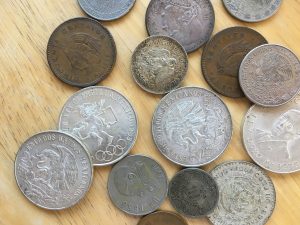
Pops left behind a coin collection.

As a kid I remember him spending his spare time in front of his roll top desk examining coins and looking them up in the many books he had on the subject. He owned his own stores in the ’50s, ’60s, and ’70s. Back then one could still find rare coins in circulation. I’m sure Pops looked at every coin that came through his till. Heck, I wouldn’t be surprised if he got rolls of coins from banks just to look through them.


Pops still had hundreds of Mexican coins left

He tried to get me interested, but I wasn’t having it. Now I wished I had paid attention because my oldest sister (who is Pops’ Executor) and I spent the last several months liquidating Pops’ coin collection, which he spent a lifetime acquiring.

Over the years he sold a some of his collection here and there. For instance, I recall when he and my Mom traveled through Mexico, he collected gold coins at a time when owning gold wasn’t possible in ‘Merka. A few years back I asked him whatever happened to those and he told be they paid for the down payment on the condo.

As many as he may have sold over the years, there were still tens of thousands of coins left. My sister and I treated liquidation like it was a job. And, it was.

Luckily, just before we started this process, I happened to hear that the biggest coin show in the country was happening in Fort Lauderdale. My sister and I went. Because we didn’t know what we had yet, all we really did was collect business cards, ask the out-of-town dealers who they’d recommend that was local, and/or what to look for in a honest coin dealer. We also got a sense of what was happening in Coin World. It was worth spending an afternoon there.

We knew that before we could ask a numismatist to give us a valuation, had to know what we had. Sounds simple, right? Did I mention there were tens of thousands of coins? Maybe hundreds of thousands. Blue books with coins slotted into the holes, 3-ring binders with coins in plastic sleeves, individual coins in plastic sleeves, rolls of coins, cigar boxes full of coins, and loose, unsorted, coins of every description and denomination. I wish I had thought to weigh it because it was serious tonnage.

B & I met once a week for 6 or 7 hours a go. The first several weeks we did nothing but sort the coins by category: ‘Merkin and foreign first. Then we took all the U.S. coinage and separated that into denominations: nickles, dimes, quarters, half dollars, pennies, wheat pennies, steel pennies, Indian head pennies. Who knew there were so many different kids of pennies?

Once it was sorted, we started creating spreadsheets. Each workday we’d open a new spreadsheet (or several over the course of a day) and log the coins by denomination and year. If Pops had noted a condition, we put that on the spreadsheet as well. However, about 95% of the coins were not graded. Coin grading being such a specialized field, we didn’t even bother to guess.

Filling the spreadsheets — logging every coin — took another 5 or 6 weeks. Two more weeks were spent sorting all the foreign coinage by country. One thing I have to say is there are (were?) some beautiful coins from around the world. Contemporary coins are not nearly as pretty.


Pops didn’t discriminate. He had many Nazi-era coins. I took other pictures, but this one had the least number of swastikas.

We continued until we had every coin sorted, logged, boxed, and sealed into various lots, as we named each spreadsheet.

We were both rookies when this process began, but my sister and I learned a fair bit about coin valuations as we researched what we were discovering.

We learned enough that, when it came time to start selling the coins, we could take one of the smaller lots to several local dealers. We knew the value of this set of quarters, so we could judge what they told us. Then we discussed the spreadsheets.

Without knowing the actual condition of the coins (on the spreadsheets), we could only get several ballpark figures from several dealers. They were all within the same range, but the difference of a penny a coin adds up when you have so many. In the end we went with our gut and chose the dealer who made us feel the most comfortable. He was the same price as another guy, but the other guy felt off, if yannow what I mean.

This gent was up in Boca Raton, so for the next 3 Mondays running, instead of my Boca sister driving here, I’d load the car up with coins and drive up there. Each time it was most of the morning (into the early afternoon), a process that was greatly streamlined because we had prepared all the spreadsheets. He said that he’s rarely seen a collection organized as well as we had done.

The first week he double-checked our tallies, but that got old after a while, especially after they all turned out to be correct. Despite how much the spreadsheets helped speed things up, it still took 3 weeks. We’d haggle a bit here and there over price — because we had been learning valuations on our own and consulting other dealers — but we also knew we were being treated fairly.  It went both ways, in fact. It was a good relationship and I was kind of sorry when it ended.

One of the things I learned from him is that coin collecting is a dying hobby. Just as I wasn’t interested in learning Pops’ hobby, later generations didn’t care either. Now coin collectors are literally dying off and the market has suffered because no one is collecting. These days there’s more profit in the melt value than you’d get by finding a coin collector looking to fill out their collection, if you could even find one.

IRONY ALERT: Obviously, melting coins makes the ones that are left rarer. However, that’s still not increasing the collecting value of those that are left. Eventually, at this rate, none of these coins will exist.

BOTTOM LINE: All the time we sorted the coins my sister and were hoping to find that BURIED TREASURE. I guess we watched too much Antiques Roadshow. While, there are coins worth tens of thousands of dollars, we didn’t have any of those.

Although there were a few coins that did alright — well above face value — there was no great score. Wheat pennies and steel pennies, which we had tons of (and that might not be an exaggeration) did okay — depending on condition. Because there was so much of it, it added up quickly.

However, most of what we cashed in went for melt value, or even face value. Not everything Pops collected increased in value.

KA-CHING! One Indian head penny we sold him brought in over $40. Later he admitted to us that it was a counterfeit coin, which he took the blame for because he had given it the once-over.

All in all it was an interesting experience.


ME’N’MARLEY: Marley has settled into the Not Now Silly Newsroom nicely and has become the perfect writing partner. She’s helped me put together the latest stories on the Coconut Grove Playhouse, which is heating up again. Meanwhile, we’re still following West Grove, and the new plan to bring much-needed money to alleviate the ghetto conditions along Grand Avenue. We’ll see how that all shakes out over time.

Meanwhile, Marley has taken down the details of several intriguing stories that sources have called in. I’m still chasing these down to see if they pan out, but she takes good notes.

While Today’s Top Ten is always in flux, the All Time Top Ten has settled into a nice groove, and one I’m proud of. [All numbers were reset at the beginning of the year, when we opened up this new joint.]

I never thought there would be another chapter in the Johnny Dollar Wars, but there it is nestled in at number 3, as Johnny Dollar Outed As Roger Ailes Operative?

Speaking of Fox: I continue to craft a Friday Fox Follies for PolitucusUSA and boy have things become interesting lately. Trying to keep the columns to a reasonable length has been a chore.

Getting back to the Top Ten at right: Just below J$, is my demand that Tom Falco issue a retraction and apology. If it’s that high on the All Time Top Ten, imagine how many people have read about his cowardice and scumbaggery.

Holding down the #6 position is the day I shaved my head. You need to see it to believe it.

However, the rest of my All Time Top Ten are stories I’m particularly proud of. Check them out. Collect them all. Trade ’em with your friends.


COIN OF THE REALM: Speaking of which, we’ve sold the Lexus and purchased a new mobile Not Now Silly Newsroom, a 2012 Ford Fusion nicknamed The Grey Ghost. When it’s not being used by Marley and the rest of the News staff, I am driving for Lyft. I’m sure I’ll have stories as time goes on, but I’ve only been doing it for a week and have just 20

See you next time, dear reader. We do it all for you, to coin a phrase.

Tiger Stadium ► Throwback Thursday

It was on this day 115 years ago the first pitch was thrown out at Detroit’s Tiger Stadium.

The Tigers moved to Comerica Park, and played their last game at Tiger Stadium in September 1999. Ten years later, despite being designated a historic site by the state of Michigan, and listed on the National Register of Historic Places, Tiger Stadium was demolished after several preservation and redevelopment schemes died on the drafting table. However, the actual playing field of Tiger Stadium is still there and lovingly maintained by a local community group.

Known as “The Corner”, because of its prominent location at Michigan and Trumbull Avenues, with Trumbull’s angle creating a trapezoidal lot. However, it had many names over the years. Originally called Bennett Park in 1895, when it consisted of a playing field surrounded by wooden bleachers and a roofed grandstand in the outfield. It was named Navin Field in 1912, after Frank Navin purchased the team and had a modern stadium constructed out of steel and concrete. Incidentally, opening day was the same for Fenway Park.

After Navin’s death in 1935, it became known as Briggs Stadium, and new owner Walter Briggs embarked on an expansion project that upped the seating to a whopping — for the day — 58,000 seats. According to the WikiWackyWoo, Briggs had a reputation as a racist:

Briggs was noted for fielding a well-paid team that won two American League pennants (1940, 1945) and a World Series championship in 1945 under his ownership.[6] He had a reputation for being somewhat prejudiced against African-Americans, in part because he refused to sign black players (though he allowed blacks to work at his factory)[7] and would not allow black fans to sit in the boxes at Briggs Stadium.[citation needed] The Tigers did not field their first non-white player until 1958, six years after Briggs’ death—making them the second-to-last team in the majors to integrate (ahead of only the Boston Red Sox).

After his death his son Walter Junior tried to hang onto it, but administers for the estate forced the sale after 5 years. The new owners called it simply Tiger Stadium in 1961, one of the classic ballparks from the classic era of ‘Merka’s Pastime.

I remember going to Tiger Stadium as a kid. The Upper Decks were really up there. It seemed like a long climb to get to the cheap seats, but when you looked down, the field was right below you; so close, it almost felt like you were on the field. It was a huge deal when I was 16 and the Tigers won the World Series in 1968. We rode around in cars for days screaming out the windows.

Later, when I was a teenager, sometimes we’d do what we called a Double Header. Plum Street, Detroit’s Hippie Mecca — where I first met John Sinclair — was just around the corner. Some days me and my friends, who were all weekend Hippies, would buy incense and hang out on Plum Street before walking the few blocks to see a weekend Tiger’s game.

The Wiki also notes:

A plan to redevelop the old Tiger Stadium site would retain the historic playing field for youth sports and ring the 10-acre property with new development has received final approval, and funding.[4] Developer Eric Larson of Larson Realty will develop a mixed residential and retail project along the Michigan Ave and Trumbull sides of the property, beginning in late 2016.[4] The Detroit Police Athletic League will begin construction, in early April 2016, on a new headquarters building along Michigan Ave and Cochrane. The L-shaped building would enclose two sides of the field.[4] Together these two projects will completely ring the old site.[4]

But, there will never be another Tiger Stadium.

How Will the Playhouse Redevelopment Hurt West Grove?


Coconut Grove is older than Miami, but has been treated
like its ugly step-sister ever since annexation in 1925.

West Grove, the historic Black enclave nestled within Coconut Grove, Miami, Florida, is currently threatened on all sides by White gentrification.

The latest challenge is the massive Coconut Grove Playhouse condo/restaurant/parking lot/theater redevelopment project threatening West Grove.

The Playhouse is at the extreme east end of Charles Avenue. It was designated a Historic Roadway because it is one of Miami’s oldest streets. It was laid out slightly out of true east/west alignment by E.W.F. Stirrup, who almost single-handed, created this neighbourhood and watched over its survival until he died in 1957. Stirrup was one of Florida’s first Black millionaires and at one time owned more properties in Coconut Grove than anyone else.

[tabembed align=”right”]

Further reading:

This reporter has been researching Charles Avenue and Main Highway since February 2009. Here are just a few of the stories from the archive.


Happy Birthday Coconut Grove!!!
Now Honour Your Past

Who Is To Blame For The Destruction
of the E.W.F. Stirrup House?

Say Goodbye to the Stirrup
House While You Still Can

Unpacking Coconut Grove
Part One

Unpacking Coconut Grove
Part 1.1

The E.W.F. Stirrup House

Open Houses and Broken Laws

A Charles Avenue Love Story

An Open Email to the City of Miami

Signs along Charles Avenue

The Coconut Grove Playhouse
Trojan Horse; Part I; Part II

The Coconut Grove Playhouse
Deal Begins to Unfold

EXCLUSIVE: Are Valet Companies
Stealing From Miami Taxpayers?

The Bicycle Shop The Latest In The
Cultural Plunder of Coconut Grove

Aries Development Continues
To Rape Charles Avenue

Aftermath of the Great
Miami Tree Massacre

[/tabembed]The more things change, the more they stay the same.

When the Miami Historic Environment Preservation [HEP] Board voted earlier this month to demolish the theater, it took another step in destroying history in order to pay lip service to preserving it. This is the same thing the HEP did with the E.W.F. Stirrup House, catercorner to the back of the Playhouse, on south side of Charles. This magnificent century-old house has now been replaced — NOT RESTORED! — because the HEP will roll over for developers, history be damned.

The Coconut Grove Playhouse — just like the Stirrup House — underwent nearly a decade of Demolition by Neglect. The Coconut Grove Playhouse’s developers — just like the Stirrup House’s developers — were then able to argue that extreme deterioration of the structure required it to be torn down.

The more things change, the more they stay the same.


The E.W.F Stirrup House before replacement

TO BE FAIR: The Playhouse developers were also able to argue the theater was renovated so many times since originally built, that it no longer was the old theater anymore. That was an argument only the HEP seemed to buy.

Ironically, the same could have been argued for the E.W.F. Stirrup House, which (according to anecdotal evidence) grew from a small 1-story Conch House to the impressive 2-story structure as Mr. Stirrup’s family and fortune grew.

However, that’s all water under the bridge.

Once the HEP approved the massive Playhouse redevelopment (in concept only) it became immediately clear how this Black neighbourhood will bear the brunt of that decision.

When it came time to build a polluting incinerator in Miami, it was given to West Grove. Almost 100 years later, when it came time to build a polluting diesel bus maintenance facility, it was given to West Grove. And now, when a massive development project is proposed for Main Highway, the negative effects will be born by West Grove.

The more things change, the more they stay the same.


A quick word about these Coconut Grove Condo-Retail-Restaurant-Parking Garage-Playhouse Megaplex drawings:

Before the HEP Board approved demolishing the historic Coconut Grove Playhouse on April 4th, the developers put on the typical Dog and Pony Show. During the hours-long meetings the community and HEB Board were presented with a confusing array of facts and figures, along with blue prints and artist’s renderings. These cane be found HERE. show that there will be entrances to the loading docks on Charles Avenue and William Avenue, one block to the north.

Just before the HEP voted it was revealed that all of the drawings just shown were already out of date, supplanted by another set of drawings, with different facts and figures, that no one had seen yet.

And the HEP Board still passed it. The more things change, the more they stay the same.

Meanwhile, I have found newer drawings online at the Miami-Dade Department of Cultural Affairs public portal, which were posted on April 10th. Now, get this: I have been told that these drawings are already out of date. However, until I finagle the latest from one of my sources, these will have to do.


How will West Grove suffer?

The latest drawings show that Charles Avenue [A, to the right] will be the entrance for all trucks with something to pick up, or take away from the Coconut Grove Condo-Retail-Restaurant-Parking Garage-Playhouse Megaplex.

Trucks will turn in from Main Highway [B] to [F}, where an entire complex of loading docks and garbage pickup will be competing for space. The drawing does show a small bit of landscaping to try and make it disappear, but it will always be a loading dock and garbage pickup on Charles Avenue.

It’s instructive to note that putting this driveway on Charles leaves the maximum amount of space on the north side of the building for the mixed use Condo/Retail/Restaurant/Parking Lot/Theater Megacomplex. All at the expense of Charles Avenue, which has been designated a Historic Roadway, just to remind you.

Lately beer trucks serving the restaurants in The Monstrosity, aka Grove Gardens Residence Condominiums, have been pulling onto Charles Avenue and parking opposite the driveway to the E.W.F. Stirrup House [G]. From there the deliveries are loaded onto a hand cart and taken it through the parking lot of the Regions Bank on the corner, across from [F]. If the Stirrup House ever gets an occupancy permit, they’ll be able to walk it through the Stirrup property instead, saving time and energy.

Oddly enough, loading docks were not required for The Monstrosity, even though the plan was always to have restaurants on the ground floor that would require deliveries. In addition, beer trucks will never be allowed to pull up in front of The Monstrosity, because that would hinder the valet parking concession.

Once the Playhouse is redeveloped — with its 31 apartment units [D], restaurant [between D & E], gargantuan 449 slot parking garage [C], and small 300 theater [E] — it will generate a massive amount of garbage. There will have to be daily pickup, if not pickup twice a day.


The Charles Avenue Historic Marker with the
two empty residential lots in the background

Let me draw your attention to the two empty lots marked [H] on the pic above. Immediately behind the Charles Avenue Historic Marker are 3227 and 3247 Charles Avenue, which are zoned single family residential. There had once been houses on those lots; a Conch on one and a Shotgun on the other. These were demolished in order to use the double lot as a marshaling yard to build The Monstrosity a decade ago.

TO BE FAIR: This made more sense than having the construction traffic on Main Highway, but the neighbouthood still lost 2 affordable houses that have never been replaced.

I wrote about these two empty lots in Another Charles Avenue Bad Neighbour Update, after I discovered that the valet concessions were illegally using these residential lots to park dozens of cars, the overflow to an event in the Cruz Building, on Commodore Plaza.

These 2 lots are not part of the footprint of Playhouse redevelopment. Yet, everyone recognizes how they would square off the Playhouse property. However, there are too many hoops to jump through for that to ever happen. Regardless, that did not stop developer Peter Gardner, of the Pointe Group/Colliers International, from dropping a half million dollars a piece to speculate that these two lots will skyrocket in value.

FULL DISCLOSURE: When I met with Peter Gardner last year I sandbagged him. Having learned he had recently signed on as a developer of the Stirrup House, I booked a sit down interview with him. After some preliminaries on the Stirrup House, I shifted to these two Charles lots and then all the property he either owns or controls on Grand Avenue.


At dawn, looking east along Grand Avenue, from the
disgusting ghetto to the extremely rich Center Grove

Please read my ongoing series Unpacking Grand Avenue


Garner was surprised that I was able to relate the history of these two empty lots and how the people he bought them from may have broken the law to get them. He suggested that it’s possible he hadn’t performed his due diligence on the properties. I assured him that no one, least of all the banks that appear to have been snookered, cared at all.

Then he appeared shocked when I pulled out my handmade map of Grand Avenue, with all the properties identified and colour-coded by owner.

And, I know he was stunned when I told him that I would fight him tooth and nail to prevent these Charles Avenue lots from being zoned for anything other than single family. TO BE FAIR: I warned him at the top of the interview that I was an advocacy journalist. This is just one of the things I advocate about.

But, I digress. One of the latest ideas for these two lots is to turn it into some kind of car turn-a-round for all the swells going to the Playhouse. Imagine the traffic this would generate. However, this idea seems as absurd an the other rumour around: That Michael Eidson’s 2-theater plan would need these two lots to expand into for something or sundry. Both ideas seem like non-starters.

Regardless, no developer drops a million dollars on 2 lots unless he thinks there’s a payoff at the end of the day. Small single family houses on these long and narrow lots will never be able to pay for themselves. That’s why eventually Miami Planning and Zoning will be called upon to either rezone the lots to Multi-Family or Commercial use. The owner of these 2 contiguous lots would need no variance to build a monster home straddling the properties, but it would be hard to make any money doing that.

And, if Not Now Silly has learned anything in the 8 years covering Miami, it’s that developers always seem to get what they ask for. Even if it contravenes the Miami21 plan and offends the NCD2 oe NCD3 neighbourhood overlays. Yeah, I’m looking at you, Planning and Zoning.

Bottom line: There’s nothing in this massive redevelopment project for the people who live in West Grove. When all is said and done, this historic neighbourhood will be forced to deal with all the negative fallout of the project, without any of the benefits. The developers are now paying lip service to putting affordable housing in the project. There were also mutterings about hiring from within the community. However, these are promises that every developer in Miami gives to get permission to build, but never seem to deliver upon.

There will be an educational component to the theater program because that was mandated by the State of Florida. But nothing said they’ll educate children in the immediate community. The theater company, GableStage — which I have heard nothing but good things about — comes from outside the community, Coral Gables. [Please see my series No Skin In The Game; Part I; Part II; Part III] Because of the relative poverty of West Grove (due to decades of systemic racism) it’s unlikely the folks there will be able to afford the $45 tickets to any of the plays GableStage currently offers. I know I would have to budget hard for something like that.

This artist’s rendering hides the fact that behind the
Playhouse are small, 1-story Conch and Shotgun homes.

District 2 Commissioner Ken Russell needs to be more vocal and proactive about these neighbourhood concerns and how this project will negatively effect West Grove. In a recent encounter this reporter asked Russell whether he has a public stance on the Playhouse redevelopment project. He declined to give me a quote because it’s an issue he may one day find himself ruling on. However, there are some aspects of this massive redevelopment that he can comment on. Chief among them, is the increased truck and car traffic on the quiet residential streets of West Grove.

I already know what Miami-Dade and the Miami Parking Authority will say, because it’s been done before. They will claim, “We didn’t hear any complaints.” It’s unlikely they will hear complaints from the West Grove. These are people who have been ignored and marginalized for decades. After nearly a century of systemic racism, they’ve stopped complaining.

That’s why they need a champion, a Commissioner who will not ignore their travails.

This is a Miami-Dade project, not a City of Miami project. This means that Commissioner Russell has very little power to protect the historic West Grove neighbourhood from the fallout from this massive project on its doorstep. But that doesn’t mean he shouldn’t try.

Update to the Update to “The Parking Garage Is The Thing”

I finally received a reply from Miami-Dade country, answering my questions of Thursday last.

I said in my previous post I would post these answers should they differ from those I got through my source. While the answers are quite similar, there are some slight differences. Here is the unedited reply to my email:

1). How many parking spaces are currently anticipated in the Playhouse redevelopment?

The current proposal would accommodate 449 spaces.

2). How many residential units in the Playhouse redevelopment?

The current proposal includes 31 units.

3). Of these residential units, how many are for Playhouse staff (however that’s loosely defined) and how many are for sale?

Units are contemplated to be rentals, possibly affordable housing units, but final determination will be subject to development, operating and management agreements which are not in place yet. Please note that the plans presented to the Historic and Environmental Preservation Board are for the master plan for the site and include preliminary concepts for the disposition of the existing building and the planned development.  The conceptual plan will continue to be refined as the drawings are further developed and quantities/sizes are likely to change.

4). How large is restaurant in the Playhouse redevelopment? Number of seating?

The proposed retail and/or food and beverage areas are comprised of approximately 10,000 square feet (in 3 levels) in the front building and approximately 5,000 square feet of new space adjacent to the garage.

5). How many retail outlets? Will the entire frontage (the Main & Charles sections) be retail?

The space is planned for retail and/or food and beverage (see answer to #4) but no agreements are in place at this time. It is possible that these spaces may have one or more operators.

While these figures are similar to those I received on Monday, there are some differences and some added information. However, it’s anticipated that there will be many changes to all of this as time marches on.

Is the OMNI CRA Expanding?


The current boundaries of the OMNI CRA

A vote Thursday at Miami City Hall could be the lifeline West Grove needs to pull itself out from under decades of poverty and systemic racism.

District 2 Commissioner Ken Russell will introduce a motion at the Commission meeting to finance a $25,000 “Finding of Necessity” study to create a West Grove CRA or expand the boundaries of the OMNI CRA [Community Redevelopment Agency] into West Coconut Grove. [This would be a non-contiguous add on to the current Omni footprint.]

CRAs are designed to attack city blight and reduce slum conditions in neglected areas. To pull this off a trust is created, which is funded by increases in property tax revenues. This money can be used in a number of ways to improve residential, commercial, or infrastructure within the CRA district.

Creating a new CRA means that it could be many years before there’s enough money in the trust to start playing Monopoly and moving pieces around the board. In addition, a blighted area by itself would probably not have the tax base to generate much of a trust fund. You’d have to include parts of Center Grove in order to generate enough revenue to make it worthwhile.

Latching onto the OMNI CRA has its own pitfalls. To begin with the OMNI (or any) CRA Board consists of all 5 members of the Commission and two community members, who must live within the CRA district. Currently there are no West Grove members on the CRA Board for obvious reasons. However, even if West Grove became part of the OMNI, it would, at best, only get one seat on the board. However, there’s no guarantee of that. Furthermore, West Grove would be competing for monies that Overtown might be eyeing for its projects.


Looking east along Grand Avenue as rosy fingered dawn approaches

Further Reading at Now Now Silly:
Unpacking Coconut Grove


As I have done on previous occasions, this morning I arrived on Grand Avenue at 6AM and sat down on my customary bench at Hibiscus to watch the street come alive.

There was less to watch this day. One of the condemned buildings on the north side of Grand has finally been evacuated and boarded up. The building on the south side, which was also condemned, has far fewer residents than it used to, but people still live there among the rats, insects, mold, and mildew. I tried to speak to a gent in the courtyard smoking a cigar at dawn, but he just growled at me. I thought it might have been a language barrier until I saw him talking a bit later to one of the street people.


The moon about to set behind a condemned building that people are still living in

As dawn approached people started gathering at the gate for the Billy Rolle Domino Park, at Elizabeth. They arrive by foot and bicycle. This is where there are public washrooms, but the gate is locked until a city employee comes around and opens up the park for the day.

It never takes very long before I am approached by an itinerant salesperson. As I have explained previously, it’s odd being racially profiled. The truth is that most of the White folk who show up here are looking to score.

I took several walks around the neighbourhood and ended up at the Charlotte Jane Memorial Park Cemetery, where I spoke to a gent who was painting his mother’s grave stark white with a roller. At one time this was the only cemetery where Black folk could be buried in Miami.

Coconut Grove was once unique in this country because it had the highest percentage of Black home ownership than anywhere else. That cohesiveness that lasted decades is under attack from greed and gentrification, not to mention systemic pverty and racism. If West Grove is to survive in any meaningful way, with its demographics relatively intact, then a Community Redevelopment Agency just might be what it needs.

This is a story that Not Now Silly will be following anxiously.

Update to “The Parking Garage Is The Thing”

This is an artists’ rendering of what that end of Charles Avenue will look like after they build this massive Garage-Condo-Restaurant-Theater-Entertainment-Plex. The building in the foreground will be known to longtime Not Now Silly readers as The Monstrosity, aka Grove Gardens Residence Condominiums. If you look carefully, you can just see the roof of the E.W.F. Stirrup House (peeking out from behind The Monstrosity, which dwarfs it), the last historic building the HEP Board voted to demolish in order save history.

This post is a follow-up to The Parking Garage is the Thing.

Something I did not mention in that post is how, after the HEP Board meeting, I introduced myself to Michael Spring, Miami-Dade’s Cultural Czar. We’ve spoken on the phone, but had never met.

Spring was the lynch-pin that brought all the competing factions together to craft a delicate plan to restore the Coconut Grove Playhouse before the deadline imposed by the State of Florida. Had the parties not been able to come to an agreement before the sunset clause, the state could have sold the land as surplus to the highest bidder. [Read: Developer.]

TO BE FAIR: Spring was busy when I approached. He and his group were basically giving each other High Fives, and trying not to appear too gleeful, after Miami’s Historic Board [HEP] signed onto the plan to demolish the historic Coconut Grove Playhouse in order to preserve history.

Knowing it was not the time for rambling conversation, I handed him my homemade business card and got to the point. After introducing myself said I’d be calling to get some specific questions answered. He replied that he would be happy to answer them. Nice finally meeting you, Same here. End of conversation.

I gave his office a call on Thursday and was told he was unavailable and would be going out of town the following day, but he would certainly get my message. I explained I was on deadline. Having already started writing the post, all I really needed was the answers to a few questions to finish it. I asked whether I could get answers to my specific questions if I sent them via email. While I was given no absolute guarantee, I was told they would try and get answers for me. Here’s the text of the email sent at noon on Thursday.

Here are the 5 Qs I have. I am asking because I heard a lot of numbers thrown around the other night and they didn’t always agree. (I know I said 4 on the phone, but thought of another.)

1). How many parking spaces are currently anticipated in the Playhouse redevelopment?
2). How many residential units in the Playhouse redevelopment?
3). Of these residential units, how many are for Playhouse staff (however that’s loosely defined) and how many are for sale?
4). How large is restaurant in the Playhouse redevelopment? Number of seating?
5). How many retail outlets? Will the entire frontage (the Main & Charles sections) be retail?

I appreciate any help you can give me in getting these answered before my (self-imposed) deadline.

I was still waiting for an answer on Saturday when I decided to ask one of my other sources, who promised to get back to me with answers. This source is always as good as their word. When, by Monday morning, I still had no answers from either Miami-Dade or my source, I finally published my post before it grew whiskers.

Consequently, I described what I knew and, most importantly, what I didn’t know in The Parking Lot is the Thing.

Late Monday afternoon my source got back to me with an apology because it took so long. Here are the answers to most of my questions. [If I ever hear back from Michael Spring’s office, we can compare these facts and figures and see how good my source really is.]

1). The parking garage has room for 460 cars.
2). There are 27 residential units in the parking garage.
3). Residences for visiting directors, writers, or actors is still up in the air, although these have been part of the plan since inception. If it happens, it’s anticipated these residences will be on the second floor of the front section of the Playhouse (the only part of the structure being saved). Of the 27 residential units, it is now anticipated that all of them will be “market value” rental properties.
4). The restaurant is 6,000 sq. ft. and will be probably be in a standalone building tucked between the parking garage and the Coconut Grove Playhouse, but could just as easily be attached to both buildings.
5). There will be 15,000 sq. ft. of retail; 10,000 of that in the facade building, the only part of being saved, with 5,000 sq. ft. in the parking garage building.

Once again I was cautioned that these numbers only represent what’s in the latest drawings, which I need to emphasize were never presented to the HEP Board on Tuesday before it voted. There will be more drawings, more plans, more numbers to come.

And, the Not Now Silly Newsroom will be there.


COMING SOON TO NOT NOW SILLY

How West Grove loses with this development

Why the Miami Parking Authority is too powerful