Tag Archives: Nostalgia Ain’t What It Used To Be

Nostalgia Ain’t What It Used To Be ► Steamboat Willie

Dateline November 18, 1928 – Mickey Mouse appears in “Steamboat Willie,” the first all-singing, all-talking, all-musical cartoon.

What made “Steamboat Willie” such a revelation to movie-goers in 1928 was that the cartoon was entirely synchronized with the music and sound effects. While we take that entirely for granted today, this was a giant advance in the technology of the day. Walt Disney’s tour de force came less than a year after the release of “The Jazz Singer,” the first full-length “talkie.”

The technological advances of The Jazz Singer and Steamboat Willie helped put a nail in the coffin of the Silent Movie Era. In the case of Steamboat Willie, this is ironic because it was paying homage to the classic Buster Keaton silent film “Steamboat Bill, Jr.” Within a decade silent movies were as dead as wax cylinders.

It cost Walt Disney $4,986 to produce Steamboat Willie.

Me and Pierre Trudeau ► Nostalgia Ain’t What It Used To Be

DATELINE October 18, 1919 – Pierre Elliot Trudeau is born in Montreal, Quebec, Canada. While he was born into wealth, when he became Prime Minister in 1968 there were no Canadians who didn’t think he also spoke for the “little guy.”

I shook Pierre Trudeau‘s hand once. It was 1967. I was a 15 year-old ‘Merkin and at summer camp, which was in Michigan. Every year, in an effort to shoehorn culture into us, we would be sent to Stratford, Ontario to take in a Shakespeare play. We were waiting in front of the playhouse and the doors were still closed, long past the time they should have opened. Several of us were milling around on the steps, hoping to be the first to get inside.

Suddenly a black limousine pulled up, a man jumped out of the back, and the crowd went wild. Suddenly all the Canadians erupted in applause and cheering. As the doors to the playhouse opened, and we were held back from entering, PET bounded up the few stairs shaking hands all the way as the crowd magically parted for him. I was right at the door. Pierre Trudeau turned to his left, where I standing, and reached out to shake my hand. I reached back. For 2 seconds we were connected. Then he ran into the theater. The audience was held back another few minutes so he could get settled, but the crowd waiting was ELECTRIFIED. I had never seen anything like it before. I turned to the closest Canadian and asked, “Who was that?”

“That’s Pierre Trudeau. He’s our Justice Minister,” words that meant absolutely nothing to me at the time. Skip ahead a few years. By 1971 I was living in Canada and Pierre Trudeau was MY Prime Minister.

Trudeau was a transformational politician. He was a Rock Star. He was loved and hated, but remained Prime Minister until his defeat in 1979. However, just a year later the Joe Clark government fell on a Motion of Non-Confidence and the Liberals won the subsequent election, with PET serving as Prime Minister until 1984 when he decided to retire.

Pierre Trudeau will always be known as the Prime Minister who patriated the Constitution from Great Britain in 1982.

This documentary was made during the period when Pierre Trudeau was still Justice Minister and shaking my hand. It was made by celebrated Canadian journalist Norman DePoe for the CBC program News Magazine.

Pierre Trudeau died in 2000 and the entire nation mourned.

Nostalgia Ain’t What It Used To Be ► Vice Presidents We Have Known

It seems only fitting this morning, after last night’s Vice Presidential debate between Vice President Joe Biden and Congresschild Lyin’ Ryan, to remind people that on this day in 1973 President Richard Nixon nominated Gerald Ford to replace Spiro Agnew as VP. Agnew was forced to resign ahead of pleading nolo contendere (no contest) to charges that he accepted bribes as governor of Maryland and tax evasion before becoming Nixon’s one-breath-away-from-the-presidency pick as Veep.

After Richard Nixon resigned in the wake of the Watergate scandal, Gerald Ford, who had been a Congressman, was elevated to the office of the presidency, despite having not been elected to either office.

“Some people say” that Ford’s massive gaffe during the Presidential Debate against Jimmy Carter doomed his reelection. There are others that say it was his own clumsiness, or perception thereof, that doomed his reelection. Then there’s a whole passel of people who blame Chevy Chase’s portrayals of Ford on Saturday Night Live as the reason Ford wasn’t reelected. I’ve never listened to those “nattering nabobs of negativity” because I’ve always believed Ford lost reelection because he pardoned Richard Nixon.

This turn of events made Gerald R. Ford the only appointed President of the United States, until George W. Bush in 2000.

Nostalgia Ain’t What It Used To Be ► Happy Birthday, John Lennon

Dateline October 9, 1940 – John Winston Lennon is born in war time Liverpool. December 8, 1980 John Ono Lennon is assassinated in New York City. There’s nothing left to say; his music still speaks for him, as it will do here: 


This John Lennon Tribute Jukebox for Spotify
has 112 tracks. Hit Random Shuffle and it will
move the air in your space for more than 6 hours.
Enjoy.

Andy’s Gang ► Another Magical Tee Vee Moment

Dateline October 7, 1905 – Andrew Vabre “Andy” Devine is born in Flagstaff, Arizona. With his trademark raspy voice, Andy Devine went on to become one of the great character actors in Hollywood. He appeared in more than 400 hundred flicks, often playing the sidekick. He was Cookie alongside Roy Rogers and appeared in several John Wayne movies, including the original Stagecoach, Island in the Sky, and The Man Who Shot Liberty Valance, where he played the cowardly marshal. Among his other movie credits are Romeo and Juliet, the original A Star Is Born, the original Geronimo, the Jack Benny comedy Buck Benny Rides Again, Pete Kelly’s Blues, and dozens of others.

However, there’s a whole generation of kids, who are now my age, that know him for the phrase “Plunk your magic twanger, Froggy” when, in mid career, he hosted the children’s show “Andy’s Gang.” Each show began with Andy leading the kids in a song that parents would go nuts if they heard it today:

♫ ♪ ♫
I got a gang,
You got a gang,
Everybody’s gotta have a gang,
But there’s only one real gang for me, 
Good ol’ Andy’s Gang.
♪ ♫ ♪

Here are some wonderful excerpts from Andy’s Gang, when children’s programming on tee vee was still in its infancy.


Jimmy Buffett name-checked Andy Devine in his song Pencil Thin Moustache, which is as good way as any to play out this blog post. Enjoy:

Groucho Marx ► Nostalgia Ain’t What It Used To Be

Dateline October 2, 1890 – Julius Henry Marx is born in NYC. Later he is nicknamed Groucho and, along with his brothers Chico, and Harpo, became one-third of the greatest comedy team of all time: The Marx Brothers.

The Marx boys started in Vaudeville as singers. The Four Nightingales were Julius, Milton (also called Gummo), Arthur, and another boy named Lou Levy. They were always near the bottom of bill. After one performance in which the audience was more interested in a mule kicking up a fuss in Nacodoches, Texas, they started cracking wise onstage. Among the ad libbed gems: “Nacogdoches is full of roaches” and “The jackass is the flower of Tex-ass.” As it turned out, they were better comedians than singers. Instead of getting angry, the audience loved them. The Marx Brothers completely rewrote the act (read: borrowed a skit about a schoolroom and had it rewritten to suit themselves) and toured in variations of it for the next seven years or so, adding Chico along the way.

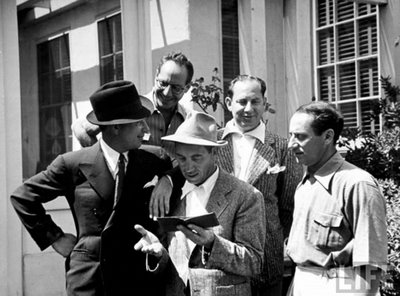
There were actually 5 Marx Brothers. 1938: Front L-R:
Harpo, Chico, Groucho; Back L-R: Zeppo, Gummo

Each of the brothers played upon a comedy trope popular at the time. Harpo played a “Patsy Brannigan:” An Irish ruffian. He was uncomfortable speaking onstage, so he took the advice of his show-biz uncle Al Shean to remain silent and mime. Chico used an Italian accent that had, in real life, helped him avoid some bullies who were looking for a Jewish kid. Groucho played the teacher in this “Fun In Hi Skule” skit with a German accent. However, after the Lusitania was sunk a German accent was no longer funny to ‘Merkins. Groucho dropped the accent and became the character we know today: a rapid-fire, joke-cracking Lothario.

After seven years The Marx Brothers found themselves at the top of the bill and starring in their own Broadway shows, two of which became their first two movies: “The Cocoanuts” and “Animal Crackers.”

FUN TRIVIA: The action in “The Cocoanuts” takes place in Coconut Grove, Florida, during the land boom of the 1920s. Coconut Grove is also the location of the E.W.F. Stirrup House, which I am trying to save from a rapacious developer. Take a few minute to read about my ongoing series dedicated to the campaign to save this 120-year old house, which is currently undergoing Demolition by Neglect.

In all, The Marx Brothers made 13 movies together and Groucho made another 13 movies without his brothers. By the time Groucho became a radio show host for “You Bet Your Life,” which he later took to tee vee, he had already been in show biz for nearly half a century.

Here are some highlights of Groucho’s long career.

This was Phyllis Diller’s first appearance on national tee vee:

Just think: Had it not been for that mule in Texas all those years ago, we might have never heard of The Marx Brothers. We are lucky to have had them.

***
***

Another Magical Tee Vee Moment ► Richard Nixon’s Checkers Speech

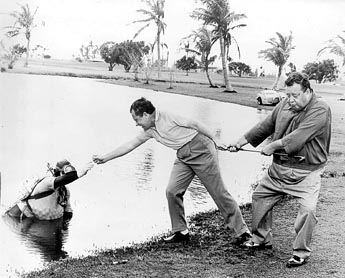
Jackie Gleason keeping Richard Nixon from falling in the
drink in Inverrary, Florida, a few miles from where I live.

Dateline September 23, 1952 – Under fire for taking money from his private backers to pay expenses, Richard Nixon went on national tee vee and delivered what has come to be known as The Checkers Speech.

At the time he was Senator Richard Nixon, having won over Helen Gahagan Douglas in 1950 after accusing her of being a Communist, who was “pink right down to her underpants.” Tapped to be General Dwight D. Eisenhower’s vice presidential running mate, Nixon ran into trouble two months later when the press learned of a fund that ‘topped off’ Nixon’s salary of $12,500 (which was about $150,000 in 2009 dollars, according to the WikiWackyWoo). As demands grew for Nixon to resign from the ticket and his senate seat, Eisenhower started to distance himself from the party’s GOP pick. To save his position on the GOP ticket, not to mention his seat in the Senate, Nixon convinced Ike to allow him to go on tee vee and make his case directly to the ‘Merkin people. However, Nixon wanted Eisenhower to make a decision on whether to keep him on the ticket immediately after the broadcast. Eisenhower wouldn’t agree to that, so Nixon famously said to the General who saved Europe for democracy, “[G]eneral, there comes a time in matters like this when you’ve either got to shit or get off the pot.” Even at that, Eisenhower said it would take a few days to determine which way the wind was blowing.

At 9:30 PM EST Nixon gave the following speech to all of ‘Merka:

The speech was both maudlin and heart-warming. It became known as The Checkers Speech, a term Nixon hated, for this passage:

One other thing I probably should tell you because if we don’t they’ll probably be saying this about me too, we did get something—a gift—after the election. A man down in Texas heard Pat on the radio mention the fact that our two youngsters would like to have a dog. And, believe it or not, the day before we left on this campaign trip we got a message from Union Station in Baltimore saying they had a package for us. We went down to get it. You know what it was?

It was a little cocker spaniel dog in a crate that he’d sent all the way from Texas. Black and white spotted. And our little girl—Tricia, the 6-year-old—named it Checkers. And you know, the kids, like all kids, love the dog and I just want to say this right now, that regardless of what they say about it, we’re gonna keep it.

Nixon ended the speech with direct appeal to the ‘Merkin people to let their views be known:

I am submitting to the Republican National Committee tonight through
this television broadcast the decision which it is theirs to make. Let
them decide whether my position on the ticket will help or hurt. And I
am going to ask you to help them decide. Wire and write the Republican
National Committee whether you think I should stay on or whether I
should get off. And whatever their decision is, I will abide by it.

But just let me say this last word. Regardless of what happens I’m
going to continue this fight. I’m going to campaign up and down America
until we drive the crooks and the Communists and those that defend them
out of Washington.

The ‘Merkin people did as Nixon had asked. They inundated the GOP with letters and telegrams, Eisenhower decided to keep him on the ticket, and Senator Richard Nixon lived to fight another day, going on to become Vice President of the United States for the next 8 years.

Another Magical Tee Vee Moment ► Chuck Jones

Dateline September 21, 1912 – Cartoonist extraordinaire Chuck Jones is born in Spokane, Washington. According to Jones, he credits his father, a failed businessman, with his love of drawing. Says the WikiWackiWoo:

His father, Jones recounts, would start every new business venture by purchasing new stationery and new pencils with the company name on them. When the business failed, his father would quietly turn the huge stacks of useless stationery and pencils over to his children, requiring them to use up all the material as fast as possible. Armed with an endless supply of high-quality paper and pencils, the children drew constantly. Later, in one art school class, the professor gravely informed the students that they each had 100,000 bad drawings in them that they must first get past before they could possibly draw anything worthwhile. Jones recounted years later that this pronouncement came as a great relief to him, as he was well past the 200,000 mark, having used up all that stationery.

Like so many children of my generation, Chuck Jones entertained me endlessly. While his cartoons were made for movie theaters, they were all over the tee vee dial when I was growing up and the cartoons are all that matter. Here are just a few:

Great Performances,” on PBS, profiled Chuck Jones in one of its previous seasons. The program included some terrific behind-the-scenes descriptions of how cartoons are created and clips of some of the great cartoons. [Unfortunately PBS has removed this from its web site. I searched hard to find one with the proper aspect ratio, but could only find bits and pieces and not the entire documentary. Here is the full documentary with the aspect ratio skewed.]

***
***

Nostalgia Ain’t What It Used To Be ► James A. Westerfield

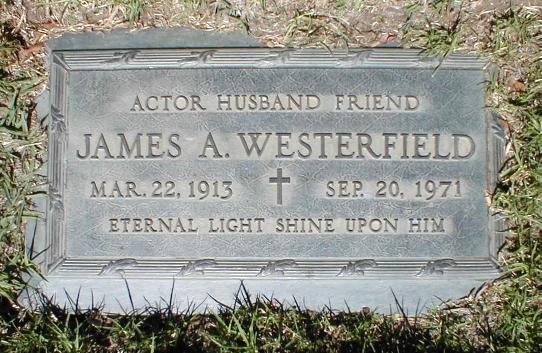
San Fernando Mission Cemetery, Los Angeles, California

Dateline September 20, 1971 – Namesake James Westerfield died from a heart attack at the age of 58. Born in 1913, James A. Westerfield was one of those character actors that you’ve seen dozens of times, yet few people know his name. 

From “The Fourflushers,”
episode 72 of The Rifleman

Westerfield appeared in some of the greatest movies of all-time including The Magnificent Ambersons, On The Waterfront, The Shaggy Dog, The Absent-Minded Professor, Son of Flubber, Birdman of Alcatraz, The Sons of Katie Elder, Hang ‘Em High, and True Grit among many others. During The Golden Age of Television he also appeared in dozens of tee vee programs over the years, including The Rifleman, Perry Mason, Hazel, Kraft Theatre, Johnny Ringo, Alfred Hitchcock Presents, The Untouchables, Maverick, Wagon Train, Mike Hammer, Bat Masterson, The Andy Griffith Show, Gunsmoke, Lost in Space, among many others. James Westerfield worked right up to his death in 1971.

This trailer from “On The Waterfront” starts with James Westerfield, as Big Mac, blowing his whistle:

Let’s tip our hat to one of Hollywood’s great character actors, James A. Westerfield.

You Made Me So Very Happy ► My Days With David Clayton-Thomas

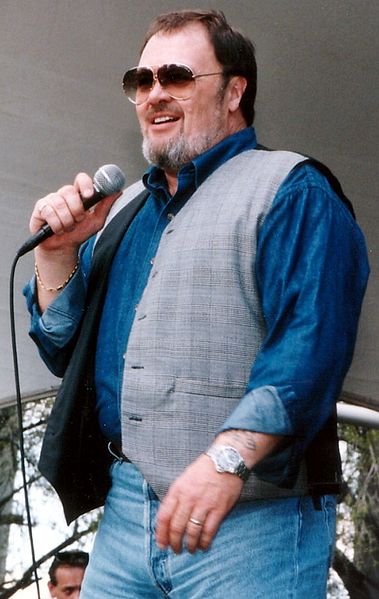
David Clayton-Thomas by Carl Lender

Dateline September 13, 1941 – A baby is born in war time England, Thames, Surrey, UK, and named David Henry Thomsett. He would later grow up to become David Clayton-Thomas. His father was a Canadian who met his piano-playing mother ‘over there’ when she went to entertain troops in a hospital in London. According to Larry LeBlanc at DCT’s official website:

After the war, the family settled in Willowdale, a suburb of Toronto. From the beginning David and his father had a troubled relationship. By the time David was fourteen he left home, sleeping in parked cars and abandoned buildings, stealing food and clothing to survive. A tough, angry street kid with a hair-trigger temper, it wasn’t long before he ran afoul of the law and was arrested several times for vagrancy, petty theft and street brawls. He spent his teen years bouncing in and out of various jails and reformatories.

David inheirited a love for music from his mother and when a battered old guitar came into his possession, left behind by an outgoing inmate, he began to teach himself to play. Before long he was singing and playing at jailhouse concerts and for the first time in his life, he found acceptance. Now he had a dream and his life had direction… he put the reformatory years behind him and he never looked back.

While Clayton-Thomas is best known as the booming voice of Blood, Sweat and Tears, (to make a long, interesting story very short) he put in his apprenticeship with a series of bands before he made it big. He had his own band, The Shays, at 21 and in 1966 he joined a new band The Bossmen, which had a hit before breaking up. Earlier he had traveled to New York and gathered some other Toronto musicians to form his back-up group The Phoenix. They played in New York City at The Scene before getting tossed out of the country for not having the proper work papers. He kicked around Toronto for a few more years, immersing himself in the Blues and Jazz scenes and sitting in with John Lee Hooker in Yorkville, Toronto’s Hippie mecca. He followed Hooker to New York and when Hooker left for Europe, Clayton Thomas stayed on where he came to the attention of Blood, Sweat and Tears following the release of their first LP. And the rest, as they say, is history.

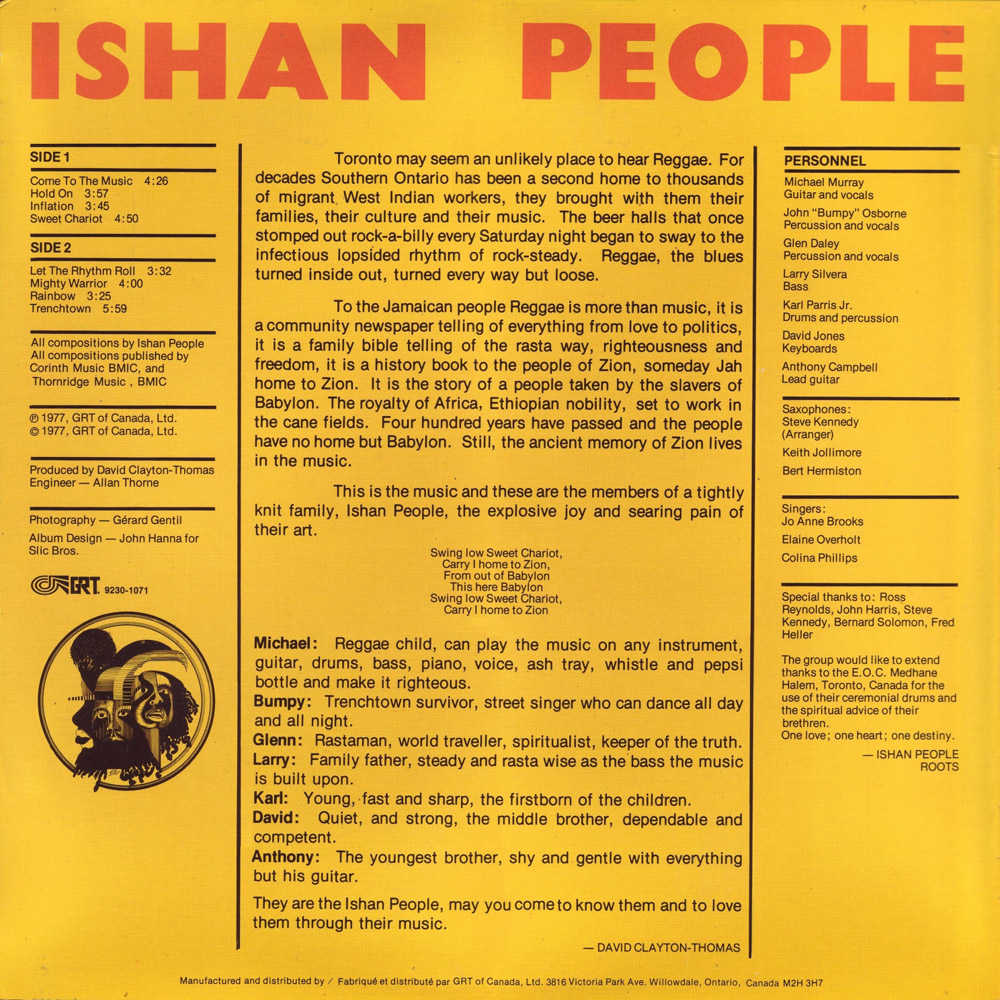
Back, with liner notes by DCT.
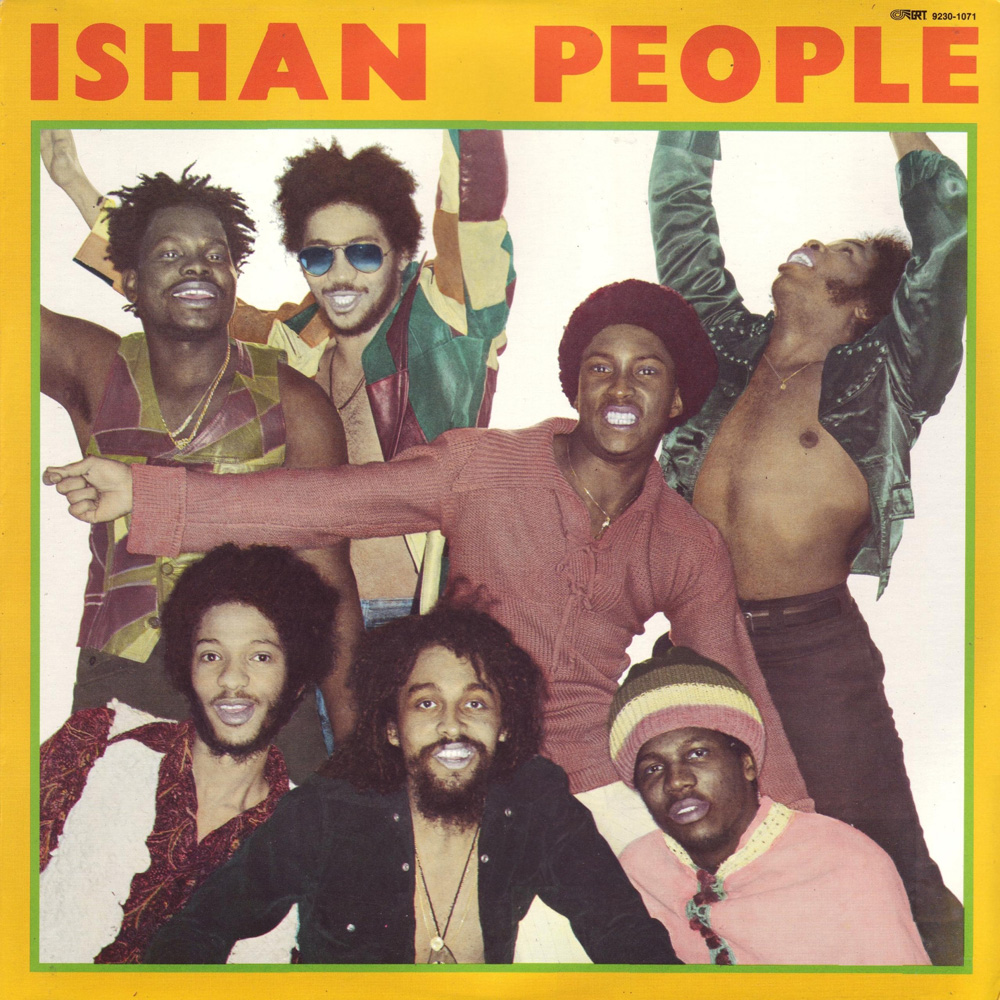
Ishan People’s 2nd LP

Surprisingly, left out of the official biography of David Clayton-Thomas, and even left off his WikiWackyWoo page, is how I came to know David. Back in the day (1976-1977) I managed a group called Ishan People, Canada’s first Roots Reggae band. David Clayton-Thomas produced both our LPs on GRT Records. David was an early proponent of Reggae, well before Bob Marley was a household word. By then Clayton-Thomas was already a singer of some renown with his work with Blood, Sweat and Tears. However, he took a small pittance as a producer to work with music and musicians he loved. Here’s a sample of David Clayton-Thoamas’ work with Ishan People.

I don’t know why this has been left off all the biographies, because this is something that David Clayton-Thomas.should take great pride in. I note he has an autobiography called, appropriately enough, Blood, Sweat and Tears, which I’ve never read. I wonder if he mentions it there. At any rate, you made me so very happy, David. Thanks for everything.

***

***