Tag Archives: Nostalgia Ain’t What It Used To Be

Me and Pink Floyd and Ivor Wynne Stadium ► Nostalgia Ain’t What It Used To Be

What’s left of Ivor Wynne Stadium.

It was sad to note in today’s news that Hamilton’s storied Ivor Wynne Stadium, home to the Tiger Cats, is almost no more.

People who know me well, also know I don’t follow sports. So why would a rickety football stadium bring a figurative tear to my eye? Because I have fond memories of a single day at Ivor Wynne Stadium: June 28, 1975.

Coincidentally Hamilton was the last city in Canada in which I lived before moving back to ‘Merka to help take care of Pops after my Mom died. Before I ever moved to The Hammer, I had only visited The Hammer on two previous occasions.

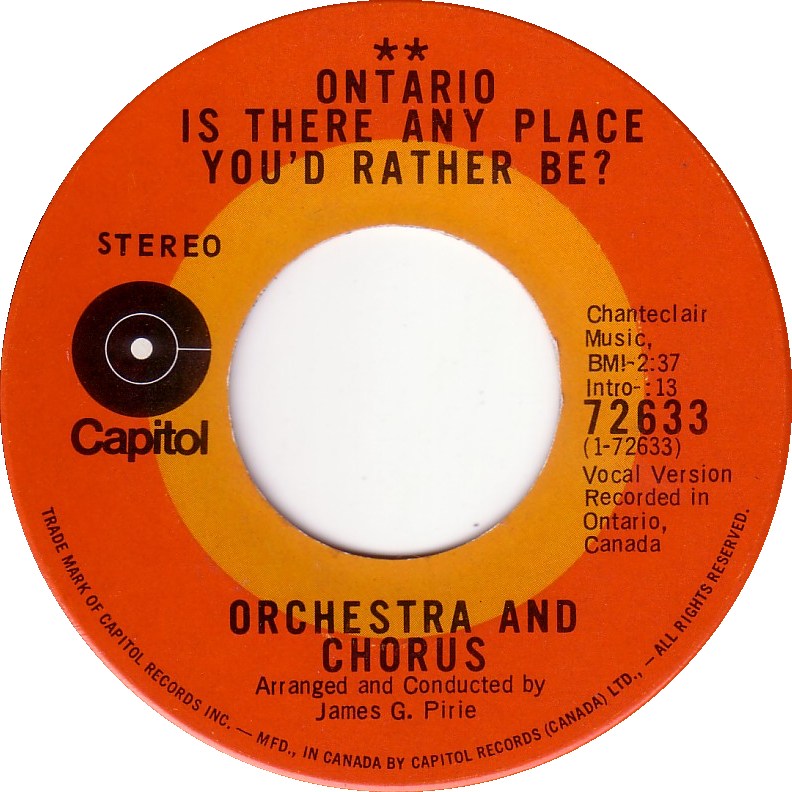
In the early ‘70s, when I was still in college, some bonehead in the Ontario government of Premier Bill Davis invited me to put on my award-winning slide show at a post-secondary school educational conference. Instinctively, I knew whoever chose my slideshow for the conference had never seen it; they had been suckered by the title: “Is There Any Place You’d Rather Be?” which just so happened to be the tourism slogan of Ontario. Maybe they thought my slide show was a travelogue.

Let’s just say Ontario wasn’t much impressed by my slideshow, which included naked women rolling around in broken watermelons, among other, err, interesting images. When the lights came up I was an instant pariah, especially among representatives from the Ontario government. Pleased at the reaction, which was wholly expected, I went for a walk.

The government had rented out the Royal Connaught Hotel, so Gore Park was steps away. I sat in the beauty of this downtown park years before the Gore Park Chainsaw Massacre ruined it forever. A sign outside The Palace Theatre beaconed. The Palace was an Art Deco monument to the era before Multiplex Madness had cheapened the movie-going experience. The cheaply painted sign was one no self-respecting film student could resist: AUCTION TODAY – CONTENTS FOR SALE. It was all going, as they say, to the bare walls.

I could have bought anything because there were so few bidders. However, I was a student on a tight budget, so I could afford to buy almost nothing. However, when a beautiful glass-etched, Deco exit sign came up for bids, I decided to go for it. The frantic bidding went all the way up to $10, but I managed to snag it. Snag it? I didn’t realize I was bidding on a lot of 10. While $1.00 a sign was a great deal, what the hell was I going to do with 10 exit signs?

Wait! The car I came in was already full. How the hell was I going to get 10 exit signs back to Oakville? Eventually I cadged transport for them and, over the years, I gave most away, before an ex-wife finally trashed the last two. Today I have none left.

It was only a few years later, June 28, 1975 to be exact, when I made my second expedition to Hamilton.

By then I was out of college and toiling as Editor [and chief grunt] for Cheap Thrills, the house organ for CPI, Concert Productions International, Toronto’s largest concert promoter. CPI had an exclusive lock on Maple Leaf Gardens, which is how it became the city’s biggest concert promoter. [That’s a story worth telling in detail some day.] While Cheap Thrills was filled with record reviews, interviews, and
profiles readily consumed by the average Rock and Roll fan, Cheap
Thrills was merely a cheap [no pun intended] and clever way for CPI to promote its upcoming shows.

How would you like to see this from your front porch?

Early on the morning of June 28 I arrived early at the printer and loaded up bundles of the latest issue of Cheap Thrills. I was headed to Hamilton’s to distribute Cheap Thrills to fans going to the now-fabled Pink Floyd concert at Ivor Wynne Stadium. I arrived at dawn. It took less than an hour to distribute tens of thousands of copies of Cheap Thrills at all the entrances. Although my work was finished, I was also sporting an ALL ACCESS PASS to a Pink Floyd concert. You don’t really think I was going to turn around and go home, do you?

To kill time until the show – some 8 – 9 hours away – I wandered in and out of the stadium and I explored the immediate neighbourhood. I was astounded that Ivor Wynne was plopped right in the middle of a residential area, with houses facing it on most sides. It made no sense to me to have a stadium right there.

As I waited the for the concert to begin the crowd grew from a few curious stragglers to a literal crush at the gates. I decided that the safest place, when the gates opened and the running and pushing started for the General Seating, would be outside the stadium. So, that’s where I watched the madness from. When the crowd outside had dwindled to mostly late arrivals, I looked around sadly. The mob left behind mountains of litter. Among the pop cans and other convenience store trash I was horrified to see my name on most of it. Copies of Cheap Thrills were everywhere: over lawns and flowerbeds. On porches. Blowing at the corners. Covered with footprints closer to the stadium. Everywhere one looked you could see my small contribution to Hamilton lore.

Pink Floyd at Ivor Wynne Stadium

As for the concert itself: I’m not here to review the show. However, it was the last concert on that Pink Floyd tour, so the band decided to go out with a bang. Rather than pack and transport the pyrotechnics, the roadies decided it would be best to explode it all at the Hamilton concert. The resulting explosion blew up the scoreboard and broke windows all around the neighbourhood.

After that Hamilton banned all concerts at Ivor Wynne Stadium, citing complaints from neighbours over the trash with my name on it. The ban held with a few notable exceptions ever since.

Happy Birthday Coconut Grove!!! Now Honour Your Past

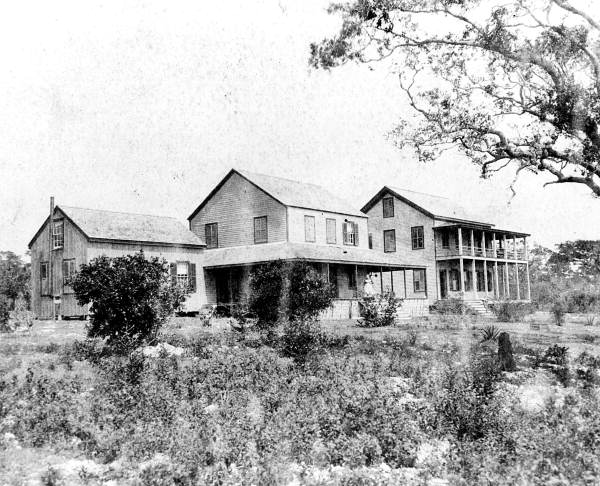
Peacock Inn circa 188?.
Courtesy State Archives of Florida, Florida Memory

Dateline January 6, 1874 – Dr. Horace P. Porter establishes the first post office in Cocoanut Grove. In the 138 years since, Coconut Grove dropped the “a” and became one of the most exclusive areas in the country, as it continues to bury its past in a way that can only be viewed as racist.

One of the first tourist attractions in south Florida was the Bay View House, built in 1883 by Charles and Isabella Peacock. It was later renamed the Peacock Inn (and is now the site of Peacock Park). Ralph Middleton Monroe also began building The Barnacle (now Barnacle Historic State Park) around the same time and Camp Biscayne a little later. While Cocoanut Grove (it didn’t lose the “a” until it was annexed by Miami in 1925) was still a virtually swamp infested wilderness, all of this development required staffing. Consequently, a parallel service industry grew around this progress and, as has always been the case in ‘Merka, these people tended to be Black.

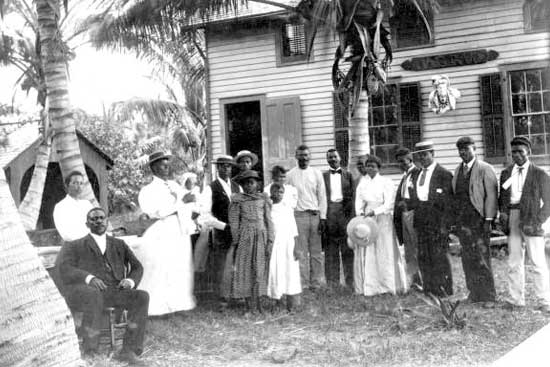
“Black citizens of Coconut Grove”
The entire Black community of Coconut Grove gathered
together in front of Commodore Ralph M. Munroe’s
boathouse. Photo taken 189?
Courtesy State Archives of Florida, Florida Memory

A Black population requires a Black enclave, of course; a place where White people don’t want to live, mostly because any Black person is welcomed. What is now known as West Grove became the area where Blacks, mostly from the Bahamas, congregated. One of the first was Mariah Brown, a Bahamian who lived in Key West. She had been hired by The Peacocks and, as “Mary the Washerwoman,” originally lived at the Inn. However, after she married Charles Brown they purchased a lot from Joseph Frow (who sold the Peacocks their plot of land as well), and built a house on Evangelist Street (now Charles Avenue) around 1892.

Joseph Frow was the first person to buy property off Biscayne Bay, in what later became Cocoanut Grove. His father Simeon had been appointed Cape Florida Lighthouse keeper in 1859. His brother John became lighthouse keeper in 1868. The lighthouse is on the southern tip of Key Biscayne and is the oldest standing structure in Miami-Dade county, even though it had to be rebuilt in the 1840s. Well familiar with the area, Joseph Frow bought up a very large chunk of land which he parceled off over the years.

1774 Map of Biscayne Bay, with Key Biscayne almost dead center.
Note: Where Coconut Grove would be located 100 years later
is labeled Grand Marsh. It was one. Map courtesy of Janthina Images,
which sells beautiful photo cards of the Cape Florida Lighthouse.

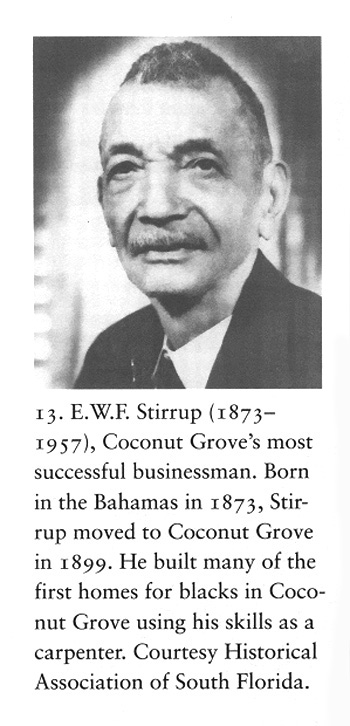
One of the men who worked in Cocoanut Grove was Ebenezer Woodbury Frankin
Stirrup, another Bahamian who came up through Key West. Being a carpenter
by trade, Stirrup’s skills were probably in high demand. It’s likely
that he worked for a variety of employers, Joseph Frow undoubtedly among them. Stirrup cleared land for Frow and it was backbreaking work. The area was little more than swamp land with occasional dry hummocks. Frow repaid Stirrup with land; for every plot of land Stirrup cleared, Frow deeded him a plot of land. Eventually E.W.F. Stirrup became one of the largest landowners in Coconut Grove and, eventually, one of Florida’s first Black millionaires.

From Black Miami . . . a brief look back

E.W.F. Stirrup was a man well ahead of his time. He believed that home ownership was important to growing Black families. To that end he used his land on which to build more than 100 houses on the streets surrounding Evangelist Street, which he sold or rented to the families that had emigrated to serve the growing tourist trade. This is also what made Coconut Grove unique. It had a higher Black home ownership than any other Black enclave in ‘Merka.

Over the years the neighbourhood has remained predominately Black, as families passed the homes down from one generation to the next, the way some families pass down precious jewels. This is also what kept the neighbourhood intact, as one urban renewal plan after another faltered when the City of Miami and developers couldn’t convince the homeowners to sell their most prized possession for peanuts.

Stirrup built his own home, of course, in late 1890s. The E.W.F. Stirrup House is the showplace he built for himself near the corner of Charles Avenue and Main Highway. Unlike most of the other houses in the West Grove, the Stirrup House is 2 stories. While it’s based on the simple Conch Style that informs the Mariah Brown House, it has been elaborated upon and added to over the years. At one time the house looked out over Stirrup’s substantial holdings. According to a report prepared by the City of Miami [PDF] to consider an historical designation for the E.W.F. Stirrup House:

The contributions of the African-American community to the City of Miami actually predate the City’s incorporation in 1896. As early as 1880, Black Bahamians arrived in Coconut Grove and began a community that still thrives today. Ebenezer Woodbury Franklin Stirrup migrated from the Bahamas to South Florida in 1888 and worked as a carpenter’s apprentice in Key West, and then as a laborer in a pineapple field in South Dade. He ultimately became a millionaire Coconut Grove property owner. Stirrup built his home in Coconut Grove, using all his construction skills to create an impressive, yet understated, residence for his family. Mr. Stirrup lived in the house until his death in 1957, a total of 58 years.

Mr. Stirrup is remembered today as an extraordinary example of entrepreneurship, a man who made the transition from immigrant to enormously successful Coconut Grove landholder, and who built more than 100 houses for African-Americans. His is an amazing legacy, as his success is all the more incredible when it is remembered that his accomplishments took place in an overwhelmingly segregated and discriminatory environment. When Ebenezer Woodberry Franklin Stirrup died in 1957 at the age of 84, he was not only one of the largest landholders in Coconut Grove, but also had done much to improve the housing conditions of the African-American community.

Panorama by author of E.W.F. Stirrup House with the Charles Avenue Historical Marker in foreground

Meanwhile, the E.W.F Stirrup House — the last remaining symbol of an important man who once shaped what is now one of the most exclusive areas in the country — is allowed to undergo Demolition By Neglect by a rapacious developer who hopes to develop the property.

There can be no doubt that if Mr. Stirrup were White, his home would have been a shrine by now. The Barnacle, Commodore Monroe‘s old homestead just a block away from Stirrup’s, is now a state park and the house restored to its earlier splendour. Commodore Plaza, which begins two blocks north of the Stirrup House, is named after him. However, try and find something named after E.W.F. Stirrup, aside from E.W.F. Stirrup Elementary School, which is 10 miles from the community in which he made his fortune. Not even the historical marker across the street from his property, which honours the original Black Bahamian immigrants, mentions E.W.F. Stirrup by name.

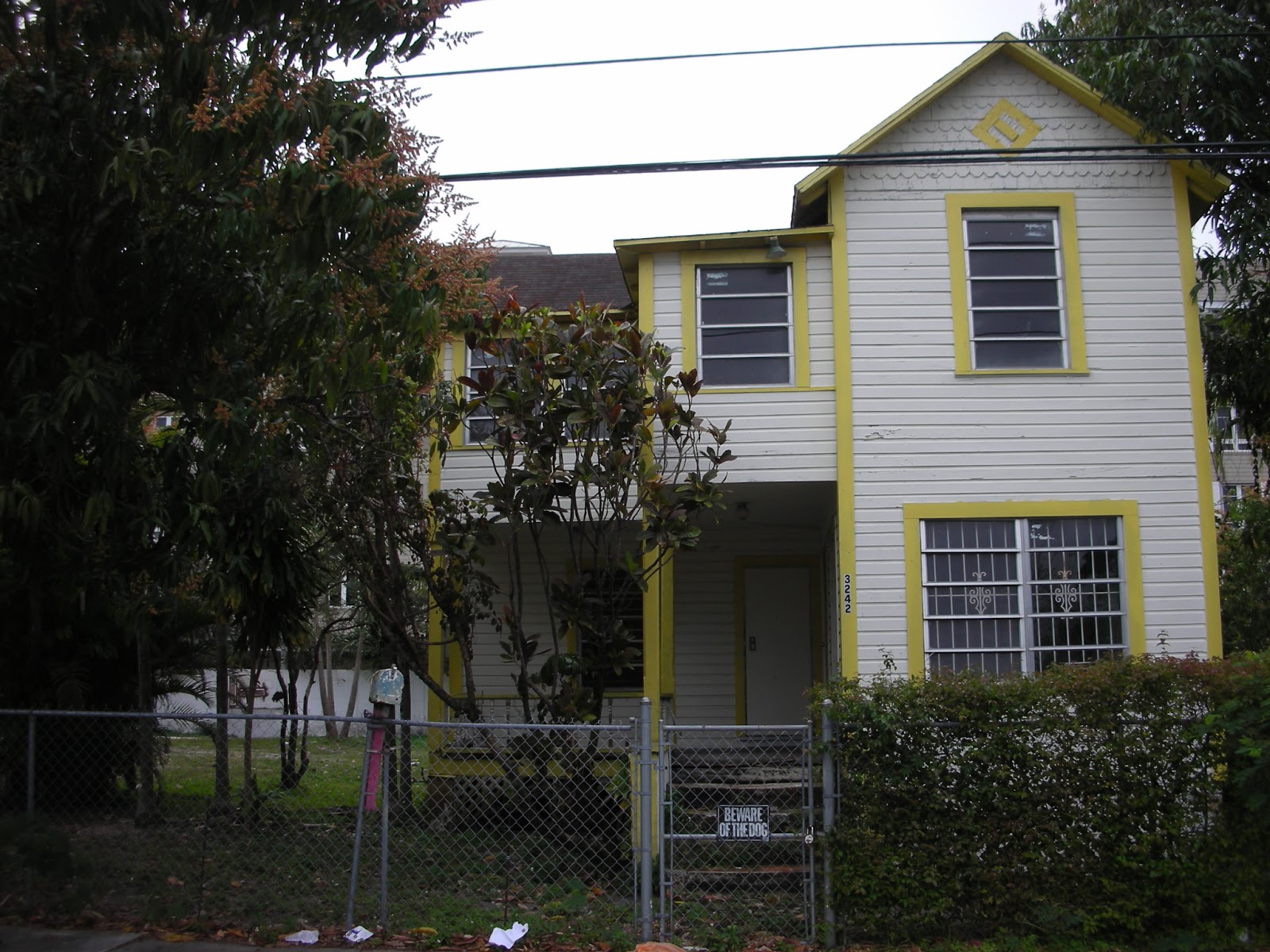
Likewise the Mariah Brown House. If Brown were White, and owned the first house in an important historical district, her house would not sit empty and boarded up today. Even worse, the Mariah Brown was slated to have been renovated as a museum and community/historical resource. That project started in 1995 and has been stalled since 2000!!! However, unlike the Stirrup House, the current Mariah Brown house is not even the original structure. According to GrandAveNews:

The original house, 3298 Charles Ave., was built in 1889. The Coconut Grove Cemetery Association bought the home, which was in severe disrepair. The group razed it in 1999 and built a replica in 2000.

However, the E.W.F. Stirrup House is the real deal. While there appears to have been been several additions over the years, it’s still the original house, much of it built by Ebenezer’s own hands. As it continues to undergo Demolition by Neglect, the E.W.F. Stirrup House is also a symbol of something else in Coconut Grove: the quiet racism that has kept West Grove impoverished right from the beginning. Despite the The Grove’s reputation for more than a century as a laid-back, funky, village which attracted painters, Bohemians and later Hippies, Black Coconut Grove has been allowed to slowly slide into disrepair as White Coconut Grove has become one of the ritziest in the country. The 33133 Zip Code is now considered one of the most exclusive in the country. Within a mile’s radius of the Stirrup House today one can find homes, condos, and townhouses priced from a million dollars all the way up to $22 million, or so.

Developer Gino Falsetto controls the Stirrup property through a 50-year lease. However, due to provisions in Ebenezer Stirrup’s will the Stirrup House must remain in the hands of the Stirrup Family. Ever since he wrested away control from E.W.F. Stirrup’s descendants several years ago, Falsetto appears to have conducted a deliberate campaign of Demolition By Neglect. It has been empty for many years now and he has not even done the barest minimum to ensure the house doesn’t fall apart. The house is entirely exposed to the elements with glass not in several of the window frames facing the ocean, where the prevailing winds come from. Vines have been allowed to grow up the walls and across the roof, with roots no doubt causing damage to those areas of the house. There is exposed wood rot all around the outside of the house, mold and mildew being one of the greatest concerns for any wooden structure in south Florida, which is why wood is no longer used as a building material here. The mold continues inside the house as well, living along side the termites that are eating the structure away from the inside. The property has been cited several times by City of Miami inspectors because of a lack of upkeep, in contravention of several Miami by-laws. Between citations by the City of Miami, the E.W.F. Stirrup property is allowed to become a trash heap, until it’s cited all over again.

Eventually City of Miami building inspectors will come along and condemn
the structure, saying it’s too far gone to save. No doubt this is what
Aries Development, the company that holds the Stirrup lease,
wants. The E.W.F Stirrup House stands in the way of Aries making mega-millions of moolah.

From the large white structure on the bottom (Grove Gardens Residence
Condominiums) to the larger white structure at the top (Commodore Plaza)
is a massive area that could be developed for mixed-use by Aries if only
that pesky E.W.F. Stirrup House didn’t stand in its way. Click to enlarge.

Follow the bouncing ball: Aries developed the Grove Gardens Residence Condominiums, the white building immediately south of the E.W.F. Stirrup House (yellow rectangle in map on the right). Right across Charles Avenue are two vacant lots (the orange rectangle) that also appear to be controlled by Gino Falsetto and/or Aries Development and/or a shell company. Aries had owned these lots previously, but defaulted and the bank took them back in foreclosure. However, who should win the auction, but Gino Falsetto’s long-time partner-in-(alleged)-crime Pierre Heafy. It hardly appears to be a hands-off sale. Lastly, Immediately to the east of those vacant lots is the Coconut Grove Playhouse, which the state of Florida just recently took back from the bankrupt board that ran it into the ground 7 years ago. Through a loan that Aries claims it made to the board several years ago in an attempt to keep it solvent, Aries has always claimed a legal control of The Playhouse as well. Until recently that has stalled any progress on the Playhouse being renovated. Aries doesn’t appear to have dropped its claim, so it might have to be tested in a court of law no matter what happens to the Playhouse down the road. The state of Florida has put the property up for sale as surplus.

As tangled as all of that sounds, here’s the simple takeaway: The E.W.F. Stirrup House is the only remaining impediment to Aries Development (Gino Falsetto) having one of the last sizable properties that could be zoned for mixed-use in Coconut Grove. No doubt that’s the reason Gino Falsetto has done nothing to protect the E.W.F. Stirrup House. It stands in the way of progress and a huge profit.

It’s time for Coconut Grove to honour its entire history — the Black as well as the White that’s already been memorialized — and say no to a developer who is trying to destroy an important part of Coconut Grove history.

SAVE THE E.W.F STIRRUP HOUSE!!!


Read my entire “Unpacking Coconut Grove” series by clicking the link below:

Unpacking Coconut Grove ► A Compendium

Nostalgia Ain’t What It Used To Be ► The Electrocution of Topsy

Dateline January 4, 1903 – On this day a circus elephant named Topsy was electrocuted to death by The Wizard of Menlo Park, Thomas Edison. The death sentence was carried out, ostensibly, because Topsy had killed 3 trainers in 3 years. However, the real reason for Topsy’s cruel death was commercial.

Trained elephants were a big attraction around the turn of the last century and Topsy had once belonged to the Adam Forepaugh Circus, just one of many traveling circuses working the large and small towns of ‘Merka. Topsy was later retired to Luna Park in Coney Island. However, Topsy wasn’t as well-trained as other elephants of the day and had killed 3 trainers, including the last one who, while drunk, tried to feed a lit cigarette to her. Topsy wasn’t happy and trampled the man to death. Go figure!

Originally Topsy was to be hanged for her crimes. However, the Society for the Prevention of Cruelty of Animals stepped in and other methods of putting Topsy to death were contemplated. Thomas Edison won the day with his suggestion that Topsy be electrocuted. Edison’s plan had less to do with killing Topsy humanly, as electrocution was considered to be. At the time Edison was locked into a commercial battle with George Westinghouse which has come to be known as The War of Currents.

The War of the Currents was the Beta vs VHS battle of the day and the prize was the ability to wire ‘Merka for electricity. Edison was pushing the Direct Current [DC] method of electrical distribution and lighting, which required a much lower voltage. Westinghouse was pushing for Alternating Current [AC] because he had licensed the patents to Nicola Tesla‘s competing system. For Tesla hooking up with Westinghouse and competing with Edison was something of a pay-back. Tesla had worked for Edison at one time and told Edison that he could redesign a motor that Edison had created. Reportedly Edison said he’s pay $50,000 to Tesla if he could pull it off. When Tesla did, Edison claimed he was merely joking and the newly emigrated Tesla just didn’t understand ‘Merkin humour. A thousand laughs that Edison.

The real reason Edison wanted to kill Topsy with electricity is that he wanted to demonstrate how dangerous Westinghouse’s AC power was. He had already created a disinformation campaign against AC current. According to the WikiWackyWoo:

Edison carried out a campaign to discourage the use of alternating current, including spreading disinformation on fatal AC accidents, publicly killing animals, and lobbying against the use of AC in state legislatures. Edison directed his technicians, primarily Arthur Kennelly and Harold P. Brown, to preside over several AC-driven killings of animals, primarily stray cats and dogs but also unwanted cattle and horses. Acting on these directives, they were to demonstrate to the press that alternating current was more dangerous than Edison’s system of direct current.[29] He also tried to popularize the term for being electrocuted as being “Westinghoused”. Years after DC had lost the “war of the currents,” in 1903, his film crew made a movie of the electrocution with high voltage AC, supervised by Edison employees, of Topsy, a Coney Island circus elephant which had recently killed three men.

Edison opposed capital punishment, but his desire to disparage the system of alternating current led to the invention of the electric chair. Harold P. Brown, who was being secretly paid by Edison, built the first electric chair for the state of New York to promote the idea that alternating current was deadlier than DC.

Executing Topsy was a two-fer for Thomas Edison. Not only was he able to make another powerful statement against Alternating Current, but he also was able to film the event with his latest invention: the movie camera. His movie “Electrocuting An Elephant” toured around ‘Merka and Edison made money off its distribution and ticket sales.

WARNING: Not for the squeamish! 

BTW: In all likelihood Topsy was named after the character of Topsy in Harriet Beecher Stowe’s famous anti-slavery novel Uncle Tom’s Cabin, published in serial format in 1851 – 1852 and in book form in 1853. It’s from the Beecher Stowe book that we get the expression “grows like Topsy” or as Topsy put it, she just “grow’d.”

While looking for pics to illustrate this blog post I came across Topsy: the Electrocuted Elephant, a series of comic strips that make one think, or at least they do me.

Nostalgia Ain’t What It Used To Be ► Flying High

Drawing of steerable dirigible created by Henri
Giffard, which reportedly flew 15 miles in 1852.

If God had meant humans to fly, She would have provided everyone with carry-on luggage. 

Back at the turn of the last century, however, people were trying to solve riddle of flight. Hot air balloons had been around for more than a century, but a hot air balloon has only two controls: up and down. Dirigibles came along in the mid-19th century, with steam-driven engines and controls. However, fixed-wing, heavier-than-air craft would have to wait for the invention of the internal combustion engine.

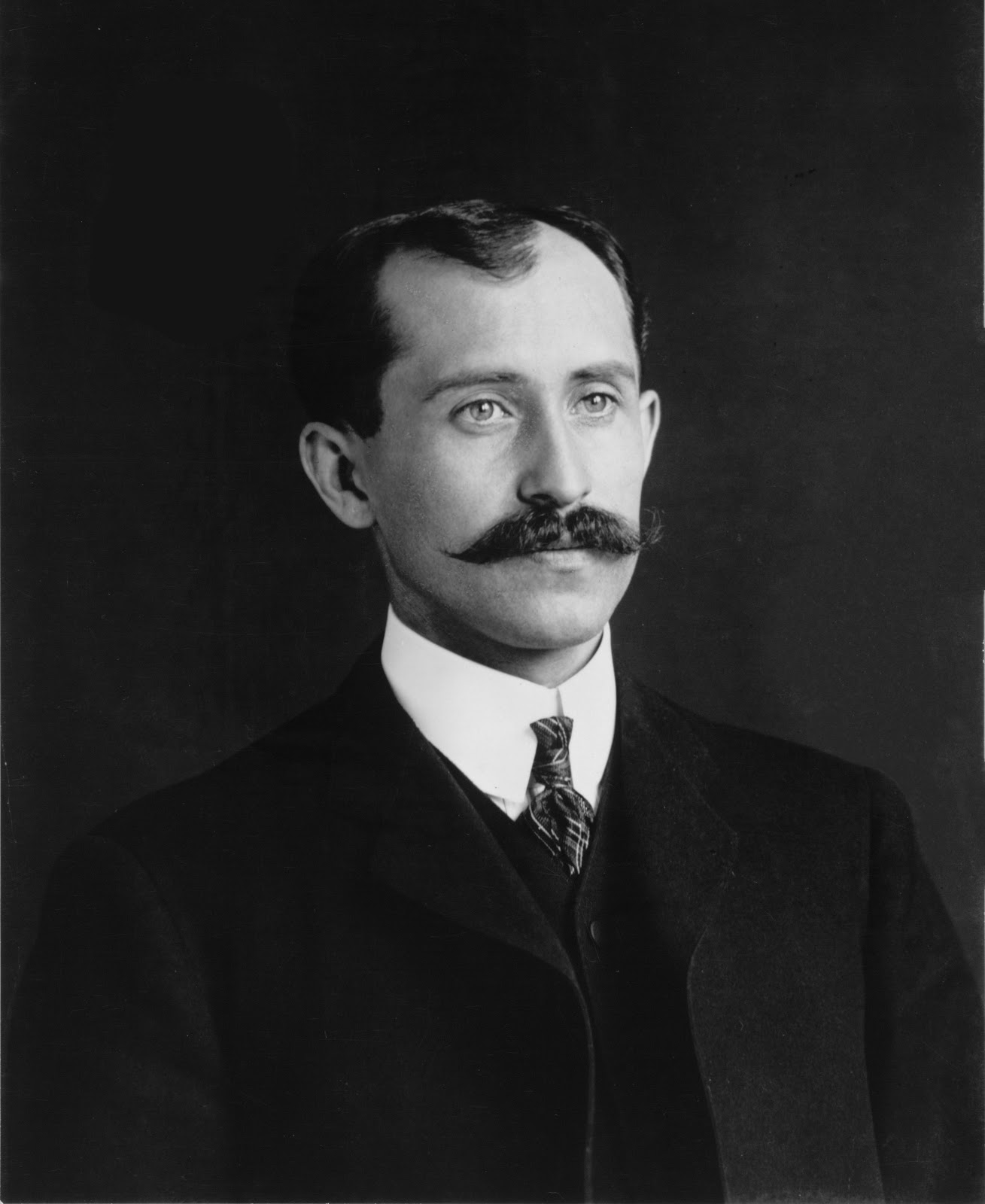
Orville Wright, 1903
Wilbur Wright, 1903

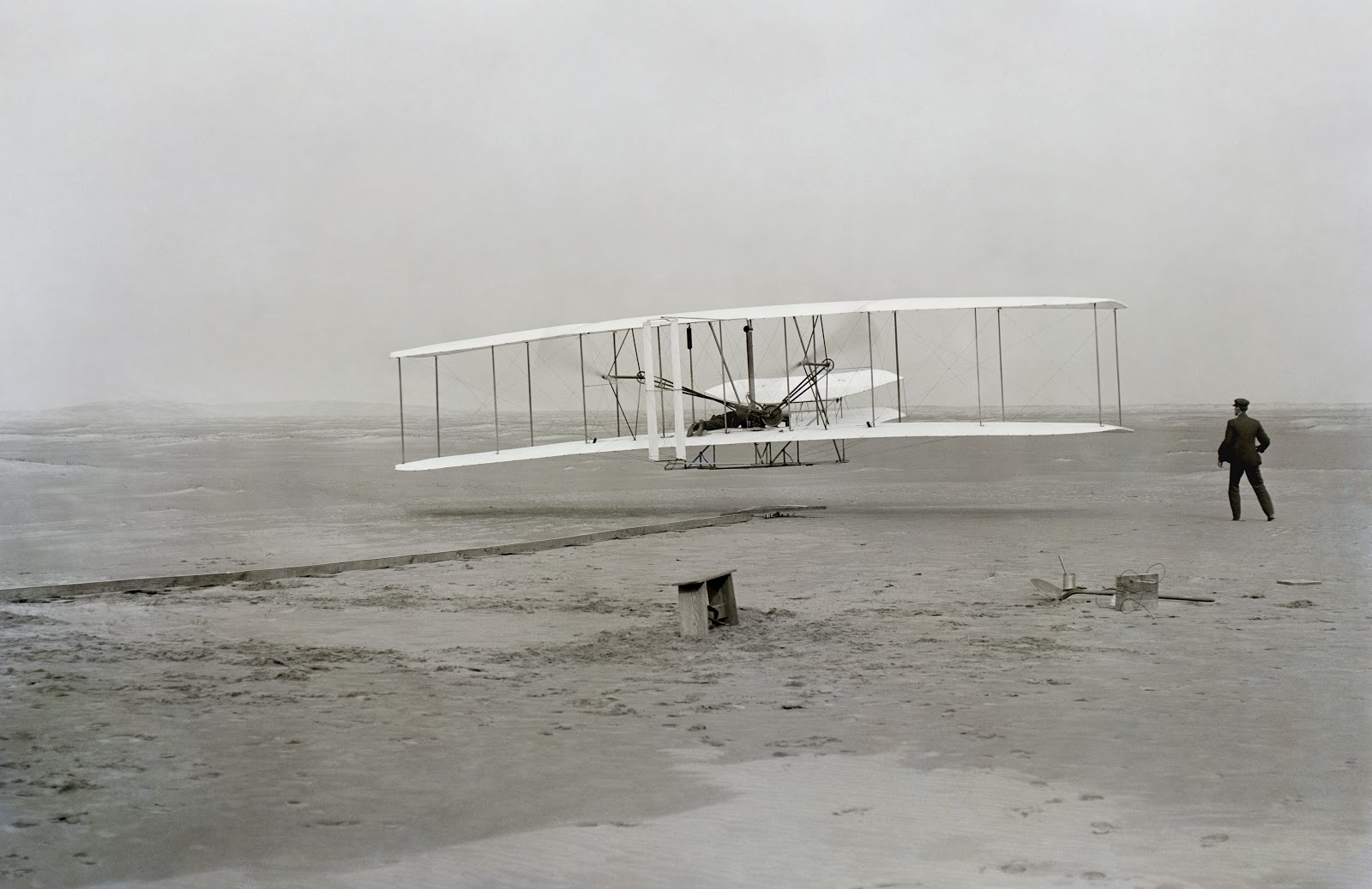
Inventors around the globe were looking for a way to control flight, including bicycle salesmen Orville and Wilbur Wright. The idea began with them in 1899, when Wilbur wrote to the Smithsonian Institution asking for info on aeronautics. The brothers spent the next several years working on their invention, realizing that they should perfect controlled glider flight before adding an engine to their airplane. There were many failures, but the Wright Brothers kept refining the glider until they were able to control its flight. In 1903 they added an engine and traveled to Kitty Hawk, North Carolina, their perennial testing ground. On December 14, Wilbur — who won a coin toss — took a 3-second flight, but the engine stalled after take-off and the subsequent crash made repairs necessary. On December 17, 1903, this time with Orville behind the controls, they succeeded with the “first controlled, powered, and sustained heavier than air human flight.” It doesn’t sound like much today, but Orville traveled 120 feet in 12 seconds about 10 feet above the ground, which works out to about 6.8 MPH. Exactly one photograph was taken of the historical event:

And, just because everybody loves movies like this, here are some attempts at flight that didn’t work out so well.

The last flight in that clip is the Wright Brothers. It was just a century from their first flight to the T.S.A.

Unpacking the Aunty Em Ericann Blog

Welcome to my occasional entry of Unpacking the Aunty Em Ericann Blog, where I ask my readers to pay attention to the man behind the curtain, who used to be “Aunty Em Ericann,” the woman behind the curtain.

Before I left Canada, 7 years ago, I told several people (who may now be too embarrassed to admit to knowing me) that I was going to become a nationally-known pundit in ‘Merka under the nom de plume “Aunty Em Ericann.” To that end I created the meta-character named Aunty Em Ericann, who eventually came to write at NewsHounds. The back story for Aunty Em was deceptively simple. Here’s her biographical profile:

Emily Ericann. That’s my real name. Well it was, before I went back to my maiden name after the divorce. My ex and I were dating for 2 months before we realized that if we got married my name could be pronounced “american” (Em Ericann). After it all went bad, I realized that’s the only real reason we got married. Ironically, I am a former American. However, I lived in Canada three and a half decades and became a Canadian citizen along the way. And yet, I recently returned to The Land of My Birth to take care of my aged father. Shocked by the before and after differences in America, I will use this forum to speak out. 

Some members of the Miklós Rózsa Society. Miklós
Rózsa
is in the center. The sack of shit who hides
behind the name of Johnny Dollar is on the far left.

I got away with the nom de plume for a number of years before the two-legged piece of excrement named Johnny Dollar decided it was his mission in life to expose Aunty Em’s identity, along with my sex life. That story is outlined in Johnny Dollar Has Proven Himself To Be A Very Dangerous Person, the very first post on this blog.

However, my long-time readers already know that story. If they’ve been paying attention they also know that my Unpacking Aunty Em Ericann Blog series is merely an excuse to find clever ways to remind them to click on some of the advertising, so I can keep the Aunty Em Ericann Blog rolling. It won’t cost you anything, but will add a few pennies (and I do mean few) to my coffers, helping to support this enterprise.

I’m looking at YOU!

Meanwhile, one statistic I can access through the Blogger platform is
what search terms people have used to find their way to the Aunty Em Ericann Blog. Take a look at this chart for this week:

Top Ten search terms delivering readers to the “Aunty Em Ericann” blog this week. They all make sense except #8.

I don’t know what disturbs me the most: That this week one of the search terms that people used to arrive here was “boy staked to the ground”; that three separate people used the search term “boy staked to the ground”; or that, somehow, “boy staked to the ground” brings people to my blog, even though I’ve tried it without any luck. While I’m thinking about it, I’m not so sure of Arawak People being on this blog either.

From time to time I also like to review what my Top Ten posts are. I can see which ones are highly-rated at any given moment in time, or by the day, by the week, by the month, and of all time since the Aunty Em Ericann Blog launched.

My Top Ten most popular posts of All Time

My Top Ten Posts of All Time™ in handy clickable hypertext:


Click on one of the links above to read one of my Top Ten blog entries, or just go exploring from the front page. There’s guaranteed to be a story or two you like, or maybe something that merely pisses you off. However, just keep in mind that it would be a small favour to me for you to click on one of the adverts . . . or two . . . on the Aunty Em Ericann Blog.

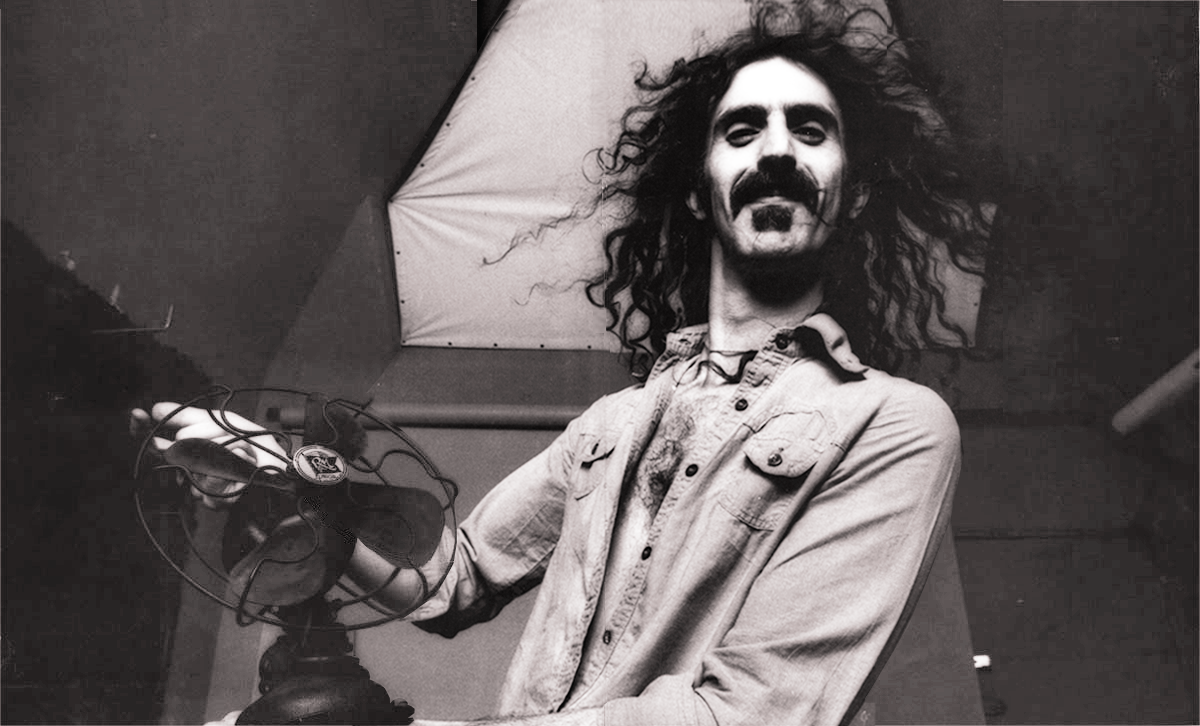
Frank Zappa ► A Musical Appreciation

Dateline December 4 – On this day in 1971 Frank Zappa and the Mothers of Invention were on stage in Montreax, Switzerland when the casino caught fire. The night was immortalized in Deep Purple’s song “Smoke on the Water.” On the same date 22 years later Frank Zappa died of prostate cancer.

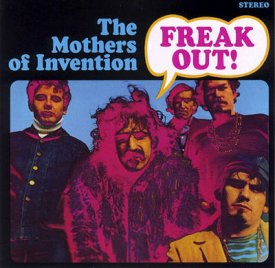
The ugliest LP cover I had ever seen.
I had to own it.

Not to brag, but I was there from the beginning. I discovered Frank Zappa some time in 1966 when I first set eyes on the cover of Freak Out at my local Kresge’s record department. As one descended on the escalator into the basement, a gap opened in the wall revealing Kresge’s 2-rack record department. The farther one descended, more of the record department was revealed in the expanding triangle of the record department. As teens we’d crane our heads into that crack to see what was new each week.

One day in 1966 my eyes spied what was the ugliest record cover I had ever seen. I had to own it.

It was a double-record set in a gatefold cover, among the first for a Rock and Roll LP. The music was also a revelation. One LP was all Doo Wop, but done in a slightly demented style, as opposed to straight up. The other LP contained longer songs and musical collages that were NOTHING like demented Doo Wop, but were demented all the same. I became an instant fan and followed Frank Zappa’s career, like a lemming follows whatever a lemming follows, ever since.

When I signed up I didn’t realize that by the time it was over I’d have collected some 90 albums, many of them double and triple sets, making Frank Zappa one of the most prolific artists/composers/Rock musicians of the 20th Century. However, I wasn’t a fan because he was prolific. I was a fan because he made great music. Here’s just a small taste of what Frank Zappa composed and released. Enjoy.

Musical Appreciation ► Thomas Edison Unveils First Phonograph

Edison with the 2nd model
of his phonograph in 1878

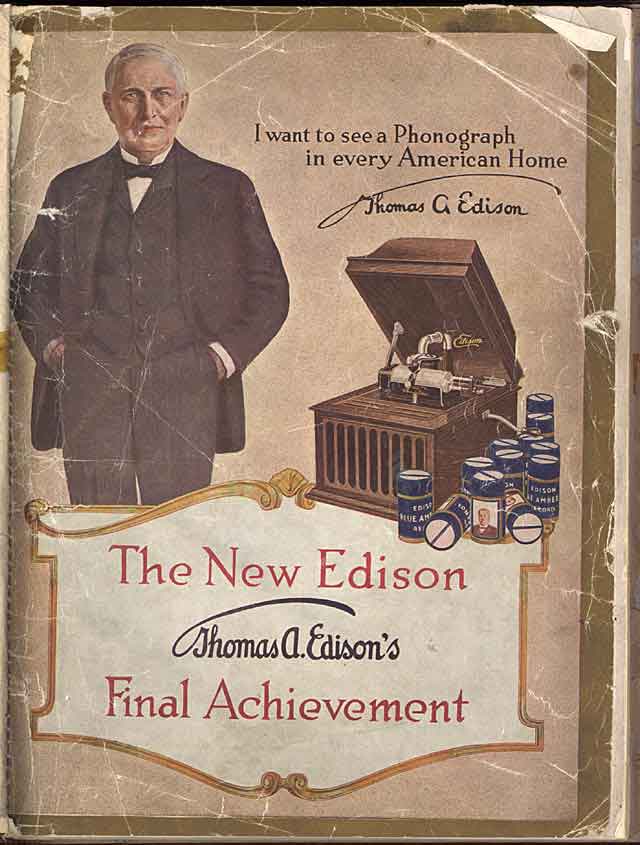
He invented the stock ticker, a mechanical voting machine, batteries for electric cars, motion pictures, not to mention the electric light bulb and electric power distribution. However, nothing Thomas Alva Edison invented has brought more pleasure to more people than the phonograph.

Edison demonstrated his first phonograph, a word he also invented, on this day in 1877. Edison was not trying to invent a phonograph when he came upon the inspiration. He was trying to improve the high technology of his day, the telegraph transmitter. However, he noticed that when the paper tape was moved through the transmitter at high speed, it sounded a bit like human speech. This led him to begin experimenting with a hard needle to etch sound waves into a rotating cylinder covered with a thick tin foil. Voila! An invention is born.

An advertisement for Edison’s phonograph

Eventually the tin foil gave way to wax cylinders, which eventually gave way to the gramophone, on which 10″ platters spun at 78 revolutions per minute, then at 45 RPM, and finally at 33 & 1/3 RPM. All of these forms of sound recreation were just variations of Edison’s original invention in which sound waves moved a diaphragm. The movement of the diaphragm made a needle quiver, which etched the sound into whatever medium was being used. The principle was reversed for playback: A needle was placed in a groove in which sound waves were already etched. The movement of the needle moved a diaphragm, which reproduced the sound through a horn. It was a totally mechanical process. Eventually electronics was added to the mix, but that still didn’t change how the sound was etched into the medium.

When the compact disc and digital recording came along, there was no more need for Edison’s great idea of a moving membrane etching and recreating the sound. Now sound waves are electronically converted into ones and zeros and encoded on computer equipment to be turned back into sound at the press of a button. This led to the invention of the ubiquitous MP3. Now one can put 10,000 songs on a device smaller than a pack of matches.

It’s also how I can share with my faithful readers a playlist of cover songs I have been collecting for many years.

Enjoy, and don’t forget to say a big THANK YOU to Thomas Edison, The Wizard of Menlo Park.

Musical Appreciation ► Happy Birthday, Berry Gordy, Jr.

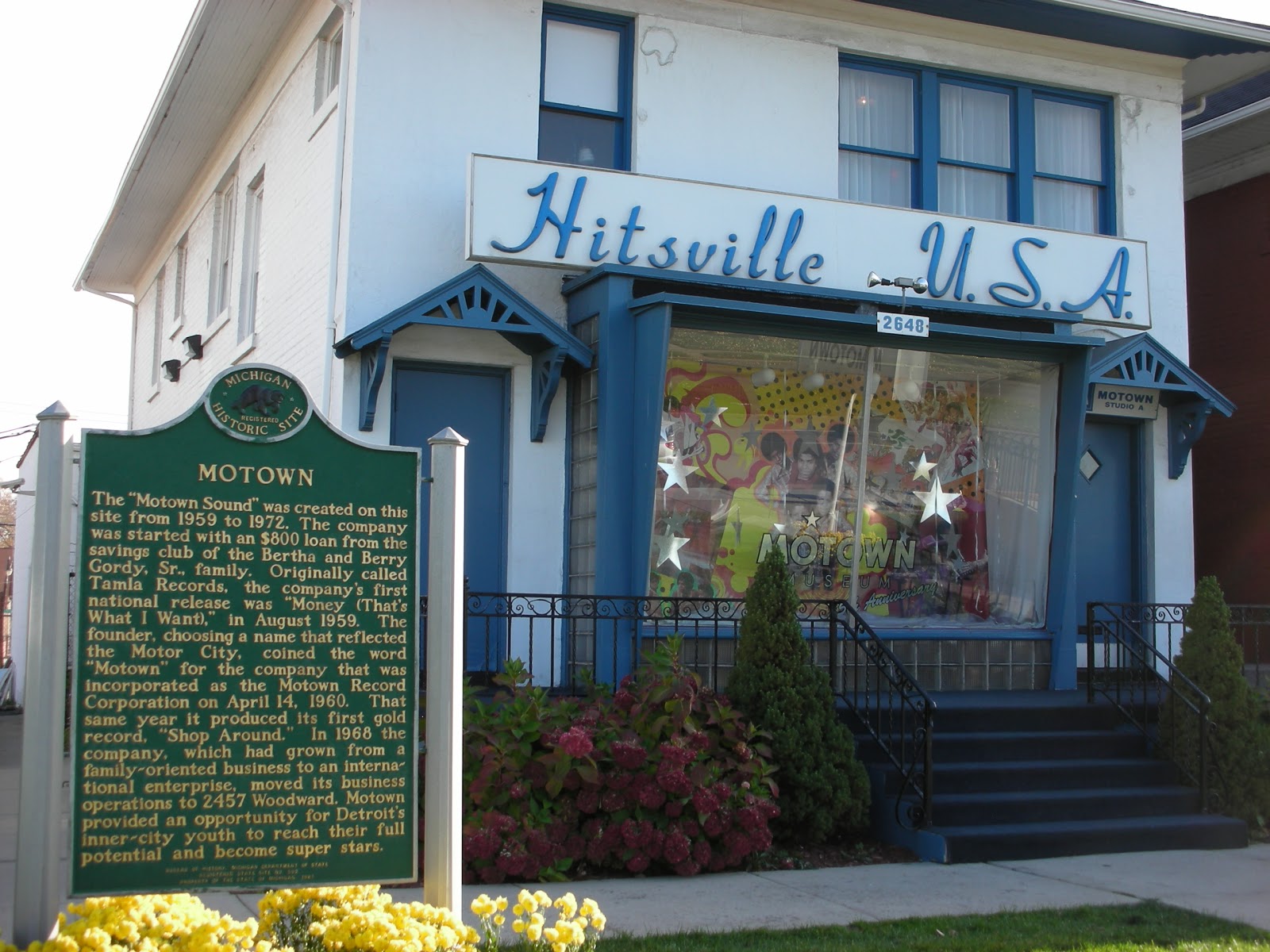
The Motown Museum in 2010, taken by author.

Dateline November 28, 1929 – Berry Gordy, Jr. is born in Detroit, Michigan, the city he would later rename Motown.

The broad contours of Gordy’s life are well-known: He was the 7th of 8 children born to Berry Gordy II and Bertha Fuller Gordy, who had come up to Detroit in the early ’20s to work in the car business. Berry dropped out of school and opted for a career as a boxer, which he abandoned when he was drafted for service in Korea. When he returned from the service, he started writing songs. His first hit was “Reet Petite” for Jackie Wilson, which started Gordy off in show biz. After a few more songwriting credits, which include the smash “Lonely Teardrops,” he decided to try his hand at producing. He found a Detroit Doo Wop group called The Matadors, renamed The Miracles, which started Gordy’s roster of artists.

The street sign in front of the Motown Museum

In 1959 Gordy borrowed $800 from his family and started up his own record label, Tamla Records. The first record issued on Tamla was “Come To Me,” by The Miracles and written by Marv Johnson, who later wrote “You Got What It Takes.” It wasn’t until the 3rd release, “Bad Girl” by The Miracles, that Motown was officially launched as a record label.

New artists and new hits followed: Barrett Strong‘s “Money (That’s What I Want),” and The Miracles‘ “Shop Around,” The Marvelettes‘ “Please Mr. Postman,” Mary Wells, The Supremes, Marvin Gaye, The Temptations, Jimmy Ruffin, The Contours, The Four Tops, Gladys Knight & the Pips, The Commodores, The Velvelettes, Martha and the Vandellas, Stevie Wonder, The Jackson 5, and many more.

Growing up in Detroit in the ’60s, it made one feel great to know the city had its own record label. When The Beatles started covering Motown tunes, we knew for sure that Motown had arrived worldwide.

However, the good times couldn’t last. In the early ’70s Gordy moved the Motown base of operations to Los Angeles, and things have never been the same since, for Detroit or the label.

However, it’s always been about the music. Here’s a Berry Gordy Jukebox for your listening pleasure. Get ready to sing and dance along, because you won’t be able to help yourself. And that, my friends, demonstrates the power of Motown.

Unpacking The Aunty Em Ericann Blog ► Shit Just Got Real

Pictures in the public domain stitched together by author

From time to time I like to unpeel the onion and reveal a bit of what it takes to put this blog together. I call the series “Unpacking The Aunty Em Ericann Blog,” Aunty Em being my nom de plume when I was writing at NewsHounds.

However, as I have explained to my faithful readers, this series has always been nothing more than an excuse to find clever ways to beg my readers to click on an advert or two (in the right-hand column) while they are here. When someone clicks on an advert, I get a few pennies . . . and I do mean “a few.” Finding clever ways to get my readers to click on the adverts has become more crucial than ever. Yesterday I learned two things simultaneously:

  1. Blogger has a limit for FREE data storage;
  2. I had JUST reached that upper limit.

I felt as if someone had just said to me, “Psst! Hey kid! The first one’s free! Now it’ll cost you.”

Faced with this dilemma there was only one practical thing to do: So that I can continue to bring to my vast reading audience all its favourite series, I’ll start to pay the monthly fee for the data storage.

All your favourites are here: Unpacking Coconut Grove, Unpacking My Detroit, Another Magical Tee Vee Moment, The Fox “News” Spin Cycle, Judge Not, Nostalgia Ain’t What It Used To Be, Fox “News” Snark, Music Reviews, Chow Mein and Bolling, and my other various looks at various topics, as varied as Watergate right up to Today in History.

Think of this series like a PBS Pledge Break: If you want to see your favourite EmTV series to continue, call the number at the bottom of your . . . Wait!!! What??? There’s no number? Then click on several ads while you’re here and keep this blog in data storage.

Pretty please with sugar on top?

You can also connect with me at facebook and Twitter. The more the merrier.