Tag Archives: Nostalgia Ain’t What It Used To Be

Elvis Scandalizes ‘Merka ► Another Magical Tee Vee Moment

Dateline June 5, 1956 – Elvis Presley appeared on the Milton Berle Show. Coming during his first brush with national fame, his pelvic gyrations were so suggestive that it became a national scandal. No, really!

In March of ’56 Elvis had released his eponymous debut LP on RCA. The label bought out his contract from Sun Studios the previous year. This LP would go on to become the first #1 Rock and Roll album, topping the Billboard charts for 10 weeks. Some 50 years later it ranked #56 on Rolling Stone’s list of the 500 Greatest Albums of All Time. However, Elvis was barely known at this point in his career. All that would change within the next six months.

Just a month after the LP’s release, Elvis appeared for the first time on the Milton Berle Show, singing an extremely hot version of Heartbreak Hotel from the deck of the USS Hancock. (Don’t ask.) When the performance finished, Elvis continued his tour. There was no public outcry. Watch:


To show how much Show Bidnezz has changed since then: Heartbreak Hotel wasn’t even on the LP Elvis had just released. He wasn’t promoting his new LP; Elvis was still promoting his January single, which had already topped the Billboard charts for 7 weeks. The music industry still thought of 45s as the money-makers, with LPs often an afterthought. Heartbreak Hotel would go on become the biggest selling single that year.

Elvis was just on the cusp of national and international fame. He had recently signed a 7-year Hollywood contract to star in movies and was still touring extensively. Milton Berle, who was trying to save his show from cancellation (unsuccessfully, as it turned out), booked Elvis for a return visit to his show in June, this time appearing at NBC’s studio in Hollywood. Before the show began Milton Berle, the show biz veteran of Vaudeville, radio, and tee vee, gave Elvis some advice; five words that changed history.

“Let ’em see you, son,” Milton Berle reportedly told Elvis, successfully convincing him to leave his guitar behind when he performed Hound Dog, a song he hadn’t even recorded yet. Without his guitar to hide behind, Elvis’ dancing was more exaggerated than his previous visit. While some girls screamed, much of the audience is confused, laughing and tittering. Clearly, they’ve never seen anything quite like this before:

‘Merka clutched its metaphorical pearls. According to the WikiWackyWoo:

Presley’s gyrations created a storm of controversy. Television critics were outraged: Jack Gould of The New York Times wrote, “Mr. Presley has no discernible singing ability. … His phrasing, if it can be called that, consists of the stereotyped variations that go with a beginner’s aria in a bathtub. … His one specialty is an accented movement of the body … primarily identified with the repertoire of the blond bombshells of the burlesque runway.” Ben Gross of the New York Daily News opined that popular music “has reached its lowest depths in the ‘grunt and groin’ antics of one Elvis Presley. … Elvis, who rotates his pelvis … gave an exhibition that was suggestive and vulgar, tinged with the kind of animalism that should be confined to dives and bordellos”. Ed Sullivan, whose own variety show was the nation’s most popular, declared him “unfit for family viewing”.

Ed Sullivan was brutal in his assessment of Elvis Presley:

Watching clips of the Allen and Berle shows with his producer, Sullivan had opined that Presley “got some kind of device hanging down below the crotch of his pants–so when he moves his legs back and forth you can see the outline of his cock. … I think it’s a Coke bottle. … We just can’t have this on a Sunday night. This is a family show!” Sullivan publicly told TV Guide, “As for his gyrations, the whole thing can be controlled with camera shots.”

Which is exactly what he did.

Sullivan was forced to book Elvis when Steve Allen’s show with Elvis singing Hound Dog to an actual hound dog, beat Sullivan’s show in the ratings. Elvis has called this the most ridiculous performance of his career:

Quickly reversing his principled stand to obtain boffo ratings, Sullivan offered Elvis the unheard of sum of $50,000 for three appearances. In case anything went terribly wrong on the first Sullivan performance, Ed Sullivan made sure that he could not be blamed. He had guest host Charles Laughton filling in while he recuperated from a car accident. Elvis performed Love Me Tender for the 60 million viewers who tuned in.

While his first Sullivan appearance cemented Elvis Presley’s fame, it was his appearance on the Milton Berle Show that earned him the nickname of Elvis the Pelvis. He hated this phrase the rest of his life, calling it, “one of the most childish expressions I ever heard comin’ from an adult.”
***
***

The Day I Met Keith Emerson ► Nostalgia Ain’t What It Used To Be

I told this story on my facebook wall and someone asked, “Why didn’t you save that for your blog?” <facepalm> Of course!!! Here’s a slightly edited version:

Over the years I’ve threatened to tell the story of meeting Keith Emerson in his living room in Nassau, Bahamas, way back in the ’70s when I was a vacationing Rock and Roll journalist from Toronto. Now seems as good a time as any.

My friend Larry Ellenson, owner of Toronto’s Round Records, had a rental property on Nassau Island in the Bahamas that he wasn’t using. I agreed to rent it from him for 3 weeks one winter when I really needed to get away from the cold. The price was reasonable, far less expensive than a hotel would cost. And, because it was a house with a functioning kitchen, I could have most meals on the cheap from groceries picked up fresh at the outdoor markets. Hanging out in a private home is far more relaxed than being a tourist in a resort, hanging out with people just like myself. My neighbours were all Bahamians, or transplanted people now calling Nassau their home.

The house was on the south side of Bay Road, across from the houses  right on the beach, west of the bridge that goes across to the fancy hotels on Paradise Island. Although there were houses all along the beach, I was told that those people only owned the property their houses sat upon, but didn’t own the beach behind their houses. Therefore, when I wanted to go to the beach I took the shortcut; I just walked across the street and down someone’s driveway to the sand, as opposed to taking the long way around. The long way was to walk a block east to the local park that connected to the beach. Consequently, I walked up and down the same driveway many times a day because in my fridge was a pitcher filled with a Kahlua and milk concoction. I kept going back to refill my glass.I was on vacation!

That’s who she worked for.

There was this a beautiful woman I saw on the beach every day. She was a nanny for the
family that lived in the house whose driveway I walked down many times every day. I’d read or swim, but occasionally we’d talk as I watched her play with the kids. After more than a week we got, shall we say, more friendly, and spent some evenings together after she was off duty.

At first, she had been really leery about the fact that I was a Rock and Roll journalist on vacation. However, she eventually found out I was truly just there for a vacation (and to meet Third World at Compass Point Studios) she relaxed somewhat. However, it’s obvious she didn’t trust me completely because she never told me who she worked for.

So, it was her day off and the family she worked for was elsewhere. She invited me across the street to hang out. We were on our 2nd or 3rd beer when suddenly a man came rushing into the house yelling something like, “Don’t mind me. I just need to pick up something.”

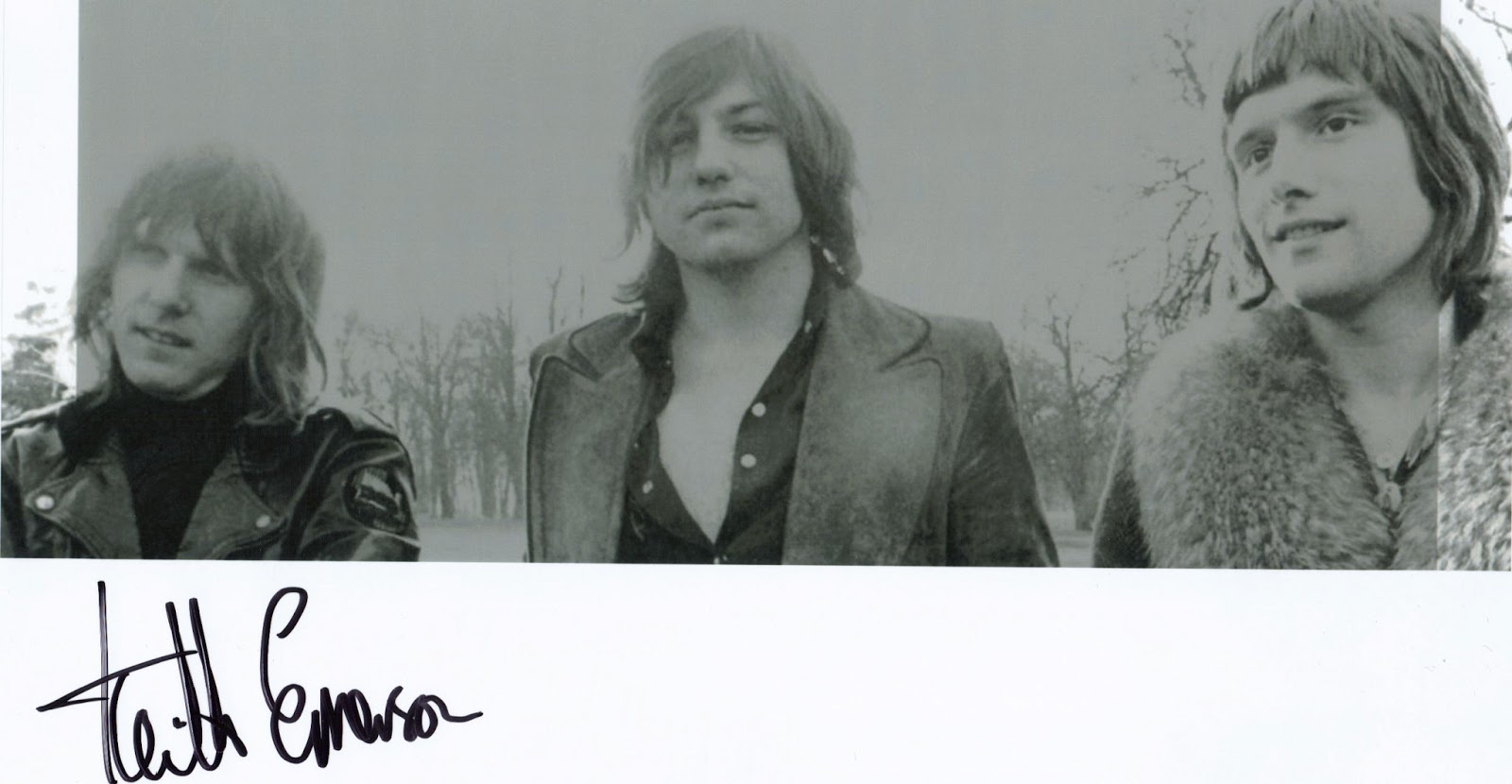
As he walked into the room, I recognized him immediately. Keith Fucking Emerson!!! His nanny introduced us. “Keith? This is Headly. Headly, Keith.”


Check out this supergroup playing in Japan in 1990: Keith Emerson – Keyboards,
Jeff “Skunk” Baxter – Guitar, Joe Walsh – Guitar, John Entwistle – Bass Guitar, Simon Phillips – Drums

I was sprawled back in his beanbag chair with his nanny and a beer in my left hand. As I awkwardly tried to get onto my feet, Keith politely reached out his hand to shake mine. I took it and he pulled me to my feet as we continued to shake hands. Then he grabbed whatever he came home for and, in less than 2 minutes, Keith Emerson was gone and I never saw him again. Not even in concert.

When I acted like a total Rock and Roll fan boy — and not a journalist — the nanny relaxed completely. She told me how difficult it could be, at times, to protect the family’s privacy. I assured her I wasn’t there to infiltrate the family and write about Keith Emerson and promised her I wouldn’t. I kept that promise until now. I think the statute of limitations is up.

EPILOGUE: A few minutes later we walked to the kitchen fridge to get another beer. I had seen the fridge on a previous walk to the kitchen, without really looking at it. However, this time I did. There’s a snapshot of Keith Emerson with Peter Frampton. There’s a snap of Keith and a Rolling Stone on the beach. There are snaps Keith and all kinds of Rock and Rollers on the fridge, posing on boats and the beach, with wives, children, and pets, just like the snapshots on everyone’s refrigerator everywhere.

***

***

The Very First Academy Awards

Dateline May 16, 1929 – The Academy of Motion Picture Arts and Sciences held the very first Academy Awards in the Blossom Room of the Hollywood Roosevelt Hotel.

Taking home the Academy Award — it wasn’t officially nicknamed Oscar until 1939 — for Outstanding Picture (later known as Best Picture) was Wings, a silent World War One Gary CoG and Charles “Buddy” Rogers, with Gary Cooper in one of his earliest roles.

Unlike the Academy Awards of today, the 1929 awards — honouring films from ’27 and ’28 — was a private affair that cost $5 to attend, and that included dinner. The ceremony itself, hosted by swashbuckler Douglas Fairbanks, lasted a mere 15 minutes and is the only one not presented on radio or tee vee. Compare this to current glitzy Oscar telecasts that have to work hard to contain themselves to 3 hours, with dozens of awards given out at a lunch ceremony earlier.

Here is the 1929 Academy Award for Outstanding Picture:

There was also no drama about the 1st Academy Awards; winners had been announced 3 months earlier. Twelve Oscars statuettes were given out that night. Stolen directly from the WikiWackyWoo:

Nominees and winners of the 1st Academy Awards

Outstanding Picture Unique and Artistic Production
Best Director, Comedy Picture Best Director, Dramatic Picture
Best Actor in a Leading Role Best Actress in a Leading Role
Best Writing, Original Story Best Writing, Adapted Story
Best Cinematography Best Art Direction
Best Engineering Effects Best Writing, Title Writing

Further reading at Not Now Silly

The Very First Grammy Awards ► Musical Appreciation 

***

***

Johnny Carson’s Last Tee Vee Appearance ► Another Magical Tee Vee Moment

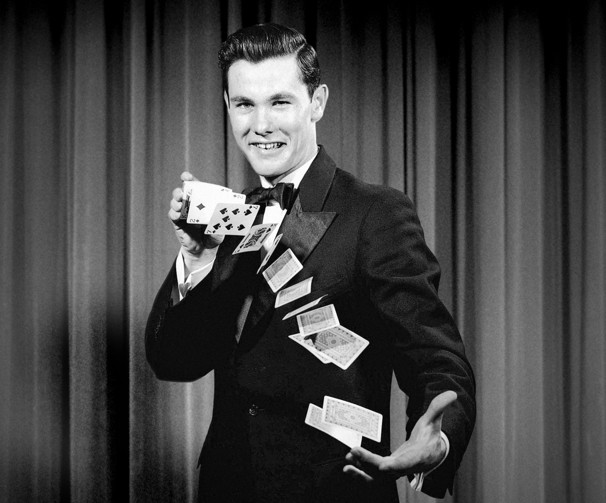
Johnny Carson got his start in Show Biz as a magician

Dateline May 13, 1994 – Johnny Carson makes his last tee vee appearance ever, fittingly on David Letterman’s show.

Carson was a tee vee institution for over 30 years. While other people hosted the Tonight Show both before and after him, Carson will always be the gold standard against which all others are judged. Carson retired from his show on May 22, 1992.

Johnny Carson always felt that David Letterman was the natural heir to the Tonight Show seat and was sorely disappointed that the show was given to Jay Leno instead. “Some people say” that’s why Carson declined to appear in NBC’s 75th Anniversary Special. “Other people say” that Carson never forgave NBC for destroying all the early Tonight Shows to make shelf room for newer shows. It very well could have been both.

Either way, it’s so appropriate that Carson’s last appearance was on Letterman’s show, almost 2 years to years to the day after his retirement. Letterman sprung Carson’s appearance as a surprise and the audience gave him a sustained standing ovation. After waiting out the applause for a while, Carson left the stage without saying a word. It looked like he had some lines, which he decided not to deliver at the last minute because anything he said would be an anti-climax. Remember: Carson was the master of Show Biz Timing™. Later Carson said he pulled his Marcel Marceau act due to acute laryngitis. This clip makes it clear he was going to say something.

This was one of the rare post-retirement appearances Carson made on tee vee, and the very last. On January 23, 2005 Johnny Carson died of respiratory failure from emphysema at the age of 79. After his death David Letterman did a Johnny Carson tribute show, which included an entire monologue written by Carson. It turned out that Carson regularly faxed jokes to the Letterman show just for the thrill of having then delivered on air.

Johnny Carson was the Comedian’s Comedian to the very end.

Here’s David Letterman’s tribute show to Johnny Carson:

Further Reading at Not Now Silly

Last Tonight Show with Johnny Carson ► Day In History
I’ve Got A Secret ► Another Magical Tee Vee Moment
Andy Kaufman ► Another Magical Tee Vee Moment

***

***

Bob Dylan Walks Out On Ed Sullivan

Dateline May 12, 1963 – Back in the day you couldn’t really say you were in Show Biz unless you had appeared on the Ed Sullivan Show. As much as Bob Dylan was known as a Protest singer, he still craved Show Biz legitimacy. That’s why he allowed himself to be booked on the Sullivan Show on this day in 1963. However, always the contrarian, Dylan walked off the show before he was to appear.

Ed Sullivan was a Tee Vee institution. Beginning in 1948 as Toast of the Town, his show ran for 23 seasons — 22 of them in the same Sunday night time slot of 8PM. Entire families would gather around the only tee vee set in the house and watch one of the only 3 tee vee networks in existence. The Sullivan Show had something for everyone in the entire family. It was a variety show, in the Vaudevillian tradition; a solo singer might be followed by a ventriloquist, who was followed by a plate spinner, with a Big Band performance next, to be followed by a comedian, and then, maybe, wrapped up with a scene from a Broadway musical. In a classic example of Art imitating Life, this “Hymn for a Sunday Evening,” from “Bye Bye Birdie,” sums up the importance of an appearance on the Sullivan show.

In ’63 Dylan was just an up-and-coming singer/songwriter, barely known outside the small, cultish world of Folk enthusiasts. If people knew him at all it was from Peter, Paul and Mary’s cover version of Blowin’ in the Wind. His 2nd LP, The Freewheelin’ Bob Dylan, with his own version of “Blowin’ In The Wind,” was just days away from being released. A Sullivan appearance would have been a huge boost to Dylan’s career and fame. However, according to the Official Ed Sullivan Show webeteria:

Bob Dylan was slated to make his first nationwide television appearance on The Ed Sullivan Show on May 12, 1963.  For the show, Dylan decided to perform “Talkin’ John Birch Paranoid Blues”, a satirical blues number skewering the conservative John Birch Society and the red-hunting paranoia associated with it.  A few days earlier, Bob Dylan auditioned the song for Ed Sullivan who seemed to have no issue with it. However, on the day of the show during the dress rehearsal, an executive from the CBS Standards and Practices department decided Dylan could not perform the song due to its controversial nature.  When the show’s producer, Bob Precht, informed Dylan of the decision, Dylan responded saying, “No; this is what I want to do. If I can’t play my song, I’d rather not appear on the show.”  Rather than choose a new song to perform or change the lyrics (as the Rolling Stones and the Doors on Ed Sullivan would agree to do), a young Bob Dylan walked off the set of the country’s highest-rated variety show.

The story got widespread media attention in the days that followed helping to establish Dylan’s public reputation as an uncompromising artist. The publicity Bob Dylan received from this event probably did more for his career than the actual Ed Sullivan Show performance would have. Unfortunately, this leaves us with no performance footage of Bob Dylan on The Ed Sullivan Show.

Here’s a live version of “Talkin’ John Birch Paranoid Blues,” which Dylan introduces by saying, “And, there ain’t nothing wrong with this song.”

No wonder they didn’t want the song performed on the show. In 1963 “Talkin’ John Birch Paranoid Blues” would have still been politically explosive. However, Ed Sullivan was a known control freak, who had his fingers in every aspect of his show. It’s hard to believe he wasn’t part of this decision, if not the instigator. An alternative theory is that Sullivan found the song a bit too far for his family audience, but wanted to come off as Mr. Nice Guy, so he told Bob Precht to deliver the bad news to Dylan. Blaming the CBS Standards and Practices office was probably just Standard Operating Procedure at the time.

Regardless of who made the decision, it resulted in Dylan’s “boot heels to be wandering.”

***

***

The First Three Stooges ► Nostalgia Ain’t What It Used To Be

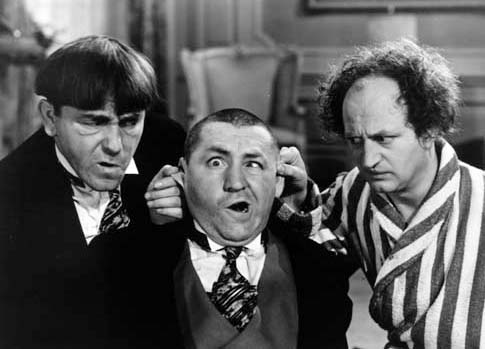
Above: Larry, Moe and Curly, not necessarily in that order.

Dateline May 5, 1934 – The Three Stooges release their first short “Woman Haters” and nothing was ever the same again.

The Three Stooges made more than 190 two-reelers over a 26 year period, but they started in the knockabout world of Vaudeville. Ted Healy was already a hit in Vaudeville when, in 1922, he took on new actors for his stageshow. Among them was Moe Howard, a childhood friend that had appeared, briefly, in the earlier act Ted Healy and his Southern Gentlemen.

Moe’s job was to act as an average audience member who is called onstage. Hilarity ensues. The showbiz term for this stock character was “stooge.” Soon Shemp, who was Moe’s real life brother, and Larry Fine joined the act. They appeared with Healy in one short, “Soup To Nuts.” but after a dispute over the movie contract, Larry, Moe and Shemp went solo, or as solo as a trio can go. They also took with them some of the material they had performed with Healy.

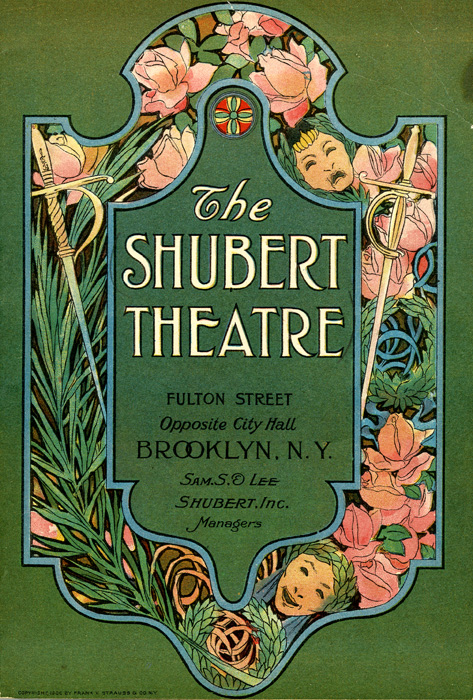
Intellectual property rights being intellectual property rights, Healey sued. However, he lost. As it turned out the material was owned by the show’s producer, the Shubert Theatre Corporation, which gave the Stooges the right to perform it.

The Three Stooges then had a brief rapprochement with Healy and were to appear together in a new Shubert production. However, when Healy got a better offer, he quit the show, taking Two Stooges with him; Shemp, who had threatened to quit previously, finally decided to pack it in. In need of a third Stooge, Moe suggested his younger brother. Jerry Howard joined the act as Curly.

Healy and the Stooges signed a contract with MGM in 1933 and made a number of shorts. When that contract expired a year later The Three Stooges split from Healy for good. Soon afterwards they signed with Columbia and released “Woman Haters,” the first official Three Stooges short

Growing up I watched a lot of Three Stooges in my time, but I don’t recall ever seeing this one. It’s all done in rhyme and song, all 20 minutes of it. There’s no way they could carry that over 2 2-reelers, let alone 190. Enjoy:

***

When High Speed Rail Died ► The Naperville Train Disaster

You can pinpoint the exact time and place ‘Merka gave up on high speed rail: midday April 26, 1946 in Naperville, Illinois. That’s when and where the Exposition Flyer, traveling at 85 miles per hour, rammed into the rear of the the Advance Flyer, which made an unscheduled stop to check on its running gear.

Forty-seven people died in the crash and more than 125 people were injured. However, as the WikiWackyWoo puts it, “Following this disaster, advancements in train speed in the United States essentially halted.

According to the Exposition Flyer’s crew engineer, W.W. Blaine applied the brakes immediately upon seeing the warning signals, but the stopping distance was greater than they had. When it plowed into the rear coach of the train it was still traveling at 60 miles an hour. It jumped up and its momentum cleaved the roof of the Advance Flyer’s last coach and buckled the diner car, the second from the end. In all 11 cars on both trains derailed, throwing people in every direction.

According to Adam Doster in The Crash that Rocked Naperville:

Dust, smoke, and debris scattered across the nearby countryside. The smell of ashes hung in the air. “The scene of the disaster,” the Tribune noted later that day, “was one of twisted and gnarled confusion, with huge luxury passenger coaches strewn across torn tracks like abandoned toy trains.” For a few seconds after the collision, the passengers on board made little noise. Then the shock wore off. “A moment of tragic silence was broken,” the AP wrote, “by screams and cries for help from the dying and injured.” The rear of The Advanced Flyer absorbed the bulk of the damage—most of those sitting in the rear coach and diner car were killed straightaway. Those seated further up the train escaped the worst, but were rocked nonetheless. “Things happened so fast,” one passenger said, “that I don’t remember what happened to me. I was doubled up suddenly and my knees were pushed against my chest.”

W.W. Blaine was exonerated of the manslaughter charge that followed the crash. One lasting result of the Interstate Commerce Commission hearings was the mandate that only trains with automatic train stop devices could exceed 79 miles per hour. Since this federal law was instituted in 1951 few passenger trains have installed the devices, keeping most passenger rail speeds below the 79 MPH threshold.

And, that’s why April 26, 1946 is the day that effectively killed high speed rail in ‘Merka – 67 years ago today!

****

****

Musical Appreciation ► AUNTY EM!!! AUNTY EM!!!

2005 stamp issued by the U.S. Postal Service

Dateline April 8, 1896 – Somewhere over the rainbow, in New York City’s Lower East Side to be exact, Isidore Hochberg was born.

He later changed his name to Edgar Harburg, but he was always known by his nickname “Yipsel” or “Yip.” As Yip Harburg he wrote the lyrics to some of the most popular songs in the ‘Merkin songbook, including Brother, Can You Spare a Dime; April In Paris; It’s Only a Paper Moon; Lydia the Tattooed Lady; and every song in The Wizard of Oz. He won an Academy Award for Best Music, Original Song for “Over the Rainbow.”

It should not be forgotten that Yip Harburg was later a victim of the Hollywood Blacklist in the ’50s. From 1951 to 1962 was unable to work in Tinsel Town due to his leftist leanings. He was luckier than some who were Blacklisted, since he was still able to write musicals for Broadway.

Here are just a few interpretations of Yip Harburg’s most famous songs:


E.Y. Harburg was inducted into the Songwriters Hall of Fame in 1972.

Happy Birthday Mama Africa

Dateline March 4, 1932 – Zenzile Miriam Makeba is born in Johannesburg, South Africa. She would go on to become one of the great voices in World music. While her music will live on forever, it’s quite possible that a more lasting legacy will be her loud voice in the struggle for Civil Rights back in her homeland — from which she had been barred from ever returning — and the rest of the world. 

Miriam Makeba’s influence is such that Google has honoured Mama Africa with a one of its famous doodles today.

There are so many Miriam Makeba songs one could play, but Pata Pata, her first ‘hit,’ for which she won a Grammy, is still the one that seems to sum up her entire career. The joyful presentation, along with her unrestrained shout of joy at the 2 minute mark, perfectly encapsulates her entire career.

HIT IT!

For politics, there was no stronger song in her repertoire than “Soweto Blues” written for her by her former-husband Hugh Masekela, a Civil Rights activist in his own right. This clip also describes her joy at being able to return to her homeland after so many years of forced exile.

Let’s all remember how Miriam Makeba fought for the Civil Rights of all of us, whether you are Black, White, African, European, Jewish, Muslim, or ‘Merkin.

Who’s Got Geronimo’s Skull?

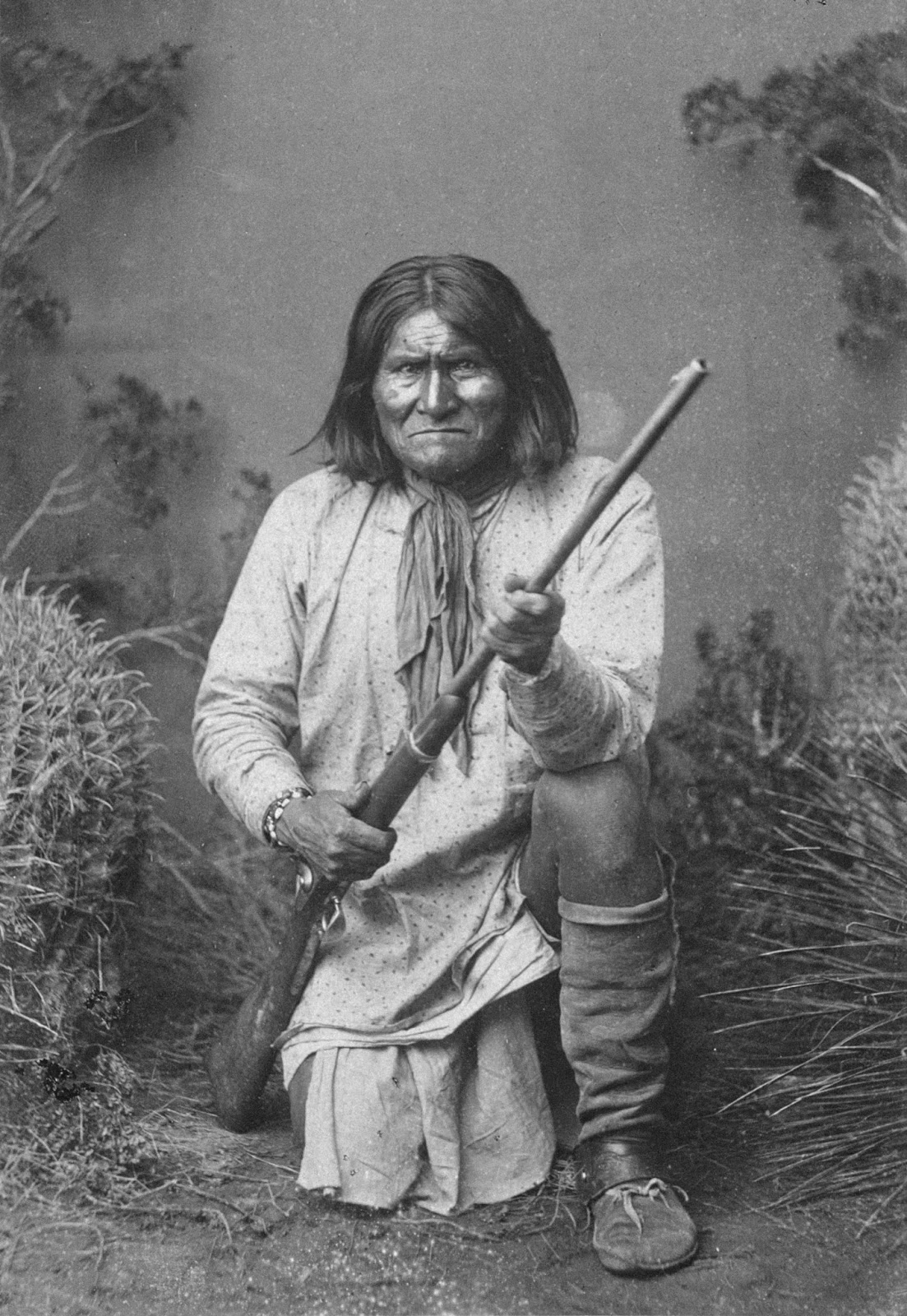
Geronimo in 1887

Dateline February 17, 1909 – Apache Chief Geronimo dies from complications from pneumonia at Fort Sill, Oklahoma. 

Geronimo surrendered in 1886 and spent his last years as a Prisoner of War of the ‘Merkin government. Despite his imprisonment he was still able to appear as a celebrity at various fairs and even rode in President Theodore Roosevelt’s 1905 inaugural parade. When he died at the age of 80, Geronimo was buried in the Apache Indian Prisoner of War Cemetery at Fort Sill.

Skip ahead a few years. The First World War — called the Great War until World War Two — was just breaking out. Prescott Bush — later a U.S. Senator and father of George Herbert Walker Bush, which makes him grandfather to George W. Bush — was stationed at Fort Sill before shipping out overseas. According to legend, Prescott Bush was one of several “Bonesmen” who dug up Geronimo’s bones and smuggled them to Yale University. They are said to have been at the Skull and Bones clubhouse ever since. G.H.W. Bush and G.W. Bush were later members of Skull and Bones, the secret society at Yale.

Edward S. Curtis, Portrait of Geronimo, 1905

There has never been a definitive answer as to whether Skull and Bones are keeping Geronimo’s bones. In 2009 Geronimo’s decendants sued. According to NBC News

Geronimo’s great-grandson Harlyn Geronimo said his family believes Skull and Bones members took some of the remains in 1918 from a burial plot in Fort Sill, Okla., to keep in its New Haven clubhouse, a crypt. The alleged graverobbing is a longstanding legend that gained some validity in recent years with the discovery of a letter from a club member that described the theft.

[…] The letter, sent to F. Trubee Davison by Winter Mead, said Geronimo’s skull and other remains were taken from the leader’s burial site, along with several pieces of tack for a horse.

“The skull of the worthy Geronimo the Terrible, exhumed from its tomb at Fort Sill by your club and Knight Haffuer, is now safe inside the T[omb] — together with is [sic] well worn femurs, bit and saddle horn,” Mead wrote.

Geronimo’s decendants lost that suit, but on very narrow grounds that doesn’t solve the controversy:

Siding with an argument by the U.S. Department of Justice, a federal judge in Washington, D.C., held that the government hadn’t waived its sovereign immunity, and hence federal officials can’t be sued in the case to force them to permit Geronimo’s descendants to remove his remains still at Fort Sill and reinter them in New Mexico near his birthplace, reports the Yale Daily News.

And, as far as the secret society is concerned, U.S. District Judge Richard Roberts held that the law under which Skull and Bones was sued, the Native American Graves Protection and Repatriation Act, only applies to grave robberies that took place after its enactment in 1990.

However, that’s not the most recent insult to Geronimo’s memory. The mission to kill ‘Merkin Enemy #1, Osama bin Laden, was codenamed “Geronimo.” From USA Today:

“Obviously, to equate Geronimo with Osama bin Laden is an unpardonable slander of Native America and its most famous leader in history,” Harlyn Geronimo said in a statement to the Senate Committee on Indian Affairs.

The panel met Thursday in a session scheduled weeks ago to discuss how racial stereotypes — mainly in the form of team mascots’ nicknames — were offensive to Indians. But the issue quickly pivoted to the code name the military had given to the sponsor of the Sept. 11 terrorist attacks.

“This victory has otherwise united our country,” Indian Affairs Chairman Daniel Akaka, D-Hawaii, said of bin Laden’s killing. “It is unfortunate that this code name was chosen.”

Today Geronimo is not thought of as the terrorist he was depicted in his lifetime. There is now an understanding that Geronimo was one of the last of his proud tribe to take up arms to defend itself from the continued encroachment and broken treaties of the newest residents of North ‘Merka. Among Natives Geronimo is deservedly considered a hero. Let us hope that one day the truth of his bones becomes known.