Tag Archives: Racism

Unpacking Coconut Grove ► Part 4.1 ► A Photo Essay

The room on the second floor in
which the (alleged) illegal
demolition was taking place.
Another angle, showing the 2nd
floor front room and the former
upper porch, now an interior room.

A quick visit to Charles Avenue confirmed the (allegedly) illegal demolition inside the historic, 120-year old E.W.F. Stirrup House has stopped. Whether that was due to my reporting them to the City of Miami Building Department, because of my weekend blog post called Open Houses and Broken Laws, or whether they just ran out of work to do, is something I don’t know.

However, I have a small clue that my post has been read by the alleged rapacious developer. There is now a lock and chain through the double-doors in the wall that separates the E.W.F. Stirrup property from the Grove Gardens Residences Condominiums mentioned in my previous post. I have never seen a chain and lock on that door before. Maybe they think that’s how I get onto the property when I visit and thought this would block my way.

That looks formidable, doesn’t it?

This is the formidable lock on the front gate. The gap is large enough to squeeze through, but I’ve never done that.

Yet locks do not prevent me from taking pictures through a chain link fence.

The workers conducting the (alleged) illegal demolition of the
E.W.F. Stirrup House filled this dumpster before work stopped.

If I were in Great Britain I’d call this a skip, which is taken to the tip. In any language, it’s full.

Locks do not prevent me from taking pictures over the wall from the Regions Bank parking lot either.
This angle showed me a new pile of trash that wasn’t there on Friday.
This is the parking lot of the Regions Bank. The wall is chest
high and you can just see the E.W.F. Stirrup House in the background.
It’s not clear what that pile of trash is, but I’d lay money it’s non-conforming.
Note the height of the grass. I’ve seen the property cited previously for a lack of upkeep on the landscaping.

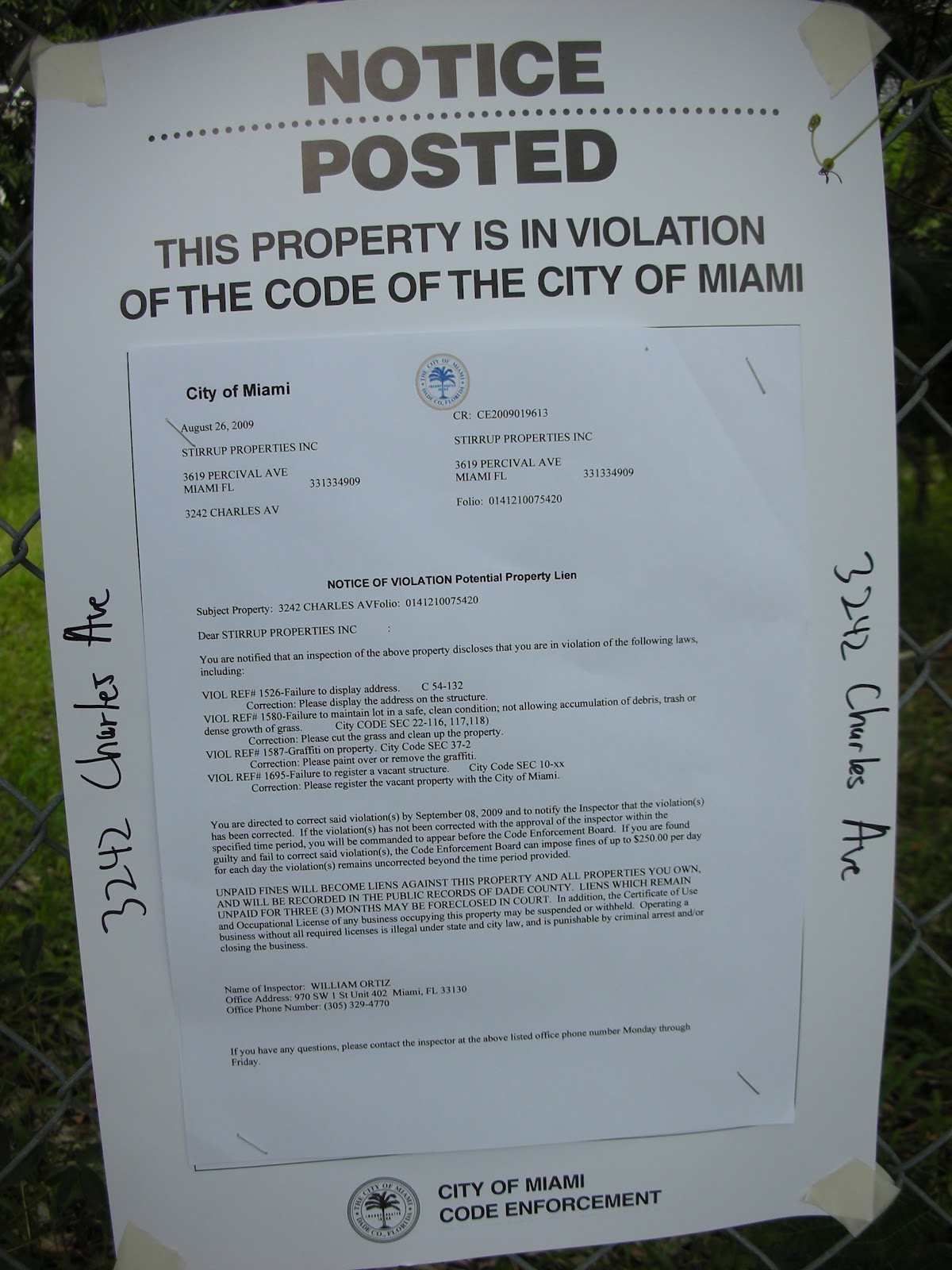
Notice from the City of Miami for code violations taken by author on August 26, 2009
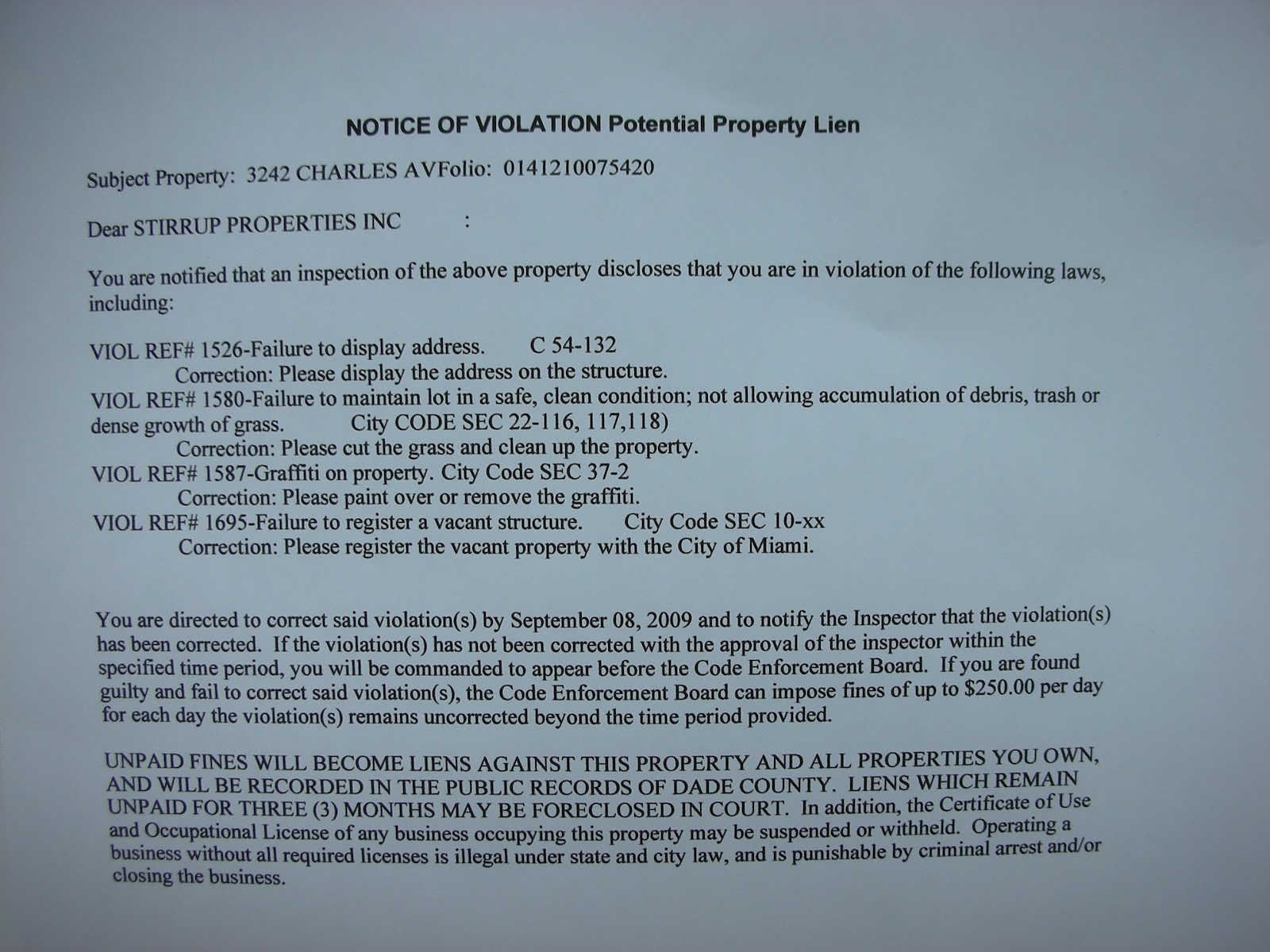
Close up of notice from August 26, 2009. The property is in worse condition now than it was in 2009.
Also from August 2009. The property across from the E.W.F. Stirrup House with a similar citation.
This is the property currently being used to shunt cars in and out of the Coconut Grove Playhouse parking lot.
A new picture from yesterday of the same fence, with far more growth than for
which the property was cited in 2009 (above). Note how it’s impeding the sidewalk.
Back to the Stirrup property and yesterday. It wouldn’t surprise me at all to find
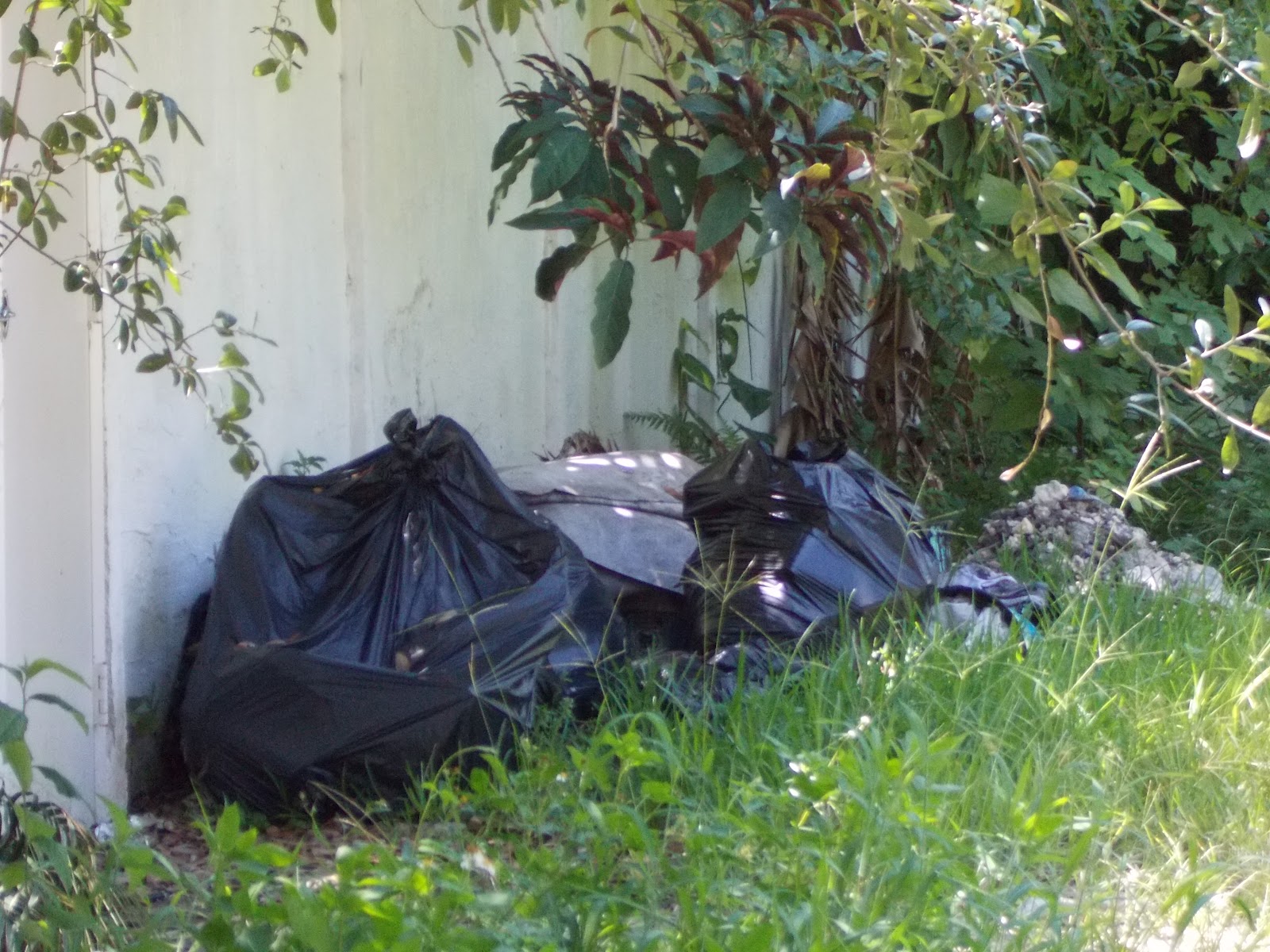
this pile of trash is also non-conforming. This is next to the padlocked doors seen above.
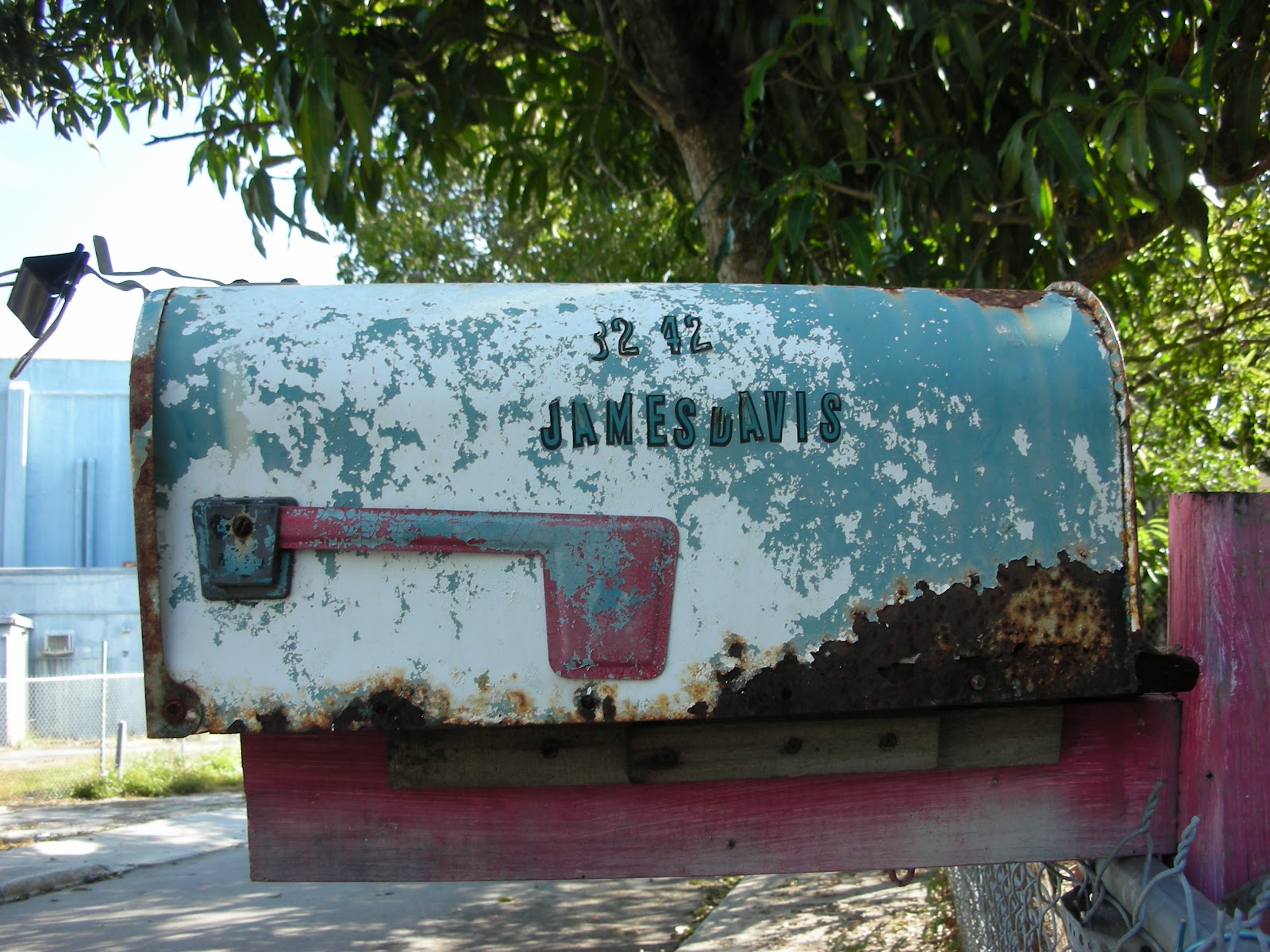
The mailbox at the E.W.F. Stirrup House at 3242 Charles Avenue
indicates the neglect as well as anything else.

Another view of the mailbox at the E.W.F. Stirrup House.
I have photographed this hole in the front of the E.W.F. Stirrup House before.
This is the first time I ever saw a creature come out of it.
It’s always a good day when I see a flyer for Reggae music.
This was on the sidewalk directly in from of the E.W.F. Stirrup House.
***

***

The Detroit Riots ► Unpacking My Detroit ► Part Five

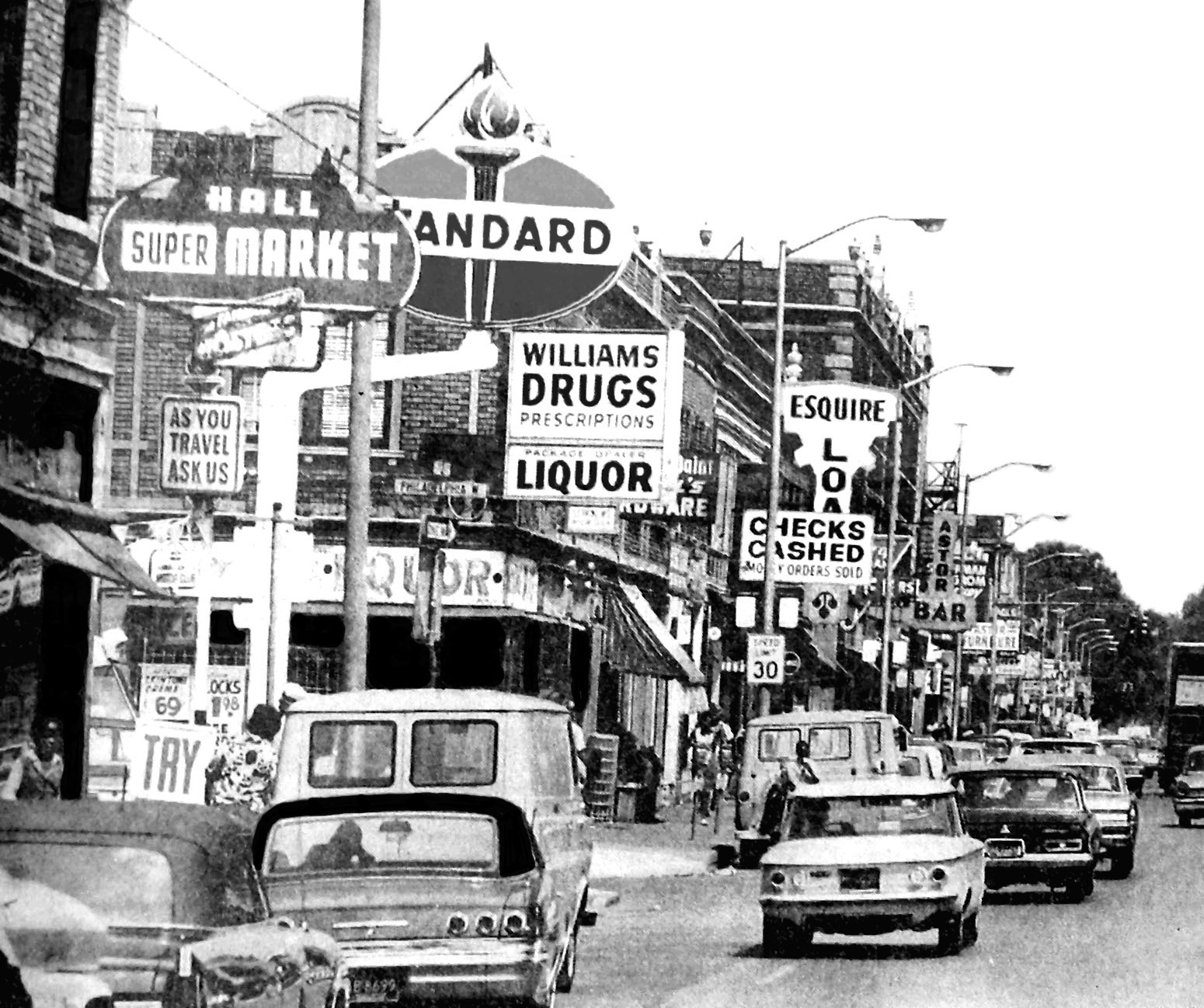
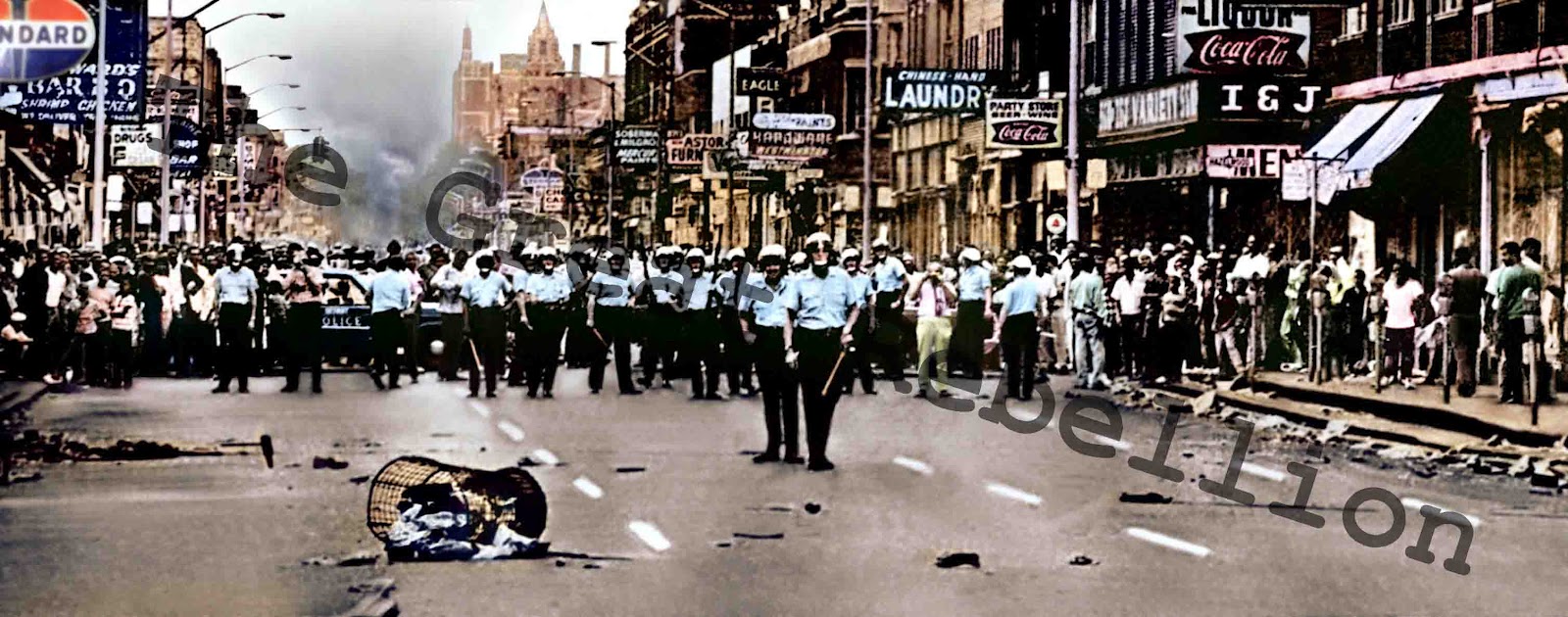
12th Street, Detroit. Michigan, one week before the 1967 Riot.
That’s Pops’ store way down the block on the left: Astor Furniture.

When people hear I am from Detroit, inevitably they ask about the Detroit Riot. “Which one?” I always reply. There was more than one, yet most people are only aware of the 1967 Black Day In July Riot. However, when you look at the history of Detroit, it’s apparent that rioting is in her DNA—both figuratively and literally—but I’ll get to that later. First I will tell you of my personal experiences during the ’67 Riot because that’s what people really want to know when they ask about the Detroit Riot. I want to get it out of the way quickly [or as quickly as my story-telling tangents allow] because there are much better riots to talk about. However, you will need some important context.

Astor Furniture, on Detroit’s 12th Street, was where my father had a new and used furniture store in 1967. The street is now known as Rosa Parks Boulevard and Pops’ store was at the corner of Blaine.  My house on the edge of Detroit, near 8 Mile, was less than 10 miles from Pops’ store on 12th Street. However, it might have been a million miles away, as different as the two places were. My neighbourhood had no Black people; where Pops had his store, there were no White people. Detroit has long been considered one of the most segregated cities in ‘Merka and this gulf between where we lived and where my father earned his living was the personification of that for me as I grew up. 

Gordon Lightfoot tells you all about it:

I used to go down to 12th Street with Pops on the weekends and, as I got older, would often go out on deliveries with the all-Black crew to deliver furniture all around the neighbourhood.  Over the years I got to see the inside of many houses and apartments along 12th Street.  One of the things that always struck me was how many living rooms had little shrines to both Jesus and President Kennedy.  However, that’s not why you’re here. It’s the riot you want to know about.

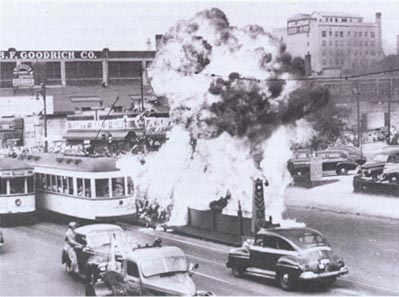
Astor Furniture after the worst of the 1967 Detroit Riot.
Police have made the streets safe for firefighting.

The Detroit Riot of 1967 began on the corner of 12th Street and Clairmont, exactly four blocks from Pops’ store. I was out of town. That’s my alibi and I’m sticking to it.

Every summer I went to camp in the wilds of Ortonville, Michigan.  At some point every year they’d pack us onto a bus and smuggle us into another country. We would head off to Stratford, Ontario, Canada to see a Shakespearean play written by Shakespeare. I guess so they could tell my parents, “We tried to civilize him” at the end of the camp session. After the play we would grab a late meal in Stratford like the young sophisticates we were pretending to be. It was the only place we could spend any of the money we took with us to camp. The Tuck Shop had crap for sale. Every year the counselors made us promise that no matter what we wouldn’t phone home, or otherwise embarrass them in the Sin City of Stratford, Ontario, while they ditched us.

In 1967, when the play ended, we spread out to various restaurants around town.  It was on a newsstand at the restaurant I saw the 1st DETROIT RIOTS headline. On the front of the newspaper was a picture of Pops’ store with the riot in progress right in front of it!!! I started running around Stratford looking for a counselor who could give me permission to phone home. Later we learned that the counselors already knew about the riot, but had withheld that information from us so as to not worry us. Word spread quickly among the campers and eventually there were lineups at all the payphones in Stratford.

There’s Astor Furniture again on the right as police make the streets safe for firefighting.
This picture is © Kenneth Stahl, of The Great Rebellion who has graciously allowed its use.

So, that’s my Detroit riot story; I missed it entirely.  I bet my father wishes he could say the same.  He lost every stick of furniture in the store, as well as his front windows. However, he was better off than other business owners who were burned out. After Marshall Law was lifted, and civilians were allowed back in the area, he was able to start all over again in the same location.  However, it was a total loss for him.  Insurance was so prohibitively expensive that he did without it. After the riot he was left to pick up the pieces by himself.

I never worked on 12th Street again.

This is the building on the corner of Clairmont and 12th Street,
where police raided a blind pig, triggering the 1967 Riot.

The 1967 Detroit Riot began over a single flash point, following many years of bad mojo between the all-White Detroit Police Department and the all-Black neighbourhoods they patrolled. The trigger was a raid on a “blind pig,” essentially an after-hours, illegal drinking establishment. Police decided they were going to arrest the people in the “blind pig.” That’s the official story and is correct as far as it goes.

Coincidentally, or maybe not, the blind pig was also a celebration for some returning Vietnam Vets. When police came to bust the joint it got loud. The veterans said, in essence, “Enough is enough. We just got back from Vietnam defending this country and we won’t be treated like 2nd class citizens any longer.” However, they didn’t start the riot. They were the straw that broke the camel’s back.

Due to the sheer numbers in the blind pig (reportedly 82) police were forced to call in several paddy wagons. As the arrests proceeded a crowd started to grow. It was a hot night and culturally this neighbourhood kept very different hours than the lily-White block where I lived, with everyone tucked safely into bed by 11 PM. It was always true that Black people were far more visible in their neighbourhood than Whites were in their own. Unemployment was one factor, culture was a bigger factor. During the ’50s and ’60s when White Home Life™ turned to suburbia, car culture, and backyard barbecues, Black Home Life™ was more street oriented; front porches, street corners, back alleys (which my neighbourhood didn’t even have) were all gathering places for friends and family, especially in the days before air conditioning was ubiquitous.

All this to explain why a large crowd gathered almost immediately while
police waited for the paddy wagons. However, that doesn’t explain the anger that
exploded into the ’67 Riot. Years of injustice does. The neighbourhood came to view the Detroit Police Department as an
Occupying Force and, despite the Civil Rights Act and promises of The Great Society,
Blacks were still getting the short end of the stick, and getting it in their own neighbourhoods. The amazing thing to me about the ’67 Detroit Riot was how instantaneous it was. It went from zero to Riot in under an hour and took five days to quell.

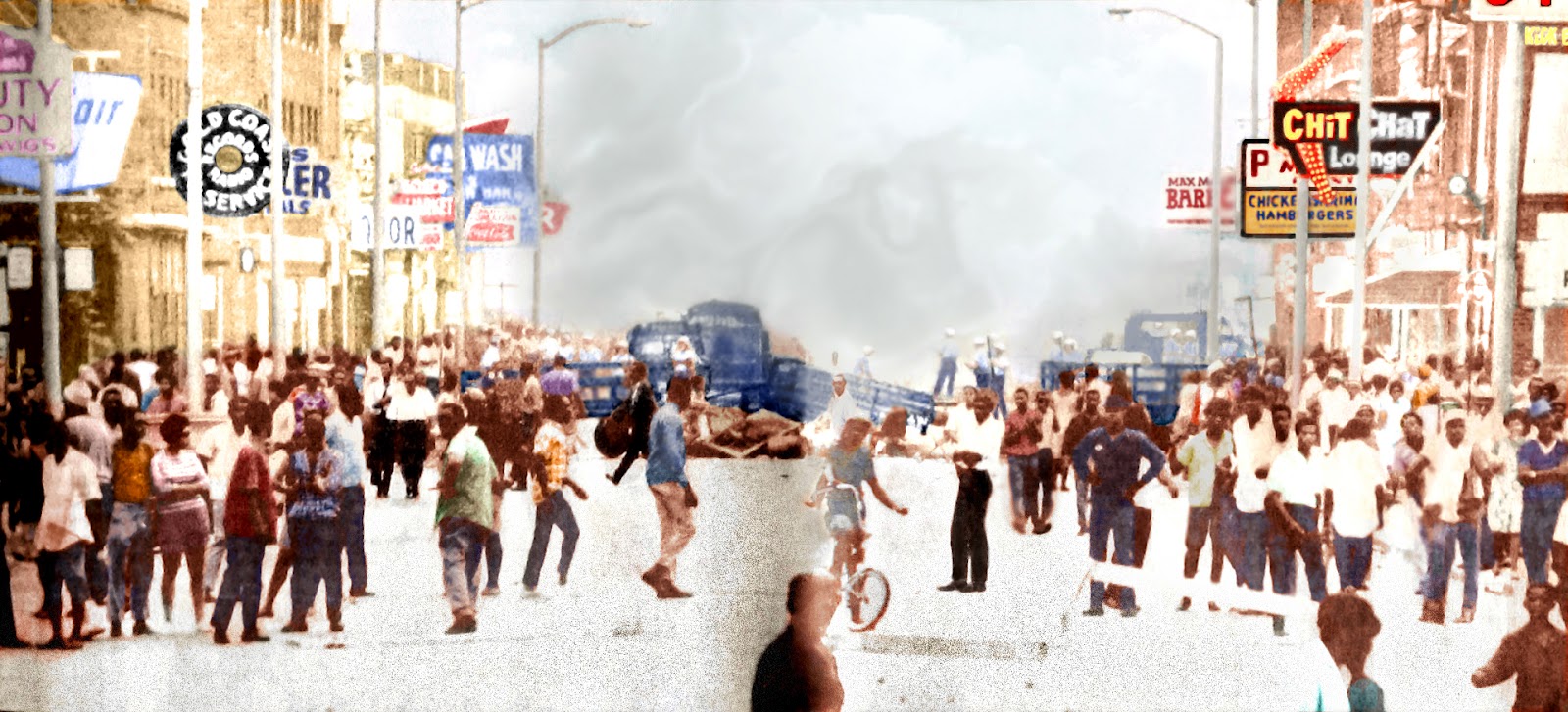
One of thousands of pictures of the ’67 Detroit Riot I have viewed. I have only found Pops’ store in two of them.

Just as fires cannot erupt in a vacuum, neither do riots. Among the
several factors underlying the 1967 Detroit Riot three loomed
large: White Flight, Police Brutality and a severe housing shortage. The housing
shortage stemmed, in part, from a growing economy. The Big Three were
hiring in those days. According to a web site at Rutgers:

Like Newark, Detroit was swept by a wave of white flight. During the
1950s the white population of Detroit declined by 23%. Correspondingly,
the percentage of non-whites rose from 16.1% to 29.1%. In sheer numbers
the black population of Detroit increased from 303,000 to 487,000 during
that decade. (Fine 1989:4) By 1967, the black population of Detroit
stood at an estimated 40% of the total population. (National Advisory
Committee on Civil Disorders 1968:89-90). As in Newark, some
neighborhoods were more affected by white flight than others. This was
particularly true for the Twelfth Street neighborhood, where rioting
broke out in the summer of 1967. “Whereas virtually no blacks lived
there in 1940 (the area was 98.7% white), the area was over one-third
(37.2%) non-white in 1950. By 1960, the proportion of blacks to whites
had nearly reversed: only 3.8 percent of the areas residents were white.
Given that the first blacks did not move to the area until 1947 and
1948, the area underwent a complete racial transition in little more
than a decade.” Sugrue 1996:244)

This rapid turnover in population in the neighborhood brought with it
the attendant ills of social disorganization, crime and further
discrimination. It’s impact in the 12th street area was devastating.
According to Sidney Fine, “The transition from white to black on
Detroit’s near northwest side occurred at a remarkably rapid rate…In a
familiar pattern of neighborhood succession, as blacks moved in after
World War II, the Jews moved out. The first black migrants to the area
were middle class persons seeking to escape the confines of Paradise
Valley. They enjoyed about “five good years” in their new homes until
underworld and seedier elements from Hastings Street and Paradise
Valley, the poor and indigent from the inner city, and winos and
derelicts from skid row flowed into the area. Some of the commercial
establishments on Twelfth Street gave way to pool halls, liquor stores,
sleazy bars, pawn shops, and second hand businesses. Already suffering
from a housing shortage and lack of open space, Twelfth Street became
more “densely packed” as apartments were subdivided and six to eight
families began to live where two had resided before. The 21,376 persons
per square mile in the area in 1960 were almost double the city’s
average” (Fine 1989:4) This neighborhood would serve as the epicenter of
the 1967 riot. 

When it’s all gone just the marker remains.
Is this the ultimate fate of the E.W.F. Stirrup House?

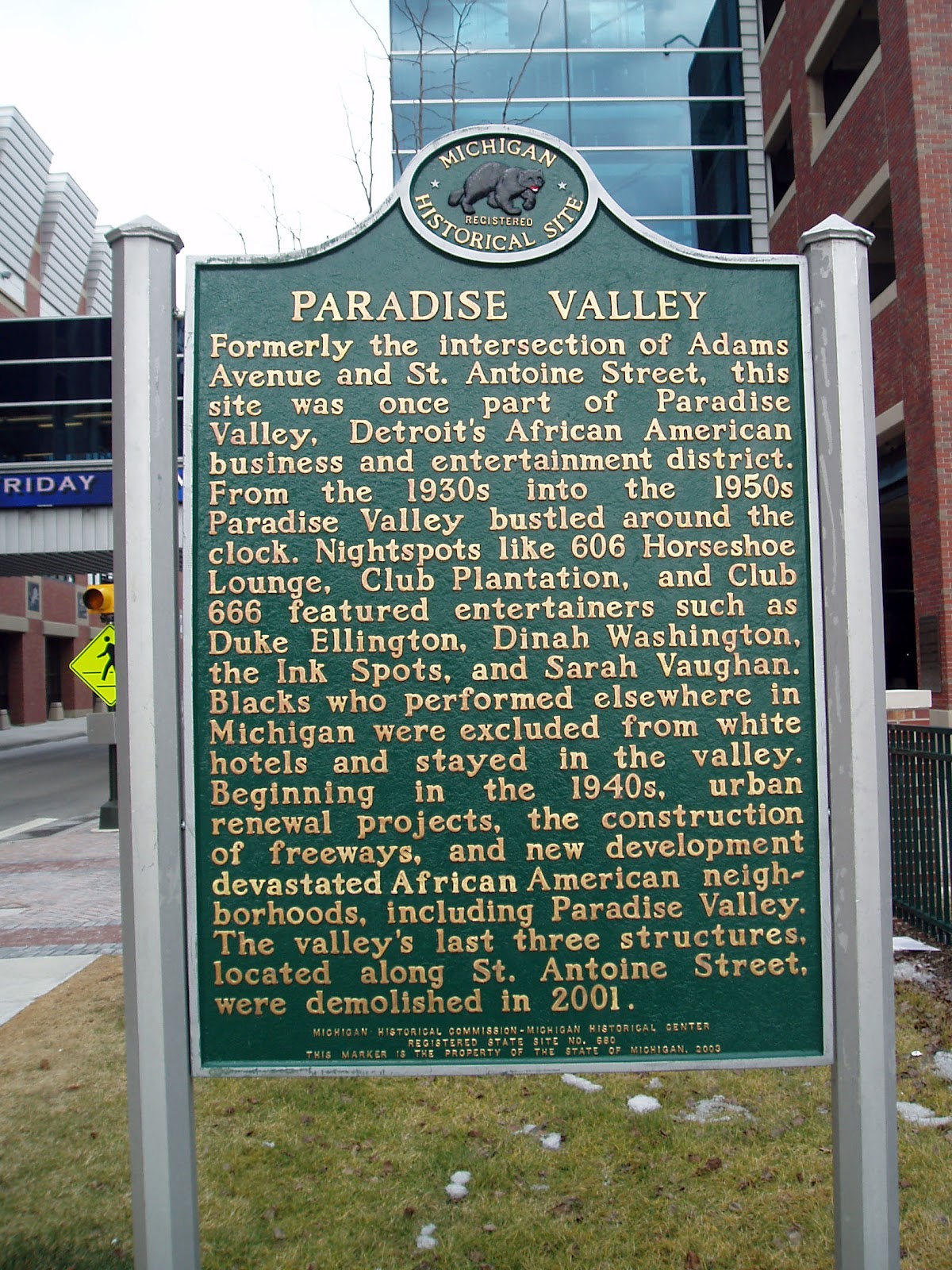
It didn’t help that, under the guise of Urban Renewal, it was decided to ram I-75 through the city. Paradise Valley and Black Bottom, the traditional Black areas of Detroit, were razed and paved over. While it’s true these were some of the worst slums in Detroit, it was also home to the thriving Black Culture of the city, with many self-sustaining businesses along with Jazz and Blues clubs up and down Hastings. When these neighbourhoods were torn down, the people had to go somewhere. Because of redlining, Blacks couldn’t move much farther than 12th Street. Had 12th Street not undergone such a dramatic demographic shift in such a short period of time, who knows how Detroit might have developed. However, that’s all water under the Ambassador Bridge now.

Rutgers also outlined the issue of Police Brutality, another factor leading up to the riot:

In Detroit, during the 1960s the “Big Four” or “Tac Squad” roamed the streets, searching for bars to raid and prostitutes to arrest. These elite 4 man units frequently stopped youths who were driving or walking through the 12th street neighborhood. They verbally degraded these youths, calling them “boy” and “nigger*”, asking them who they were and where they were going. (Fine 1989:98). Most of the time, black residents were asked to produce identification, and having suffered their requisite share of humiliation, were allowed to proceed on their way. But if one could not produce “proper” identification, this could lead to arrest or worse. In a few notable cases, police stops led to the injury or death of those who were detained. Such excessive use of force was manifested in the 1962 police shooting of a black prostitute named Shirley Scott who, like Lester Long of Newark, was shot in the back while fleeing from the back of a patrol car. Other high profile cases of police brutality in Detroit included the severe beating of another prostitute, Barbara Jackson, in 1964, and the beating of Howard King, a black teenager, for “allegedly disturbing the peace”. (Fine 1989:117) But the main issue in the minds of Detroit’s black residents was police harassment and police brutality, which they identified in a Detroit Free Press Survey as the number one problem they faced in the period leading up to the riot. (Detroit Free Press 1968, Fine 1989, Thomas 1967). According to a Detroit Free Press Survey, residents reported police brutality as the number as the number one problem they faced in the period leading up to the riot. (Detroit Free Press 1968, Fine 1989, Thomas 1967).

[…]

Despite the election of a liberal Democratic mayor who appointed African Americans to prominent positions in his administration, and despite Mayor Jerome Cavanaugh’s good working relationship with mainstream civil rights groups, a significant segment of the black community in Detroit felt disenfranchised, frustrated by what they perceived to be the relatively slow pace of racial change and persistent racial inequality. Local militant leaders like the Reverend Albert Cleague spoke of self-determination and separatism for black people, arguing that whites were incapable and or unwilling to share power. The civil rights movement was deemed a failure by these young leaders in the black community. At a black power rally in Detroit in early July 1967, H. Rap Brown foreshadowed the course of future events, stating that if “Motown” didn’t come around, “we are going to burn you down”.

Detroit was ripe for riot by 1967, especially following the mini-Kercheval riot of the previous year.

The WikiWackyWoo sums up:

Over the period of five days, forty-three people died, of whom 33 were black and ten white. The other damages were calculated as follows:

  • 467 injured: 182 civilians, 167 Detroit police officers, 83 Detroit firefighters, 17 National Guard troops, 16 State Police officers, 3 U.S. Army soldiers.
  • 7,231 arrested: 6,528 adults, 703 juveniles; the youngest, 4, the oldest, 82. Half of those arrested had no criminal record.
  • 2,509 stores looted or burned, 388 families rendered homeless or displaced and 412 buildings burned or damaged enough to be demolished. Dollar losses from arson and looting ranged from $40 million to $80 million.[19]

That, ladies and gentleman, is your Detroit Riot of 1967. After John Lee Hooker reports to us via The Blues, we can get to the good stuff.

* I refuse to soften the ugliest word in the English language by using that awful construct “The N Word.” Don’t like it? Me neither.

Part Two – The 1943 Detroit Riot

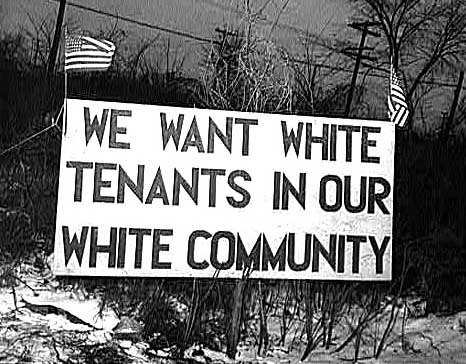
When I start telling people about the 1943 Detroit Riot, they blink. Huh? What? Yet, the ’43 riot seems almost as predictable as the ’67 Riot. Just as fires cannot erupt in a vacuum, neither do riots. There were several pressures that led to the ’43 riot. Again jobs and housing were two of the main flashpoints, but systemic racism was at the bottom of it all.

Dr. Ossian Sweet, movin’ on up?
Not if the neighbours can help it.

One of the festering resentments in Detroit’s ugly housing legacy goes back to the ’20s, when Dr. Ossian Sweet found himself on trial for murder merely because he wanted to move to a better neighbourhood. Sweet purchased a house on Garland Avenue, on what would become my birthday, June 7, 1925. According to published reports, Sweet paid $6,000 over market-value to a White homeowner who knew how desperate Blacks were to find good housing. The trouble started when Sweet and his family tried to occupy the house in September. When a White mob formed for the second day in a row, it trapped Sweet, his wife Gladys, and nine other men recruited to help Sweet protect his Civil Rights. The mob threw rocks and shots were fired from an upstairs window; one of the mob was killed, another wounded. All 11 in the house were put on trial for murder, with Clarence Darrow defending. After a mistrial, there was an acquittal against Sweet and the prosecutors decided to dismiss all charges against the remaining defendants.

A sign near the Sojourner
Truth housing project.

Less than 20 years later Detroit housing would become another flashpoint, with Whites once again the instigators. When the Feds announced a housing projects for Detroit, on the edge of a traditional White neighbourhood, the local community assumed it was for their own kind. When  it was named the Sojourner Truth housing project, Whites protested. The government reversed its decision and decided this would be for Whites and it would find another location for a Black housing project, even tho’ it would retain the Truth name. Then Detroit Mayor Edward Jeffries, Jr. got involved and the Feds reversed their decision again: This housing would be for the Black people of Detroit who desperately needed housing. On moving day Whites protested, turning away the first families. It was months before people would eventually move in.

Less than a year later, according to the WikiWackyWoo:

In early June 1943, three weeks before the riot, Packard Motor Car Company promoted three blacks to work next to whites in the assembly lines. This promotion caused 25,000 whites to walk off the job, effectively slowing down the critical war production. It was clear that whites didn’t mind that blacks worked in the same plant but refused to work side-by-side with them. During the protest, a voice with a Southern accent shouted in the loudspeaker, “I’d rather see Hitler and Hirohito win than work next to a Nigger”*.[7]

The kindling was already there. Tempers were obviously at a boiling point and the muggy heat of a late June evening didn’t help. According to PBS:

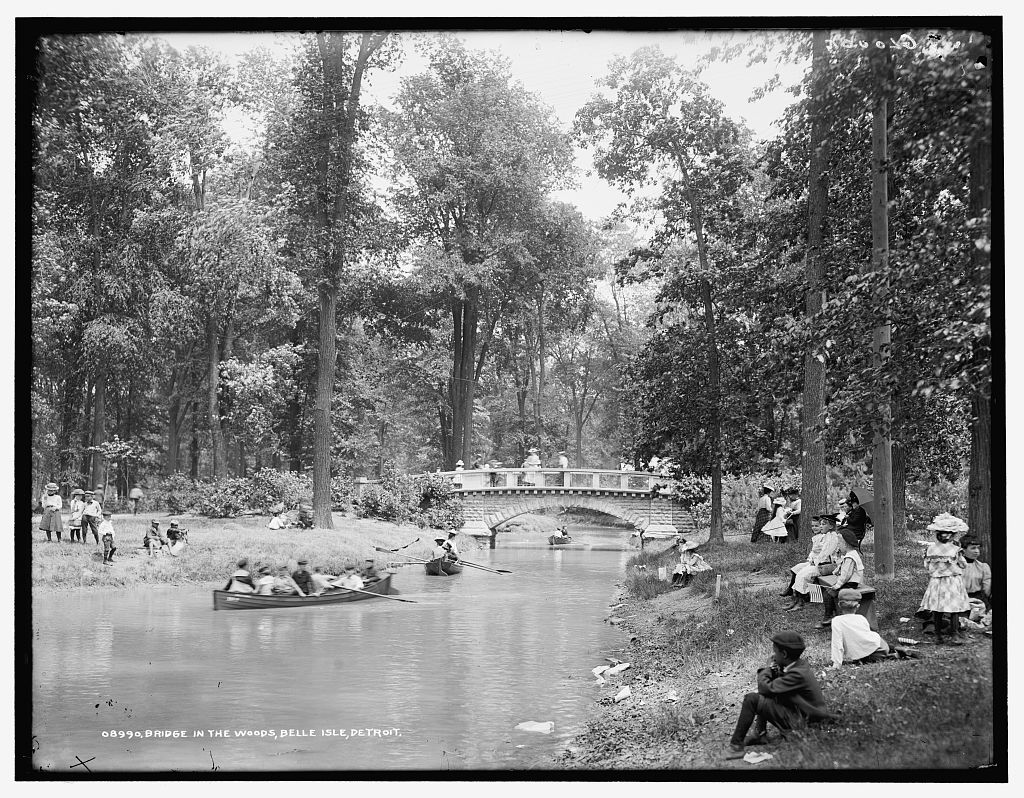
Belle Isle

Detroit riot began at a popular and integrated amusement park known as Belle Isle. On the muggy summer evening of June 20, 1943, the playground was ablaze with activity. Several incidents occurred that night including multiple fights between teenagers of both races. White teenagers were often aided by sailors who were stationed at the Naval Armory nearby. As people began leaving the island for home, major traffic jams and congestion at the ferry docks spurred more violence. On the bridge which led back to the mainland, a fight erupted between a total of 200 African Americans and white sailors. Soon, a crowd of 5,000 white residents gathered at the mainland entrance to the bridge ready to attack black vacationers wishing to cross. By midnight, a ragged and understaffed police force attempted to retain the situation, but the rioting had already spread too far into the city.

Man being dragged off a
Woodward Avenue streetcar
by an angry White mob.
Car burns on Woodward.

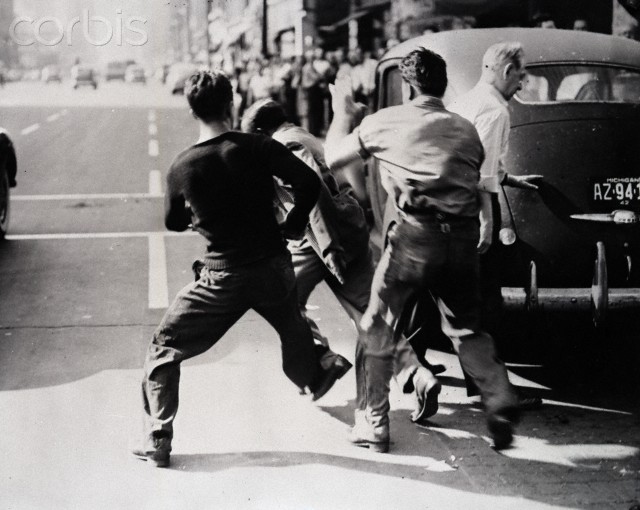
Two rumors circulated which exacerbated the conflict. At the Forest Club, a nightclub in Paradise Valley which catered to the black population, a man who identified himself as a police sergeant alerted the patrons that “whites” had thrown a black woman and her baby over the Belle Isle bridge. The enraged patrons fled the club to retaliate. They looted and destroyed white-owned stores and indiscriminately attacked anyone with white skin. Similarly, white mobs had been stirred up by a rumor that a black man had raped and murdered a white woman on the bridge. The white mob centered around the downtown Roxy Theater which harbored a number of black movie-goers. As the patrons exited the theater, they found themselves surrounded by gangs who attacked and beat them. As rumors about the incidents in Paradise Valley and the downtown area spread through the night, so did the nature and the extent of the violence. White mobs targeted streetcars transporting black laborers to work, forced the cars to come to a halt, and attacked the passengers inside. They also targeted any cars with black owners, turning them over and setting them on fire.

White mob overturns car in front of White Tower

By mid morning, black leaders in the community had asked Mayor Edward J. Jeffries to call in federal troops to quell the fighting. But it was not until late that evening, when white mobs invaded Paradise Valley, that Jeffries took the necessary steps to get outside help. Around midnight, a disturbing silence reigned over the city as a truce between the city’s warring factions was kept by U.S. Army troops. More than 6,000 federal troops had been strategically stationed throughout the city. Detroit, under armed occupation, virtually shut down. The streets were deserted, the schools had been closed, and Governor Harry Francis Kelly had closed all places of public amusement. Most of the Paradise Valley community feared to leave their homes. Yet spurts of violence still flared up. As late as Wednesday, white mobs threatened black students leaving their graduation ceremony at Northeastern High School. The graduates had to be escorted home by truckloads of soldiers bearing bayonets.

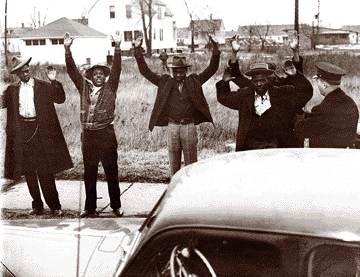
An arrest by police
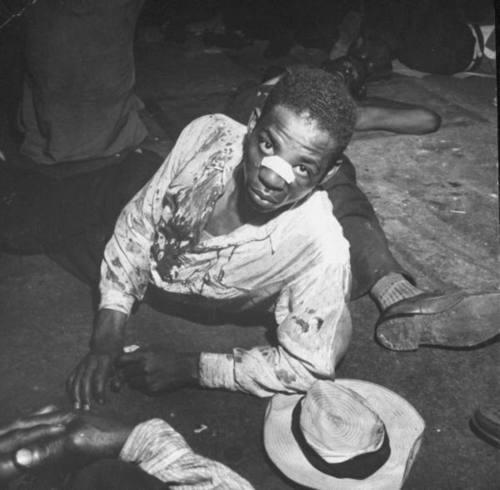
A victim

If you read between the lines, it seems pretty clear this is a White riot. While there may have been some skirmishes between isolated groups on Belle Isle, it wasn’t until the [White] Navy got involved that things spun out of control. They were reacting to the rumour that a Black man did something-something to a White something-something.  Does it really matter what details were? That’s the same excuse Whites always used when they went crazy and attacked Blacks. It was a “Get out of jail free” card for Whites for as long as anyone can remember. It was probably used as a knee-jerk excuse without any grounding in reality. The naval cadets attacked any Black leaving the small island over the only bridge and the riot escalated from there.

The chronology above is slightly off. The rumour that swept through the Black community came only AFTER the Whites were already rioting. It very well could have been true, based on what people were already seeing with their own eyes. Whites targeted any and all Blacks they could find, including innocent people who were just minding their own business. This was a White riot, with Black community defending itself and then retaliating. There’s no other way to view the events in retrospect.

Black Past gives another perspective:

As
the violence escalated, both blacks and whites engaged in violence. 
Blacks dragged whites out of cars and looted white-owned stores in
Paradise Valley while whites overturned and burned black-owned vehicles
and attacked African Americans on streetcars along Woodward Avenue and
other major streets.  The Detroit police did little in the rioting,
often siding with the white rioters in the violence.

The
violence ended only after President Franklin Roosevelt, at the request
of Detroit Mayor Edward Jeffries, Jr., ordered 6,000 federal troops into
the city.  Twenty-five blacks and nine whites were killed in the
violence.  Of the 25 African Americans who died, 17 were killed by the
police.  The police claimed that these shootings were justified since
the victims were engaged in looting stores on Hastings Street.  Of the
nine whites who died, none were killed by the police.  The city suffered
an estimated $2 million in property damages.

An eyewitness to history:

Again, the WikiWackyWoo sums up: 

  • 34 people were killed, 25 of whom were African Americans in which 17 of them were killed by the police. 
  • Out of the approximately 600 injured, black people accounted for more than 75 percent and of the roughly 1,800 people who were arrested over the course of the 3 day riots, black people accounted for 85 percent.

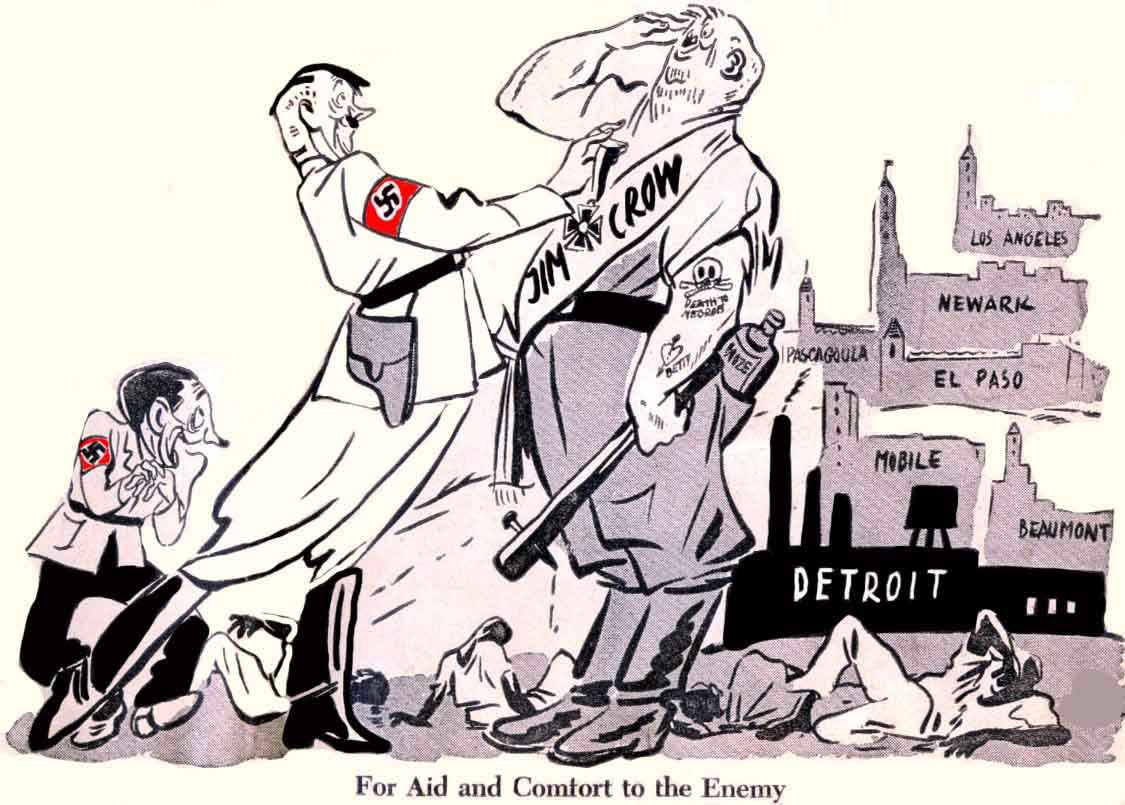
Remember: It was War Time. Cartoonists feared the Japanese and the Nazis would use this incident to their propaganda advantage, with Jim Crow discrimination to blame. The mayor blamed Black hoodlums; Wayne County prosecutors blamed the NAACP for instigating. However, Detroit’s Black community knew the truth and passed it along orally for the next 24 years until the next riot.

Ironically, the 1943 Riot was also one of the catalysts for the city’s later decision to tear down Black Bottom and Paradise Valley for its so-called Urban Renewal. This was one of the direct pressures on the 12th Street area described in the section on the 1967 Riot above.

* as above, I refuse to soften the ugliest word in the English language.

Part Three – The 1863 Detroit Riot

Just as fires cannot erupt in a vacuum, neither do riots. The 1863 Detroit Riot — dubbed at the time “the bloodiest day that ever dawned upon Detroit” — has to be seen in context. It was during the Civil War, when Detroit was not yet a great city. Motown was little more than a small town, huddled along the river, which was also the international border to Canada. This is why Detroit was a terminus for so many escaped slaves traveling north on the famed Underground Railroad. This had created certain tensions within the separate Black and White communities of Detroit. Escaped slaves could be arrested and returned by bounty hunters. Some Free Blacks were arrested and sent south. Some Whites were sympathetic to the cause of abolition and others were not. Race was a big factor in the 1863 riot, as was the military draft. Many Whites didn’t see this as their war and resented being forced to fight for a cause diametrically opposed to what they believed.

Was it all President Lincoln’s fault?

In September of the previous year, President Abraham Lincoln signed the Emancipation Proclamation, which went into effect on January 1st. The Proclamation had no practical effect on anyone –North or South. It merely freed the slaves in the southern states, already in rebellion. Those ten states had already refused to kowtow to Washington, having declared a Civil War in the first place, so it seemed unlikely they would do what Washington demanded. The Proclamation did not outlaw slavery, nor did it confer citizenship on ‘Merkin Blacks. It did, however, stir up intense feelings on the part of racist Whites. So did the Detroit Free Press, which published incendiary articles about Blacks in the months prior to the March riot. According to Matthew Kundinger in his thoroughly researched Racial Rhetoric: The Detroit Free Press and Its Part in the Detroit Race Riot of 1863 [PDF]:

Once the articles are examined, it becomes clear that the Detroit Free Press was a racist paper, and it printed racist stories in the months preceding the riot. The paper was pushing a racial ideology, one that taught that blacks were inferior and a threat. I will show this by pointing to four types of stories the paper printed in the months before the war: stories that connected blacks to labor problems, blacks to citizenship issues, blacks to the war, and blacks to crime and a general degradation of the moral order. Within all of these categories the paper portrayed blacks as a threat. The readers of the Free Press were mostly lower class white laborers, a class with little power. Even absent the racial rhetoric, issues of labor, of voting, of war, and of crime—especially sexual transgressions such as rape—are at their core about power. By showing how African-Americans were a threat to whites when it came to these issues, the paper was suggesting that the already limited power of the white working class was at risk. Further, each of these categories represent a function that was vital to a man’s main role in life, being the head of his household. In essence, the articles of the Free Press were portraying a threat to its male readers’ power to fulfill their primary functions. The paper was showing a threat to their masculinity.

Copy of “A Thrilling Narrative…”

Oh, shit! Can’t allow that to happen. Nothing is more fragile than the precious masculinity of the ‘Merkin White Male, especially if threatened by Blacks. In that respect, the situation was not a lot different than it is today.

However, the Free Press didn’t start the riot, no matter how incendiary were its articles. The riot started because somebody said a Black man did something-something to a White something-something. According to the contemporaneous document called A Thrilling Narrative From the Lips of the Sufferers of the Late Detroit Riot, March 6, 1863, with the Hair Breadth Escapes of Men, Women and Children, and Destruction of Colored Men’s Property, Not Less Than $15,000 [Electronic Edition], one of the few eye-witness accounts remaining:

The Detroit Riot in 1863.

On the 6th of March an organized mob made their way from the jail down Beaubien street. They were yelling like demons, and crying “kill all the d–d niggers.”* In the cooper shop, just below Lafayette street, were five men working, namely: ROBERT BENNETTE, JOSHUA BOYD, SOLOMON HOUSTON, LEWIS HOUSTON, MARCUS DALE. These men were busy at work in the shop until the mob made an attack upon the shop. The windows were soon broken and the doors forced open. The men in the cooper shop were determined to resist any that might attempt to come in. The mob discovered this, and did not attempt to come in, but stood off and threw stones and bricks into the windows, a perfect shower. There happened to be one old shot gun in the shop, a couple of discharges from which drove the mob back from the shop. The dwelling house was attached to the shop, in which were three women and four children, namely: Mrs. REYNOLDS, Mrs. BONN and one child, Mrs. DALE and three children.

Some ten minutes after the mob had fallen back from the shop, they made a rush upon the house in which were the women and children. The men in the shop seeing this, rushed out of the shop into the house to protect the women and children. The windows of the houses were soon all broken in; stones and bricks came into the house like hail. The women and children were dodging from one room to another to escape the stones. The men frequently stood before the women and children to shield them from the stones. Very soon after the men went from the shop into the house, the shop was set on fire by the mob. There were plenty of shavings in the shop, which facilitated the burning. The flames soon reached the house in which were the women and children. The mob by this time had completely surrounded the building. Mrs. Reynold attempted to go out at the back door but could not get out, for hundreds of stones were flying at that part of the building. Mr. Dale, in shielding his wife, got a blow in the face with a stone, which his wife might have gotten had he not stood before her. Some person outside was heard to say “the women will be protected–no protection for the men.” Hearing this, Mr. Dale told the women to go out at the front door. Mrs. Dale seeing the blood running.

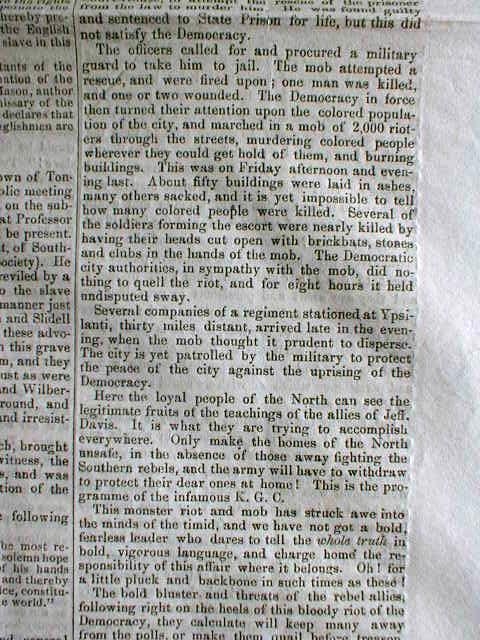
Anti-slavery newspaper of the time.

And it goes on for pages and pages of hard-to-read, heart-rending descriptions of Whites attacking any and all Blacks who are unable to flee. This includes women and children alike, and didn’t spare the 80-year old pastor of the local A.M.E. Church. Essentially this riot, just like the 1943 Detroit Riot — or the Tulsa riot I wrote about earlier — was a White Riot. Whites went crazy and Blacks paid for it. A full reading of the two documents quoted above gives a much fuller story than can be given here, but you should take the time.

However, what was the legacy of the 1863 Detroit Riot? Wikipedia foolishly tried to sum it up with one prosaic sentence:

Detail from anti-slavery newspaper.

The riot resulted in the creation of a full-time police force for Detroit.

As I said above, Detroit was still not much more than a town and, in 1863, did not have police force. The riot itself had to be quelled by soldiers from Fort Wayne and some of the Michigan’s 27th Infantry out of Ypsilanti. However, 35 burned buildings, 2 people dead and a “multitude of others, mostly African-American, mercilessly beaten” has a way of focusing the citizens on Law and Order. As a result of the 1863 Riot a full time police force was constituted. Written into the originating documents incorporating Detroit’s 1st police force were the fateful words that guided Detroit ever since. Detroit’s first officers were tasked with keeping the Blacks in line, because the 1863 came to be blamed on them. Some things never change.

Is it any wonder why I say riots are in Detroit’s DNA, from 1863 to 1943 to 1967?

* as above, again, I refuse to soften the ugliest word in the English language.

Unpacking Coconut Grove ► Part 2.1 ► Today in The Grove

I love Google alerts. While not everything below belongs to Miami’s Coconut Grove, most of it does. And, what’s there has all the appearance of bling in the Florida sun: ritzy hotels, bed races, show biz, outdoor cafes, wine tasting, high fashion, and high end real estate. Imagine how much money is exchanging hands today in The Grove, just in food and drink service.

To hell with Coconut Grove’s history when there’s money to be made.

News 8 new results for Coconut Grove
Newton assault victim on suicide watch
Herald Sun
Miami
trial lawyer Michael Seth Cohen has filed a complaint on behalf of
Ariel Vargas, 42, who was working the graveyard shift in the Coconut Grove Courtyard Marriott on April 17 when Newton launched an attack that was captured on CCTV. Mr Cohen said
See all stories on this topic »
Magic and more: Singers, comedians, performers to showcase talent in variety
Cherokee Tribune

and more: Singers comedians performers to showcase talent in variety
show – CANTON — The Canton Theatre hopes to bring some laughs to
downtown Canton with two nights of a variety show. The Coconut Grove Players which consists of six perform…
See all stories on this topic »
Man ordered to stand trial for murder of parents
ABC Online
Thomas Bradley, 40, is charged murdering his parents, Bill and Hilary Bradley, in their Coconut Grove
townhouse in March. An autopsy showed both were killed by stabbing.
Bradley was today committed to stand trial in the Northern Territory
Supreme Court.
See all stories on this topic »
Matthew Newton ‘sued over hotel assault’
Yahoo!7 News
Ariel Vargas was doing the graveyard shift just before 5am on April 17 at the Courtyard Marriott Hotel in Miami’s Coconut Grove. Video surveillance at the hotel appears to show Newton punch the 42-year-old in the face. The 35-year-old Underbelly star
See all stories on this topic »

Yahoo!7 News
New Providence Police investigate alleged drowning – Mobile division make
thebahamasweekly.com
A 17 year old male of 2nd Street, Coconut Grove
is in police custody after being found in possession of a handgun and
ammunition. According to police reports around 11:23 pm on Monday 9th
July, 2012 police received information of gunshots being heard
See all stories on this topic »

thebahamasweekly.com
On the Road Again
New York Times
One long-haired owner hops on his ride, fires her up and smoothly navigates her into a well-to-do avenue of Coconut Grove.
The loud, wet growl of her pipes instantly stops all talk in the
open-air cafes and along the crowded sidewalks down which women
See all stories on this topic »
Filming in Miami
Miami Today
Newspaper;
Filming; Fashion Photography; Photography; Commercials; Videos; Miami,
Florida; Miami Today; MiamiTodayNews; Miami-Today; South Florida; Coral
Gables; Coconut Grove; Aventura; Miami Beach; Ocean Drive; Lincoln Road; South Beach;
See all stories on this topic »
Miami-Dade way ahead of state in spending rebound
MiamiHerald.com
“On
average, we’re still about 10 or 15 percent behind that pace” hit in
2007 and 2008, said Robert Finvarb, owner of several Marriott hotels in
Miami-Dade, including a 196-room Courtyard by Marriott along the Coconut Grove waterfront. “We’re getting
See all stories on this topic »

Blogs 3 new results for Coconut Grove
Coconut Grove Grapevine: Great Grove Bed Race registration is
By Grapevine
Good, cause the sign-up form is now open for the 2012 Great Grove Bed Race, which will take over the streets of Coconut Grove on Sunday, September 2. This is one of the Grove’s big signature event, thousands of people crowd the village to
Coconut Grove Grapevine
New Wine tasting series at the Ritz Carlton 7/12/12 « Soul Of Miami
By soulofmiami
Guests’
palates will be greeted with complimentary hors d’oeuvres, while
sipping on carefully selected winesthemed by varietal type, region or
country of origin, for an educational wine tasting at The Ritz-Carlton-Coconut Grove in Miami’s
Soul Of Miami
Destination Miami | Fashion News, The latest trends, Catwalk – Motilo
By CressidaMeale
Districts such as Coral Gables, Little Havana and Coconut Grove
offer the kind of sultry indulgences their names suggest, but it is
South Beach (SoBe) that’s the heart of the party scene in a city that
takes its hedonism, ostentation and
Fashion News, The latest trends,…

Web 6 new results for Coconut Grove
3400 27 Avenue UNIT 401, Coconut Grove, FL 33133. MLS
3400 27 Avenue UNIT 401, Coconut Grove, FL 33133. RITZ CARLTON. MLS# A1663109.
www.yellowkeyrealty.com/…/3400-27-avenue-unit-401-coco…
Sonesta New Orleans, Boston, Miami, St. Maarten, Brazil, Peru, Egypt
Cruises and Beach Resorts. Discover the distinctive Sonesta resorts and hotels in New Orleans, Maho Beach, Boston / Cambridge, Coconut Grove, and more.
www.sonesta.com/Orlando/index.cfm?fa=c.HPRedirect…
Miami planning board to consider proposed school on July 18
IF YOU GO What: Miami Planning, Zoning and Appeals Board Where: Miami City Hall, 3500 Pan American Drive, Coconut Grove When: 6:30 p.m. on July 18
www.miamiherald.com/…/miami-planning-board-to-consider….
Coconut Grove-$900 Mostly Furnished with Parking & Utilities
This is a great housing opportunity for a responsible male or female in the center of Coconut Grove! $900 per month includes room (180 sq ft), garage parking,
miami.craigslist.org/mdc/roo/3129302623.html
ESL Jobs in Coconut Grove Florida | ESLemployment
Job search for ESL jobs in Coconut Grove Florida at ESLemployment.com.
www.eslemployment.com/…/esl-jobs-Coconut-Grove-Florida….
Buyer Representation For Coconut Grove Commercial Retail
3340 GRAND AV – Coconut Grove, FL 33133. Beds: 0 Baths: 0; Type: Commercial/Industrial; MLS ID: D1369668; Sq Ft: 4500. on grand ave one block from the
www.agreservices.com/…/coconut-grove-retail-properties-for-…

Unpacking Coconut Grove ► Part Two ► E.W.F. Stirrup House

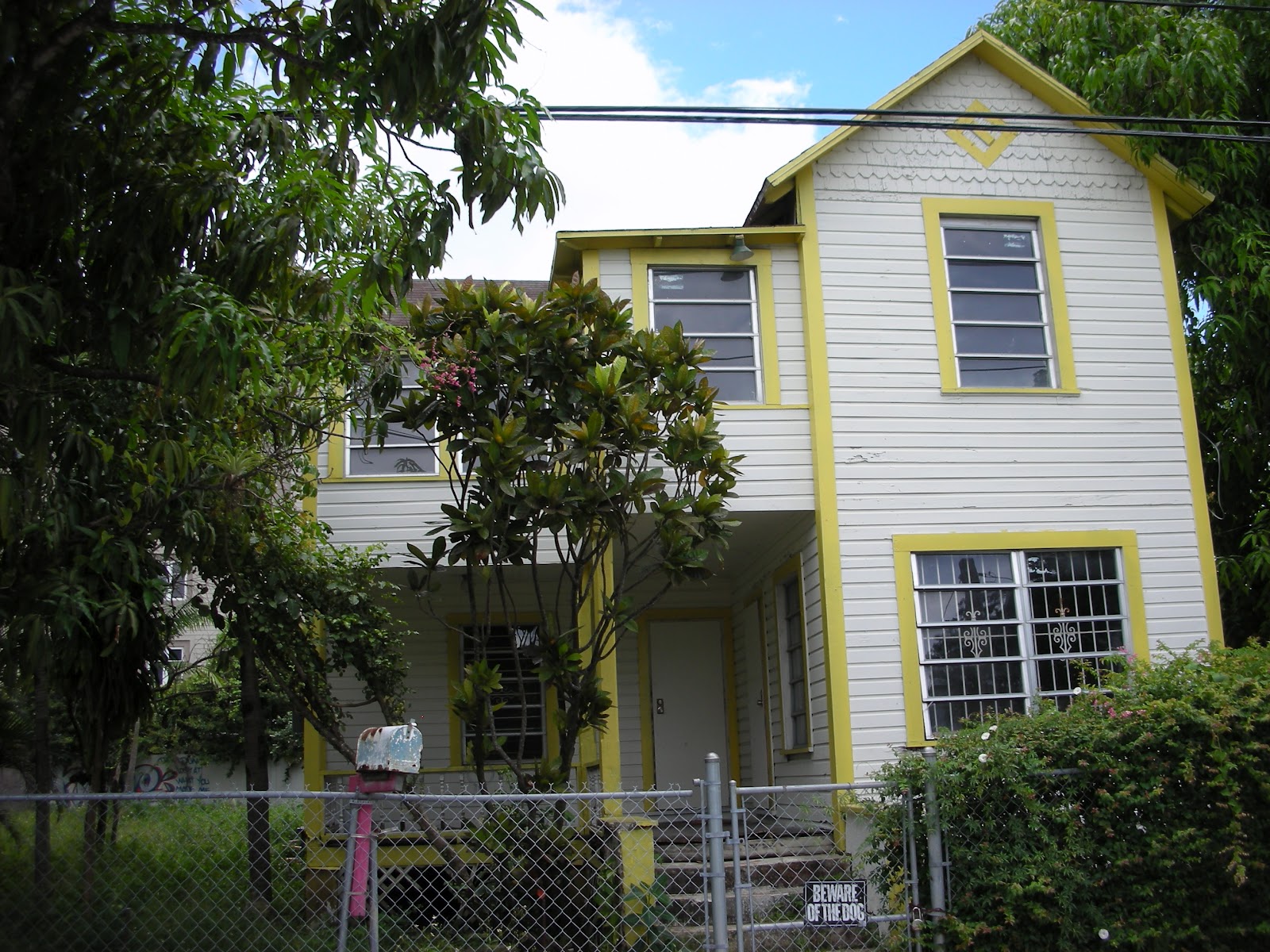
Standing proud. The beautiful E.W.F. Stirrup House.

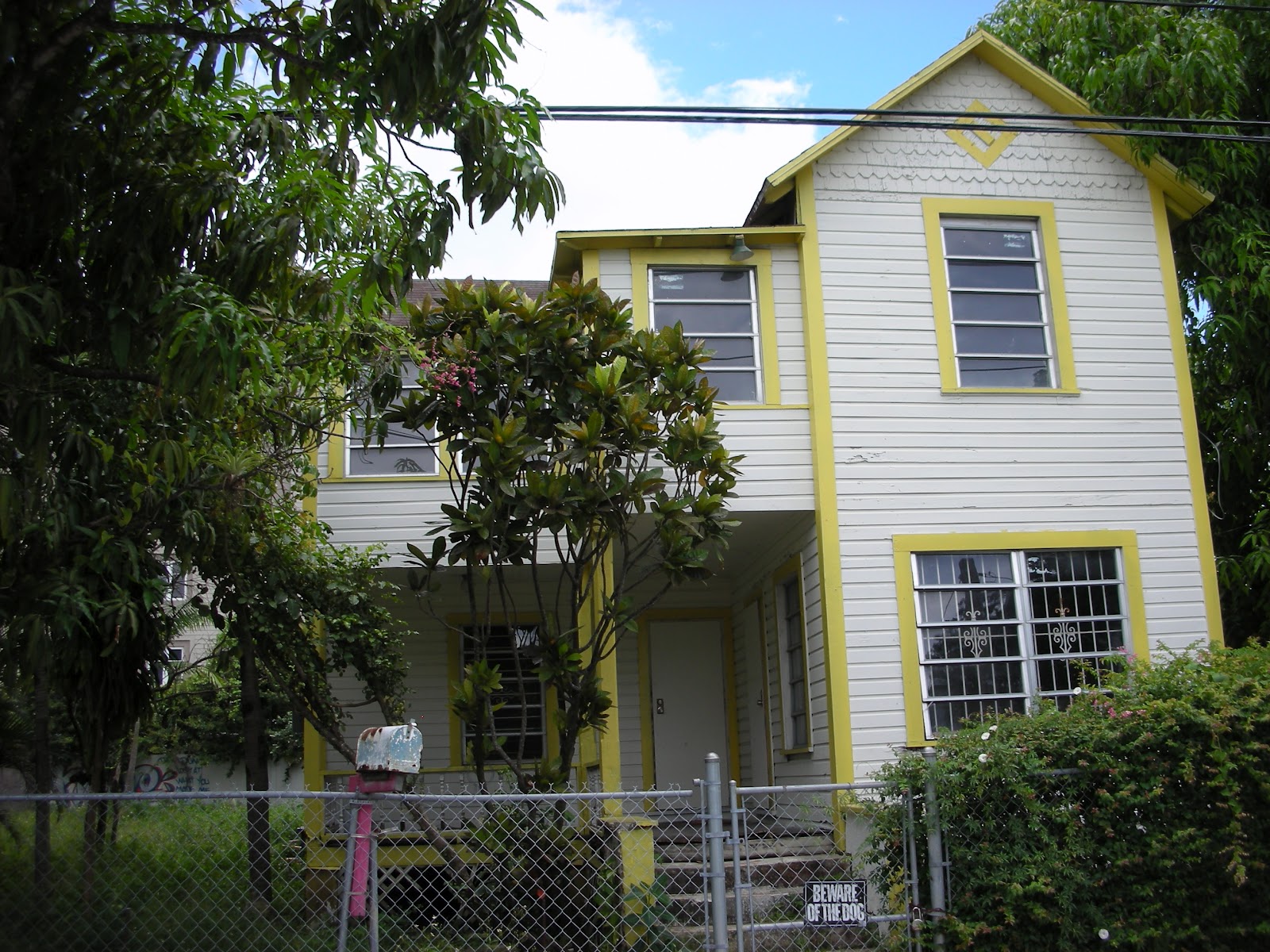
The E.W.F. Stirrup House (left) at 3242 Charles Avenue, Miami, FL, 33133, is reportedly one of the last wood frame homes in Miami-Dade County. It is almost certainly one of the oldest houses, built in the late 19th century, as Caribbean Blacks started arriving in lower Florida to work at the Peacock Inn. The house sticks out on Charles Avenue, but also in Florida. Homes don’t look like this anywhere else. According to a report looking in to designating the E.W.F. Stirrup House a Miami historical site:

The key elements that reflect its nineteenth century origins are its extremely narrow proportions, the size and shape of the fenestration, and its L-shaped plan. This design is based on a builder’s tradition, and was especially popular throughout America in the last half of the nineteenth century.
There is more than one way to describe this property type. In their book A Field Guide to American Houses, Virginia and Lee McAlester describe it as a “front gable folk house.” In a more detailed article, Barbara Wyatt of the State Historical Society of Wisconsin described it as a “Gabled Ell.” Wyatt explains that this type was especially common in late–nineteenth century America, and was almost exclusively a residential type. The Gabled Ell takes the form of two gabled wings that are perpendicular to one another, and that are frequently of different heights.

The longitudinal face parallel to the street almost always had the lower height. The result was typically an L-shaped plan. Ms. Wyatt explains that the form allowed for outdoor living space (the porch) and a sheltered entrance. Entry is always via the porch at the “ell,” or junction of the two wings.

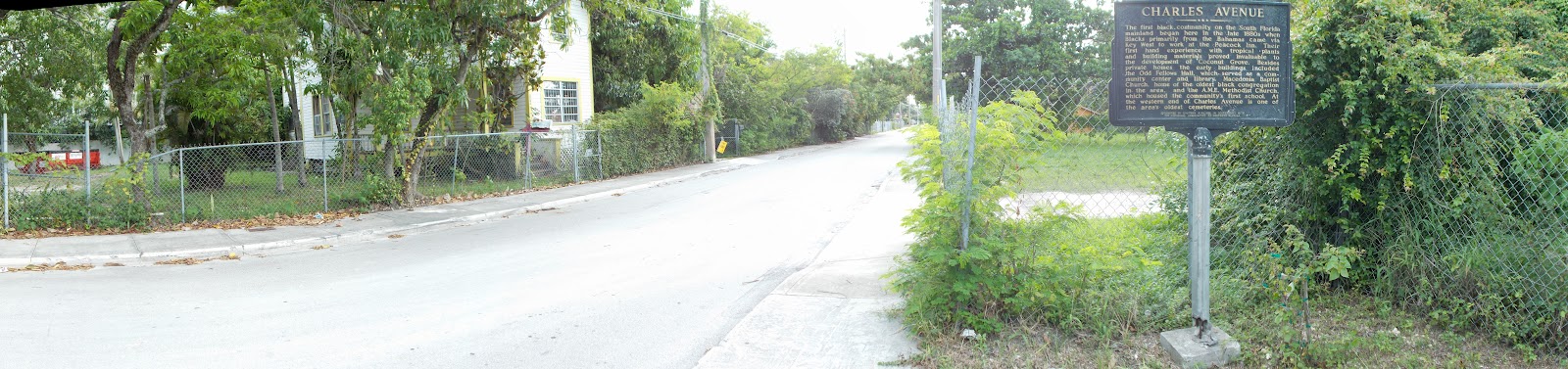
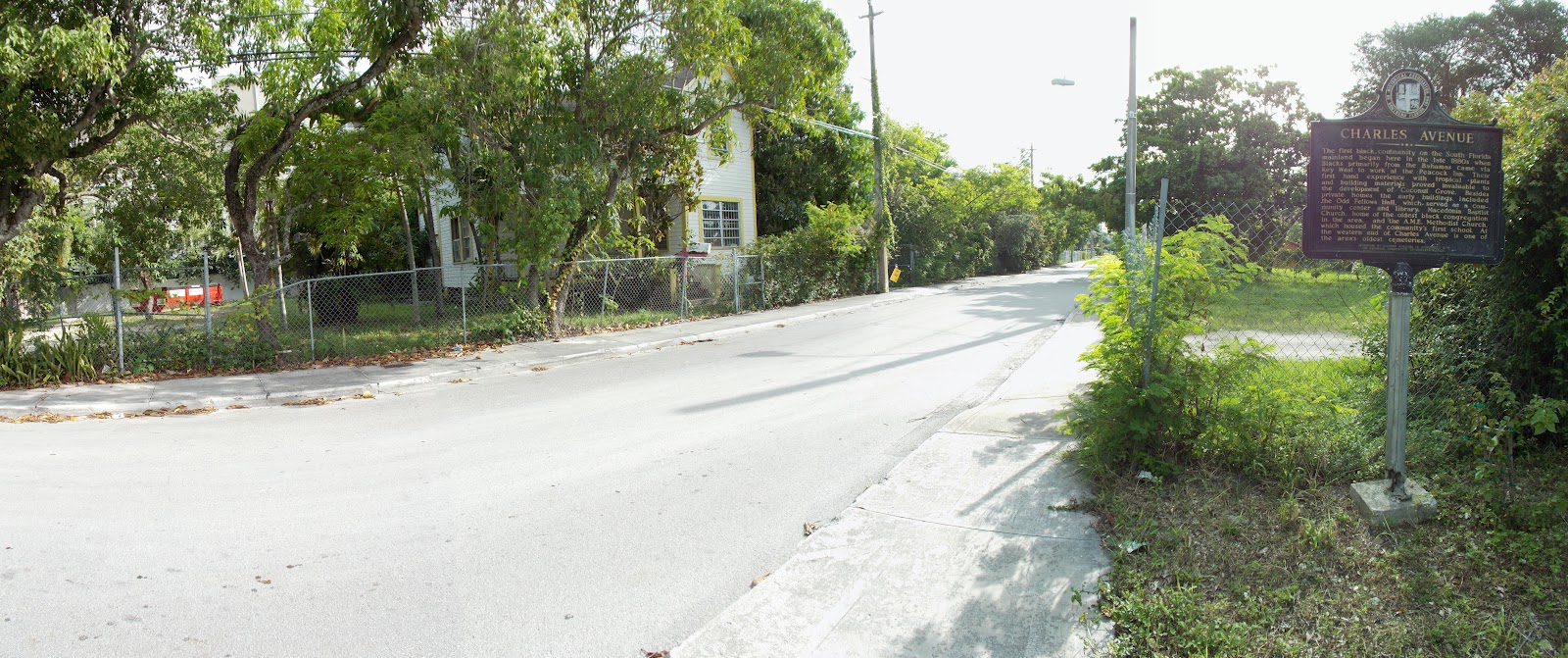
My latest panorama of the E.W.F. Stirrup House and the historical marker that started my journey.

The Stirrup House mailbox in 2010

While the E.W.F. Stirrup House certainly deserves to be preserved for its age and architecture, it also needs to be preserved as a standing monument to Ebenezer Woodbury Franklin Stirrup, one of the people who built Coconut Grove with his bare hands.

E.W.F. Stirrup arrived in Coconut Grove in 1899 at the age of 25. Like a lot of Bahamians, he first migrated to Key West. There he apprenticed with an uncle as a carpenter, a trade he would utilize later. After 10 years, and unhappy with the financial arrangement with his uncle, Stirrup first moved to Cutler, Florida, working in pineapple fields and clearing lots for houses. Occasionally, instead of cash, Stirrup was paid in land, which began his real estate holdings that at one time included most of downtown Coconut Grove. That’s what made him one of Florida’s first Black millionaires. However, that’s not what made him extraordinary, especially for his times.

As his landholdings increased Stirrup began building houses which he rented and sold to other Bahamians who had emigrated up through Key West to take the jobs offered by Coconut Grove’s growing tourist industry. According to Kate Stirrup Dean, Stirrup’s oldest daughter:

Father believed in every family having a house, a yard and a garden, so you would feel like you had a home. He felt that people became better citizens when they owned their own homes.

The Mariah Brown House with its marker and No Trespassing sign.

Stirrup apparently built more than 100 houses, often at night after a full day’s work. Because of this Coconut Grove had a greater percent of Black home
ownership than any other ‘Merkin city I have studied. Most other cities
had a higher percentage of rental properties and absentee landlords as a result
of the neighbourhoods once belonging to other ethnic types who moved up
and out, a natural progression. Coconut Grove was an area settled almost entirely by Blacks when there was nothing but swamp and wilderness surrounding it. They didn’t inherit the neighbourhood, they built it and owned it themselves.

Stirrup was obviously a proud man because his house, which once dominated a large lot at the east end of Charles Avenue overlooking his estate, is a showpiece. It looks nothing like the simple Bahamian style homes he built for his neighbours. One of the last surviving examples of the Bahamian style is The Mariah Brown House, which pre-dates Stirrup’s arrival by nine years. It is thought to be the first house owned by a Black person in the area. A report was also prepared to designate the Brown House a Miami historical property. The report declares the Brown House:

[O]ne of the most important remaining sites from this early black Bahamian settlement in Coconut Grove. The house is also a good example of the type of architecture of the nineteenth century frame vernacular architecture that was inspired by the houses of the Bahamas and Key West.
The importance of the contributions made by African Bahamians to the develoment [sic] of Coconut Grove and the City of Miami has long been overlooked. Although recent studies show that by 1920 West Indian blacks made up over 16 percent of Miami’s population, information about their community and lifestyle has been basically undocumented.

Undocumented? Overlooked? Yes!!! Researching the Bahamian phase of Coconut Grove has been a monumental task. I have it through 2nd and 3rd hand information that in the ’20s, or ’30s, or ’40s, and well into the ’60s according to some, Coconut Grove was an artists’ community. It attracted a certain type of Bohemian Beatnik hipster, the archetype of which had little problem mixing with Blacks, listening to Jazz, and smoking reefer. That’s where my novel is going.

However that’s not where my research keeps taking me. My research keeps taking me to the E.W.F. Stirrup House, the Mariah Brown House, and the Coconut Grove Playhouse [another boondoggle I have yet to write about, but which I believe is just one more piece in the giant corruption jigsaw puzzle I find myself investigating] . Yet, the more I find out, the less I know. A little over a year ago the local NBC affiliate and CBS affiliate both filed reports which filled in some more of the blanks of the Stirrup House:


What has happened since then? Aside from someone straightening the historical marker? Nothing. I have now been documenting Charles Avenue in photos and essays for three years. In that time there has been no change to the Mariah Brown House or the E.W.F Stirrup House. Aside from more weather damage they stand in the EXACT same state of disrepair as they were the day I discovered them. My research confirms that each of them were vacant for years before I stumbled across them.

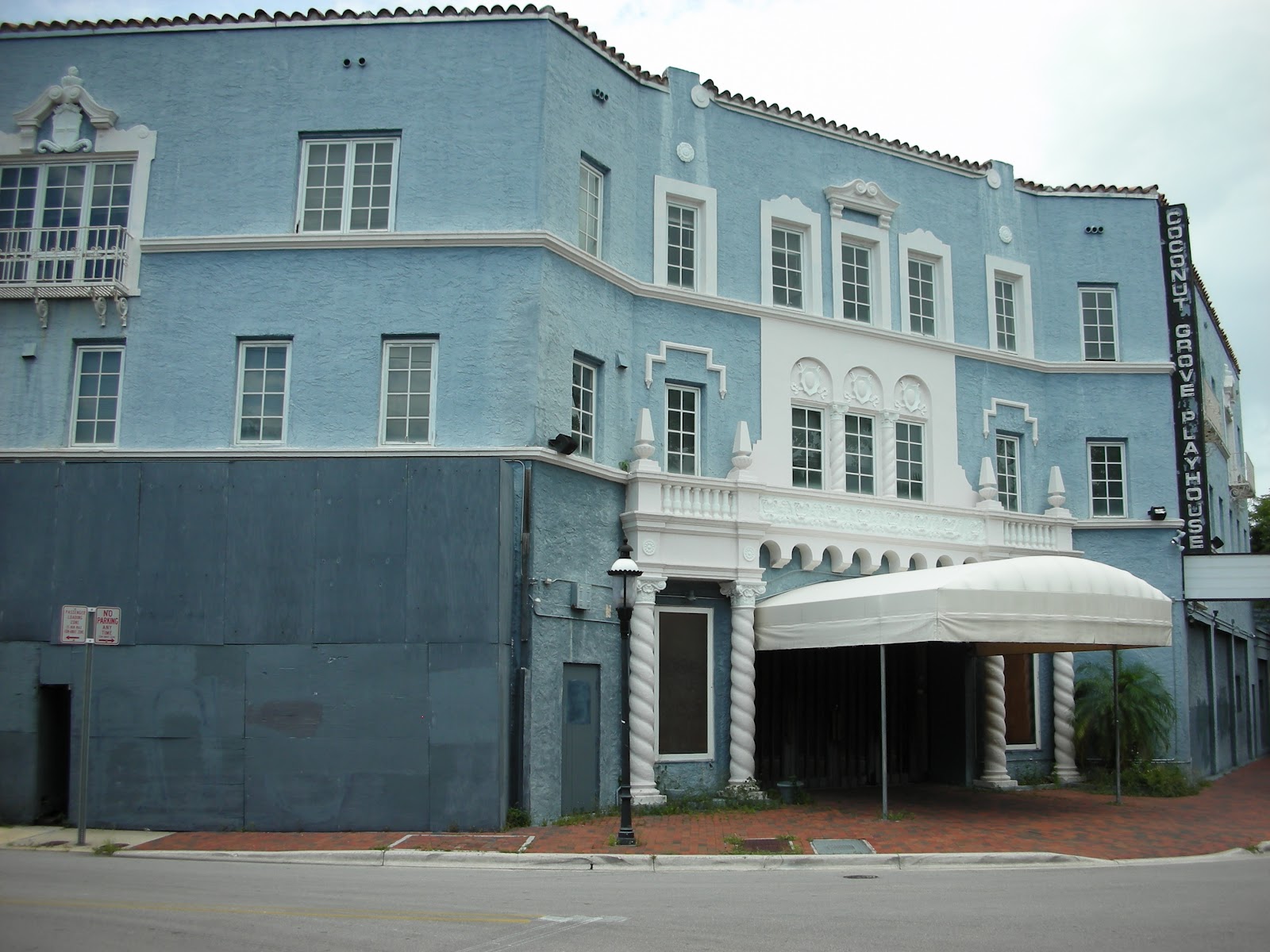
The Coconut Grove Playhouse in 2009.

In April of this year a “Give It Back!!! Give It Back!!!” campaign fired up to save the Coconut Grove Playhouse. However, it appears to have sputtered out almost as quickly as it flared up. More importantly, it was only concentrated on the Playhouse. What’s clearly needed is a comprehensive plan for a specially designated historical district from the Charlotte Jane Memorial Cemetery (named after Stirrup’s wife and childhood sweetheart and once the only place Blacks could be buried in the area because it was owned by Mr. Stirrup) to the Coconut Grove Playhouse, which could be the jewel in the rich tapestry of historical preservation of a Black neighbourhood unique in this country.

If such a designation can be done for a DAMNED DESIGN DISTRICT, then Miami can certainly see to it that this stretch of Charles Avenue be saved, and preserved. What physically remains of Coconut Grove’s rich history has been neglected and allowed to rot. I believe this has always been the original intent, ever since these three properties went vacant. Ask yourselves this question? In the middle of one of the most exclusive Zip Codes in the country, why has Miami allowed this to happen? Have you ever heard of Demolition by Neglect?

I believe the fix was in a long time ago. Therefore the question has always been, in my mind, who would benefit from from these properties being razed to the ground?

Coming soon: Unpacking Coconut Grove ► Part Three ► Who has a financial stake in the east end of Charles Avenue?

Previous entries:
Unpacking Coconut Grove ► Part One
Unpacking Coconut Grove ► Part 1.1

Colour Me Shocked!!! A Revolution In Condo World

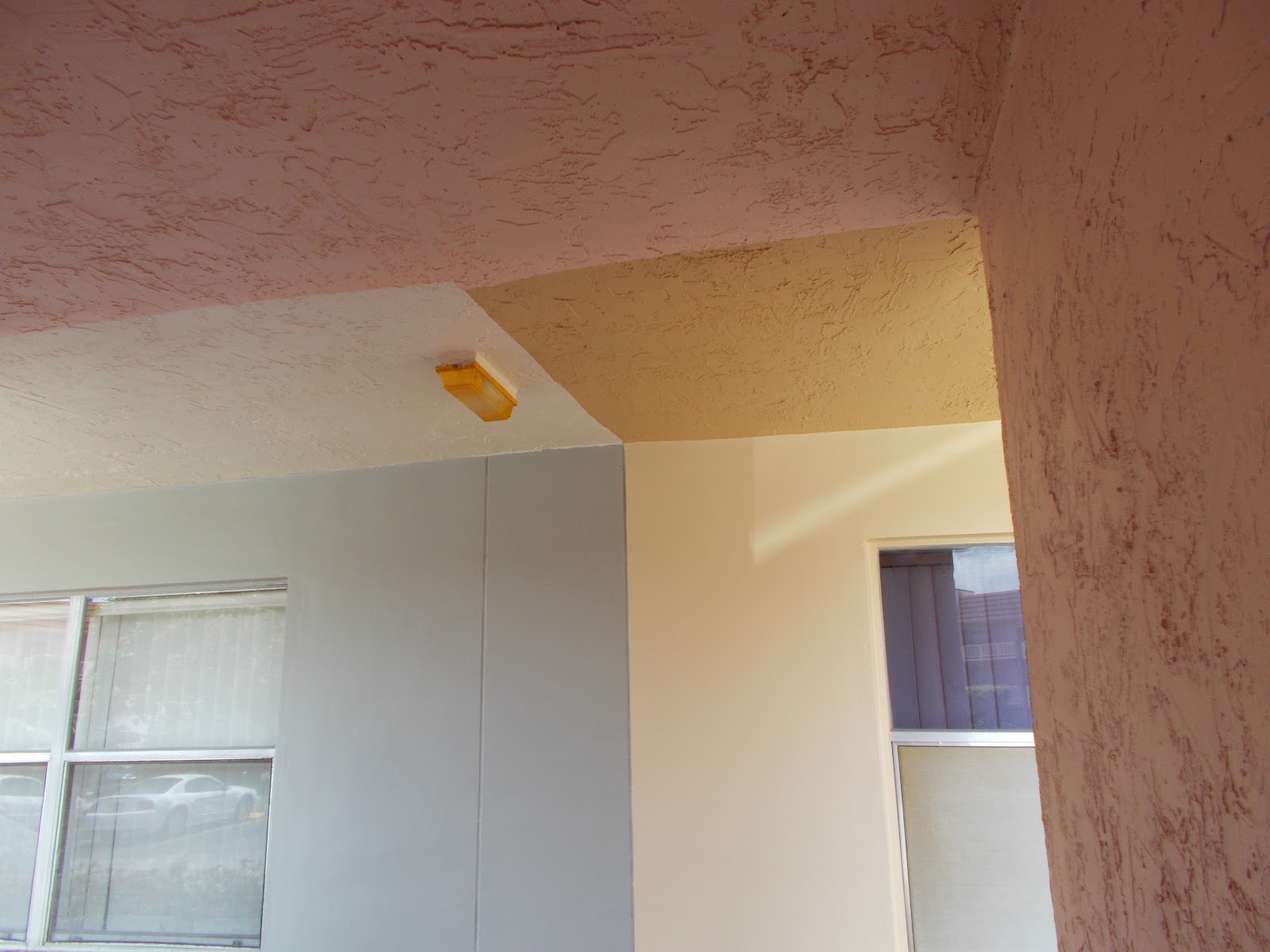
In my world this is earthshaking news. It’s hard to describe in mere words just how shocking this is (which is why I also have pictures), but I’ll try because I’m a writer, dammit!!! This is the equivalent of discovering, late in life, that not only were you adopted, but so were both of your parents, and your parents’ parents. Nothing you ever believed makes any sense any more. It’s that shocking. Really. Trust me.

My parents’ condo complex was built 35-40 years ago; some 240 buildings of 30 units each, with almost no variation from building to building. Del Boca Vista, the Florida condo complex where Jerry Seinfeld’s tee vee parents retired, had to have been based on this community. However, the writers toned down the craziness because they knew how unbelievable it would be, even in a show about nothing. I moved in here after my Mom died to take care of Pops. Within weeks I had run afoul of the Condo Board President. At the next board meeting the bitch moved a motion to have me ejected from the complex. It was seconded and passed with nary a discussion, in contravention of condo by-laws, and I was ordered to leave within 10 days. That was 7 years ago and is a long, involved, Kafkaesque story I don’t care to get into here. However, it is indicative of how conformity is a way of life in this condo complex.

And, that includes the colours. Especially the colours. Oh, those colours!!!

Panorama showing 4 buildings in my complex. There are 236 other buildings just like them. Click to enlarge.
The pink wasn’t quite flamingo pink, nor was it Milk of Magnesia pink. It was a tedious and uninteresting pink. The brown accent was also dull and joyless, not quite chocolate or tan, but somewhere uncomfortably in the middle without having to make a declaration. And this is how it’s been for the past 4 decades. The incorporating documents of the complex stipulate that all the buildings will be the exact same colour. Every so many years the complex gets painted top to bottom, one end to the other. Whenever they’ve painted they have tried to match the colours as close as possible. However, there have always been slight variations from one painting to the next, or from one end of the complex to the other. It must be hard matching that much paint. It still amuses me to hear people complain about a paint job a few occasions back that came out far too pink and not quite brown enough. People were forced to live with it until the next painting. Let’s face it: The people here don’t like change, unless it’s to make a new condo by-law.
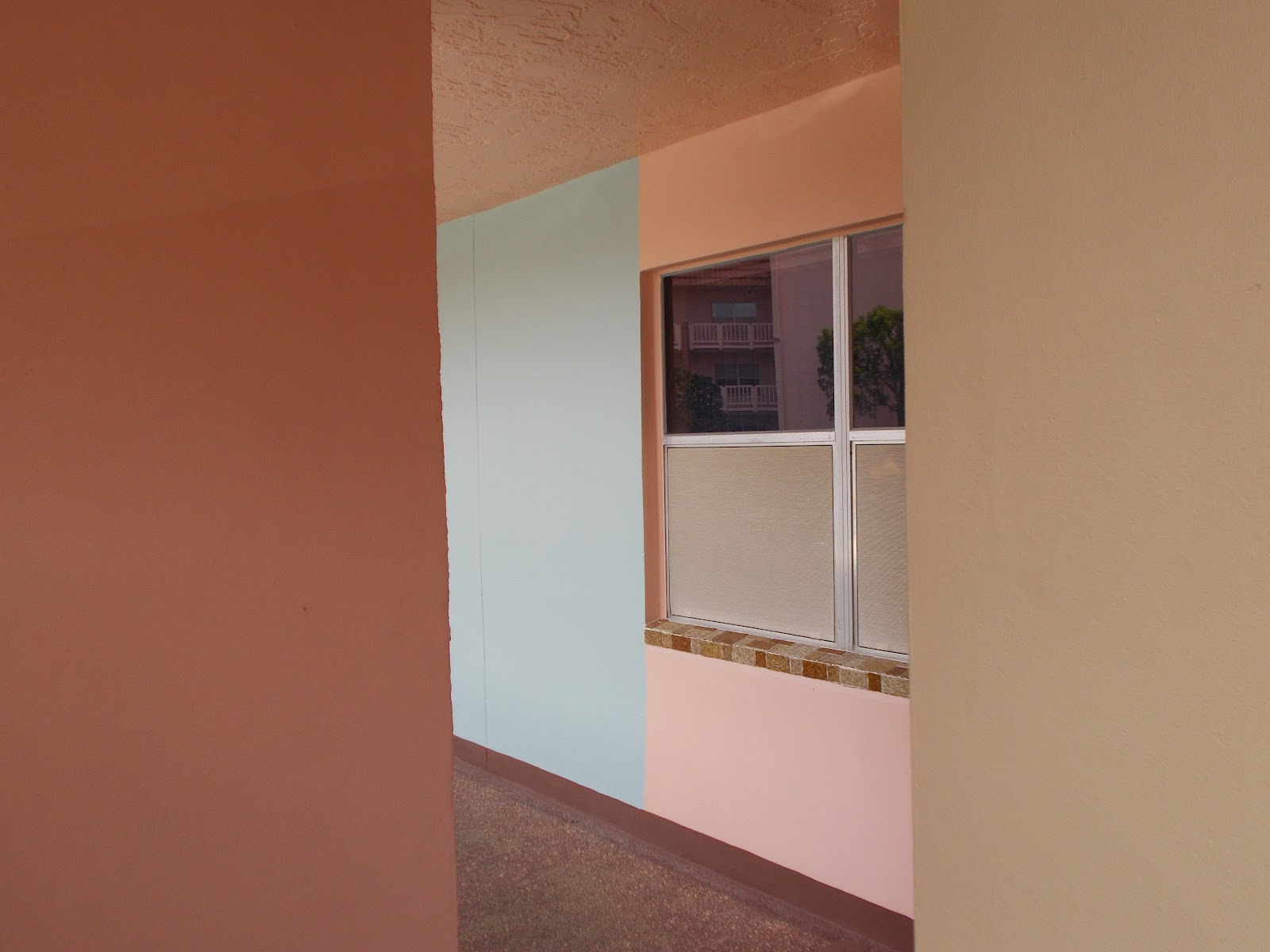
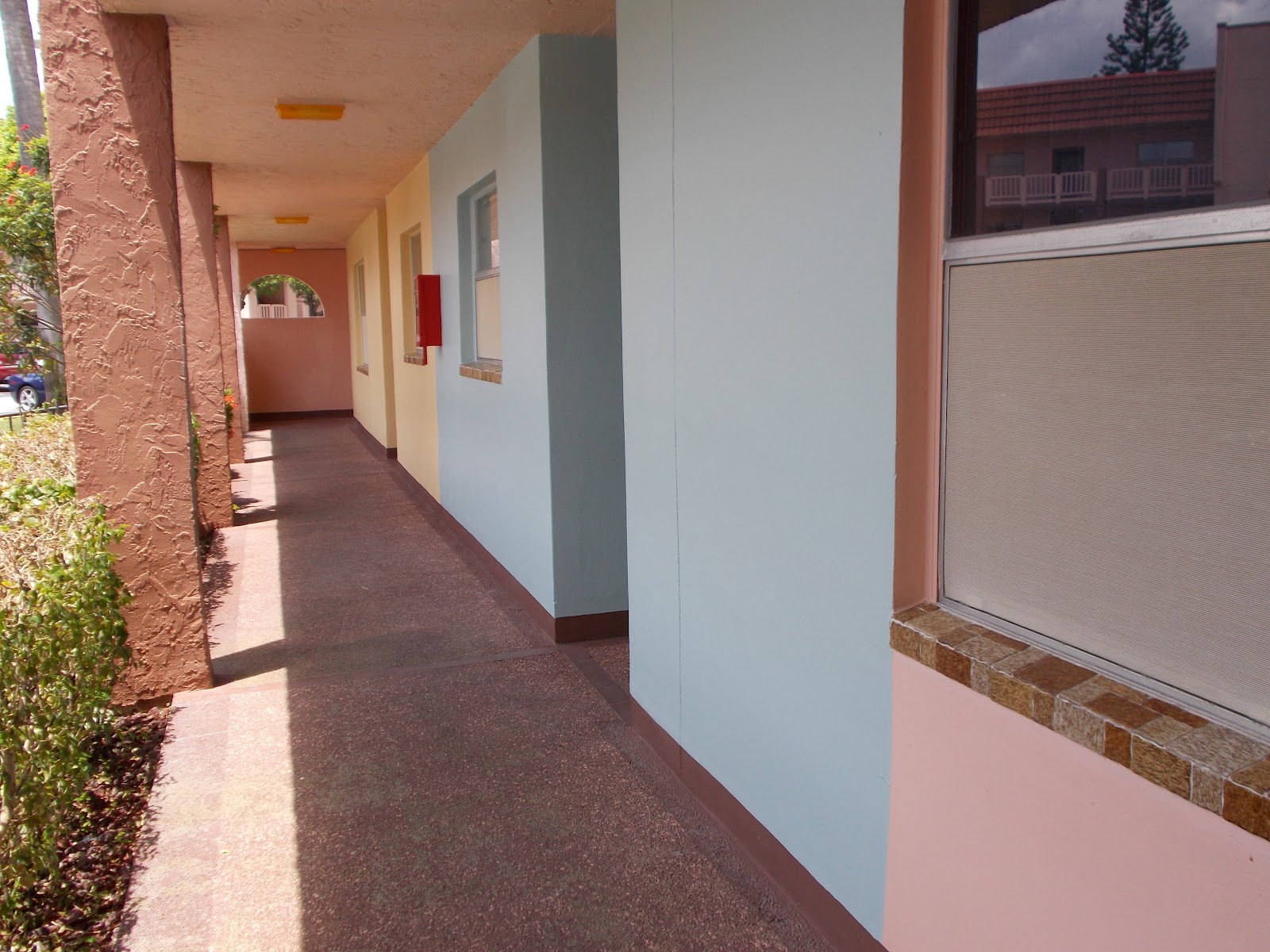
And then…suddenly…without warning…without any changes to the condo by-laws…without seemingly a whole lot of discussion…without our previous knowledge…a number of new colours have appeared on my building, and my building alone. And, just on my floor. And, just on my wing. Get a load of this:

No longer in the pink. My front door showing the bilious almost-yellow wall and not-quite-tan door.

My almost-yellow wall against my neighbour’s somewhat greenish-blueish wall.
Where my condo touches my neighbour’s condo. Note the old, not-really-pink in the foreground..
Close up detail of above. Four colours touch.

An intersection where the old colours (left) coexist with the new.

Several condo colour scemes: a slightly different almost-yellow and a slightly different greenish-blueish.

Several condo colour scemes.

Here’s what I have managed to cobble together: A new committee (comprised of whom I do not know) is going to select a new colour scheme for the entire complex. A decision was made (by whom I do not know) to paint a few sample colour schemes (chosen by whom I do not know) and have people live with them a while before deciding (with what input from the owners I cannot determine) what colour to paint the complex in the fall.

I LOVE IT!!! Aside from the sheer anarchy of the whole enterprise, suddenly we look like a happy and colourful community, instead of one with a foot already in the grave. My first suggestion was to make all the buildings multi-coloured, just like my floor is now. It creates a really vibrant look to the building, although I would have stuck more to a pastel/ice-cream pallet, which looks good in the Florida sunshine. However, I was told that that would be impossible because of the incorporating documents. My next suggestion was to choose several colour schemes and dot them around the complex, so that no two buildings next to each other were the same colour. Again, the incorporating documents make that impossible and the cost to change the incorporating documents, ie: the condo by-laws, is prohibitively expensive, according to someone in the know.

And therein lies the big Catch 22: These sample colour schemes themselves seem to contravene the condo by-laws. I have yet to hear if there was a vote by the Board of Directors, but the condo board cannot overrule the incorporating documents.

Short HOA rant: ‘Merkins willingly sign documents which give them almost no rights whatsoever. They allowed themselves to be ruled by capricious, mendacious, and sometimes criminal Boards of Directors. Here in “The Land of the Free and the Home of the Brave” ‘Merkins are legally prevented, and afraid, to paint their front door any colour they want, let alone add any other non-conforming element to the house or condo they think they own. Fun HOA trivia: HOAs were specifically invented to keep out Blacks and Jews. Eventually they lost that power (although it is still applied covertly by some condo boards; a charge that’s hard to prove), but that’s one of the few powers HOAs have lost over the years. Today condo boards are very powerful entities and can crush any dissent. Don’t believe me? My treatment when I moved in is Exhibit A. I publicly called the Board President a bully and, ironically, she set out to prove how right I was.

Meanwhile, until further notice, here’s my very colourful building in a very large panorama:

Colour my world. The 3 almost-yellows are not the same, nor are the two greenish-blueish.

Unpacking Coconut Grove, Florida ► Part One

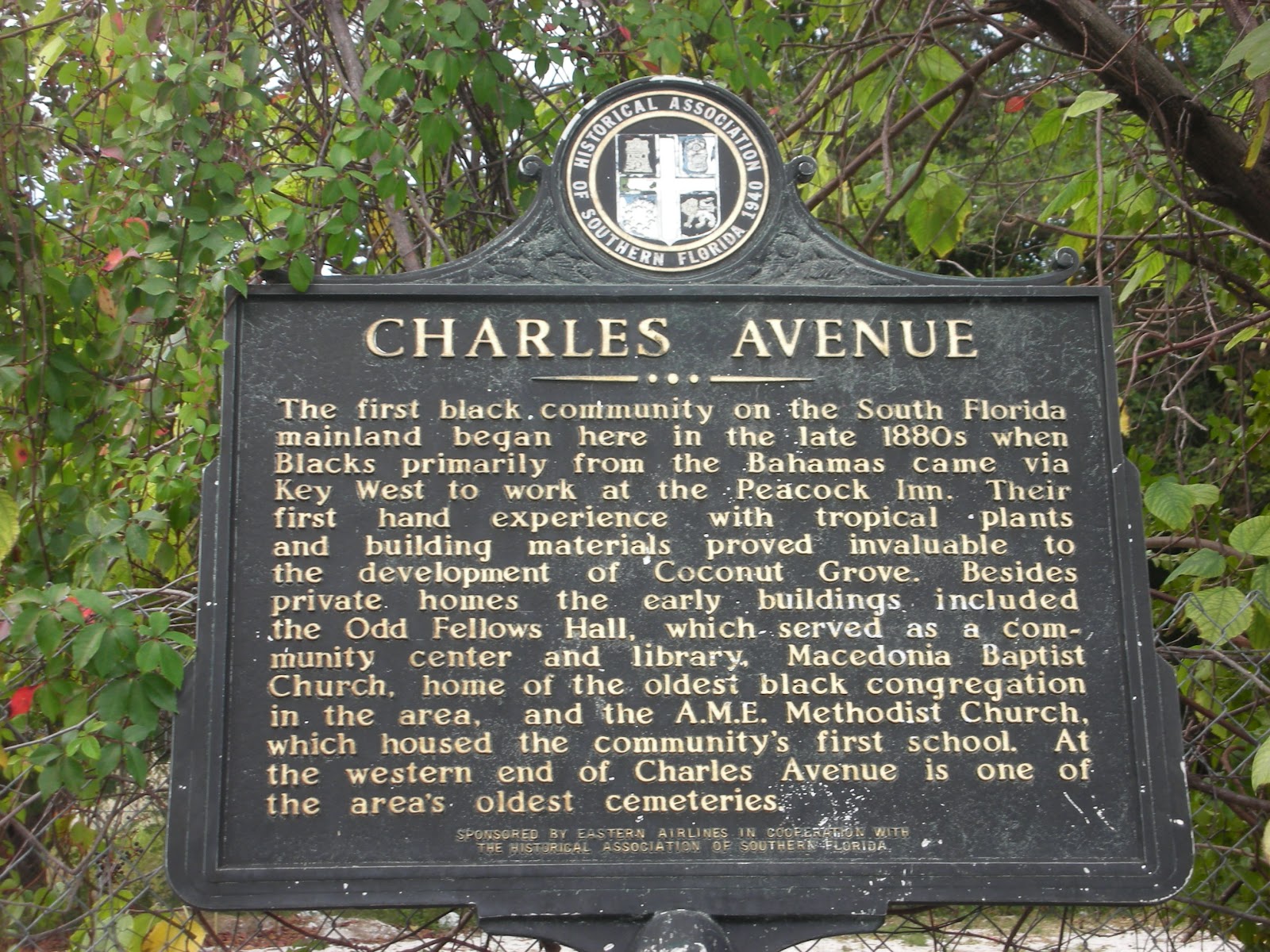
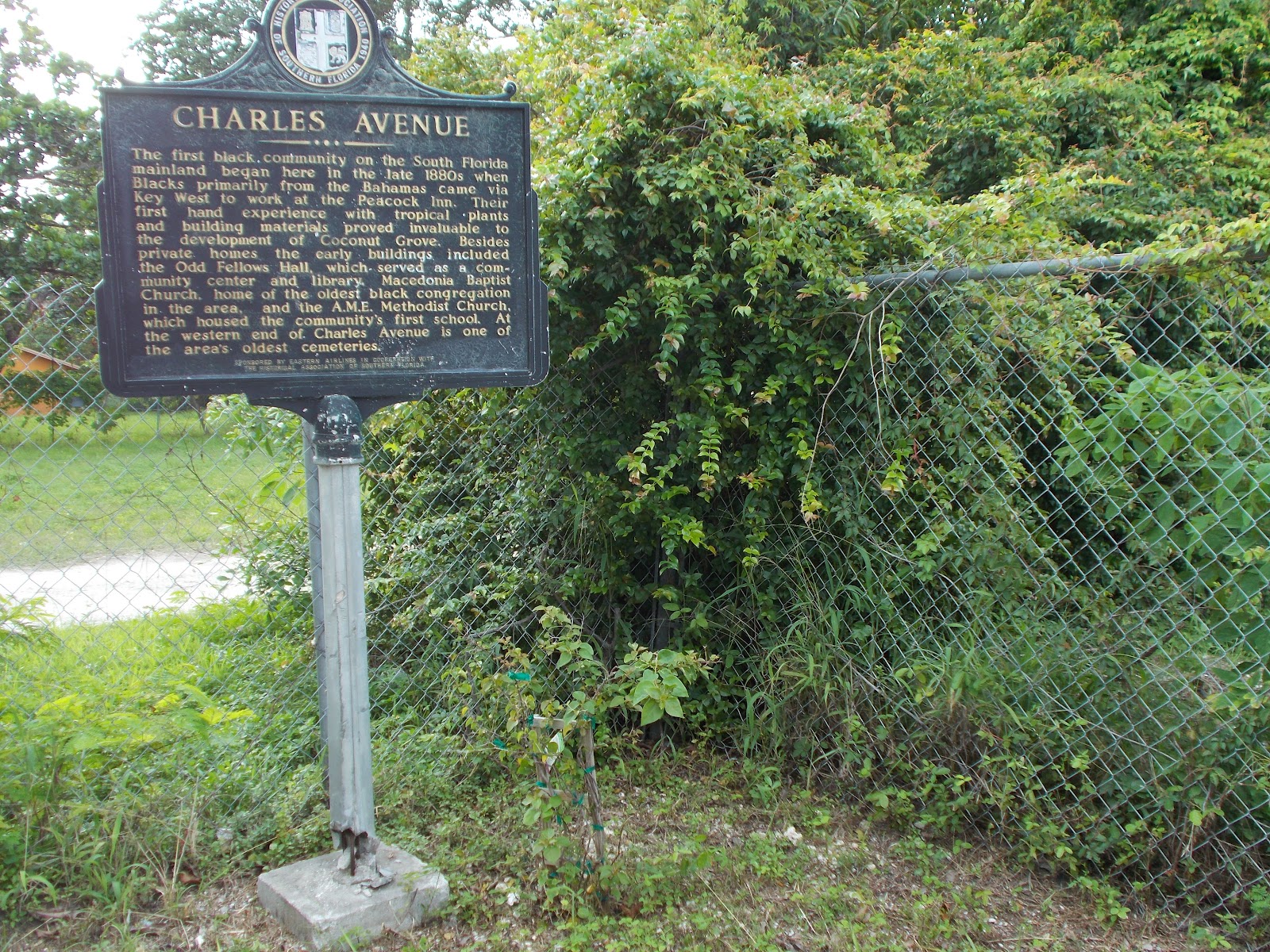
The marker that started my quest. Click to enlarge.

After a short hiatus, here’s a fair warning for those who got tired of hearing me spout off about Charles Avenue and Coconut Grove: I got the bug all over again, so get used to hearing me spout off about Charles Avenue and Coconut Grove all over again.

At my old, former, moribund blog Aunty Em’s Place (now overgrown with spammers and ivy) I started a series called The Shame of Coconut Grove™, which I continued on facebook on my old, former, moribund Aunty Em Ericann account. Before Aunty Em was kicked off facebook, she (me!) had unpacked quite a bit of Coconut Grove, both its history and internal politics, all because of an accidental encounter with a historical marker (at left).

A must read book on race

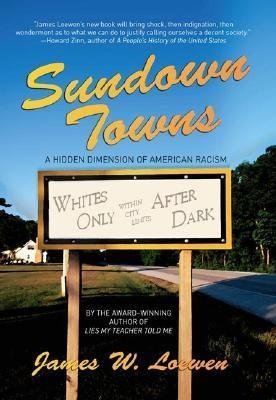
People who have known me a long time know I gravitate towards stories about race relations, a life-long interest. Had I really taken up that Black Studies Program when I first considered it, I’m sure I would be Black by now. Coincidentally on the day I discovered the Charles Avenue historical marker, as part of my independent study reading list, I was in the middle of “Sundown Towns: A Hidden Dimension of American Racism,” by James W. Loewen, which is the single greatest book on race relations I have ever read. It explained to me why every ‘Merkin city looks the way it does and why the overt racism of days gone by led to the covert racism of today. It also explained, for me, how White Privilege was woven into the fabric of life as generations experienced it so that, today, it covers us like a warm blanket that is so comfy we don’t even realize we’re wrapped in it. The events and attitudes described in Loewen’s book affect our lives every day, whether we stop to consider it or not.

There was just something about the Charles Street historical marker that spoke to me. The sign, the location, and the condition seemed to encapsulate the Black ‘Merkin Experience: a rich history not only ignored and forgotten, but mistreated in its memory. The panorama below shows the condition of the marker and the historic E.W.F. Stirrup House across the street. [More about the house and Mr. Stirrup in later chapters.]

Panorama of the historical marker and the E.W.F. Stirrup House across the street. Click to enlarge.

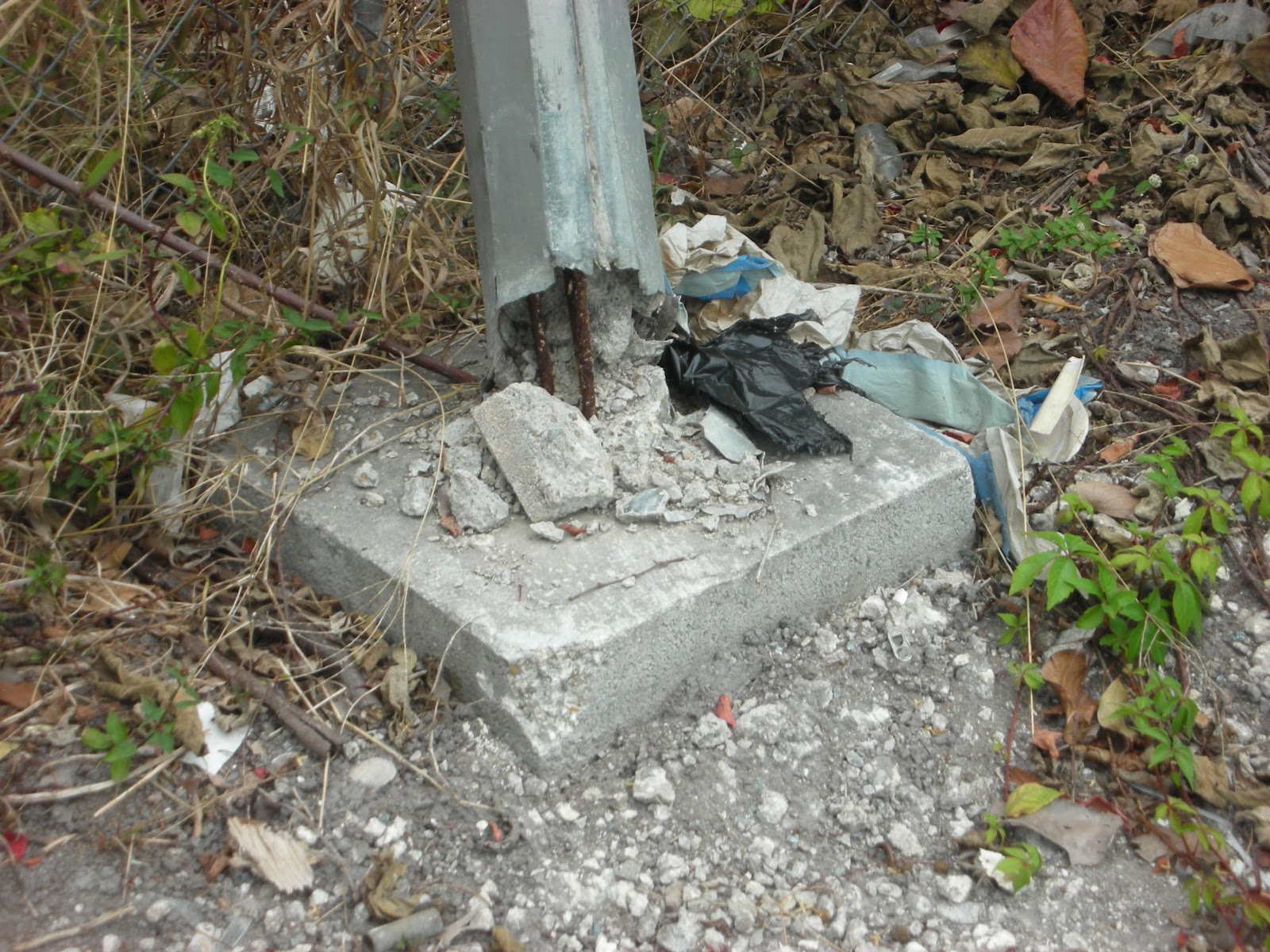
Detail of sign’s base. Click to enlarge.

The sign was leaning backwards at an uncomfortable angle. If not for the fence behind it, it might have fallen down completely. The base (see right) was broken. The first time I visited (early 2009) I just thought the pole was bent. I didn’t see the base due to the garbage bags piled up all around it. [I cannot seem to find the pics of my 1st visit, but have all the rest.] On my second visit, and subsequent visits, the garbage had changed, which meant that it was being used as a regular, accepted trash collection site. And, why not? The base had clearly been broken for quite a while to have sustained the damage I saw. The aluminum post, when new, had been filled with cement and steel rebar, which was in a dreadful state of disrepair having been exposed to the elements for…how long? I had no way to estimate, but it was clearly not recent. The sign had been sponsored by Eastern Airlines, a defunct company, in cooperation with The Historical Association of Southern Florida, an entity I could never find.

The location of the sign is no less significant. There’s no way to whitewash this: Coconut Grove, Florida (incorporated into Miami in 1925) is considered one of the most exclusive addresses in all of ‘Merka.


View Charles Avenue, Coconut Grove, Fl, 33133 in a larger map. Zoom out to see Coconut Grove in relation to Miami.

E.W.F. Stirrup House

Let’s get oriented: Coconut Grove is nestled up against the western edge of Biscayne Bay, where the 3,000 mile long intercoastal waterway trails off into nothingness. The E.W.F. Stirrup House (pictured at left), the Coconut Grove Playhouse (pictured below) and the Charles Avenue historic marker are on the eastern end of Charles Avenue at Main Highway,  On the opposite, eastern side of Main Highway is a residential area I have been unable to breach. It is one of the most exclusive areas in ‘Merka, so gated and secured even Google mapping cars aren’t allowed inside. I once walked to the gate and started taking pictures and within a minute was shooed away by a security guard that appeared out of nowhere. These fuckers are serious.

The Coconut Grove Playhouse taken from
the more exclusive side of Main Highway.

I became obsessed with the Charles Avenue historical marker and Coconut Grove, to the point where I decided it was the perfect place to locate my favourite character in my novel-in-progress. That gave me another reason to research Coconut Grove. Work took me through the area every couple of weeks. I would always stop and take as many pictures as I could stand before the oppressive Florida heat got to me. I now have thousands of pictures of Charles Avenue and enough research to think I have uncovered a years old scandal in the village of Coconut Grove that could become a non-fiction book all on its own.

However, two years ago my circumstances changed and I no longer had any reason to drive the 35 miles to
The Grove. When I was visiting it regularly, Aunty Em Ericann would come back and post dozens of pictures on facebook with a small essay describing the lack of changes on Charles Avenue from week to week. I became dejected. Aunty
Em
had spent a considerable amount of my time posting pictures, writing essays, and contacting community
activists. However, I couldn’t get any traction on my
Save the Charles Avenue Sign campaign. Worse, I couldn’t get anyone interested in what I (still) believe is a massive, multi-gajillion dollar real
estate scandal.

Since I couldn’t get anyone to listen, and I am no longer an investigative journalist with an editor to support and sponsor these expensive fishing expeditions into possible malfeasance, I gave up. However, I never forgot about Coconut Grove, especially since my novel character Adrian had moved there at the end of the ’60s, after Detroit had started to become toxic.

Lately Charles Avenue has been nagging at me. Because it’s 35 miles away —
all crazy Florida highway — I have been putting off making the trip for the past few weeks. I knew I would need a minimum of 3 hours to do it justice; get there, take some pictures, check on recent developments, and come home. It was difficult to work into my schedule and the longer I tried, the guiltier I felt for having abandoned Charles Avenue. Last week I finally bit the bullet, gassed up the tank, and made the harrowing highway adventure. I returned more despondent than ever about Charles Avenue. I came back even more pissed off at what is clearly The Shame of Coconut Grove™. However, it also made me more determined than ever to do something about it. What? I do not know. I am still processing and writing about the trip, which will be Part Two in this series. Part One is long enough already, but I felt this background was needed.

However, before I sign off, there was one bit of good news on Charles Avenue. Someone (or a group of someones) have taken it upon themselves to attempt to straighten the Charles Street historical marker. They have also planted a drought-resistant flowering bush next to it. It will look nice when it fills in.

The sign, while still not true, no longer leans against the fence. The new plant is staked in the ground to the right of it.

The late afternoon sun streams down Charles Avenue in this recent panorama.

However, this small sliver of hope doesn’t even begin to mitigate all the negative I saw. That’s why I have decided to take up the cause of Charles Avenue once again. I am going to make Charles Avenue the most famous street in ‘Merka, representing centuries of institutional racism. And, along the way, I just might expose a multi-gajillion dollar Coconut Grove boondoggle. Who’s along for the ride?

Stay tuned for Part Two of Unpacking Coconut Grove.

Day In History ► Manhattan Island Sold

Dateline June 10, 1610 – The most one-sided real estate deal in history as the Dutch think they are buying Manhattan Island from the Natives. Whenever possible I get my history from Stan Freberg. This is from his “Stan Freberg Presents The History of the United States of America, Volume One,” animated by Saul Bass & Art Goodman for the February 4, 1962 broadcast of “Stan Freberg Presents The Chun King Chow Mein Hour: Salute to the Chinese New Year.”

You’ve Come A Long Way, Baby – NYT Decides To Capitalize Negro

Dateline June 7, 1930 – The New York Times decides to start capitalizing the word “Negro” out of respect.

Look, it’s just a truism that the English language, as well as the times—not to mention The Times—evolve. These days no one is ever pulled over for driving while Negro.

Meanwhile, here’s an article (PDF) in the very same NYT on January 10, 1903 arguing in favour of the capital “N,” so very many years before it ever happened. That’s only proof that the English language, as well as the times—not to mention The Times—evolve slowly. One day we can hope that no one will be pulled over for driving while Black.

Day In History ► Josephine Baker Born

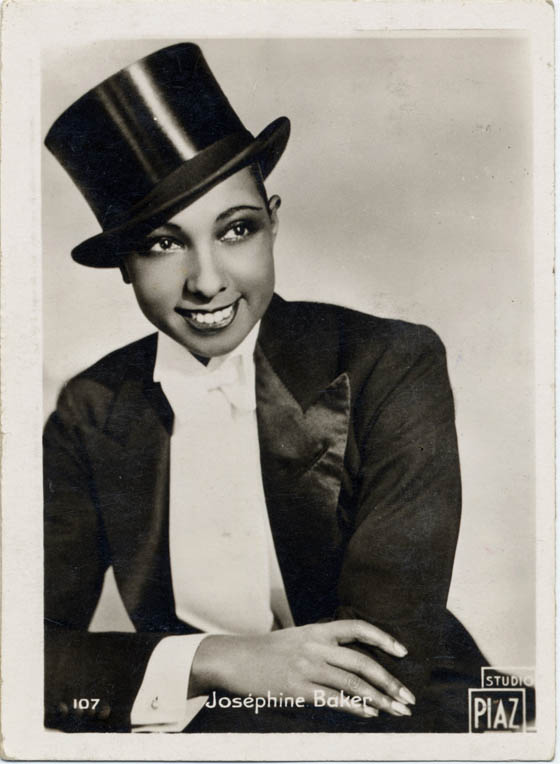
Dateline June 3, 1906 – Chanteusse Josephine Baker is born. Is there any doubt that had Josephine Baker been born White, she’d have been a huge star in ‘Merka who everyone would still know today? As her official web site puts it:

Josephine Baker sashayed onto a Paris stage during the 1920s with a comic, yet sensual appeal that took Europe by storm. Famous for barely-there dresses and no-holds-barred dance routines, her exotic beauty generated nicknames “Black Venus,” “Black Pearl” and “Creole Goddess.” Admirers bestowed a plethora of gifts, including diamonds and cars, and she received approximately 1,500 marriage proposals. She maintained energetic performances and a celebrity status for 50 years until her death in 1975. Unfortunately, racism prevented her talents from being wholly accepted in the United States until 1973.

The WikiWackyWoo adds:

Baker was the first African American female to star in a major motion picture, to integrate an American concert hall, and to become a world-famous entertainer. She is also noted for her contributions to the Civil Rights Movement in the United States (she was offered the unofficial leadership of the movement by Coretta Scott King in 1968 following Martin Luther King, Jr.’s assassination, but turned it down), for assisting the French Resistance during World War II, and for being the first American-born woman to receive the French military honor, the Croix de guerre.

Born as Freda Josephine McDonald into relative poverty, Baker started earning her living as a child working as a cleaning woman/babysitter for wealthy St. Louis Whites. At 13 she began to wait tables at The Old Chauffeur’s Club, where she met the first of her four husbands, Willie Wells. As a street corner busker, she danced her way into the St. Louis Chorus vaudeville show when she was only 15, which began her official show biz career. She kicked around vaudeville for a few years until she auditioned for “Shuffle Along,” the first all-Black Broadway musical, written by Eubie Blake [one of my favourite artsts] and Nobel Sissle. Amazingly, as her web site puts it:

She was rejected because she was “too skinny and too dark.” Undeterred, she learned the chorus line’s routines while working as a dresser. Thus, Josephine was the obvious replacement when a dancer left. Onstage she rolled her eyes and purposely acted clumsy. The audience loved her comedic touch, and Josephine was a box office draw for the rest of the show’s run.

That’s when Josephine Baker became a star. However, it was only when she went to Paris that she became a SENSATION. Paris society was integrated and Baker became one of the highest paid entertainers in all of Europe and welcomed into all aspects of Parisian society. Yet, when she returned to ‘Merka in 1936, she was savaged by the ‘Merkin critics; the New York Times calling her a “Negro wench.” She is reported to have returned to France heartbroken by the reception.

Here is Josephine Baker performing the famous Banana Dance that WOWED Paris:

However, if Josephine Baker’s singing and dancing were her only accomplishments, she would be remembered as merely an entertainer who scaled the heights of Europe and little more. In my mind her greater accomplishments are those that are less well known. Josephine Baker is the first ‘Merkin woman to be buried in France with a 21 gun salute and full military honours for her work for the resistance during the Second World War. The WikiWackyWoo picks up the story:

Her affection for France was so great that when World War II broke out, she volunteered to spy for her adopted country. Baker’s agent’s brother approached her about working for the French government as an “honorable correspondent”, if she happened to hear any gossip at parties that might be of use to her adopted country, she could report it. Baker immediately agreed, since she was against the Nazi stand on race, not only because she was black but because her husband was Jewish. Her café society fame enabled her to rub shoulders with those in-the-know, from high-ranking Japanese officials to Italian bureaucrats, and report back what she heard. She attended parties at the Italian embassy without any suspicion falling on her and gathered information. She helped in the war effort in other ways, such as by sending Christmas presents to French soldiers. When the Germans invaded France, Baker left Paris and went to the Château des Milandes, her home in the south of France, where she had Belgian refugees living with her and others who were eager to help the Free French effort led from England by Charles de Gaulle. As an entertainer, Baker had an excuse for moving around Europe, visiting neutral nations like Portugal, and returning to France. Baker assisted the French Resistance by smuggling secrets written in invisible ink on her sheet music.

Despite the treatment she received in ‘Merka in 1936, she wasn’t done with her native land quite yet. In the ‘50s she threw her support behind the ‘Merkin Civil Right’s Movement, though she still lived in France. She refused to perform for segregated audiences when she toured and is credited with helping to integrate Las Vegas shows. In a famously reported incident, she accused the Stork Club in Manhattan with refusing her service. Grace Kelly, who happened to be in the club at the time, saw what happened. She marched her entire party out of the club, arm-in-arm with Baker. Kelly never set foot in the club again and the two women became friends to the end. [Years later, when Baker had fallen on hard times she was supported by Grace Kelly, who was known as Princess Grace of Monaco by then, with money and a villa, .]

Baker worked with the NAACP and was beside Reverend Martin Luther King, Jr. at the March On Washington in 1963, the only woman to officially address the throngs. After Dr. King was assassinated Coretta Scott King asked her to lead the ‘Merkin Civil Rights Movement. Baker declined. She also adopted 12 children of various backgrounds, calling them her Rainbow Tribe, as demonstrable proof that people can get along.

But wait! That’s not all!

Baker was bisexual. Her son Jean-Claude Baker and co-author Chris Chase state in Josephine: The Hungry Heart that she was involved in numerous lesbian affairs, both while she was single and married, and mention six of her female lovers by name. Clara Smith, Evelyn Sheppard, Bessie Allison, Ada “Bricktop” Smith, and Mildred Smallwood were all African-American women whom she met while touring on the black performing circuit early in her career. She was also reportedly involved intimately with French writer Colette. Not mentioned, but confirmed since, was her affair with Mexican artist Frida Kahlo. Jean-Claude Baker, who interviewed over 2,000 people while writing his book, wrote that affairs with women were not uncommon for his mother throughout her lifetime. He was quoted in one interview as saying:

“She was what today you would call bisexual, and I will tell you why. Forget that I am her son, I am also a historian. You have to put her back into the context of the time in which she lived. In those days, Chorus Girls were abused by the white or black producers and by the leading men if he liked girls. But they could not sleep together because there were not enough hotels to accommodate black people. So they would all stay together, and the girls would develop lady lover friendships, do you understand my English? But wait wait…If one of the girls by preference was gay, she’d be called a bull dyke by the whole cast. So you see, discrimination is everywhere.”

On April 8, 1975, Baker starred in a retrospective revue at the Bobino in Paris, Joséphine à Bobino 1975, celebrating her 50 years in show business. The revue, financed by Prince Rainier, Princess Grace, and Jacqueline Kennedy Onassis, opened to rave reviews. Demand for seating was such that fold-out chairs had to be added to accommodate spectators. The opening-night audience included Sophia Loren, Mick Jagger, Shirley Bassey, Diana Ross and Liza Minnelli.

Four days later she was found in a coma in bed, surrounded by the latest rave reviews of what could have been the second act to her fabulous career. She never came out of it and died 4 days later.

By any standards Josephine Baker’s life is worthy of memorializing, which Lynn Whitfield did in 1991 in HBO’s The Josephine Baker Story. For her performance she received the Emmy for Outstanding Lead Actress in a Miniseries or a Movie, making her the first Black woman to do so.

Despite the biopic, sadly, when you mention Josephine Baker to people these days they stare blankly. Is there any doubt this would be the case were she White?