Tag Archives: unpacking-coconut-grove

Where The Sidewalk Ends, Racism Begins *

Where the sidewalk ends. If you’re Black, you might want to stop right here.

Some day you simply must take a stroll southbound on the west side of South Douglas Road in Coconut Grove, Florida. Walk from Grand Avenue past Washington and Thomas Avenues and the Frances S. Tucker Elementary School

On your left Thomas Avenue jogs and Charles Avenue [on which the E.W.F. Stirrup House anchors the other end of the street, near Main Highway] ends; although Charles has an odd little western dogleg that can’t be seen from SW 37th Ave, aka Douglas. Crossing Charles Terrace, a street that only runs two blocks west and not at all east, you can’t help note the serene, stark beauty of the Charlotte Jane Memorial Park Cemetery on your left. While distracted you almost walk into a wooden fence as the sidewalk abruptly ends.

The wooden fence hides a cinder block wall that runs from this point west for two long blocks. The wall was built for one reason and one reason alone: to keep Black Coconut Grove out of White Coconut Grove. The sidewalk ends for one reason. Racism begins.

This wall represents the historic COLOUR LINE that divided the Black backyards on Charles Terrace from the White backyards along Kumquat Avenue. To heighten the sense of segregation, none of the streets along Charles Terrace were allowed to link to Kumquat Avenue or any of the White streets to the south or west.

The Coconut Grove Wall of Shame™ is not unlike the wall in my home town of Detroit known alternatively as The 8 Mile Wall, The Wailing Wall, or the Birwood Wall. A search on the Googalizer for the 8 Mile Wall turns up references, history, as well as tons of images. However, one has to go digging to find any images or references to the Coconut Grove Wall, the history of which is being buried like much of the history of West Grove.


A CAPSULE HISTORY OF THE 8 MILE WALL: Back in the ’40s the Wyoming-8 Mile neighbourhood was mostly farmland; while the city’s northern border was already established at 8 Mile, it hadn’t been developed yet. However, there was already a Black enclave in the area from earlier times. During The War Years Detroit was experiencing a war time boom and housing was desperately needed. Meanwhile, a developer wanted to build in the Wyoming-8 Mile area was having trouble getting Federal Housing Authority loans for the new tract due to the perceived undesirability of the adjacent Black. The developer struck a deal: It would build a 6-foot wall to separate the Whites from the Blacks. The Black folk could have their side of the wall and would be redlined out of the other side of the wall, and a lot of the rest of Detroit, for that matter.

Related: The Detroit Riots

Pic from Racial, Regional Divide Still Haunt Detroit’s
Progress
, an excellent All Things Considered on NPR

The main reason you will find thousands of pictures of the 8 Mile Wall is because parts of it have been reclaimed and decorated with gayly painted scenes of iconic Black historic moments.

The 8 Mile Wall no longer divides Black from White; White Flight has seen to that. Both sides of that wall are now predominately Black in a city that is now almost entirely Black, except for all the new carpetbagging hipsters gentrifying huge swaths of Motown. But, that’s another story for another day.

The Coconut Grove Wall of Shame is of a slightly later vintage. The following comes from a much longer article — about the much longer COLOUR LINE that has West Coconut Grove hemmed in TO THIS VERY DAY. There are two distinct sides to The Wall, as Miami New Times writer Kirk Nielsen called it 15 years ago, when he asked and answered the musical question, “How can you tell where white Coconut Grove ends and black Coconut Grove begins? Just look for the barbed wire.”

In 1946 the Miami Housing Authority approved construction of a 25-acre tract of small single-family homes for low-income blacks on Charles Terrace, west of Douglas Road. By the time the houses were completed in 1949, workers had also erected a concrete block wall along the southern boundary of the new development. As reported by the Miami Herald (and cited by Marvin Dunn in his new book Black Miami in the Twentieth Century), the city planning board required the wall in order to provide “suitable protection” for the white neighborhood. A Florida Supreme Court ruling three years earlier had rendered illegal Dade County’s segregation of black residential districts. But that didn’t stop the city from putting the wall up.

Brown and weathered, the concrete block barrier still runs a quarter-mile, from Douglas Road west to the Carver Middle School parking lot. Six feet tall, higher in some places, it divides the leafy back yards of Kumquat Avenue on one side from the tree-starved lots of Charles Terrace on the other.

Lou-vern Fisher, who moved to Miami with her parents in 1936 from Georgia, bought one of the single-family homes next to the wall with her husband back in 1950. She still lives there, with a daughter, granddaughter, and grandson. “We enjoyin’ the wall,” says the jolly 73-year-old retired maid. “They put it here for a reason. And you know the reason. To keep us from going over there,” she wags a finger, letting off a loud gravelly ha-ha-ha.

Another section of the Coconut Grove Wall of Shame™ along Charles Terrace

However, get this: When the same wall became inconvenient for the White folk of Coconut Grove, a small section of it was torn down:

While Father Gibson’s petitioning [in the ’50s and ’60s] failed to inspire city commissioners to topple the wall, the fears of white parents proved far more effective. In 1970, the year Carver Middle School (then Junior High) was racially integrated, the western end of the wall was demolished, allowing a one-lane road to be paved from Kumquat Avenue to the school. White parents had demanded that southern access to drop their kids off because they considered the other route, down Grand Avenue in the black Grove, unsafe.

This isn’t unlike how (at around the same time, in fact) the polluting incinerator nicknamed Old Smoky was only closed when [White] Coral Gables — the town that racism built — started to complain, despite years of complaints from West Grove residents. As I like to tell my followers on Twitter and facebook, “History is complicated.” Racial history even more so. I will will be documenting the Coconut Grove Colour Line more fully as time goes on, but thanks for reading the first inn an ongoing series.

That doesn’t mean we can’t Rock Out while waiting for the next exciting episode. Listen to a speech by Ambalavaner Sivanandan set to music by Asian Dub Foundation.

Crank it up!!!

* With apologies to Shel Silverstein

Some More Coconut Grove(s) History

Cocoanut Grove is a 1938 movie, made well
after Coconut Grove lost the “A” in its name

I’ve been collecting historic pictures of Coconut Grove as long as I’ve been researching and taking pictures of the E.W.F. Stirrup House. For the past several years whenever I stumbled over a new old picture of Coconut Grove on the innertubes, I save it to my hard drive. I have built up a pretty fair collection, but I am always looking for more. 

Direct searches for pictures, or articles, on historic Coconut Grove, Florida can be an exercise in frustration. All searches are complicated by how many things have been named Coconut/Cocoanut Grove over the years, how often the generic term “coconut grove” has appeared in print over the years, and how often things have been misspelled on the internet over the years.

The candy bar is not the village

There’s the candy bar, of course, but that’s just the beginning. High up on any Googalizer list is the famous Cocoanut Grove nightclub in the Ambassador Hotel in Los Angeles. During Hollywood’s heyday the nightclub drew celebrities and Hollywood royalty to witness shows that featured performers such as Frank Sinatra, Judy Garland, Bing Crosby, Nat King Cole, Dorothy Dandridge, Benny Goodman, and Sammy Davis, Jr., just to name a few. Long before the Oscars were ever televised, six Academy Award ceremonies were held at the Cocoanut Grove nightclub. Incidentally, Robert Kennedy gave his last speech at the Ambassador Hotel and was gunned down in the kitchen on his way out of the hotel. The kitchen, the Cocoanut Grove nightclub, and the Ambassador Hotel no longer exist, but they live on on the internet.

The Cocoanut Grove nightclub in the Ambassador
Hotel during happier and kitchier times:

Another Cocoanut Grove nightclub was built as a roof garden atop the Century Theatre by impresario Florenz Ziegfeld — who had taken over the struggling theater built a mile north of the actual Theater District — with partner and Broadway producer Charles Dilligham. Even this couldn’t save the building, which also suffered from poor acoustics, and it was knocked down to build the Art Deco Century Apartments in 1931.

The aftermath of the horrific Cocoanut Grove fire in Boston, 1942

While there’s a Cocoanut Grove ballroom and conference center on the Santa Cruz Beach Boardwalk, the most famous Cocoanut Grove nightclub was the site of the deadliest nightclub fire in history. On that night in 1942, 492 people were killed, and hundreds injured,as a fire tore through the Boston nightclub during Thanksgiving celebrations. From the WikiWhackyWoo:

As is common in panic situations, many patrons attempted to exit through the main entrance, the same way they had entered. The building’s main entrance was a single revolving door, rendered useless as the panicked crowd scrambled for safety. Bodies piled up behind both sides of the revolving door, jamming it to the extent that firefighters had to dismantle it to enter. Later, after fire laws had tightened, it would become illegal to have only one revolving door as a main entrance without being flanked by outward opening doors with panic bar openers attached, or have the revolving doors set up so that the doors could fold against themselves in emergency situations.

A lot of laws were changed in the wake of the Cocoanut Grove fire and whenever there’s another fire in a nightclub, newspapers have to make reference to the tragedy in Boston. It’s in their contract.

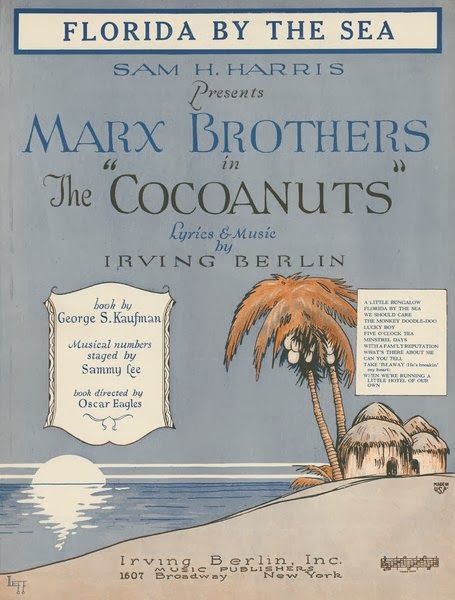
At least on Google video searches I’ll always stumble across one of my favourite Marx Brothers movies. While the first Marx Brothers release, “The Cocoanuts” took place in Cocoanut Grove, Florida, it was filmed in Astoria, Queens between performances of their smash hit musical Animal Crackers. It was based on the earlier Broadway hit, The Cocoanuts, something that also crops up in many Google searches; which always find Gus Arheim and His Cocoanut Grove Orchestra; Judy Garland’s opening night at Cocoanut Grove; Mercury at the Cocoanut Grove; not to mention Phil Harris and His Cocoanut Grove Orchestra. Adding to the confusion is an episode of The First 48, called Gangs of Little Havana/Execution in Coconut Grove, which pops up; as does an episode of Sell This House, when Cesar and Lisa Verde tried to unload their Coconut Grove house. Both get posted on the YouTubery occasionally, but are always removed by a copyright take-down order.

Liverpool had a nightclub called Coconut Grove; as does Sacramento; as did Dundee, Scotland; and Buffalo, New York; while a cartoon I’ve never been able to find is called The Coo-Coo Nut Grove, and spoofs the famous Hollywood nightclub; a suburb of Darwin, in the Northern Territories of Austrailia, is called Coconut Grove; not to mention a song I have yet to hear, written for the Fred McMurray movie Cocoanut Grove [poster above] by Harry Owen, of Harry Owen and his Royal Hawaiians, who also wrote one of my favourite tunes, “Sweet Leilani.” [A long time ago I created a Spotify playlist with about 100 versions of Sweet Leilani.]

Which brings us full circle. Harry Owen was able to write music for and appear in a Fred McMurray movie was because Hawaiian Music was a hot a craze in “Merka at one time. From there the interest went World Wide and now there are many several whole bucketfuls of stuff named Coconut Grove all around the world, from carpet cleaners to hole-in-the-wall diners to motels. Sometimes they make the news. Sometimes my Google ‘As It Happens’ Alerts go haywire for nothing to do with the Coconut Grove I’m monitoring. F’rinstance, remember that recent crazy FloriDuh story, that broke national, because the two convicts escaped using forged release papers, like recently when those two escaped convicts were nabbed at the Coconut Grove Motor Court.

If you think all of that makes a search for Coconut Grove complicated, I have been adding my own to the Googleopolis. All my Not Now Silly posts on Coconut Grove rank fairly high on the Googalizer now andI have to weed through those now to find anyting worthwhile.

ANd, Because I have been trying to become more multi-media savvy here at Not Now Silly, for the last week I have been learning how to use a movie making program. When I realized I had all the makings for a pretty little montage, I created my latest entry to the Google Coconut Grove search engine confusion.

Play this movie full screen for the best effect

If I still have your attention, here are a couple of other montages I’ve put together:


As always, comments welcome.

No Safe Harbour In Coconut Grove

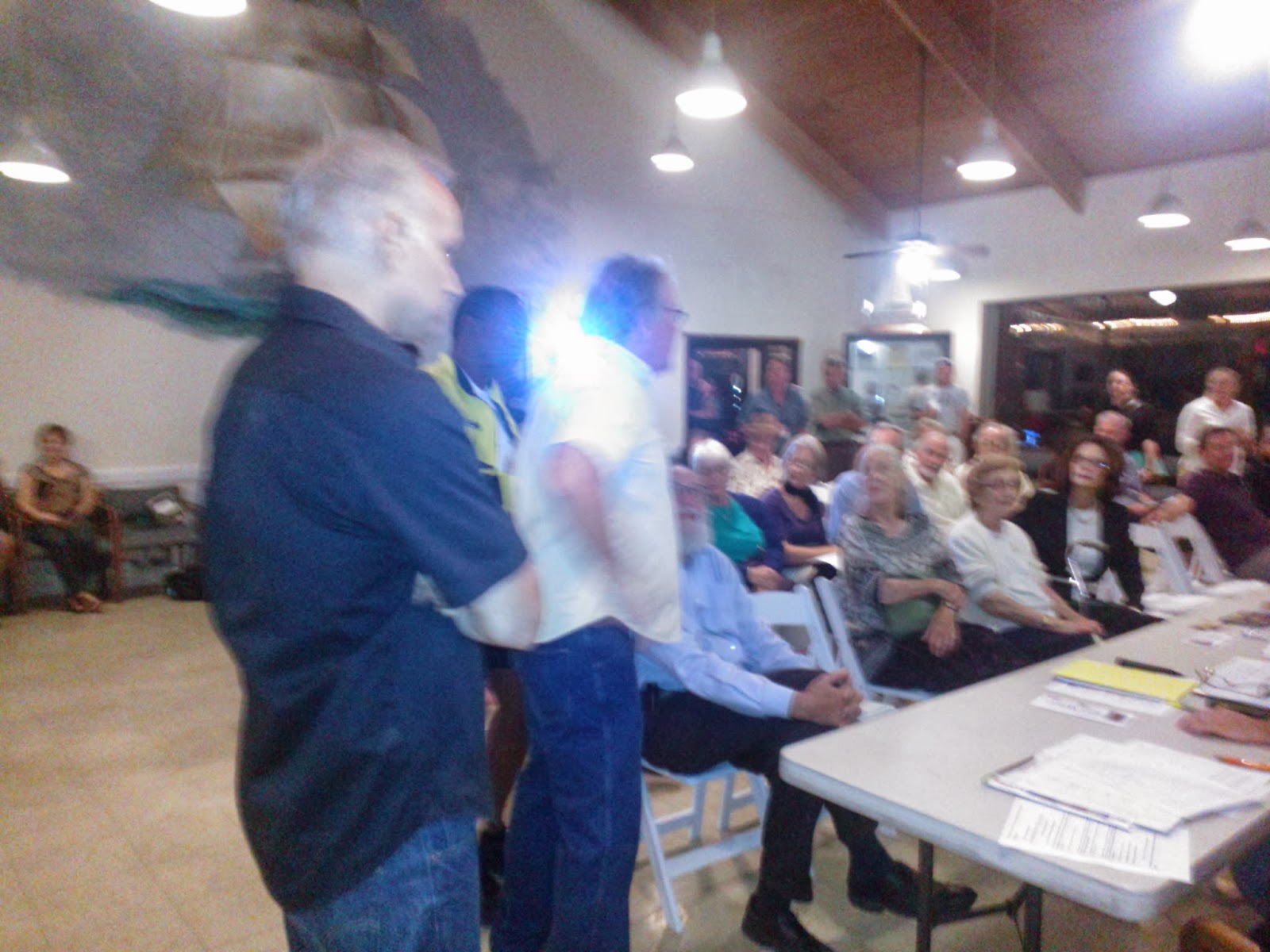
The exact moment the meeting exploded into chaos. Note
the police officer about to lead the angry gentleman away.

Last night I traveled down to Coconut Grove to attend a meeting of the Center Grove Homeowners Association. Fireworks were expected and I wanted to capture it as it happened. 

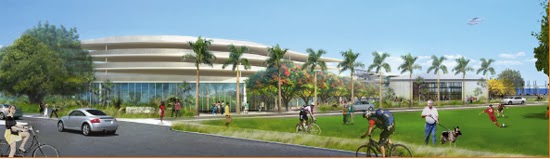
The reason for the potential fireworks was simple: many of the folks of Center Grove are vehemently against a proposed new development on the waterfront called Grove Harbour. [I like that it’s spelled the way I would spell it.] Both Miami Mayor Tomás Regalado and [allegedly] corrupt Commissioner Marc D. Sarnoff were on the agenda to sell their vision of the waterfront development and why this project is good for the community.

The exact moment the meeting exploded into chaos? When it was learned that both men skipped the meeting and Sarnoff sent his Chief of Staff, Ron Nelson, instead. That’s when all the yelling and screaming started. A police officer had to escort one man who wanted answers out of the meeting. That’s when most people left and the meeting devolved to wondering whether the meeting could be rescheduled so that [allegedly] corrupt Commissioner Sarnoff and Mayor Regalado could address their own constituents, just like it said on the agenda.

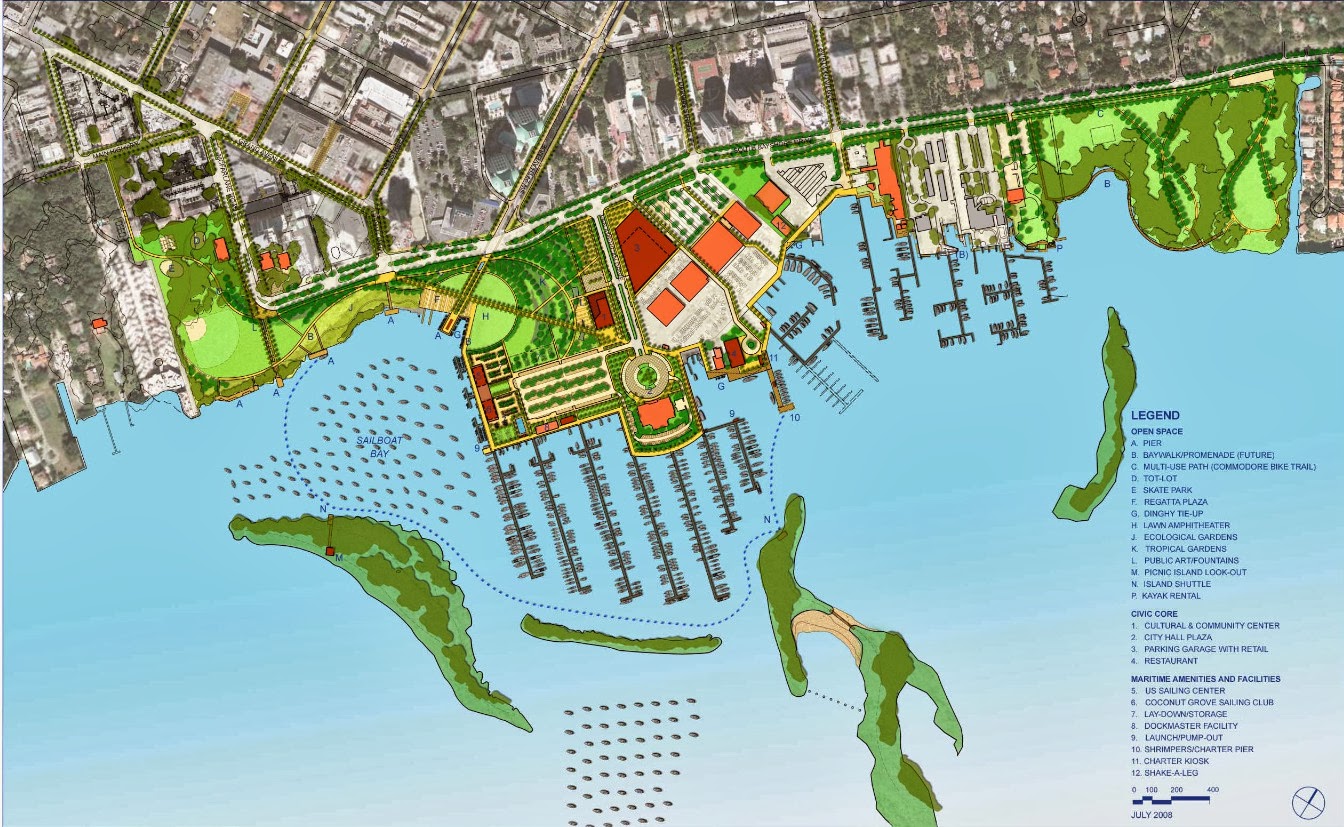
Proposed Grove Harbour development

That’s when I left as well, to go back to the footprint of what will become Grove Harbour to take another look see.

Back in August I wrote about Grove Harbour and how one of my faithful readers had urged me to get involved and come out against this latest Coconut Grove controversy. In that post, in which I stated I wasn’t going to involve myself in this controversy I made this point, to quote myself:

I’m philosophically against any development on any waterfront anywhere in the world: It blocks access to the waterfront, no matter how small the waterfront or the development. I am reminded of Frank Lloyd Wright who loved to build on hills, but said you should never build on top of a hill because you lose the hill. Same thing in my opinion.

One of 5 former airplane hangers in the footprint of Grove Harbour

However, I’ve been reconsidering my decision not to get involved in this controversy. The impetus for reversing my stand not to get involved was a brief exchange I had with Coconut Grove Village Councilor Michelle Niemeyer, who is backing the project. Neimeyer is someone for whom I have a great amount of respect. That’s what first got me thinking, “If she’s for it, how bad can it be? What am I missing?” However, I also realized that she’s a sailor and, because of that, she may have a conflict of interest on a project that includes amenities for the Coconut Grove boating crowd.

However, I had a crazy thought. I contacted Michelle and asked her whether she would show me around and walk me through the footprint of what will become Grove Harbour. She was happy to do it. To that end we met early Monday evening, appropriately at Scotty’s Landing, which is not only Ground Zero for the Grove Harbour development, but also Ground Zero for the entire controversy; because Grovites wanted to save the venerated crappy restaurant with the crappy food that everyone complained about before it appeared they would lose it. That’s when the “Save Scotty’s” campaign started.

SPOILER ALERT: I am now, conditionally, in favour of the project.

What I said above still stands. Philosophically I believe the waterfront belongs to the people and, whenever possible, waterfront should be grass and park as far as the eye can see. However, I also listed 12 edicts I would make if I were to suddenly become Emperor of Coconut Grove. The first of which said:

1). Raze every building on the east side of South Bayshore Drive from McFarlane through David T. Kennedy Park, except those few that have historic designation.

Dinner Key back in the day, with the Pan AM terminal in
the foreground and airplane hangers in the background.

And, therein lies one of the rubs of any proposed development along the Coconut Grove waterfront. Back in the day when Dinner Key was the location for the Pan American Airlines Clipper Ship flights, the company built the building that now houses Miami City Hall, as well as 5 massive airplane hangers. After Pan Am moved off Dinner Key, the airplane hangers were converted into marine use, a function they’ve served ever since.
Approximately 15 years ago then Commissioner J.L. Plummer used a pocket item (something placed on the agenda at the last minute) at a commission meeting to push for a mixed-use highrise development for Dinner Key. A group of Grovites were aghast at the idea of a massive development on Dinner Key. Springing into action they had the 5 airplane hangers registered on the index of National Historic Buildings. What this means is that these 5 former-airplane hangers will be there until Coconut Grove freezes over. Those buildings are represented on the site plan (above) by the orange rectangles. The 6th orange rectangle is the current Miami City Hall.

[Additionally, removing them would be a monumental job. While they are just large, hollow, aluminum buildings — with little to recommend them architecturally-speaking — the concrete pad on which the hangers were build are 8 feet thick.]

A list of just some of the public meetings asking for input from the community

This is just one of the many interesting facts I learned as Michelle Niemeyer and I spent the next few hours discussing the Grove Harbour development and walking the entire perimeter, as well as all through it. My first surprise was that Neimeyer was part of the team that sought public input and, as Chair, helped pilot this unwieldy ship of a project through the shoals of citizen involvement to come up with a master plan that was agreeable to as many of the citizens as possible. To that end there it took approximately 40 public meetings to come up with the Coconut Grove Waterfront Master Plan. [PDF] This Master Plan was the blueprint for the public bidding process to develop the waterfront.

Where were the people during the public input process who are now protesting vociferously against this project? Every one of them could have had their say at the public meetings that were not only publicized, but stretched over a period of several years. It seems a little late now that the boat left the berth.

Follow THIS LINK for a full series of PDF files
on the Master Plan and winning and losing bids

However, the citizens of Miami will have one more kick at the can: A November referendum puts the final project on the ballot. If the citizens of the small hamlet of Coconut Grove can convince enough Miamians to vote against this project, it’s dead in the water. However, I don’t believe they have a hope in hell of derailing this project, to mix metaphors. Coconut Grove is a miniscule part of Miami proper. It will be like sailing into the wind to get enough people to vote against this project.
When I was finished with Niemeyer’s walking tour I had a much better understanding of the issues involved. I also was able to decide for myself about the plan for Grove Harbour. It’s my opinion that what is being proposed for the waterfront is 1000% better than what is currently there. Here are some of my reasons for coming to that conclusion:

► It’s not as if they are taking pristine land and turning it into a huge development. The entire area is already developed. Grove Harbour simply makes it far more people friendly.

► Many people are disturbed by the proposed parking garage, which will be located as close to South Bayshore Drive as possible. However, the parking garage eliminates acres of hardscape, which are currently used as parking lots, next to parking lots, which are beside parking lots. Almost all of that reclaimed area will become grass and parkland.

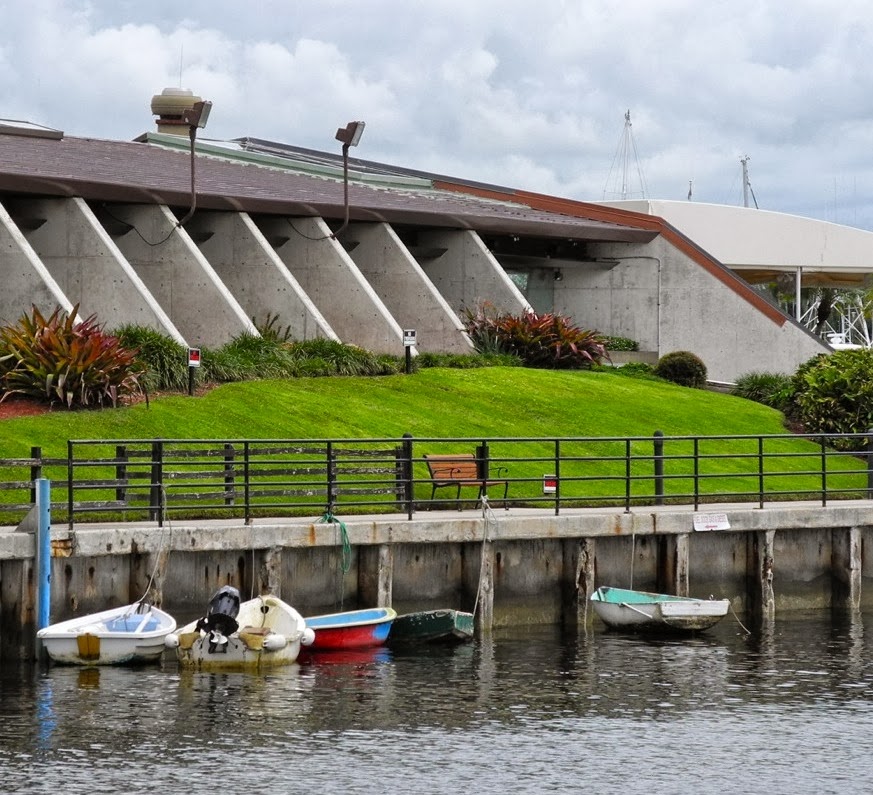
The Chart House Bunker from the water

► Anything that gets rid of The Chart House can only be considered a good thing. This is easily one of the ugliest buildings I’ve ever seen, masquerading as a fine dining restaurant. People call it “The Bunker” and that’s not an inaccurate description. While it might look nice on the inside and have great views of Biscayne Bay, from the outside it’s a monstrosity that never should have been built. At the bay side walkway there is an 8 foot berm that’s totally inappropriate for the waterfront. To be fair: While I say good riddance, Curbed Miami has a differing view and believes it’s a wonderful example of organic architecture. I don’t see organic. I see something that sticks out like a sore thumb.

► New laws that went into effect after Scotty’s Landing and The Chart House were built now requite a minimum of 50 feet as a public easement along the waterfront for pedestrians. Currently both of these restaurants are virtually on the edge of the water. The Grove Harbour plan will make the pedestrian walkway much more of a boardwalk, without the boards.

One of several boat racks in the current footprint of the proposed development

► The proposed plan creates much safer pedestrian walkways that bisect Grove Harbour and cross perpendicularly. Currently families with children and strollers are forced to walk through one of the boatyards to get from the parking lot to the waterfront. This is where boats are being shunted in and out of the water by giant forklifts and a terrible accident is always a possibility there.

►The Grove Harbour plan creates a seamless walkway from Peacock Park all the way to Kennedy Park, with plenty of amenities for families, boaters, joggers, and cyclists alike.

Having said all that, there are a few things I do not like about Grove Harbour. My biggest concern is the building itself:

Looking west through Grove Harbour, showing one of the pedestrian walkways bisecting the development

The parking garage viewed from South Bayshore Drive, showing retail on the ground floor

Call me crazy, but I think a development on the water should somehow reflect the sense of place. I’ve seen buildings on waterfronts that, at first glance, seem to be
large sailboats. It’s only on the second glance that you realize it’s a
building. I don’t see this glass and chrome building as saying anything about Biscayne Bay. It’s a building that could be dropped anywhere else in Magic City and not seem out of place. Here it does, to my eyes. The only accommodation made to the site is the floor to ceiling glass walls, through which visitors will have unimpeded views of Biscayne Bay.

I am told the choice of materials used for Grove Harbour was meant to reflect the aluminum construction of the former-airplane hangers. Again, I don’t see it. The airplane hangers have a funky feel, while the renderings of Grove Harbour remind me of glitzy Vegas.

Another concern I have is about the retail space in the project. There are already empty storefronts in Center Grove, just blocks away. Could the Grove Harbour retail harm struggling businesses in Coconut Grove? It’s possible, but only time will tell. Originally the RFP was supposed to call for marine-related retail, but an editing error appears to have left it out, which leaves it open to any retail. However, a previous marine retail outlet failed in one of the hangers, so maybe that error is not such a bad thing. One of the retail outlets that seems the most welcome is a convenience store. Currently those who live on their boats in the harbour have a huge hike just to get a gallon of milk. This will alleviate them having to get in a car just to get a bottle of pop.

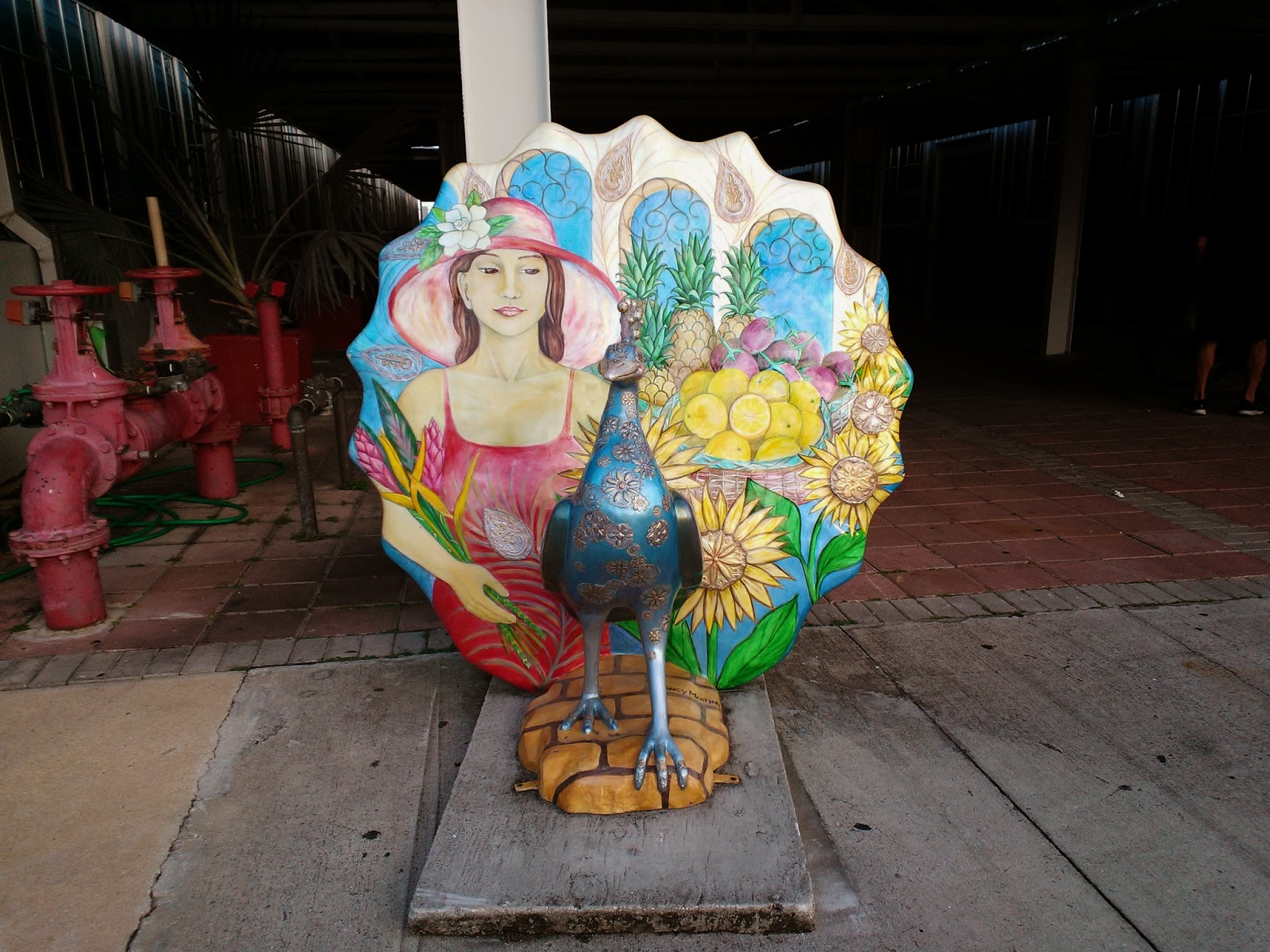
This peacock stands guard outside Fresh Market

Furthermore, there’s already retail in the footprint of Grove Harbour. In the northernmost hanger is a Fresh Market, which appears to be doing good business and will remain.

I think it’s unfortunate that so many rumours are being circulated about this development. It’s not a “mall,” as it’s being constantly described on the Coconut Grove Grapevine. The Grapevine has come out solidly against Grove Harbour and has given plenty of its blog real estate to promoting the antis.

One wonders where all these people were when there was an opportunity to have input into the project.

This is what it’s all about: A view of Biscayne Bay

A Century of Coconut Grove Racism ► Soilgate Is Trolleygate Writ Large

One of hundreds of thousands of Racist internet memes

Follow the bouncing ball: Trolleygate is modern day Racism, pure and simple. Furthermore, the Racism that allowed for Trolleygate is exactly the same Racism that thought West Grove was the perfect place for Old Smokey, an incinerator that belched carcinogenics into the air for 5 decades. Racism — which is a cancer on our body politic — may have led to actual cancer clusters in Coconut Grove. I’m here to prove that thesis. 

Let’s start here: It’s been a truism since the founding of ‘Merka that People of Colour have always gotten the short end of the stick. There is no disputing that. But that’s a thing of the past, according to modern day Racists, because we now have a Black president. We are now living in a post-racial society. MISSION ACCOMPLISHED!!! Right?

For an explanation on the pics used to illustrate this article, please read my essay Racist Memes and Blogging ► Unpacking the Writer

Not even close. While some Racism is less blatant than it has been in previous decades, one can find hundreds of thousands of Racist memes against President Obama, each more disgusting than the next. However, make no mistake: It’s still Racism. Racism doesn’t have degrees. Like being pregnant, a meme can’t be a little bit Racist. It’s either Racism, or it isn’t. The entire story of Coconut Grove depicts a Racism that continues to this very day, culminating in Trolleygate.

West Grove is a quiet residential neighbourhood that has remained predominantly Black since its founding in the late 1880s. It was settled by Bahamians who came up through Key West, at one time Florida’s largest city. The Black Bahamians who settled in Coconut Grove worked for The Peacock Inn and Commodore Ralph Monroe, among the earliest residents. As a nascent tourist trade flourished, more Black folk arrived to do all of the backbreaking work and menial labour that made it all happen.

That West Grove wasn’t razed is due almost entirely to the efforts of one man, Ebeneezer Woodbury Franklin Stirrup. E.W.F. Stirrup was one of Florida’s first Black millionaires and, at one time, the largest landholder in Coconut Grove. On some of the land he owned he threw up more than 100 houses with his own hands. These he rented, sold, and bartered to other Bahamians. That’s why, at one time, Coconut Grove once had the highest percentage of Black home ownership in the entire country, making it unique.

It’s for that reason and that reason alone that The Powers That Be were unable to dislodge the Black residents of Coconut Grove. Overtown, just up the road and the second Black neighbourhood in Miami, had I-95 rammed through the middle of what had been the Black Shopping and Entertainment district. However, Overtown was mostly renters with absentee landlords, who were happy to cash out on their investments. The same pattern took place in Paradise Valley, in my home town of Detroit, which was leveled for I-75. The same scenario played out all across the country.

It’s not as if the Powers That Be didn’t try to get rid of Black Grove. There were three separate attempts to get rid of the neighbourhood. In 1921 an urban renewal project called The Bright Plan, approved but never realized due to an economic downturn, would have created a golf course on everything west of Main Highway to Douglas and north to Grand Avenue. In 1925 City Fathers tried to get Miami to annex around what was called Coloredtown, instead of including it. Miami decided to annex it all instead, which led to the creation of Coral Gables, the city that Racism built. In the ’50s, long after the rest of the city had indoor plumbing, West Grove still used outhouses. Honey wagons were just a way of life long after every surrounding neighbourhood (read: White neighbourhoods) had an indoor toilet. In the ’50s. The city wanted to raze the entire blighted neighbourhood and start all over, but the high percentage of Black home ownership defeated the proposal. People, who in some cases were now the 2nd or 3rd generation in the same house, refused to sell. They knew better. Where could they go? They would be redlined out of any neighbourhood they wanted to buy into. It was better to stay put and bequeath their homes to their children and their children’s children.

Which is to explain why the neighbourhood has remained predominately Black. That and the fact that White folk tend not to move into Black neighbourhoods. I’ll now let Nick Madigan, writing in yesterday’s New York Times, pick up the story of Old Smokey:

MIAMI — When she was little, Elaine Taylor remembers rushing home whenever Old Smokey fired up. Clouds of ash from the towering trash incinerator would fill the air and settle on the ramshackle houses and the yards of the West Grove neighborhood.

Her mother, who took in laundry, would be whipping sheets and shirts off the clotheslines. Often, the soot would force Elaine and her mother to wash everything again, by hand.

Old Smokey was shut down in 1970, after 45 years of belching ash, but its legacy might be more ominous than mere memories of soiled laundry. Residents of the neighborhood, established by Bahamian immigrants in the 1880s, have become alarmed by recent revelations that soil samples there show contamination from carcinogens like arsenic and heavy metals, including lead, cadmium and barium.

Ash from the old incinerator is being blamed, and residents are asking why none of this came to light sooner.

Something that Madigan leaves out of his story — because it makes a simple story of soil pollution and subsequent coverup far too complicated — is that the coverup was only discovered due to Trolleygate, the story I’ve been following since January. The documents were discovered by the pro bono legal team researching Trolleygate while preparing its case against Miami, Coral Gables, and Astor Development. While that suit was thrown out of court for a lack of jurisdiction, the documents kicked loose during the research are still bearing fruit. Friday I wrote about an email from a City of Miami Zoning and Building Department official who said that Trolleygate did not conform to the Miami 21 Plan. Yet, after some undetermined jiggery-pokery, [allegedly] corrupt Commissioner Marc D. Sarnoff managed to get the project approved anyway, despite the fact that it screws his owns constituents and rewards a developer in the next town over. But, that’s now a side issue to Soilgate, the discovery of toxic soil throughout Coconut Grove and greater Miami. [Coral Gables is now suing to get out of ever having to use the polluting diesel bus garage.]

The Racism that decided a Black neighbourhood was the perfect place for a polluting diesel bus garage — despite it not being zoned for it — can be seen as a parallel to the decision in the 1920s to build Old Smokey, the incinerator that polluted Miami. Miami needed an incinerator. Why not stick it as far away from the White folk as possible? Stick it in West Grove. Again from the New York Times:

Across the street from Old Smokey’s former site lies Esther Mae Armbrister Park and its playground. Down the block is George Washington Carver Elementary School, a once all-black institution that traces its history to 1899. Former students recall ash blowing in through the school’s open windows.

[University of Miami law] Professor [Anthony V.] Alfieri [of the Environmental Justice Project] said that the construction of Old Smokey “in the middle of a Jim Crow community” in 1925 exemplified the city’s pattern of neglecting the West Grove, an area that has never experienced the prosperity so evident in its neighboring communities. In a 1950 article in Ladies’ Home Journal, Marjory Stoneman Douglas wrote that when the city installed a water and sewage system in Coconut Grove, its western neighbor was left out of the project, and for years residents continued to use wells and outhouses.

Old Smokey was shut down in 1970 after many years of neighbourhood protests and a successful legal battle initiated by the White folk of Coral Gables. Yet, 98% White Coral Gables learned nothing from that court battle. When it needed a place to build its polluting diesel bus garage, Astor Development chose West Grove. This is the neighbourhood that’s been given the short end of the stick since it was called Kebo by the original Bahamian settlers almost 130-years ago. Even if you attempted to argue, against all logic, that the developer was unaware it was a Black neighbourhood, the only reason the land was cheap was due to the last century of systemic Racism, that depressed every economic indicator you can name in West Grove, especially when compared to the rest of the 33133 Zip Code, now considered one of the most exclusive in the entire country.

The Supreme Irony: Air pollution — emanating from a fake diesel-powered trolley bus or a giant incinerator — doesn’t abide by the Colour Line, of course. There appears be less pollution the closer one gets to Old Smokey’s former site. As the expression says, “What goes up, must come down.” It seems a lot of Old Smokey’s toxins came down in the Marc D. Sarnoff Memorial Dog Park. Coincidentally, or not, that’s right across the street from where [allegedly] corrupt Commissioner Marc D. Sarnoff lives. The New York Times again:

“Everything is testing to be residential standard,” Mr. Sarnoff said, referring to contaminant levels permitted under environmental regulations.

That may not be the final word. A cancer researcher at the University of Miami said that she and several colleagues discovered a cluster of pancreatic cancer cases in the West Grove several years ago.

“That’s the little region that lights up,” said the researcher, who spoke on the condition of anonymity because of the delicate nature of the issue. Although she found the discovery “puzzling,” she said she did not pursue it because of a lack of funds. But when she read a newspaper article this year about Old Smokey that said its ash had spewed arsenic and heavy metals into the neighborhood, she said “everything started making sense.”

The researcher noted that no correlation could be established between the cancer cluster and the old incinerator without more research.

Institutional Racism could be the answer as to why so many people in Coconut Grove are now being diagnosed with cancer. Yet, despite this ugly history of sticking the Black neighbourhood with what the White neighbourhood doesn’t want, [allegedly] corrupt Commissioner Marc D. Sarnoff, the City of Miami, and Astor Development all still think it’s appropriate for them to have played a shell game in order to get Trolleygate approved.

That’s nothing but Modern Day Racism, pure and simple.

Enjoy some videos of the Marc D. Sarnoff Memorial Dog Park from September 13, 2013, as the soil testing was occurring.


Grove Harbor ► No Skin In The Game

When I think of seashore I don’t think of chrome and glass superstructures.

A faithful reader has written [privately] to ask that I get involved in the latest Coconut Grove controversy, Grove Harbor * [sic], or Grove Horror as some of the locals have taken to calling it. To that end, I spent about 2 hours reading up on the project, both pro & con, but mostly con because there seems to be more of that ‘out there’ on the innertubes.

I’m philosophically against any development on any waterfront anywhere
in the world: It blocks access to the waterfront, no matter how small the waterfront or the development. I
am reminded of Frank Lloyd Wright who loved to build on hills, but said
you should never build on top of a hill because you lose the hill.
Same thing in my opinion.

I tend to think of all Coconut Grove issues in relation to the E.W.F. Stirrup House. This proposed development is just a mile’s walk from the E.W.F. Stirrup House. At one time it might have been a gorgeous walk. Walk it these days and you’ll barely catch a glimpse of the majesty of Biscayne Bay, with Miami Beach in the distance, even though you’re walking parallel to it. Decades of bad decisions along the waterfront have led to what it is today, for better or worse.

What would Emperor Headly do?

The footprint of the proposed Grove Harbour development is roughly everything
on the right half of this vintage post card, but the historic buildings will remain

Let’s face it, that job is already filled by alleged corrupt Miami Commissioner Marc D. Sarnoff. However, if I were a benevolent Emperor of Coconut Grove, here’s what I’d do to correct previous dunderheaded mistakes along that section of South Bayshore Drive, after hanging banners that said “The Waterfront Belongs to Everybody.”  

  1. Raze every building on the east side of South Bayshore Drive from McFarlane through David T. Kennedy Park, except those few that have historic designation. 
  2. Declare the resultant green space, once landscaped, a People’s Park;  
  3. If the members made enough noise, I might be inclined to grandfather in establishments like the Coral Reef Yacht Club and the Coconut Grove Sailing Club, that serve a ‘community’ of members. However, I would maintain a public access to the waterfront for all;
  4. I would be disinclined to grandfather in commercial enterprises such as Scotty’s, the Chart House, or any of the boat sales/rentals places or the charter boat companies. If any of those businesses wish to remain on prime Coconut Grove real estate, they will have to pay through the nose, on short leases, with all the money going into waterfront improvements;
  5. Decree that from this day forward nothing larger than bike racks and public restrooms could be built on the east side of South Bayshore Drive until the end of time;
  6. Remove every parking space from the east side of South Bayshore Drive, forcing people to walk over from the thousands of parking spaces just a few short blocks away in Coconut Grove Center;
  7. Create level pedestrian crossings at every intersection along South Bayshore Drive, forcing drivers to yield to anyone within the crosswalk; 
  8. Add calming speed bumps and traffic circles to discourage drive-through traffic on South Bayshore Drive;
  9. Set my mind on other ways to encourage pedestrians and make it harder for cars along South Bayshore Drive;
  10. Rip out all the mangroves in Peacock Park, which were only planted in the ’80s;
  11. Take back Peacock Park from the private lease given to St. Stephen’s Church (What the hell was Sarnoff thinking on that one?);
  12. Turn the former NET office into something that actually serves the community.
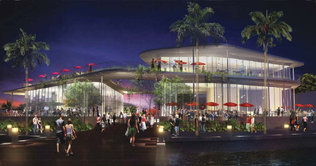
An artist renderinging of Grove Harbor at night,
when the chrome and glass will really shine

That’s just 12 things I would do off the top of my head and, admittedly, I’ve done no research on these ideas. However, none of my suggestions would ever include building a chrome and glass thingamajig on the waterfront, give restaurants 80-year leases, and attach a huge parking garage. But, that’s just me because, in my opinion, the waterfront belongs to everybody.

Truth be told, this is a long-winded way of saying I really don’t care and I am hesitant to get involved in this battle. I have no skin in the game. I don’t live in Coconut Grove. I don’t own a boat, therefore I don’t need that kind of access to the water. Nor am I one of those rich folks on the west side of South Bayshore Drive, hoping a few deluxe restaurants and a glitzy glass and chrome dealie on their doorstep will improve their property values. It’s hard not to compare those values to the property values on Charles Avenue, just a mile away, where the E.W.F. Stirrup House is still undergoing Demolition by Neglect.

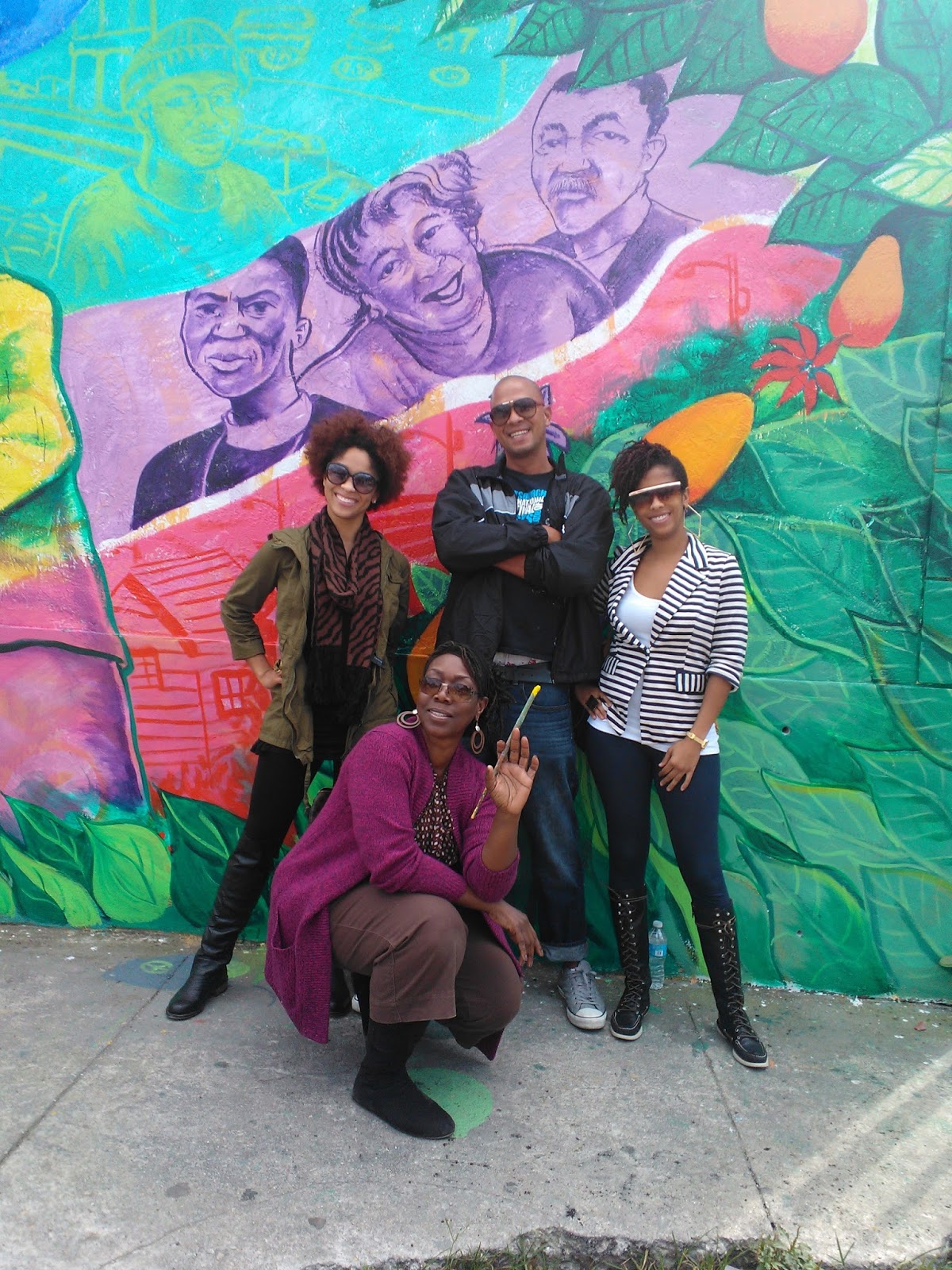
Despite the wish fulfillment expressed in the One Grove mural, Coconut Grove is one of the most racially and economically divided communities you’re ever going to see. This project is only 2.2 miles away from the Trolleygate garage, which is across from the One Grove mural, but it might as well be a million miles. The concerns of the folks on South Bayshore Drive are light years away from what affects the people of West Grove. One community is complaining about a huge development that MIGHT be placed on its doorstep, while the other is complaining of huge diesel bus maintenance facility ALREADY dropped on its doorstep, which a judge recently ruled they are powerless to stop. What’s wrong with this picture?

At the unveiling of the One Grove mural earlier this year

Truth be told, I really don’t know enough about *THIS* particular project to jump into it. There will apparently be a referendum, so the community will have its say. And, when I say “community” I really mean Miami as a whole, because Coconut Grove is only a fraction of Miami. And, the community will get whatever the community decides, unlike West Grove.

However, there are two big red flags on this project that should give everyone pause:

  • Just like Trolleygate and the Coconut Grove Playhouse, all the serious
    negotiations and decisions have already happened in the back rooms
    between the politicians and the developers. 
  • Allegedly corrupt Miami Commissioner Marc D. Sarnoff is involved in Grove Harbor negotiations up to his hip-waders.

As near as I can tell the referendum will just be
the rubber stamp to what Coconut Grove assets allegedly corrupt Miami Commissioner Marc D. Sarnoff has already sold out to the developers. Unless the Coconut Grove community can muster
enough opposition to stop the project, it’s a fait accompli. Just like Trolleygate was for his other constituents. Rich or poor, Black or White, Marc Sarnoff doesn’t care who he sells out.

I’ll leave this windmill for the Coconut Grove Grapevine to tilt at.

* My fingers stutter whenever I am called upon to type a word that should have a “U” in it, like harbour and colour.

UPDATE: It turns out my fingers needn’t stutter. Grove Harbour is spelled exactly the way I would spell it.

Is Gino Falsetto Breaking The Law Again? ► A Charles Avenue Update

The Charles Avenue historical marker with the
E.W.F. Stirrup House across the street.

It’s always been about the E.W.F. Stirrup House. My research into Ebeneezer Woodbury Franklin Stirrup has led to many interesting tangents, none of which would I have ever heard about had it not been for Mr. Stirrup.

Among those tangents include my series No Skin In The Game, documenting 90 years of Coral Gables racism; my investigations into [allegedly corrupt] Miami Commissioner Marc D. Sarnoff, who managed to build himself a dog park and a traffic circle, not to mention the undying enmity of his West Grove constituents; and my ongoing reporting on Trolleygate, which culminated in a hearing at the Dade-County Courthouse on Friday. However, I would never have come across those stories had I not accidentally encountered the Charles Avenue historical marker in February of 2009. That was the day I first set eyes upon the E.W.F. Stirrup House and fell in love.

That’s the very same day I started researching the history of the house, which quickly led to the discovery that E.W.F. Stirrup was a remarkable man — decades ahead of his time. Mr. Stirrup created an area unique to this entire country. Because of his efforts Coconut Grove at one time had the highest percentage of Black home ownership in the entire country, which might be the only reason West Grove has remained intact all these years.

Elsewhere in ‘Merka, Black neighbourhoods were comprised of a majority of renters, with absentee landlords. This is why I-95 could be punched through the middle of Overtown, or why I-75 totally obliterated Paradise Valley, in my home town of Detroit.

Yet, sadly, Mr. Stirrup’s legacy is barely known to the people of Coconut Grove. If they know the name at all it’s only because of the E.W.F. Stirrup Elementary School. However, that’s not Mr. Stirrup being honoured by having a school named after him. That’s his son. Not that he doesn’t deserve to be commemorated, because he was a man with a legacy in his own right. However, his father was far more significant to the history of Coconut Grove, Miami, Florida and the United States. This is not hyperbole. Read my previous chapters on the E.W.F. Stirrup House to understand why Mr. Stirrup was important and why it’s imperative to save his house.

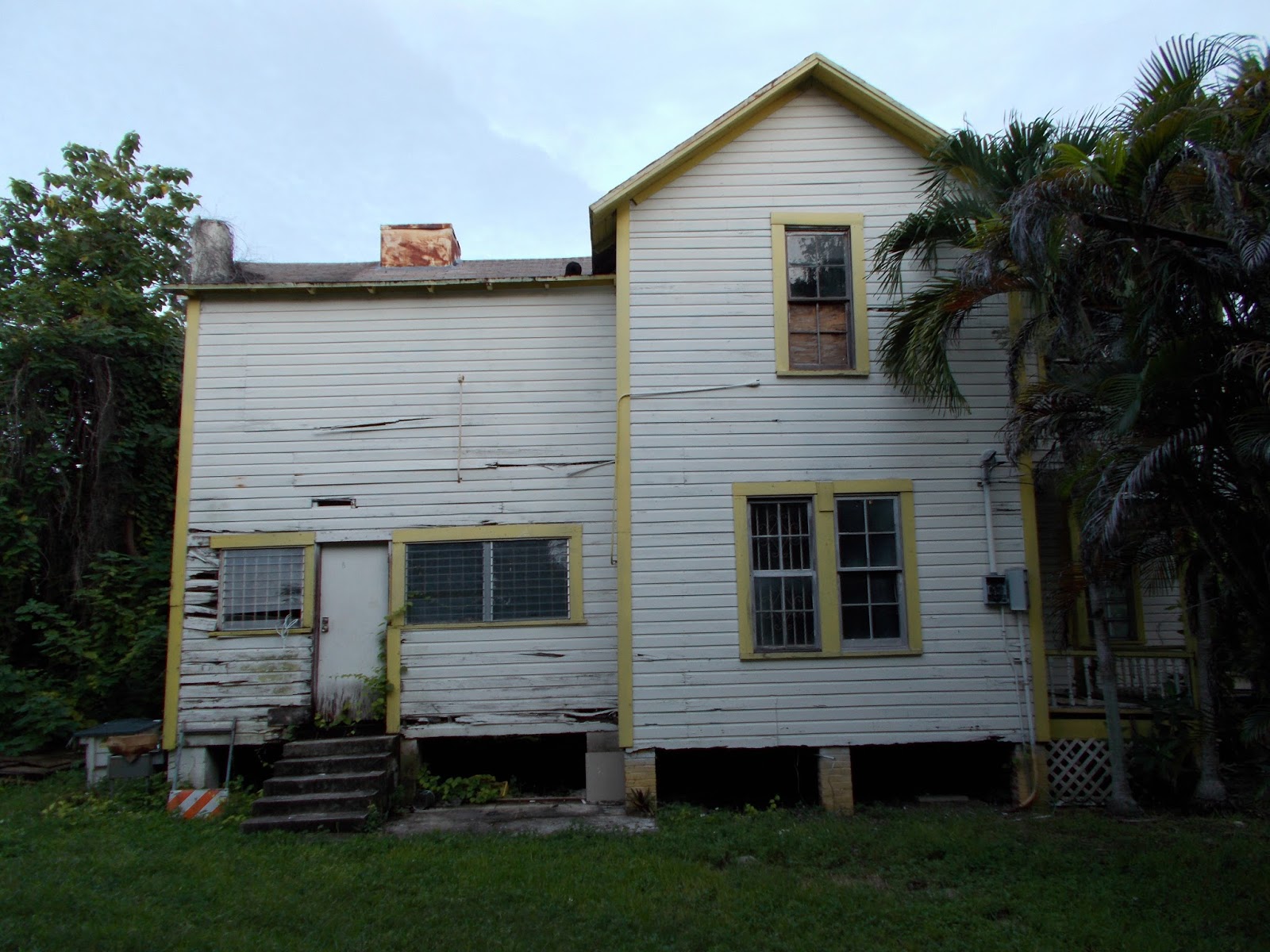
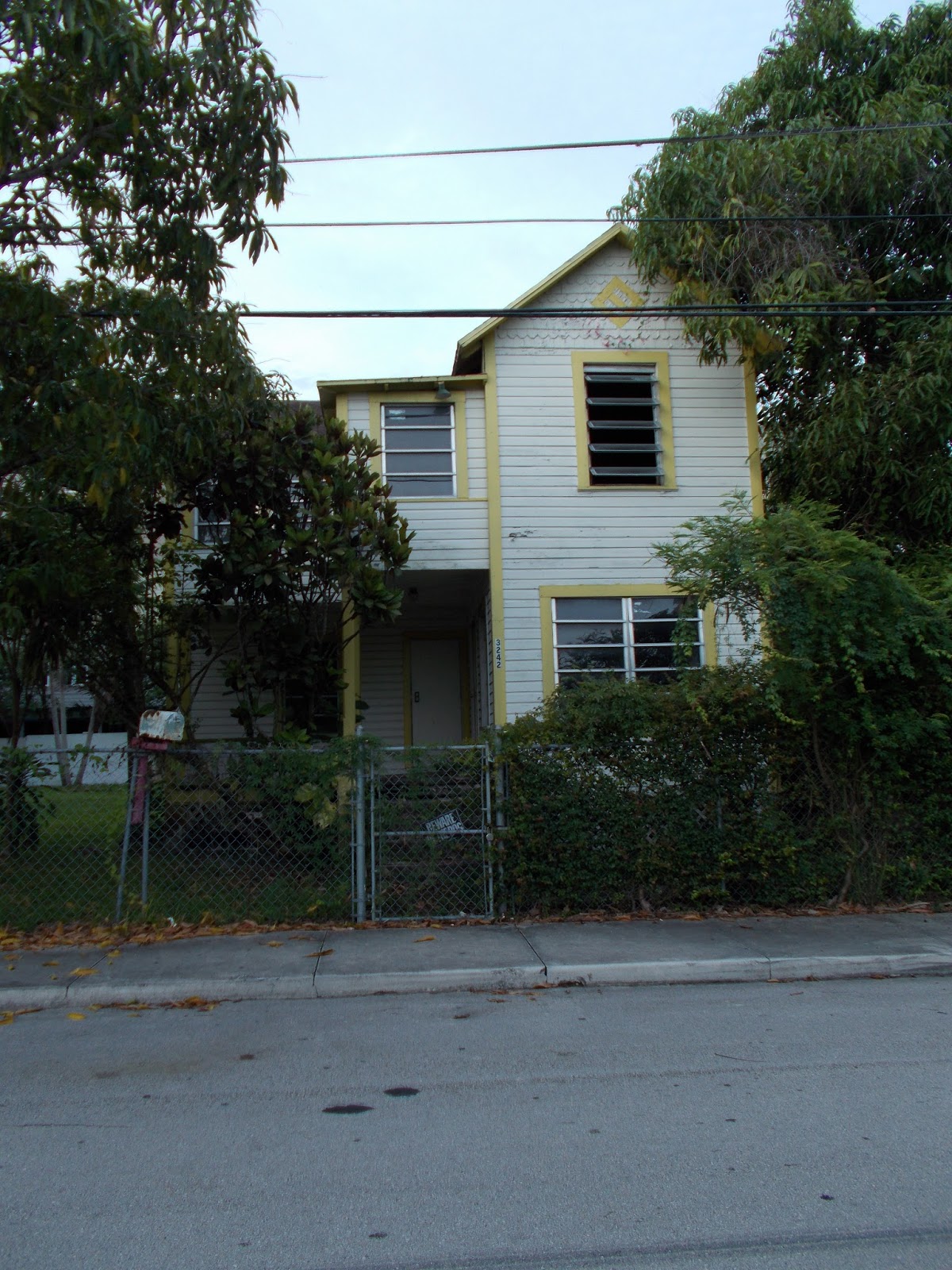
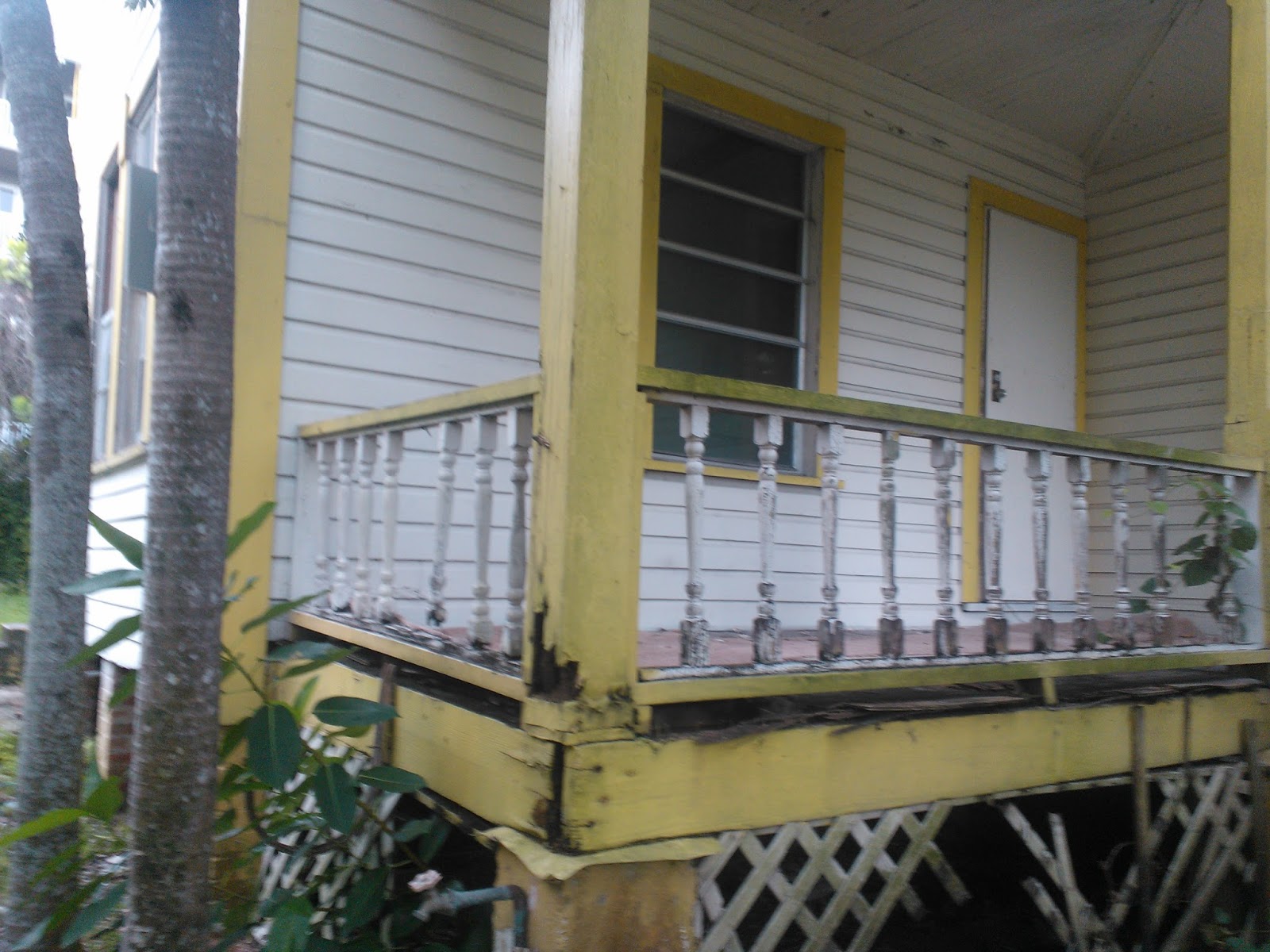
Even though the E.W.F. Stirrup House has been designated historic by the City of Miami, a rapacious developer got his hands on the Stirrup House 8 years ago and has been allowing it to undergo Demolition by Neglect ever since. Aries Development is the name of the company and and Gino Falsetto is the name of the man who runs it. Falsetto is Canadian, not that I hold that against him because so am I. However, Falsetto left a string of bankrupt restaurants behind in Ottawa, Ontario, Canada on which the Canadian taxpayers lost an estimated $1,000,000. And, of course, all the employees and vendors lost money. However, shortly afterwards Falsetto landed on his feet as one of Miami Real Estate’s big wheelers and dealers. Then he set his eyes on Coconut Grove and built the Grove Gardens Residence Condominiums on Main Highway, immediately behind the E.W.F. Stirrup House. And that’s when the E.W.F. Stirrup House began to fall apart.

One wonders if the Canadian taxpayers provided Gino Falsetto with the grub stake to buy into the always over-heated Miami real estate market.

During Falsetto’s property-trading he managed to acquire a 50-year lease on the E.W.F. Stirrup House, the ownership of which still remains in the Stirrup Family. At the time he acquired the lease, Falsetto promised to restore the house. In the 4 years I have been visiting the house, and the 4 years prior to that, he’s done virtually nothing, except to make things worse by allowing it to undergo Demolition by Neglect.

It was just a year ago, August 18th, that I got into the house for the first time. I documented that in a Not Now Silly post called Unpacking Coconut Grove ► Part Four ► Open Houses and Broken Laws. Compare the pics in that post to the current look of the interior in this video taken on August 16, 2013:

All of that interior destruction is apparently taking place without the benefit of a plan for historic restoration, which I am told must be approved by the Miami Historical Board before any work is to take place. The work is also being done without benefit of a building permit, which must be posted prominently on the property while work is going on and until the completion of the renovation.

A wide-open gate on the Stirrup property says, “C’mon in.”

Let me tell you a little something about getting inside the E.W.F. Stirrup House. Last Friday was the first time I ever surreptitiously entered the house, but the two previous times I was invited in by workmen.

There was a time I used to wander onto the Stirrup property at will. There was a very large hole in the chain link fence at the extreme south-east corner of the property. After I started posting pictures of the property (that had obviously been taken from on the property), I discovered the hole had been patched. Once that hole was fixed I stopped slipping through that gap. Nor did I ever slip through the gap between the two front gates, which are chained together so loosely that Rush Limbaugh could squeeze through. However, I have encountered those gates wide open on many subsequent visits. When the gate is left wide open I take that as a personal invitation to document Gino Falsetto’s shoddy stewardship of a precious Miami historic site.

On August 16th, when I arrived at 7 a.m., the gate was wide open and had clearly been left that way overnight. I wandered onto the property and took several pictures before I headed off to my next appointment. However, I noted something on that visit that required an additional visit later to see whether my eyes were deceiving me.

When I got back to the E.W.F. Stirrup House I discovered my eyes hadn’t deceived me at all. The front door had been left open a crack all night and, at 2 in the afternoon, it was still open the same crack, which meant that there had been no workmen there in the interim. So, if an open gate says, “C’mon in,” so does an unlocked front door. My desire to save the house and protect it from idiots who have no conception of the history the house represents overrules any proprieties about property rights.

An example of some of the destruction that’s taken place inside the E.W.F. Stirrup House.

So, yesterday I a very busy boy. I spoke to a very nice woman at the City of Miami Historical Preservation office. She told me that as far as she could tell, there were no plans on file for historic preservation of 3242 Charles Avenue, aka The E.W.F. Stirrup House. However, she would have to do some more research before she could state that categorically.

Then I left a message for Peter Iglesias, who is head of the Building Department, where any building permits would have been issued for work on the E.W.F. Stirrup House. However, I suspect there is no building permit. Just like there was no building permit last year when I reported [allegedly] illegal demolition work inside the house. That file was closed without a determination. What’s crazier is that no matter how many times I called back, no one was ever able to tell me what happened to my complaint, only that it had been closed. I had a confirmation number and everything. I believe it fell into a Black hole, pun intended.

In fact, I have documented here, in an open letter to Miami, how all my previous phone messages left for City of Miami employees have all gone into the same Black hole. Miami employees never answer their phones and have never returned the phone messages I’ve left. I was shocked when Marina Novaes in the Historic Preservation office answered her phone. That was a first! She took my number and said she’d get back to me. That would also be a first.

And, just like last year, and the [allegedly] illegal demolition work inside the house, it’s invisible if and when the building inspector comes around because IT’S ALL HAPPENING INSIDE THE WALLS OF THE HOUSE, not outside. I can’t stress this enough. That’s why Gino Falsetto has been getting away with this [allegedly] illegal work. And, that’s why I took the risk and decided to enter the house. I’ve got it all documented if the City of Miami Building Department Chief Peter Iglesias wants to see what’s happening inside this historic house.

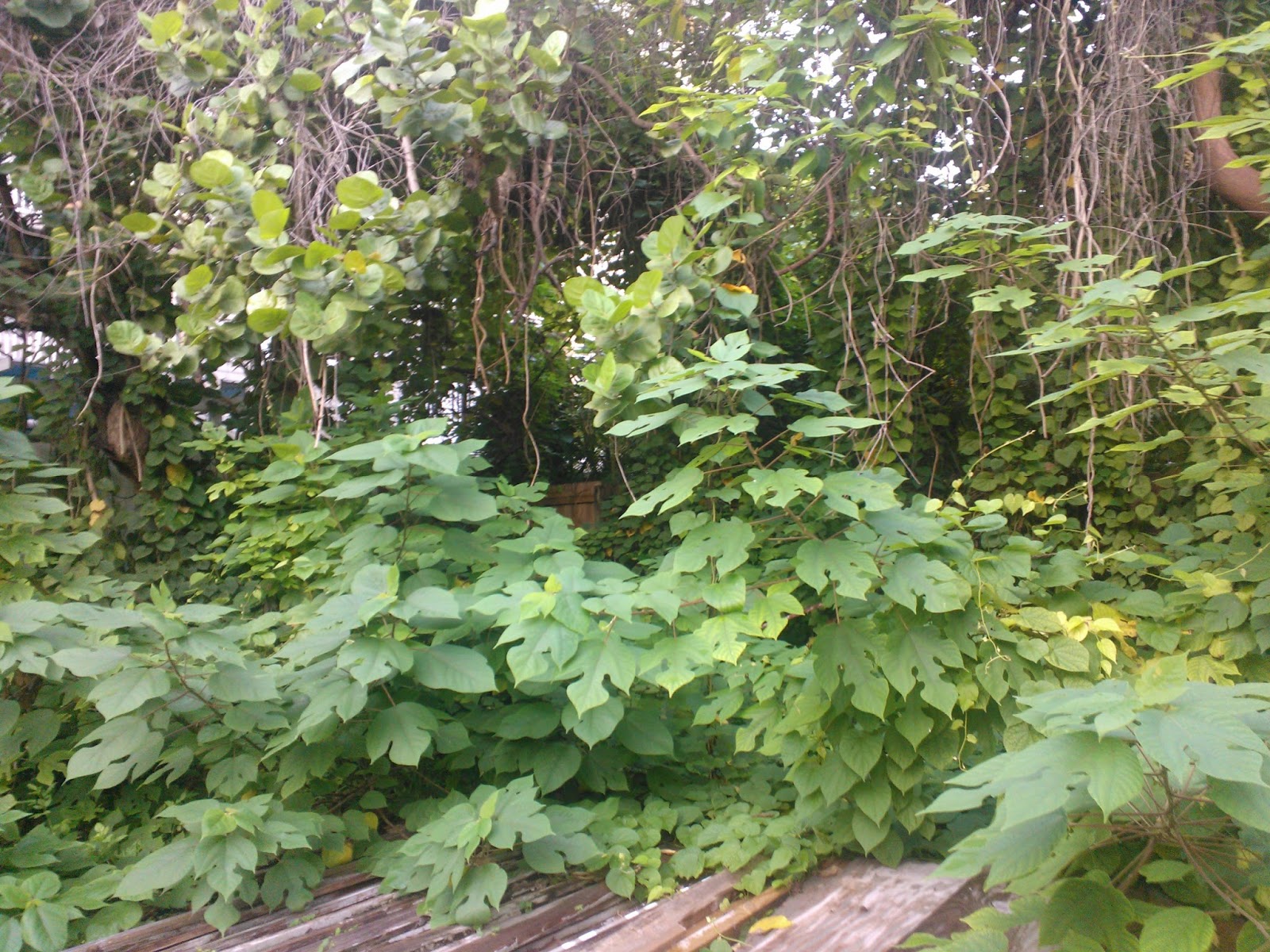
After cutting back the vines in February, they’ve not been cut since. Before
they were cut the last time, they grew 30 feet high and over the top of the house.

And, while I’m on that topic: The City of Miami by-law compliance officers need to see what’s happening behind the house, too. I’ve documented previous occasions when the property has been cited for a lack of landscaping upkeep and graffiti on the back wall. Remember that Gino Falsetto (Aries Development) is the lease-holder. However, it’s the owner, Stirrup Properties, that gets cited for all the deficiencies caused by Falsetto. Do I have to point out the obvious? The Black corporation is being blamed for the White corporation’s misdeeds.

However, Gino Falsetto seems to have learned something else: the by-law compliance officers cannot see what’s behind the house, so that area is almost never landscaped. It became a jungle, which I also documented in previous posts. It grew over 30 feet tall and part way across the roof of the house in the back, all unseen by the by-law compliance officers.

That jungle was cut back drastically in February for the first time in the 4 years I have been visiting the property. However, that had nothing to do with being cited by the city. It was in advance of a meeting of the Charles Avenue Historic Committee, on which Gino Falsetto sits. He wanted to be able to point to SOME WORK having taken place, in case people asked. However, what was done actually destroyed part of the house, as documented here.

Since then the vines have been allowed to grow unmolested again.

Say, I got an idea! Let’s start a pool and bet on how tall the vines are allowed to grow before Gino Falsetto feels he needs to impress someone else with the work he hasn’t been doing on restoring the E.W.F. Stirrup House and it gets cut back again merely for appearance sake, and not because the vines are harming a precious historic house.

Of course, if the City of Miami ever manages to inspect the inside of the E.W.F. Stirrup House and determines that Gino Falsetto has ordered illegal work, it will be Stirrup Properties, LLC, that is cited and/or fined.

Let’s face it, Gino Falsetto doesn’t care about Stirrup Properties, LLC; Coconut Grove history; or the Stirrup legacy; nor has he shown any care of the historic 120-year old E.W.F. Stirrup House. Falsetto is a rapacious developer who cares only about making money by developing property. In fact, having to save the Stirrup House foils Falsetto’s ultimate plan. He has managed to scoop up every bit of property surrounding the Stirrup House, including a financial stake in the Coconut Grove Playhouse. An empty lot where the Stirrup House currently sits would be far more valuable to Falsetto than this house that he’s committed to restoring. Is that why he’s allowed 8 years of Demolition by Neglect to eat away at the house? Is that why the property is left unsecured, hoping for an accident to happen?

Here are several more pictures of the state of the E.W.F. Stirrup House on August 16, 2013:

West Grove Residents Lose ► Polluting Bus Garage Will Go Ahead

Indefatigable Coconut Grove community activist Laurie Cook leading the protest

The residents of west Coconut Grove had their hopes dashed yesterday when Miami-Dade County Judge Ronald G. Dresnick ruled that a polluting diesel bus garage will go ahead in their residential neighbourhood as planned.

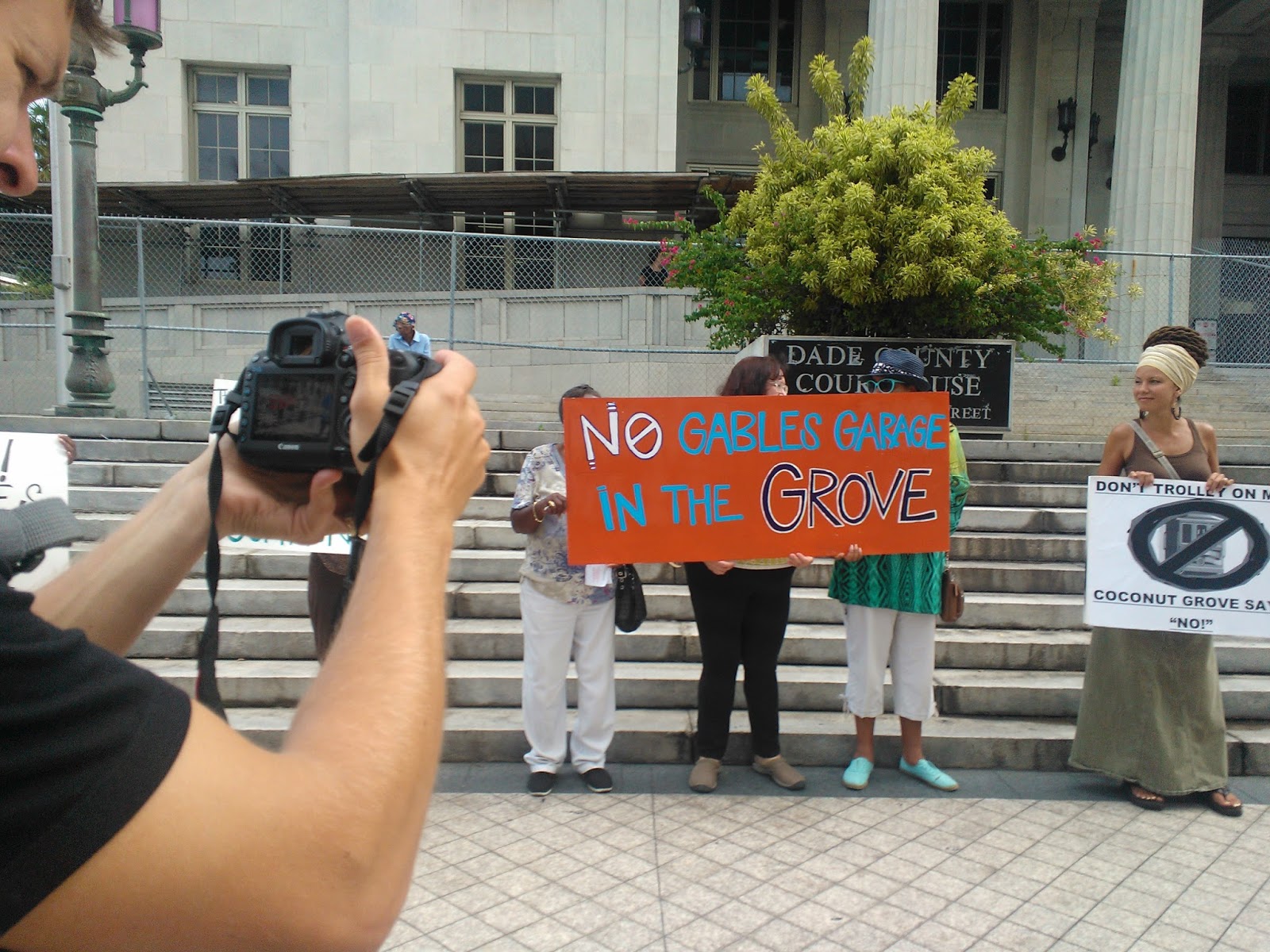
Prior to the hearing about 50 resident of the Grove gathered in the 100 degree heat for a public awareness campaign on the courthouse steps, until they were kicked off the steps and made to use the sidewalk. Then everyone gathered in courtroom 4-2 at 10:30 a.m. to hear oral arguments.

[This was the coldest room I have ever been in. After we all came in sweaty and clammy from the heat, everyone was immediately chilled to the bone and remained that way until the hearing ended at 1 p.m. Meat lockers are not kept this cold. It must be so the law won’t spoil. The court clerk had what appeared to be a blanket pulled over her shoulders. The lawyers were the only ones not disadvantaged by the cold. Now I know why they all wear suits.]

The meat locker called Courtroom 4-2. Can you see their breath?

The legal arguments went on for nearly 2.5 hours and when it was all over the judge ruled — to make a long story short — that he really didn’t have jurisdiction to issue the residents an injunction to stop the polluting diesel bus garage based on the several legal arguments presented.

To make a long story long: The judge decided he wasn’t going to rule on the Plaintiff’s Constitutional arguments, which were about prior neighbourhood notification (where residents only have 15 days to file a protest) and how one gets word a project has finally been approved. Those approval notices are posted every 2 weeks on a hard-to-find area of the City of Miami’s web site. [I’m net savvy and I’ve never been able to find it.] Furthermore, as I learned in court from the plaintiff’s lawyers, 49% of West Grove residents do not have access to the internet. And, even if they did, they would be required to keep checking the city’s web site every 2 weeks — 26 times a year — in case a building permit has been issued on a project of local concern. It’s a lot like that opening scene of the Hitchhiker’s Guilde to the Galaxy when a work crew arrives to demolish Arthur Dent’s house for a highway bypass. They tell him that he had every opportunity to protest the highway because he could have always gone to City Hall to see the plans:

“But the plans were on display…”
“On display? I eventually had to go down to the cellar to find them.”
“That’s the display department.”
“With a flashlight.”
“Ah, well, the lights had probably gone.”
“So had the stairs.”
“But look, you found the notice, didn’t you?”
“Yes,” said Arthur, “yes I did. It was on display in the bottom of a locked filing cabinet stuck in a disused lavatory with a sign on the door saying ‘Beware of the Leopard.”

Another Plaintiff argument the judge rejected was that the Coral Gables Bus Garage would be a “government vehicle maintenance facility” which is specifically EXCLUDED by the Miami 21 Plan for the Douglas Road corridor. That argument didn’t fly for 2 reasons, as I understand it. * Defendants argued that the bus garage is currently owned by Astor Development and, therefore, it’s not government operated yet. Only when Astor Development signs over the bus garage to the City of Coral Gables would it become a government vehicle maintenance facility . . . or, maybe not.

The other argument from the defendant seemed far more arcane to me, but the judge bought it. Lawyers for the defendants argued that under the Miami 21 Plan a commercial gas station, or tire repair place, would be allowed on that site and these places could provide minor repairs. Therefore, it came down to the definition of “minor repairs” versus “major repairs.” Furthermore, defendants argued, a gas station or tire garage would have similar environmental and noise impacts on the neighbourhood. That might be so, but those businesses do not start their day at 5 a.m. and run to 11 at night. Their hours would be limited to whatever the Miami by-laws allow, as in any city, and 5 in the morning to 11 at night would not pass muster. Regardless of those details, in essence, the judge ruled that it appeared to be merely a by-law violation if (when?) major vehicle repairs are done in a place where only minor repairs are allowed.

Nor was the judge swayed by the safety arguments of the plaintiffs. The design of the diesel bus garage, with bus parking and bays in the rear, requires the buses to enter on Frow Avenue and exit on Oak Avenue; both are residential streets, without sidewalks, upon which thousands of children walk to school — to say nothing of all the other residents, some of whom are elderly and infirm, just like in any neighbourhood.

None of the safety or environmental issues — those that most concern the residents — mattered to the judge because those arguments were not legal arguments. Legal arguments are the clauses and subclauses of the written law and the precedents the lawyers can cite for the judge to rule one way or another.

However, what the residents of west Coconut Grove were reminded of, as if they needed further reminding, is that “the Colour Line is the Poverty Line is the Power Line (Ambalavaner Sivanandan, 1923 – ). If this were a White neighbourhood this never would have happened; not because the residents would have successfully won an injunction in court. It would never have come to court because had this been a White neighbourhood the property values would have been such that Astor Development would have never found cheap land to buy in West Grove. Those 9 decades of Systemic Racism are described in the several previous articles on Not Now Silly under the rubric “No Skin In The Game.” People tell me they are shocked at what the series reveals.

* I am not a lawyer, nor do I play one on television. I only had few minutes to debrief Ralf Brookes, one of the lawyers for the plaintiffs, before he rushed off to a depo, as he called it. If I misunderstood anything I will provide corrections once my bone-headed errors are pointed out to me.

No Skin In The Game ► Part Four

The One Grove mural in Coconut Grove

On the same day I was posting about the upcoming court hearing for Trolleygate, a news article came across my transom that dovetails with that story nicely. Tell me if this doesn’t sound familiar:

A nearly all-White town refuses to install bus stops that would make it convenient for Black folk to get to their community. While this fight is between suburban Beavercreek and the nearby city of Dayton, Ohio, it could almost be coming from Coral Gables and Coconut Grove.

The brouhaha in Ohio began a few years back, when the Greater Dayton Regional Transit Authority decided to add three bus stops in Beavercreek. The Bevercreekians said, ‘No fucking way‘ and started enacting legislative barriers to any new bus stops in the community, which oddly enough, don’t apply to current bus stops, like heat, air conditioning, and a high-tech camera system. According to Think Progress:

Many in the area argue that their opposition boils down to a simple reason: race. According to the 2010 census, 9 in 10 Beavercreek residents are white, but 73 percent of those who ride the Dayton RTA buses are minorities. “I can’t see anything else but it being a racial thing,” Sam Gresham, state chair of Common Cause Ohio, a public interest advocacy group, told ThinkProgress. “They don’t want African Americans going on a consistent basis to Beavercreek.”

A civil rights group in the area, Leaders for Equality in Action in Dayton (LEAD), soon filed a discrimination lawsuit against Beavercreek under the Federal Highway Act. In June, the Federal Highway Administration ruled that Beavercreek’s actions were indeed discriminatory and ordered them to work with the Dayton Regional Transit Authority to get the bus stops approved without delay.

Beavercreek, though, isn’t particularly keen to do that. The city council voted most recently on Friday to put off consideration of the matter until later this month. They are weighing whether to appeal the federal ruling, or perhaps whether to just defy it altogether. Appealing the ruling could cost the city hundreds of thousands of dollars in legal fees, according to a Washington D.C. lawyer the council hired. However, non-compliance with the ruling could cost Beavercreek tens of millions of dollars in federal highway funds.

Fake-trolly that won’t be stopping in Coconut Grove

Oddly enough, White Coral Gables has refused Black Coconut Grove a bus stop outside the polluting government vehicle maintenance facility that it has foisted upon their neighbourhood. When it appeared the bus maintenance facility was a fait accompli, some residents asked for a bus stop at the very least. They were turned down flat.

Keep in mind these are the FREE diesel buses to take shoppers up and down what Coral Gables likes to call Miracle Mile, the exclusive, high-end shopping district. Of course, it might affect the businesses bottom line and Coral Gables property values if too many Black folk were able to get Coral Gables conveniently. It’s better if they walk a half mile to one of the Coral Gables fake-Trolley stops than to give them a bus stop in their own community.

The more research I do into the history of Coral Gables, the more I see that its progress and development over the years is due to almost a century of systemic racism. I make that case in my previous chapters on Coral Gables:

No Skin In The Game ► Part One
No Skin In The Game ► Part Two
No Skin In The Game ► Part Three

Click here to read all my stories on Trolleygate.

Trolleygate Update ► The End Of The Line?

Artist rendering of the Coral Gables’ diesel bus garage designed in a Bahamian style

Circle the court date: August 16th. 

At times it seems the wheels of justice turn ever so slowly. I posted An Introduction to Trolleygate just over 6 months ago. I followed up a few days later with The Trolleygate Dog And Pony Show, which documented the joke of a public information meeting conducted by (allegedly corrupt) Miami Commissioner Marc D. Sarnoff.

Ironically that was the very same day a lawsuit was launched by residents of Coconut Grove asking for an injunction to stop the neighbouring town of Coral Gables from building its polluting government vehicle maintenance facility in their residential neighbourhood. Ironic because it allowed Sarnoff to wriggle out of answering any of his VERY ANGRY constituents questions, since the issue was now in front of a judge. However, that didn’t stop him from presenting his Dog & Pony Show, during which I watched a masterful performance by (allegedly corrupt) Commissioner Marc D. Sarnoff.

Diesel bus disguised to look like an old-timey, non-polluting, trolly bus

In late February I documented Coral Gable’s Modern Day Colonialism and Trolleygate and in March I spoke to plaintiff’s lawyer Ralf Brookes for An Update On Sarnoff’s Trolleygate aka Astor’s Trolley Folly. In fact, I’ve been the only journalist who has been covering this story on an ongoing basis. That may be why I was sent the notice of hearing for August 16, 2013, along with the pleadings from both sides in the dispute.

My source tells me this hearing should decide all matters and the judge will issue a ruling one way or another. Either Coconut Grove gets stuck with a polluting government vehicle maintenance facility, or Astor Trolly LLC will have to find another location for this building; a facility promised to Coral Gables so that Astor Development (another tentacle of the same company) can develop the site of the current government vehicle maintenance facility in order to make millions of dollars for itself and Coral Gables. [This paragraph was massaged slightly after being published for clarity.]

Neighbours opposed to the polluting diesel bus garage are calling for a protest on August 16th on the courthouse steps at 73 West Flagler Street for 9 a.m.with the hearing set to begin at 10.

It will be interesting to see how the court rules. I’ve been told off the record by several someones-in-the-know that this building will never be used as a bus garage. That would be welcome relief to the economically poor, minority neighbourhood trying to stop it, but it then begs the question:

What will happen to the building, which is almost finished?

THE DECISION IS IN! READ:
West Grove Residents Lose ► Polluting Bus Garage Will Go Ahead

Pictured below: 
Unveiling the One Grove Mural on March 3, 2013. immediately across the street from the polluting Trolleygate garage:

An E.W.F. Stirrup House Shocker! ► Is Gino Falsetto Following The Rules?

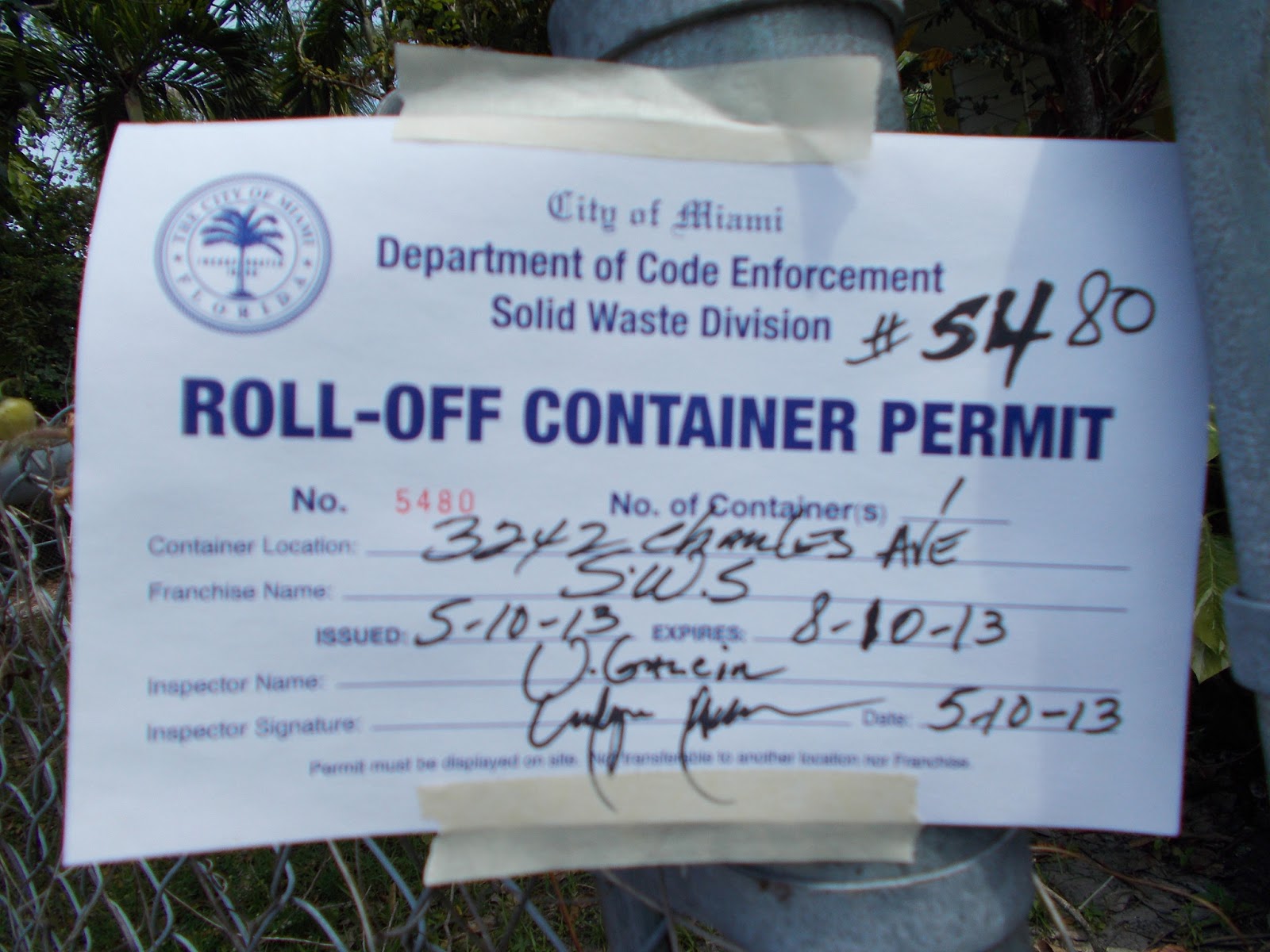
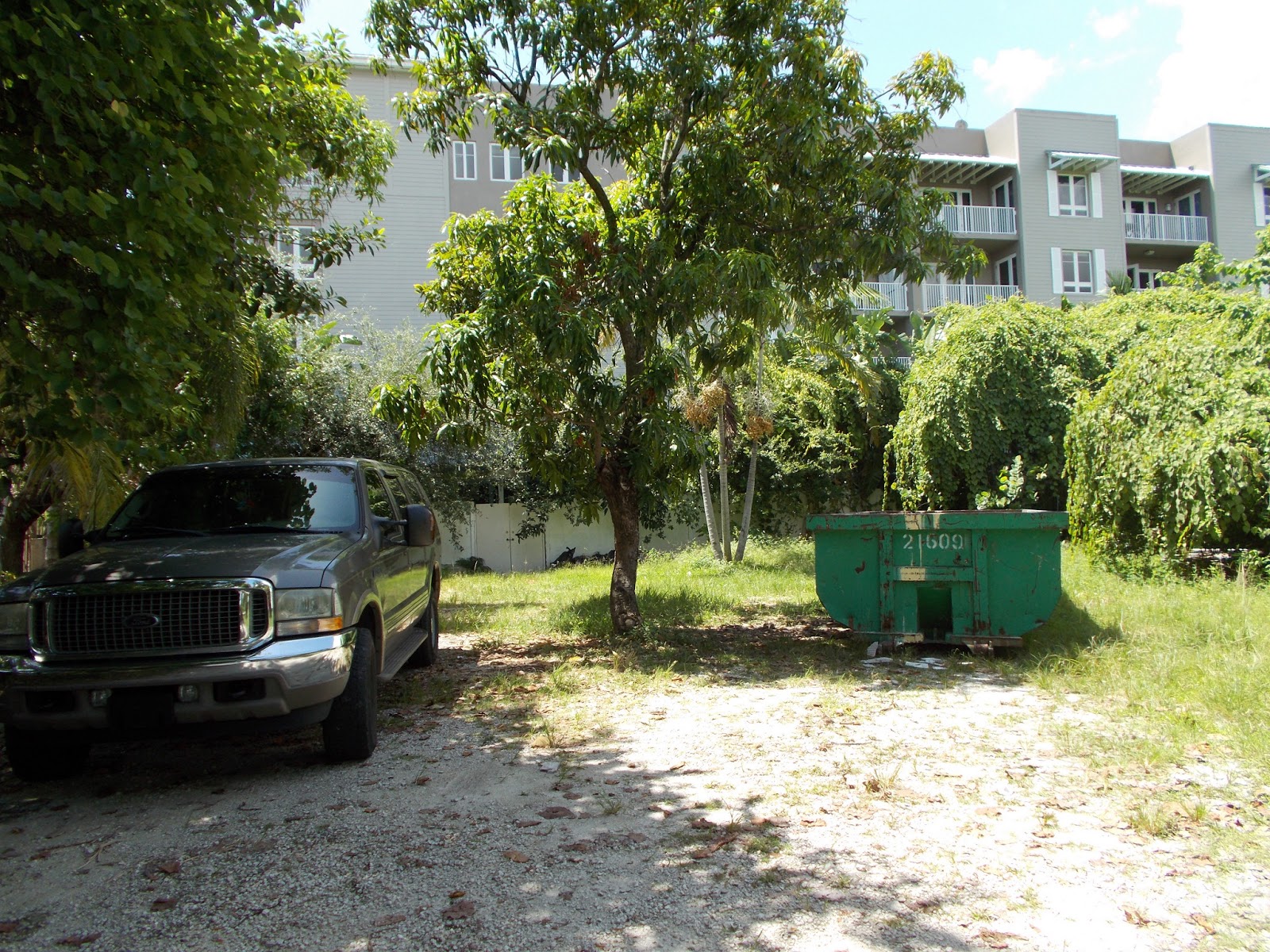
The dumpster on the property is finally legit, until August at least

Dateline May 17, 2013 – A quick visit to the E.W.F. Stirrup House produced something totally surprising.

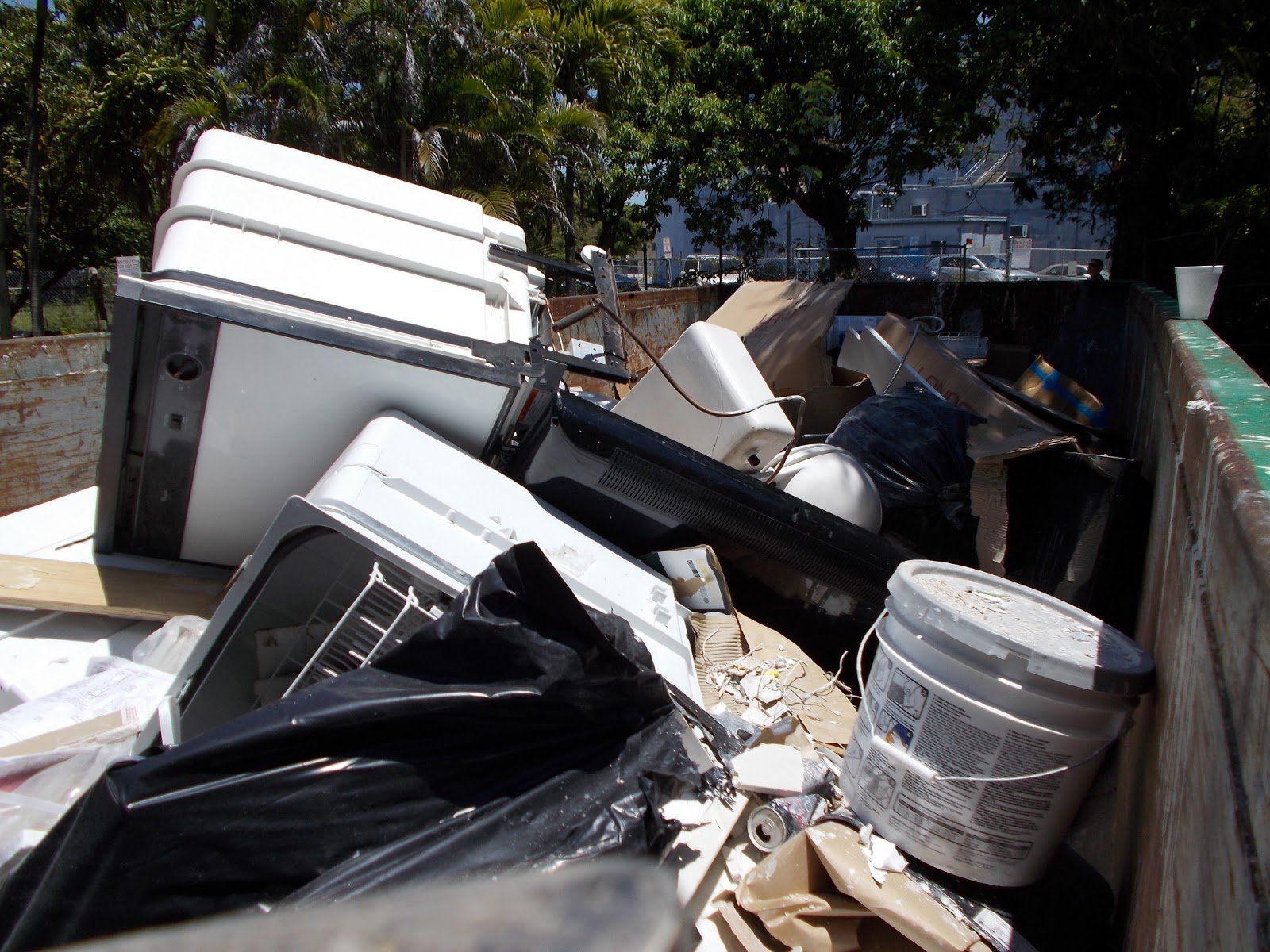
For the last several years I have been documenting the dumpsters that come and go from the Stirrup property. Earlier this week I made special mention of the most recent dumpster, filled with what appeared to be refuse carted out from some restaurant renovation within the Grove Gardens Residence Condominiums.

However, what do I discover when I arrive at the E.W.F. Stirrup House for my latest visit? Lo and behold: a permit for the dumpster. FINALLY!!! I have seen dozens of interchangeable dumpsters disappear, only to be replaced by an empty dumpster. However, this is the first time it has ever been permitted, literally, by the city.

Dumpster Still Life, May 17, 2013

It begs the question: Why? Did the city finally clue in to the fact that the Stirrup Family had been flagrantly breaking the law for the last several years?

TO BE FAIR: While Stirrup Properties, Inc. is the owner of the property on paper, it ceded effective control of the property to Aries Development, owned in part by Gino Falsetto. The Stirrup Family gave Aries a 50-year lease on the property. It’s Aries who has allowed the property to turn into a garbage dump time and time again. However, whenever the property is cited for violations, it’s the Stirrup family’s company that gets its metaphorical hands slapped, not Falsetto’s company. Cute, that.

I wonder if this means Aries Development will finally go to the city and get a building permit for the illegal, covert work that’s been going on inside the E.W.F. Stirrup House since last August, at the very least.

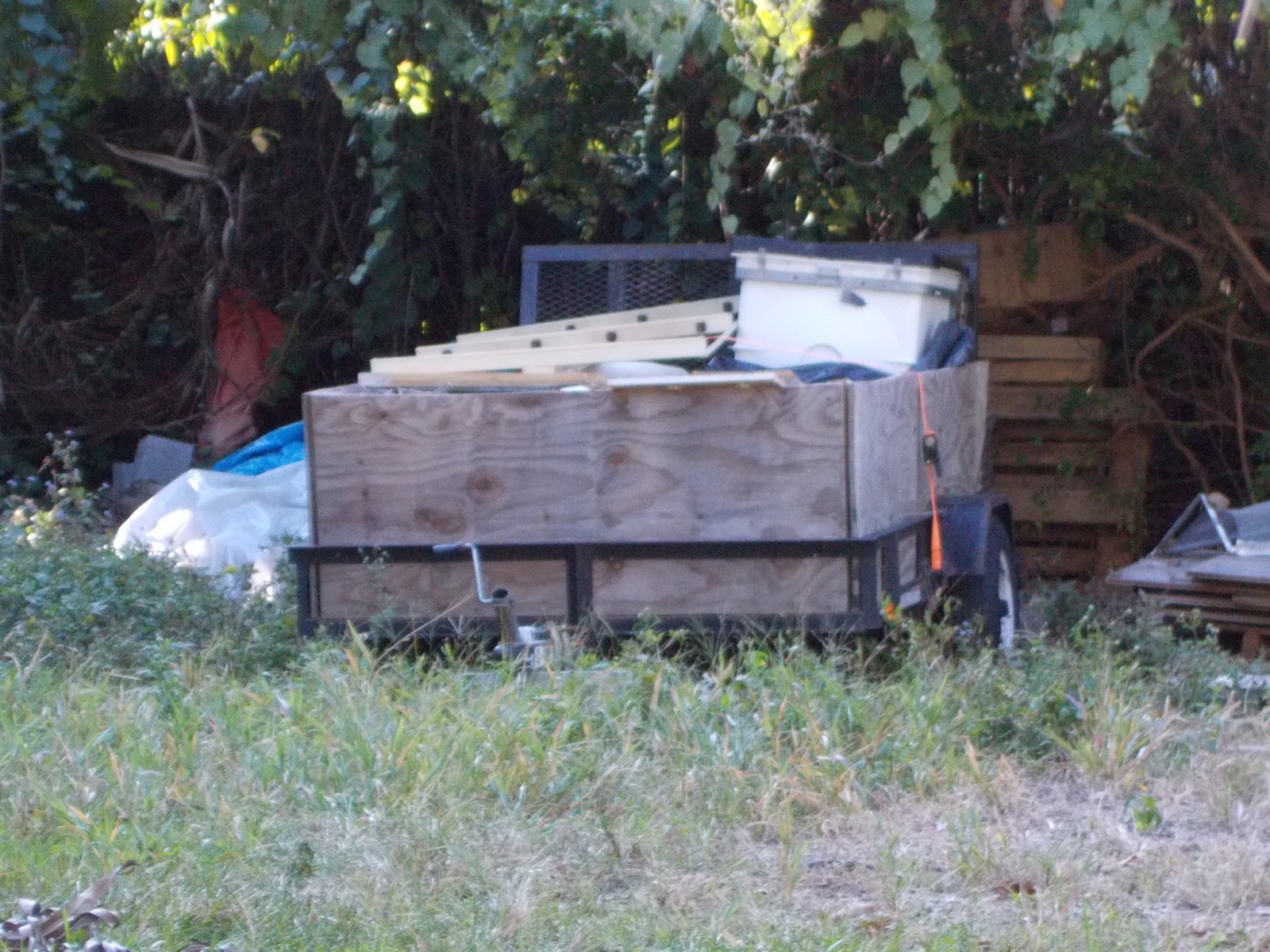
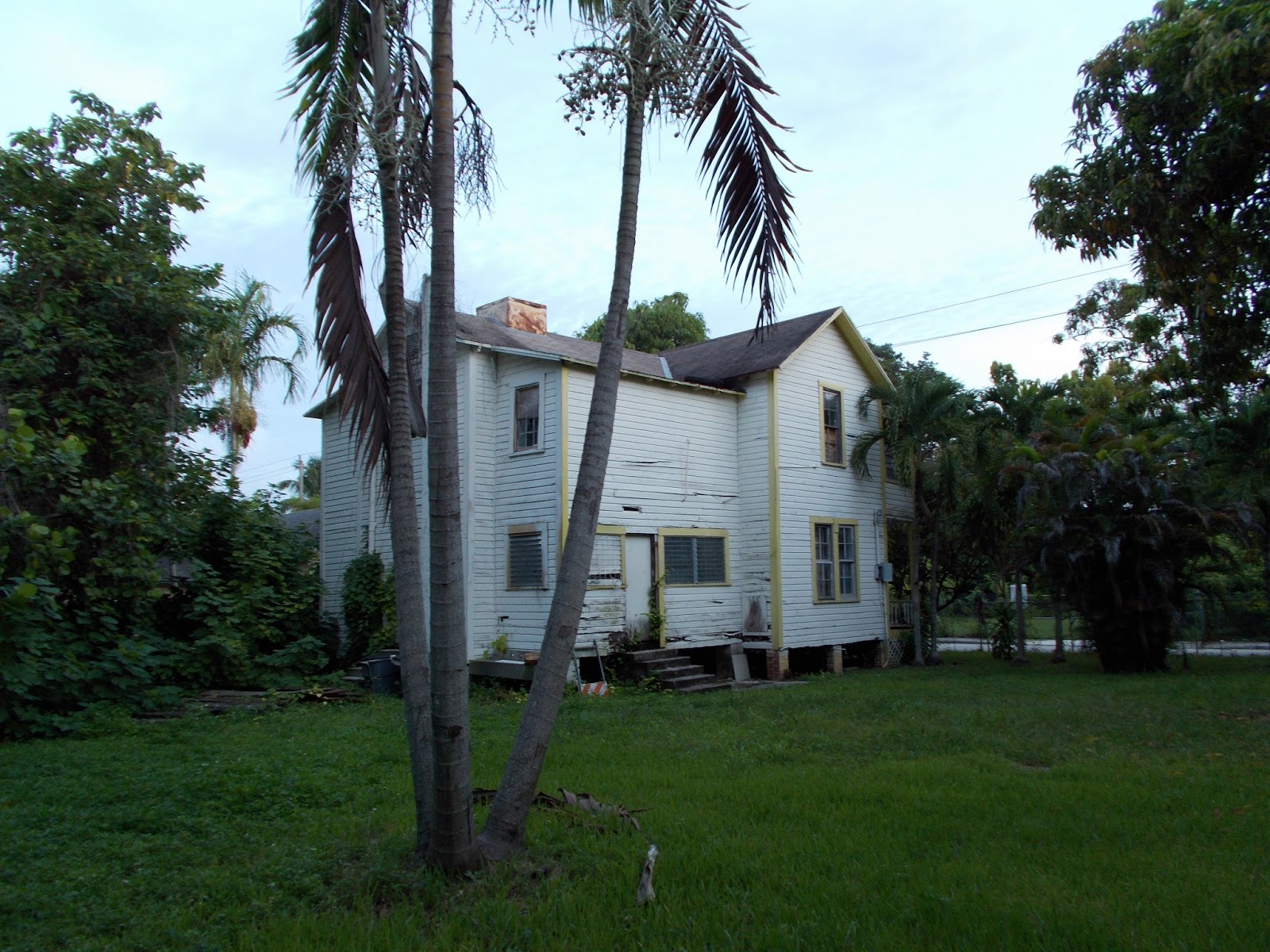
Here is a series of pictures we’ll call Dumpsters I Have Known: They were taken on various visits to Charles Avenue.

These are all separate and different dumpsters. There are still some 20 file directories filled with pictures of the E.W.F. Stirrup House, but I got bored looking for dumpsters.

***

***