All posts by Headly Westerfield

About Headly Westerfield

Calling himself “A liberally progressive, sarcastically cynical, iconoclastic polymath,” Headly Westerfield has been a professional writer all his adult life.

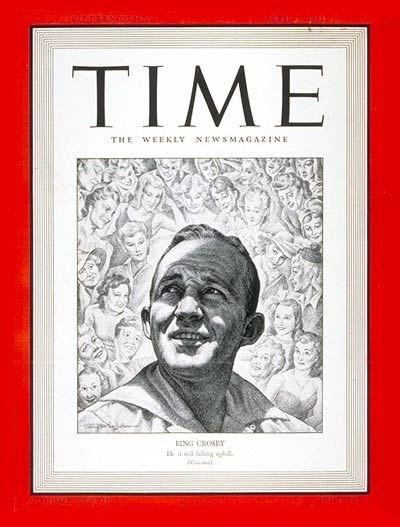
Bing Crosby’s Last Christmas Special ► Monday Musical Appreciation

On this day in 1977 (as The Music History Calendar tells us): Bing Crosby’s last Christmas special airs. The show was recorded in September, and Crosby died that October. The show is remembered for Crosby’s unusual duet with David Bowie, where they sang a modified version of “Little Drummer Boy,” with Bowie singing the new “Peace On Earth” lyrics composed by the show’s writers.

For many decades — and for millions of people around the world — Bing Crosby meant Christmas. His rendition of Irving Berlin‘s White Christmas has been certified by Guinness World Records as the best selling single in history, with well over 150 million copies. According to the WikiWackyWoo:

The first public performance of the song was by Bing Crosby, on his NBC radio show The Kraft Music Hall on Christmas Day, 1941; a copy of the recording from the radio program is owned by the estate of Bing Crosby and was loaned to CBS News Sunday Morning for their December 25, 2011, program.[5] He subsequently recorded the song with the John Scott Trotter Orchestra and the Ken Darby Singers for Decca Records in just 18 minutes on May 29, 1942, and it was released on July 30 as part of an album of six 78-rpm discs from the film Holiday Inn.[5][8]
At first, Crosby did not see anything special about the song. He just
said “I don’t think we have any problems with that one, Irving.”[9]

Crosby reprised the tune in the 1954 movie White Christmas, which was virtually a remake of Holiday Inn.

One of my earliest posts here was called “Okay, I’ll Confess. I Love Bing Crosby!” It is a paean to one of my favourite vocalists, and one I used to make jokes about. However, as I explained, it took Louis Armstrong to make me appreciate Bing Crosby, who rocketed up to the top of my personal hit parade.

Here is the last time the country was able to celebrate Christmas with Bing Crosby.

Long may he sing.

Harpo Plays! ► Monday Musical Appreciation

He never said a word in the movies, but Harpo Marx never had a problem getting his point across. At a time when Talkies were all the rage, Harpo remained gloriously mute.

Adolph Marx — he later changed his name to Arthur  — was born on this day in 1888, the 2nd oldest of the 5 Marx Brothers. With his older brother Chico (Leonard) and his younger brother Groucho (Julius), The Marx Brothers became one of the greatest comedy teams of all time. [Gummo never appeared with his brothers on film and Zeppo left after the first five.]

Much to Groucho’s regret, because he was considered the “smart one,” Harpo was a member in good standing of The Algonquin Round Table, an exclusive club that included such notables as Robert Benchley, Heywood Broun, Marc Connelly, George S. Kaufman, Dorothy Parker, Harold Ross (The New Yorker editor), Robert E. Sherwood, Alexander Woollcott, Tallulah Bankhead, and Noel Coward.

However, it’s not Harpo’s mime shtick or his intelligence Not Now Silly wants to commemorate today; it’s his harp playing, for which he got his nickname. According to the WikiWackyWoo:

Harpo gained his stage name during a card game at the Orpheum Theatre in Galesburg, Illinois. The dealer (Art Fisher) called him “Harpo” because he played the harp.[5][6] He learned how to hold it properly from a picture of an angel playing a harp that he saw in a five-and-dime.
No one in town knew how to play the harp, so Harpo tuned it as best he
could, starting with one basic note and tuning it from there. Three
years later he found out he had tuned it incorrectly, but he could not
have tuned it properly; if he had, the strings would have broken each
night. Harpo’s method placed much less tension on the strings.[citation needed]
Although he played this way for the rest of his life, he did try to
learn how to play correctly, and he spent considerable money hiring the
best teachers. They spent their time listening to him, fascinated by the
way he played.[6]

Here are some of Harpo’s greatest musical performances:


The Gettysburg Address ► Throwback Thursday

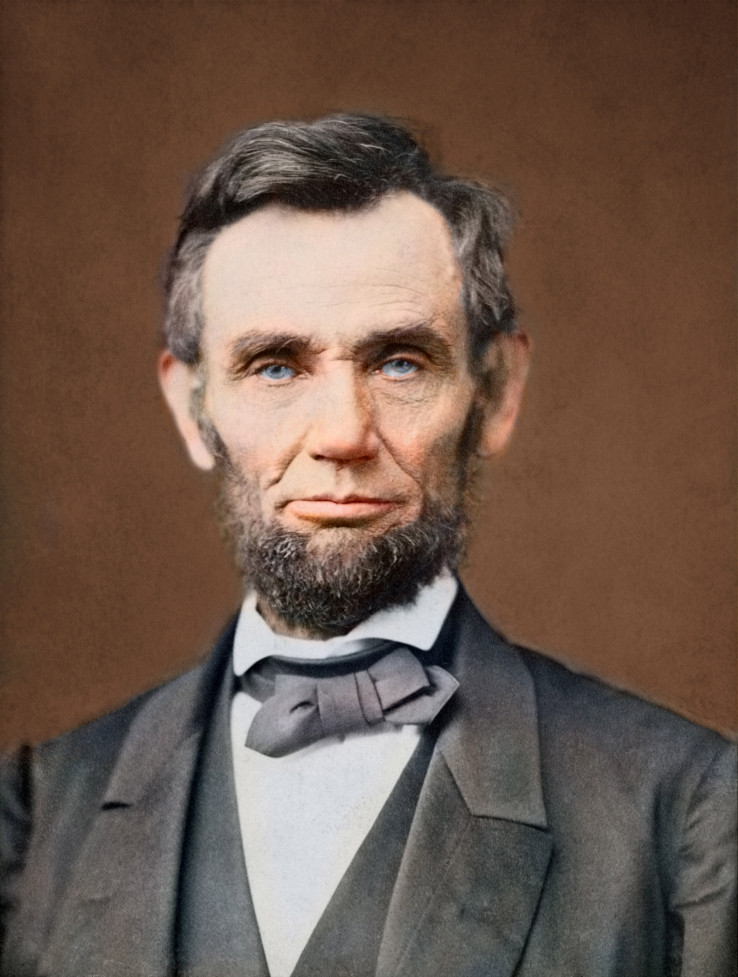
On this day in 1863 President Abraham Lincoln delivered the Gettysburg Address, considered one of the greatest speeches ever given in English.

A mere 271 words, the Gettysburg Address followed the dedication of the Soldiers’ National Cemetery by Edward Everett. That speech must have exhausted the crowd. It lasted more than 2 hours and contained more than 13,600 words.

Lincoln’s short speech lasted only a few minutes, but has gone down in history as one of the greatest of his career.

As the WikiWackyWoo explains, Lincoln was under the weather at the time:

During the train trip from Washington, D.C., to Gettysburg on November 18, Lincoln remarked to John Hay that he felt weak. On the morning of November 19, Lincoln mentioned to John Nicolay
that he was dizzy. In the railroad car the President rode with his
secretary, John G. Nicolay, his assistant secretary, John Hay, the three
members of his Cabinet who accompanied him, William Seward, John Usher and Montgomery Blair,
several foreign officials and others. Hay noted that during the speech
Lincoln’s face had ‘a ghastly color’ and that he was ‘sad, mournful,
almost haggard.’ After the speech, when Lincoln boarded the 6:30 pm
train for Washington, D.C., he was feverish and weak, with a severe
headache. A protracted illness followed, which included a vesicular rash
and was diagnosed as a mild case of smallpox. It thus seems highly likely that Lincoln was in the prodromal period of smallpox when he delivered the Gettysburg address.[10]

The Hay version of the speech

Yet, there’s no agreed upon text of the speech:

Despite the historical significance of Lincoln’s speech, modern
scholars disagree as to its exact wording, and contemporary
transcriptions published in newspaper accounts of the event and even
handwritten copies by Lincoln himself differ in their wording,
punctuation, and structure.[16][17]
Of these versions, the Bliss version, written well after the speech as a
favor for a friend, is viewed by many as the standard text.[18]
Its text differs, however, from the written versions prepared by
Lincoln before and after his speech. It is the only version to which
Lincoln affixed his signature, and the last he is known to have written.[18]

Here is the text that every grade school child memorized:

Four score and seven years ago our fathers brought forth on this
continent a new nation, conceived in liberty, and dedicated to the
proposition that all men are created equal.

Now we are engaged in a great civil war, testing whether that nation,
or any nation so conceived and so dedicated, can long endure. We are
met on a great battlefield of that war. We have come to dedicate a
portion of that field, as a final resting place for those who here gave
their lives that that nation might live. It is altogether fitting and
proper that we should do this.

But, in a larger sense, we can not dedicate, we can not consecrate,
we can not hallow this ground. The brave men, living and dead, who
struggled here, have consecrated it, far above our poor power to add or
detract. The world will little note, nor long remember what we say here,
but it can never forget what they did here. It is for us the living,
rather, to be dedicated here to the unfinished work which they who
fought here have thus far so nobly advanced. It is rather for us to be
here dedicated to the great task remaining before us—that from these
honored dead we take increased devotion to that cause for which they
gave the last full measure of devotion—that we here highly resolve that
these dead shall not have died in vain—that this nation, under God,
shall have a new birth of freedom—and that government of the people, by
the people, for the people, shall not perish from the earth.

Dan Penn ► Monday Musical Appreciation

Celebrating a birthday today is Dan Penn, a name almost unknown, but the writer of some of the greatest Soul tunes ever recorded.

Born Wallace Daniel Pennington according to his official biography he was:

 A native of Vernon, Alabama, Penn moved to the Florence/Muscle Shoals area while still a teenager and assumed the role of lead vocalist in a local group calling itself the Mark V Combo. When asked what kind of music they played, Penn replies, “R&B, man. There was no such thing as rock. That was somethin’ you picked up and throwed.” He laughs. “Or threw.” It was around this time that he penned his first chart record, Conway Twitty’s “Is a Bluebird Blue”. During the early ’60s, Penn began working with Rick Hall at Fame Studios in Muscle Shoals, first as a songwriter, and then as an artist under the names Lonnie Ray, Danny Lee, and finally Dan Penn. 

The WikiWackyWoo picks up the story:

In early 1966, Penn moved to Memphis, began writing for Press Publishing Company, and worked with Chips Moman at his American Studios.[5]
Their intense and short-lived partnership produced some of the best
known and most enduring songs of the genre. Their first collaboration,
the enduring classic “The Dark End of the Street”, was first a hit for James Carr and has since been recorded by many others. A few months later, during the legendary recording sessions that saw Jerry Wexler introduce Aretha Franklin
to FAME Studios and her first major success, the pair wrote “Do Right
Woman, Do Right Man” in the studio for her, which went to #37 in
Billboard in 1967. In early 1967 Penn produced “The Letter” for The Box
Tops. He and long-time friend and collaborator Spooner Oldham also wrote
a number of hits for the band, including “Cry Like a Baby”, another
song which has been covered many times.[6]

As always, it’s all about then music. Here are just some of the many hit tunes penned by Penn:


Interview With District 2’s Ken Russell

Ken Russell, potential Commissioner-elect for District 2
while the Veterans’ Day commemoration gathers to march

I originally met potential Commissioner-elect Ken Russell way back when — during Soilgate — when I called out of the blue to interview him.

We met at a local coffee shop just as it appeared his battle with [allegedly] corrupt Miami Commissioner Marc D. Sarnoff was finished. It was an epic battle over the toxic soil in Merrie Christmas Park and, in the end, the residents got the kind of toxic soil remediation they felt their children deserved.

While it appeared as if Merrie Christmas Park would be re-mediated properly, I was surprised when he moved on to his next concern, which was all the other toxic parks in the city. Russell was genuinely concerned that those residents might not have enough clout, or enough money, to hire a lawyer like he and his neighbours had. That’s when I knew Ken was about far more than his own property values. He had a Social Justice bone.

He wasn’t doing it for effect. At the time Russell had no intention to run for office, but the fight over toxic soil made him feel that he could do better than the current Commissioner. And, the secrecy in
which [allegedly] corrupt Miami Commissioner Marc D. Sarnoff went behind the backs of the residents, breaking several laws about proper notification for a Brownfield Site — not to mention when he lied to this reporter that it had never been so designated — told Russell there must be a better way to conduct city business on behalf of constituents.

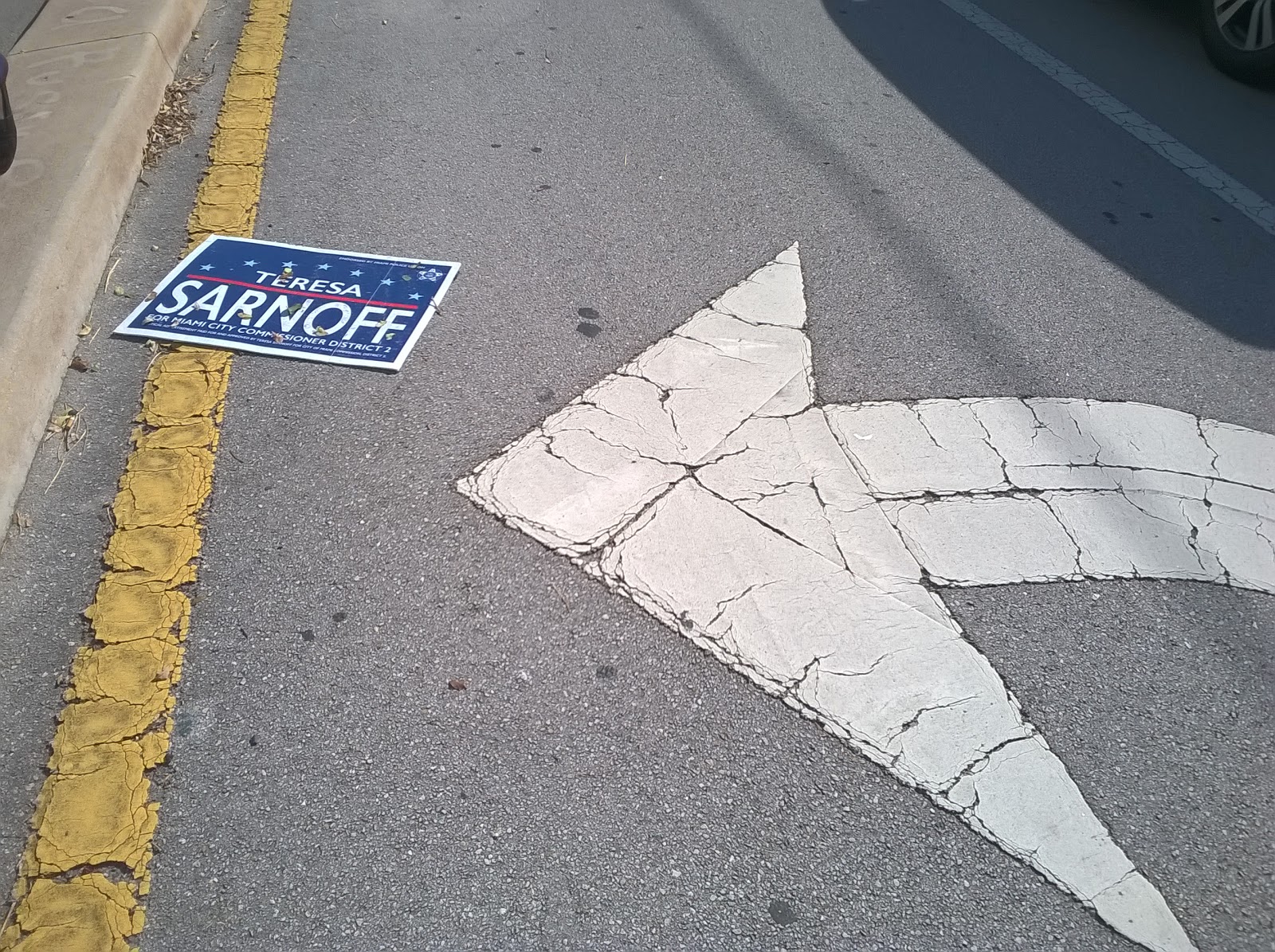
It’s a sign!!!
The Veterans’ Day Parade marched right past this.

When he later declared he was running for District 2 Commissioner, Russell made transparency one of the cornerstones of his platform.

In one of the craziest election finishes in Miami history, Ken is engaged in a runoff election with wife of term-limited Teresa Sarnoff. However, with Sarnoff withdrawing from the race, the city lawyer says the runoff will still be held, but that votes for Teresa Sarnoff won’t count. Yet, Democracy dictates that the votes count and Ken maintains that he’s still in it to win it. He wants a clear mandate, so he’s still campaigning for every vote on November 17th.

Russell agreed to a sit down interview and suggested we meet in West Grove after the Veterans’ Day commemoration. As I drove down I couldn’t help but wonder if he had chosen the perfect photo op for a politician, or whether it was simply to accommodate me. I requested an interview, but told him it had to be on Wednesday because that was the only day I had free. I left it up to him to choose the time.

That we met in Coconut Grove for this interview seems appropriate because that’s where he received his highest support, with a nearly 20% turnout. It’s also the area I’ve been researching extensively since 2006. Watching Russell work the crowd was nothing like watching a politician work a crowd. There were enough hugs, kisses, handshakes, and genuine warmth in both directions, that it was obvious that Russell is already well-liked by this part of his potential constituency.

Russell surprised me by sitting in the grass his suit for this interview.

NNS: You’re making up for a politician that was reviled in this district. How are you planning to overcome that?

KEN RUSSELL: It’s true that part of the reason I got involved was seeing how my Commissioner operated and seeing how I felt things could be done better. The day he’s out of office, the day I get into office, that’s the first step and it’s really not that hard. A new tone, a new communication, a new conversation with the neighbours.

I’m already being told, and I’m not even in there, that this already feels different than it has for the last 9 years. So, the first step is to be open and even that, at the very least, wasn’t done to my understanding. And, that comes easy for me.

NNS: Especially in this neighbourhood of West Grove, the people here kinda felt burned by promises made years ago that were never fulfilled. Yet, you were able to overcome that to get a 20% turnout at the polls that went overwhelmingly to you. How are you going to keep that bridge open to the community?

KR: The community’s going to keep that bridge open. At this point, I owe so much to this area that I don’t even have a choice of closing the door. It’s too important. It’s been vocalized and it’s been publicized well enough where my heart is, that I couldn’t turn back if I wanted to, and I wouldn’t. I wouldn’t be here if it wasn’t for the support of the West Grove and, despite advice I received early on, I could see that there was a community here with a lot to lose, that would turn up at the polls if they felt they had an advocate.

NNS: And, you’re going to be that advocate?

KR: Absolutely. I’ll be the best that I can.

NNS: One of the things I did during the elections is I did door knocks with you in various neighbourhoods. Where do you think your biggest support was coming from overall?


KR: I knocked [on] over 2,000 doors during the 10 month period, all the from the South Grove to the West Grove to Morningside. It was very difficult to knock doors in Brickell and downtown, but we found other ways to reach the community there. The largest support was from the Grove as a whole, all parts of the Grove together. There was nearly a two-to-one margin in my favor at almost every major precinct in the area.

NNS: Do you have any job you want to do on Day One?

KR: Day One is learning for me because I don’t pretend to have all the answers, especially within process. I have the intention of what I’d like to accomplish and, as you can see here today, just the conversation, the conversation that we’re having even today with folks, is part of the first step; is part of that first step of giving them a trust [and] a feeling of comfort that their Commissioner is going to be open with them.

NNS: Is there any big project you’ve got in mind? Something you want to try to do while in office.

KR: Yeah, I would like to see something good come of the Trolley garage. I’d like to see that building serve the community. And, I’ve heard a lot of good ideas, but not in a formal setting to where I could say what should be done with it, but it’s a symbol of how this part of town’s been treated and, I think, in the same symbolic gesture should be converted into something that builds up the community.

With that Ken Russell was off to a meeting at Miami City Hall, where the learning curve for a new potential Commissioner-elect is steep.

For further reading please see: Soilgate, Trolleygate, [allegedly] corrupt Miami Commissioner Marc D. Sarnoff, and the Anybody But Teresa facebookery, where so many of these issues intertwine.

The Expoding Whale ► Throwback Thursday

It hardly seems like 45 years ago, but November 12, 1970 was a whale of a day.

It happens all the time: a dead whale washes up on shore, threatening to stink up the joint unless something is done. But what?

When a a sperm whale washed up on the beach at Florence, Oregon, the authorities sprung into action. As the WikiWackyWoo explains, they left it up to rank amateurs:

All Oregon beaches are under the jurisdiction of the Oregon Parks and Recreation Department,[3]
but in 1970, Oregon beaches were technically classified as state
highways, so responsibility for disposing of the carcass fell upon the
Oregon Highway Division (now known as the Oregon Department of Transportation, or ODOT).[4] After consulting with officials from the United States Navy,
they decided that it would be best to remove the whale the same way as
they would remove a boulder. They thought burying the whale would be
ineffective as it would soon be uncovered, and believed dynamite would
disintegrate the whale into pieces small enough for scavengers to clear up.

Thus, half a ton of dynamite was applied to the carcass. The engineer
in charge of the operation, George Thornton, stated—on camera, in an
interview with Portland newsman Paul Linnman—that he wasn’t exactly sure
how much dynamite would be needed. (Thornton later explained that he
was chosen to remove the whale because the district engineer, Dale
Allen, had gone hunting).[5][6]

WATCH THE FUN:

As it happened, there was an expert on the scene, but no one listened:

Coincidentally, a military veteran from Springfield with explosives
training, Walter Umenhofer, was at the scene scoping a potential
manufacturing site for his employer.[1]
Umenhofer later told The Springfield News reporter Ben Raymond Lode
that he had warned Thornton that the amount of dynamite he was using was
very wrong—when he first heard that 20 cases were being used he was in
disbelief. He had known that 20 cases of dynamite was far too much
dynamite to be used. Instead of 20 cases they needed 20 sticks of
dynamite. Umenhofer said Thornton was not interested in the advice. In
an odd coincidence, Umenhofer’s brand-new Oldsmobile was flattened by a
chunk of falling blubber after the blast. He told Lode he had just
bought the Ninety-Eight Regency at Dunham Oldsmobile in Eugene, during
the “Get a Whale of a Deal” promotion.[1]

You can’t make this shit up, even tho’ some people accuse Wikipedia of doing so.

Meanwhile, exploding whales are not that uncommon. Watch:

A Song So Great They Named It Twice ► Monday Musical Appreciation

When I was going to Coffey Junior High School, in Detroit, a prized piece of ephemera was a mimeographed sheet of paper with what was purported to be the real, DIRTY, lyrics to Louie, Louie, released on this day in 1963.

I had one passed to me by a classmate. Where he got it from, I don’t know. Of course, it had to be hidden from teachers and parents, so it was folded in eighths and kept tucked away until it was needed.

That’s why it was so dog-eared by the time I finally lost it, after loaning the sheet to someone who never returned it. It didn’t matter. By then I had memorized the dirty lyrics and can recite them to this very day.

Who knows how many of those mimeographed sheets were in circulation? By the time I lost mine, it had been read by dozens of young boys who guffawed over the juvenile humour. We were astounded by what The Kingsmen had gotten away with, right under the nose of the record industry, and everybody!

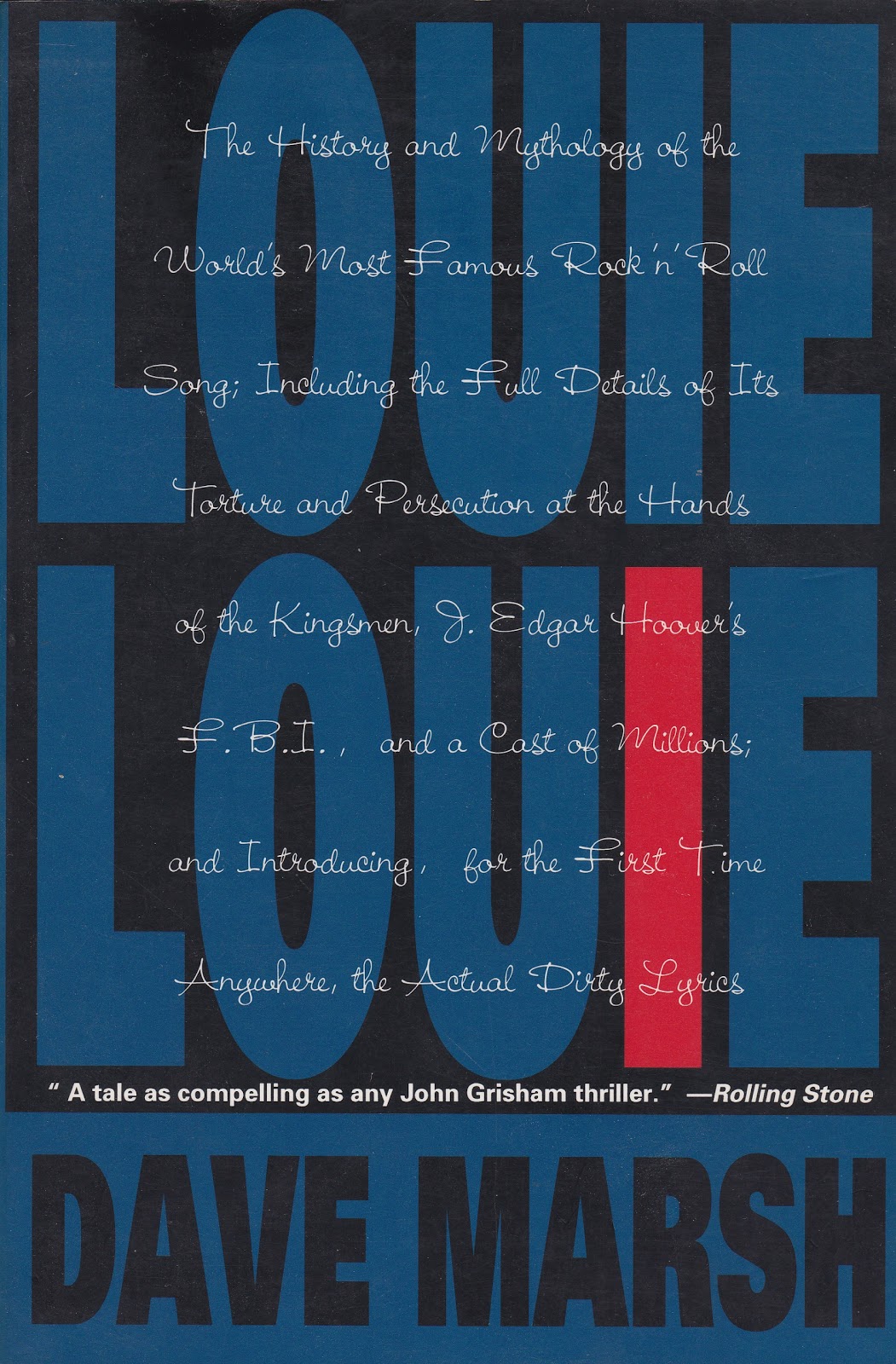
When I read the great book by Dave Marsh, Louie Louie; The History and
Mythology of the World’s Most Famous Rock ‘n Roll Song; Including the
Full Details of Its Torture and Persecution at the Hands of the
Kingsmen, J. Edgar Hoover’s FBI, and a Cast of Millions; and Introducing
for the First Time Anywhere, the Actual Dirty Lyrics
, I was gratified
to see that the dirty lyrics he reproduced were the exact same dirty lyrics I had in my possession for a while.

Of course, the joke was on us. The lyrics weren’t really dirty, just totally undecipherable. However, now Louie, Louise is one of the most recognizable and covered songs in all of Rock and Roll. As the WikiWackyWoo tells us:

“Louie Louie” has been recognized by organizations and publications
worldwide for its influence on the history of rock and roll. A partial
list (see “Recognition and rankings” table below) includes the Rock and Roll Hall of Fame, the Grammy Hall of Fame, National Public Radio, VH1, Rolling Stone, the National Endowment for the Arts, and the Recording Industry Association of America. In addition to new versions appearing regularly on YouTube and elsewhere, other major examples of the song’s legacy include the unsuccessful attempt in 1985 to make it the state song of Washington, the celebration of International Louie Louie Day every year on April 11, the annual Louie Louie Parade in Philadelphia from 1985 to 1989, the LouieFest in Tacoma from 2003 to 2012, and the ongoing annual Louie Louie Parade and Festival in Peoria.

The most amazing thing about Louie, Looue is that the FBI spent untold dollars, and wasted much time, researching the lyrics to decide whether the song was a Communist plot to destroy the minds of youth, or sumptin’. The FBI web site says:

In 1963, a rock group named the Kingsmen
recorded the song “Louie, Louie.” The popularity of the song and
difficulty in discerning the lyrics led some people to suspect the song
was obscene. The FBI was asked to investigate whether or not those
involved with the song violated laws against the interstate
transportation of obscene material. The limited investigation lasted
from February to May 1964 and discovered no evidence of obscenity.

CLICK HERE to read the actual FBI file in PDF form.

The Kingsmen’s tune was actually a cover of a Richard Berry song, written as a Jamaican ballad in 1955, which he released as a B side to a single in 1957. It became popular on the west coast, especially the Pacific Northwest, where The Kingsmen hailed from. They heard it, recorded it, and the rest is history. Nothing was ever the same again.

IRONY ALERT: When Dave March published his book, copyright infringement prevented him from passing along the real, actual lyrics to Louie, Louie, something easily found on the innertubes today.

I queried Der Google and here are the actual lyrics of Louie, Louie.

LOUIE LOUIE
The Kingsmen

Louie Louie, oh no

Sayin’ we gotta go,

yeah yeah, yeah yeah yeah

Said Louie Louie, oh baby

Said we gotta go

A fine little girl, she waits for me

Catch a ship across the sea

Sail that ship about, all alone

Never know if I make it home

Louie Louie, oh no no no

Sayin’ we gotta go, oh no

Said Louie Louie, oh baby

Said we gotta go

Three nights and days I sail the sea

Think of girl, all constantly

On that ship I dream she’s there

I smell the rose in her hair

Louie Louie, oh no

Sayin’ we gotta go,
yeah yeah, yeah yeah yeah

Said Louie Louie, oh baby

Said we gotta go

Okay, let’s give it to ’em, right now!

See, see Jamaica, the moon above

It won’t be long, me see me love

Take her in my arms again

I’ll tell her I’ll never leave again

Louie Louie, oh no

Sayin’ we gotta go,
yeah yeah, yeah yeah yeah

Said Louie Louie, oh baby

Said we gotta go

I said we gotta go now

Let’s take this on outta here

Let’s go!

Proving the song is as mild as milk, even Paul Revere and the Raiders covered it.

Nat Turner Sentenced To Be Hanged ► Throwback Thursday

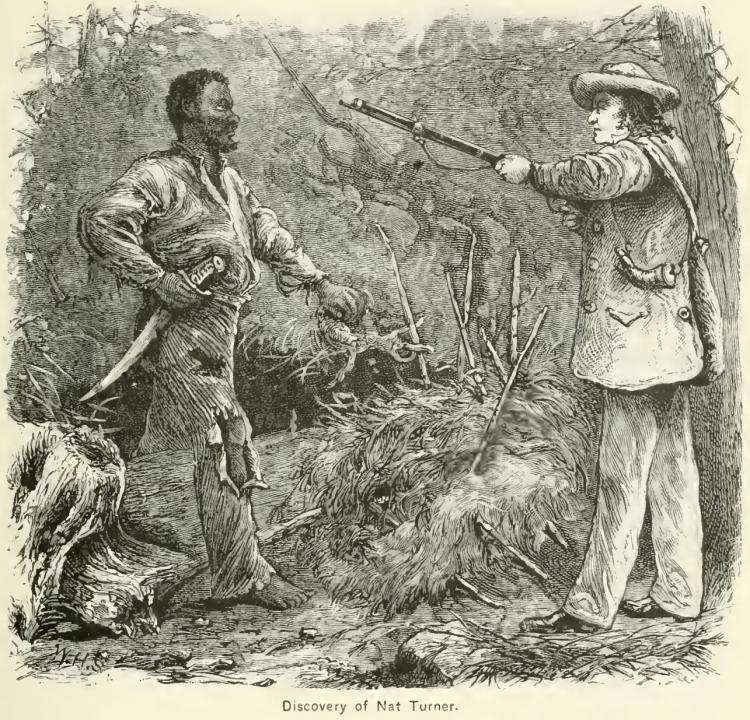
Benjamin Phipps, a local farmer, accidentally
discovers Nat Turner almost 2 months after the revolt

On this day in 1831, Nat Turner was tried, convicted, and sentenced to be hanged as leader of the slave revolt of two months earlier.

Turner believed his revolt was ordained by God. According to History:

He was born on the Virginia plantation of Benjamin Turner, who allowed him to be instructed in reading, writing, and religion. Sold three times in his childhood and hired out to John Travis (1820s), he became a fiery preacher and leader of African-American slaves on Benjamin Turner’s plantation and in his Southampton County neighbourhood, claiming that he was chosen by God to lead them from bondage.

Believing in signs and hearing divine voices, Turner was convinced by an eclipse of the Sun (1831) that the time to rise up had come, and he enlisted the help of four other slaves in the area. An insurrection was planned, aborted, and rescheduled for August 21,1831, when he and six other slaves killed the Travis family, managed to secure arms and horses, and enlisted about 75 other slaves in a disorganized insurrection that resulted in the murder of 51 white people.

Afterwards, Turner hid nearby successfully for six weeks until his discovery, conviction, and hanging at Jerusalem, Virginia, along with 16 of his followers. 

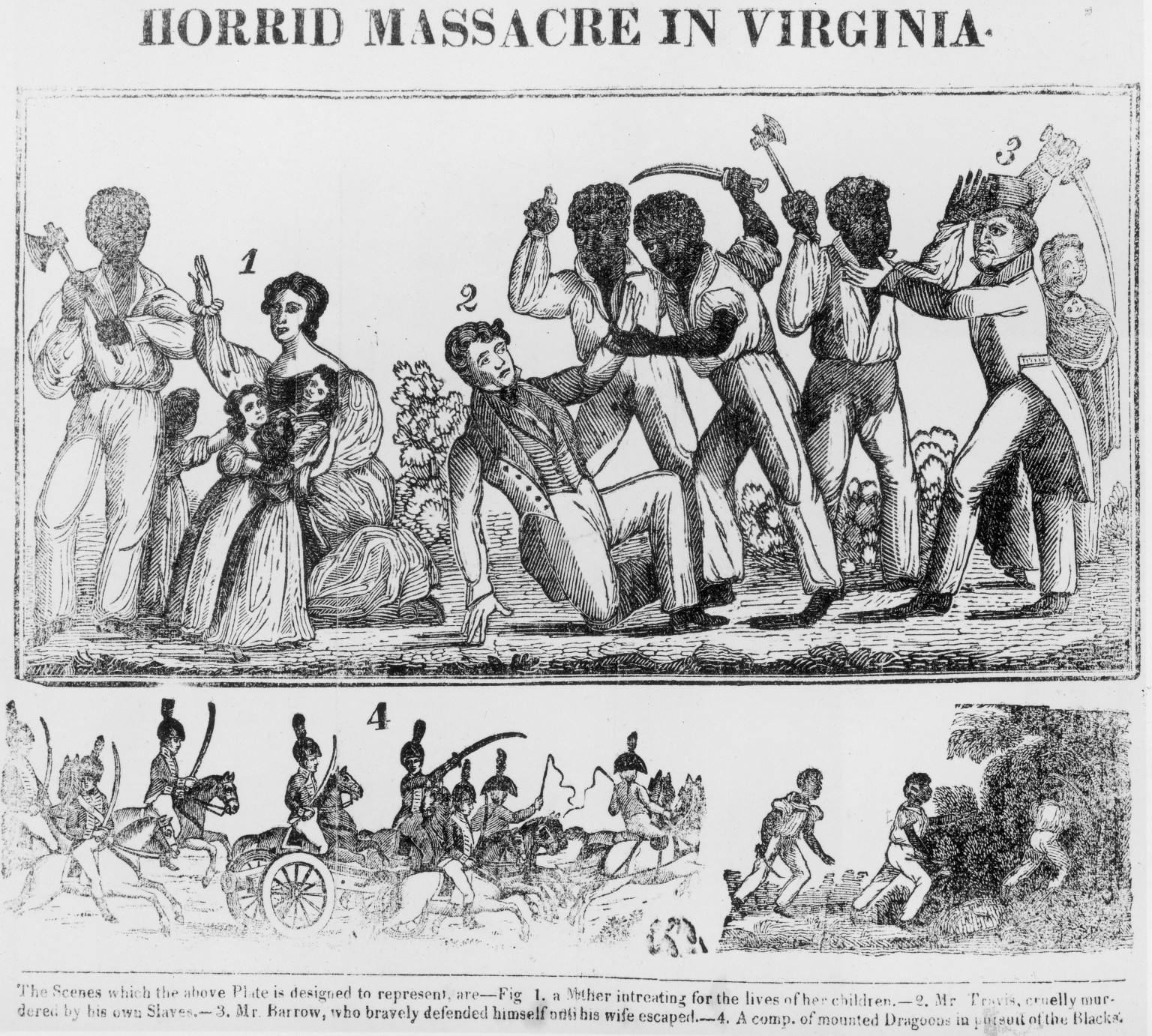
Racist cartoon depicting the revolt

If Nat Turner thought his revolt would lead to freedom for slaves, he was sadly mistaken. In fact, as the WikiWackyWoo tell us, it got worse for all Black folk, Free Black and slave alike.

In total, the state executed 56 blacks suspected of having been
involved in the uprising. But in the hysteria of aroused fears and anger
in the days after the revolt, white militias and mobs killed an
estimated 200 blacks, many of whom had nothing to do with the rebellion.[32]

[…]

The fear caused by Nat Turner’s insurrection and the concerns raised
in the emancipation debates that followed resulted in politicians and
writers responding by defining slavery as a “positive good”.[34] Such authors included Thomas Roderick Dew, a William and Mary College professor who published a pamphlet in 1832 opposing emancipation on economic and other grounds.[35]

Fears of uprisings polarized moderates and slave owners across the South. Municipalities across the region instituted repressive policies against
blacks. Rights were taken away from those who were free. The freedoms
of all black people in Virginia were tightly curtailed. Socially, the
uprising discouraged whites’ questioning the slave system from the
perspective that such discussion might encourage similar slave revolts. Manumissions
had decreased by 1810. The shift away from tobacco had made owning
slaves in the Upper South an excess to the planters’ needs, so they
started to hire out slaves. With the ending of the international slave
trade, the invention of the cotton gin, and opening up of new territories in the Deep South,
suddenly there was a growing market for the trading of slaves. Over the
next decades, more than a million slaves would be transported to the
Deep South in a forced migration as a result of the domestic slave
trade.

Nat Turner was hanged on November 11, 1831, just 6 days after he was tried, convicted, and sentenced.

k.d. lang ► Monday Musical Appreciation

Celebrating a birthday today is k.d. lang, born Kathryn Dawn Lang in Edmonton, Alberta, Canada. 

Canadians have been enjoying k.d. lang since 1983, when she was performing what she called Cow Punk Music, which was really a combination of Country, Rockabilly, and Rock and Roll, all delivered with a unique attitude. Watch:

At the time she maintained she was the reincarnation of Patsy Cline and even called her back up band the Reclines. They put out three LPs together: A Truly Western Experience, Angel with a Lariat, and Absolute Torch and Twang, all of which were well received by both Country and Rock and Roll fans.

However, she was still considered an underground artist. As the WikiWackyWoo explains:

Lang first earned international recognition in 1988 when she performed, as “The Alberta Rose”, at the opening ceremonies of the Winter Olympics.[10] 

Lang’s career received a huge boost when Roy Orbison chose her to record a duet of his standard, “Crying, “ a collaboration that won them the Grammy Award for Best Country Collaboration with Vocals in 1989. The song was used in the Jon Cryer film Hiding Out released in 1987. Due to the success of the song, Lang received the Entertainer of the Year award from the Canadian Country Music Association.
Lang would win the same award for the next three years, in addition to
two Female Vocalist of the Year awards in 1988 and 1989. 

After that, there was no holding her back. Canadians have to share this gigantic talent with the rest of the world. But, we’re used to that.

Here’s just some more examples of k.d. lang’s incomparable talent, starting with her cover of another Canadian tune, Leonard Cohen’s Hallelujah:


Before and After Synchronicity ► A Pastoral Letter

A reading assignment from Pastor Ken Wilson.

Dear Pastor Kenny: I began this Pastoral Letter several weeks ago and have been tinkering with it ever since, trying to get it right. Then came the car crash. That’s why this essay is bifurcated into Before & After; before my accident and after.

BEFORE:

It’s been well over a month since my last Pastoral Letter and almost 2 months since I received your response. I have so much to tell you that I barely know where to begin.

It hardly seems like a year since I rediscovered you and wrote the first of my Pastoral Letters, which I called Finding An Old Friend. It was slotted under the Unpacking The Writer rubric because little did I know at the time it would become another series in the Not Now Silly Newsroom. I don’t know how they’re working out for you, but they sure are helping me. Being forced to turn what’s firing through my neurons into words, helps me get my thoughts straight on these weighty matters.

First let me thank you (I think) for your reading assignment and sending me “Changing Our Mind” by David P. Gushee. (I have so many books on my “to be read” shelf, that the last thing I needed was a reading assignment.) I’ve yet to crack it open, other than to look at the chapter titles, making special note of Chapter 20, Ending the Teaching of Contempt, the one concerning anti-Semitism that you felt I should read. However, I’ll be reading the whole thing.

In your last Pastoral Letter, which I called a Pastor Kenny Responds (in lieu of a better title), you said: 

One of the things I’d forgotten was just how racist things were growing up. You reminded me what it was like to grow up Jewish— and it all came rushing back, the horrible jokes about Jews, and Blacks, and Poles, and well, non WASPS. I remember being warned by someone not to attend a Catholic Mass because they spoke Latin and you didn’t know whether they were saying bad stuff or not.

It made me feel ashamed. Using the N-word was strictly forbidden in my family. Same with anti-Jewish rhetoric. But talk of “Injuns,” “Krauts” and “Japs” was tolerated. Now I’m ashamed. But I was also ashamed because of my forgetting. Forgetting how bad the Christian participation in anti-Semitism was in that era.

Back in college I edited the school’s alternative paper
(ie: the one not put out weakly weekly by the Journalism
students). This was the cover of our Revelations issue.

While I never participated in racial denigration growing up — perhaps because of my Jewish upbringing or the fact that Pops had a store on 12th Street, where I got to know a lot of Black folk — I have my own shame over the names I called people in the LGBT communities back then. I console myself with the notion that it was a different time and I simply did not know any better.

My children were taught to know better, which is one of the ways with which we CAN change the world. And, that reminds me of a story:

One day my youngest son and I were walking down the street when he was about 8 or 9. Suddenly he yelled, “LOOK, DAD! A FAGGOT!!!”

Just as I was about to blast him for using such an awful word, I looked at where he was pointing. There, waiting for trash pick-up, was a bundle of sticks. How can you not like word play like that from a child? He now owns a successful restaurant in Toronto.

Ken, you also told me:

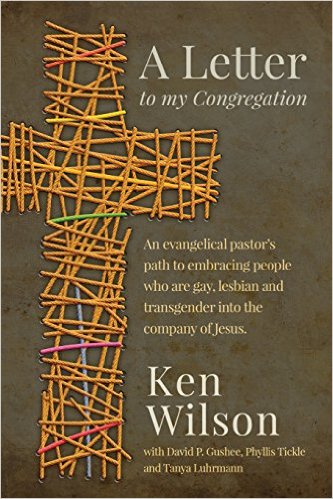
I must say I have been honored by your interest in my little LGBT soap opera. Spreading the word about Letter to My Congregation,
being interested, curious, sympathetic.  But it has also been
comforting to reconnect a little bit with my Gilchrist past through your
reaching out. 

The cover design is a bundle of sticks

The fact of the matter is, Ken, that I feel you’ve written a very
important book, which I tell anyone who will listen, for as long as they
will listen. With your book you are on the leading edge of an important
Social Justice Movement within the church. Only time will tell whether
the masses will follow, and I mean masses in both senses of the word.

Books: another one of the ways with which we can change the world.

And, as I explained to you as we walked around downtown Ann Arbor in July, reaching back and reconnecting with my Gilchrist past has become very important to me because of The Trunk Lost In Transit.

What I find amusing, Ken — and your mileage may vary — is that I reject almost everything else you believe in. I identify as a non-evangelical Atheist. I don’t proselytize because I don’t care all that much whether people agree, or disagree, with me. Whether they do, or do not, affects my life not one iota. That’s why I don’t understand evangelicals, whether they’re about Jesus, Atheism, or FitBit. (Say Ken, have you heard about E.W.F. Stirrup and his house?)

Having said that, while you may be used to having your beliefs challenged, I am not used to having my disbeliefs challenged.

Which brings me to what I really want to talk about: Cosmic Synchronicity. But first, some definitions:

Merriam-Webster defines “synchronicity” as “the coincidental occurrence of events and especially psychic events (as similar thoughts in widely separated persons or a mental image of an unexpected event before it happens) that seem related but are not explained by conventional mechanisms of causality—used especially in the psychology of C. G. Jung.”

In the same post I defined it differently:

Think of your own personal synchronicity as a blanket you are shaking rhythmically up and down. The sine waves created by the blanket is a two dimensional representation of your synchronicity in a 3-Dimensional space. However, everyone knows that synchronicity works in the 6th Dimension, where it interacts with the ‘waving blankets’ belonging to everyone else. Where these waves collide are where the EXACT moments and locations the FSM [Flying Spaghetti Monster] has stitched together Space and Time and Gravity and Dimensionality and Predestination. If, as they contend in Quantuum Mechanics or String Theory or Whatever They’re Calling It These Days™, that all choices are possible in the Alternative Universes that exist, then the chances of anything so improbable can be proven possible by multiplying boiling water with pasta and adding sauce.

So . . . where to start? Let’s go all the way back to the beginning, Ken. And, get comfortable, because this is going to take a while.

Barbara way back when

Back when you were visiting me in the early ’70s, my first ex-wife was going to school at George Brown College to learn all about the Sewing Arts, the field she eventually made her living in. There she met a gal named Barbara. I don’t think I met Barbara back then.

A few years later I lived and worked on Bedford Road. Barbara lived on Bedford Road, just up the street. I don’t think I met Barbara back then.

I finally met Barbara when I
was a freelance writer selling my words to any publication that had a
few extra dollars to spend. Among those was TO Tonight, Yorkview Magazine and a tabloid called Entertainment Weekly (long before and no relation to the tee vee show), where Barbara worked.

She was gorgeous and I asked her out. We went to a concert and then a
bar. Afterwards, full of liquor and hormones, we repaired to my place on Nassau Street, in Kensington Market, which makes me an official Marketeer. At some point — maybe we were discussing George Brown College, or maybe it just came out in casual conversation
— but Barbara realized she knew my ex-wife. Which explains why we
never did The Deed that night. Sisterhood Solidarity was more important to Barbara. She left shortly after that.

Later Barbara left Entertainment Weekly and I became its Editor and Head Writer.

Skip ahead another 30 years, or so, and somehow I became facefriends with Barbette Kensington, her online persona. She’s done community outreach for more than 3 decades in The Market and is often called the “Unofficial Queen of Kensington Market.” She’s posted a lot of pictures of herself and the various Marketeers at various locations in The Market. There’s The Stoop, The Office, The Office Annex, the Alley and Lola.

Every time I saw one of her pics, I would gasp. She simply takes my breath away. She’s gorgeous.

Knowing she’s an event organizer, when I needed to throw myself a party in Toronto, I went to her (digitally) and asked where she’d hold such a party. [Read: The Nuptial Nostalgia Tour and the follow-up, Love Makes The World Go Round.] In all honesty, I had no expectations, other than she might know of a place. I haven’t lived in Toronto in 17 years and Canada in 10. What do I know about entertaining in Toronto these days?

I certainly didn’t expect her to take that ball and run with it. As an event organizer she assumed that’s what I was asking. She found the perfect location in Kensington Market, Lola, and went about organizing the whole thing. Selfishly I let her because I didn’t have to do a thing. However, I did sent out the invites on the facebookery.

When Barbara and I met up I hugged her. Hugged her hard. She tells me was not the kind of hug one normally gives an old acquaintance, but she allowed herself to fall into it. We’ve been allowing ourselves to fall into it ever since.

I keep telling Barbara that “I don’t believe in any of that Mumbo Jumbo.” She’s Mohawk and deeply spiritual. I keep saying that because of all the coincidences that have built up to the point of cosmic synchronicity.

• Late last year one of Barbara’s face-to-facefriends messaged me requesting facefriendship on Barbara’s recommendation. I replied, “That’s good enough for me.” Little did I know that ever since this friend has been urging Barbara to go to me.

• One of the first conversations Barbara and I had at our reunion included an off-hand remark she made about her upcoming birthday and how she always thought she’d be married at that age. Without thinking I blurted out, I’ll marry you. And, I meant it.

• Days later, at my Coming Home Party, one of Barbara’s dear friends, who is downsizing and loves to give her things to random people, arrived at my party at Lola with a bag of jewellery. Some of it was real, some of it was costume. [I was on the other side of the patio, so I didn’t realize this was going on at the time.] She slipped Barbara 2 very simple, tasteful, wedding rings and said, “Here.”

This hand shook the hand of Bob Marley

• After the jewellery had been divided up, there remained one piece which was handed to me. It spoke to me immediately. It’s the colours of the Jamaican flag and the Rastafarian religion, if a religion is said to have colours. I slipped it on my right wrist, where it has remained. Since returning to Florida several people have taken note and remarked on it. Now I get to say with more emphasis than ever something I’ve been saying for many years anyway: “This hand shook the hand of Bob Marley.”

That’s as far as I’d gotten with this Pastoral Letter.

AFTER:

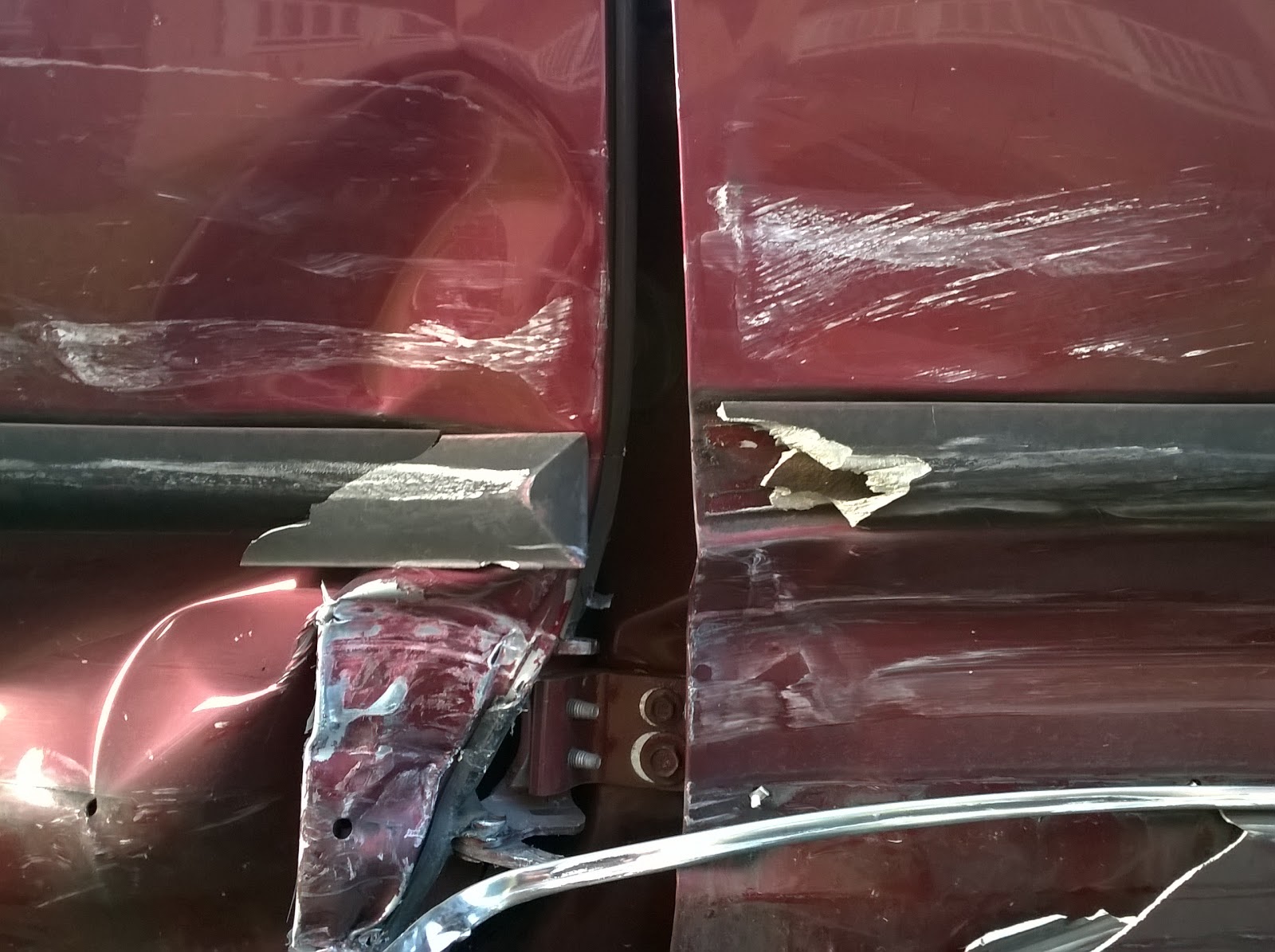
And, then came the car crash. Long story short: I was sideswiped by a car turning right on the red as I motored through a green light just a mile from home. After all those 3,000 mile road trips it seems ironic to be taken out of commission so close to home.

That was more than a week ago and I didn’t know where to take this essay after that. Therefore, I’ve just let it sit and stew in its own juices hoping I would be inspired.

The problem was: I no longer felt inspired. I’d read this and re-read this, not knowing where to take it, what to add, what to subtract, and whether to start all over. Yet, this morning I woke up inspired by the word “bifurcated.” Here’s where I’m taking this now:

I returned from Toronto feeling better than I have in decades. 

It wasn’t just being back in the city that I love and call home, no matter where I happen to be. It wasn’t just how Toronto feels as comfortable as a Johnny LaRue‘s smoking jacket. It wasn’t that, as a Marketeer, this was like a homecoming. It wasn’t even that Kensington Market, in which I spent most of my time while in Toronto, revitalized the Hippie slumbering in me. And, it wasn’t that I fell in love with one of the most fascinating women I’ve ever known.

Me in Johnny LaRue’s actual smoking jacket

No, Ken. It’s that one of the most fascinating women I’ve ever known fell in love with me and calls me handsome. It was such an ego boost to know my affection was being returned. It made me feel good right to my core. It made me forget all the trials, tribulations, and challenges I have in Florida taking care of Pops. It gave me something to look forward to after feeling my life has been on hold for so very long.

Then came the car crash. Like an elastic band, it snapped me back to where I was — what I was — before I went to Toronto. I was morose. I was filled with ennui. While I put one foot in front of the other, I merely moved through life, life didn’t move through me.

During the interregnum between returning from Toronto and the car accident I had more than once wondered, “What’s it going to be like when this good feeling goes away as it inevitably will? What will the bubble-bursting feel like?”

Now I know.

However, and here’s the important part: I don’t feel as if I have regressed completely. Barbara has provided an important spark, which won’t be extinguished. I told Barbara I was seeking her healing energy, which she gladly gave. Her spiritual beliefs go far deeper than my deeply held Atheism.

I feel spiritual when I’m banging two wooden sticks together in a drum circle when the rhythm takes me to a place where I’m not thinking any longer. I call that my Zen space, but I don’t really know squat about Zen because I also say that driving with the tunes cranked up is also my Zen Space.

UNITY

I won’t even begin to describe Barbara’s spirituality (because that would be unfair to her), but I have on several occasions felt the need to say, “You know I don’t believe in any of that mumbo jumbo.”

Which is, I guess, the worst I can say about your beliefs, Kenny. While we appear to agree on so many Social Justice issues, we have a giant disagreement about the core belief driving us. I act in a socially conscience manner because I’ve long come to the conclusion it’s the only way to live, both with the world at large and with myself. I don’t need a God in my life in order to know the difference between right and wrong. You know I don’t believe in that mumbo jumbo.

Maybe it would be easier if I could ascribe all events to a higher power. Reconnecting with Barbara after all these years certainly feels fated, predestined, kismet. Yet, the car accident does not.

My happiness can only be found within myself, as opposed to the belief that praying to a higher power brings me fulfillment and makes me happy. That thought, and that belief, makes me happier than I’ve been since the accident.

Two headlines that crossed my electronic transom yesterday couldn’t be more diametrically opposed:

Now, that’s funny. We’ll see if I’m still laughing once I start fighting with the insurance company of the teenager who hit me.

Your childhood friend,
Marc Slootsky