Tag Archives: Musical Interlude

Musical Appreciation ► Cole Porter

An example of a “coal porter,”
a man who delivers the coal.
© 2012 Friedrich Seidenstücker,
from the MoMa collection
Another example of a coal
porter is a rail car for coal.
It’s my opinion that no ‘Merkin songwriter has ever been more
deft at the lyric than Cole Porter.
While there are many wonderful things to praise in his music, I would like to
praise his wordplay and his sense of the rhythm of the syllables of spoken,
contemporary English, while imbuing that honest, simple language with more than
a hint of sophistication. His love of language is clear in his lyrics. I have always wondered whether he got his penchant for playing with words because his name is, in fact, a pun, not unlike Aunty Em Ericann.
With a string of songs ranging from “I Get A Kick Out Of You” to “You’re The Top” to “Don’t Fence Me In” to “When We Begin The Beguine” to “Let’s Do It (Let’s Fall In Love)” to “Night and Day” to “Anything Goes” to “Let’s Misbehave” there are so many wonderful Porter lyrics, so let’s get started and break some of them down to celebrate Cole’s 121st birthday.
Ella Fitzgerald has agreed to help me out with this first set of lyrics with “Anything Goes.” Take it away, Ella:

Look at the cadence of these words and the tune, which we all know by heart, just fall into place, that’s how closely locked the words are with the actual rhythms of the song. And, look at where the rhymes fall: both at the ends of lines and within the middle. And, in the middle of the middles are other rhyming words. Look:

In olden days, a glimpse of stocking
was looked on as something shocking.
Now heaven knows, anything goes.
Good authors too who once knew better words,
now only use four-letter words writing prose,
anything goes.
The world has gone mad today,
and good´s bad today, and black´s white today,
and day´s night today,
When most guys today that women prize today
are just silly gigolos.
So though I´m not a great romancer,
I know that you´re bound to answer
when I propose, anything goes.
Isn’t that tasty?

Louis Armstrong and my fellow Canadian Oscar Peterson will be demonstrating a whole different sly word play with “Let’s Do It (Let’s Fall In Love),” which, in 1928, was considered quite risqué for its time. Armstrong sings more different verses than anyone else in this almost 9 minute version and every one of them is clever as all hell.

One of my favourite Cole Porter tunes has to be “You’re The Top” also from the Broadway show “Anything Goes.” It’s filled with clever wordplay, funny pop cultural references which would have, in its time, been known by everyone in the audience, and a wonderful sentiment all wrapped up in that wonderful sense of cadence that the words have on their own. This time Cole Porter has agreed to sing his own song for us and he’s asked us all to sing along:

At words poetic, I’m so pathetic
That I always have found it best,
Instead of getting ’em off my chest,
To let ’em rest unexpressed,
I hate parading my serenading
As I’ll probably miss a bar,
But if this ditty is not so pretty
At least it’ll tell you
How great you are.

You’re the top!
You’re the Coliseum.
You’re the top!
You’re the Louver Museum.
You’re a melody from a symphony by Strauss
You’re a Bendel bonnet,
A Shakespeare’s sonnet,
You’re Mickey Mouse.
You’re the Nile,
You’re the Tower of Pisa,
You’re the smile on the Mona Lisa
I’m a worthless check, a total wreck, a flop,
But if, baby, I’m the bottom you’re the top!

Your words poetic are not pathetic.
On the other hand, babe, you shine,
And I can feel after every line
A thrill divine
Down my spine.
Now gifted humans like Vincent Youmans
Might think that your song is bad,
But I got a notion
I’ll second the motion
And this is what I’m going to add;

You’re the top!
You’re Mahatma Gandhi.
You’re the top!
You’re Napoleon Brandy.
You’re the purple light
Of a summer night in Spain,
You’re the National Gallery
You’re Garbo’s salary,
You’re cellophane.
You’re sublime,
You’re turkey dinner,
You’re the time, 

of a Derby winner.
I’m a toy balloon that’s fated soon to pop
But if, baby, I’m the bottom,
You’re the top!

You’re the top!
You’re an arrow collar
You’re the top!
You’re a Coolidge dollar,
You’re the nimble tread
Of the feet of Fred Astaire,
You’re an O’Neill drama,
You’re Whistler’s mama!
You’re camembert.
You’re a rose,
You’re Inferno’s Dante,
You’re the nose
On the great Durante.
I’m just in a way,
As the French would say, “de trop”.
But if, baby, I’m the bottom,
You’re the top!

You’re the top!
You’re a dance in Bali.
You’re the top!
You’re a hot tamale.
You’re an angel, you,
Simply too, too, too diveen,
You’re a Boticcelli,
You’re Keats,
You’re Shelly!
You’re Ovaltine!
You’re a boom,
You’re the dam at Boulder,
You’re the moon,
Over Mae West’s shoulder,
I’m the nominee of the G.O.P.
Or GOP!
But if, baby, I’m the bottom,
You’re the top!

You’re the top!
You’re a Waldorf salad.
You’re the top!
You’re a Berlin ballad.
You’re the boats that glide
On the sleepy Zuider Zee,
You’re an old Dutch master,
You’re Lady Astor,
You’re broccoli!
You’re romance,
You’re the steppes of Russia,
You’re the pants, on a Roxy usher,
I’m a broken doll, a fol-de-rol, a flop,
But if, baby, I’m the bottom,
You’re the top!

That’s poetry. And it’s such a clever use of the English language. They don’t make songwriters like that anymore.

Here are some more classic interpretations of Cole Porter songs. I’ve also included a few instrumentals, one parody, a few unearthed gems sung by Cole himself (who wasn’t much of a singer), and two totally different versions and arrangements by Julie London, so you can also hear what a terrific tunesmith he was. Cole Porter is The Tops!

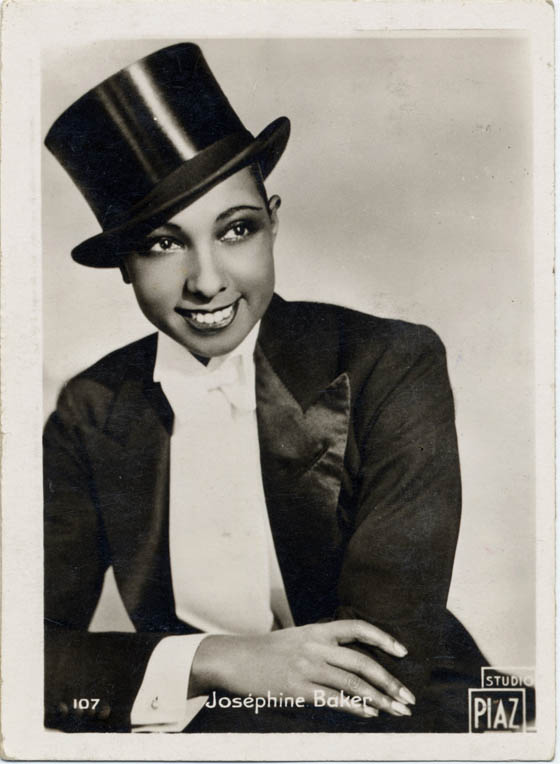
Day In History ► Josephine Baker Born

Dateline June 3, 1906 – Chanteusse Josephine Baker is born. Is there any doubt that had Josephine Baker been born White, she’d have been a huge star in ‘Merka who everyone would still know today? As her official web site puts it:

Josephine Baker sashayed onto a Paris stage during the 1920s with a comic, yet sensual appeal that took Europe by storm. Famous for barely-there dresses and no-holds-barred dance routines, her exotic beauty generated nicknames “Black Venus,” “Black Pearl” and “Creole Goddess.” Admirers bestowed a plethora of gifts, including diamonds and cars, and she received approximately 1,500 marriage proposals. She maintained energetic performances and a celebrity status for 50 years until her death in 1975. Unfortunately, racism prevented her talents from being wholly accepted in the United States until 1973.

The WikiWackyWoo adds:

Baker was the first African American female to star in a major motion picture, to integrate an American concert hall, and to become a world-famous entertainer. She is also noted for her contributions to the Civil Rights Movement in the United States (she was offered the unofficial leadership of the movement by Coretta Scott King in 1968 following Martin Luther King, Jr.’s assassination, but turned it down), for assisting the French Resistance during World War II, and for being the first American-born woman to receive the French military honor, the Croix de guerre.

Born as Freda Josephine McDonald into relative poverty, Baker started earning her living as a child working as a cleaning woman/babysitter for wealthy St. Louis Whites. At 13 she began to wait tables at The Old Chauffeur’s Club, where she met the first of her four husbands, Willie Wells. As a street corner busker, she danced her way into the St. Louis Chorus vaudeville show when she was only 15, which began her official show biz career. She kicked around vaudeville for a few years until she auditioned for “Shuffle Along,” the first all-Black Broadway musical, written by Eubie Blake [one of my favourite artsts] and Nobel Sissle. Amazingly, as her web site puts it:

She was rejected because she was “too skinny and too dark.” Undeterred, she learned the chorus line’s routines while working as a dresser. Thus, Josephine was the obvious replacement when a dancer left. Onstage she rolled her eyes and purposely acted clumsy. The audience loved her comedic touch, and Josephine was a box office draw for the rest of the show’s run.

That’s when Josephine Baker became a star. However, it was only when she went to Paris that she became a SENSATION. Paris society was integrated and Baker became one of the highest paid entertainers in all of Europe and welcomed into all aspects of Parisian society. Yet, when she returned to ‘Merka in 1936, she was savaged by the ‘Merkin critics; the New York Times calling her a “Negro wench.” She is reported to have returned to France heartbroken by the reception.

Here is Josephine Baker performing the famous Banana Dance that WOWED Paris:

However, if Josephine Baker’s singing and dancing were her only accomplishments, she would be remembered as merely an entertainer who scaled the heights of Europe and little more. In my mind her greater accomplishments are those that are less well known. Josephine Baker is the first ‘Merkin woman to be buried in France with a 21 gun salute and full military honours for her work for the resistance during the Second World War. The WikiWackyWoo picks up the story:

Her affection for France was so great that when World War II broke out, she volunteered to spy for her adopted country. Baker’s agent’s brother approached her about working for the French government as an “honorable correspondent”, if she happened to hear any gossip at parties that might be of use to her adopted country, she could report it. Baker immediately agreed, since she was against the Nazi stand on race, not only because she was black but because her husband was Jewish. Her café society fame enabled her to rub shoulders with those in-the-know, from high-ranking Japanese officials to Italian bureaucrats, and report back what she heard. She attended parties at the Italian embassy without any suspicion falling on her and gathered information. She helped in the war effort in other ways, such as by sending Christmas presents to French soldiers. When the Germans invaded France, Baker left Paris and went to the Château des Milandes, her home in the south of France, where she had Belgian refugees living with her and others who were eager to help the Free French effort led from England by Charles de Gaulle. As an entertainer, Baker had an excuse for moving around Europe, visiting neutral nations like Portugal, and returning to France. Baker assisted the French Resistance by smuggling secrets written in invisible ink on her sheet music.

Despite the treatment she received in ‘Merka in 1936, she wasn’t done with her native land quite yet. In the ‘50s she threw her support behind the ‘Merkin Civil Right’s Movement, though she still lived in France. She refused to perform for segregated audiences when she toured and is credited with helping to integrate Las Vegas shows. In a famously reported incident, she accused the Stork Club in Manhattan with refusing her service. Grace Kelly, who happened to be in the club at the time, saw what happened. She marched her entire party out of the club, arm-in-arm with Baker. Kelly never set foot in the club again and the two women became friends to the end. [Years later, when Baker had fallen on hard times she was supported by Grace Kelly, who was known as Princess Grace of Monaco by then, with money and a villa, .]

Baker worked with the NAACP and was beside Reverend Martin Luther King, Jr. at the March On Washington in 1963, the only woman to officially address the throngs. After Dr. King was assassinated Coretta Scott King asked her to lead the ‘Merkin Civil Rights Movement. Baker declined. She also adopted 12 children of various backgrounds, calling them her Rainbow Tribe, as demonstrable proof that people can get along.

But wait! That’s not all!

Baker was bisexual. Her son Jean-Claude Baker and co-author Chris Chase state in Josephine: The Hungry Heart that she was involved in numerous lesbian affairs, both while she was single and married, and mention six of her female lovers by name. Clara Smith, Evelyn Sheppard, Bessie Allison, Ada “Bricktop” Smith, and Mildred Smallwood were all African-American women whom she met while touring on the black performing circuit early in her career. She was also reportedly involved intimately with French writer Colette. Not mentioned, but confirmed since, was her affair with Mexican artist Frida Kahlo. Jean-Claude Baker, who interviewed over 2,000 people while writing his book, wrote that affairs with women were not uncommon for his mother throughout her lifetime. He was quoted in one interview as saying:

“She was what today you would call bisexual, and I will tell you why. Forget that I am her son, I am also a historian. You have to put her back into the context of the time in which she lived. In those days, Chorus Girls were abused by the white or black producers and by the leading men if he liked girls. But they could not sleep together because there were not enough hotels to accommodate black people. So they would all stay together, and the girls would develop lady lover friendships, do you understand my English? But wait wait…If one of the girls by preference was gay, she’d be called a bull dyke by the whole cast. So you see, discrimination is everywhere.”

On April 8, 1975, Baker starred in a retrospective revue at the Bobino in Paris, Joséphine à Bobino 1975, celebrating her 50 years in show business. The revue, financed by Prince Rainier, Princess Grace, and Jacqueline Kennedy Onassis, opened to rave reviews. Demand for seating was such that fold-out chairs had to be added to accommodate spectators. The opening-night audience included Sophia Loren, Mick Jagger, Shirley Bassey, Diana Ross and Liza Minnelli.

Four days later she was found in a coma in bed, surrounded by the latest rave reviews of what could have been the second act to her fabulous career. She never came out of it and died 4 days later.

By any standards Josephine Baker’s life is worthy of memorializing, which Lynn Whitfield did in 1991 in HBO’s The Josephine Baker Story. For her performance she received the Emmy for Outstanding Lead Actress in a Miniseries or a Movie, making her the first Black woman to do so.

Despite the biopic, sadly, when you mention Josephine Baker to people these days they stare blankly. Is there any doubt this would be the case were she White?

Musical Interlude ► Easy Star’s Lonely Hearts Dub Band

The greatest LP of the entire Rock era was released 45 years ago today. The Beatles masterpiece was a revelation, a concept album with a gatefold cover (already done by Frank Zappa, tho’), cool cut-outs, and the lyrics printed right on the back cover!!!

I listened to it over and over again when it was brand new, just like all my friends. Every listen seemed to bring something new to the ears.

There have been many interpretations over the years, including a recent Cheap Trick Sgt. Pepper performed completely live. However, the best interpretation is one I have already spoken about in these pages. Here’s Easy Star All-Stars performing the entire LP as “Easy Star’s Lonely Hearts Dub Band” with many special guest stars.

As always…CRANK IT UP!!!

Musical Interlude ► Papa John Creach

Dateline May 28, 1917 – Papa John Creach, violinist, was born on this day and would have turned 95, had he not had the misfortune of dying in 1994. Creach was in Hot Tuna, Jefferson Airplane, and Jefferson Starship, but had been playing clubs since the mid-’30s, much older than the musicians he would eventually play with.
Here’s a Papa John jukebox:
Aunty Em!!! Aunty Em!!!

I’m going to sting you, Bumble Bee.

Some HOT HOT HOT Hot Tuna, from the movie “Fillmore: The Last Days:”

For those so inclined, here’s a Hot Tuna concert from 1968 that lasts an hour and 20 minutes:

Papa John was also in Dinosaurs with Merl Saunders, Peter Albin, and Vince Littleton:

Another tasty rendition of a classic:

And here he is adding to the psychedelia with Jefferson Airplane:

Today’s blog post is dedicated to Vermont Dave, who does odd jobs around here and is a big Hot Tuna fan. Thanks Dave.

My Days With John Sinclair ► Nostalgia Ain’t What It Used To Be

John Lennon wrote very few songs about REAL people, and when he did he disguised the name of the subject, like “Sexie Sadie,” who was “Maharishi” in the original version.

However, Lennon wrote and recorded a song called “John Sinclair,” about one of Detroit’s a cultural icons. Lennon’s “John Sinclair” was just one protest song on “Some Time in New York City.” a double-record set (filled with political polemic as 3 minute tunes on one LP, and live concert with Frank Zappa and the Mothers of Invention on the other). Lennon was protesting the sentencing of John Sinclair to 10 years of hard time for GIVING an undercover agent two joints. This made the already infamous Sinclair, who only had a regional reputation until then, an international cause célèbre, which is what prompted Lennon to write the song and later appear at a Free John Sinclair concert. However, I knew John Sinclair before he ever became a jailbird.

I first encountered John Sinclair way back in the ’60s. I grew up in Detroit on Gilchrist Street (we called it Gilchrist Avenue because that was classier), one block and three houses south of the infamous 8 Mile (aka M-102) and five houses south of David Palmer, the original drummer for the Amboy Dukes. We were all in our middle teens then, but Dave was a year or two older which made all the difference back then. He wasn’t part of our clique, just a few doors down. His clique was far more exciting to us. We thought he was really cool because he was in a real rock and roll band who played real concerts and made real records. However, for some of us there was a more important reason for admiring David Palmer: When the administration threw him out of Coffey Junior High School because his hair was well-below his collar, he responded with a lawyer who argued that this was how Palmer made his living and he would be affected adversely if he had to cut his hair. Those of us who were still fighting the Hair Wars — and still being kicked out for having long hair — knew that it was only a matter of time before the rule fell, because David Palmer had already blown right through it.  The school was forced to make an accommodation with Dave: He had to wear his hair tucked in his shirt collar the entire day so that it was no longer than his shirt collar.
From then on Dave wore wild paisley shirts, with even wilder ties to hold all the hair in. It was always a bit of a thrill to follow Dave out the door at the end of the school day, see him scoop his hair out of his collar, and watch it cascade down his back. When the Amboy Dukes rehearsed in Dave’s garage, all us neighbourhood kids would hang out at the end of the driveway to listen. They were my first garage band.
I was only 15 and most weekends  and would head to Plum Street—Detroit’s Haight-Ashbury—on weekends, where I’d occasionally get a glimpse of John Sinclair holding forth. He was Detroit’s Top Hippie and I was a weekend wannabe.  On more than one occasion I’d work up the nerve to talk to him. Despite the age difference, and his massive height, he never talked down to me and all these years later I never forgot that kindness. Sinclair seemed to be everywhere: He helped launch the The Fifth Estate (one of ‘Merka’s oldest alternative/underground newspapers) manager of the MC5, and head of the White Panther Party.
Skip ahead many years—through many twists and turns that no one could have predicted at the time. In the new century my nephew became John Sinclair’s merchandising manager. What a thrill it was to learn that.
That’s merely all background to the real story.

It’s Labor Day weekend, 2006 and I’m excited. I am going to the Detroit International Jazz Fest where I am going to see John Sinclair for the first time in about 40 years. More importantly, my nephew is going to officially introduce us, even though we met way back when. John is at the Jazz Fest performing with his band The Blues Messengers.
We get there early because my nephew has lots to do before the show and I’m directed to a little table in the VIP area to wait. I need to describe this VIP section so the story makes more sense. There are 8 stages around the downtown area and each has a VIP section. It’s not backstage; it’s off to one side or another in front of the stages. It’s for audience, but special audience. Like me. The regular audience sits on fold-up chairs or the ground. We get real chairs and small cabaret tables to sit at. How civilized.
I’m killing time and I see John Sinclair arrive and sit at a table a few away from me. When my nephew comes back he says, “So, didja say ‘Hi!’ yet?” I reply, ” No, he’s going to do a show soon and I don’t want to bother him now.” I said that because I saw someone approach him only to be told, “I’m going to do a show soon. Don’t bother me now. I need to concentrate. I’ll gladly talk to you after.”
My nephew doesn’t care about such niceties and drags me over and makes introductions.
John Sinclair says to me, “I’ve heard so much about you I feel like I know you. Your nephew talks about you all the time.”
After I come back to earth I say, “John, I just want to thank you for treating me with respect way back when, instead of the snot-nosed Hippie weekend-wannabe that I was.”
With that my nephew starts cackling, “I hear people come up to you all the time and say pretty much the same thing, John. But this time it’s my uncle.”
It turns out that for all our own reasons, the three of us are all thrilled at the meeting.
Introductions over, I go back to my table. Eventually Sinclair performs. We talk a bit after the set and then head off in separate directions, John to meet up with some musician friends and me to go see a 24-piece Big Band playing all Zappa music with Big Band arrangements. (!)
A few hours later I find myself at the same VIP table alone, rocking out to the Regal Brass Band of New Orleans, which I had seen earlier in the year during Mardi Gras, the first one after Katrina.  I didn’t see anyone sit down next to me, but suddenly I was nudged from someone on the left. It was John Sinclair passing me a joint. I have to say that again: JOHN SINCLAIR PASSING ME A JOINT!!!
And, I do inhale.
As I begin to pas sit back he nods, as if to say, “Now pass it to the guy on the other side of you,” so I nudge that guy and he turns towards me. That’s when Dr. John says to me, in his gravely voice, “No man, I gotta do a show soon,” so I pass it back to John Sinclair.
So now me, John Sinclair and Dr. John are all dancing in our seats to a New Orleans Jazz band. Amazingly, as we talk and smoke, I learn that Sinclair was also at that very same Mardi Gras I attended—on the other side of the street from where I was watching the parade. Exactly on the other side of the street. I’m amazed I didn’t see him.
Eventually Dr. John gets up and leaves because his set’s on soon and the joint goes out. Sinclair rips it open and puts the shreds on the table. Then he starts fishing in his pockets. He pulls out several roaches and starts ripping them apart. He’s determined to get one more joint out of this mess on the table and, believe me, I’m rooting for him.
While I’m watching John do his thing I vaguely become aware that the guy on stage has been talking longer than usual. I focus on what he’s saying:
“…a really dear friend of ours. We’d like to have him stand up and say “Hello.” He’s a Detroit native, but now he’s a citizen of the world, living part time in New Orleans and part time in Amsterdam. Please, a warm hand for Detroit’s own, John Sinclair!”
John is in his own world. He’s on a mission. He doesn’t realize the applause is for him.
I nudge him.
“What?”
“Stand up, John.”
He looks around a minute, sees that everyone is looking at him (at us!!!) and clapping, so he stands up and takes a small bow and then sits back down laughing. “Why did he have to introduce me then? Look at this table.”
“John, there was no other time to introduce you. What are you known for?”

<breathing air> And that, ladies and gentlemen, is my
John Sinclair Story. However, I invite you to tune in to listen to
John Sinclair
at Radio Free
Amsterdam
, one of the oldest regular online podcasts going and just another
one of the cultural touchstones John Sinclair helped create in his long and creative
career. And, if you are in Ireland
later this month, check out the BREATHIN’ AIR
– Irish Tour 2012
With Howard Marks.

Another Magical Tee Vee Moment ► David Frost Interviews Paul McCartney

Dateline: May 18, 1964 – Paul McCartney is interviewed by David Frost in the full flush of Beatlemania.

It’s so funny they were talking about a possible retirement in 2010. who knew that 5 decades later Paul would still be making music and still making fans scream?

Thanks for all the music, Paul.

Harry Nilsson ► Thursday (Here’s Why I Did Not Go To Work Today) ► A Musical Interlude

“Thursday (Here’s Why I Did Not Go To Work Today)” has always been one of my favourite Harry Nilsson tunes. It comes from Sandman, a latter day effort. Harry’s voice had never been the same after the John Lennon produced Pussycats during Lennon’s “Lost Weekend.” This was no fault of Lennon’s. Nilsson had hurt his vocal cords and rather than tell Lennon he continued afraid to delay working with his hero. It only made it worse. While he never had that angelic voice again, he still wrote some lovely songs and this is one of them.It’s also a song on which his raspy voice gave the song the exact right amount of pathos. What do you think?

I’ve always especially loved the lyrics nearest the end. They’ve always had a Cole Porter feel to them for me, and that’s one of the highest forms of praise there is.

Monday is a blues day
That goes for Tuesday
Wednesday’s just the middle of the week, yeah mm
Friday is just another payday
The weekend’s just another heyday
But Thursday’s surreptitiously unique

That’s why I didn’t go to work today

Thursday’s got its own peculiar way

Of saying “hey”
Sometimes Thursday makes you want to run away

Thursday’s such a crazy, lazy day

Thursday’s such a crazy, lazy day

Thanks, Harry, for giving me a musical excuse to toss Thursday aside from time to time. However, today my clients were forced to cancel so I have the day off anyway.

So, while I have your attention: Here’s another wonderful Harry Nilsson performance, 100% live, from a BBC broadcast on which he did his entire “A Little Touch of Schmilsson In The Night” LP live. It’s sublime. And please note: Harry Nilsson was covering the American songbook long before Rod Stewart, Willie Nelson, or even Linda Ronstadt.

If you liked that, you will love parts two, three, four and five, which are all on the YouTubery.

You’re welcome.

National Velvet ► Nostalgia Ain’t What It Used To Be

During my long career as a professional writer, there have been times that I was on staff and on a publication’s masthead and other times that I freelanced. As a freelancer, I would take just about any job that involved jamming words together. Once I wrote an entire work of fiction for a corporate brochure that made Scarborough, Ontario, Canada sound like a great place to live and work. It was fiction because I didn’t really feel that Scarborough was a great place to live and work. Despite my dislike for Scarberia, as it is derisively called, the brochure won an award by the City of Scarborough, which couldn’t read through to the sarcasm.  Another of my freelance jobs was writing for record companies. Occasionally these were the dry sales sheets, 200 words tops, which the salesmen would use to get the rack-jobbers to stock the LP. These were boring and tedious to write, but I could bang off up to 10 a day. However, my favourite writing for record companies was when I was hired to write artist biographies. These always involved meeting and interviewing the artists and I liked to spend as much time as possible with the artist/band before I ever sat down to write. And that’s how I came to meet National Velvet, when I was hired to write their biography.

 
Aside from the actual music, artist bios are one of the most important calling cards a band and/or record company has.
Before the first note of music is even heard, the artist biography is
often fully digested. Artist bios are a tricky business. Every word must
be right. The bio needs to capture the essence of the band or artists. It needs to make the reader WANT to play the record. It needs to tell you everything you need to know about the band, yet retain some mystery that can only be solved by listening to the music. There is no formula for writing an artists’ bio. Every one is different because every artist is different.

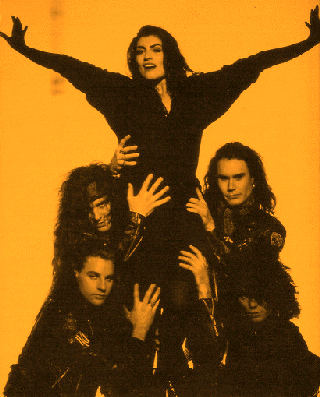
National Velvet were more different than most. NV was a Canadian Goth band before Goth was named Goth. Intrepid Records, distributed by Capital Records Canada, was preparing the release of their first National Velvet LP and hired me to write the bio. I spent about a week with the band, on and off. I went to a few rehearsals, met them in a coffee shop or two, and then someone’s living room. I took notes on how they interacted while recording all their words for posterity. When I felt I had enough, I went back to my belfry to write. One of the things I was struck with after re-reading all the notes I had taken (and which I still have and just used to refreshed my memory) is how thoughtful the band was about their place in the city, the music industry, the record business. I decided that the band’s thoughtful considerations deserved a thoughtful consideration in the biography, which I would blend with the dark, back alleys of the city. Sort of The Dark Knight meets The Hudsucker Proxy.

When I finally had a 1st draft I was happy with I showed it to the record company, the client.  That’s how it worked. Once I had something I liked, I would show it to the client who would tell me whether they liked the path I was on. If so, we’d kick the first draft around 5 or 10 or 15 times, until everyone was happy with the final product. If, in the alternative, the client hated it I would be back at square one, using their ideas to form an entirely new first draft.

In this case Intrepid Records didn’t much like the bio. While it managed to capture the band and the dark underbelly of the city, it came across as far too portentous, far too weighty.  They said, “We like everything about it, except it’s far too serious. What if we made it a cartoon instead?”

It must be noted that the band was not my client. I only had to make the
record company happy. If the band liked the biography the record company
chose to represent them with, that it was a happy bonus.

I wasn’t sure how this raw-edged Goth band would like being turned into a cartoon, but that was hardly my problem. The record company was paying the shots and I won’t get paid until they approve a final draft. So I go back to my belfry with a new task: Create a band biography that is dark without being serious because it needs to come off as a cartoon while, at the same time, capture the essence of these individuals.  Amazingly, that’s just what I did. I used contact sheets of the band’s photo session to create a comic book featuring the band collectively and individually. The words inside the word balloons were their own words. The words of the comic book narrator (me) conveyed the dark throb of the city surrounding the band, while the off-camera record company exec kept putting his 2 cents in for the commercial considerations. Yeah, I know; it was weird as hell. When I went back with that new 1st draft I was fully prepared for them to reject it and throw me out of the office forever.

However, that’s not what happened. It was one of the few times in my career that a first draft of something was also the last draft. Everyone loved it except me. It’s not that I didn’t like the words I wrote, or the concept. It had always been the execution that bothered me. It was supposed to mimic a comic book, but I felt there was only a passing resemblance to a comic book. A typed narration at the bottom, with intentional strike-outs over intentional typos was not part of my concept.

No matter. I got paid.

Skip ahead some 25 years. . . .

Skip ahead some 25 years and my son, who was so much of a National Velvet fan when he was a teen that he bought the LP, tells me he’s going to be seeing National Velvet in Ottawa and will be taking one of the biographies I gave him a million years ago with him.

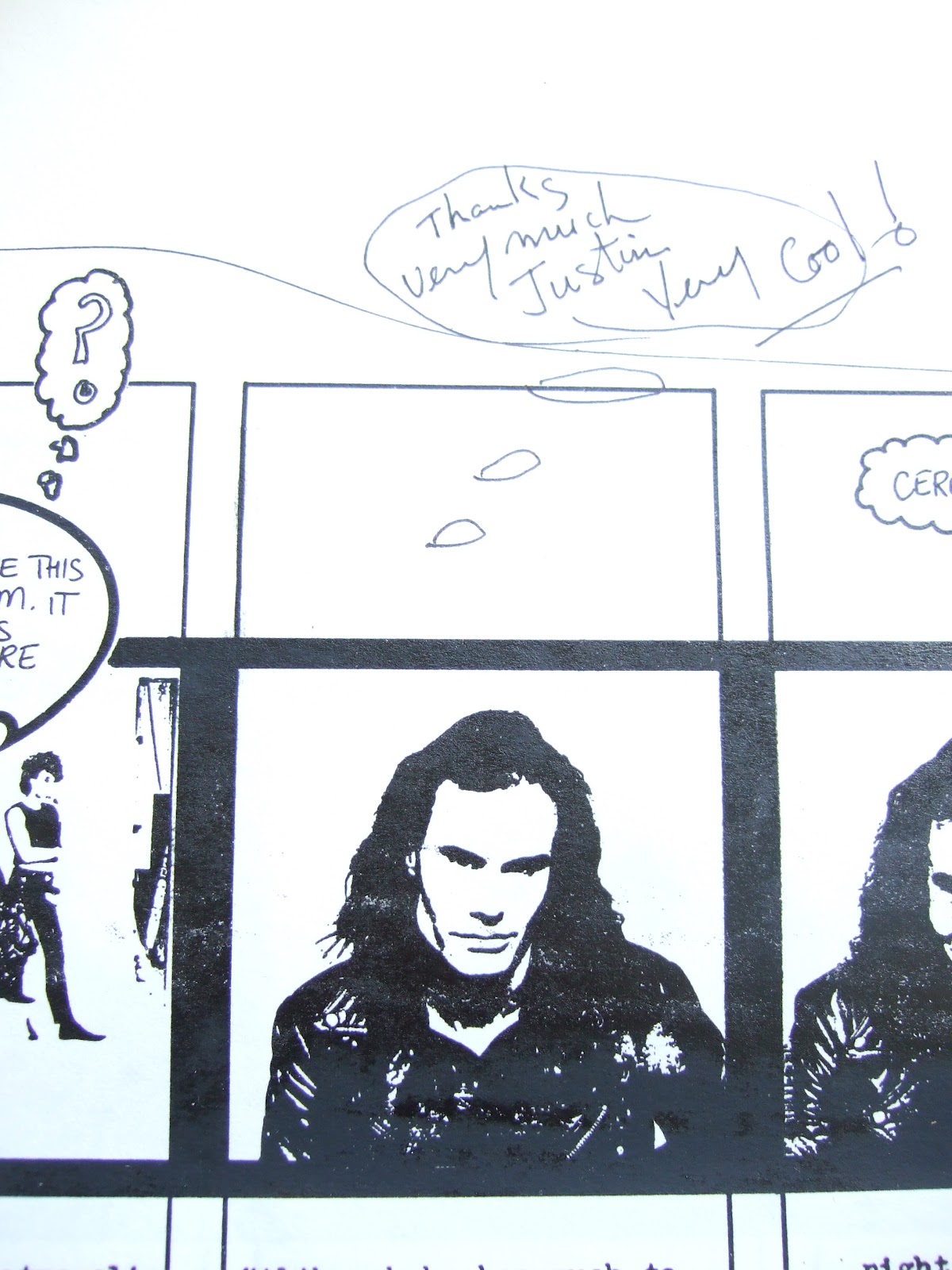
He returned with a happy surprise: The band not only autographed the bio, but part of the inscription was praise for the concept that I felt never worked properly.

THANKS MARIA!!!

Click to enlarge.

Click to enlarge.

Click to enlarge.

And thanks, Justin!!!

Here’s National Velvet’s big hit!!! Flesh Under Skin!!!

Elvis Presley and Frank Sinatra ► Nostalgia Ain’t What It Used To Be

Dateline: May 12, 1960 – Elvis Presley, newly returned from the U.S. Army, serving Uncle Sam, makes his first network tee vee appearance with Chairman of the Board, Frank Sinatra:


And here is Elvis in his prime, in 1956, with one of his earliest hits:


Elvis loved Gospel Music. Listen to his sensitive treatment of the classic “It Is No Secret.”


Fifty-two years ago today!!!

Happy Birthday Dennis Cowan ► Bonzo Dog Band ► May 6

The Bonzo Dog Band

Happy Birthday to Dennis Cowan, celebrating the big Six Five today. Dennis was bassist for the Bonzo Dog Band, originally The Bonzo Dog Dada Band, then The Bonzo Dog Doo Dah Band, before finally settling on the name everyone knows and loves.  The Bonzos, as they are affectionately known among fans, were the most influential band you never heard of and almost indescribable, but I’ll try. Cross a smattering of Lawrence Welk, with heavy doses of Spike Jones and his City Slickers, Frank Zappa and The Mothers of Invention, and Weird Al Yankovic and you’d get the Bonzo Dog Band…but Bonzos are funnier.

A little lesson in British comedy: One can draw a very crooked line from the surreal ’50s radio show The Goon Show–from which Peter Sellers sprang–to the anarchy of Monty Python’s Flying Circus. Between the two was the seminal children’s show [sic] Do Not Adjust Your Set. Later-Pythons Eric Idle, Terry Jones, and Michael Palin wrote and starred in this Thames tee vee series. However, people of all ages tuned in to see the antics of The Bonzo Dog Band, which featured today’s Birthday Boy Dennis Cowan on bass.

Here’s some very early Bonzos from Do Not Adjust Your Set:

People know the band Death Cab For Cutie. However, few know that the name is a tribute to the song of the same name that The Bonzo Dog Band performed in Magical Mystery Tour. This tasty little morsel of Doo Wop is one of few highlights in this horrible film that will always be an albatross around Paul McCartney‘s neck:

Neil Innes also came from the Bonzos and he became, almost, an auxiliary member of Monty Python Flying Circus. As told (accurately) by the WikiWackyWoo:

Innes wrote the songs for Monty Python and the Holy Grail. He appeared in the film as a head-bashing monk, the serf crushed by the giant wooden rabbit, and the leader of Sir Robin’s minstrels. He also had a small role in Terry Gilliam‘s Jabberwocky. Because of these long-standing connections, Innes is often referred to as “the Seventh Python”.

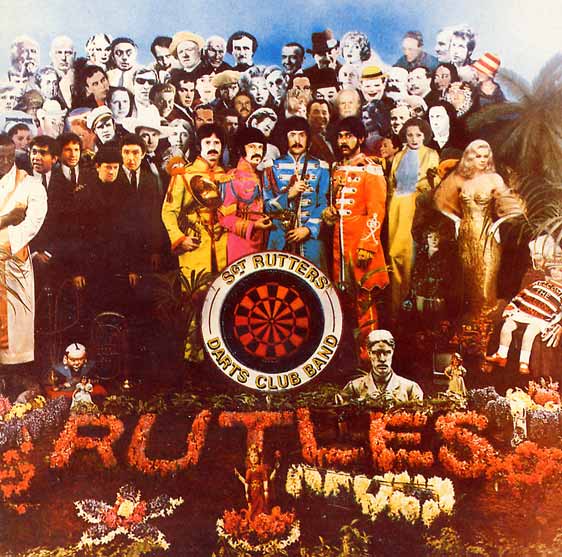
And, indeed, a Neil Innes documentary was called The Seventh Python. Innes was also Ron Nasty in The Rutles, which makes him one
of the Pre-Fab Four. But this isn’t about Innes, which would be a fun transgression.

Photo © Barrie Wentzell
L to R: Dennis Cowan, Roger Ruskin
Spear & Rodney Slater 1969
Photo © Barrie Wentzell, who
sells beautiful prints of early
Bonzo Dog Band and more.

The Bonzo Dog Band classic 1967 recording The Intro and the Outro lampooned every band that ever name-checked and introduced the members of the band. Vivian Stanshall voiced the introductions. This song was the inspiration for Mike Oldfileld when he recorded his solo album Tubular Bells, famously used as the theme music for The Exorcist. Oldfield’s long version introduced all the instruments he played, voiced by none other than the very same Vivian Stanshall.

Lastly, for fans of Beatles trivia, like James Rosen of Fox News (who I stumped. That story coming.), here’s a real rarity: The promotional film for I’m The Urban Spaceman. The original recording of Urban Spaceman was produced Apollo C. Vermouth, which was a pseudonym for Paul McCartney. Enjoy.