Tag Archives: Today in History

Idle No More ► Happy Birthday Eric!

Say no more!

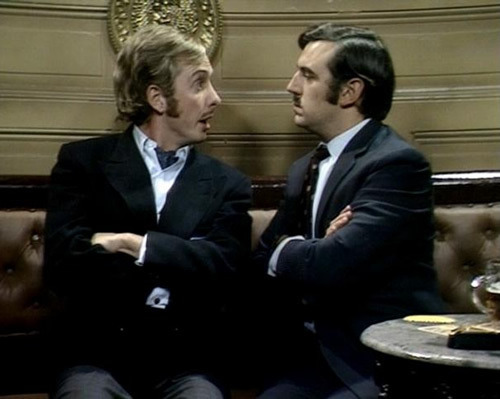
He’s been a Python, a Rutle, a cartoon, a song writer, an author, a comedian, a hit Broadway playwright, and the comic relief at an Olympics ceremony. And he turns 70 today.

Whole episodes of Monty Python are available all over the place. Here’s one with English subtitles for those who have trouble understanding English:

Dr. Carl Sagan wishes he could have explained it this simply:

Enjoy this Eric Idle Jukebox and wish him a Happy Birthday.

Who’s Got Geronimo’s Skull?

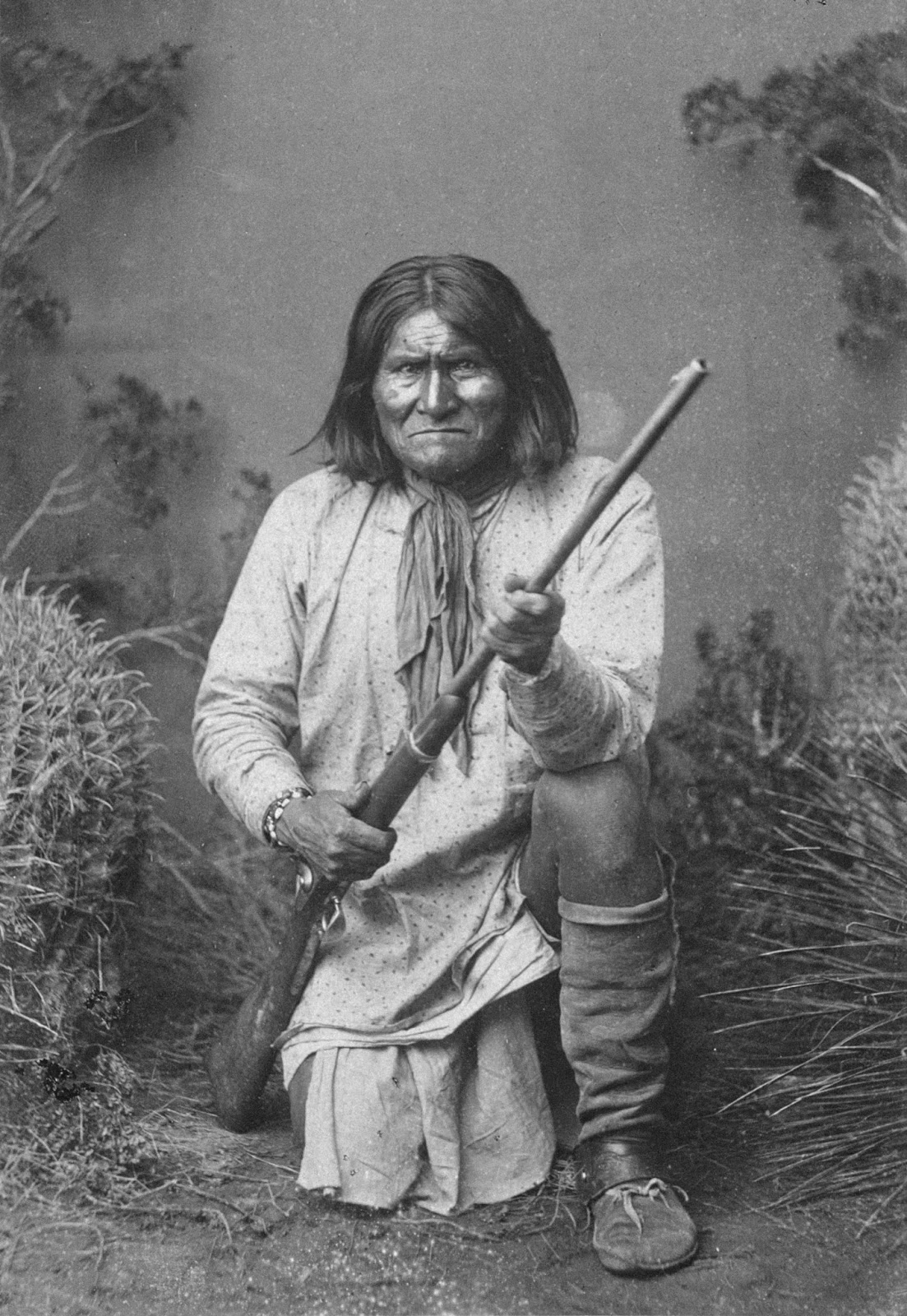
Geronimo in 1887

Dateline February 17, 1909 – Apache Chief Geronimo dies from complications from pneumonia at Fort Sill, Oklahoma. 

Geronimo surrendered in 1886 and spent his last years as a Prisoner of War of the ‘Merkin government. Despite his imprisonment he was still able to appear as a celebrity at various fairs and even rode in President Theodore Roosevelt’s 1905 inaugural parade. When he died at the age of 80, Geronimo was buried in the Apache Indian Prisoner of War Cemetery at Fort Sill.

Skip ahead a few years. The First World War — called the Great War until World War Two — was just breaking out. Prescott Bush — later a U.S. Senator and father of George Herbert Walker Bush, which makes him grandfather to George W. Bush — was stationed at Fort Sill before shipping out overseas. According to legend, Prescott Bush was one of several “Bonesmen” who dug up Geronimo’s bones and smuggled them to Yale University. They are said to have been at the Skull and Bones clubhouse ever since. G.H.W. Bush and G.W. Bush were later members of Skull and Bones, the secret society at Yale.

Edward S. Curtis, Portrait of Geronimo, 1905

There has never been a definitive answer as to whether Skull and Bones are keeping Geronimo’s bones. In 2009 Geronimo’s decendants sued. According to NBC News

Geronimo’s great-grandson Harlyn Geronimo said his family believes Skull and Bones members took some of the remains in 1918 from a burial plot in Fort Sill, Okla., to keep in its New Haven clubhouse, a crypt. The alleged graverobbing is a longstanding legend that gained some validity in recent years with the discovery of a letter from a club member that described the theft.

[…] The letter, sent to F. Trubee Davison by Winter Mead, said Geronimo’s skull and other remains were taken from the leader’s burial site, along with several pieces of tack for a horse.

“The skull of the worthy Geronimo the Terrible, exhumed from its tomb at Fort Sill by your club and Knight Haffuer, is now safe inside the T[omb] — together with is [sic] well worn femurs, bit and saddle horn,” Mead wrote.

Geronimo’s decendants lost that suit, but on very narrow grounds that doesn’t solve the controversy:

Siding with an argument by the U.S. Department of Justice, a federal judge in Washington, D.C., held that the government hadn’t waived its sovereign immunity, and hence federal officials can’t be sued in the case to force them to permit Geronimo’s descendants to remove his remains still at Fort Sill and reinter them in New Mexico near his birthplace, reports the Yale Daily News.

And, as far as the secret society is concerned, U.S. District Judge Richard Roberts held that the law under which Skull and Bones was sued, the Native American Graves Protection and Repatriation Act, only applies to grave robberies that took place after its enactment in 1990.

However, that’s not the most recent insult to Geronimo’s memory. The mission to kill ‘Merkin Enemy #1, Osama bin Laden, was codenamed “Geronimo.” From USA Today:

“Obviously, to equate Geronimo with Osama bin Laden is an unpardonable slander of Native America and its most famous leader in history,” Harlyn Geronimo said in a statement to the Senate Committee on Indian Affairs.

The panel met Thursday in a session scheduled weeks ago to discuss how racial stereotypes — mainly in the form of team mascots’ nicknames — were offensive to Indians. But the issue quickly pivoted to the code name the military had given to the sponsor of the Sept. 11 terrorist attacks.

“This victory has otherwise united our country,” Indian Affairs Chairman Daniel Akaka, D-Hawaii, said of bin Laden’s killing. “It is unfortunate that this code name was chosen.”

Today Geronimo is not thought of as the terrorist he was depicted in his lifetime. There is now an understanding that Geronimo was one of the last of his proud tribe to take up arms to defend itself from the continued encroachment and broken treaties of the newest residents of North ‘Merka. Among Natives Geronimo is deservedly considered a hero. Let us hope that one day the truth of his bones becomes known.

Nostalgia Ain’t What It Used To Be ► Flying High

Drawing of steerable dirigible created by Henri
Giffard, which reportedly flew 15 miles in 1852.

If God had meant humans to fly, She would have provided everyone with carry-on luggage. 

Back at the turn of the last century, however, people were trying to solve riddle of flight. Hot air balloons had been around for more than a century, but a hot air balloon has only two controls: up and down. Dirigibles came along in the mid-19th century, with steam-driven engines and controls. However, fixed-wing, heavier-than-air craft would have to wait for the invention of the internal combustion engine.

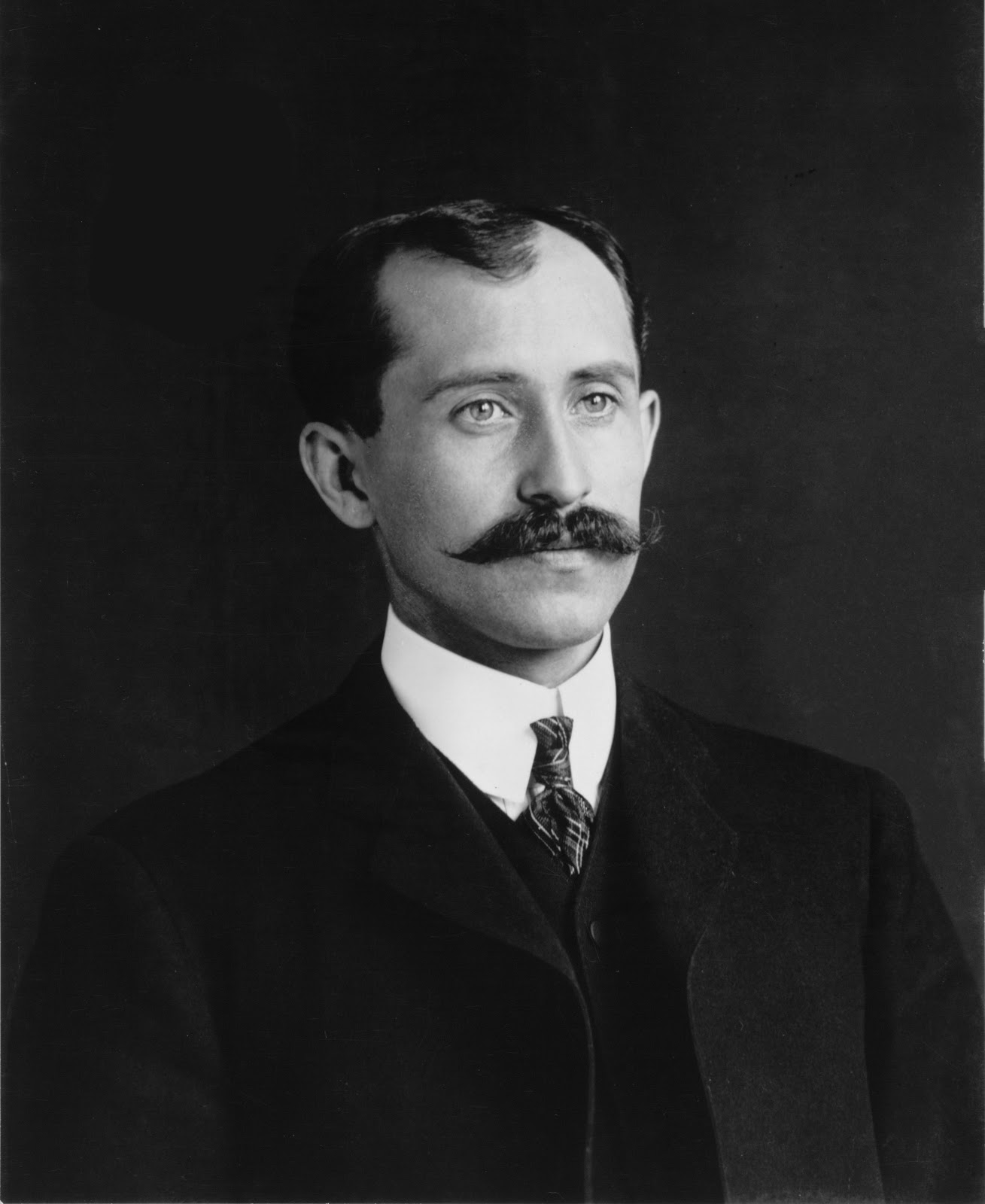
Orville Wright, 1903
Wilbur Wright, 1903

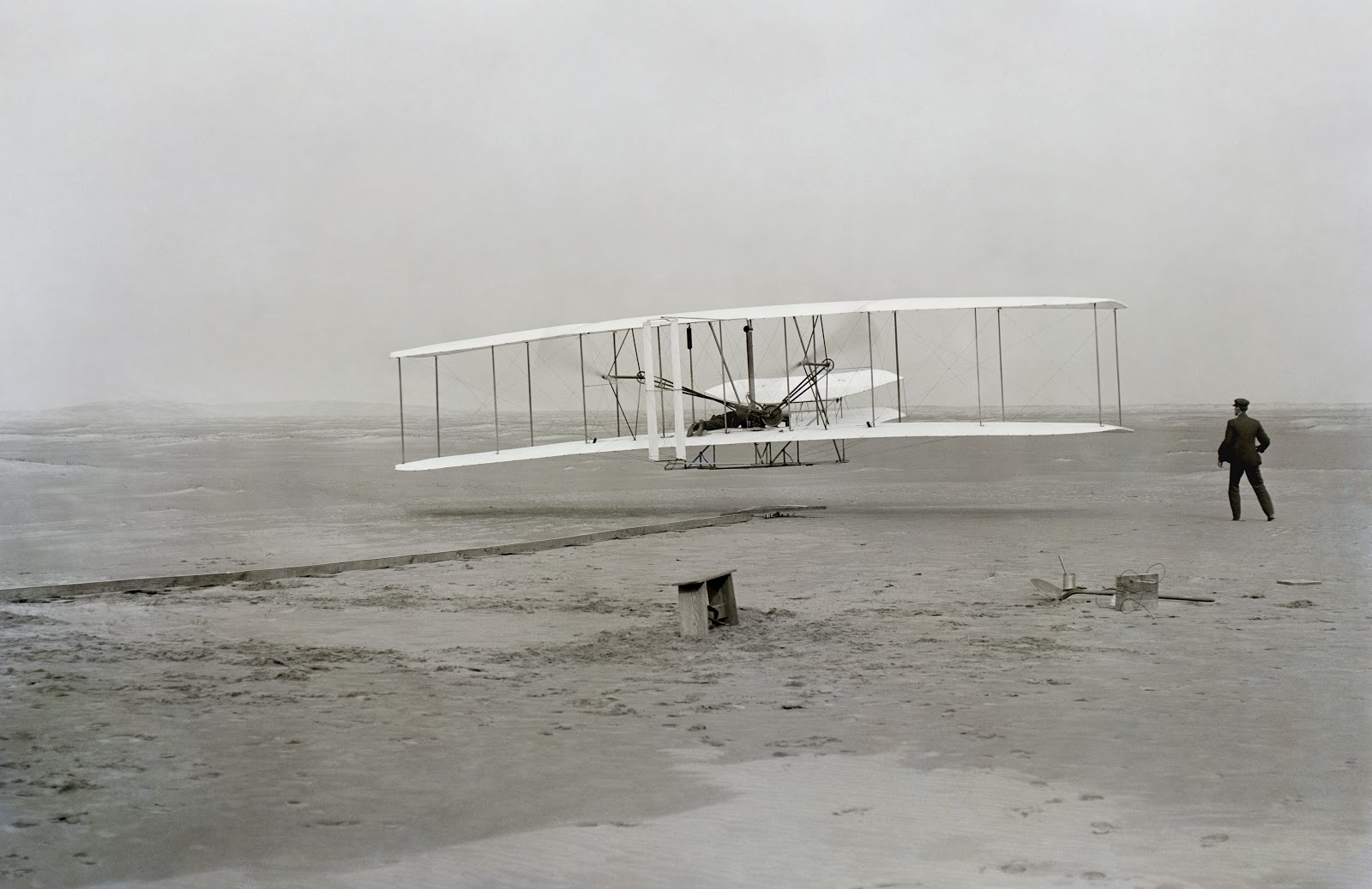
Inventors around the globe were looking for a way to control flight, including bicycle salesmen Orville and Wilbur Wright. The idea began with them in 1899, when Wilbur wrote to the Smithsonian Institution asking for info on aeronautics. The brothers spent the next several years working on their invention, realizing that they should perfect controlled glider flight before adding an engine to their airplane. There were many failures, but the Wright Brothers kept refining the glider until they were able to control its flight. In 1903 they added an engine and traveled to Kitty Hawk, North Carolina, their perennial testing ground. On December 14, Wilbur — who won a coin toss — took a 3-second flight, but the engine stalled after take-off and the subsequent crash made repairs necessary. On December 17, 1903, this time with Orville behind the controls, they succeeded with the “first controlled, powered, and sustained heavier than air human flight.” It doesn’t sound like much today, but Orville traveled 120 feet in 12 seconds about 10 feet above the ground, which works out to about 6.8 MPH. Exactly one photograph was taken of the historical event:

And, just because everybody loves movies like this, here are some attempts at flight that didn’t work out so well.

The last flight in that clip is the Wright Brothers. It was just a century from their first flight to the T.S.A.

Unpacking the Aunty Em Ericann Blog

Welcome to my occasional entry of Unpacking the Aunty Em Ericann Blog, where I ask my readers to pay attention to the man behind the curtain, who used to be “Aunty Em Ericann,” the woman behind the curtain.

Before I left Canada, 7 years ago, I told several people (who may now be too embarrassed to admit to knowing me) that I was going to become a nationally-known pundit in ‘Merka under the nom de plume “Aunty Em Ericann.” To that end I created the meta-character named Aunty Em Ericann, who eventually came to write at NewsHounds. The back story for Aunty Em was deceptively simple. Here’s her biographical profile:

Emily Ericann. That’s my real name. Well it was, before I went back to my maiden name after the divorce. My ex and I were dating for 2 months before we realized that if we got married my name could be pronounced “american” (Em Ericann). After it all went bad, I realized that’s the only real reason we got married. Ironically, I am a former American. However, I lived in Canada three and a half decades and became a Canadian citizen along the way. And yet, I recently returned to The Land of My Birth to take care of my aged father. Shocked by the before and after differences in America, I will use this forum to speak out. 

Some members of the Miklós Rózsa Society. Miklós
Rózsa
is in the center. The sack of shit who hides
behind the name of Johnny Dollar is on the far left.

I got away with the nom de plume for a number of years before the two-legged piece of excrement named Johnny Dollar decided it was his mission in life to expose Aunty Em’s identity, along with my sex life. That story is outlined in Johnny Dollar Has Proven Himself To Be A Very Dangerous Person, the very first post on this blog.

However, my long-time readers already know that story. If they’ve been paying attention they also know that my Unpacking Aunty Em Ericann Blog series is merely an excuse to find clever ways to remind them to click on some of the advertising, so I can keep the Aunty Em Ericann Blog rolling. It won’t cost you anything, but will add a few pennies (and I do mean few) to my coffers, helping to support this enterprise.

I’m looking at YOU!

Meanwhile, one statistic I can access through the Blogger platform is
what search terms people have used to find their way to the Aunty Em Ericann Blog. Take a look at this chart for this week:

Top Ten search terms delivering readers to the “Aunty Em Ericann” blog this week. They all make sense except #8.

I don’t know what disturbs me the most: That this week one of the search terms that people used to arrive here was “boy staked to the ground”; that three separate people used the search term “boy staked to the ground”; or that, somehow, “boy staked to the ground” brings people to my blog, even though I’ve tried it without any luck. While I’m thinking about it, I’m not so sure of Arawak People being on this blog either.

From time to time I also like to review what my Top Ten posts are. I can see which ones are highly-rated at any given moment in time, or by the day, by the week, by the month, and of all time since the Aunty Em Ericann Blog launched.

My Top Ten most popular posts of All Time

My Top Ten Posts of All Time™ in handy clickable hypertext:


Click on one of the links above to read one of my Top Ten blog entries, or just go exploring from the front page. There’s guaranteed to be a story or two you like, or maybe something that merely pisses you off. However, just keep in mind that it would be a small favour to me for you to click on one of the adverts . . . or two . . . on the Aunty Em Ericann Blog.

Frank Zappa ► A Musical Appreciation

Dateline December 4 – On this day in 1971 Frank Zappa and the Mothers of Invention were on stage in Montreax, Switzerland when the casino caught fire. The night was immortalized in Deep Purple’s song “Smoke on the Water.” On the same date 22 years later Frank Zappa died of prostate cancer.

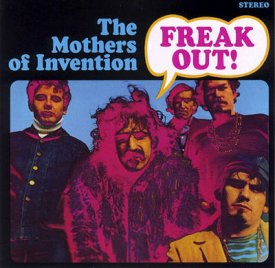
The ugliest LP cover I had ever seen.
I had to own it.

Not to brag, but I was there from the beginning. I discovered Frank Zappa some time in 1966 when I first set eyes on the cover of Freak Out at my local Kresge’s record department. As one descended on the escalator into the basement, a gap opened in the wall revealing Kresge’s 2-rack record department. The farther one descended, more of the record department was revealed in the expanding triangle of the record department. As teens we’d crane our heads into that crack to see what was new each week.

One day in 1966 my eyes spied what was the ugliest record cover I had ever seen. I had to own it.

It was a double-record set in a gatefold cover, among the first for a Rock and Roll LP. The music was also a revelation. One LP was all Doo Wop, but done in a slightly demented style, as opposed to straight up. The other LP contained longer songs and musical collages that were NOTHING like demented Doo Wop, but were demented all the same. I became an instant fan and followed Frank Zappa’s career, like a lemming follows whatever a lemming follows, ever since.

When I signed up I didn’t realize that by the time it was over I’d have collected some 90 albums, many of them double and triple sets, making Frank Zappa one of the most prolific artists/composers/Rock musicians of the 20th Century. However, I wasn’t a fan because he was prolific. I was a fan because he made great music. Here’s just a small taste of what Frank Zappa composed and released. Enjoy.

Unpacking The Aunty Em Ericann Blog ► Shit Just Got Real

Pictures in the public domain stitched together by author

From time to time I like to unpeel the onion and reveal a bit of what it takes to put this blog together. I call the series “Unpacking The Aunty Em Ericann Blog,” Aunty Em being my nom de plume when I was writing at NewsHounds.

However, as I have explained to my faithful readers, this series has always been nothing more than an excuse to find clever ways to beg my readers to click on an advert or two (in the right-hand column) while they are here. When someone clicks on an advert, I get a few pennies . . . and I do mean “a few.” Finding clever ways to get my readers to click on the adverts has become more crucial than ever. Yesterday I learned two things simultaneously:

  1. Blogger has a limit for FREE data storage;
  2. I had JUST reached that upper limit.

I felt as if someone had just said to me, “Psst! Hey kid! The first one’s free! Now it’ll cost you.”

Faced with this dilemma there was only one practical thing to do: So that I can continue to bring to my vast reading audience all its favourite series, I’ll start to pay the monthly fee for the data storage.

All your favourites are here: Unpacking Coconut Grove, Unpacking My Detroit, Another Magical Tee Vee Moment, The Fox “News” Spin Cycle, Judge Not, Nostalgia Ain’t What It Used To Be, Fox “News” Snark, Music Reviews, Chow Mein and Bolling, and my other various looks at various topics, as varied as Watergate right up to Today in History.

Think of this series like a PBS Pledge Break: If you want to see your favourite EmTV series to continue, call the number at the bottom of your . . . Wait!!! What??? There’s no number? Then click on several ads while you’re here and keep this blog in data storage.

Pretty please with sugar on top?

You can also connect with me at facebook and Twitter. The more the merrier.

Nostalgia Ain’t What It Used To Be ► Steamboat Willie

Dateline November 18, 1928 – Mickey Mouse appears in “Steamboat Willie,” the first all-singing, all-talking, all-musical cartoon.

What made “Steamboat Willie” such a revelation to movie-goers in 1928 was that the cartoon was entirely synchronized with the music and sound effects. While we take that entirely for granted today, this was a giant advance in the technology of the day. Walt Disney’s tour de force came less than a year after the release of “The Jazz Singer,” the first full-length “talkie.”

The technological advances of The Jazz Singer and Steamboat Willie helped put a nail in the coffin of the Silent Movie Era. In the case of Steamboat Willie, this is ironic because it was paying homage to the classic Buster Keaton silent film “Steamboat Bill, Jr.” Within a decade silent movies were as dead as wax cylinders.

It cost Walt Disney $4,986 to produce Steamboat Willie.

Happy Magazine Day ► Nostalgia Ain’t What It Used To Be

First issue of Rolling Stone
First issue of The Atlantic

DATELINE November 9 – On this date in 1967, Rolling Stone published its first issue in San Francisco. On this date in 1857, The Atlantic Monthly was founded in Boston, Massachusetts.

A lot of magazines have folded in the 155 years since the first issue of The Atlantic Monthly, or the 45 years since Rolling Stone first came out. Yet both magazines are still essential reading and important cultural touchstones.

We know tend to know about the founding of Rolling Stone by Jann Wenner and Ralph J. Gleason of Rolling Stone Magazine. While Wenner came out of nowhere, almost, Gleason had already carved a reputation. By contrast, most of the founders of The Atlantic are names you would still recognize: Harriet Beecher Stowe, Ralph Waldo Emerson, Henry Wadsworth Longfellow, Oliver Wendell Holmes, Sr., John Greenleaf Whittier and James Russell Lowell.

Current front page of Rolling Stone
Current front page of The Atlantic

In 1977 Jann Wenner moved Rolling Stone to New York City. The Atlantic Monthly published, err, monthly until 2001. After a year in which The Atlantic published 11 issues, it settled down to producing 10 issues a year and dropped the word “Monthly” from its name.

Both magazines remain important and vibrant today, and both currently have a strong electronic presence. However, with Newsweek already deciding to kill its analog version, how much longer will magazines be around?

Prohibition Then and Now

Detroit on January 16, 1920, the day before prohibition began.

DATELINE October 28, 1919 – The House overrides President Woodrow Wilson’s veto to pass the 18th Amendment, also known as the Volstead Act. The Senate went along the following day, which brought in prohibition across the nation the following January. Prohibition lasted for almost 14 years — 14 years of extreme lawlessness. It was a complete failure. As PBS tells us

Prohibition turned law-abiding citizens into criminals, made a mockery
of the justice system, caused illicit drinking to seem glamorous and
fun, encouraged neighborhood gangs to become national crime syndicates,
permitted government officials to bend and sometimes even break the law,
and fostered cynicism and hypocrisy that corroded the social contract
all across the country. With Prohibition in place, but ineffectively
enforced, one observer noted, America had hardly freed itself from the
scourge of alcohol abuse – instead, the “drys” had their law, while the
“wets” had their liquor. 

 I highly recommend the three-part Ken Burns-Lynn Novik documentary Prohibition. Here’s a taste:

Watch Al Capone Beer Wars on PBS. See more from Prohibition.

Prohibition Now

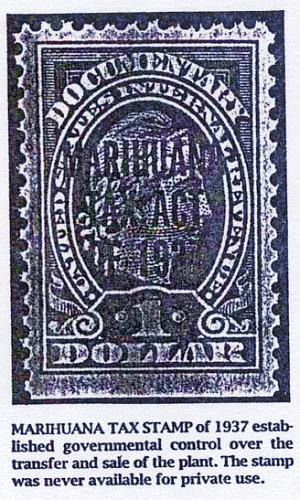
‘Merka learned almost nothing from Prohibition. No sooner did the country do away with Prohibition, it brought in the Marihuana [sic] Tax Act of 1937. Oddly enough, the law did not outlaw marijuana; it merely required paying a tax of about a dollar to deal in hemp, marijuana, or cannabis. However, it was impossible to obtain a tax stamp. This effectively made marijuana illegal even though there are many uses for marijuana, whether for smoking or making products out of hemp, such as paper.

The outlawing of marijuana was a perfect storm of business interests and racism, all whipped up by Harry J. Anslinger, who was appointed to the Federal Bureau of Narcotics in 1930 by Treasury Secretary Andrew W. Mellon. One of the Mellon Bank’s financial interests was DuPont, which was moving out of munitions and into plastics and synthetic fibers. Hemp, which had been a huge industry at the time, was a threat to DuPont’s plans.

One of Anslinger’s weapons in his campaign to outlaw marijuana was undisguised racism, as DrugWarRant.com clearly lays out in its report on Why Is Marijuana Illegal:

He also promoted and frequently read from “Gore Files” — wild reefer-madness-style exploitation tales of ax murderers on marijuana and sex and… Negroes. Here are some quotes that have been widely attributed to Anslinger and his Gore Files:

    “There are 100,000 total marijuana smokers in the US, and most are Negroes, Hispanics, Filipinos, and entertainers. Their Satanic music, jazz, and swing, result from marijuana use. This marijuana causes white women to seek sexual relations with Negroes, entertainers, and any others.”

“…the primary reason to outlaw marijuana is its effect on the degenerate races.”

“Marijuana is an addictive drug which produces in its users insanity, criminality, and death.”

“Reefer makes darkies think they’re as good as white men.”

“Marihuana leads to pacifism and communist brainwashing”

“You smoke a joint and you’re likely to kill your brother.”

“Marijuana is the most violence-causing drug in the history of mankind.”

And he loved to pull out his own version of the “assassin” definition:

“In the year 1090, there was founded in Persia the religious and military order of the Assassins, whose history is one of cruelty, barbarity, and murder, and for good reason: the members were confirmed users of hashish, or marihuana, and it is from the Arabs’ ‘hashashin’ that we have the English word ‘assassin.’”

Yellow Journalism

Harry Anslinger got some additional help from William Randolf Hearst, owner of a huge chain of newspapers. Hearst had lots of reasons to help. First, he hated Mexicans. Second, he had invested heavily in the timber industry to support his newspaper chain and didn’t want to see the development of hemp paper in competition. Third, he had lost 800,000 acres of timberland to Pancho Villa, so he hated Mexicans. Fourth, telling lurid lies about Mexicans (and the devil marijuana weed causing violence) sold newspapers, making him rich.

Movies such as Reefer Madness (1936) helped to drive the national hysteria:

While the Marijuana Tax Act of 1937 was supplanted by various laws over the years, the result is the same: Marijuana is still illegal. Some of the costs of the War on Drugs include:

  • Amount spent annually in the U.S. on the war on drugs: More than $51,000,000,000
  • Number of people arrested in 2010 in the U.S. on nonviolent drug charges: 1,638,846
  • Number of people arrested for a marijuana law violation in 2010: 853,838
  • Number of those charged with marijuana law violations who were arrested for possession only: 750,591 (88 percent)
  • Number of Americans incarcerated in 2009 in federal, state and local prisons and jails: 2,424,279 or 1 in every 99.1 adults, the highest incarceration rate in the world
  • Fraction of people incarcerated for a drug offense in state prison that are black or Hispanic, although these groups use and sell drugs at similar rates as whites: 2/3
  • Number of states that allow the medical use of marijuana: 17 + District of Columbia
  • Estimated annual revenue that California would raise if it taxed and regulated the sale of marijuana: $1,400,000,000
  • Number of students who have lost federal financial aid eligibility because of a drug conviction: 200,000+
  • Tax revenue that drug legalization would yield annually, if currently-illegal drugs were taxed at rates comparable to those on alcohol and tobacco: $46.7 billion

Gary Johnson, former Governor of New Mexico and current candidate for President of the United States for the Libertarian Party argues

It’s time we tax and regulate marijuana. The War on Drugs is a proven failure.  We have spent several decades and close to a trillion dollars trying to eliminate drugs.

Consider these facts:

  • The last three Presidents and half of American adults have said they have smoked marijuana.
  • More children have tried marijuana, which is illegal, than cigarettes, which are regulated.
  • Last year we arrested 850,000 people for marijuana, mostly for possession.
  • So far, fourteen states have passed medical marijuana laws enabling sick people to benefit.
  • Massachusetts, Denver, and Seattle have either successfully decriminalized, or instituted lowest priority law enforcement policies for marijuana possession.

We learned a valuable lesson with alcohol prohibition in this country. Prohibition created black markets and violence as gangs fought to control the market. The same thing is true today.  Mexican cartels make the majority of their profits distributing marijuana in 230 American cities, and the resulting violence is tragic. That’s why the presidents of many Latin American countries signed a declaration that the war on drugs needs to be ended.

Isn’t it time to do away with the War on Drugs?

Ron Mann’s 1999 documantary Grass: The History Of Marijuana is a great overview of how marijuana became illegal.

Harry Houdini’s Last Performance

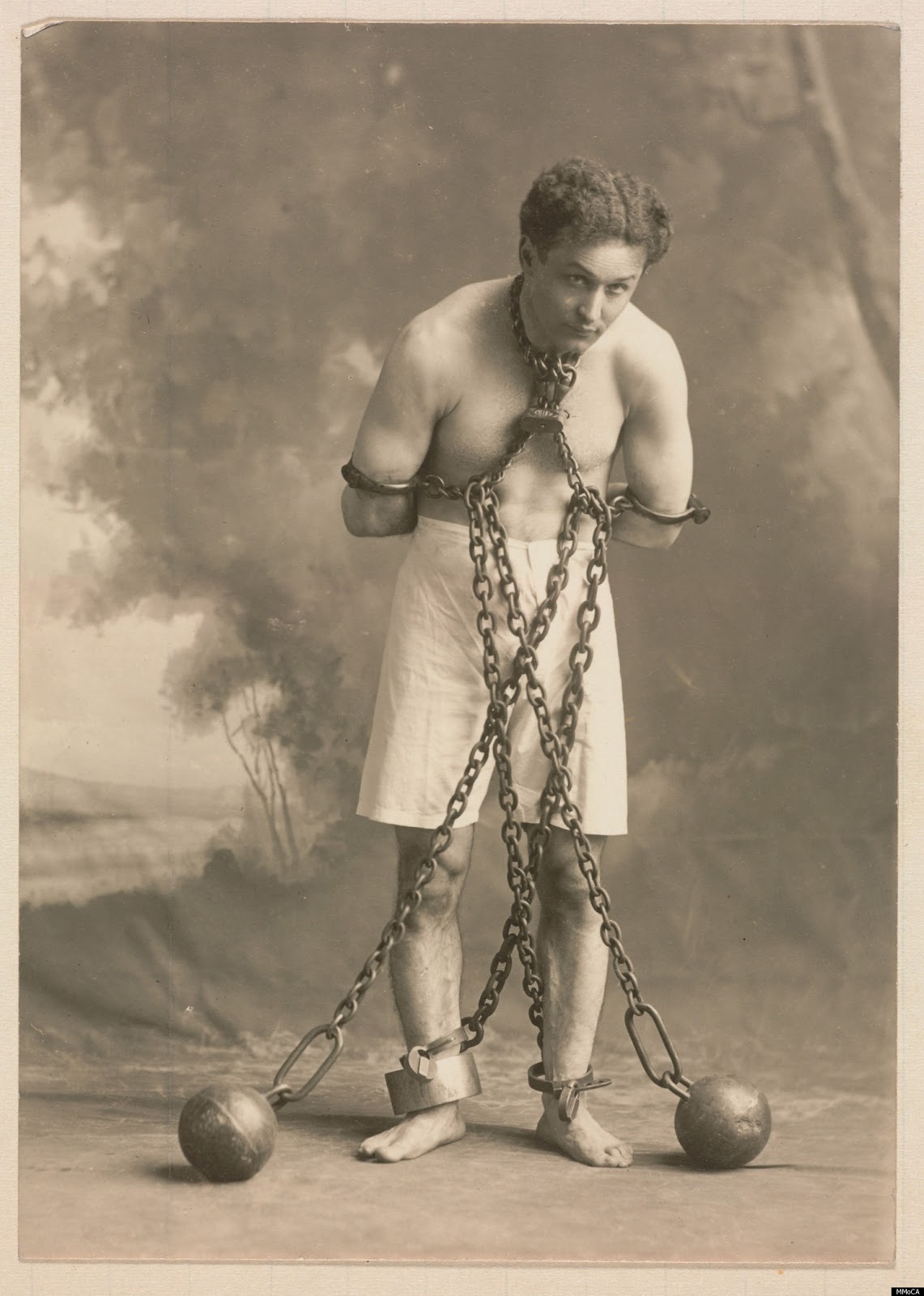
Dateline October 24, 1926 – It was on this day that illusionist and
escape artist Harry Houdini gave his last performance in 1926 at
Detroit’s Garrick Theater. He was to die of peritonitis from a ruptured
appendix room 401 of Grace Hospital on Halloween at the age of 52.

Harry Houdini was a sensation in the early part of the last century.
Born Erik Weisz in Budapest, Hungary, on March 24, 1874, he emigrated
with his family to America in 1878, at first settling in Appleton,
Wisconsin where his father was a Rabbi. In 1887 the family moved to New
York where the young Ehrich Weiss (both names having been Americanized)
performed at the age of 9 as a trapeze artist. In 1891 began his career
as a magician, calling himself Houdini in honor of famous French
Magician Jean Eugène Robert-Houdin.

At first he wasn’t very successful and had to double as “The Wild
Man” at the circus. While he concentrated on card tricks at first,
Houdini eventually began to add escape acts to his repertoire. He was
also a master of publicity, challenging police in every city he
performed in to see if they could lock him up in a way he could not
escape. No one ever could. It took years before Houdini found success,
but once he hit, he hit it big. For a while he was the highest paid
performer in Vaudeville and the toast of society on every continent,
feted by both royalty and high society.

One of Houdini’s claims led to his downfall. He was known as being
able to withstand any blow to his stomach. While performing in Montreal,
he was asked by a McGill University student if this was true. Houdini
said it was, but before he had time to contract his muscles, J. Gordon
Whitehead hit him with a series of body blows. Apparently Houdini had
been suffering from appendicitis for several days, but had not sought
medical attention. While doctors say his appendix would have burst
without the punches, certainly the punches didn’t help matters. While in
severe pain, Houdini still didn’t seek medical attention and traveled
to his next date in Detroit. Despite rinning a fever of 104 °F and a a
diagnosis of acute appendicitis, ‘the show must go on,’ as the slogan
goes. He performed, with one report saying he passed out and was revived
at one point during the show. After the show, he allowed himself to be
taken to Detroit’s Grace Hospital, where he died of peritonitis 7 days
later.

This article first appeared on Stones Detroit, where I place some of my posts about Detroit, my home town.