Unretouched photo of Bully Boy Bolling taken off my tee vee screen
I get email. Several people have asked me me how I came up with such an odd name for a series that (quite rightly) skewers Bully Boy Bolling for being the supreme asshole that he is. While I explained in the first episode of Chow Mein and Bolling, I guess it would be hubris for me to expect my faithful readers to go back that far.
The truth of the matter is I stole the name from Mike Nesmith, my favourite Monkee, who named a terrifically funny song “Chow Mein and Bolling.”
Now I guess I need to apologize to Mike Nesmeth, Nez to his fans, because my popular series Chow Mein and Bolling has knocked Nesmith off the top of the Google listings. I’ll do that my treating my fans to another great Mike Nesmith song, which helps put Bully Boy Bolling’s tee vee bullshit into the proper perspective.
Dateline October 10, 1917 – Thelonious Sphere Monk is born in Rocky Mount, North Carolina. When he was 4 years old his family would move to the “San Juan Hill” area of Manhattan. A year later he would start playing piano after listening to his sister’s music lessons. By the time of his death in 1982, he would be one of only 5 Jazz artists to appear on the cover of Time Magazine (the others being Louis Armstrong, Duke Ellington, Wynton Marsalis and Dave Brubeck). Today he’s generally considered The Father of Bebop music.
With the arrival Thelonious Sphere Monk, modern music — let alone modern culture — simply hasn’t been the same. Recognized as one of the most inventive pianists of any musical genre, Monk achieved a startlingly original sound that even his most devoted followers have been unable to successfully imitate. His musical vision was both ahead of its time and deeply rooted in tradition, spanning the entire history of the music from the “stride” masters of James P. Johnson and Willie “the Lion” Smith to the tonal freedom and kinetics of the “avant garde.” And he shares with Edward “Duke” Ellington the distinction of being one of the century’s greatest American composers. At the same time, his commitment to originality in all aspects of life — in fashion, in his creative use of language and economy of words, in his biting humor, even in the way he danced away from the piano — has led fans and detractors alike to call him “eccentric,” “mad” or even “taciturn.” Consequently, Monk has become perhaps the most talked about and least understood artist in the history of jazz.
The WikiWackyWoo says, “Monk is the second-most recorded jazz composer after Duke Ellington, which is particularly remarkable as Ellington composed over 1,000 songs while Monk wrote about 70.“
It wasn’t just his own compositions. When Monk covered another artists’ song, he had a way of turning it inside out and creating his lovely dissonance, where it none had before.
Clint Eastwood, when he’s not berating empty chairs, is a great aficionado of Jazz. He produced this 1988 documentary, directed by Charlotte Zwerin that can say far more than I can:
If that has whetted your appetite, here’s a Thelonious Monk Jukebox I put together:
Dateline October 9, 1940 – John Winston Lennon is born in war time Liverpool. December 8, 1980 John Ono Lennon is assassinated in New York City. There’s nothing left to say; his music still speaks for him, as it will do here:
This John Lennon Tribute Jukebox for Spotify has 112 tracks. Hit Random Shuffle and it will move the air in your space for more than 6 hours. Enjoy.
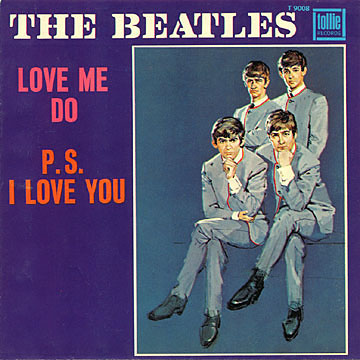
Dateline October 5, 1962 – The Beatles first single “Love Me Do” is released. The rest, as they say, is history.
The Beatles had been signed to EMI Records earlier in the year. In June they recorded “Love Me Do” with original drummer Pete Best at a demo test. By the time they returned to the studio in September for their first official recording session Pete Best had been fired, replaced by Ringo Starr. Producer George Martin had been less than impressed with Best’s drumming in June and told Brian Epstein he’d be using a session drummer for their upcoming recording session. That’s all John Lennon and Paul McCartney needed to hear. Aside from being a mediocre drummer, Best wasn’t the greatest fit personality-wise either. Lennon and McCartney tapped Ringo, who was in Rory Storm and the Hurricanes. Ringo had actually sat in with them during their Hamburg days. Also from Liverpool, they knew Ringo would fit right in.
When The Beatles returned to EMI to record on September 4th, it was with Ringo on drums. However, George Martin was unhappy with his meter and the song was re-recorded a week later with session drummer Andy White on the skins and Ringo Starr relegated to tambourine. That’s why there are two different versions of “Love Me Do.” The originally released single was the Ringo Starr version, while the Andy White recording is the one on The Beatles first LP “Please, Please Me.” The Pete Best version, which for the longest time had been thought lost, was including on the Anthology 1 box set.
This version is clearly the Andy White version, as there was no tambourine on the Ringo Starr version.
I also found two covers of “Love Me Do:” that are a lot of fun. One is by a string quartet and the other is a terrific Tex-Mex version by Flaco Jimenez.
It hardly seems like half a century has passed, but in the last 50 years our lives have been enriched non-stop by the music of The Beatles.
Before Mike Love stabbed his cousins in the back and fired Brian Wilson and Al Jardine from The Beach Boys, it was gratifying for this long-time fan to know they were back on the road making music. On the same day I read that Mike Love fired his band mates of 50 years, I discovered this wonderful tribute to Brian Wilson. I not only loved the song, but dug the whole video production, which touches upon some of the highlights and lowlights of Brian Wilson’s life.
This video made me curious. Knowing absolutely nothing about Rich Aucoin, I used Der Googalizer. The WikiWackyWoo wasn’t much help, although it told me that this was a good Canadian boy from Nova Scotia. It also informed me:
[H]e also recorded material across Canada with a wide variety of musicians, friends and fans for what would become his debut full-length album, 2011’s We’re All Dying to Live; in total, the album features over 500 guest musicians, including Jay Ferguson of Sloan, Becky Ninkovic of You Say Party and Rae Spoon. The album’s release party, held at the 2011 Halifax Pop Explosion festival, featured over 80 musicians onstage.
Even his Official Web Site had very little actual information, but it did open up a treasure trove of videos. The music and the videos will just have to do the talking for Rich Aucoin.
And, if you have your anaglyph 3D glasses, you’ll get the most out of this video:
Dateline September 13, 1941 – A baby is born in war time England, Thames, Surrey, UK, and named David Henry Thomsett. He would later grow up to become David Clayton-Thomas. His father was a Canadian who met his piano-playing mother ‘over there’ when she went to entertain troops in a hospital in London. According to Larry LeBlanc at DCT’s official website:
After the war, the family settled in Willowdale, a suburb of Toronto. From the beginning David and his father had a troubled relationship. By the time David was fourteen he left home, sleeping in parked cars and abandoned buildings, stealing food and clothing to survive. A tough, angry street kid with a hair-trigger temper, it wasn’t long before he ran afoul of the law and was arrested several times for vagrancy, petty theft and street brawls. He spent his teen years bouncing in and out of various jails and reformatories. David inheirited a love for music from his mother and when a battered old guitar came into his possession, left behind by an outgoing inmate, he began to teach himself to play. Before long he was singing and playing at jailhouse concerts and for the first time in his life, he found acceptance. Now he had a dream and his life had direction… he put the reformatory years behind him and he never looked back.
While Clayton-Thomas is best known as the booming voice of Blood, Sweat and Tears, (to make a long, interesting story very short) he put in his apprenticeship with a series of bands before he made it big. He had his own band, The Shays, at 21 and in 1966 he joined a new band The Bossmen, which had a hit before breaking up. Earlier he had traveled to New York and gathered some other Toronto musicians to form his back-up group The Phoenix. They played in New York City at The Scene before getting tossed out of the country for not having the proper work papers. He kicked around Toronto for a few more years, immersing himself in the Blues and Jazz scenes and sitting in with John Lee Hooker in Yorkville, Toronto’s Hippie mecca. He followed Hooker to New York and when Hooker left for Europe, Clayton Thomas stayed on where he came to the attention of Blood, Sweat and Tears following the release of their first LP. And the rest, as they say, is history.
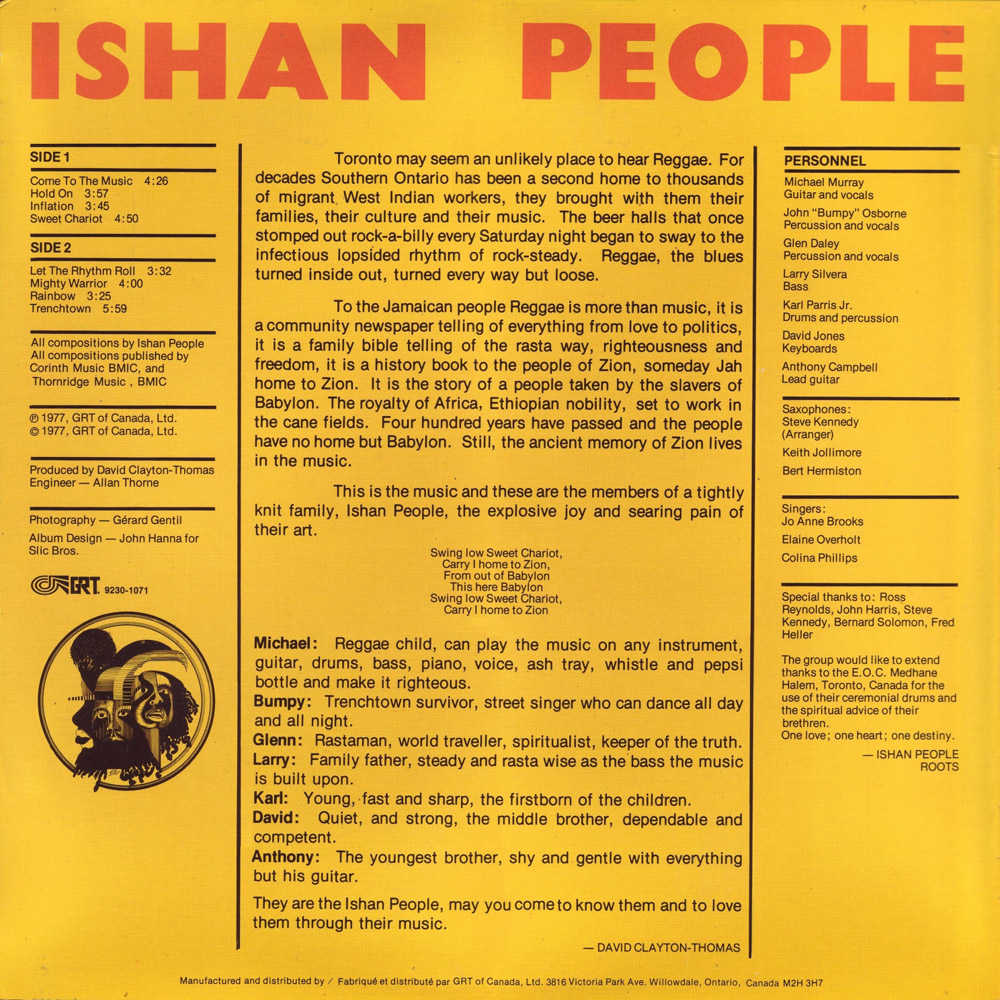
Back, with liner notes by DCT.
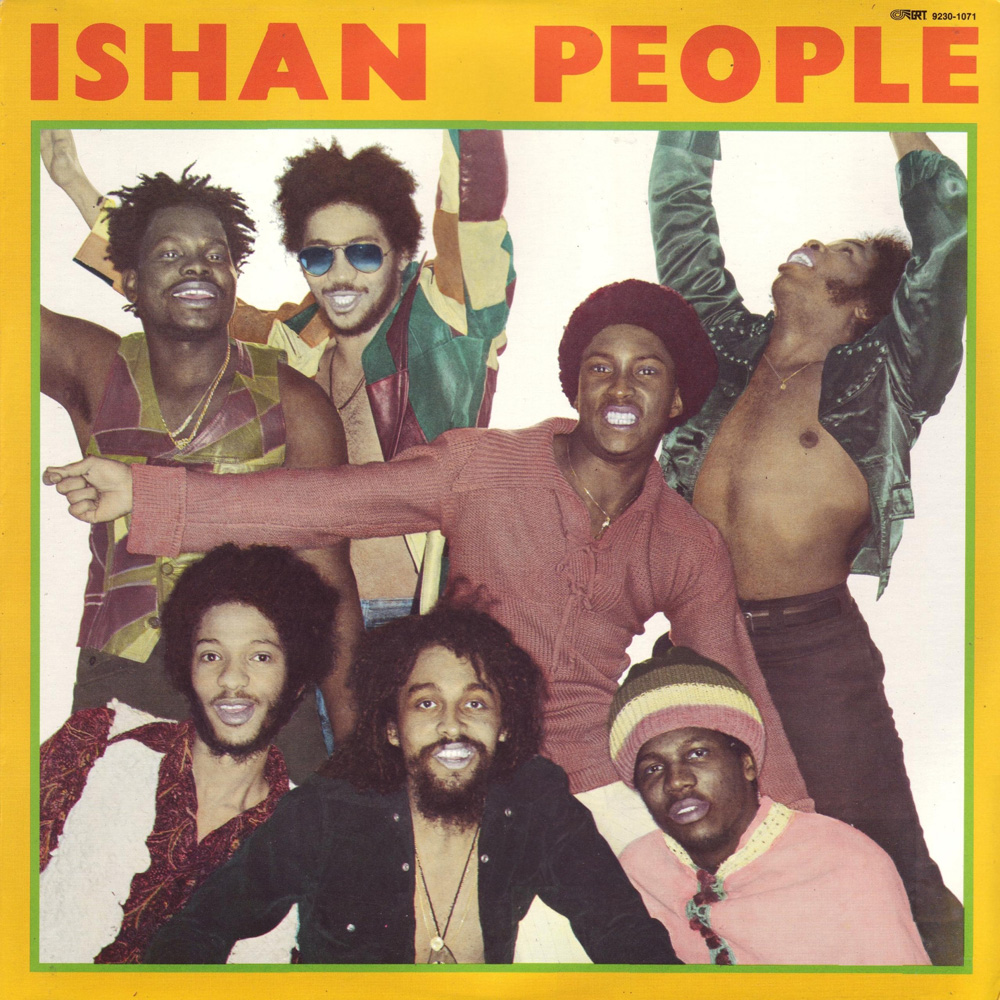
Ishan People’s 2nd LP
Surprisingly, left out of the official biography of David Clayton-Thomas, and even left off his WikiWackyWoo page, is how I came to know David. Back in the day (1976-1977) I managed a group called Ishan People, Canada’s first Roots Reggae band. David Clayton-Thomas produced both our LPs on GRT Records. David was an early proponent of Reggae, well before Bob Marley was a household word. By then Clayton-Thomas was already a singer of some renown with his work with Blood, Sweat and Tears. However, he took a small pittance as a producer to work with music and musicians he loved. Here’s a sample of David Clayton-Thoamas’ work with Ishan People.
I don’t know why this has been left off all the biographies, because this is something that David Clayton-Thomas.should take great pride in. I note he has an autobiography called, appropriately enough, Blood, Sweat and Tears, which I’ve never read. I wonder if he mentions it there. At any rate, you made me so very happy, David. Thanks for everything.
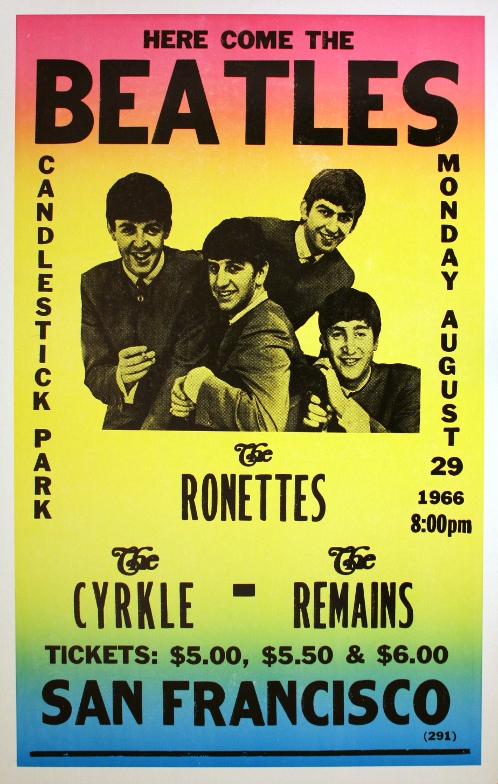
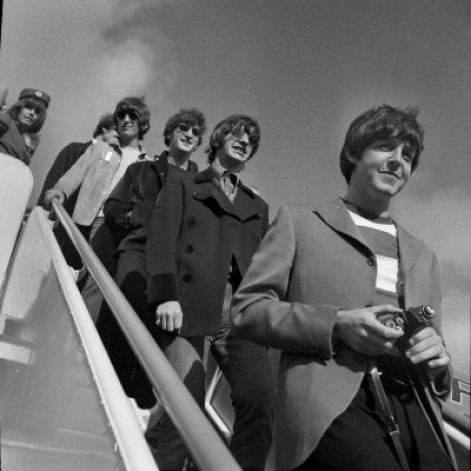
Dateline – August 29, 1966 – Candlestick Park, San Francisco – After an estimated 1,400 live shows and 9 years as a Band on the Run, John, Paul, George and Ringo, collectively known as The Beatles, perform their last concert for paying customers.
The Beatles arriving in San Francisco for the last concert
It had been a Long and Winding Road. From Hamburg to Liverpool. Then all around England, at first. Then the entire world. It seemed Beatlemania would never end. It got crazier and uglier and more dangerous as time went on. By the time The Beatles reached Candlestick Park in 1966, they knew it would be their last show. Even Paul was ready to throw in the towel and he was the Beatle who always wanted to tour and record.
“On our last tour people kept bringing blind, crippled and deformed children into our dressing room and this boy’s mother would say, ‘Go on, kiss him, maybe you’ll bring back his sight.’ We’re not cruel. We’ve seen enough tragedy in Merseyside, but when a mother shrieks, ‘Just touch him and maybe he’ll walk again,’ we want to run, cry, empty our pockets. We’re going to remain normal if it kills us.”
~~~~~John Lennon
“There was a big talk at Candlestick Park that this had got to end. At
that San Francisco gig it seemed that this could possibly be the last
time, but I never felt 100% certain till we got back to London.
John wanted to give up more than the others. He said that he’d had enough.”
~~~~~Ringo Starr
“Thank you very much everybody. Everybody, wonderful. Frisco, butchered.
We’d like to say that, erm, it’s been wonderful being here, in this
wonderful sea air. Sorry about the weather. And we’d like to ask you to
join in and, er, clap, sing, talk, do anything. Anyway, the song is…
good night.”
~~~~~Paul McCartney, introducing the last song at Candlestick Park
The Beatles took 65% of the gross, the city of San Francisco took 15% of paid admissions and 50 free tickets. This, along with lukewarm ticket sales and other unexpected expenses resulted in a financial loss for Tempo Productions;
The oversize tickets were to [sic] large to fit the counting machines at Candlestick and had to be counted by hand;
The performance was taped by Tony Barrow at Paul McCartney’s request and is available in bootleg format. The last song was truncated because the recorder ran out of tape;
Just before leaving the stage, John teasingly strummed the opening guitar notes of “In My Life”;
Wes Wilson designed the concert poster for the show. Wes later on to become one of the most influential artists of the psychedelic movement and designed many important posters for Bill Graham.
Although Candlestick Park had 42,500 seats, unbelievably the ticket sales were sluggish and just over half were sold. Only 25,000 people were on hand to witness the final official concert by the greatest Rock and Roll band to ever come down the pike.
Knowing it could be their last show The Beatles took some commemorative pictures:
“Before one of the last numbers, we actually set up this camera, I think it had a fisheye, a wide-angle lens. We set it up on the amplifier and Ringo came off the drums, and we stood with our backs to the audience and posed for a photograph, because we knew that was the last show.”
~~~~~George Harrison
The 33 minute show had a slightly altered setlist from the other shows on the tour:
Rock and Roll Music (Chuck Berry cover)
She’s a Woman
If I Needed Someone
Day Tripper
Baby’s in Black
I Feel Fine
Yesterday
I Wanna Be Your Man
Nowhere Man
Paperback Writer
Long Tall Sally (Little Richard cover) (with ‘In My Life’ snippet at the end)
One other thing The Beatles did to commemorate the occasion was to ask press officer Tony Barrow to record the show: According to The Beatles Bible:
“At San Francisco airport, as our plane prepared to take off, Paul’s head came over the top of my seat from the row behind: ‘Did you get anything on tape?’ I passed the cassette recorder back to him: ‘I got the lot, except that the tape ran out in the middle of Long Tall Sally.’ He asked if I had left the machine running between numbers to get all the announcements and the boys’ ad lib remarks. I said: ‘It’s all there from the guitar feedback before the first number.’ Paul was clearly chuffed to have such a unique souvenir of what would prove to be an historic evening – the farewell stage show from the Fab Four.
Back in London I kept the concert cassette under lock and key in a drawer of my office desk, making a single copy for my personal collection and passing the original to Paul for him to keep. Years later my Candlestick Park recording re-appeared in public as a bootleg album. If you hear a bootleg version of the final concert that finishes during Long Tall Sally it must have come either from Paul’s copy or mine, but we never did identify the music thief!”
Beatles fans (and completists like myself) are lucky there was a music thief. That’s why 46 years later we can still listen to the last concert The Beatles ever performed for a ticketed audience. Sadly the tape ran out part way through the last song. However, we still have this record of The Beatles at the height of their live performances.
From this moment through to Abbey Road, The Beatles were a recording band, save for their one brief appearance on the roof of Apple for the Let It Be film (which has still not been released on DVD. Get on that, Sir Paul.)
Dateline August 7, 1926 – Born Stanley Victor Freberg in a manger in a hospital in Pasadena, California, the newborn “Stan” (as his Baptist minister father improbably nicknamed him) waited a few years as he planned and schemed and schemed and planned. Once he was ready to unleash himself on the world, nothing could hold him back from parodying everything under the sun to become of of ‘Merka’s favourite (unknown) humourists.
While I was growing up Stan Freberg was one of my favourite comedians, although I knew nothing about him and had never seen him on tee vee. Yet, I could quote entire passages from his recordings and I knew how to quote “Turn off the bubble machine” from his hilarious “Wun’erful, Wun’erful” long before I even knew who Lawrence Welk was. Once I learned of Welk, the parody was even funnier. In fact, there are many songs for which I knew Freberg’s parodies LONG before I knew the original.
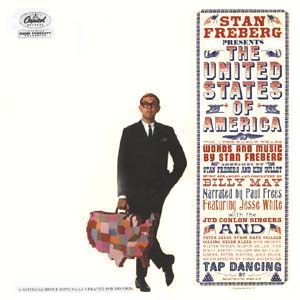
While Freberg’s humour was gentle parody, there was still a bite to it. Back in the day I actually had a Civics teacher who played us “Stan Freberg Presents the United States of America, Volume One: The Early Years” once every year. No doubt it was just an excuse to not have to present a lesson, but looking back on it now it seems like an example of extreme anarchy. Until the release of his “United States” he was better known for his song parodies, making him the Weird Al of his time. However, Freberg didn’t change the lyrics in his parodies. Instead he lampooned entire genres of music — most notably early Rock and Roll — by using the absurdities of the music, or artist, against them.
One of better-known songs was a send-up of the Calypso craze that had been sweeping the nation. Harry Belafonte never saw it coming.
From song parodies to commercials, Freberg went on to change the face of television advertising by adding humour and over-the-top production values. Ann Miller was willing to parody herself in a Campbell’s Soup commercial.
The Lone Ranger and Tonto were willing to parody themselves in this commercial that also poked fun at the Lark Cigarette campaign — when tobacco companies were still allowed to advertise on tee vee — that demanded “Show us your Lark pack!”
Ray Bradbury was a even up to making fun of himself.
However, it’s the song parodies that I love the most. To celebrate Stan Freberg’s 86th Birthday, here’s a Stan Freberg Jukebox:
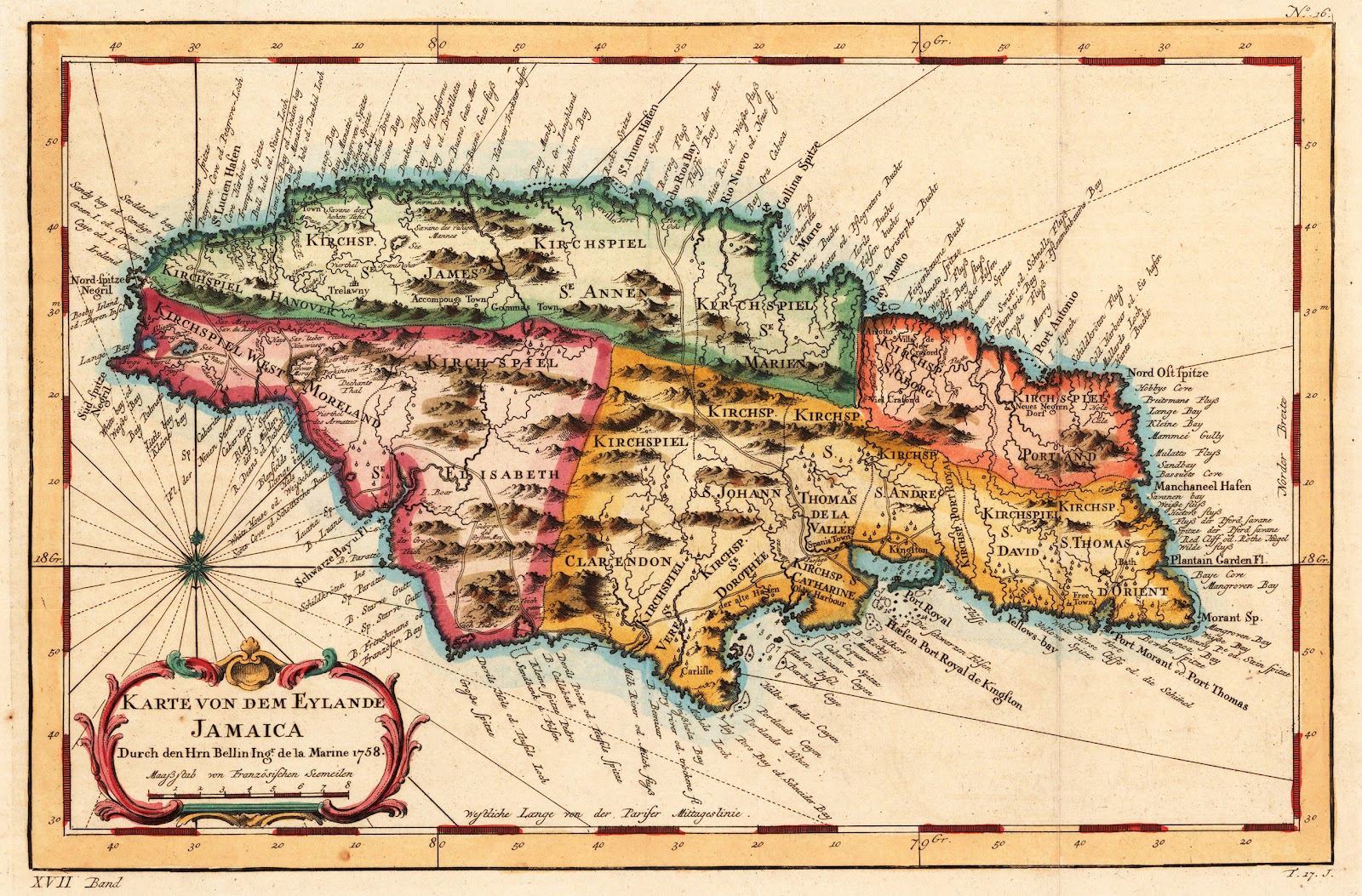
Let’s face facts: Jamaica is probably the closest Christopher Columbus ever came to what was later called the United States of ‘Merka, the country he is alleged to have ‘discovered.’ And, when he landed in Jamaica in 1494, there were already people there. The Arawak and Taino peoples, who had originated in South America, had been on the island by as much as 2,500 – 5,000 years by then. By the time of Columbus’ arrival there were over 200 villages, but he claimed the island in the name of Spain anyway. The British, led by the same William Penn who founded the ‘Merkin province of Pennsylvania, forced the Spanish out in 1655, with slavery and sugar becoming the main exports, until the British abolished slavery in 1807. Then it was just sugar. Still needing a workforce, they imported Indian and Chinese workers as indentured servants. This is one of the reasons Jamaican population is such a multicultural mix and reflects its national motto: “Out of many, one people.” It’s also why so many Jamaican dishes use curry and other hot spices.
Skipping ahead a hundred and fifty years: On this date in 1962, after 4 years of being a province in the Federation of the West Indies, gained full independence and adopted its national anthem.
However, it’s not the music of the National Anthem that has spread Jamaica’s reputation around the world: It’s Reggae music. According to the WikiWackyWoo:
I had the pleasure of working for Island Records Canada when it was still an independent company run by Chris Blackwell. Blackwell is one of my heroes. He didn’t create Reggae, but he took it global starting with Millie Small. Blackwell discovered the 15-year old singer and produced her single “My Boy Lollipop,” which sold over 7 million records worldwide. Then he signed Bob Marley and many other Reggae artists; launching many careers (and not just Reggae artists) onto the international stage. I met Blackwell once, on the same day I met Bob Marley, yet they were not together, nor were they even in the same country. It’s a long, complicated story that I keep promising to write and, maybe, one day I will.
I was also honoured to be interviewed for my (very small) part in “How Jamaica Conquered the World,” a terrific series of podcasts which documents Jamaica’s outsized influence, when compared to the small footprint of the small island nation of just 4,244 square miles, smaller than Connecticut, the 48th largest state.
However, let’s face it: It’s the music and ganja for which Jamaica is known. Since I can’t push any ganja through my computer, I am reduced to just sharing a small sampling of the music. Here’s a Jamaican Jukebox so you can celebrate along with Jamaicans all around the world as they proudly wave the flag on their half-century anniversary.
Dateline August 4, 1901 – A Black boy is born into a world of extreme poverty and Jim Crow laws in New Orleans, Louisiana. By the time Louis Armstrongdied in 1971, in Queens, New York, he was one of the most recognizable musicians on the planet. Along the way he entertained millions and became one of the greatest performers in all of Jazz. However, that’s just the tip of the iceberg.
While I’ve been a fan of Louis Armstrong for many years, I became a huge fan all over again by what Jazz historian Gary Giddins said in Ken Burns’ (amazing multi-part) Jazz documentary. Giddins was asked whether Armstrong was a genius. Giddins replied (paraphrasing), “We tend to throw the word ‘genius’ around. However, if by ‘genius’ you mean that after him nothing was ever the same again, then by that measure Louis Armstrong was a genius.”
“You can’t play anything on a horn that Louis hasn’t played” ~~~~~Miles Davis
“What was the greatest band of the 20th century? Forget the Beatles – it was Louis Armstrong’s Hot Five and its subsequent incarnation, the Hot Seven… these bands altered the course of popular music.” ~~~~~Playboy magazine
There are two things that have always impressed me about Louis Armstrong and neither have to do with his music.
Armstrong being fitted by Toronto’s world famous hatter Sam Taft
1). In the mid-’40s, when he was just starting to make some really good money, he bought a house on 107th Street in Corona, Queens, NYC. He lived there the rest of his life, long after he could have afforded to move to better and more expensive digs. When he wasn’t touring he was known for sitting on his porch and greeting the neighbourhood kids, who all called him Pops, and giving them apples and unconditional love. That house was made a National Historical Landmark in 1977 and is now the Louis Armstrong House and Museum.
2). During his lifetime Armstrong was criticized for being an Uncle Tom for playing to segregated audiences, accepting the title “King of the Zulus” in the 1949 Mardi Gras parade, and not doing more for ‘his people.’ Billie Holliday was even quoted as saying, “Of course Pops toms, but he toms from the heart.” Aside from the fact that being named King of the Zulus was a singular New Orleans honour misunderstood elsehwre in the country, when Louis Armstrong made his views on race relations known, the entire world listened.
In 1957, during the desegregation controversy in Little Rock, Arkansas, Arstrong sppoke out loud and clear. He called President Eisenhower “gutless” and “two-faced” for sitting on his hands and doing nothing. And, to put his money where his mouth was, Armstrong cancelled a tour of the Soviet Union he was about to do on behalf of the State Department. Uncle Tom would never have said, “The way they’re treating my people in the South, the government can go to hell.”
“Louis Armstrong is the master of the jazz solo. He became the beacon, the light in the tower, that helped the rest of us navigate the tricky waters of jazz improvisation.” ~~~~~Ellis Marsalis
Louis Armstrong also helped change Jazz singing. He wasn’t the first to Scat, but he helped popularize the genre with his joyful Scat singing, which was as revolutionary as is trumpet playing.
As for honous:
When his version of “Hello Dolly” knocked The Beatles off the top of the charts in 1964, he became the oldest person to have a #1 hit on the Billboard charts;
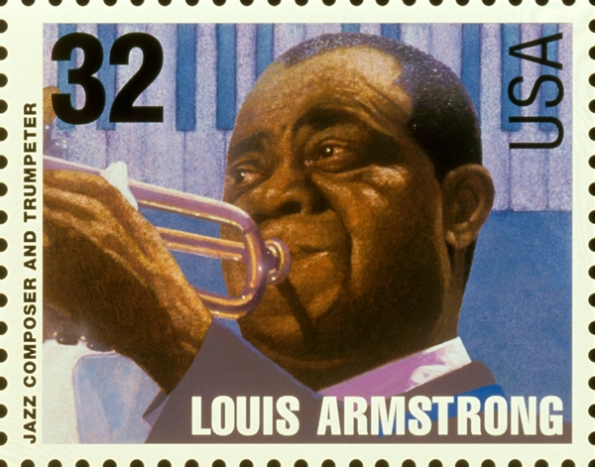
Also on his centenery the United States Postal Service put Armstrong on a First Class stamp;
He was given a postumous Lifetime Grammy Award in 1972;
Eleven of his songs have been inducted into the Grammy Hall of Fame;
President Richard Nixon released a statement upon Armstrong’s death calling him Mr. Jazz.
“I’m proud to acknowledge my debt to the ‘Reverend Satchelmouth’ … He is the beginning and the end of music in America” ~~~~~Bing Crosby
However, it’s always been about the music. Louis Armstrong recorded hundreds, maybe thousands, of sides in his lifetime. Here is just a small sample of what made Louis Armstrong one of the greatest musicians ever.
“If you don’t like Louis Armstrong, you don’t know how to love” ~~~~~Mahalia Jackson