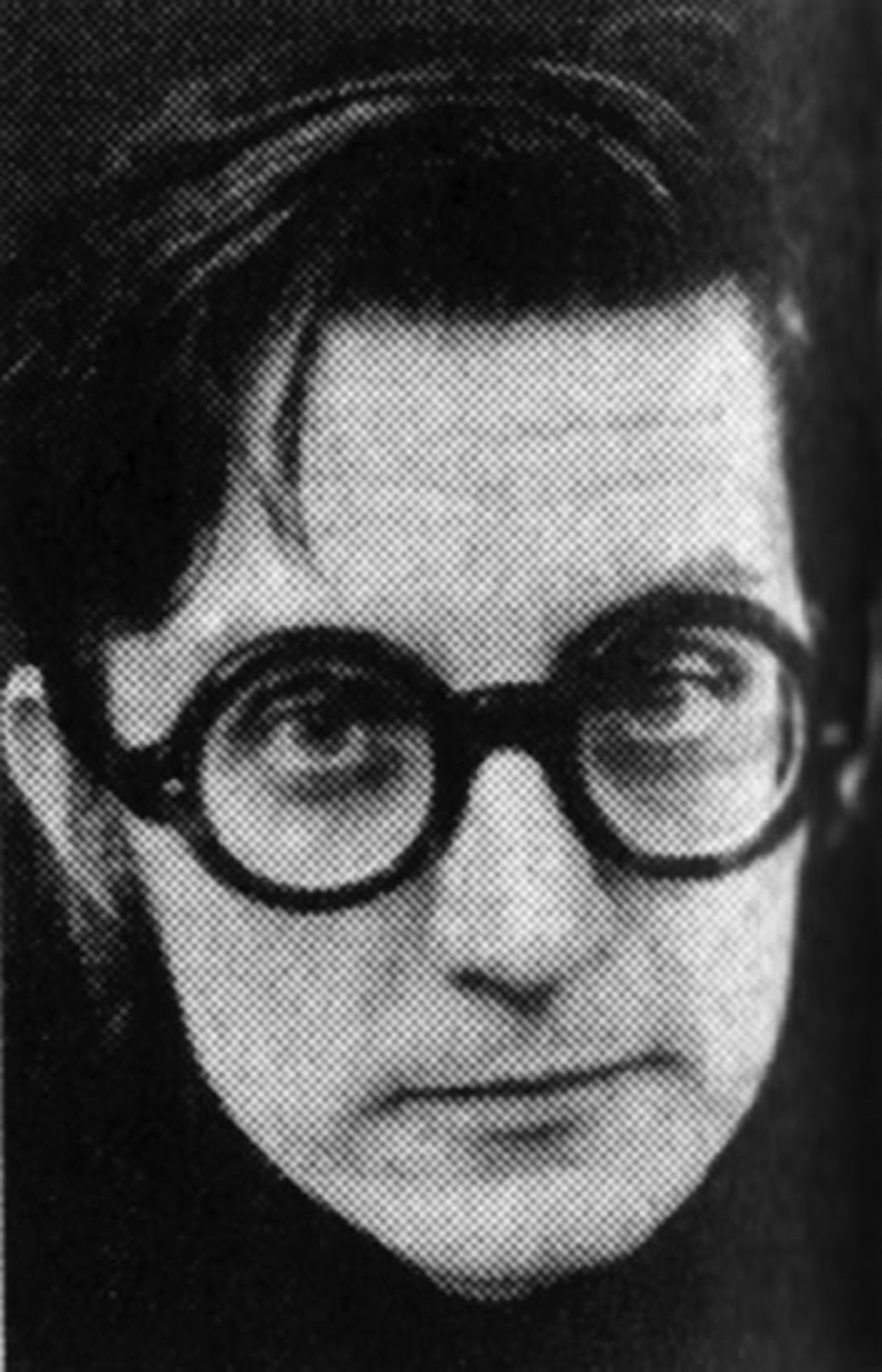
It wasn’t all that long ago that I celebrated the birth of Dennis Cowan, a founding member of The Bonzo Dog Dada Band. Today let’s all press our trousers for Roger Ruskin Spear, another founding Bonzo. Music/Not Music called Spear “The Forgotten Bonzo” just 12 days ago. Not for me. While Spear never achieved the later fame of Neil Innes, for me Roger Ruskin Spear was the one who put the Dada in The Bonzo Dog Dada Band, those off-the-wall tangents into clothing and other fashion accoutrements that’s clearly a Spear obsession. Ironically, while he played many instruments — tenor saxophone, trumpet, xylophone, bells, clarinet, guitar, oboe, accordion, glockenspiel, as well as sang — he is still best know for playing The Theremin Leg, most notably on the recording “Noises For The Leg.”
Here Roger Ruskin Spear plays the dress form to piano accompaniment on Strauss’ Blue Danube:
I was fortunate to see The Bonzo Dog Doo Dah Band live once at, of all things, The First Annual Detroit Rock and Roll Revival, in May of 1969, my last summer in ‘Merka. That’s where I first heard Bonzo Dog Band and was amazed at the performance they put on. Check out that line-up: Among the other band that performed that weekend
were MC5, Chuck Berry, Sun Ra, Dr. John, Johnny Winter, Stooges, Amboy
Dukes, SRC, The Frost, The Rationals, Teegarden & Van Winkle, Lyman
Woodard, Up, Wilson Mower Pursuit, Grand Funk Railroad, Third Power, New
York Rock & Roll Ensemble, David Peel & The Lower East Side,
Red White & Blues Band, Sky, The Train, Savage Grace, James Gang,
Caste, Gold Brothers, Dutch Elm, Plain Brown Wrapper, Brownsville
Station.
When I moved to Canada, I took with me my love of the Bonzos with me. However, I found that most of the people I tried to turn on to The Bonzos already knew who they were, from the British/Monty Python influence.
Bonzo Dog Band performing at the First Annual Detroit Roch and Roll Revival. Photo by Alan Gotkin.
Because people always get the various Bonzos confused, here’s a handy introduction:
I first heard Georgie Fame as did many other ‘Merkins, as the singer of “The Ballad of Bonnie and Clyde” in 1967. It was one of those out-of-the-box hits that always appealed to me. I was unaware of his earlier hits “Yeh Yeh,” which knocked The Beatles off the #1 on the British charts, and “Getaway.” Nor did the name Georgie Fame register with me. Therefore, I was surprised many years later when my boss at Island Records Canada handed me a record to promote. One of the tracks was “The Ballad of Bonnie and Clyde” and I knew every note and nuance, even if I didn’t know the name Georgie Fame. I later learned this was a compilation LP by Georgie Fame. (I’m not sure how that came about. My assumption, which could be wrong, is that Island Records licensed the tracks for markets other than Great Britain.) However, I soon learned “The Ballad of Bonnie and Clyde” was not representative of the music Georgie Fame and the Blue Flames (a name that didn’t appear on the sleeve, if memory serves) had been making. I immediately became a fan, precisely because his music is so hard to pigeon-hole, playing Jazz, Ska, R&B, Rock and Roll, Pop, and Standards.
This clip shows a nice bit of Georgie Fame’s history, along with Bonnie & Clyde’s.
Georgie Fame performing his earlier hit “Yeh Yeh” live for a Swinging Sixties tee vee show:
Georgie Fame & Alan Price performing one of their best known songs: Rosetta:
Let’s not forget that Georgie Fame was such a huge fan of Ska, that he started performing it in the ’60s, which only helped popularize the genre throughout the British Colonies. That’s why he can hold his own with Prince Buster and Suggs from Madness, (along with getting his own shout-out:
Presenting a Georgie Fame Jukebox, which includes a few renditions of a song all about him, while you read a short little bio of Georgie Fame:
As always, CRANK IT UP!!!
Born on June 26, 1943 in Leigh, Lancashire, where his father played in an amateur dance band and where music was a intregal part of home life. Early training on the piano led to a love of some of the early rockers like Fats Domino, Jerry Lee Lewis and Little Richard. Soon he was performing with his own band “The Dominoes.” As the story on the official web site goes:
In July 1959, at a summer holiday camp, Clive was spotted by Rory Blackwell, the resident rock and roll bandleader. Blackwell offered the young singer/pianist a full time job and the teenager happily left his job at the weaving mill. Rory and the Blackjacks departed for London, their hometown, when the summer season ended prematurely and Clive went with them. The promise of lucrative work in the music business didn’t materialize, however, and the band broke up. The determined young man from Leigh opted to stay on in London, but for a time it proved rough going. He tried unsuccessfully to make his way back home, and eventually he had the good fortune of finding “lodging” at The Essex Arms pub in London’s Dockland, where the kindly landlord provided him a room where he could sleep.
In October of that year, the Marty Wilde Show was performing at the Lewisham Gaumont and Rory Blackwell arranged for Clive to audition “live” for impresario Larry Parnes. After walking on stage, without any rehearsal, he sang Jerry Lee Lewis’ High School Confidential and was promptly hired as a backing pianist for the Parnes “stable” of singers. As with all the other young talent Parnes had taken on (such as Billy Fury and Johnny Gentle), he renamed Clive Powell “Georgie Fame,” and the name has stuck to this day. By the age of 16, Georgie had toured Britain extensively, playing alongside Marty Wilde, Billy Fury, Eddie Cochran, Gene Vincent, Tony Sheridan, Freddie Canon, Jerry Keller, Dickie Pride, Joe Brown and many more. During this time, Billy Fury selected four musicians, including Fame, for his personal backing group and the “Blue Flames” were born. At the end of 1961, after a disagreement, the band and Fury parted company.
I was also unaware Fame’s earlier work with Alan Price. Price was already well-known in the world of Pop music. He had hired a young Eric Burton to sing with his “Alan Price Rhythm and Blues Combo” in 1962, which by 1964 had become The Animals, mining old Blues songs. Price’s arrangement of “House of the Rising Sun” was a worldwide hit. Skipping ahead some 7 years, as the Alan Price web site tells us:
He then began a partnership with fellow-blues keyboardist and old chum, Georgie Fame, which gave birth to a hit single, Rosetta (which reached No. 11 in 1971), a highly-rated album (Price And Fame Together), their own television series (The Price Of Fame), and regular appearances on many others.
It was during one of the duo’s road tours that Malcolm MacDowell and Lindsay Anderson approached Alan about composing the music for the legendary cult film, O Lucky Man (in which he also appeared as himself). The phenomenal success of this project earned Price a BAFTA award, an Oscar nomination, and yielded his first US chart album.
Georgie Fame has been performing his own brand of music for more than 50 years. I feel lucky I got see him in a club on Jarvis Street in Toronto years later. Happy Birthday, George. You brought me many years of terrific music.

Dr. Goldmark examining creation of a 33 1/3 record.
Pic used by Fair Use, even tho’ Corbus thinks it owns it.
Dateline June 21, 1948 – Dr. Peter Goldmark, of CBS, demonstrated the first 12 inch LP, “Long Playing” record, that spun at 33 1/3 revolutions per minute, as opposed to the 10 inch 78 RPM record. You could only shove about three and a half minutes of music on one side of a 78. A symphony or opera issued on 78, would come in an album with any number of platters to spin out the entire length of the piece. In contrast the LP would hold about 28 minutes of music a side. With this the format wars wars ON! RCA refused to pay CBS for the license to press LPs, so it came out with its own format, the 45 RPM disc, 7″ wide with a bigger hole in the middle. The 45 could hold more music than a 78, but not nearly as much as a LP. No one really won this format war. These two systems remained viable formats side-by-side until the digital compact disc, CD, almost put vinyl out of business.
Dateline June 21, 1969: The worst song ever released!!! On this day One Hit Wonders Zager & Evans release the biggest piece of crap in all of recorded music, and that includes “An Evening With Wild Man Fisher.” Ladies and gentlemen, I give you “In the Year 2525.” REMEMBER: I tried to warn you.
There’s no point in writing a Brian Wilson biography; every one knows the high points of his life. What started as a love of the four-part harmonies of The Four Freshmen consumed a lad in Hawthorne, California, who went on to write music that defined several generations. As the leader of The Beach Boys and beyond Brian Wilson has created true art in the form of music. For me it’s sufficient that Brian Wilson’s music is the background to so many of my memories. His music will stand the test of time, but it’s an absolute bonus that he’s come back around to playing music again, both without and with The Beach Boys. Celebrating their 50th Anniversary The Beach Boys are touring again, with BruceJohnston and David Marks. Too bad Glen Campbell couldn’t join them. They have also released a new album, “That’s Why God Made the Radio,” which will be a fitting capstone to their career, if they decide to wrap it up.
Brian Wilson still has the ability to write an instant classic:
The first 45 I ever bought (kids, ask your parents) was “I Get Around,”
because it was all the money I had left over after buying “The Best of
the Lovin’ Spoonful.” I have been a huge Beach Boys, Brian Wilson fan ever since; collecting bootlegs like I also did with The Beatles. One of the things that I have found thrilling is that 20 years ago, starting with the 4-CD box set of “Good Vibrations; Thirty Years of The Beach Boys,” the band has been releasing alternative takes and works-in-progress in the studio. [Sadly, that box can’t be shared on Spotify.] It was also done with The Pet Sounds Sessions and culminated in the semi-recent massive box for The SMiLE sessions. These give the listener the total Fly on the Wall experience. With SMiLE, we can hear just how close Brian Wilson really was to releasing his Magnum Opus. Collectors of bootlegs have, over the years, put together the fragments based on scant evidence. It’s great to finally hear SMiLE as Brian envisioned. It was worth the wait.
SMiLE took his sanity and some 35 years to finally finish, but Brian Wilson and The Beach Boys are back and, if show biz metrics mean anything, back on the top of the game. This week The Beach Boys broke a record set by The Beatles. As Billboard tells us:
As their reunion set, “That’s Why God Made the Radio” (their first album of all-new material since 1992), bursts onto the chart at No. 3,
the Beach Boys break a record by expanding their span of Billboard
200 top 10s to 49 years and one week. They first graced the top 10
with “Surfin’ U.S.A.” the week of June 15, 1963. The
Beach Boys’ stretch between their first week in the Billboard 200
top 10 to their most recent is now the longest among groups, passing
the Beatles, whose top 10 span covers 47 years, seven months and
three weeks. The Fab Four first entered the top bracket when “Meet
the Beatles” rocketed 92-3 on the Feb. 8, 1964, chart at the
blastoff of Beatlemania. The group most recently appeared in the top
10 with “1” the week of Oct. 1, 2011.
Now with sell-out concerts and current hits on the radio. Here’s a Brian Wilson Jukebox for your listening pleasure, with some rarities, some well-known songs, and some versions you’ve never heard before:
As always, CRANK IT UP!!!
A BRIAN WILSON – BEACH BOYS BONUS:
For people who are as certifiably insane as I am, here is every version of Heroes and Villains I could find. Set on crossfade and you will never need another song. Ever!
There is no denying that Paul McCartney has written a wealth of music that will stand the test of time. As we listen to Beethoven and Bach long after their lifetimes, we will be listening to the music of Paul McCartney.
And, just because it pisses Mark Koldys-Johnny Dollar off, I am going to link to otherversions of this story again.
Uncle Russ Gibb
Here’s what I find funny: I have made no claims, yet Johnny Dollar has gone out of his way to refute them.
J$ asked one person one question (or had a confederate ask one
question) and then spun out an entire new conspiracy theory. While, that’s
hardly journalism, it’s par for the course for Markie K and the Sycophant Five.
I only ever told this to ONE journalist. The resultant article that came
out was so garbled, I never told it again “on the record.” Therefore, every other
version I have read is second hand, or a re-writing of the
original post. Each has managed to garble the story further.
However, and I stress, only one person ever bothered to ask me any questions and I answered them all honestly.
However, I am most grateful that Markie K and the Sycophant Five, along with their patron Mark Koldys-Johnny Dollar are such loyal followers of my Aunty Em Ericann Blog.
What’s left of The Grande Ballroom; Picture by author 2010
The Grande Ballroom on opening night of a whole new era.
I always have music on in the background when I’m writing. When I’m writing about Detroit, I listen to music from Detroit and Detroit Music is more than just Motown. Here’s a Detroit Jukebox for your listening pleasure:
The BBC produced a nice little documentary on the music of Detroit, Michigan. Includes contributions from Iggy Pop, Alice Cooper, George Clinton, Martha Reeves, John Sinclair and the MC5, among others. This is the music of my youth.
Sadly Part Four of this documentary cannot be embedded. However, it wraps up here.
There was a time I listed my Top Three artists as Frank Sinatra, Frank Zappa, and Harry Nilsson. Who knew that Sinatra would outlive the other two?
I first learned of Harry Nilsson the same way much of ‘Merka did, when The Beatles name-checked him twice during their ’68 press conference to announce the formation of Apple. Wait! What? Who? The Harry Nilsson Web Pages picks up the story:
The album came to the attention of the Beatles (through Derek Taylor their press agent). At the press conference to announce the formation of Apple, the Beatles were asked “Who is your favorite American artist?” to which John Lennon replied, “Harry Nilsson.” When asked “What is your favorite American group?” Paul McCartney replied, “Harry Nilsson.”
Harry’s arrangement of “You Can’t Do That” weaves some 20-something other Beatles’ songs in and around the Lennon-McCartney melody.It needs to be heard to know why The Beatles were so knocked out by it.
The great irony of Harry Nilsson’s all-too-short artistic career is that while he is an amazing songwriter, the two songs he is best known for were not written by him: “Without You” was written by two of the members of Badfinger and was originally recorded by that group, while “Everybody’s Talkin'” was written by Fred Neil.
That’s why we’ll start with songs Harry wrote. Here’s a rare version of “Coconut” created for one of his his BBC shows. All vocals are Harry re-recorded specifically for this ‘video’ and the instrumentation is minimalist. to say the least:
Many people have covered Nilsson’s “One.” His version followed by the obscure Chris Clark on the even more obscure Motown subsidiary label Weed, because that’s what this LP was apparently fueled by.
Here is a rare tee vee appearance of Harry’s on The Smother’s Brothers Comedy Hour. Harry was a good friend of The Smothers Bothers, which is why he thought he and John Lennon could heckle them at The Troubadour, but we won’t rehash THAT story. “Think About Your Troubles,” the second song here, is personally one of my favourite Harry Nilsson songs. I like the circular story. I like how it sums up this larger dynamic than the listener and then says, “You think you’re the center of the universe? Well, I got news for you.” The third song is from the upcoming “The Point” cartoon, which is remembered fondly by many big kids.
Another rarity from his BBC tee vee special is this medley of three covers intertwined, Walk Right Walk, Cathy’s Clown, Let The Good Times Roll all recorded with 3-part harmony done by Harry himself.
Here’s the very obscure Miss Butter’s Lament, written by fellow Canadian Bob Segarini.
When Harry Met John resulted in PussyCats, an album that marked the nadir of Harry’s career. Yet there are still some true gems on this LP. Harry makes his ravaged voice work for this incredibly emotional cover of Jimmy Cliff’s Many Rivers To Cross.
I could go on and on, but this makes a good starting point for Harry Nilsson if you are just getting to know him.
It’s my opinion that no ‘Merkin songwriter has ever been more
deft at the lyric than Cole Porter.
While there are many wonderful things to praise in his music, I would like to
praise his wordplay and his sense of the rhythm of the syllables of spoken,
contemporary English, while imbuing that honest, simple language with more than
a hint of sophistication. His love of language is clear in his lyrics. I have always wondered whether he got his penchant for playing with words because his name is, in fact, a pun, not unlike Aunty Em Ericann.
With a string of songs ranging from “I Get A Kick Out Of You” to “You’re The Top” to “Don’t Fence Me In” to “When We Begin The Beguine” to “Let’s Do It (Let’s Fall In Love)” to “Night and Day” to “Anything Goes” to “Let’s Misbehave” there are so many wonderful Porter lyrics, so let’s get started and break some of them down to celebrate Cole’s 121st birthday.
Ella Fitzgerald has agreed to help me out with this first set of lyrics with “Anything Goes.” Take it away, Ella:
Look at the cadence of these words and the tune, which we all know by heart, just fall into place, that’s how closely locked the words are with the actual rhythms of the song. And, look at where the rhymes fall: both at the ends of lines and within the middle. And, in the middle of the middles are other rhyming words. Look:
In olden days, a glimpse of stocking
was looked on as something shocking.
Now heaven knows, anything goes.
Good authors too who once knew better words,
now only use four-letter words writing prose,
anything goes.
The world has gone mad today,
and good´s bad today, and black´s white today,
and day´s night today,
When most guys today that women prize today
are just silly gigolos.
So though I´m not a great romancer,
I know that you´re bound to answer
when I propose, anything goes.
Isn’t that tasty?
Louis Armstrong and my fellow Canadian Oscar Peterson will be demonstrating a whole different sly word play with “Let’s Do It (Let’s Fall In Love),” which, in 1928, was considered quite risqué for its time. Armstrong sings more different verses than anyone else in this almost 9 minute version and every one of them is clever as all hell.
One of my favourite Cole Porter tunes has to be “You’re The Top” also from the Broadway show “Anything Goes.” It’s filled with clever wordplay, funny pop cultural references which would have, in its time, been known by everyone in the audience, and a wonderful sentiment all wrapped up in that wonderful sense of cadence that the words have on their own. This time Cole Porter has agreed to sing his own song for us and he’s asked us all to sing along:
At words poetic, I’m so pathetic
That I always have found it best,
Instead of getting ’em off my chest,
To let ’em rest unexpressed,
I hate parading my serenading
As I’ll probably miss a bar,
But if this ditty is not so pretty
At least it’ll tell you
How great you are.
You’re the top!
You’re the Coliseum.
You’re the top!
You’re the Louver Museum.
You’re a melody from a symphony by Strauss
You’re a Bendel bonnet,
A Shakespeare’s sonnet,
You’re Mickey Mouse.
You’re the Nile,
You’re the Tower of Pisa,
You’re the smile on the Mona Lisa
I’m a worthless check, a total wreck, a flop,
But if, baby, I’m the bottom you’re the top!
Your words poetic are not pathetic.
On the other hand, babe, you shine,
And I can feel after every line
A thrill divine
Down my spine.
Now gifted humans like Vincent Youmans
Might think that your song is bad,
But I got a notion
I’ll second the motion
And this is what I’m going to add;
You’re the top!
You’re Mahatma Gandhi.
You’re the top!
You’re Napoleon Brandy.
You’re the purple light
Of a summer night in Spain,
You’re the National Gallery
You’re Garbo’s salary,
You’re cellophane.
You’re sublime,
You’re turkey dinner,
You’re the time,
of a Derby winner.
I’m a toy balloon that’s fated soon to pop
But if, baby, I’m the bottom,
You’re the top!
You’re the top!
You’re an arrow collar
You’re the top!
You’re a Coolidge dollar,
You’re the nimble tread
Of the feet of Fred Astaire,
You’re an O’Neill drama,
You’re Whistler’s mama!
You’re camembert.
You’re a rose,
You’re Inferno’s Dante,
You’re the nose
On the great Durante.
I’m just in a way,
As the French would say, “de trop”.
But if, baby, I’m the bottom,
You’re the top!
You’re the top!
You’re a dance in Bali.
You’re the top!
You’re a hot tamale.
You’re an angel, you,
Simply too, too, too diveen,
You’re a Boticcelli,
You’re Keats,
You’re Shelly!
You’re Ovaltine!
You’re a boom,
You’re the dam at Boulder,
You’re the moon,
Over Mae West’s shoulder,
I’m the nominee of the G.O.P.
Or GOP!
But if, baby, I’m the bottom,
You’re the top!
You’re the top!
You’re a Waldorf salad.
You’re the top!
You’re a Berlin ballad.
You’re the boats that glide
On the sleepy Zuider Zee,
You’re an old Dutch master,
You’re Lady Astor,
You’re broccoli!
You’re romance,
You’re the steppes of Russia,
You’re the pants, on a Roxy usher,
I’m a broken doll, a fol-de-rol, a flop,
But if, baby, I’m the bottom,
You’re the top!
That’s poetry. And it’s such a clever use of the English language. They don’t make songwriters like that anymore.
Here are some more classic interpretations of Cole Porter songs. I’ve also included a few instrumentals, one parody, a few unearthed gems sung by Cole himself (who wasn’t much of a singer), and two totally different versions and arrangements by Julie London, so you can also hear what a terrific tunesmith he was. Cole Porter is The Tops!